

You launched the site. The service is solid. Your team answers the phone. Customers who do find you tend to buy.
But when you search for what you offer, competitors keep showing up first.
That gap is where keyword research matters. It's not a trick for gaming Google. It's a way to understand how real customers describe their problems, what they expect to find, and whether your page matches that expectation. For a small business, that can mean the difference between a website that looks nice and a website that brings in leads.
A lot of owners hit this problem right after a launch or redesign. They assume the hard part was building the website. In practice, launch is only the start. If you're thinking through visibility at the same time, these insights on product launches are useful because they connect launch activity to discoverability and positioning, not just shipping a new site.
Your Guide to Getting Found Online
Take a local example.
You open a coffee shop in Omaha. The espresso is dialed in. The pastry case looks great. The staff is friendly. But on a Tuesday afternoon, the seats are still empty. A few blocks away, another shop with a worse latte is packed.
Online, the same thing happens every day. A business can be better than the competition and still lose because the competition is easier to find.
Keyword research is the bridge between what you sell and what people type into search. If someone searches for "coffee shop near downtown Omaha," "best espresso in Omaha," or "quiet cafe for meetings," those are not random phrases. They're signals. They tell you what people want, how specific they are, and what kind of page Google thinks should answer them.
That matters whether you run a coffee shop, law firm, HVAC company, or ecommerce store. Search traffic isn't just traffic. It's often a person actively looking for help, a place to go, or a product to compare. If your site doesn't line up with those searches, you stay invisible while someone else collects the clicks.
The basics of keyword research sound simple on the surface. Find terms. Put them on pages. Hope for rankings.
The part most beginners miss is this: you also need to read the results page like a strategist. Google tells you what kind of content it wants to reward. If you skip that step, you can target the right phrase with the wrong page and get nowhere.
What Is Keyword Research and Why It Matters
Keyword research is the process of finding and analyzing the words and phrases people use in search. In business terms, it's market research with search behavior as the input.
Instead of asking a focus group what they care about, you look at the language people use when they need something. That language helps you shape service pages, product pages, blog posts, FAQs, and site structure.
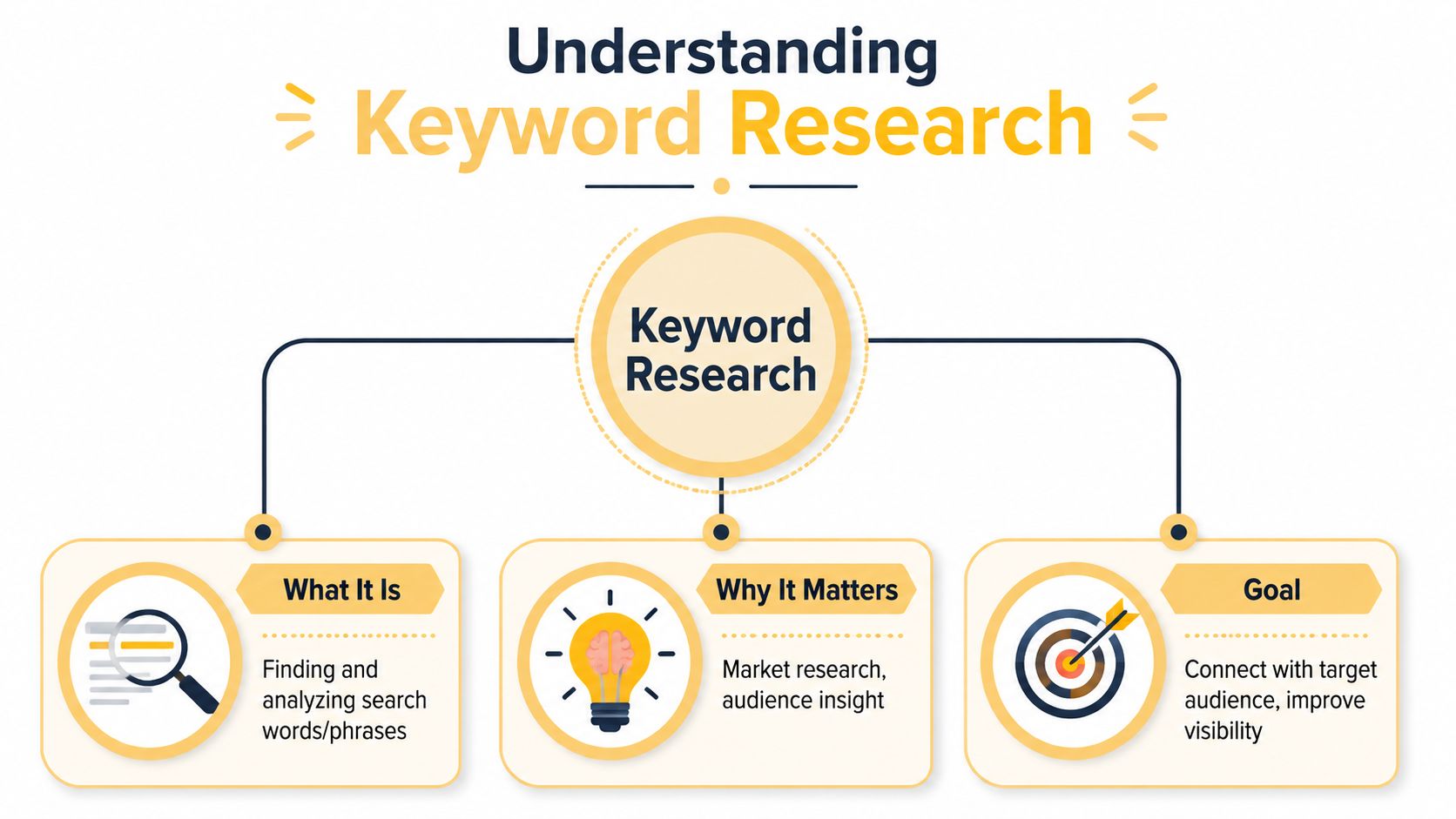
What keyword research actually does
It helps you answer a few practical questions:
- What do customers call the problem when they search for it?
- Which services deserve their own page because demand and intent are distinct?
- Which topics belong together so one strong page can rank for related searches?
- Which opportunities are realistic for your site right now?
Keyword research became a formal SEO workflow because search behavior on the web is measurable. Practitioners commonly evaluate terms using monthly search volume, competition or difficulty, and intent, and many modern guides recommend starting with about 10 to 20 keywords instead of trying to target hundreds at once, as explained in HubSpot's guide to how to do keyword research.
Why small businesses should care
Most small businesses don't need more random traffic. They need qualified traffic.
If you own a plumbing company, ranking for a broad phrase that attracts DIY readers may feel good, but it won't help much if those visitors never book service. A more specific query can be far more valuable if it connects to a real job you perform and the page matches what the searcher wants.
Practical rule: Good keyword research doesn't start with "What gets searched most?" It starts with "What search connects to revenue, leads, or local visibility for this business?"
The basics of keyword research are really about fit. Fit between your services and search language. Fit between a keyword and a page. Fit between what people want and what your site can credibly provide.
That's why experienced teams don't just collect phrases. They build a keyword map. One page gets one primary target. Related phrases support that main topic. That structure helps your site stay organized and keeps pages from competing with each other.
Decoding the Language of Search with Key Metrics
Once you start researching, the spreadsheet gets crowded fast. You'll see terms, variants, questions, and tool scores everywhere. Most of that noise becomes manageable when you focus on four metrics.
The four metrics that matter
| Metric | What It Measures | Why It Matters for Your Business |
|---|---|---|
| Search volume | How often people search for a term in an average month | Helps you judge whether a topic has enough demand to justify a page or campaign |
| Keyword difficulty | How competitive a term appears to be | Helps you avoid chasing targets that are unrealistic for your current site strength |
| CPC | What advertisers are willing to pay per click | Gives a directional signal about commercial value and buyer seriousness |
| Search intent | Why the person is searching | Determines what kind of page you should create and whether you should target the term at all |
Search volume isn't the same as opportunity
Volume matters, but beginners often overrate it.
A high-volume phrase can be too broad, too competitive, or too vague to turn into business. A lower-volume phrase can be a great target if the person searching is close to taking action. For a local company, "emergency roof repair Omaha" may matter more than a broader phrase about roofing.
Use volume as a filter, not as the final answer.
Difficulty is a reality check
Difficulty helps you judge effort.
If the first page is crowded with strong brands, deep content, and highly established sites, a newer business usually shouldn't build its plan around outranking all of them immediately. That doesn't mean the topic is useless. It may mean you need a narrower angle, a local modifier, or a different page type.
If you want a clearer sense of how third-party authority metrics are interpreted, this comparison of Ahrefs DR and Moz DA is a helpful companion when you're trying to understand why some sites look harder to compete with than others.
CPC can hint at business value
CPC is often overlooked by beginners, but it can be useful.
If advertisers consistently bid on a term, that usually suggests commercial relevance. It doesn't automatically mean the keyword is right for SEO, but it can help you separate casual browsing queries from phrases tied more closely to products, services, or buying behavior.
Treat it as a clue. Not a verdict.
Intent is the part most people skip
At this point, strategy begins.
A major underserved angle in beginner keyword-research content is validating search intent against the actual results page, not just collecting terms. Basic guides often stop short of the practical rule beginners need: if the SERP is dominated by product pages, local packs, or listicles, a blog post may not be the right format, as noted by Iowa State's overview of the basics of keyword research.
That single habit saves a lot of wasted work.
If you search a phrase and Google shows mostly:
- Product pages, build or optimize a product or service page
- Listicles, consider a comparison or roundup
- Local pack results, strengthen your local SEO signals
- Guides and tutorials, create educational content
- Videos, think beyond text alone
Search the keyword yourself before you assign it to a page. Google is already telling you the format it prefers.
This is why the basics of keyword research are not just about finding phrases with data attached. They're about reading what Google is rewarding and deciding whether your business can produce the right response.
A Simple 5-Step Keyword Research Workflow
Most business owners need a process they can repeat, not a giant SEO theory lesson. A simple workflow keeps the work practical.
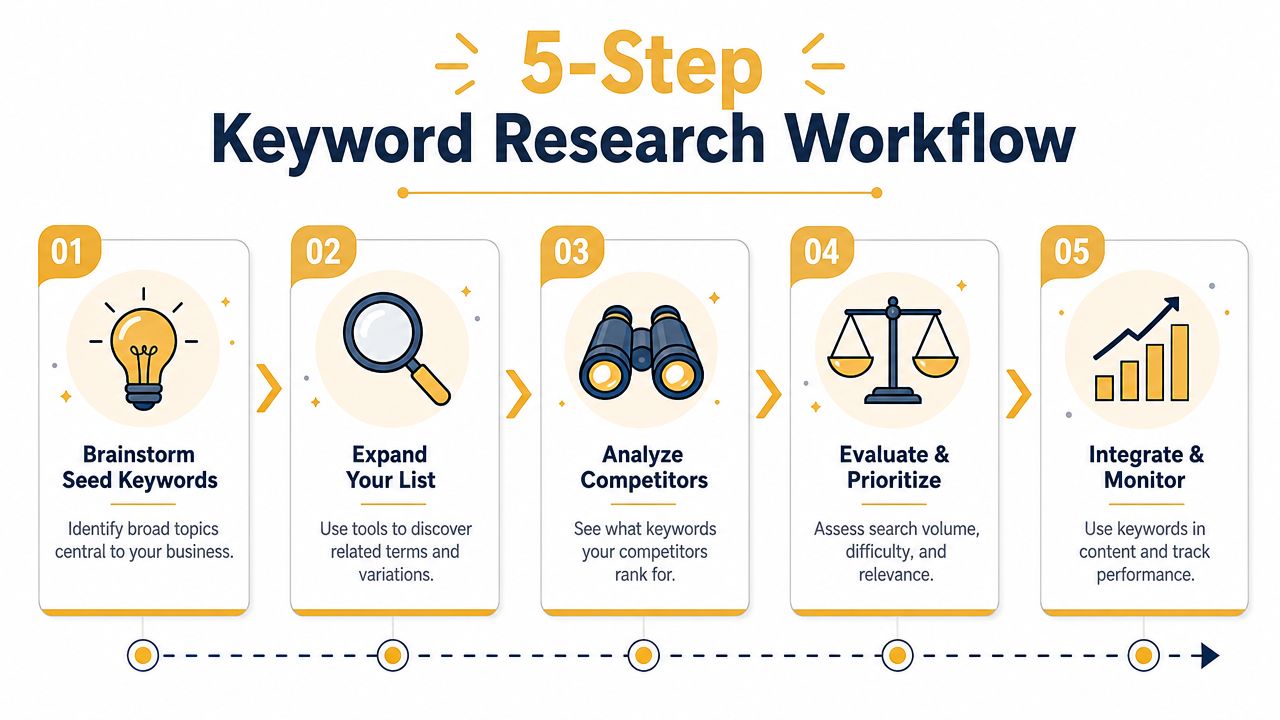
Step 1. Start with seed keywords
Seed keywords are your broad starting points.
If you're a family law firm, your seeds might be divorce lawyer, child custody attorney, mediation, and prenuptial agreement. If you run an ecommerce store selling fitness accessories, they might be resistance bands, yoga mats, or adjustable dumbbells.
Keep this list grounded in what you sell. Beginners often drift into adjacent topics that bring visitors but not business.
Step 2. Expand the list from real language
At this stage, you widen the net.
Advanced keyword research works best when it combines seed-keyword expansion, SERP validation, and content-cluster planning. Good discovery methods include autocomplete, People Also Ask, related searches, forums, customer-support language, and competitor gap analysis, followed by reviewing top-ranking pages to understand depth, format, and SERP features, according to We Are TG's guide on keyword research.
Use that advice in plain terms:
- Autocomplete and related searches show common phrasing
- People Also Ask surfaces question-driven opportunities
- Sales and support conversations reveal the words customers use naturally
- Competitor pages show what already has traction in your market
- Forums and communities uncover language tools often miss
One useful side note here is authority. Many owners assume a competitor outranks them only because they "did SEO better." Sometimes they have a stronger site profile. If you want a simple backgrounder, NameSnag's explainer on what is domain authority gives context for why some domains are harder to challenge.
Step 3. Review the SERP before choosing the keyword
Many keyword lists often fall apart here.
Search the term. Open the first page results. Check what's ranking.
Ask:
- What page type wins here?
- How detailed are the top pages?
- Are local packs, videos, snippets, or shopping results present?
- Does my site have a page that belongs in this result set?
If your business has a service page but the SERP is filled with "best of" comparison articles, you may need supporting content before the service page has a shot.
Here's a quick walkthrough if you want to see the process visually:
Step 4. Map one primary keyword to one page
This is the organizational step that saves a lot of trouble later.
Assign one primary keyword to each important page. Then group related terms around it. That creates clusters instead of a pile of disconnected targets.
For example:
- Service page targets a core commercial phrase
- Supporting blog post answers a related question
- FAQ page handles narrow concerns
- Internal links connect those pages so Google sees the topical relationship
Field note: When multiple pages chase the same keyword, they often weaken each other. Clear mapping usually performs better than publishing more pages.
Step 5. Track, refine, and update
Keyword research isn't a one-time worksheet.
Watch what pages start getting impressions. Check whether the right page is appearing for the right search. If Google starts ranking a blog post for a service query, that may mean your service page needs stronger optimization or clearer positioning.
Refinement matters more than perfection. The first version of a keyword map is a draft. Real search behavior tells you how to improve it.
Essential Tools for Finding Keywords
You don't need an enterprise budget to start doing this well. You need a handful of tools and the discipline to use them correctly.
Free tools that do real work
Google Keyword Planner is still a practical starting point. It was built for advertisers, but it helps with keyword discovery and directional demand. If you already have a Google account, you can plug in seed terms and get related ideas.
Google Search itself is another research tool hiding in plain sight. Autocomplete, People Also Ask, related searches, and the actual ranking pages often tell you more about intent than a spreadsheet can.
Google Search Console becomes valuable once your site has search visibility. It helps you see what queries already trigger impressions and which pages may deserve improvement.
Paid tools that speed up the process
Paid platforms like Ahrefs and Semrush make the work faster. They're useful for competitor keyword discovery, grouping terms, checking ranking pages, and filtering large lists without so much manual effort.
If you're comparing stacks and want a broader look at categories and options, this guide to killer SEO software is a practical place to sort through common tool choices.
For businesses with technical teams, custom workflows sometimes go beyond off-the-shelf SEO tools. If you're pulling large-scale search result data, monitoring competitors, or building internal research pipelines, a developer-first scraping API can support that kind of collection work. That's usually more relevant for advanced operations than for a typical local business, but it's good to know where the ceiling is.
What each tool is actually for
- Keyword Planner for basic ideas and rough demand
- Search Console for finding terms you already show up for
- Ahrefs or Semrush for competitor research and faster filtering
- Manual Google searches for intent validation
- Agency support or managed SEO platforms for businesses that want execution, not just data
For example, a local company that wants keyword research tied directly to content planning and optimization might use an agency option such as Up North Media's SEO services as one execution path, alongside self-serve tools if the team wants to handle research internally.
The mistake isn't using the wrong tool. It's expecting any tool to replace judgment. Tools generate lists. Strategy decides what to do with them.
A Starter SEO Strategy for Small Businesses
Small businesses usually don't win by going broader. They win by going more specific, more relevant, and more useful.
Focus on long-tail and local intent
A broad phrase may look attractive, but it often puts you in direct competition with major brands, directories, or established publishers.
A narrower phrase does two things. It reduces ambiguity and sharpens intent. Someone searching for a detailed, specific need is often much closer to choosing a provider than someone searching a generic term.
For local businesses, location modifiers matter too. City names, neighborhood names, service areas, and "near me" patterns all shape what kind of search demand you can realistically capture.
Build around topics, not isolated pages
The strongest starter strategy usually looks like this:
- Create a core service page for each primary offer
- Support it with related articles that answer common questions
- Use internal links to connect those pages logically
- Keep the map clean so each page has a distinct role
If you want a broader foundation for putting this into practice, this resource on SEO basics for small business pairs well with the keyword process because it connects research to the rest of your local and on-site SEO work.
Adjust for AI-shaped search behavior
A 2026 beginner guide explicitly says content should be optimized to surface in both search results and AI-generated responses, which signals a shift in baseline practice. The implication is that some low-volume, highly specific questions may be more valuable than broad head terms if they're easier for AI systems to quote, as discussed in Ryan Tronier's guide on how to do keyword research.
That changes the way small businesses should think about keyword value.
A highly specific question with a clear answer can do more for visibility than a broad term you never had a realistic shot at ranking for.
So don't dismiss narrow queries just because they look small. If they match your expertise and can be answered clearly, they can support both traditional rankings and newer search experiences.
Common Keyword Research Mistakes to Avoid
The first mistake is chasing broad vanity terms. They look impressive in a report, but they often waste months of effort. Most small businesses should start with narrower targets they can support.
The second is ignoring intent. This is the one that burns budgets. If Google is ranking product pages, local listings, or comparison articles, publishing a generic blog post usually won't solve the problem.
The third is keyword stuffing. Cramming the exact phrase into every heading and paragraph makes the page worse for readers. It also signals that the content was written for the keyword first and the person second.
The last mistake is paralysis. Some owners spend so long trying to pick the perfect keyword that they never publish the page. A solid keyword, matched to the right page type, is usually enough to get moving. You can refine later based on real impressions, rankings, and leads.
If your team wants help turning keyword research into a working SEO plan, Up North Media works with businesses on SEO strategy, content mapping, and digital growth tied to real business goals.