
The ecommerce app market is projected to hit USD 3.19 trillion in 2025 and USD 5.07 trillion by 2031, with Android at 72.67% platform share and transaction fees at 39.34% of revenue in 2025 according to Mordor Intelligence. That scale changes the conversation fast, because ecommerce app development services aren't a nice-to-have build project anymore, they're a revenue system you either get right or bleed money through. Mordor Intelligence's ecommerce app market forecast makes the point clearly, the winners are building for payments, mobile shopping, and regional growth, not just prettier storefronts.
If you're buying an app to raise conversion, retention, and lifetime value, the right question isn't “What features can we cram in?” It's “What build choices move revenue, and what choices just inflate the budget?” That's the lens I use with clients in Omaha and beyond, because flashy doesn't pay the freight. Durable commerce systems do.
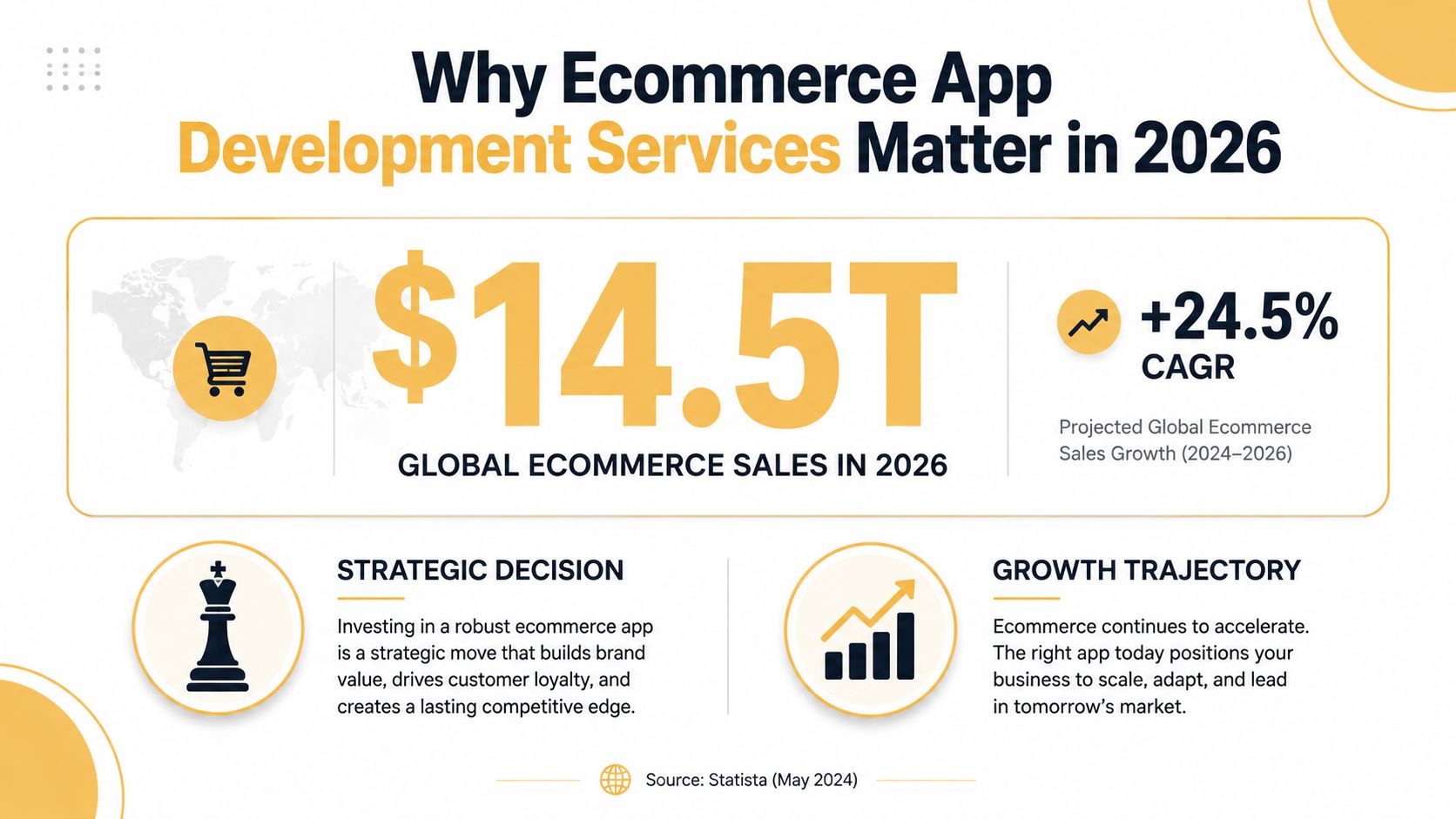
Why Ecommerce App Development Services Matter in 2026
The market keeps scaling, and that changes what a build is supposed to do. A commerce app now has to support checkout, repeat purchase, and customer retention without wasting spend on features that never earn their keep. Mordor Intelligence points to a category that keeps expanding across mobile shopping and transaction-heavy use cases, which is exactly why the app has to be treated as a revenue system.
ecommerce app development services matter because the app is where conversion either happens or dies. If the storefront is slow, the catalog is hard to browse, or payments fail at the wrong moment, revenue slips out the door. The right build prioritizes the work that raises conversion, improves retention, and increases lifetime value. Everything else is expensive decoration.
The services market is growing for the same reason. Independent research values the global e-commerce development services market at USD 15.2 billion in 2023, with a projection to USD 42.7 billion by 2033 and a 10.8% CAGR from 2025 to 2033. North America is projected to rise from USD 6.2 billion in 2024 to USD 16.8 billion by 2033, while Asia Pacific moves from USD 5.1 billion to USD 15.3 billion in the same period. DataHorizzon Research is showing that companies are spending on this work because it affects sales performance, not because it fills a budget line.
What buyers need to decide early
The first release should prove one thing, that the app can generate more revenue than it costs to run. If a feature does not improve conversion, reduce support burden, or make repeat orders easier, it belongs on the cutting room floor. That standard keeps the build focused and keeps the budget from drifting into vanity work.
A good partner will force those tradeoffs early. They will ask what drives order value, where customers drop out, and which flows deserve engineering time. If you want a higher-ROI app, that is the conversation that matters.
What an Ecommerce App Is Under the Hood
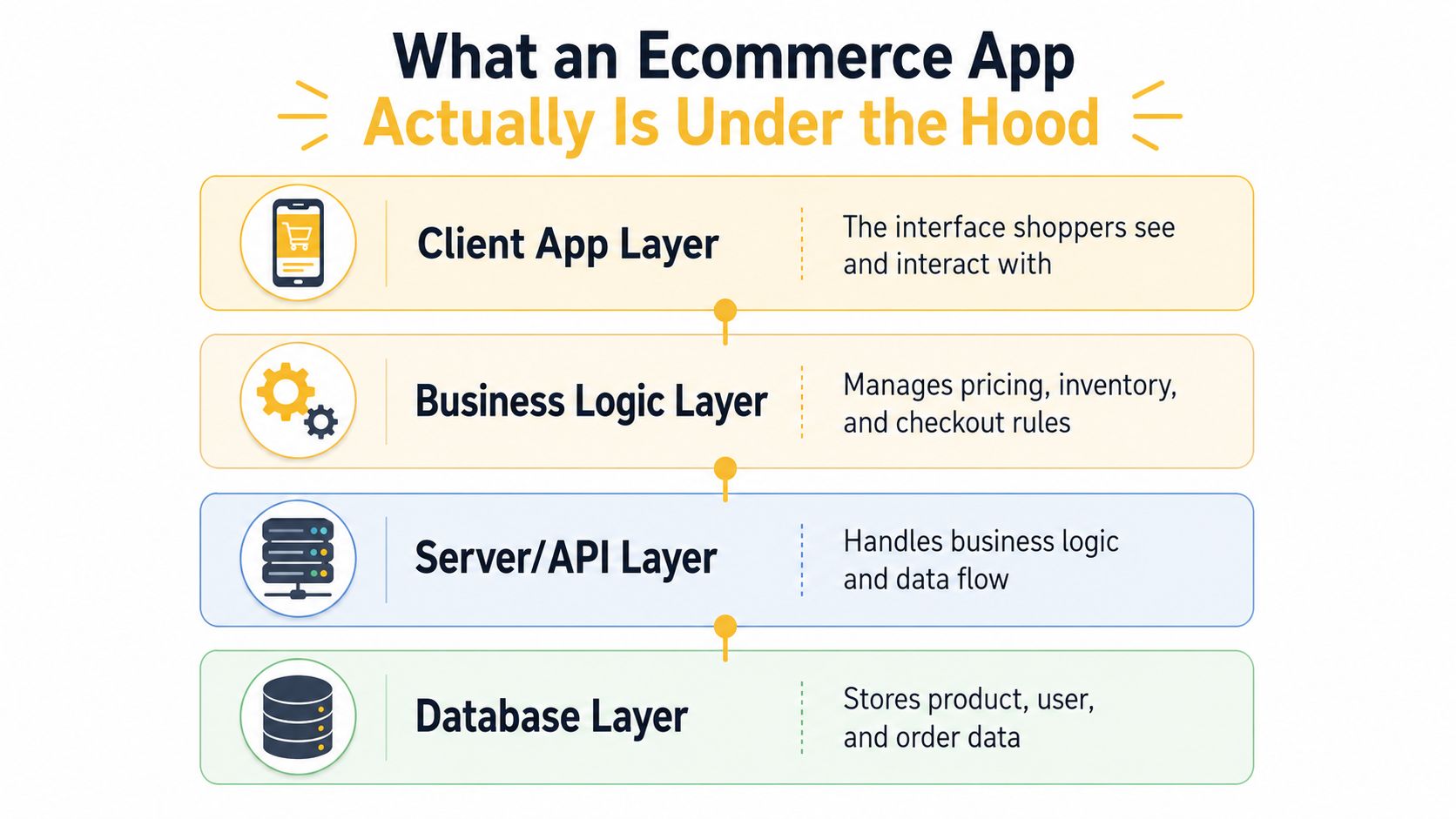
A serious ecommerce app is a revenue system made of connected layers, not a single screen. At the top is the client app, the screen shoppers tap, swipe, and leave when the experience gets clunky. Under that sits an API-first backend, which handles the business logic, and below that are the commerce and payment integrations that connect the storefront to gateways, ERPs, and fulfillment tools. The bottom layer is the transactional database, often paired with Redis or MongoDB for catalog and session caching so busy shopping flows stay fast. Developers.dev
The structure matters because every layer affects conversion. If browsing slows, shoppers leave. If checkout breaks, revenue leaks. If inventory sync falls behind, support teams inherit the mess. That is the cost of a sloppy build: lost orders and more manual cleanup.
A restaurant analogy still holds up. The app is the dining room, the backend is the kitchen, the integrations are supply and delivery, and the database is the storage room where nothing useful happens unless it is organized and quick to reach. When the kitchen runs hard but the dining room stays smooth, customers keep ordering. When the storage room gets chaotic, checkout and inventory start bleeding money.
Why the layers matter to revenue
Caching matters because slower browsing and checkout create more drop-off. Stateless services matter because seasonal traffic spikes should not bring down the whole storefront when a campaign hits or a product drops. Cloud platforms such as AWS, Azure, or Google Cloud let teams scale separate services independently, so search can lag without taking checkout down with it. That separation protects conversion and keeps support tickets from piling up.
The buyer does not need to design the stack from scratch. You need enough technical literacy to ask whether the agency is building for speed, resilience, and maintainability, or just dressing the scope up with buzzwords. If a vendor cannot explain how the layers connect to order flow and uptime, move on.
For teams comparing API choices, a close look at GraphQL vs REST matters before you approve the scope, especially if the app needs tight control over data fetching and storefront responsiveness. The useful question is not which term sounds newer, it is which one helps your team move revenue faster without creating a maintenance mess.
Native, Cross-Platform, and Headless Explained
Build approach is a business decision, not a religion. Native apps give you the best device-specific performance and the cleanest access to platform features, but you pay for that with two codebases and more overhead. Cross-platform frameworks such as React Native or Flutter usually make more sense for SMBs that want one build path and a faster route to market. Headless commerce separates the storefront from the backend, which gives you more flexibility across channels but makes integration discipline essential. Kogifi's headless commerce explainer is a good background read if your team is weighing that split.
Build Approach Comparison for Ecommerce Apps
| Approach | Best For | Cost Range | Key Trade-off |
|---|---|---|---|
| Native | Brands that need top performance and platform-specific UX | Highest | Two codebases, more maintenance |
| Cross-Platform | SMBs and growth brands that want speed and reach | Moderate | Some platform nuance gets abstracted away |
| Headless | Teams with omnichannel plans and strong internal ops | Highest complexity | Flexibility comes with more integration work |
The common mistake is choosing based on vendor preference instead of business reality. A lean catalog with a clear checkout path doesn't need an architectural trophy case. A retailer with serious omnichannel ambitions may need headless later, but that doesn't mean it belongs in the first release.
Match the build to the business
A smaller retailer should usually prioritize cross-platform unless there's a hard reason not to. If the app must tie closely into native device features or performance-sensitive workflows, native can be worth it. If your catalog, channels, and fulfillment model are already complex, headless can remove long-term friction, but only if you've got the team to keep it synchronized.
The wrong choice isn't just expensive, it's slow. And slow kills momentum in ecommerce faster than almost anything else.
The Real Ecommerce App Development Process and Timelines
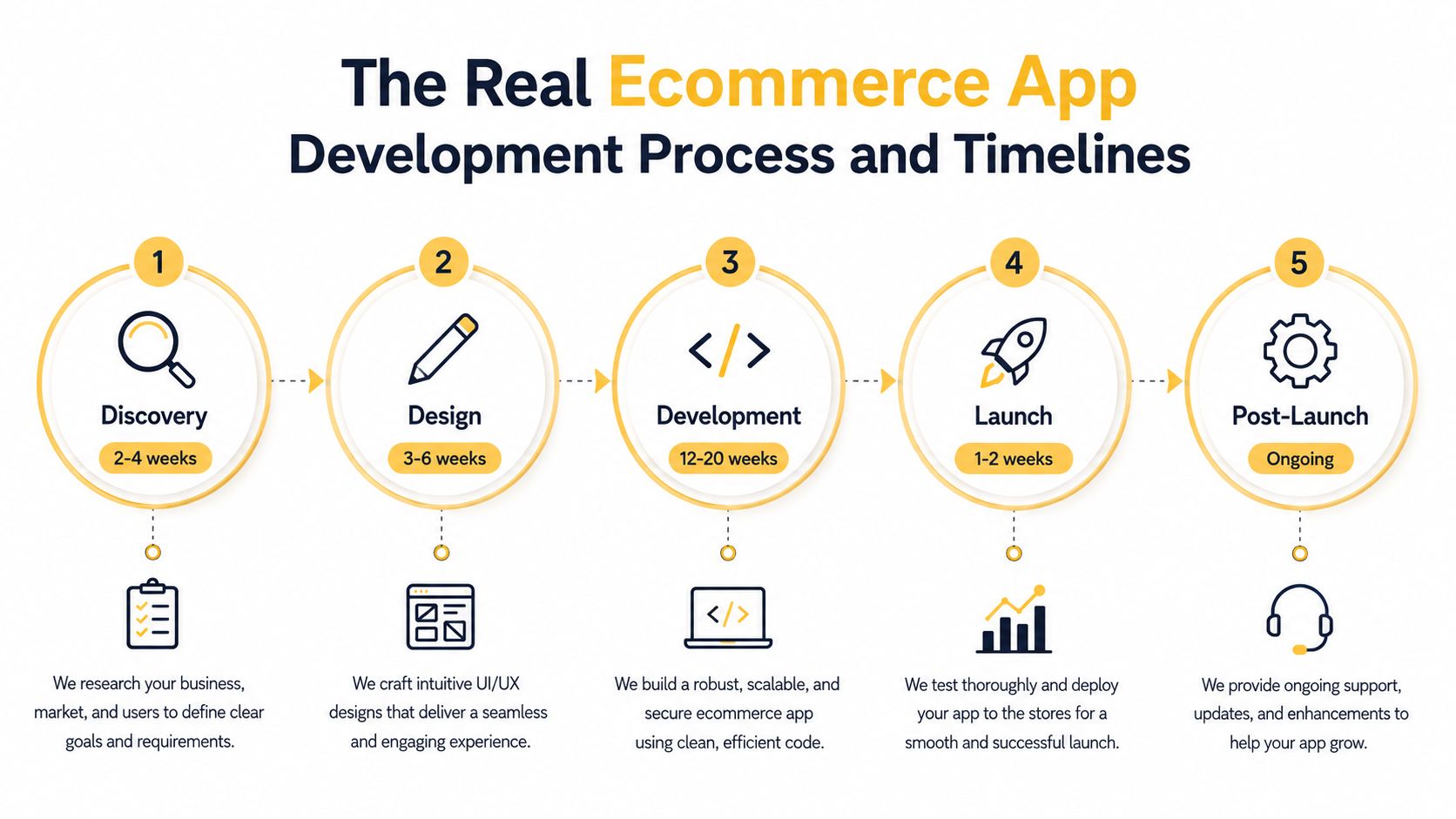
A serious ecommerce build follows a predictable path, and every step needs input from the buyer. Discovery and strategy usually come first, then UX and design, then development and integrations, followed by testing and QA, and finally launch and iteration. If someone promises a polished commerce app with no real discovery, they're either cutting corners or planning to bill you for the cleanup later.
What each stage looks like in practice
Discovery should surface goals, required integrations, and the actual revenue problem. Buyers need to bring product data, tax rules, fulfillment logic, and the brand constraints that shape the experience. If that material is missing, the timeline slips before a single screen is mocked up.
Design turns the strategy into flows that reduce friction. That means fewer dead ends, cleaner navigation, and checkout paths that don't make shoppers think. Good design work protects conversion because it removes hesitation.
Development is where APIs, payments, inventory, and customer accounts get stitched together. The agency should be able to explain which systems are being connected and which ones are being left out for now. Anything else is wishful thinking.
Testing and QA needs real devices, real scenarios, and real payment checks. Bugs in cart logic or checkout flow are not minor annoyances, they're revenue leaks. Launch and iteration is where teams learn what shoppers do, then tighten the funnel.
A serious ecommerce app rarely ships in under 12 weeks, and a full-featured build often takes four to nine months. I've seen faster builds, but they usually get there by shrinking the scope, not by magically compressing reality. The work after launch is where the revenue case gets proved, because the app gets better when the team sees what shoppers abandon, repeat, or support.
If an agency treats launch as the finish line, they're selling you a project, not an ecommerce system.
Pricing Models and the Cost Drivers That Decide Your Budget
Pricing is where buyers get trapped. Fixed-price sounds safe until the scope changes, then the contract starts fighting your business. Time and materials gives flexibility, but if the team doesn't manage scope tightly, the invoice grows while the plan drifts. Milestone-based works when deliverables are crisp, and a dedicated team makes sense when the relationship is long-term and the roadmap keeps moving.
What each model is actually good for
- Fixed-price works when you know exactly what ships and what doesn't.
- Time and materials fits evolving builds where discovery will change the shape of the app.
- Milestone-based gives you payment checkpoints tied to real deliverables.
- Dedicated team is the right call when you're treating the app like an ongoing product, not a one-off launch.
Cost drivers matter more than the pricing model itself. More integrations mean more testing, more failure points, and more coordination. Payment gateways, custom design, catalog size, multi-currency support, localization, and post-launch maintenance all push the budget up because they increase both build effort and operational risk. That's why two apps that look similar on the surface can have wildly different budgets underneath.
Budget around the work, not the wish list
If you're comparing estimates, ask what's included in discovery, QA, post-launch support, and integration work. That's where low bids usually hide the actual cost. If a vendor gives you a simple number without showing the assumptions underneath, they're selling you surprise invoices.
For a deeper look at how agency pricing gets shaped by scope, team composition, and technical complexity, the breakdown in this web application development cost guide helps frame the conversation before you sign anything. It's the same discipline here, because ecommerce doesn't get cheaper just because the storefront sells products instead of software.
A good budgeting heuristic is simple. Plan for build cost plus 15 to 25 percent annual maintenance, then leave room for iteration. Commerce apps don't stay still, and the budget shouldn't assume they will.
How to Choose the Right Ecommerce App Development Partner
Start with the questions that expose competence. Ask whether the team has shipped commerce apps with payment integrations, order logic, and post-launch support. Ask who's on the project, how they handle QA, how they protect code ownership, and why they're recommending a specific stack instead of another one.
Questions that should get clear answers
- Relevant experience: Have they shipped commerce products similar to yours?
- Team composition: Do you know who's designing, building, and testing?
- Support model: What happens after launch, and who responds to issues?
- Security practices: How do they handle data, access, and payment-related risk?
- Ownership: Do you own the code, assets, and IP when the project ends?
The red flags are easy to spot if you stay disciplined. Vague timelines, no discovery phase, no testing process, and reluctance to share references should knock a vendor out fast. So should a proposal that talks about every trendy feature but can't explain how those features tie to checkout, retention, or support cost.
What separates a decent agency from a risky one
Communication cadence matters. So does transparency on pricing and the ability to talk plainly about trade-offs. A polished portfolio can still hide weak process, and weak process is what burns time and budget once the project gets real.
If you're still deciding on the underlying commerce platform, use a practical resource like picking the right ecommerce platform to separate platform fit from agency fit. Those are two different decisions, and mixing them up leads to bad contracts.
Up North Media belongs in that conversation as one option because it offers web development services that include e-commerce platforms and API development, plus custom web applications built around business tools and shopping workflows. That kind of scope matters if you want one partner who can handle the store, the backend connections, and the logic in between.
Score partners on outcomes, not polish. Ask what they've improved, how they measure success, and what they'd cut if the budget tightened tomorrow.
The Case for Lean, Conversion-First Builds and Smarter Localization
More features do not equal more revenue. In ecommerce, every extra module adds maintenance, slows iteration, and creates another place for the funnel to break. A lean, conversion-first build usually wins for SMBs because it focuses on the moves that matter, checkout completion, repeat purchase behavior, and reduced support volume.
Trend lists love AI personalization, headless commerce, AR/VR, and voice commerce. Those can be useful in the right context, but they also create complexity that many smaller retailers don't need on day one. If the app still has friction in search, cart, or checkout, fancy features won't save it.
Localization is not a checkbox
Global-ready doesn't mean one universal build with a flag picker. A US-focused app might lean harder on buy now, pay later and one-click checkout, while an EU or APAC build usually needs stronger consent handling, data minimization, and local payment rails. The right stack depends on the market you're entering, not on a trend report's broad idea of modern commerce.
That's why localization and compliance belong in the product plan, not as a late-stage patch. If the app can't fit the market's payment habits and privacy expectations, it won't convert well enough to justify the launch cost. The smarter move is to ship the version that matches the customer's reality first, then expand deliberately.
A focused app also gives your team more room to learn. When the surface area is smaller, it's easier to see what shoppers use and what they ignore. That makes iteration faster and the revenue story clearer.
FAQs and Your Next Step Toward a Higher-ROI App
How long does an ecommerce app usually take to build?
A real build usually takes longer than the optimistic pitch. If the scope is serious, expect the process to run past the early discovery and design work, especially once integrations and QA enter the picture.
What should an SMB budget for an ecommerce app?
Budget around the actual complexity, not the fantasy version of the project. A simple catalog with a straightforward checkout is one thing, but payments, fulfillment rules, localization, and support change the economics fast.
How do I evaluate ROI before signing?
Tie the app to business outcomes. If the build doesn't have a plausible path to better conversion, stronger retention, or lower support burden, the ROI case is weak.
Should I build custom or start on top of an existing platform?
Start with the business need. If speed matters and your requirements are standard, an existing platform can reduce risk. If your revenue model depends on custom logic, deeper integrations, or a more controlled customer experience, custom work is worth serious consideration.
If you want a realistic scope review before you commit, Up North Media offers free consultations to pressure-test the build, the timeline, and the budget assumptions. That's the right first step if you want a commerce app that supports revenue instead of just adding complexity.
If you're weighing an ecommerce build, Up North Media can help you sort out what's worth building now and what should wait. Visit Up North Media to book a consultation, compare options, and get a practical estimate before you spend on features that won't move revenue.