
You've signed an SEO contract, granted access to analytics, and answered a long list of questions about your customers. A few weeks later, the rankings look mostly unchanged, your inbox contains a polished report, and someone at the next leadership meeting asks the uncomfortable question: “What are we paying for?”
That situation is common because SEO has two very different timelines. An agency can begin auditing, fixing, researching, and improving your site quickly, but search visibility and qualified demand usually build through repeated work. The right question isn't only when rankings will rise. It's whether the agency is making sensible improvements, measuring commercial outcomes, and showing you what happens next.
For an Omaha small business, an e-commerce store, or a publisher with a large content library, what to expect from an SEO agency should be clear before the agreement is signed. You should understand the work, the reason behind it, the evidence of progress, and the limits of what SEO can accomplish on its own.
Introduction to What an SEO Agency Actually Does
An SEO agency helps search engines discover, understand, and trust the pages that matter to your business. That work can include technical repairs, page improvements, content planning, internal linking, authority building, conversion analysis, and ongoing measurement. Publishing blog posts is only one possible part of the service.
Consider a local service company that wants more qualified enquiries. Its agency may find that important service pages aren't being indexed properly, that page titles don't match how customers search, and that the contact path is difficult to use on mobile. Fixing those issues may not create an overnight ranking jump, but it removes obstacles between the business and the people already looking for its services.
Practical rule: A good agency should be able to explain what it changed, why the change mattered, and how the team will judge its effect.
SEO also isn't a single campaign that ends when a page reaches a desirable position. Competitors publish, search results change, websites develop technical problems, and customer language evolves. A durable program treats the site as a system that needs research, implementation, observation, and adjustment.
This matters particularly for small and mid-sized businesses. Owners often need to balance SEO against sales, operations, hiring, and product work. A clear agency relationship reduces that burden by turning specialist activity into business decisions you can understand.
By the end of this guide, you'll be able to assess whether an agency has a credible process, whether its deliverables are substantial enough to justify the engagement, and whether its reporting connects visibility with qualified demand and revenue quality. You'll also have a better basis for discussing AI-driven discovery, where classic rankings are no longer the only way prospects may encounter a company.
How SEO Works Behind the Scenes
Think of your website as a library and a search engine as a librarian helping a visitor find the right book.
First, the librarian needs to reach the shelves. In SEO, crawlability describes whether search-engine systems can discover and access pages through links, sitemaps, and a usable site structure. Broken links, blocked resources, confusing navigation, and inconsistent technical signals can make valuable content harder to find.
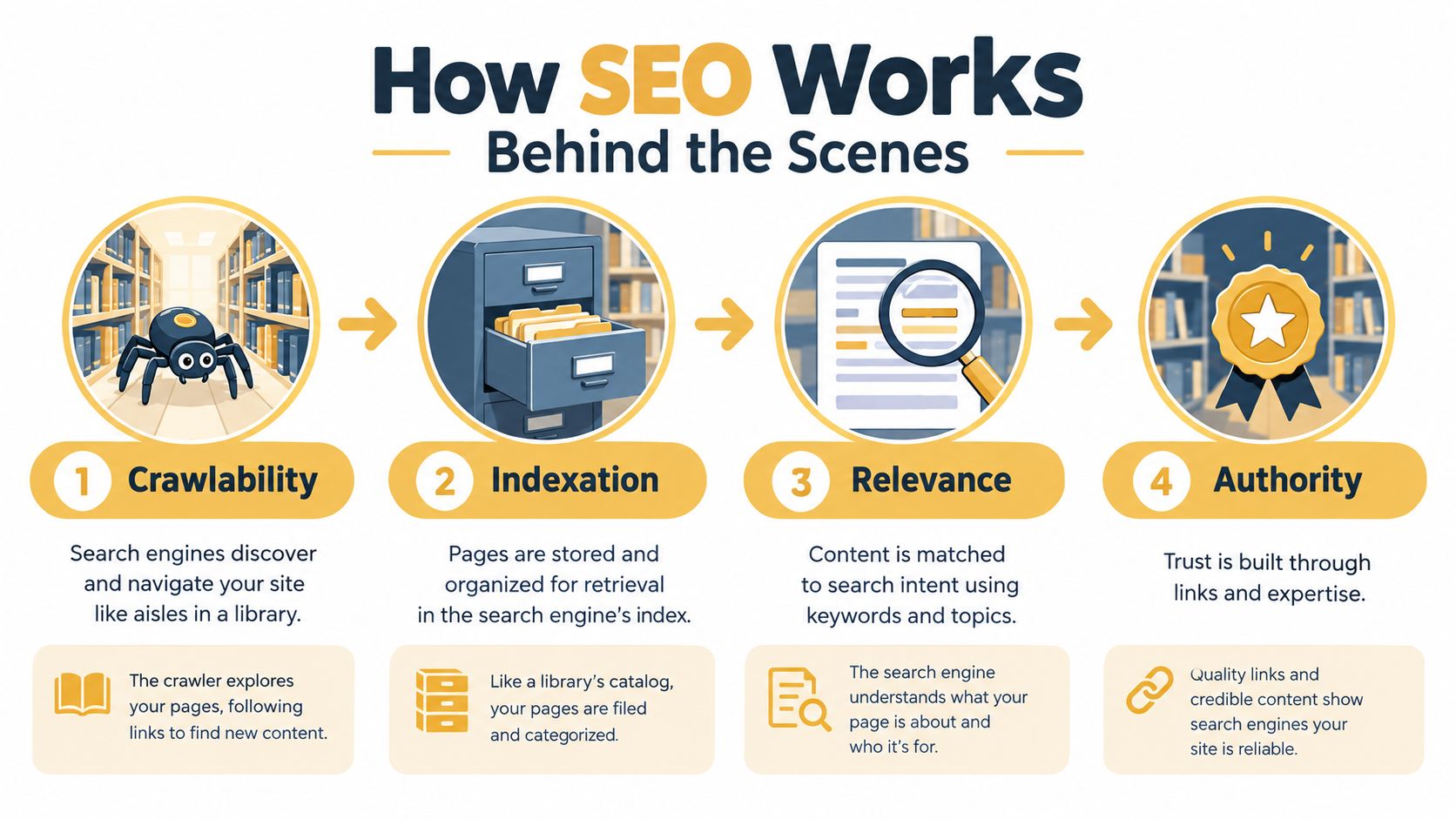
Next comes indexation. The librarian decides which books belong in the catalog and how they should be organized. Search engines similarly process pages and decide whether they can retrieve them for relevant searches. Canonical tags, XML sitemaps, redirects, duplicate pages, and language versions all influence that organization.
Relevance connects pages with real questions
A page can be accessible and indexed yet still fail to attract useful visitors. Relevance means the page addresses the intent behind a search. Someone searching “emergency furnace repair Omaha” needs a different page from someone researching how furnaces work. A capable agency studies the difference rather than forcing every phrase onto the same page.
Good content answers the visitor's question clearly, demonstrates subject knowledge, and gives the reader a sensible next step. It also uses titles, headings, images, structured data, and internal links to make the subject easier for both people and search systems to interpret.
Authority gives the library a reputation
The final layer is authority, which is the trust associated with a site, page, brand, or subject area. Relevant mentions and editorially earned links can support that trust, but they aren't a substitute for useful pages or sound technical foundations. An agency should explain how its authority work fits the business, not promise a fixed quantity of questionable links.
This model also separates three outcomes owners often blend together:
- Rankings show where a page appears for a tracked query.
- Traffic shows visits generated by search visibility.
- Business outcomes show whether those visits become enquiries, purchases, subscribers, or other valuable actions.
A high ranking for an irrelevant phrase may produce little commercial value. A lower-volume, high-intent query can matter much more if it brings the right buyer to a page that converts.
Your First 90 Days With an SEO Agency
The first three months should feel like a sequence of decisions, not a mystery subscription. The agency needs enough information to understand your business before it recommends a large list of changes.
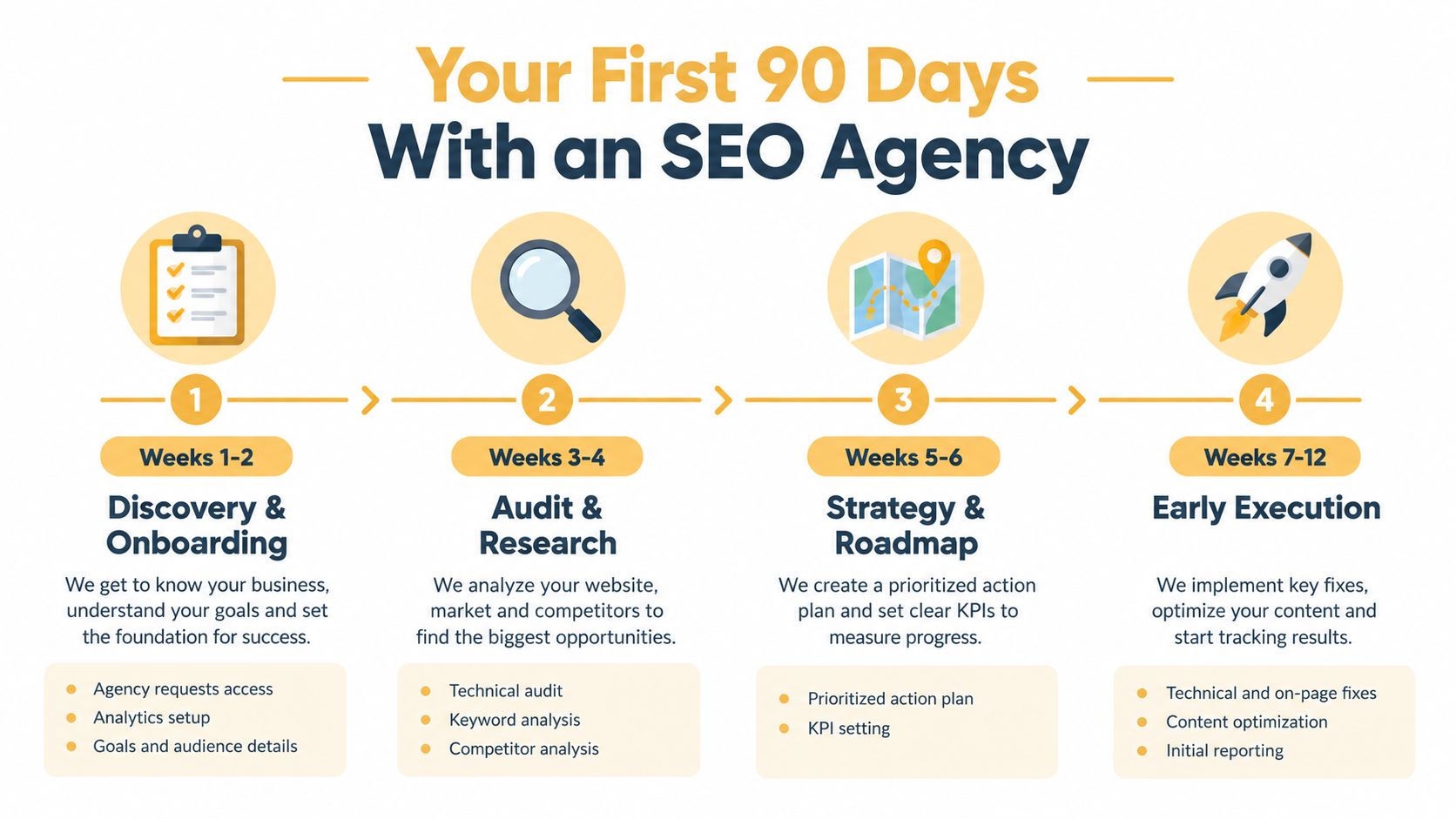
Weeks one and two focus on context
During onboarding, expect questions about your best customers, profitable services or products, sales cycles, geographic markets, seasonal demand, competitors, and existing marketing activity. The agency may request access to Google Analytics, Google Search Console, a content management system, a product feed, a CRM, or conversion tracking.
That access isn't busywork. Without it, the agency may optimize pages that attract visitors but don't support sales. You should also agree on ownership, approval responsibilities, communication channels, and the people who can implement technical recommendations.
Weeks three and four reveal the constraints
The audit should examine crawlability, indexation, page templates, internal links, mobile experience, page performance, metadata, structured data, content quality, and conversion paths. For multi-region or multilingual sites, the agency should review language and regional signals.
Keyword and competitor research then puts those findings into a market context. The agency should distinguish brand searches, informational questions, local intent, product searches, and high-intent commercial phrases. A useful presentation connects opportunities to specific pages and business priorities instead of delivering a giant unranked spreadsheet.
Weeks five through twelve turn research into action
The roadmap should prioritize work by impact, effort, dependencies, and available resources. Early execution may involve repairing technical issues, revising important titles and headings, improving internal links, updating existing pages, or preparing content briefs.
Don't judge the first month only by visible rankings. A new agency often spends early time correcting measurement, resolving indexation barriers, and creating a trustworthy baseline. That doesn't excuse silence. You should still receive a clear record of completed work and an explanation of why each priority came first.
For a deeper discussion of the factors that influence SEO timing, review how long SEO takes to work.
A recorded walkthrough can also help your team understand the sequence of work:
By the end of this opening period, you may not have a dramatic traffic story. You should have a documented strategy, corrected tracking gaps, visible implementation, and a prioritized queue for continued improvement.
Core Services and Deliverables You Should Expect
A strong scope document describes work you can inspect. It doesn't need to guarantee a particular ranking or promise a fixed outcome, but it should make the agency's responsibilities concrete.
Technical SEO protects access
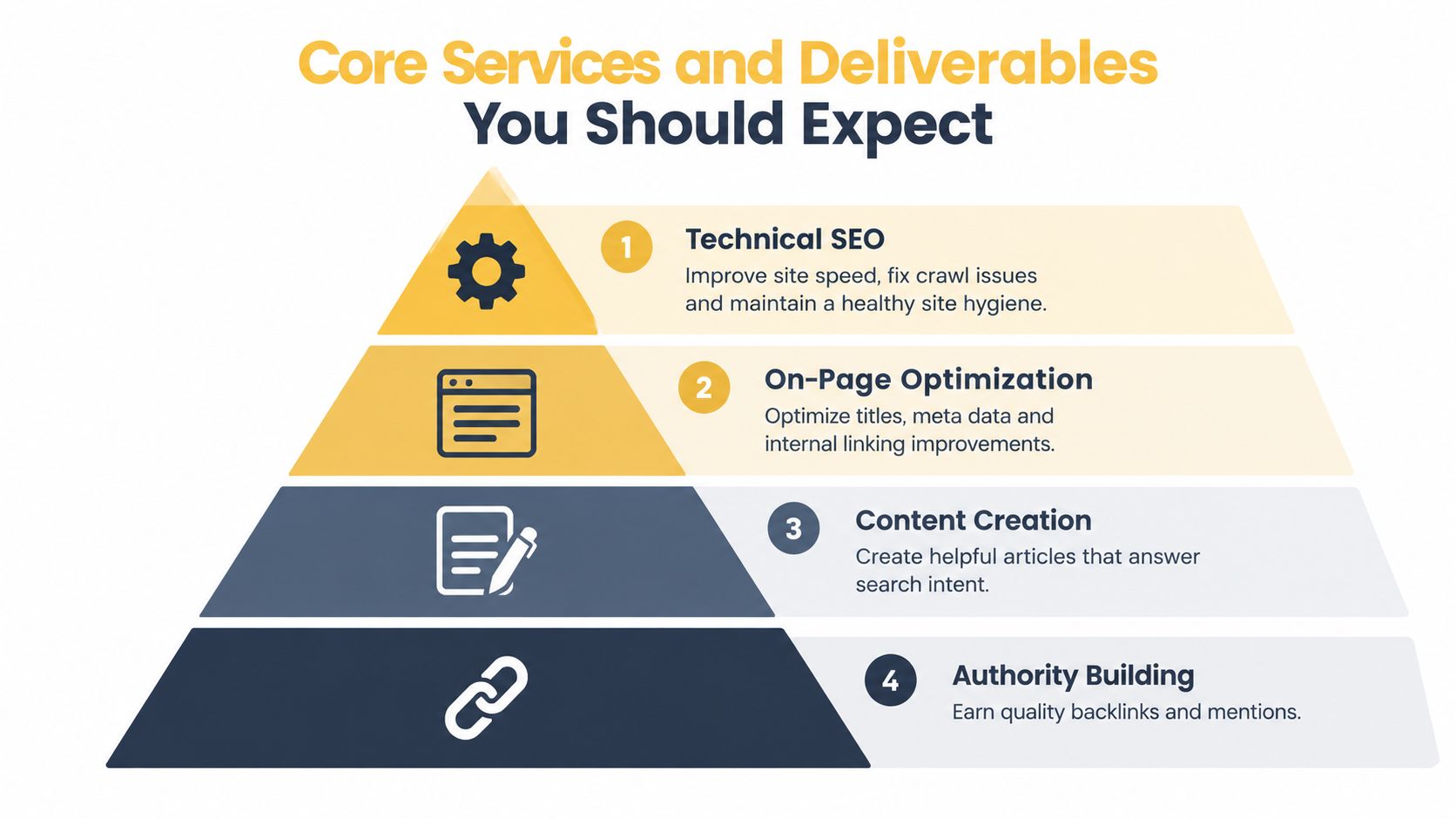
Technical work should cover more than a one-time audit PDF. A technically competent agency should provide quarterly crawl audits, monitor Core Web Vitals against Google's LCP, INP, and CLS thresholds, validate schema on important page types, maintain XML sitemaps, check canonicalization, and review hreflang on multilingual or multi-region sites. These expectations are outlined in the scope of a good SEO agency.
The deliverable might be a prioritized ticket list, a developer-ready specification, or direct implementation. It should identify affected URLs, explain the user or search impact, and record what was resolved.
On-page work improves the page you already have
On-page optimization can include title tags, meta descriptions, headings, body copy, image alternatives, product information, internal links, and structured data. The agency should show the original issue, the proposed change, and the page's role in the wider topic or conversion path.
A landing page for commercial roofing, for example, needs different content and calls to action from an educational article about roof maintenance. Strong optimization reflects that distinction.
Content should answer intent
Content briefs should define the audience, search intent, recommended coverage, internal links, conversion opportunity, and standards for accuracy. A useful agency may update an underperforming page rather than constantly creating new articles. That choice often protects quality and reduces duplication.
Authority building should be explainable
Ethical authority work focuses on relevant partnerships, editorial mentions, useful resources, digital public relations, and legitimate citations. Be cautious if an agency offers secret tactics, guarantees large quantities of links, or can't explain where mentions will appear.
If you're comparing broader digital capabilities alongside SEO, you can choose your Busylike partner using its agency directory. Whatever provider you select, confirm that your business retains ownership of domains, analytics, content, profiles, and accounts.
Pricing Models Reporting and Communication Rhythm
SEO pricing makes more sense when you separate how the agency is paid from what the agency is accountable for. A recurring retainer suits ongoing research and optimization, while a fixed project can work when you have a defined technical migration, content audit, or site structure problem. Hourly consulting may fit an experienced internal team that needs specialist direction.
Performance-based arrangements require extra scrutiny. Search engines, developers, editors, competitors, and market demand all affect outcomes, so a contract should define which outcomes are controllable and how attribution works. Never accept vague language about guaranteed rankings as a substitute for a detailed plan.
| Model | Best For | Typical Scope | Reporting Rhythm |
|---|---|---|---|
| Monthly retainer | Businesses needing continuous strategy and execution | Technical SEO, content, on-page work, authority, and analysis | Monthly reporting with regular communication |
| Project-based | A defined audit, migration, or optimization initiative | A fixed set of tasks and documented recommendations | Milestone updates and a final handoff |
| Consulting | Teams with internal implementation capacity | Research, reviews, training, and strategic guidance | Meetings tied to deliverables or decisions |
| Performance-based | Businesses with mature tracking and carefully defined goals | Scope varies, with attribution and qualification rules agreed in advance | Reporting must connect agreed outcomes with completed work |
A useful report should explain completed work, unresolved issues, changes in organic impressions and clicks, priority page performance, conversions, lead quality, and next actions. A ranking chart alone doesn't tell you whether the campaign is helping the business.
Communication should match the complexity of the work. Some teams need a brief operational check-in, while others need a monthly working session and a quarterly strategic review. Ask to see a sample report before signing and confirm who answers questions when implementation is blocked.
The report should also preserve a decision trail. If the agency deprioritizes a recommendation, you should know whether the reason was development effort, limited search opportunity, weak commercial intent, or a more urgent business need.
How Agencies Measure Success Beyond Rankings
Search visibility becomes useful only when it moves through a measurable path:
Impressions → clicks → engaged visits → qualified actions → revenue quality
Impressions tell you that search engines are showing your pages. Clicks tell you that the result persuaded someone to visit. A conversion event then indicates whether the visitor took an action, but your sales team still needs to determine whether that action represents a serious opportunity.
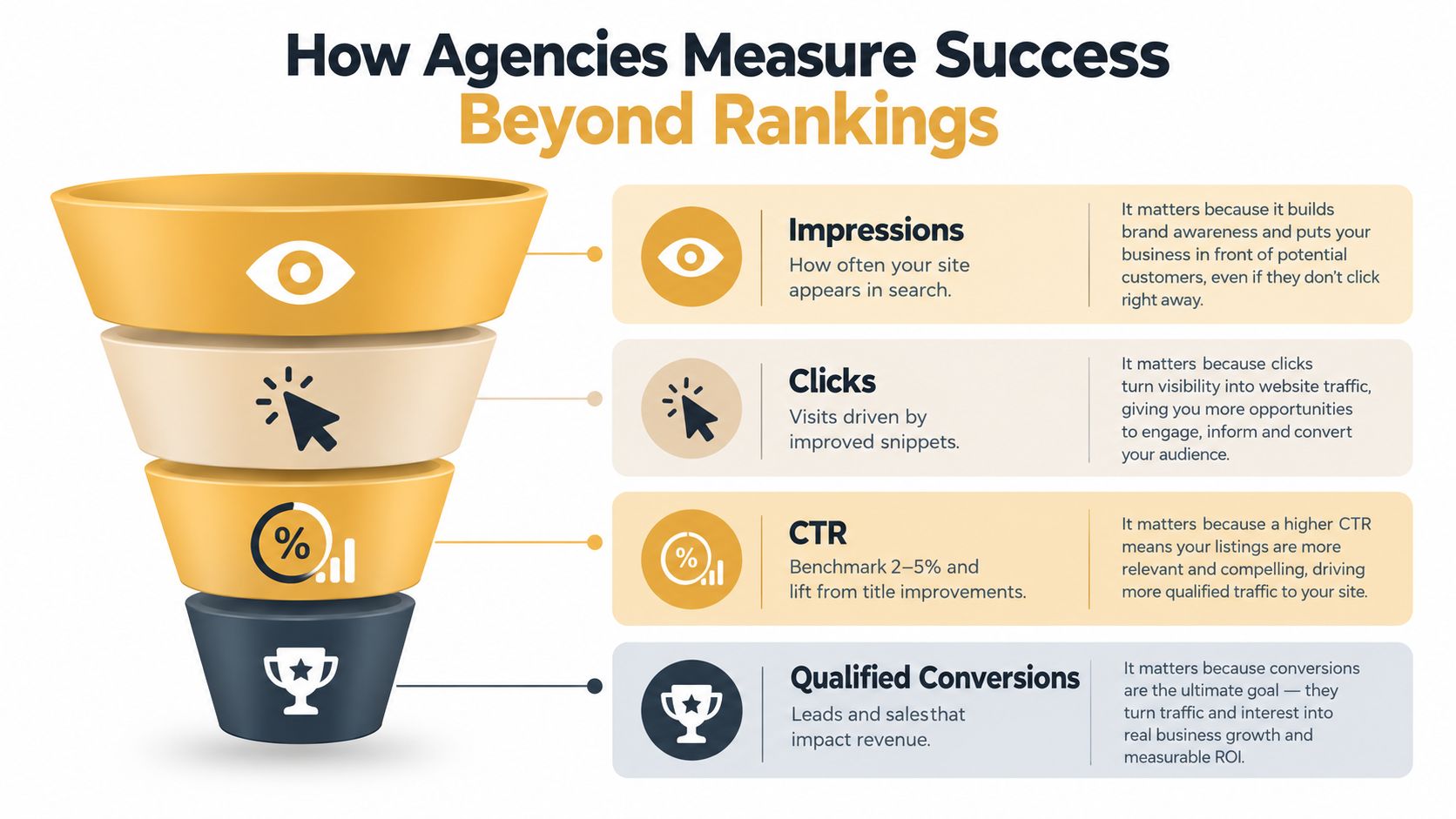
CTR shows whether the result earns attention
A practical organic CTR benchmark is often around 1% to 2% overall, while higher-performing pages can move above 3%, according to Ahrefs' CTR guidance. Treat those figures as directional context, not a universal target. Query type, brand familiarity, search features, device, and position all change the opportunity.
An agency should test clearer title tags, intent-matched descriptions, page structure, and appropriate structured data. If impressions remain similar while clicks improve, the snippet work may be doing its job.
Qualified demand is the commercial test
Traffic quality matters more than traffic volume. A local contractor might value calls from service-area customers, while an e-commerce business might care about product-level purchases, repeat customers, and margin. A publisher may measure engaged subscribers rather than pageviews alone.
Ask the agency to connect organic landing pages with form submissions, phone calls, booked appointments, purchases, or CRM stages. Then compare the quality of those actions with paid, referral, direct, and other channels instead of assigning every outcome to SEO.
For a practical framework for connecting SEO activity with financial outcomes, use this guide to measuring SEO ROI.
AI search adds another visibility layer
Traditional rank tracking doesn't capture every way a prospect can discover your company. Industry coverage indicates that client demand in 2026 is shifting toward AEO and SEO for AI-driven search, with Google AI Overviews and LLM-based discovery changing what agencies need to measure. That coverage appears in AgencyAnalytics' 2026 agency benchmarks.
Ask whether the agency tracks relevant AI Overview presence, citation rate, and share of voice across answer engines. These measurements are still developing, so the agency should explain its methodology and avoid presenting uncertain visibility as precise revenue attribution.
Choosing the Right Agency and Setting Expectations for Growth
The right agency won't hide behind jargon, but it also won't reduce SEO to a promise that your site will reach a particular position. It should ask about customers, margins, sales capacity, geographic priorities, and the pages that can support growth.
Use this short screening checklist before choosing a provider:
- Commercial understanding: Can the team identify which products, services, or audiences deserve priority?
- Technical competence: Will it address crawlability, indexation, performance, schema, and site architecture?
- Execution clarity: Does the proposal name deliverables, owners, approval steps, and implementation requirements?
- Measurement discipline: Will reporting connect impressions and clicks with qualified enquiries, purchases, or pipeline?
- AI-search awareness: Can the agency explain how it will evaluate visibility in AI-generated answers?
- Account ownership: Will your business retain access to analytics, content, profiles, domains, and reporting systems?
- Ethical practice: Will the team explain its link and content methods without relying on secrecy or guaranteed rankings?
A proposal that lists only blog posts and ranking targets is incomplete. A proposal that promises traffic without discussing conversion tracking is also weak. The strongest plans acknowledge trade-offs, such as whether to improve an existing commercial page, build a supporting topic, repair a technical barrier, or invest in authority.
Your internal team has a role, too. Decide who approves content, who can implement site changes, how sales will classify lead quality, and which business data the agency can access. SEO performs better as a shared operating process than as a task handed to an outside vendor and forgotten.
For additional questions to ask during selection, review this guide on how to hire an SEO company. Choose a partner that can show its work, explain uncertainty clearly, and keep the discussion focused on the customers you want, not merely the visitors you can attract.
Up North Media offers data-driven SEO marketing, technical audits, keyword research, content strategy, link building, local SEO, AI-focused optimization, and monthly reporting for businesses that need qualified demand rather than vanity metrics. Visit Up North Media to discuss your goals and request a consultation for your site, market, and revenue priorities.