

A lot of Omaha businesses hit the same point. The local reputation is strong, referrals are steady, and the product is proven, but growth starts to flatten because the website isn't built to sell the way the business operates.
That usually shows up in familiar ways. Orders still depend on phone calls. Inventory updates lag behind reality. Mobile shoppers browse but don't finish checkout. Marketing brings traffic, but the site can't turn that attention into clean, profitable transactions.
That's where ecommerce website development services matter. This work isn't just about putting products on a website. It's about building the digital version of a real business: pricing rules, payments, shipping logic, inventory accuracy, mobile usability, speed, security, and the operational plumbing behind every order. For an Omaha company, that means translating strong regional demand and trusted customer relationships into an online store that can scale beyond a single zip code without breaking under pressure.
Your Guide to Ecommerce Website Development Services
A common Omaha scenario goes like this. A company has a strong sales team, repeat customers, and a product people trust. Then the owner starts comparing ecommerce options and gets pulled in five directions at once. One shop recommends Shopify, another insists on custom development, and a freelancer offers a low-cost theme build that looks fine in screenshots but says nothing about inventory sync, shipping rules, or checkout performance.
Good ecommerce website development services bring that decision back to business reality. The job is to build a revenue system that matches how the company operates. That includes catalog structure, payments, shipping logic, tax handling, mobile checkout, integrations, and the workflow your staff has to manage every day after launch.
For Omaha businesses, the challenge is rarely product quality. It is translation. A company that runs well offline still needs an online store that can explain the offer clearly, process orders accurately, and hold up when traffic spikes after an email campaign, seasonal rush, or local promotion tied to curbside operations and tech.
I tell clients to judge ecommerce development by one practical standard. Does it reduce manual work for the team while making buying easier for the customer?
That standard changes the conversation fast. A cheap build may lower the launch bill, but it often pushes costs into rework, support tickets, and patchwork integrations six months later. A fully custom stack gives more control, but it also raises complexity, maintenance needs, and the number of technical decisions your team has to own. The right answer depends on order volume, product complexity, internal systems, and growth plans. Budget matters, but scope discipline matters just as much. If you are weighing those trade-offs, this guide on ecommerce website development cost helps frame what drives the number.
The best ecommerce projects do not start with design trends. They start with operational questions. What has to sync with your ERP or POS? Where do orders break today? Which promotions need custom pricing rules? How many steps can checkout take before mobile buyers give up?
Those are the questions that separate a store that looks finished from one that earns its keep.
The Blueprint What Services Actually Include
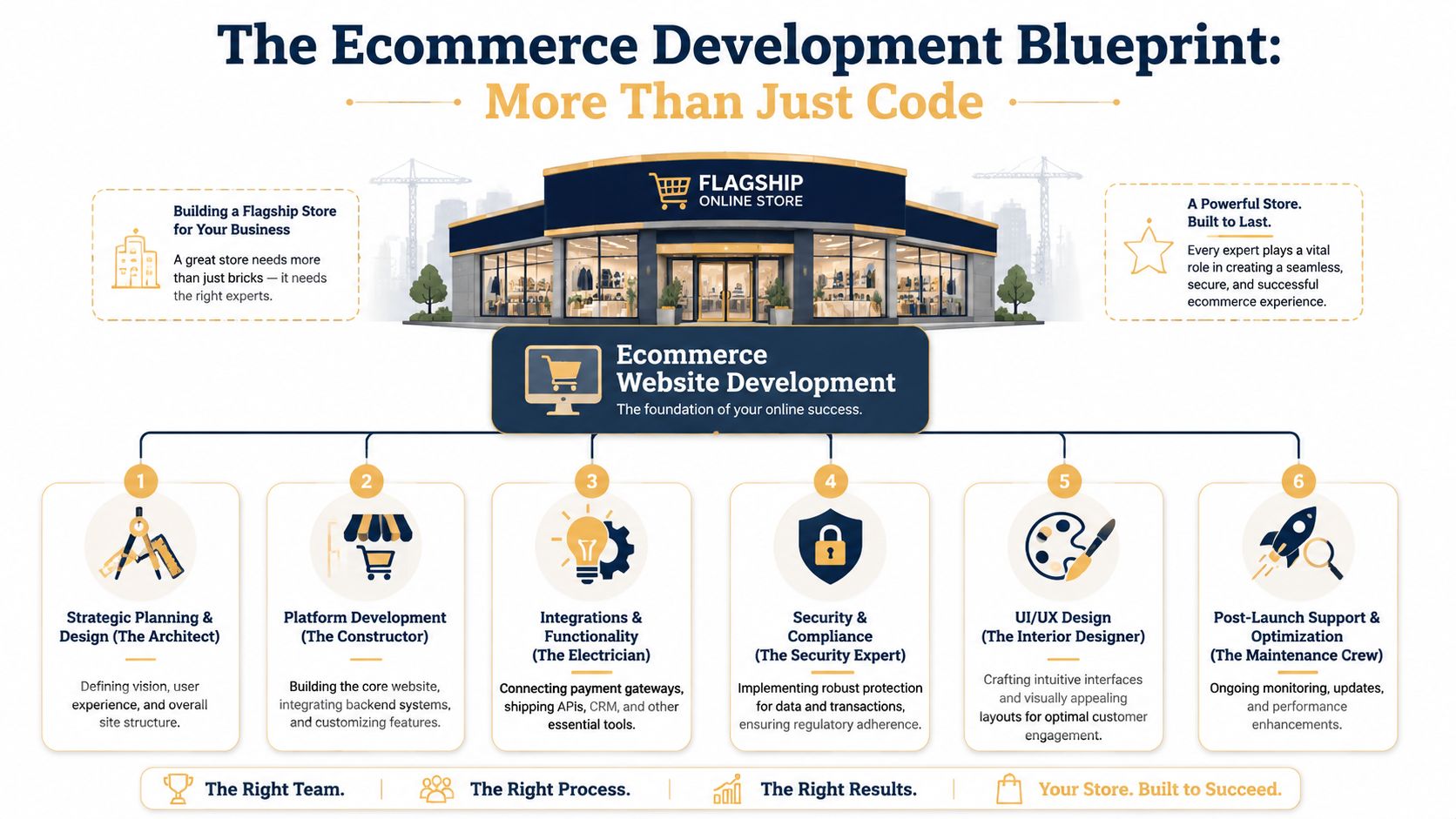
A lot of business owners hear “web development” and picture someone coding product pages. Real ecommerce website development services are broader than that. A better analogy is building a flagship retail location. You need architecture, layout, utilities, security, and ongoing maintenance, not just walls and a cash register.
Strategy and UX come first
The first layer is strategy. That includes platform selection, site architecture, user flows, product taxonomy, and deciding how the customer should move from discovery to checkout. If those decisions are weak, no amount of design polish will save the project.
Then comes UI and UX design. That's your aisle layout, shelf signage, and checkout counter. Categories have to make sense. Product pages need the right information in the right order. Mobile users need tap targets, filters, and checkout forms that don't fight them.
In Omaha, I've seen this matter especially for businesses that know their customers well offline. They often assume buyers already understand the catalog the way a repeat in-person customer does. Online, that assumption breaks fast.
Development is the commerce engine
The next layer is core build work. That includes frontend implementation, backend setup, theme or component development, checkout logic, and account features. But custom ecommerce work goes deeper than presentation.
As explained in Full Scale's overview of e-commerce development services, custom ecommerce development goes beyond storefront configuration into the commerce engine itself: payment rules, inventory synchronization, shipping and tax integrations, pricing logic, and the data pipeline that has to keep functioning during traffic spikes. That distinction matters. A theme-based launch can be quick. A reliable commerce system takes engineering discipline.
Here's the practical split:
- Storefront setup: Good for simpler catalogs, faster launches, and businesses that can work within platform conventions.
- Custom commerce engineering: Necessary when pricing, fulfillment, product logic, or system integrations are specific to how the business runs.
- Hybrid builds: Often the sweet spot. Use a stable platform for core commerce, then customize where operations need it.
Integrations, operations, and support
Integrations are where many projects either become useful or become expensive. Payments, shipping, taxes, ERP, CRM, warehouse tools, email systems, and analytics all need to exchange clean data. If they don't, your team ends up fixing orders by hand.
That's also where operational details matter. If you offer local pickup, delivery routing, or hybrid retail fulfillment, resources on curbside operations and tech can help frame what the website must coordinate beyond checkout.
For budgeting, scope matters more than broad guesses. A catalog-heavy store, a subscription model, and a B2B portal won't price the same, which is why a breakdown of ecommerce website development cost is useful before you compare proposals.
Practical rule: If an agency only talks about design, ask what happens when inventory, taxes, payment failures, and shipping exceptions hit the site on a busy day.
The Development Process From Idea to Launch
The cleanest ecommerce projects follow a sequence. Not because agencies like process for its own sake, but because skipping steps is how teams end up rebuilding features halfway through the project.
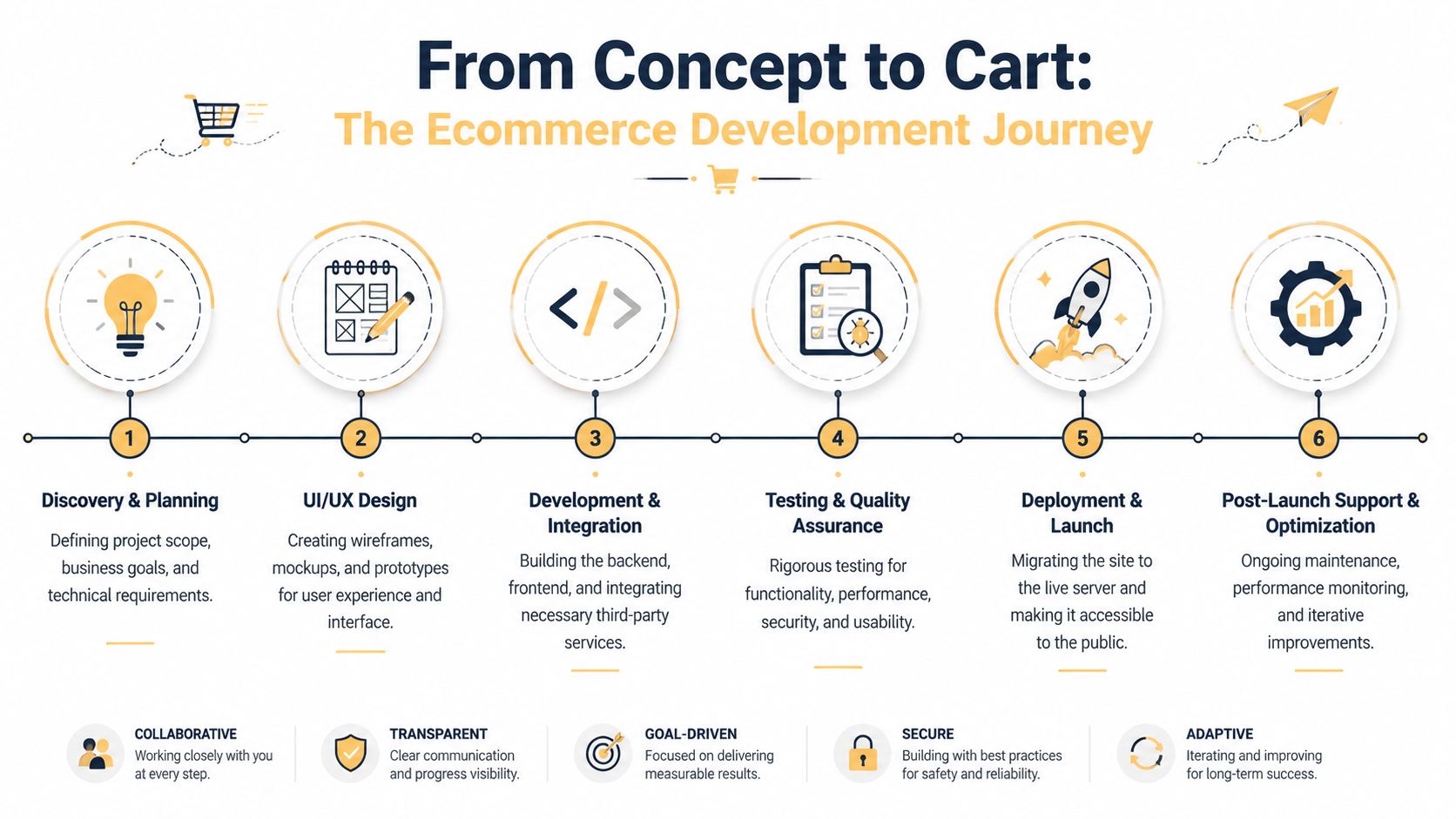
A typical engagement starts with planning, then moves into design, build, testing, and post-launch iteration. The exact timeline changes with scope, but the order shouldn't.
Here's the development journey in a simple visual:
Discovery and design
Discovery is where the agency should learn how your business works. Not just what products you sell, but how orders get fulfilled, how pricing is handled, where customer data lives, what your team does manually today, and what absolutely can't break during launch.
That phase usually produces a few core outputs:
- Requirements definition: Products, customer types, integrations, user roles, content needs.
- Platform recommendation: Based on business model, not trend chasing.
- Feature prioritization: What must exist at launch versus what can wait.
- Success criteria: Faster checkout, cleaner operations, easier content management, stronger search visibility, or other business outcomes.
After that, design work starts. Wireframes are more important than many clients realize. They expose friction before expensive code gets written. If a product page, cart, or account area feels confusing in a wireframe, it'll still feel confusing after launch.
A walkthrough video can help make that progression easier to visualize:
Build, QA, and launch
Once the experience is approved, development begins. Frontend and backend work often run in parallel. Developers configure the platform, build templates or components, connect external systems, and implement product, cart, checkout, and account logic.
Then comes QA. Discipline shows here. Teams should test more than happy-path scenarios.
- Functional testing: Checkout, taxes, shipping methods, coupons, account creation, transactional emails.
- Device testing: Mobile browsers, tablets, desktop resolutions, and edge-case behavior.
- Integration testing: Inventory sync, payment confirmations, shipping updates, data handoffs.
- Content review: Product data quality, collection logic, search relevance, legal pages.
Launch itself should feel boring. That's a good sign. A stable launch means the hard work happened earlier.
After go-live, the site enters its most honest phase. Real users reveal weak spots quickly. Search patterns expose missing navigation. Cart behavior shows where customers hesitate. Post-launch support should include monitoring, fixes, and a prioritized roadmap, not a handoff email and silence.
Choosing Your Technology Stack
Platform choice is one of the few ecommerce decisions that can feel inexpensive at the start and costly later. The wrong stack usually doesn't fail immediately. It creates drag. Your team works around missing features, piles on apps, accepts brittle integrations, and slowly inherits a system nobody wants to touch.
That's why stack selection should start with business shape, not platform popularity.
What the main options are good at
Shopify works well when speed, ease of administration, and operational simplicity matter most. It's a strong fit for many small and midsize stores, especially if the product model is straightforward and the business wants a managed environment.
Magento (Adobe Commerce) makes more sense when catalog complexity, customization needs, and integration depth are materially higher. It can support advanced commerce requirements, but it also expects stronger development and infrastructure discipline.
Custom builds are appropriate when the business model doesn't map cleanly to common platforms, or when the company needs deep control over workflows and architecture. The trade-off is obvious. More flexibility usually means more responsibility.
For business owners comparing options, a good supplemental read on ecommerce platforms for small business helps frame where managed platforms make sense and where they can become limiting.
Ecommerce Platform Comparison
| Factor | Shopify | Magento (Adobe Commerce) | Custom Build |
|---|---|---|---|
| Launch speed | Faster for most standard stores | Slower, more implementation work | Slowest, because everything is defined and built |
| Ease of management | Strong for non-technical teams | Better suited to experienced admins and developers | Depends entirely on how well it's built |
| Customization depth | Good, within platform patterns | High | Highest |
| Integration complexity | Can work well, but app sprawl can become an issue | Strong for complex business rules and integrations | Fully flexible, but every integration must be engineered |
| Maintenance burden | Lower | Higher | Highest |
| Best fit | SMBs, DTC brands, faster launches | Complex catalogs, advanced workflows, larger operations | Unique business models, specialized workflows |
The hidden decision is long-term cost
The launch proposal is only part of the cost. The longer-term issue is whether the stack creates maintenance headaches, plugin dependency, upgrade friction, or migration pain.
Orbit Media highlights an important blind spot in its ecommerce web design discussion: buyers need to look at post-launch operational cost and stack lock-in, because integration complexity and technical debt are major barriers to scaling ecommerce. That matches what happens in real projects. Businesses rarely regret asking harder architecture questions early. They often regret not asking them.
If you're weighing platforms side by side, a more direct ecommerce platform comparison can help organize the trade-offs before vendor calls start.
Choose the platform your team can run well six months after launch, not the one that sounds most impressive in a sales deck.
Performance Security and Why They Drive Revenue
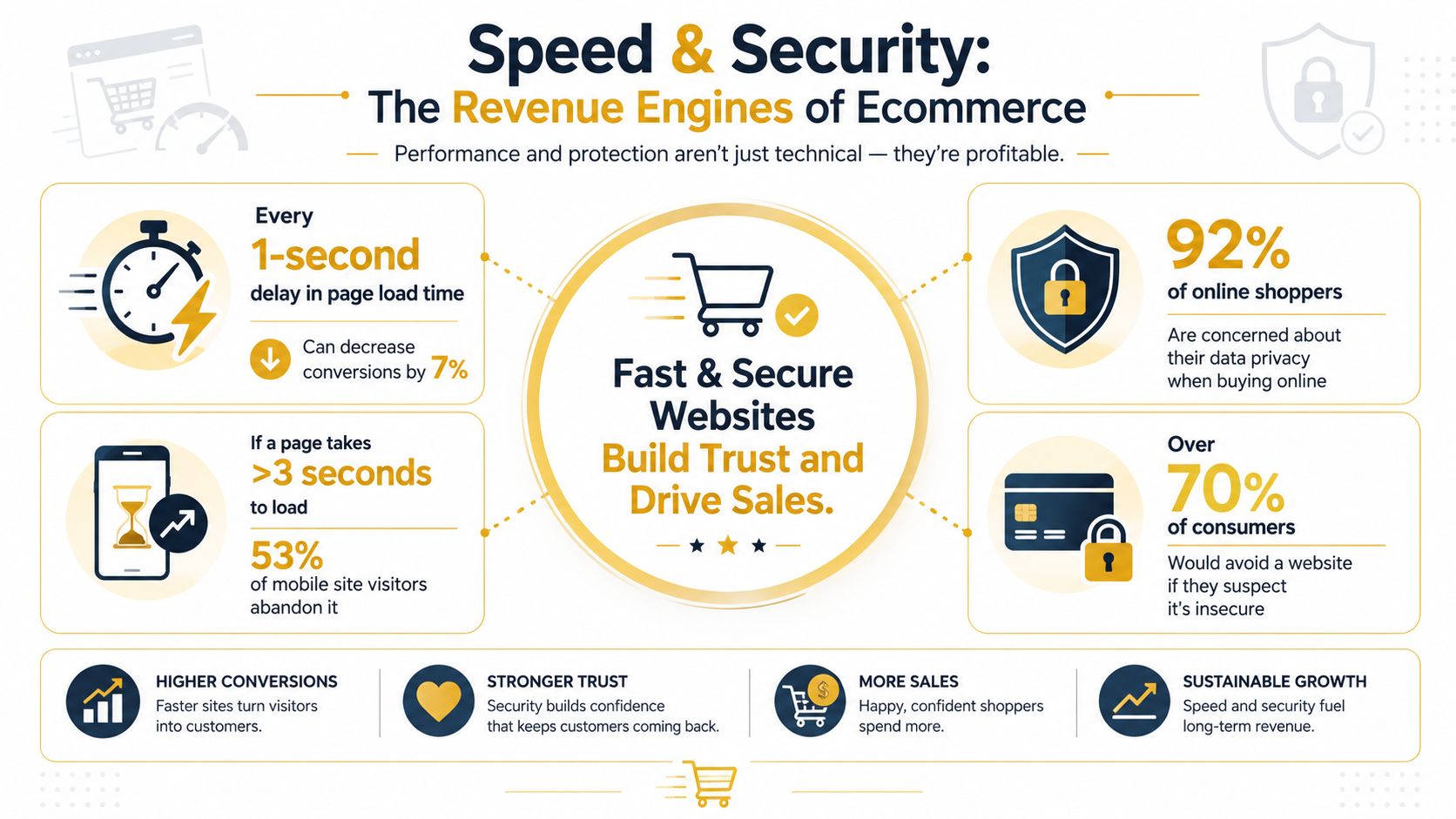
Performance and security usually get discussed as technical checkboxes. In ecommerce, they're sales issues.
If a product page loads slowly, the customer doesn't care whether the bottleneck came from oversized images, bad script loading, or a bloated app stack. They just leave. If checkout feels unstable or untrustworthy, they hesitate. That hesitation shows up directly in abandoned carts and lost orders.
Speed is a conversion input
The business case for performance is unusually clear. DesignRush reports that 1 in 4 visitors abandon a site if it takes more than 4 seconds to load, and each additional second of load time can decrease conversion rates by 4.42% on average, with the steepest decline in the first five seconds, according to DesignRush web development statistics. That turns frontend decisions into revenue decisions.
VWO adds the larger context in [its UX-focused analysis cited in the same verified dataset]: the ecommerce industry loses $1.420 trillion due to bad UX, global cart abandonment reaches 75.6%, and an estimated $260 billion in purchases is abandoned in the US and EU alone because of unsatisfactory checkout flow and design. You don't need a huge Omaha store for those patterns to matter. Any business with mobile traffic and checkout friction feels the effect.
What teams should optimize
Modern ecommerce builds should treat performance as engineering work, not a final polish pass. Guidance from Crystallize on ecommerce web development specifically recommends prioritizing Core Web Vitals such as LCP, FID, and CLS, using server-side rendering (SSR) to improve perceived speed and SEO, and compressing or responsively serving images to reduce load time and layout instability.
In practical terms, that usually means:
- Reduce page weight: Product galleries, third-party scripts, and oversized media are common offenders.
- Control rendering strategy: SSR can help important content appear faster and improve crawlability.
- Audit app and plugin bloat: Every add-on has a performance cost.
- Watch layout shift: A jumping mobile page makes the site feel broken, even when it technically works.
Fast stores feel easier to trust. Slow stores make buyers second-guess the purchase.
Security supports trust and continuity
Security has a similar business effect. Customers may not know the technical vocabulary, but they notice warning signs immediately. Broken HTTPS, awkward redirects, suspicious payment behavior, and inconsistent checkout messaging all damage confidence.
At minimum, ecommerce development should include secure payment processing, role-based admin access, disciplined update practices, and careful handling of customer and order data. Security also has to be operational. A store isn't protected just because it launched with the right settings. Someone has to maintain those settings, review changes, and keep integrations from introducing risk later.
For most businesses, the winning formula is straightforward: build for speed, simplify checkout, reduce front-end instability, and treat trust signals like part of the buying experience, not legal fine print.
The Omaha Advantage Why Local Partnership Matters
A warehouse manager in Omaha spots a recurring order problem. The website accepts purchases for products that are technically in stock, but the packing team keeps finding inventory mismatches and partial shipments. In a local partnership, that issue can move from a frustrated email thread to a working session with the people who own operations, sales, and the site. Problems get solved faster when the team can see the business behind the checkout.
That matters here because many Omaha companies are not pure-play ecommerce brands. They are distributors, manufacturers, retailers, and service-led businesses adding ecommerce to an existing operation. Their stores often need to reflect contract pricing, regional shipping realities, sales rep relationships, or inventory rules that do not fit a default template.
Local context improves decisions
A local agency has an easier time spotting the gap between how the business says it works and how it works. That gap is where expensive ecommerce mistakes usually start.
I've seen projects slow down because the website brief focused on design while the actual constraint was inside fulfillment, customer service, or product data. A nearby team can get the owner, operations lead, and marketer in one room, trace the order flow from product page to pick ticket, and find the bottleneck before it becomes a costly rebuild.
There is also a trust factor. Omaha businesses often grow through reputation first, then through wider digital reach. The website has to serve both audiences well. Local buyers may already know the company from years of business relationships. New customers from outside Nebraska need clearer proof, cleaner messaging, and a buying process that makes sense without a salesperson filling in the gaps.
Local perspective, current standards
Local knowledge is only useful if it connects to current ecommerce practice. A partner in Omaha should understand the regional buyer, then apply the same standards that strong stores use anywhere else: clear information architecture, dependable integrations, clean checkout logic, and mobile-friendly flows, as noted earlier in this article.
That combination is where local partnership earns its keep. The team is close enough to understand how your business sells in this market, but experienced enough to build for customers well beyond it. If you want a practical example of how that mix works, this overview of an Omaha digital marketing agency shows how local strategy and technical execution can support each other.
The best local advantage is not proximity by itself. It is faster understanding, better decisions, and fewer expensive assumptions.
How to Choose the Right Ecommerce Development Agency
A lot of Omaha companies start agency conversations after something has already gone wrong. The site is slow, the catalog is hard to manage, checkout breaks under edge cases, or the marketing team cannot launch a promotion without filing a developer ticket. At that point, the right agency is not the one with the sharpest pitch. It is the one that can diagnose the root cause of the problem and explain the cost of each fix.
A serious ecommerce partner should ask how your business sells. For a regional manufacturer, that may mean dealer pricing, freight quotes, and customer-specific terms. For a local retailer shipping nationwide, it may mean promotional flexibility, accurate inventory, and a checkout flow that works on mobile without confusion. Good agencies work from business rules first, then choose tools and design patterns that fit.
Questions worth asking early
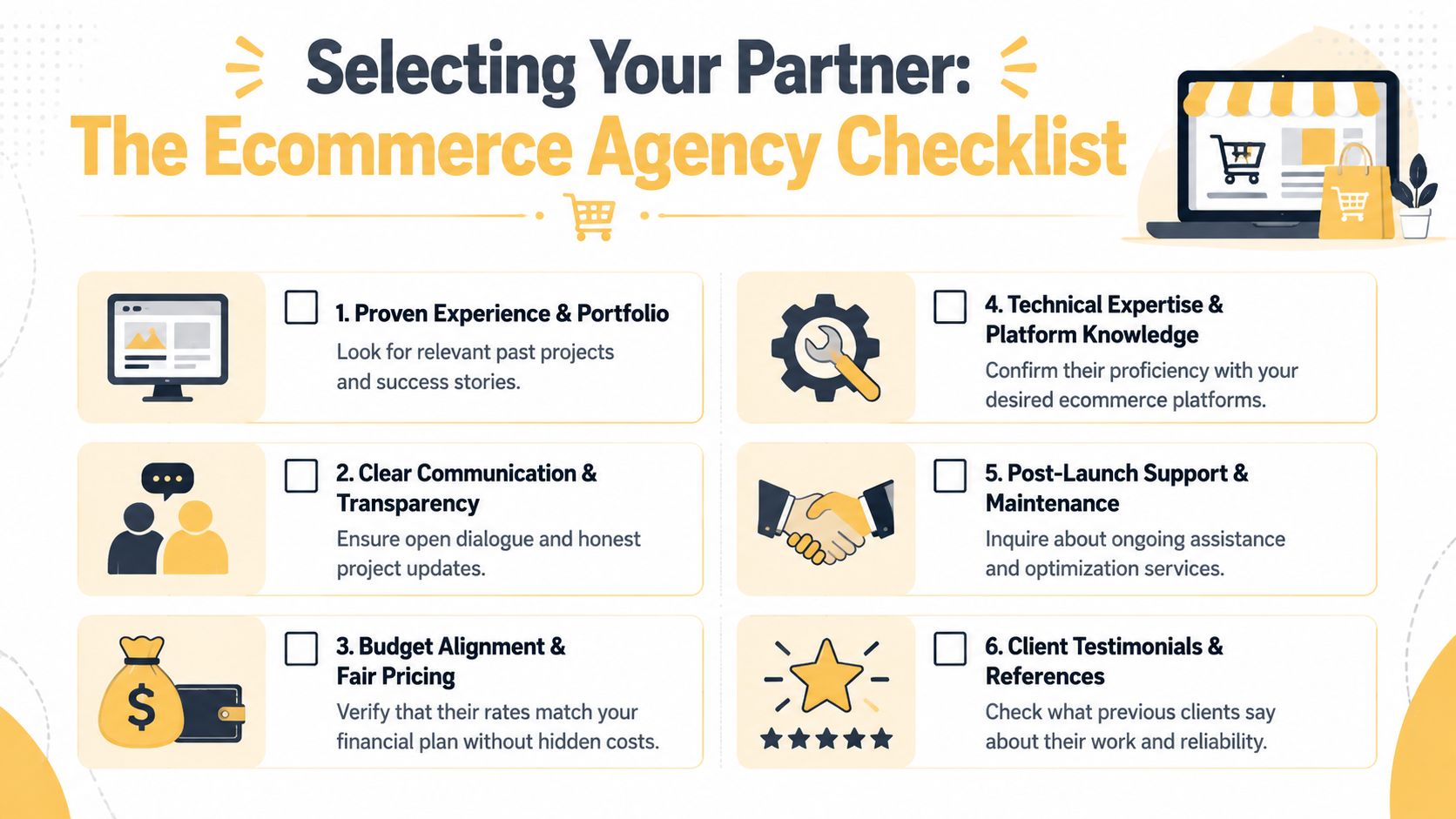
Use these questions to separate builders from sales teams:
- How do you scope complexity? Ask how they evaluate catalog structure, shipping rules, tax handling, account logic, and third-party integrations.
- What would you simplify first? Experienced teams cut avoidable complexity before they write custom code.
- Who is doing the work? Get clarity on who handles strategy, UX, development, QA, and post-launch support.
- How do you test the store? Look for specific answers about device coverage, checkout scenarios, failed payment handling, and integration testing.
- What happens after launch? Support should include updates, monitoring, bug triage, and a process for prioritizing improvements.
- Can you show relevant builds? Ask for examples that match your order flow, product complexity, or fulfillment model, not just attractive homepages.
What strong answers sound like
Strong answers are specific. An agency should be able to explain platform limits, app risks, data ownership, staging workflow, and what your team will need to maintain internally. If the answer stays at the level of branding language, that usually means the technical plan is still fuzzy.
This also applies if you sell beyond your own site. Teams supporting marketplace-heavy brands should understand how ecommerce operations connect across channels, including the kinds of issues covered in these FAQs for D2C brands scaling on Amazon.
One Omaha-based option in this space is Up North Media. The company offers ecommerce development that can include custom shopping cart logic, payment workflows, and inventory-related functionality. That matters for businesses whose requirements go past a standard theme setup. It should still be evaluated the same way as any other agency, based on fit, process quality, technical depth, and the support available after launch.
The best agency relationship feels practical from the start. You should leave the conversation with a clearer picture of risk, cost, timeline, and maintenance responsibility. If an agency cannot explain those trade-offs before the contract is signed, the build usually gets harder after kickoff.
Frequently Asked Questions About Ecommerce Development
How long does an ecommerce website take to build
It depends on scope. A simpler store using a standard platform, a defined catalog, and limited integrations moves much faster than a custom build with complex pricing, account roles, or ERP synchronization. The more your website has to mirror unique business logic, the longer planning and QA will take.
Do I need custom development or will a theme-based store work
A theme-based approach can work well if your products, checkout flow, and operations fit common ecommerce patterns. Custom development becomes more useful when your business has specialized pricing, fulfillment logic, account structures, or system integrations that can't be handled cleanly with apps and configuration alone.
Can I manage the site myself after launch
You should be able to manage everyday merchandising and content tasks without calling a developer every time. Product updates, page edits, promotions, and basic reporting should be accessible to your team. More technical work, such as integration changes, architecture updates, and performance tuning, usually still needs developer support.
What matters most in the first version of the site
Clarity beats feature volume. Get the catalog structure right, make mobile shopping easy, ensure checkout is reliable, and connect the operational systems that keep orders accurate. Many businesses overbuild launch features and underinvest in the fundamentals.
What if I also sell on marketplaces like Amazon
Then your website has to be part of a broader commerce system, not an isolated storefront. Product data, pricing, fulfillment expectations, and brand consistency need tighter coordination. If that's part of your growth plan, these FAQs for D2C brands scaling on Amazon are a useful complement because they surface the marketplace questions that often spill back into site architecture and operations.
If you're evaluating ecommerce website development services and want a practical conversation about platform choice, integrations, mobile UX, and long-term maintainability, Up North Media is an Omaha-based option worth considering. They build ecommerce experiences with custom web development, SEO, and related digital strategy in mind, which is useful when the goal is not just to launch a store, but to run one effectively.