The panic usually starts on a quiet weekday. Friday lunch was full, the phones rang, and reservations kept coming in. Then a competitor slid into the map pack, your clicks thinned out, and Tuesday started feeling even emptier than usual.
That's the shape of local SEO for restaurants. It isn't a vanity exercise about “being found,” it's a conversion system that turns discovery into calls, bookings, and orders. In restaurant search, the battle happens fast, in a tiny slice of results, and the winner often isn't the biggest brand, it's the one with the clearest local signals and the least friction to action.
Why Restaurant Local SEO Is a Different Game
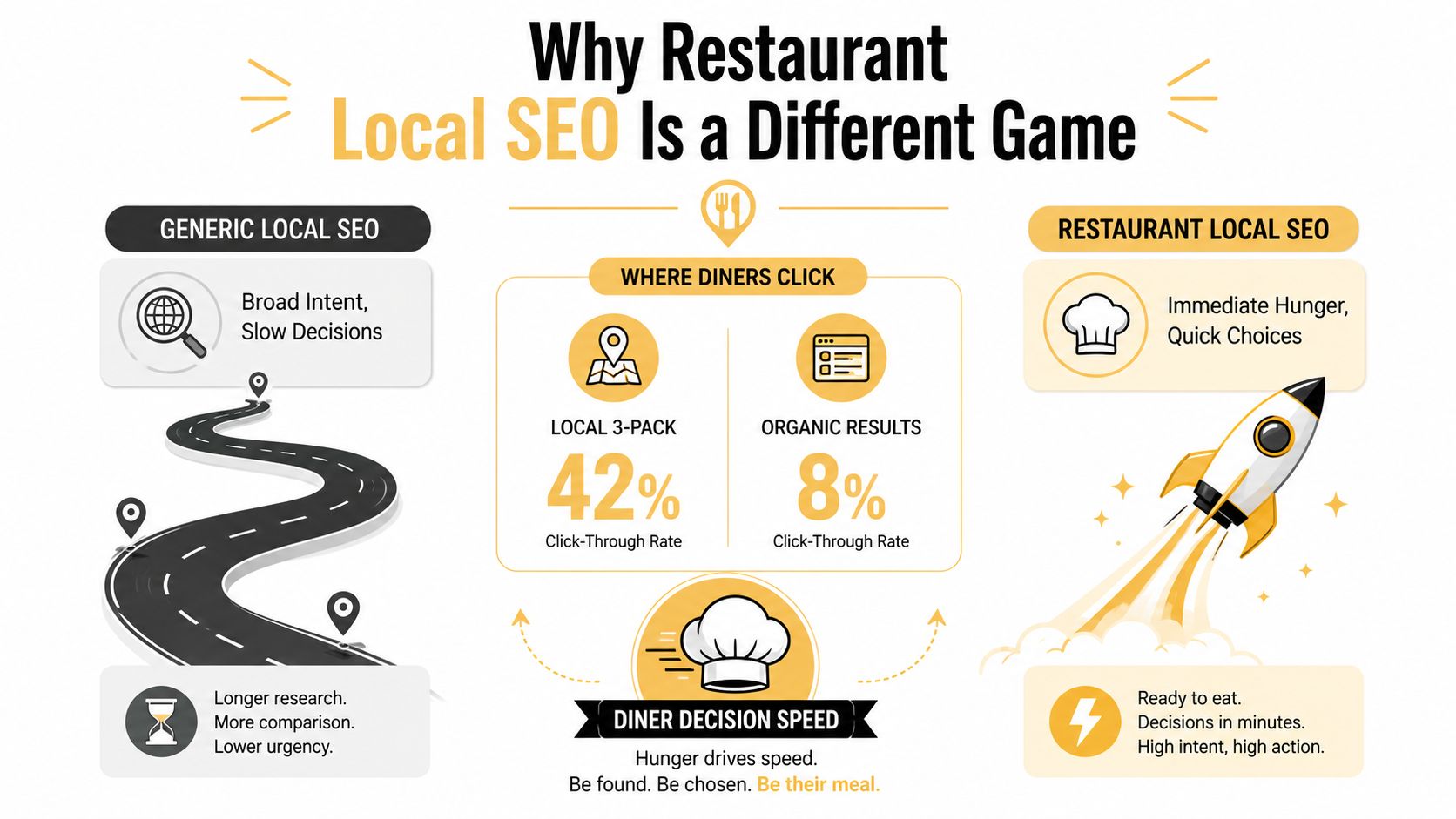
The difference shows up in the click economics. One source says the local 3-pack captures 40% to 50% of all clicks on local-intent searches, while another cites 44% of clicks for local restaurant searches and says the #1 local-pack position earns 17.8% of clicks, with the first three organic results taking 54% to 59% of clicks (restaurant SEO statistics). That concentration matters because a small ranking shift can move real diners, not just abstract traffic.
A restaurant owner feels that difference on the floor. A packed Friday lunch service can turn into a dead Tuesday if a nearby competitor wins the map pack for “best Thai near me” or “lunch near downtown.” The searcher doesn't browse for long, they pick, they call, or they tap directions.
The decision window is short
Restaurant searchers aren't behaving like research-heavy buyers. They're hungry, they're nearby, and they're making a choice in a narrow attention window. That's why map-pack visibility and top organic placement both matter, but only when they lead to a usable next step, like a call, reservation, or menu view.
Practical rule: if the search result doesn't make it easy to act in one tap, the visibility isn't doing its job.
That's also why generic local SEO advice falls apart for restaurants. A plumber can survive on a lead form. A restaurant needs immediate trust, obvious hours, current photos, and a path to table or takeout. If those pieces are missing, a ranking win can still leak revenue.
For a local comparison of how diners decide what to click on a city outing, the pacing of the experience is closer to a curated guide than a broad search project, and a resource like best Manchester food tours makes that behavior easy to picture. The common thread is simple, diners want confidence fast.
Setting Up Your Google Business Profile the Right Way
A restaurant GBP is not a one-time form fill. Claim it, verify it, and manage it like a live operating asset. The profile should reflect the restaurant you are running today, not the version you opened with last year.
The first choice is the primary category. If the listing only says “restaurant,” Google has to infer too much. Add 3 to 5 secondary categories that match the menu and service model, then write a description that names the cuisine, the neighborhood, and how people order without stuffing it with keywords.
The setup should follow the same order you would use on the floor.
- Verify the profile and make sure the live landing page matches the listing details.
- Choose categories based on the menu and concept, not on what feels broad.
- Set holiday hours well ahead of time so seasonality does not break trust.
- Upload photos that show the room, the exterior, signature dishes, and the team.
- Connect ordering or reservations so the profile earns its keep.
- Audit weekly so drift does not creep back in.
The weekly audit matters more than many owners expect. A practical workflow is to check NAP accuracy, category alignment after menu changes, holiday-hours exceptions, photo freshness, review-response coverage, and whether menu and reservation links still work (weekly audit workflow). Assign each item to one person. For example, the general manager owns hours, the host lead checks booking links, and the marketing coordinator handles photos and responses.
A good profile reduces hesitation. A diner opens the listing, sees current hours, clear cuisine, recent photos, and a working order link, then moves faster toward a call, a reservation, or directions. That is how GBP helps bookings and orders, which is the point.
What a good profile does
A strong GBP does not just rank, it shortens the path to action. When the profile is complete and current, the listing answers the questions that usually send a hungry searcher back to the results page. It works like the front door, not a brochure.
If you want a practical walkthrough of the setup sequence, the guide on how to set up Google Business Profile is a useful companion while you clean up the basics. For a broader reference on profile completion and visibility, GrandviewGuide.com Google Business guide is also worth a look.
A clean profile only works when it fits the rest of the local search stack. Categories, photos, hours, reviews, and links all feed the same ranking and conversion signals, which is why it helps to review the broader local SEO ranking factors before you treat GBP as finished.
Operational standard: if an hours change, menu change, or reservation outage is not reflected in GBP the same day, the listing is already out of date.
On-Site Signals That Decide Whether Clickers Become Diners
The website has one job after the click, remove doubt quickly. A hungry searcher should be able to find the menu, confirm the location, see the hours, and either call or reserve without digging. That sounds obvious, but a lot of restaurant sites still bury the essential information under sliders, PDFs, or vague “experience” copy.
HTML menus are the right default. PDFs look tidy in a design review, but they're often poor for both crawling and AI-assisted discovery. The newer restaurant local SEO guidance around AI-readiness keeps pointing in the same direction, menus should be readable in HTML, not locked inside documents that search systems struggle to parse (AI discovery and HTML menus). If the system can't read the dish names cleanly, you've made it harder to surface the food in search.
Schema and page structure do the heavy lifting
Use Restaurant and LocalBusiness schema on each location page, and make sure the markup reflects the actual hours, cuisine, reservation path, and menu structure. The reason isn't mystical. Structured data gives search engines and AI systems a cleaner way to understand what the business is, where it is, and what it serves.
Keep NAP consistent across the header, footer, contact page, and any location pages. Don't make a searcher verify the phone number in one place and the address in another. If your blog has a footer, the same location data belongs there too.
Your mobile experience has to support a quick decision. Tap-to-call should be obvious above the fold, the menu should load without jumping the page around, and the booking or ordering path should not stall on a slow image carousel. For a restaurant, speed isn't a technical vanity metric, it's the difference between an action and a bounce.
A searcher on mobile usually gives you one chance to make the next step obvious. If the menu loads slowly, they'll move on before they ever read the specials.
The cleanest checklist is simple. Put the menu in HTML, mark up the core business data, keep every contact point consistent, and test the order or reservation flow on an actual phone. If a user can't move from search to action in under ten seconds, the page is working against the restaurant.
The ranking angle and the conversion angle are the same thing here. A cleaner site helps crawlers understand the location, and it helps diners trust what they see. Those two outcomes should never be separated.
Citation Cleanup as a Triage Operation
Citation work gets framed like a giant directory project, but that's the wrong mental model. For restaurants, it's a consistency audit. The goal is not to be everywhere, it's to make the places that matter agree on the same business facts.
Start with the data aggregators and the high-visibility platforms. Then move into the verticals that diners check before choosing where to eat. The reason is practical, some sources feed the long tail of business data, while others influence the local search experience directly.
Top Restaurant Citation Sources by Impact
| Source | Trust Signal | Traffic Potential | Menu Updates Supported |
|---|---|---|---|
| Google Business Profile | Very high | Very high | Yes |
| Yelp | High | High | Limited |
| Tripadvisor | High | High | Limited |
| Apple Maps | High | High | No |
| Bing Places | High | Medium | No |
| OpenTable | High | High | Yes |
| Resy | High | High | Yes |
| DoorDash | High | High | Yes |
| Grubhub | High | High | Yes |
| Medium | Medium | Limited | |
| Medium | Medium | No | |
| Data aggregators | High | Indirect | No |
| City guides | Medium | Medium | Sometimes |
| Neighborhood business associations | Medium | Low | No |
| Chamber of commerce | Medium | Low | No |
| Local tourism boards | Medium | Low | No |
| Food blogs | Medium | Medium | Sometimes |
| Specialty dining guides | Medium | Medium | Sometimes |
| Event platforms | Medium | Low | No |
| Reservation partner pages | High | High | Yes |
That table is how I'd triage it in practice. Fix the aggregators first because they influence a wide set of downstream listings. Then clean up the reservation and delivery platforms, because they affect both trust and revenue. After that, work the directories that show up in restaurant searches.
The common mistake is to spend hours on low-value niche listings while a broken phone number sits live on a platform that drives bookings. A better rule is to rank each citation source by whether it affects trust, traffic, or a booking action.
For restaurant operators, the question isn't “how many citations do we have?” It's “which of these pages would a diner trust enough to click, and which ones are contradicting us?” That's where the time goes.
Reviews as a Ranking Lever and a Revenue Channel
Reviews do two jobs at once. They help shape map-pack performance, and they persuade the next diner that the room is worth booking. If the last ten reviews are fresh, answered, and specific, they do part of the closing work before the guest ever calls.
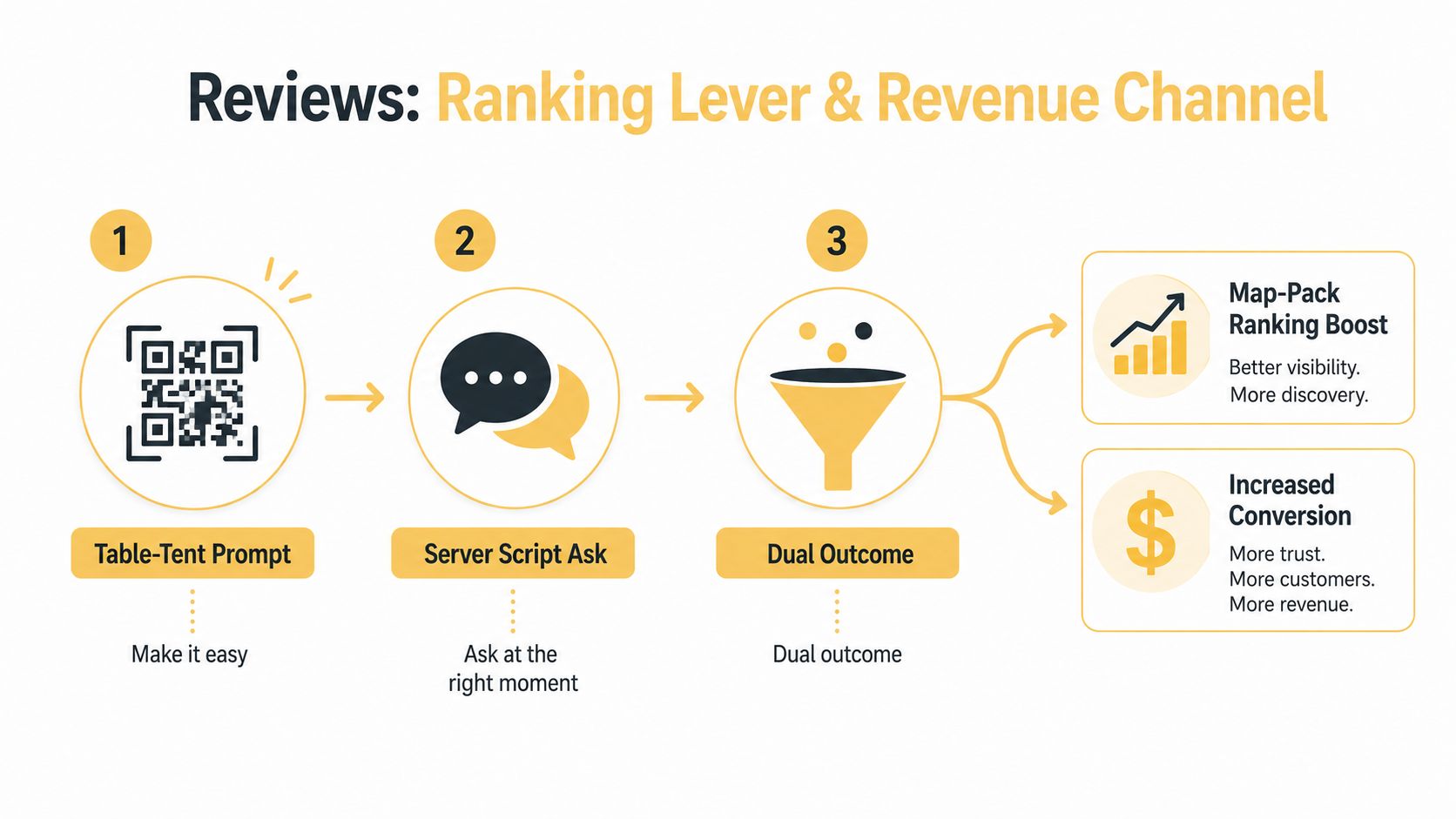
The best review prompts happen at the table, not in a random email blast days later. QR codes on table tents or on the check presenter make the ask easy. Servers can also use a short script after the check drops, when the guest has already had the meal and is in the right frame of mind to respond.
Make the ask operational
The floor manager should own the process, not marketing. That means the team needs a script, a timing rule, and a response standard.
- QR prompts: put them where guests naturally pause, like the check presenter or table tent.
- Server script: ask after the check drops, not while the entrée is still on the table.
- Response timing: answer reviews consistently, especially the ones that raise concerns.
- Fake or off-topic reviews: flag them fast and keep the response factual.
A useful response template is short and grounded in the visit. Thank the guest, mention one detail they referenced, and invite them back. For negative reviews, acknowledge the issue without arguing in public, then move the resolution offline. The guide on responding to negative reviews is a solid reference for keeping that process calm and professional.
The point isn't to chase volume for its own sake. It's to build a visible pattern of activity that reassures both search engines and prospective diners. A profile with recent, answered reviews looks alive. A profile with stale responses looks unattended, even if the food is excellent.
The last few reviews often do more selling than the homepage copy ever will.
That's why review generation and review response should live in the same workflow. One creates the signal, the other preserves the trust. Restaurants that treat them separately usually end up with either silence or chaos.
Local Content and Backlinks That Compound
Generic guest-post spam is a waste of a restaurant team's time. What works better is content that belongs to the neighborhood and gives another local business a real reason to mention you. The strongest links usually come from relationships that already exist, not from outreach templates sent in bulk.
A nearby hotel can link to your brunch page because its concierge recommends it. A food blogger can reference a signature dish because the story is worth covering. A charity event can earn local press pickup because the event supports something visible in the community. Those mentions build local relevance without sounding manufactured, and they can also send diners who are already close to booking.
Build assets a local writer can use
The easiest linkable pieces are the ones with a clear local hook. A seasonal dish story, a neighborhood map, or a collaboration with a nearby venue can all pull in citations and links if the angle is specific enough. A sponsored guide to the surrounding district works better than a generic “best of” roundup because it gives other sites something concrete to reference.
The AI-discovery angle matters here too. Restaurant SEO guidance is pushing harder toward HTML menus, dish-level schema, and strong photography because AI and visual systems need readable, structured content to understand the offer. The same guidance also points out that visual search is a meaningful part of local discovery, which makes the content format as important as the content idea itself.
A developer can implement the basics with a clean menu entry like this in concept, even if the actual code lives elsewhere:
- Dish name: the exact name used on the menu
- Description: ingredients and preparation in plain language
- Cuisine type: matched to the location page
- Location association: tied to the relevant restaurant page
- Image: a real photo of the plated dish
That structure helps both the crawler and the diner. It also gives local writers and partners something specific to cite instead of a vague restaurant brand name.
The best backlinks usually follow a useful local asset. Build the asset first, then earn the mention. A neighborhood map, a chef's seasonal story, or a venue partnership page gives people a reason to link because it solves a real local need.
Tracking, Reporting, and the 30-60-90 Day Launch Plan
If the reporting is built around vanity metrics, the strategy drifts. The metrics that matter are the ones tied to revenue actions, calls answered from map-pack listings, reservation clicks from GBP, online orders placed from organic search, and branded searches that rise after the work starts to compound. Those are the signals that tell you whether local visibility is turning into actual business.
A useful sprint gives the team a sequence instead of a pile of tasks. The first month is for foundation, the second is for activation, and the third is for compounding. That keeps operators from chasing shiny tactics before the basics are stable.
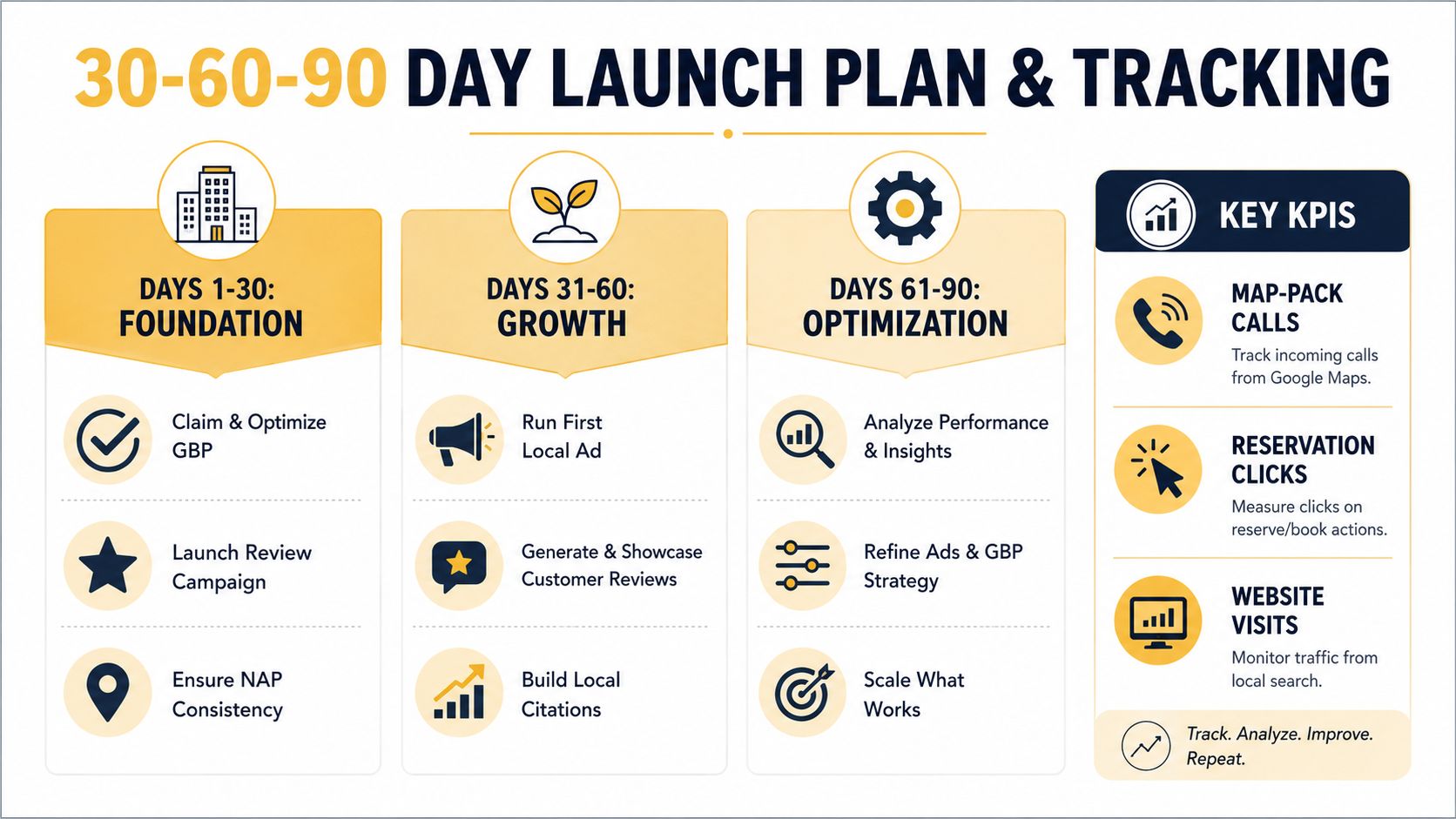
The sprint that keeps the work sane
Days 1 to 30, foundation. Claim and optimize GBP, clean up citations, add schema, and test mobile speed. Get the core page experience and listing data aligned before anything else.
Days 31 to 60, growth. Launch review prompts, publish GBP posts, and connect reservations or ordering so the visibility can turn into revenue. The listing starts behaving like a channel, not a profile.
Days 61 to 90, optimization. Earn local media mentions, publish one neighborhood-relevant asset, and track a short list of priority queries. The job here is to compound the early gains with real local authority.
The cleanest delegation sheet is simple. One person owns GBP, one owns the website, one owns reviews, and one owns the reporting. If one person owns all four, the process usually slips the moment service gets busy.
A restaurant local SEO program only works when someone owns the follow-through every week, not just the launch.
Keep the checklist short enough that a busy manager can use it. If the work can't be delegated, it won't survive the first rush of the season. If it can be delegated, it becomes a repeatable system instead of a marketing wish list.
If your restaurant needs local SEO that turns searches into tables, calls, and orders, Up North Media can help build the system and clean up the execution. Visit Up North Media to talk through GBP setup, conversion-focused website fixes, citation cleanup, and the kind of tracking that shows where diners are coming from.