
The most popular advice about generative engine optimization is to get your brand mentioned in AI answers. That's incomplete. A mention can be wrong, unattributed, or linked to a broken page, and a citation doesn't prove that a buyer chose you. For an Omaha business, the better goal is to be described accurately, credited to the right source, and connected to a measurable business outcome.
Generative engine optimization services should address attribution and accuracy before chasing citation counts. Visibility matters, but only when the answer represents your business correctly and gives the right customer a reason to take the next step.
Why Rankings Are No Longer the Whole Game
A strong search ranking doesn't guarantee that a customer sees your website. Google announced the rollout of AI Overviews in the United States on May 14, 2024, with “hundreds of millions” of people expected to have access during the initial launch week and a stated goal of reaching more than one billion people by the end of that year. Google later announced an international expansion across more than 100 countries and territories. Search results increasingly include generated answers, so a blue-link position and visibility inside the answer are different things.
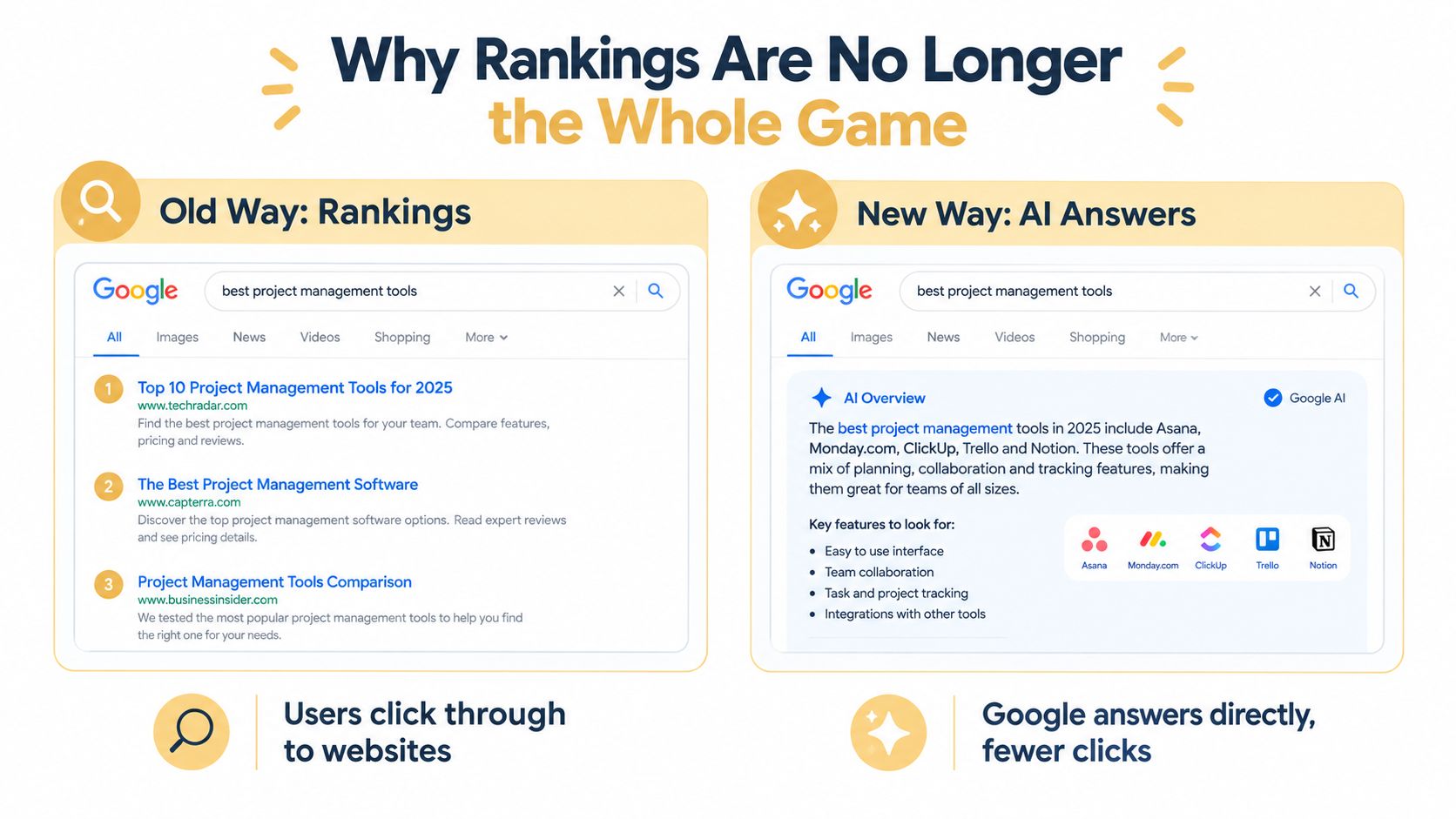
That change affects local service companies, e-commerce brands, and publishers in different ways. A customer asking for a nearby provider may see a synthesized recommendation before scanning websites. A shopper comparing products may receive a summary that shapes their shortlist. A publisher may find its reporting summarized, while readers never reach the original article.
Pew Research Center's analysis of Google searches from March 2025 found that users clicked a traditional search-result link on 8% of visits when an AI summary appeared, compared with 15% when it didn't. The study also found that 88% of AI summaries cited at least three sources, which means competing to be selected is only part of the challenge. Businesses also need to know whether the system identifies the right organization and points to the right page. Pew's analysis of clicks when AI summaries appear gives useful context for why citation visibility and website traffic shouldn't be treated as interchangeable.
For an overview of how people search across different discovery experiences, Captapi on search and discovery is a useful companion resource. The strategic point is simple: ranking is still useful, but accurate inclusion and attribution are now part of search visibility. A citation that misstates your service or leads nowhere isn't a win.
What Generative Engine Optimization Actually Is
Think of traditional SEO as making sure your restaurant appears on the map. Generative engine optimization, or GEO, is making sure an AI host describes the restaurant correctly when someone asks where to eat. The system needs to find reliable information, understand which business it describes, choose that information for its answer, and credit the source accurately.

Those requirements translate into practical work. First, make pages accessible and clear enough to be discovered. Then explain services, products, and locations in language that makes the business easy to distinguish from similar organizations. Support important claims with evidence, and make sure the official page can be cited without ambiguity.
GEO doesn't replace SEO. Search engines and answer systems still need content they can access and interpret, while customers still use conventional search results. GEO adds a sharper focus on selection, citation, and correct attribution. A page can rank in search and still be omitted from an AI answer, or appear in an answer with its facts attributed to someone else.
A useful definition: GEO is the discipline of earning correct, attributable mentions inside AI-generated answers.
That's the sentence a business owner can use to keep a service proposal grounded. If the work promises more mentions but says nothing about accuracy, source links, or business outcomes, it's missing important parts of the job. For another introduction to the field, CitationOS's generative engine optimization insights offer additional background.
How an AI Answer Is Built and Where GEO Fits
Consider an Omaha homeowner asking an AI assistant which local company can handle a particular home service. The answer doesn't appear because a business uses the right phrase on its website. The system has to locate usable information, connect it to the right company, decide whether it belongs in the response, and present it with a source.
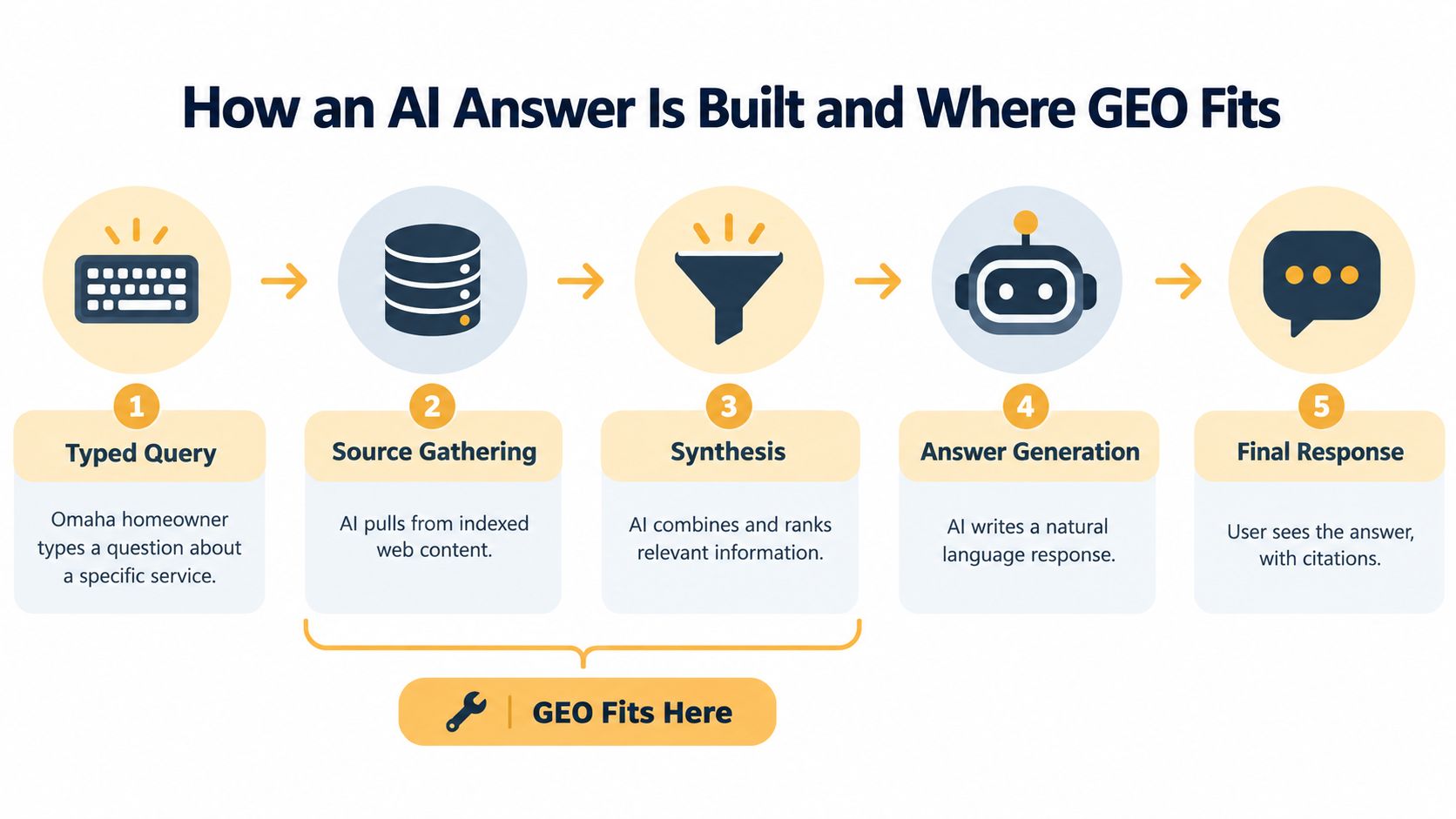
The journey has several points where careful optimization helps:
- The homeowner asks a question. The prompt may include a location, service type, and constraints. Clear service and location pages give the system a better chance of matching the query to the right business.
- The system gathers possible sources. Crawlability, indexation, and clear business identity matter here. Conflicting names, outdated service details, or incomplete pages can make a source harder to interpret.
- The system selects and synthesizes information. Direct answers, defined services, and supporting evidence make it easier to evaluate what a company does and where it operates.
- The answer presents recommendations and citations. Accurate source information and functioning official URLs help the user verify the claim and contact the business.
A useful way to think about GEO measurement is as a series of linked stages: discovery, selection, citation, citation prominence, incorporation into the answer, and any referral or conversion that follows. Improving one stage doesn't guarantee improvement in the next. A direct, useful answer may earn a citation but satisfy the user without sending them to the site.
A video can help illustrate how search systems assemble answers and sources:
The competitive point isn't to appear somewhere in an answer. It's to be selected for the relevant question, credited correctly, and useful enough that the right prospect knows what to do next.
The Core Components of a GEO Service
A real GEO engagement should produce more than an AI visibility report. It should address the pages and claims an answer engine can find, the evidence it can rely on, and the accuracy of what it tells potential customers.
Research summarized in GEO literature reports that adding verifiable statistics, credible citations, and relevant expert quotations increased source visibility by as much as 40% across tested queries. The result is not a guarantee for any particular company. It does support a practical recommendation: make important claims specific, supported, and easy to identify. See the GEO research paper for the reported finding.
| Component | Primary Deliverable | Signal It Moves |
|---|---|---|
| Content structure and quotable claims | Answer-first service pages, clear headings, and evidence-backed statements | Extractability and source selection |
| Entity clarity and structured data | Consistent business, service, and location details, supported by relevant schema | Discovery and entity understanding |
| Source authority and digital PR | Credible references and independent mentions that support expertise | Trust and citation potential |
| Prompt testing across engines | A repeatable set of buyer questions checked across AI answer platforms | Presence, citation position, and answer context |
| Attribution and accuracy monitoring | A record of source links, factual errors, and correction actions | Citation integrity and brand accuracy |
The technical details should serve the customer, not become a checklist detached from the business. For example, structured data can help clarify what a page describes, but it won't rescue vague service copy or inconsistent business information. Up North Media's guide to schema markup for SEO is a useful reference when assessing this part of a proposal.
Likewise, a prompt test should check more than whether the brand appears. It should record what the answer says, which URL it cites, whether the cited page works, and whether the information matches the company's actual offer. That turns an AI mention into something a team can inspect and act on.
When evaluating budgets and scopes, it can help to compare generative engine optimization pricing. Compare deliverables, not just headline fees. A monitoring-only package and an engagement that includes content improvements, accuracy checks, and conversion measurement aren't equivalent services.
Measuring GEO Without Fooling Yourself
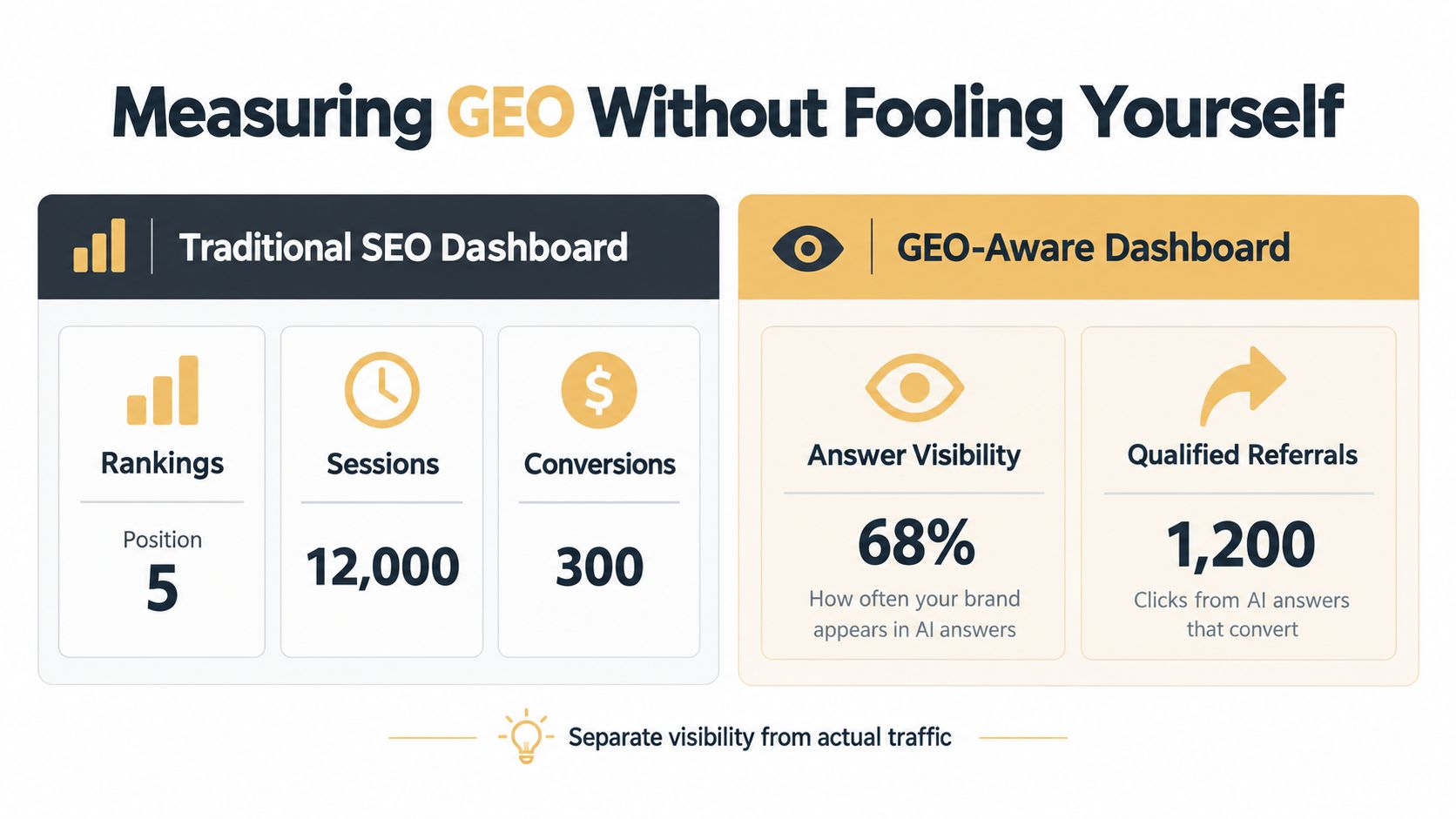
A traditional SEO dashboard commonly centers on rankings, organic sessions, and conversions attributed to a website visit. That remains useful, but it won't show the full role of an AI-generated answer. A buyer might encounter your business in an answer, search your name later, click a map listing, or call without visiting the cited page.
Pew's browsing study found that visits ended without further browsing on 26% of pages with an AI summary, compared with 16% of pages without one. That result is a reason to treat click-through traffic as an incomplete measure, not a reason to stop measuring it. The same study found that longer searches were more likely to produce an AI summary: 53% of searches containing 10 or more words did, compared with 8% of one- or two-word searches. These figures describe the study's observed searches, not a forecast for any individual business.
A GEO-aware report should separate three questions:
- Answer visibility: Does the brand appear for the prompts that matter, and is it represented accurately?
- Qualified referrals: Are people arriving from AI answers, and do those visits show meaningful intent?
- Assisted business outcomes: Do branded searches, calls, forms, or CRM records indicate that AI exposure may have played a role?
No single dashboard can prove that every lead came from a citation. Use tracking links where appropriate, monitor calls and forms, compare branded-search patterns, and ask new customers how they found you. For larger campaigns, controlled comparisons between similar pages can provide additional evidence, but results still need cautious interpretation.
If a campaign can't tell you whether it changed answer selection, qualified referrals, and business activity, it isn't measuring GEO well. It's relabeling familiar SEO metrics.
The right standard is transparent reporting: show what was observed, what can't be attributed confidently, and which decisions the evidence supports.
What This Looks Like for Local Businesses and Publishers
A local services company and a digital publisher may both want accurate AI citations, but their business goals aren't the same. A service company wants qualified customers to contact the right location. A publisher may need readers to reach original reporting rather than consume an unattributed summary.
For a multi-location Omaha service business, the practical work starts with location pages that clearly state what each office serves and which services it provides. Put the direct answer near the top, use consistent location and service descriptions, and make it easy to distinguish one branch from another. Then check whether AI answers cite the official location page or rely on stale listings and third-party summaries.
A local SEO audit can help surface gaps in local business information before an AI visibility review begins. The important question isn't just whether a business appears. It's whether the system directs a prospective customer to the correct service area and a reliable way to get in touch.
A digital publisher has a different priority. Original reporting, clear bylines, publication dates, and careful syndication practices help establish which page is the primary source. If another site republishes the article, the publisher should review whether the original remains clearly identifiable and whether the important claims still point back to the original reporting.
Those two scenarios call for different measures. A local business might care most about accurate service details, relevant calls, and qualified inquiries. A publisher might focus on attribution to original articles, functional source links, and referral quality.
Treat GEO as a set of decisions adapted to the business model, not a standard package of content changes. The same citation count can represent a good result for one organization and a poor one for another.
Citation Accuracy Is the Real GEO Differentiator
More mentions aren't automatically better. If an AI answer associates your company with the wrong service, confuses it with another organization, or sends users to a broken URL, visibility may damage trust instead of building it.
A Columbia Journalism Review Tow Center test of eight generative search tools analyzed 1,600 queries and found that the systems produced incorrect answers in more than 60% of cases. The test also found examples of fabricated or broken links and citations to syndicated copies instead of original publishers. Those findings concern the tools tested, but the risk is directly relevant to any business whose name, claims, or URLs appear in generated answers. The Tow Center's citation test provides the details.
Use a practical accuracy audit:
- Build a representative prompt set. Include real customer questions about services, products, locations, comparisons, and qualifications.
- Check source preference and link health. Record whether the answer uses an official page, a third-party description, a syndicated copy, or a broken URL.
- Log factual errors. Compare statements about your business with current, approved information. Note what's wrong and where the answer appears.
- Set a remediation cycle. Correct your own pages, address inconsistent third-party information where possible, and retest prompts on a regular schedule.
The audit should distinguish between errors your site can fix and errors created elsewhere. A company can improve its own pages and make its official information clearer, but it can't directly control every generated answer or external source. That's why a useful report records both the error and the practical next action.
For guidance focused on Google's AI search experience, Up North Media's article on how to optimize for AI Overviews provides a relevant starting point. When reviewing an agency's offer, ask for an accuracy deliverable: prompt examples, source checks, a factual-error log, and a remediation plan. A visibility report without those checks can count the exposure while missing the risk.
What to Decide This Week About GEO
Don't start by buying a dashboard. Start by deciding what a good AI answer needs to get right about your business.
Write down the questions buyers ask before they choose a provider, product, or publisher. Be specific about location, use case, service scope, and the information that separates your offer from a competitor's. Those prompts become a practical test set, not a list of keywords chosen to inflate a report.
Next, inspect how AI answers those questions today. Record whether your business appears, whether the description is accurate, which source gets cited, and whether the link works. Then agree on what counts as a business result: a qualified referral, a call, a form submission, a sale, or an assisted conversion. If the team can't agree on that definition, a citation increase won't settle whether the work is worthwhile.
Choose one part of the work to address first. A business with unclear location pages may need to fix those before buying wider monitoring. A publisher with strong articles but weak original attribution may need to review bylines and syndication. A company with accurate content but no visibility data may start with prompt testing.
Make the first objective accuracy. Optimize to be cited correctly before you optimize to be cited more.
Take these decisions into your next planning meeting and assign an owner to each one. That turns GEO from a debate about AI hype into a manageable search and measurement program.
Up North Media offers SEO and AI consulting, including AEO visibility audits and work to make business information easier for answer engines to discover, understand, and cite. If you want a practical review of your AI answers, attribution, and conversion measures, visit Up North Media to discuss a plan aligned with your business.