
The most popular advice about AI Overviews is also the least useful: “Keep doing traditional SEO and hope for the best.” Ranking in the blue links still matters, but it no longer answers the more important question, which page will Google choose to quote?
That distinction changes the work. A page can rank well and remain uncited, while a clearly structured, evidence-backed page earns a source link inside the summary. Seer Interactive found that cited pages earned 120% more organic clicks per impression than pages appearing for the same search without a citation. Uncited pages received about 9,445 clicks per million impressions, compared with 20,743 for cited pages, according to Seer Interactive's AI Overview traffic analysis.
The practical objective, then, isn't just to rank in AI Overviews. It's to engineer citation-worthiness, the combination of clarity, evidence, structure, and entity context that makes your page easy to extract and safe to reference. This is the working difference between conventional SEO and answer engine optimization.
Why AI Overviews Change the SEO Playbook
AI Overviews changed the search result from a list of destinations into a synthesized answer with supporting sources. Google launched AI Overviews in the United States on May 14, 2024, expanded the feature to six additional countries on August 15, 2024, and reached more than 100 countries and territories by October 28, 2024, as documented in Google's rollout announcement. That rapid expansion made internationally understandable content relevant across major markets, not only English-speaking ones.
A conventional SEO strategy asks whether a page can reach a strong organic position. An AI Overview strategy asks whether the page contains a precise, defensible passage that can support part of Google's answer. Those are related goals, but they aren't identical.
Practical rule: Don't make the algorithm reconstruct your answer from a long introduction, vague claims, and scattered evidence.
The traffic trade-off is real. A randomized field experiment found that AI Overviews reduced organic clicks to external websites by 38% on queries where they appeared, while user satisfaction stayed nearly unchanged when the summaries were removed, according to Search Engine Journal's report on the field experiment. That result supports a cautious response, not a panic response. Some clicks disappear because the summary satisfies the query, but citation status can materially affect the clicks that remain.
Ranking is only the entry requirement
A page that ranks below the overview may still receive impressions without being part of the answer users read first. A cited page has a different role. It becomes evidence within the answer, giving the brand an opportunity to earn both visibility and a qualified visit.
That means long-form content needs a different rhythm. Context still matters, but it should follow the answer rather than delay it. Marketing copy should support the explanation, not replace it. Definitions, comparisons, process steps, and sourceable claims should be visible in the HTML and understandable without interpretive effort.
The global rollout also raises a localization standard. Use plain language, define specialized terms, identify products and organizations consistently, and avoid relying on idioms that lose meaning across markets. Structured content helps both search systems and readers who scan rather than read every paragraph.
Citation-worthiness requires editorial discipline
AI systems need to connect a claim with an identifiable source, entity, and context. A sentence such as “our platform transforms reporting” offers little that can be safely summarized. A sentence that defines the reporting method, identifies what it measures, and explains when it should be used gives the system a much clearer extraction target.
The strongest pages don't hide their main point behind brand positioning. They answer directly, demonstrate why the answer is reliable, and make the next decision easier. That's the playbook shift. You're still competing for rankings, but you're also designing passages that Google can quote accurately.
Formatting Content to Earn Direct Citations
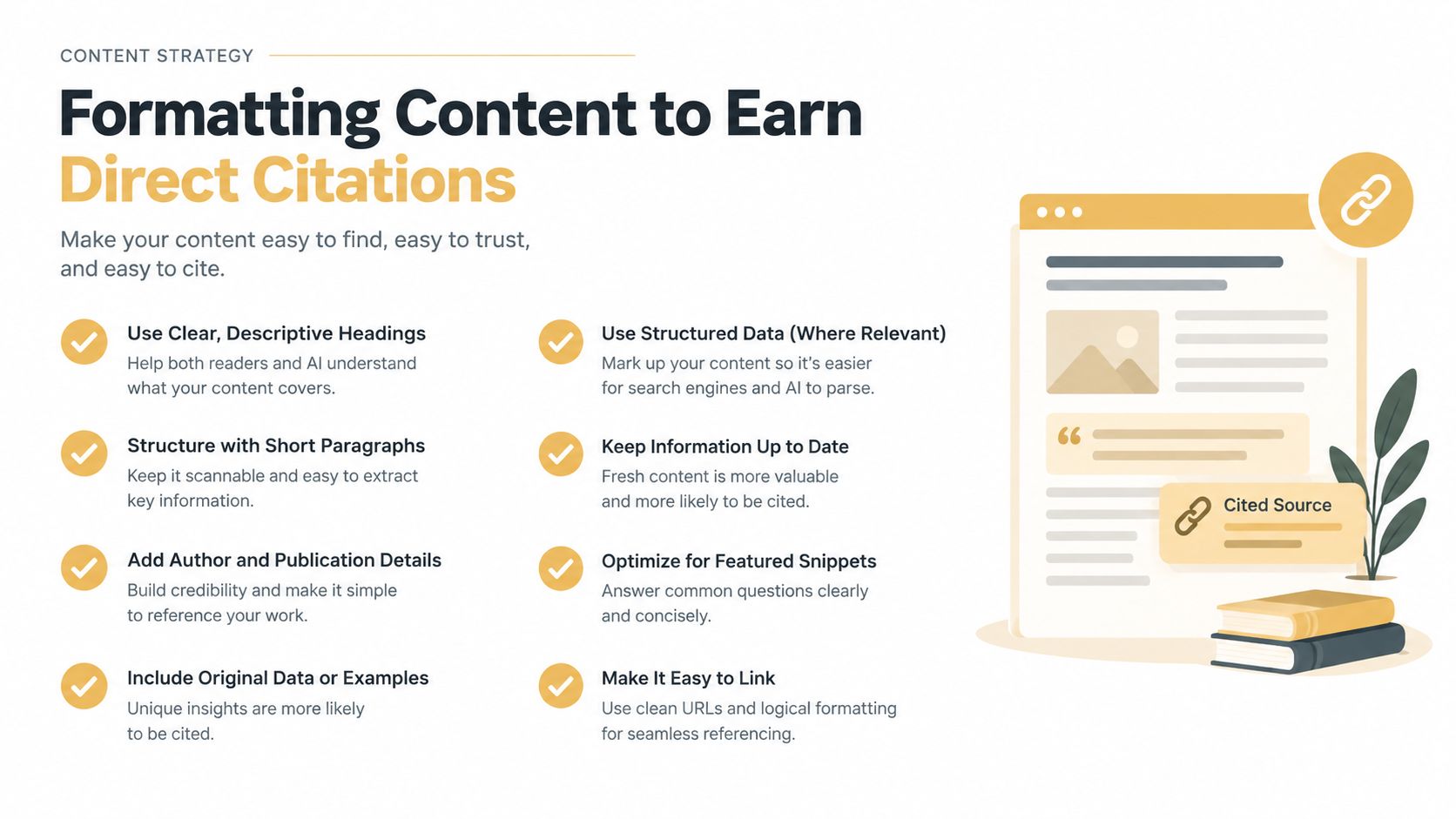
The most reliable content format is answer first, evidence second, conversion path third. Put the direct response near the top of the page, then explain the reasoning, limitations, examples, and next action. This gives search systems a compact extraction target while preserving enough depth for readers who need more than a summary.
A practical page sequence looks like this:
- Lead with a definitive answer. Open with a concise paragraph that resolves the primary query. Define the subject, state the recommendation, or identify the relevant distinction.
- Use descriptive subheads. Write headings as questions or claims that make the section's purpose obvious. “How does schema clarify product context?” is stronger than “Additional considerations.”
- Keep one idea per paragraph. Short paragraphs reduce ambiguity and make individual claims easier to isolate.
- Break processes into numbered steps. Sequential instructions should appear in the order a user would follow them.
- Name entities precisely. Identify the product, organization, author, method, or source connected to each important statement.
- Add supporting evidence immediately after the claim. Don't force readers or systems to search the page for the qualification.
Build extractable answer blocks
An answer block should stand on its own if copied out of context. Start with a direct sentence, add a short explanation, and then include a qualification where necessary.
For example, a page about canonical tags could begin with a definition, explain the duplicate-content problem they address, and distinguish canonicalization from redirects. The section shouldn't start with the company's history or a broad statement about digital transformation. Those details may help conversion later, but they don't answer the query.
Bold text can help readers locate the important phrase, but formatting alone won't create authority. Use bold selectively for definitions, decision criteria, and terms that deserve attention. Don't bold entire paragraphs or turn every sentence into a visual signal.
Make evidence easy to verify
Sourceable content includes concrete names, dates where relevant, methodological boundaries, and links to authoritative documentation. It also separates facts from recommendations. A sentence stating what a tool does should not blur into a sentence claiming what every business should do.
Tables work well for comparisons because they align a concept, attribute, and implication in a compact structure. Lists work well for procedures. Prose works better for nuance, trade-offs, and exceptions. Use the format that matches the information instead of forcing every page into a blog template.
For teams that need broader guidance on representing expertise in generative search, AI search visibility for founders offers a useful complement to the page-level formatting practices above.
Don't bury the answer under conversion copy
A hero section with a vague promise, several promotional paragraphs, and an oversized form may look polished, but it delays the information users searched for. Put the commercial invitation after the explanatory block. Product and service pages can still convert, but they should first establish what the offering is, who it serves, how it differs, and what decision it supports.
The field experiment cited earlier makes this structure more urgent. When an overview satisfies more of the query, the remaining click is likely to go to a source that offers a clear reason to continue. Your page needs to earn that click by making the quoted answer accurate and the deeper experience worthwhile.
Adding Structured Data to Clarify Context
Visible formatting tells readers how information is organized. Structured data tells search systems what the information represents. It can clarify whether a page is an article, a product, a procedure, an organization profile, or a review, while connecting related entities such as the author, publisher, brand, and subject.
That context matters because generative summaries don't only match words. They need to understand relationships. A product name should connect to its brand, attributes, availability, and category. An article should connect to its author, publisher, publication date, and main topic. A procedure should connect to ordered steps and the result those steps produce.

Choose markup that matches the page
Use schema according to the page's actual purpose:
- Article schema identifies editorial content and can connect the article to its author, publisher, headline, image, and dates.
- HowTo schema describes a genuine procedure with ordered steps. The visible page should contain the same steps as the markup.
- Product schema clarifies a product's name, brand, description, and relevant attributes. It should describe the product users can see and evaluate.
- Organization schema helps associate a business with its name, logo, website, and other identifiable information.
- BreadcrumbList schema describes the page's position within the site hierarchy, which can reinforce category and product relationships.
FAQ markup should support real, visible questions and answers. Adding a large collection of invented questions just to create more markup produces weak context and can create a mismatch between the page and its structured representation.
For a deeper technical reference, see schema markup for SEO, particularly when deciding how visible HTML and JSON-LD should correspond.
Connect entities instead of adding isolated labels
Nested JSON-LD can create a clearer model of the page. An article can identify its author as a Person, its publisher as an Organization, and its subject as a defined entity. A product can connect the item to its brand and offer information. The exact fields depend on the content, but the editorial principle stays consistent: every marked-up relationship should reflect something a user can verify on the page.
Don't use schema as a substitute for content quality. Markup can't make an unsupported claim trustworthy, turn a thin product description into a buying guide, or correct contradictory information. It can clarify context after the page has earned that context through useful content.
The implementation also needs technical hygiene. Validate the JSON-LD, keep names and dates consistent, remove obsolete properties, and review templates after major site changes. A schema deployment that describes the wrong page type can create confusion rather than clarity.
Structured data works best alongside semantic HTML. Use headings for hierarchy, lists for procedures, tables for comparisons, and descriptive link text for supporting resources. The markup should confirm the visible structure, not invent a second version of the page.
A visual explanation can help teams connect the technical layer with the editorial layer:
Review the rendered page as a user would. If the article says one thing, the schema says another, and the metadata names a third entity, no implementation trick will resolve the underlying inconsistency.
Aligning Pages with Shifting Search Intent
AI Overviews began primarily around informational searches, but that boundary has weakened. Semrush reported informational intent declining from 91.3% of AI Overview-triggering queries in January to 57.1% in October, while navigational intent rose from 0.74% to 10.33% over the same period, according to the Semrush AI Overview study.
The implication is straightforward. A strategy built only around educational blog posts leaves commercial and branded opportunities exposed. Product pages, category pages, comparison pages, and service pages now need to help users learn and decide within the same experience.
Build for learn-and-buy behavior
A commercial page should answer the questions that appear before a transaction. That doesn't mean turning every page into a generic buying guide. It means identifying the decision points specific to the product or service.
A useful structure might include:
- Definition: What is the product or service, and what problem does it address?
- Fit: Who should use it, and who may need a different solution?
- Comparison: Which alternatives matter, and where does each option perform well?
- Evaluation: What features, constraints, integrations, or requirements affect the choice?
- Decision support: What should the buyer do next, and what information should they prepare?
A category page for accounting software, for example, shouldn't stop at a grid of product names. It can explain the category, distinguish use cases, compare capabilities, and answer implementation questions. That gives Google more useful passages to synthesize and gives buyers a reason to visit the page after reading the overview.
Match structure to intent, not just keywords
Informational pages benefit from definitions and stepwise explanations. Commercial pages need comparisons, eligibility criteria, and transparent limitations. Navigational pages should make the brand, product, location, or service relationship unmistakable.
Avoid forcing one article to satisfy every intent. A broad explainer may attract discovery searches, but a separate comparison page can provide cleaner evidence for a buyer evaluating alternatives. Internal links should connect these assets so users and search systems can follow the topic from education to decision.
The expansion into navigational searches also makes brand consistency more important. Use the same official product names, company descriptions, and service terminology across key pages. Inconsistent naming makes it harder to establish which entity a passage describes.
Write decision support that survives summarization
AI-generated answers often compress several stages of research into a short response. Your content should therefore state the decision criteria explicitly rather than relying on implication. Explain why a feature matters, what constraint it addresses, and which user should prioritize it.
This approach also protects against a common failure mode: optimizing a commercial page like a top-of-funnel article. A page can be informative without becoming noncommercial. The strongest pages explain the choice clearly, acknowledge trade-offs, and place a relevant next step where a high-intent reader can act.
Measuring Citation Visibility and Traffic Impact
Traditional rank tracking shows where a page appears in blue-link results. It does not show whether Google selected that page as evidence for an AI Overview. Measure ranking visibility, citation visibility, and business value separately because they describe different outcomes.
Citation visibility records whether a page appears as a linked source inside an AI Overview. Ranking visibility records its position in standard results. Business value measures whether that exposure leads to a meaningful action, even when fewer users click through.
Seer Interactive found that cited pages earned 120% more organic clicks per impression than uncited pages appearing for the same search. Its analysis reported about 9,445 clicks per million impressions for uncited pages and 20,743 for cited pages, as detailed in the cited versus uncited traffic analysis. Treat that comparison as directional evidence, not a site-wide forecast.
Use a page-level measurement model
Create a query and URL set that records four signals: whether an AI Overview appears, whether your page is cited, where the page ranks, and what users do after visiting. Search Console and analytics may not expose every AI-specific distinction consistently, so keep an observation log alongside standard reporting.
| SERP Status | Clicks per Million Impressions | Strategic Focus |
|---|---|---|
| No AI Overview | 33,500 | Protect direct organic clicks and improve conversion paths |
| AI Overview, cited page | 20,743 | Earn and retain citations while supporting qualified visits |
| AI Overview, uncited page | 9,445 | Improve citation-worthiness before pursuing more traffic |
The table uses the traffic outcomes reported by Seer Interactive. Compare your own pages against the pattern rather than treating these figures as expected performance.
Track changes at the page and query level. A citation can persist while rankings move, or rankings can remain stable while citation visibility disappears. Those changes require different responses, such as revising evidence and passage structure for citation loss, or addressing relevance and technical issues for ranking loss.
Assign each page a primary job
Page goals should determine how you interpret exposure. An informational guide may prioritize citation and brand authority. A product page may prioritize fewer, higher-intent visits and assisted conversions. A branded service page may need clear navigational signals and an easy path to contact or evaluation.
A click decline is serious for a page built primarily for acquisition. It may be acceptable for a page that supplies a cited definition and strengthens branded consideration elsewhere in the funnel.
Track assisted conversions, branded searches, engaged sessions, and qualified leads alongside clicks. A page with fewer visits can produce better commercial results when those visitors understand the problem and match the offer.
Use analytics implementation guidance to define events and reporting workflows consistently. The measurement system should connect search exposure with a business action, not stop at the SERP.
Adapting Your SEO Strategy for Long-Term AI Search
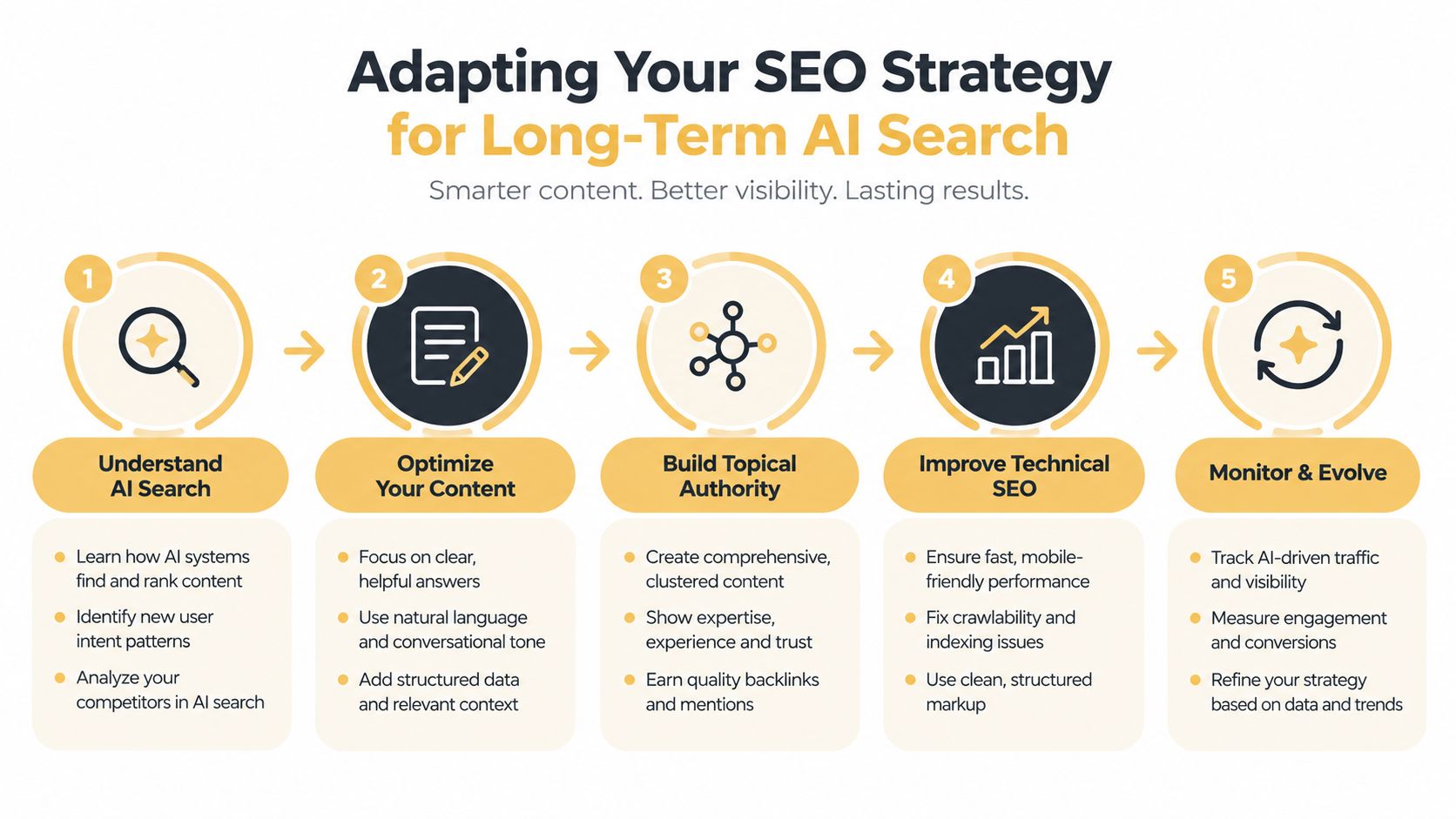
AI Overview optimization isn't a one-time schema deployment or a rewrite performed after a traffic dip. Search presentation changes, competitors improve their source pages, and Google may select different evidence as the query context changes. Treat citation-worthiness as an operating discipline.
The available traffic evidence supports that approach. Ahrefs found AI Overviews correlated with a 58% lower average CTR for the top-ranking result in December 2025, while Seer Interactive later found CTR on AI Overview queries rebounded from 1.3% in December 2025 to 2.4% in February 2026, an 85% increase in two months, according to the reported analysis of changing Google CTR patterns. The market isn't behaving like a fixed traffic-loss event.
Establish a recurring audit cycle
Start with pages that matter commercially and pages that already attract relevant impressions. Review whether the opening answer is still accurate, whether claims have clear support, whether the headings match current user questions, and whether the page still reflects the product or service.
Then compare cited and uncited pages covering similar queries. Look for structural differences, not only backlink differences. The cited page may define entities more clearly, answer the query earlier, present a cleaner comparison, or provide evidence competitors don't make easy to verify.
Test structure, not just headlines
A useful test can compare two answer formats:
- A concise definition followed by supporting explanation.
- A short decision summary followed by a comparison table and implementation details.
Keep the underlying claim stable so the test measures presentation rather than a change in factual substance. Record citation appearance, qualified organic visits, engagement, and conversions. Don't declare success from a temporary visibility change.
Review technical foundations during the same cycle. Confirm important pages remain crawlable, indexable, internally linked, mobile-friendly, and aligned with their structured data. A perfect answer block can't help if the page is inaccessible or the markup describes a different entity.
Combine organic and paid decision-making
Some pages should earn citations, while others should be designed to capture demand directly. Paid search can provide control during volatile periods, especially for commercial queries where a qualified visit has clear value. Teams evaluating that balance may find Advisor Momentum paid search useful as a reference for connecting search visibility with acquisition planning.
The long-term workflow is simple to state, even if it requires consistent execution: identify valuable queries, make the answer extractable, support it with evidence, clarify entities with accurate markup, observe citation status, and refine the page based on business outcomes. That's how to optimize for AI Overviews without abandoning the fundamentals that make a site useful to people.
Up North Media offers SEO marketing, AI consulting, and AEO audits that evaluate visibility across Google AI Overviews and other answer engines. Visit Up North Media to discuss a structured content and measurement plan for your business.