
You publish a carefully researched article, watch impressions remain steady, and still notice fewer visits from search. Your rank tracker shows no obvious problem, yet an AI answer now summarizes the topic before a prospect reaches your page. The missing explanation is often AI search visibility, not a conventional ranking decline.
AI search optimization helps answer engines discover, retrieve, understand, trust, and cite your content. It builds on the historical foundation of Generative Engine Optimization, formally introduced in the paper “GEO: Generative Engine Optimization”, first posted to arXiv on November 16, 2023. The original framework evaluated strategies across roughly 10,000 queries and found that adding statistics, citations, and quotations could improve visibility in generative responses by up to 40%.
The discipline matters because AI-driven answer layers are already changing how people encounter businesses. AI platforms generated more than 1.1 billion referral visits in June 2025, a 357% year-over-year increase, while Google AI Overviews reached 2 billion monthly users and appeared in about 13.14% of U.S. desktop searches by March 2025, according to AI search statistics compiled by Click Vision.
What AI Search Optimization Actually Means
AI search optimization is the practice of making your content discoverable, retrievable, and quotable inside systems such as ChatGPT, Perplexity, Gemini, and Google AI Overviews. Traditional SEO asks how to help a page appear in a search result. AI search optimization asks a broader question: can an answer engine find your information, judge it as useful evidence, and reuse it accurately in a response?
That creates three practical jobs:
- Enter the candidate set. Search systems must be able to crawl, index, and retrieve your page for the relevant question.
- Earn enough trust to be cited. Your claims need clear evidence, identifiable sources, and an entity that the system can understand.
- Provide clean language for synthesis. A model should be able to extract a passage without guessing what you mean or separating a claim from its qualification.
A page can succeed at one job and fail at another. Your site may be technically accessible but absent from the retrieved set. It may be retrieved but lose during reranking because competing sources offer stronger corroboration. It may be selected but omitted because its key claim is buried in vague marketing language.
The four outcomes that matter
A useful working model connects optimization to four business outcomes:
- A clearer pipeline model, from search activation through retrieval and citation.
- Stronger on-page evidence, including sourced statistics, definitions, quotations, and structured passages.
- Compounding external authority, built through credible third-party mentions and consistent entity information.
- More honest measurement, separating visibility in answers from traffic, leads, and revenue.
Treat this guide as a working playbook. You don't need to redesign every page at once. You need to identify where your content loses probability in the pipeline, then improve the specific evidence or access problem responsible.
How AI Search Differs from Traditional SEO
Think of a traditional search engine as a library with a card catalog. SEO improves the catalog entry so a visitor can find the right shelf, select the page, and decide whether to click. AI search optimization helps write the paragraph the librarian reads aloud after reviewing several books.
That distinction changes the competitive unit. Classic SEO often focuses on a page competing for a position among many results. AI search optimization focuses on whether a source contributes to a single synthesized answer, sometimes alongside only a small set of citations.
| Dimension | Traditional SEO | AI search optimization |
|---|---|---|
| Primary goal | Rank a page for a query | Earn inclusion and citation in an answer |
| Unit of competition | Search results and page positions | Evidence competing within a synthesized response |
| Relevance signal | Keywords, links, intent, and page quality | Retrieval probability, semantic fit, source agreement, and evidence clarity |
| Output format | Title, URL, and meta description | Extracted claims, quoted passages, and citation links |
| Success metric | Rankings, impressions, and click-through rate | Citation frequency, answer inclusion, referral quality, and assisted conversions |
The ranking metaphor breaks down because an answer engine treats sources as probabilistic evidence, not only as discrete results. A page does not rank at position four and wait for a click. The system may retrieve it, compare it with other sources, allocate context to one passage, and then decide whether its claims are safe to include.
What changes for marketers
A page that wins conventional rankings without earning citations can become practically invisible inside an answer layer. The reverse can also happen. A focused, authoritative passage may contribute to an answer even when the page isn't the strongest traditional result for the entire topic.
Practical rule: Optimize the page for discovery, then optimize each important passage for independent understanding and attribution.
That means using clear headings, direct definitions, identifiable authorship, and evidence placed close to the claim it supports. Traditional SEO still matters because answer systems often depend on searchable, indexable content. But it no longer describes the entire visibility problem.
The Pipeline Behind Every AI Answer
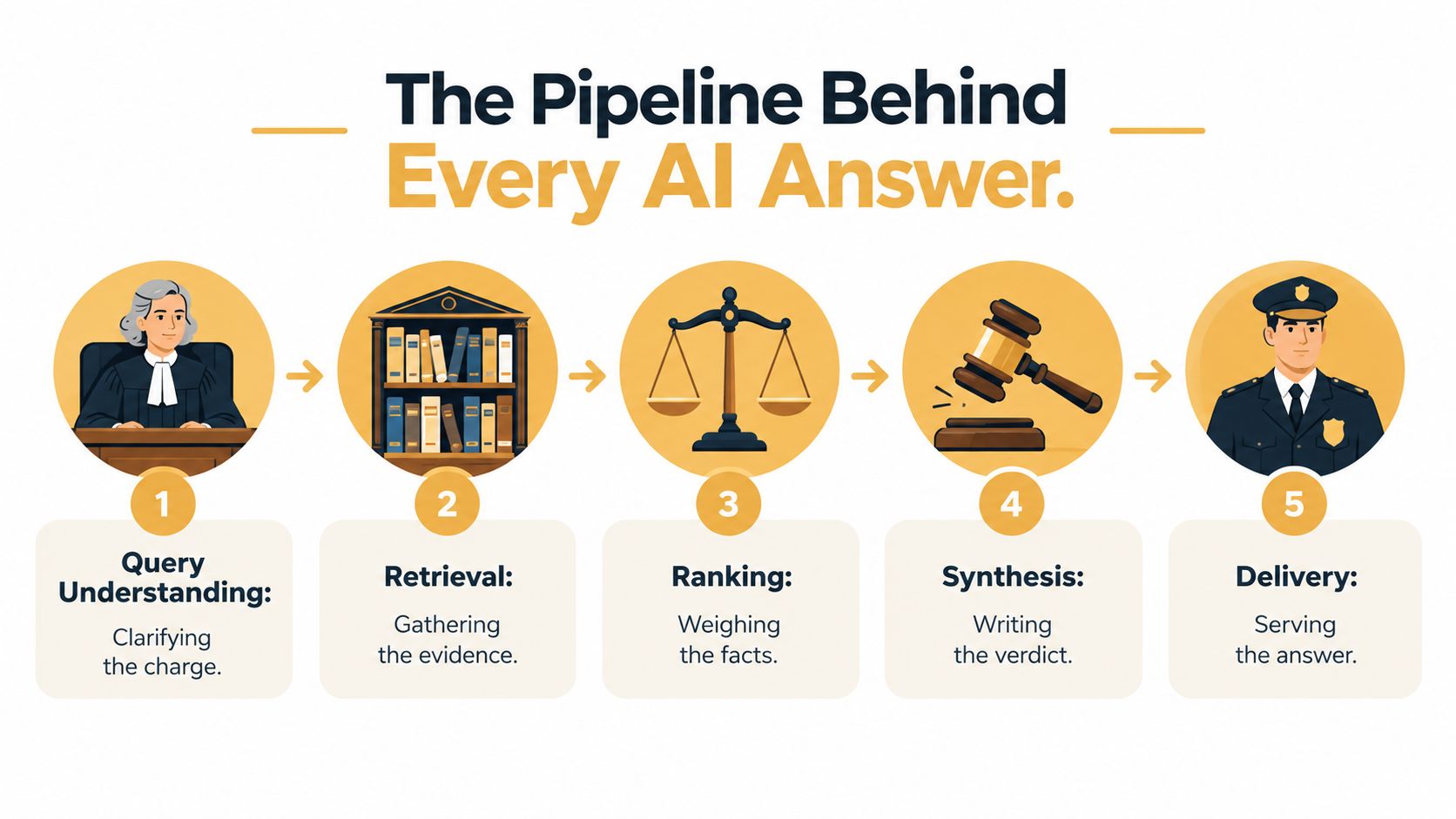
AI search optimization works best when you treat an answer as the output of a chain rather than a page ranking event. A recent survey describes that chain as a stochastic pipeline involving activation, crawling and indexing, retrieval, reranking, context allocation, citation, prominence, factual absorption, fidelity, and user behavior. Its survey of the generative engine optimization pipeline makes the operational point clear: a failure at any stage can suppress visibility even when the underlying article is well written.
Five stages to inspect
Query understanding is the judge clarifying the charge. The system interprets the user's words, intent, entities, location, urgency, and implied subquestions. A page about “business automation” may be filtered out when the user needs workflow software for a specific industry.
Retrieval is the archive search. The engine gathers potentially relevant pages from its available indexes or connected search sources. Robots directives, indexation problems, weak internal linking, unclear terminology, and missing entity relationships can keep a useful page out of the evidence pool.
Reranking is the jury weighing the files. Retrieved pages compete on topical relevance, authority, freshness, source agreement, and passage usefulness. A general article may lose to a narrower page that answers the exact question with stronger documentation.
Synthesis is the argument assembled from the record. The model selects and combines passages into a natural response. Dense paragraphs, ambiguous pronouns, unsupported claims, and promotional wording make the source harder to reuse accurately.
Citation is the footnote read aloud. The engine must connect a claim to a source and preserve enough fidelity that the citation supports what the answer says. Missing attribution, unclear authorship, or evidence separated from the relevant statement can remove a source at the final step.
Reduce variance instead of chasing one lever
The pipeline explains why no single tactic guarantees visibility. A page can have excellent schema and poor retrieval. It can have strong backlinks and weak passage structure. It can be cited for one prompt and ignored for a closely related prompt because the engine activates a different evidence path.
Audit these areas together:
- Access: Can search systems crawl and index the relevant page?
- Entity clarity: Does the page clearly identify the business, author, product, topic, and relationships?
- Passage structure: Can each section answer a narrow question without relying on hidden context?
- Evidence quality: Does each important claim have a verifiable source or clearly described basis?
- Citation readiness: Can a system attribute the passage without reconstructing your meaning?
This is a risk-reduction discipline. You aren't trying to control a model's hidden ranking formula. You're making your content easier to retrieve, evaluate, quote, and verify at every observable stage.
Signals That Move AI Visibility
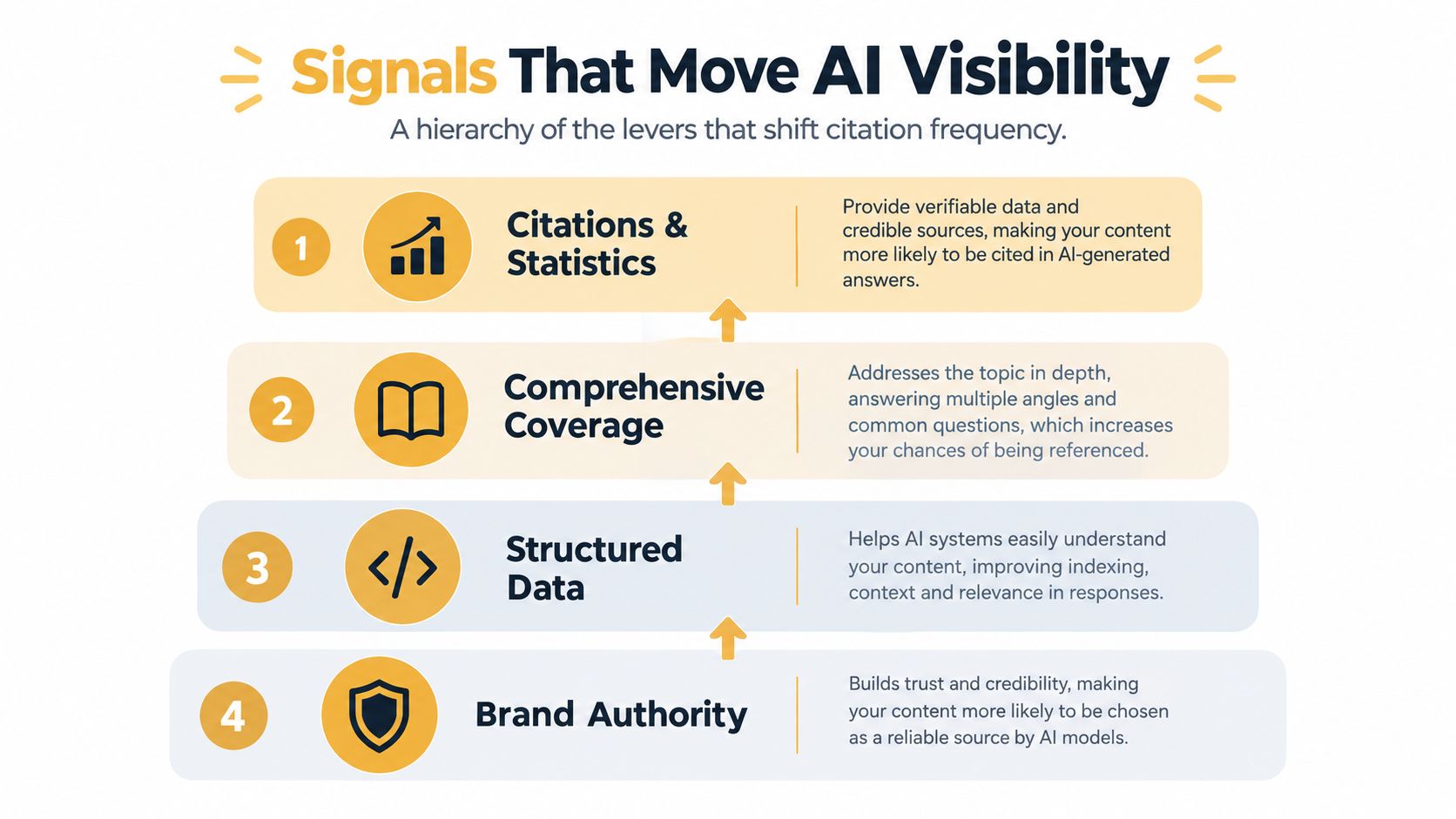
The strongest practical signals fall into three groups: content evidence, structural clarity, and external proof. They don't all influence the same outcome. Evidence-rich passages may help citation frequency, while broader topical coverage may improve the chance of being retrieved for related questions. Treating every signal as a generic ranking factor leads to wasted effort.
Controlled experiments in the original GEO research found that the strongest methods, particularly source citations, added quotations, and added statistics, produced a 30% to 40% relative improvement on Position-Adjusted Word Count and a 15% to 30% improvement on Subjective Impression. The published GEO paper provides the experimental context.
Content evidence
Write claims that an answer engine can verify. Use original research where you have it, named experts with relevant credentials, precise definitions, sourced statistics, and examples that show how a principle works. Put the source close to the claim rather than collecting every reference at the bottom of a long page.
A sentence such as “our method improves performance” gives a model little usable evidence. A sentence that identifies the method, the measured outcome, the context, and the source is easier to ground. Don't add numbers for decoration. Add them when they clarify a decision and can be checked.
Structural clarity
Use headings that match the questions your audience asks. Build FAQ sections when they answer related questions, add appropriate schema markup, identify authors and reviewers, and write short passages that remain understandable when extracted from the page around them.
Semantic research can help you map related concepts and subquestions. The guide to semantic keyword research is useful when a page needs stronger coverage without turning into a list of disconnected keywords.
External proof
Answer systems also encounter your brand through the wider web. Relevant third-party publications, accurate business profiles, reviews, expert interviews, reputable backlinks, and consistent descriptions help establish whether your organization is a recognizable entity in its field.
External proof isn't a substitute for a useful page. It strengthens the context around the page and can help a system distinguish a specialist source from an unverified promotional claim.
Make every important claim easy to retrieve, easy to verify, and easy to quote.
A Worked Example From Query to Citation
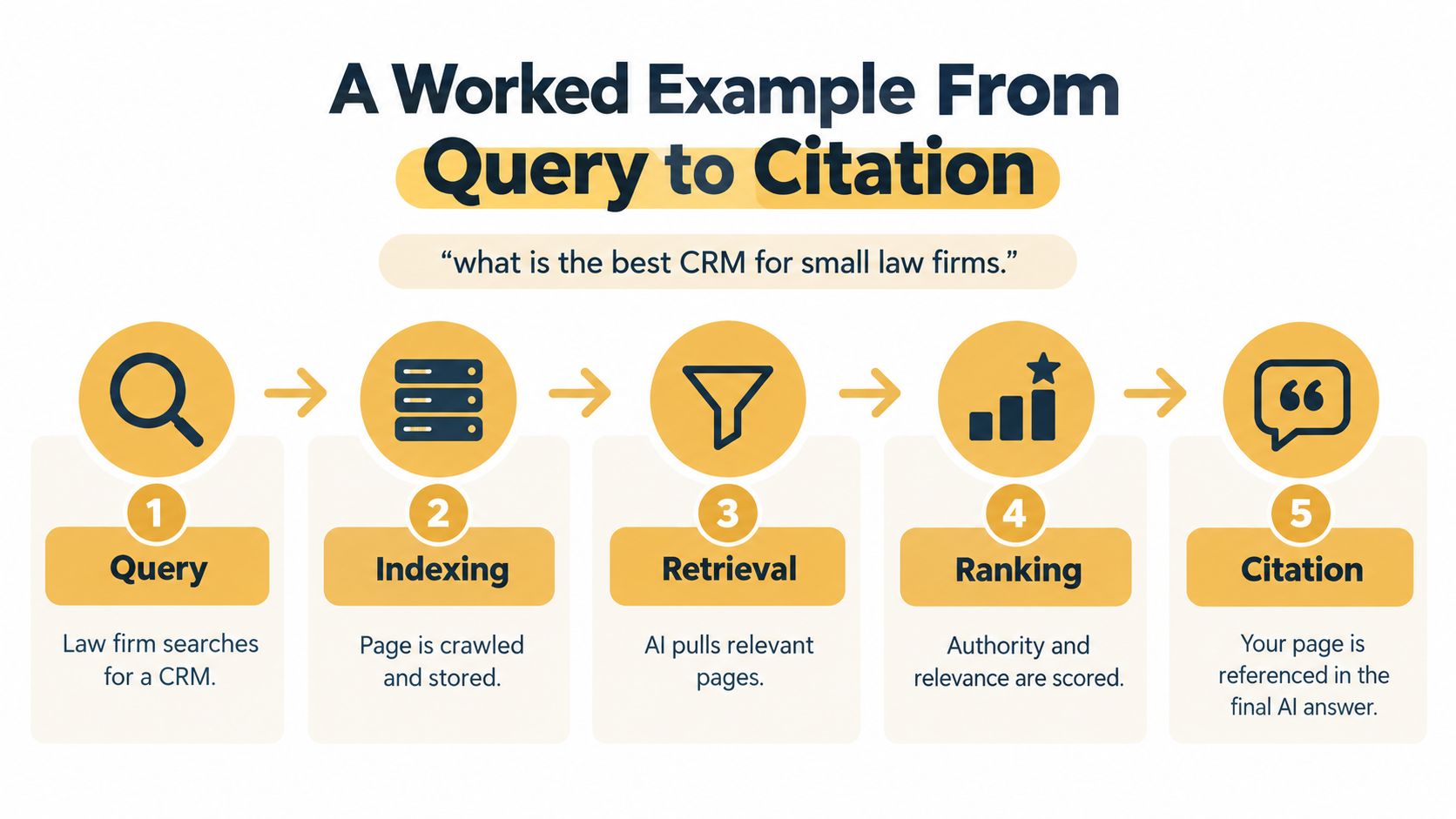
Consider the query, “what is the best CRM for small law firms.” A page can address that question and still fail to appear in an AI answer because the pipeline doesn't evaluate only the page's final recommendation.
At publication, the page needs a crawlable URL, indexable content, and clear language about its audience. A title such as “CRM Software for Small Law Firms” establishes the entity relationship more clearly than a vague headline such as “Work Smarter With Better Technology.” The opening passage should define the buying criteria, such as matter management, intake workflows, permissions, and reporting, without forcing the reader or model to infer the context.
What happens at each stage
During retrieval, the engine looks for pages that connect CRM software with small law firms. A page that uses the audience phrase, explains related subtopics, and links its claims to accessible sources gives the system more relevant material to select.
During reranking, evidence matters. A comparison that names the evaluation method, identifies the author, cites product documentation, and distinguishes observed features from opinion gives the engine a stronger basis than an unsupported “best CRM” claim.
During synthesis, short sections and an FAQ block can supply clean passages. For example, one passage might answer who benefits from a particular CRM, while another explains a limitation. External mentions can reinforce that the business or reviewer is a credible entity, but they can't rescue unclear or inaccessible content.
The chain breaks when the page hides its audience, makes unsupported superlatives, buries its criteria, or provides no source for important claims. A practical guide to optimizing for AI Overviews can help translate these principles into a page audit.
Why Generic AI SEO Advice Often Fails
Generic advice fails because generative engines don't necessarily share the same retrieval systems, source inventories, grounding rules, or citation behavior. A format that performs well in one environment may transfer poorly to another. The critical survey of generative engine optimization describes unstable, engine-specific gains, weak transfer of generic heuristics, and meaningful run-to-run variability.
That doesn't make optimization arbitrary. It means your team should separate portable fundamentals from engine-specific observations. Clear entities, accessible pages, relevant passages, and verifiable evidence are broadly useful. The precise sources an engine retrieves, the way it displays citations, and the authority signals it favors require testing.
How leading AI engines differ on citation signals
| Signal | ChatGPT | Perplexity | Google AI Overviews | Claude |
|---|---|---|---|---|
| Source selection | May rely on model knowledge and, when web search is available, connected web sources | Retrieves and cites sources from its search environment | Uses the Google search ecosystem to assemble answer citations | May use model knowledge and connected web search |
| Citation emphasis | Strongly affected by whether browsing is active and whether the source is attributable | Often makes source diversity and inline evidence visible | Connects answer claims to indexed web pages | Citation behavior depends on the active search experience |
| Practical priority | Authoritative, clearly sourced passages | Relevant passages with visible, varied corroboration | Strong indexability, topical fit, and trustworthy page structure | Clear claims and accessible supporting evidence |
| Testing question | Is the page selected and cited for the target prompt? | Does the page appear among varied supporting sources? | Does the page contribute to an overview or cited answer? | Does the system retrieve and accurately represent the page? |
These distinctions are working hypotheses, not permanent rules. Run the same prompt across the platforms your customers use, record the cited sources, and compare the language each system extracts.
Testing discipline: Don't ask whether your page “ranks in AI.” Ask which engine, which prompt, which passage, and which citation outcome you're measuring.
A one-size-fits-all checklist can also create counterproductive edits. The critical survey notes that citation-focused rewrites can hurt retrieval, competition can erase apparent gains, and source overlap can remain low. Preserve usefulness and topical relevance while testing evidence improvements in controlled groups.
Measuring AI Search Performance
Classic rank tracking can't tell you whether a brand appeared inside a synthesized answer, whether the cited passage was accurate, or whether the visit generated a qualified opportunity. Measurement needs separate visibility from business impact.
A useful dashboard has three KPI families:
- Citation share: How often your brand or URL appears in answers for a defined prompt set.
- Answer accuracy: Whether the cited passage represents your positioning, qualifications, products, and limitations correctly.
- Assisted conversions: Whether visits referred from AI systems contribute to leads, sales conversations, or other meaningful outcomes.
The measurement gap is substantial. A survey of 300 enterprise leaders found that crawlability, traffic and citation tracking, FAQ and Q&A formats, and content refreshes were among the most selected tactics. It also identified measurement, attribution, and trust as unresolved problems, with 19% specifically flagging accuracy and transparency concerns, according to Branch's 2026 survey findings.
A workable tracking system
Start with a prompt library that reflects real buying questions, comparison questions, local intent, support questions, and category definitions. The survey data identifies a minimum viable dataset of 50 tracked prompts, so use that as a practical starting point rather than trying to monitor every possible query.
Test prompts across ChatGPT, Perplexity, and Gemini at a consistent weekly cadence. Record the answer, cited URLs, brand mentions, competitors, factual errors, and the exact passage associated with each citation. Tag referrals from cited URLs in analytics, then connect those sessions to CRM records where possible.
| Goal | Traditional SEO metric | AI search equivalent |
|---|---|---|
| Visibility | Impressions and ranking position | Prompt-level presence and citation share |
| Engagement | Organic click-through rate | Visits from cited or mentioned sources |
| Relevance | Keyword ranking and landing-page behavior | Answer inclusion for commercially meaningful prompts |
| Message control | Search snippet accuracy | Accuracy of the AI-generated description |
| Revenue | Organic leads and assisted conversions | LLM-referred sessions, pipeline, and assisted revenue |
Keep presence metrics separate from revenue metrics. A rise in citations doesn't automatically prove commercial value, while a small number of high-intent referrals may matter more than broad visibility. Review the dashboard weekly, annotate content changes, and look for repeated patterns rather than reacting to one answer.
Your 90 Day AI Search Optimization Plan
A small team can begin without rebuilding its entire marketing operation. The first phase creates a baseline, the second improves evidence, and the third tests whether those improvements change answer visibility and business outcomes.
Days 1 to 30 establish the baseline
Select the 50 prompts most closely tied to your products, customers, and buying decisions. Test them across the relevant answer engines, record citations and mentions, and identify which competitors appear consistently. Check crawlability, indexation, internal links, entity descriptions, author information, and referral tagging.
Don't start by rewriting every article. Find the pages connected to the prompts that matter commercially, then document where each page fails in the pipeline.
Days 31 to 60 improve citation readiness
Rewrite the 10 highest-value pages so each one answers a clear question directly. Add sourced statistics only where they support a decision, identify authors and reviewers, clarify product or service entities, and turn important claims into concise, independently understandable passages.
Pursue external proof at the same time. Relevant industry mentions, expert contributions, accurate profiles, and credible references can strengthen the source ecosystem around your business. Use AI for SEO guidance to support research and workflow design, but have people verify claims, sources, and recommendations before publication.
Days 61 to 90 expand and iterate
Add suitable structured data for entities, authors, products, services, and frequently asked questions. Expand into long-tail prompts revealed by your testing, then compare content variants to see which passages earn more citations and which answers represent your business more accurately.
Every Monday morning, complete this checklist:
- Review one AI answer: Ask what evidence earned each citation.
- Inspect one important page: Check access, entity clarity, structure, and attribution.
- Record one test result: Note a new prompt, source, competitor, or factual error.
- Choose one correction: Improve the highest-impact weakness rather than making broad edits.
The habit that compounds is simple: examine one answer every day and ask why the engine trusted that source. Over time, those observations turn AI search optimization from speculation into an operating system for content, authority, and measurement.
Up North Media offers custom AI SEO planning, visibility audits across ChatGPT, Perplexity, and AI Overviews, SEO marketing, and AI consulting for businesses that need a measurable search strategy. Visit Up North Media to discuss how an evidence-led AI search program can support your traffic, leads, and revenue goals.