
Trying to boost your ecommerce sales is a bit like tuning an engine. You've really only got two main levers to pull: getting more of the right people to your store (qualified traffic) and getting more of those visitors to actually buy something (conversion rate).
This playbook is all about doing that methodically. We'll start by figuring out where you stand right now, lock in some quick wins for an immediate boost, and then build out smarter traffic and retention strategies for long-term growth.
Establish Your Baseline for Growth
Before you start changing things, you need a crystal-clear picture of your starting point. Trying to grow without knowing your numbers is like driving in a new city without a map. You might get somewhere eventually, but you’ll waste a ton of time, energy, and cash hitting dead ends. The first real step is always a thorough, honest audit of your store's performance.
This isn’t about vanity metrics like total site visitors or how many followers you have on Instagram. We need to dig into the numbers that directly impact your bottom line. Think of yourself as a detective looking for clues—where is the business strong, and more importantly, where is it leaking money? A good audit helps you prioritize, ensuring you spend your time on the stuff that will actually move the needle.
It's a simple, repeatable cycle: you audit your performance, analyze what the data is telling you, and then build a strategic plan based on those facts.
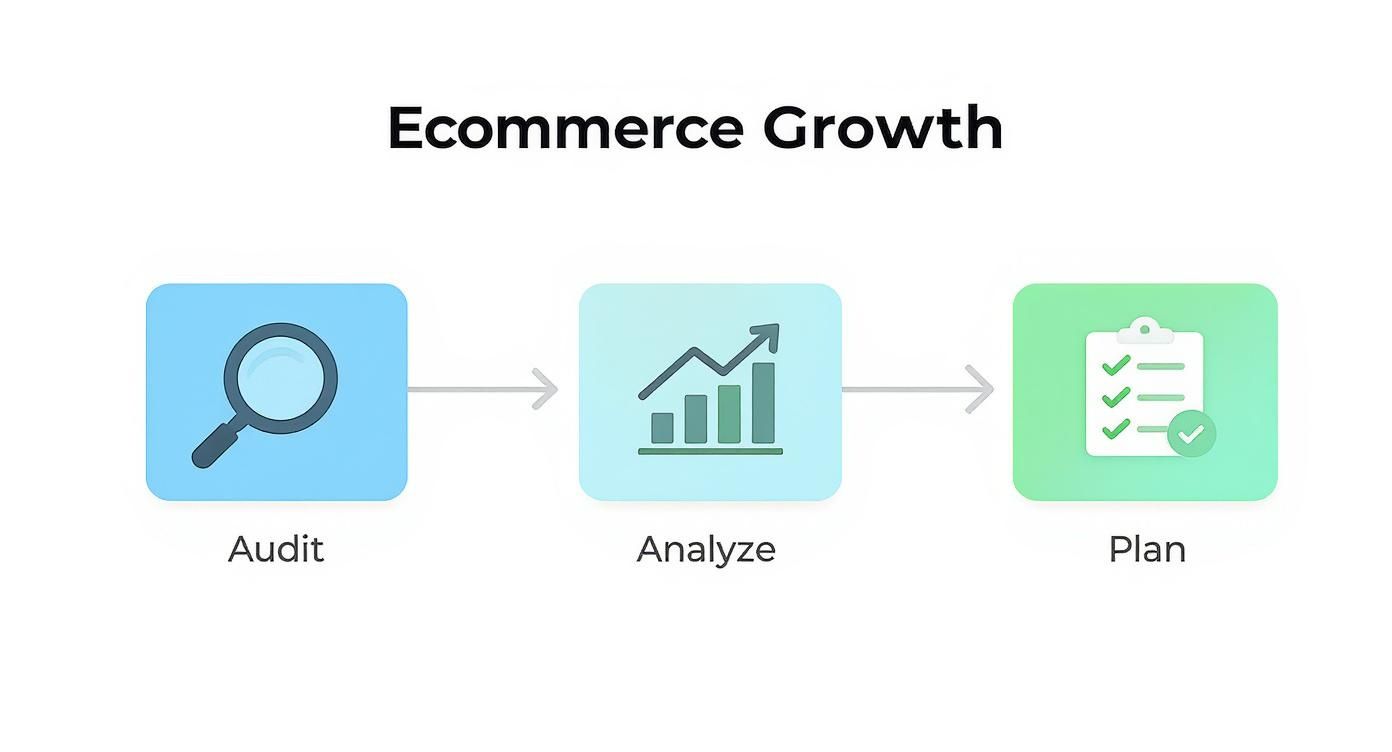
Following this loop ensures every move you make is backed by data, not just a gut feeling. That’s how you get sustainable, predictable growth.
Identify Your Key Performance Indicators
Your audit should zero in on a handful of critical metrics that tell the real story of your store's health. Don't get lost in the sea of data inside your analytics tools. Just start with these three essentials:
- Conversion Rate: This is the percentage of visitors who make a purchase. It's the ultimate measure of how effective your site is. A low conversion rate can point to problems with your product pages, pricing, or checkout flow.
- Average Order Value (AOV): This tells you how much a customer spends, on average, each time they buy. Bumping up your AOV is one of the fastest ways to make more money without needing a single new visitor.
- Customer Lifetime Value (LTV): This is the total amount of revenue you can expect from one customer over their entire relationship with your brand. A healthy LTV means you have loyal customers and your retention marketing is working.
I see so many store owners obsess over traffic. But a 1% increase in your conversion rate will almost always have a bigger impact on your profit than a 10% jump in traffic, especially if that new traffic isn't a great fit for your products.
Uncover Friction Points in Your Sales Funnel
Once you have your core numbers, it’s time to figure out why they look the way they do. Using a tool like Google Analytics 4 (GA4), you can trace the customer's path through your store and see exactly where people are giving up and leaving.
Start by mapping out your conversion funnel, from the moment someone lands on your site to the second they hit the "thank you" page. Are tons of people bailing from certain product pages? That could mean your descriptions are weak, your photos are low-quality, or your pricing is confusing.
Pay very close attention to your checkout process. A high cart abandonment rate is a massive red flag. The usual suspects are unexpected shipping costs, a checkout form that asks for too much information, or a lack of payment options people trust. The industry average for cart abandonment is around 70%, so even tiny improvements here can unlock a surprising amount of revenue. It's also smart to see how you measure up against others in your space by checking out some detailed ecommerce conversion rate benchmarks.
Translate Data into an Actionable Plan
The final piece of the audit is turning all these insights into a concrete plan. Based on what you found, pick the top 2-3 biggest opportunities for improvement.
For example, if your data shows that mobile visitors convert at half the rate of desktop users, optimizing the mobile experience just became your number one priority.
If your AOV is flat, your plan might be to test some new upsell and cross-sell placements. If your LTV is stuck, you might decide to build out an email sequence designed to bring customers back for a second purchase. This data-driven foundation is what separates the stores that grow consistently from the ones that just spin their wheels.
Snag Some High-Impact Conversion Quick Wins
Once you've got a clear picture of your store's performance, it's time to go after the low-hanging fruit. I'm talking about the quick, high-impact fixes that can give you an immediate lift in your conversion rate without needing a massive overhaul or a huge budget.
Focusing on these foundational improvements builds momentum and starts bringing in more revenue right away. We're not just throwing random tips at the wall; these are proven tactics grounded in customer psychology that give hesitant buyers the little nudge they need to click "Add to Cart" and follow through.
Craft Product Pages That Actually Sell
Your product page is your digital salesperson. It has one job: convince a visitor that your product is the solution they've been looking for. So many store owners make the classic mistake of just listing features, but people buy based on benefits and emotion.
Instead of just saying "waterproof fabric," explain the benefit: "Stay completely dry and comfortable on your commute, even in a downpour." See the difference? One is a spec, the other paints a picture and solves a real-life problem.
To really get your product pages working for you, they need a few key things:
- Benefit-Driven Descriptions: Always focus on how the product improves your customer's life.
- High-Quality Visuals: Use multiple high-res images, videos, and even 360-degree views if you can. Show the product in use by real people—it helps customers imagine themselves using it.
- Clear Calls to Action (CTAs): Your "Add to Cart" button should be impossible to miss. Seriously. Use a contrasting color that pops right off the page.
A huge mistake I see all the time is using generic, manufacturer-provided descriptions. This not only tanks your SEO but does absolutely nothing to create a unique brand voice. Taking the time to write original copy that speaks directly to your ideal customer is one of the highest ROI activities you can do.
Radically Simplify Your Checkout Process
This is where the money gets lost. The checkout. The average cart abandonment rate hovers around a staggering 70%. Let that sink in. For every ten customers who add an item to their cart, seven of them walk away without buying.
Even tiny improvements here can have a massive impact on your bottom line. Your goal should be to make buying from you as frictionless as humanly possible. Every extra step, every unnecessary form field, and every moment of confusion is another reason for a customer to give up.
Here are the absolute must-do fixes:
- Offer Guest Checkout: Forcing people to create an account is one of the top reasons for abandonment. Don't do it. Always have a big, obvious guest checkout option.
- Minimize Form Fields: Only ask for what you absolutely need to process the order. Do you really need their phone number? Can you auto-fill their address? Cut the fat.
- Provide Multiple Payment Options: Offer trusted gateways like PayPal, Apple Pay, and Google Pay. These one-click options are a game-changer for speeding up the process, especially on mobile.
Reducing friction is how you stop the bleeding. For a deeper dive, our guide on how to reduce cart abandonment has more advanced strategies you can use.
Leverage Social Proof and Build Trust Instantly
People are wired to follow the crowd. They are way more likely to buy something if they see that other people have bought it and loved it. This is social proof, and it's one of the most powerful tools in your conversion toolkit.
You need to strategically place these trust signals where hesitant buyers will see them most.
Start by featuring customer reviews and star ratings prominently on your product pages, ideally right below the product title. Don't make people hunt for them on a separate page.
Another killer form of social proof is user-generated content (UGC). Encourage customers to share photos of themselves using your products on social media with a specific hashtag. Displaying these real-world photos on your product pages is far more authentic and persuasive than any polished, professional shot you could take.
This is especially critical for mobile shoppers, who are taking over online retail. Mobile commerce is a massive market, projected to hit $2.51 trillion in 2025. That’s a 21.25% jump from the previous year and will account for almost 59% of all ecommerce sales. These numbers make it crystal clear: a seamless, trust-filled mobile experience isn't just nice to have—it's essential for growth.
Drive Targeted Traffic That Converts

Alright, your store is now a lean, mean, conversion machine. So what's next? It's time to open the floodgates—but not to just anyone. Throwing random traffic at your site is a good way to burn through cash with nothing to show for it.
The real goal is attracting shoppers who are already looking for what you sell. We're talking about people who are primed to buy.
This means you need a solid, two-pronged attack. For steady, long-term growth, search engine optimization (SEO) is your best friend. For getting results right now and gathering valuable data, paid ads give you the speed you need.
Build a Foundation with Ecommerce SEO
SEO is the ultimate long game. Think of it as slowly building a reputation with search engines so they trust you enough to send their users your way. It takes time, but the traffic it generates is highly qualified and, best of all, you don't pay for every click.
Start with product-level keyword research. You have to get inside your customer's head. What words are they actually typing into Google? Forget broad terms like "running shoes." A long-tail keyword like "men's trail running shoes for wide feet" is pure gold—it attracts a much more serious buyer.
Once you have your keywords, weave them naturally into your:
- Product titles
- Product descriptions
- Image alt text
- URL slugs
Beyond just tweaking product pages, create content that actually helps people. A blog post on "How to Choose the Right Trail Running Shoe" can pull in customers while they're still in the research phase. You become the trusted expert before they're even ready to add something to their cart.
A lot of store owners get overwhelmed by SEO, but it's really just about making your site as clear and helpful as possible for both people and search engines. If you focus on creating the best, most informative product pages in your niche, you’re already halfway there.
Accelerate Growth with Paid Advertising
While your SEO efforts are quietly building momentum in the background, paid advertising lets you jump the line and get in front of buyers immediately. Platforms like Google Ads and Meta (Facebook and Instagram) let you target people with scary precision based on their interests, demographics, and online behavior. This is how you boost ecommerce sales fast.
The secret to a profitable paid ads strategy is to start small and double down on what works. Don't spray your budget across ten different campaigns and hope for the best. Launch a few highly focused campaigns and watch their performance like a hawk.
A Google Shopping campaign is almost always the best place to start for an ecommerce store. These ads slap your product image, price, and store name right at the top of the search results, grabbing the attention of people who are ready to buy now.
Choosing the Right Ad Formats
Not all ads are created equal. You need to match the ad format to your goal, whether that's making a direct sale, just getting your name out there, or nudging a past visitor to come back.
A Meta retargeting campaign is non-negotiable. You’re essentially showing ads only to people who’ve already been to your site but left without buying. Showing them the exact product they were looking at is a powerful little reminder that often gets them to finally pull the trigger.
On social media, video is everything. Short, punchy video ads on platforms like TikTok and Instagram Reels are perfect for grabbing attention and showing your products in a way that static images just can't. To really nail it, you have to get creative. If you want to dive deeper, there's a lot to learn from TikTok creative best practices for ads.
Comparing Traffic Generation Channels
Picking where to spend your time and money can be tricky. Each channel has its own rhythm and ideal purpose. Here's a quick cheat sheet to help you decide where to focus your energy first.
| Channel | Typical Cost | Time to Results | Best For |
|---|---|---|---|
| Ecommerce SEO | Low (Time/Content) | 6-12 Months | Building a sustainable, free source of traffic and becoming a trusted authority. |
| Google Ads | Medium to High (PPC) | 1-4 Weeks | Grabbing high-intent shoppers who are actively searching for your products. |
| Meta Ads | Low to High (PPC/PPM) | 1-2 Weeks | Getting your products discovered and bringing back past website visitors. |
Every successful brand I've seen uses a smart mix of SEO and paid ads. One builds your foundation, the other lets you hit the accelerator. By investing in both, you create a powerful and resilient traffic engine that brings the right kind of customers to your store, day in and day out.
Turn One-Time Buyers Into Lifelong Customers
It costs five times more to land a new customer than to keep an existing one. Let that sink in for a second.
While chasing new acquisitions feels like progress, the real, sustainable money in ecommerce comes from repeat business. This is the difference between an expensive one-off transaction and a predictable, profitable revenue stream.
Your goal is to stop the leaky bucket. You work way too hard pouring new customers in just to have them drain out the bottom. A solid retention strategy is what plugs those holes, building genuine loyalty and boosting the lifetime value (LTV) of every person who buys from you.
Master the Art of Email Marketing
Your email list is one of the most valuable assets you own. It's a direct line to your most engaged audience. But in a world of overflowing inboxes, you have to earn your spot. That means using automation that feels personal, not robotic.
Every single ecommerce store should have these three automated email sequences running 24/7:
- The Welcome Series: This is your first impression after someone subscribes. Don't just blast them with a single discount code. Create a 3-5 part series that tells your brand story, highlights best-sellers, and sprinkles in some social proof. Make them glad they signed up.
- The Abandoned Cart Sequence: This is pure revenue recovery. A simple reminder sent an hour after someone leaves, followed by another 24 hours later that handles common objections (like shipping costs or returns), can claw back up to 10-15% of otherwise lost sales. It's a money-printing machine.
- The Post-Purchase Follow-Up: The journey doesn't end at checkout. Send order confirmations, shipping updates, and—this is key—a follow-up asking for a review. This builds trust, keeps the conversation going, and sets the stage for their next purchase.
I often see brands focus only on their weekly promotional newsletters. But your automated flows are out there working for you while you sleep. A well-crafted abandoned cart sequence is almost always the single most profitable email marketing effort you can make.
Design a Loyalty Program That Actually Rewards Behavior
A great loyalty program does more than just hand out points for purchases; it makes your customers feel like they're part of an exclusive club. The key is to keep it simple. If your points system is confusing, it's worthless.
And think beyond just "spend more, get more." Reward customers for the behaviors that help you grow.
Consider offering points when they:
- Write a product review
- Follow you on social media
- Share a photo of their purchase with your hashtag
- Refer a friend (this one is huge!)
Tiered programs are also incredibly effective. For example, you could create Bronze, Silver, and Gold levels. As customers spend more, they unlock better perks like early access to new products, free shipping, or a special birthday gift. It gamifies the experience and gives people a real incentive to stick with your brand.
Boost Every Transaction with Upsells and Cross-Sells
Increasing your Average Order Value (AOV) is one of the fastest ways to make more money without needing more traffic. And the best time to do it is when a customer is already in a buying mood.
Upselling is when you encourage a customer to buy a better, more expensive version of the item they're looking at. If they're eyeing a 16GB laptop, you might prominently feature the 32GB model and highlight the performance benefits.
Cross-selling is about suggesting complementary products. When someone adds a digital camera to their cart, a pop-up could suggest a memory card, a camera bag, and a spare battery. Amazon famously attributes as much as 35% of its revenue to this tactic.
You can place these offers strategically:
- On the Product Page: A "Frequently Bought Together" section works wonders here.
- In the Cart: Show items that "Complete the Look" or accessories for products already in their cart.
- At Checkout: Offer a last-minute, low-cost add-on, like product insurance or gift wrapping.
Building these retention strategies is non-negotiable. With the global online shopper population projected to hit 2.77 billion by 2025, the market is more crowded than ever. To build real relationships and improve customer retention, you have to give people a reason to come back.
For more on this, you can check out our dedicated guide on increasing customer lifetime value.
Build a System for Continuous Optimization
Sustainable growth isn't about finding one magic bullet; it's about building a flywheel. The most successful e-commerce brands I've worked with don’t just launch a great store and hope for the best. They build a system for continuous improvement, constantly testing, learning, and iterating to make their site just a little bit better every single week.
This data-driven mindset is what separates stagnant stores from those that consistently find new ways to grow. It’s about moving from guesswork and gut feelings to a predictable process of optimization. When you embrace this, your store becomes a living, evolving asset that gets smarter and more profitable over time.

Embrace the Fundamentals of A/B Testing
The engine of any optimization system is A/B testing, sometimes called split testing. It’s a beautifully simple concept: you create two versions of a webpage (an ‘A’ and a ‘B’), show each version to a different segment of your audience, and see which one performs better. Simple.
Think of it as a scientific experiment for your website. Instead of arguing with your team about which headline sounds better, you let the data decide. A/B testing removes ego and opinion from the equation, replacing them with cold, hard facts about what actually convinces people to click "buy."
A lot of store owners get intimidated by testing, but you can start incredibly small. I've seen clients get surprising lifts just by changing the color of their 'Add to Cart' button or testing 'Buy Now' versus 'Add to Bag'. The goal is just to build the habit of testing.
To get started, focus on high-impact areas where small changes can make a big difference. These are your best candidates for early tests:
- Headlines: Test benefit-driven headlines against more straightforward, descriptive ones.
- Calls-to-Action (CTAs): Experiment with button text, color, size, and placement.
- Product Images: Try lifestyle shots versus clean studio photos on a white background.
- Page Layouts: Test different arrangements of key elements on your product or category pages.
Go Beyond Clicks with Qualitative Data
A/B testing is great at telling you what is happening on your site, but it doesn't always tell you why. That’s where qualitative tools come in. They give you a window into your customers' minds, helping you understand the real human behavior behind the clicks.
Heatmaps are a fantastic starting point. Tools like Hotjar create a visual overlay showing where users are clicking, moving their mouse, and scrolling. If a heatmap shows tons of people are clicking on a non-clickable image, that's a clear signal your design is creating confusion.
Session recordings take this a step further. These are like watching a DVR of a real user's visit to your store. You can see their mouse movements, where they hesitate, and where they get stuck. Trust me, watching a few recordings of users trying and failing to get through your checkout is one of the most painfully effective ways to find friction points you never knew you had.
Choosing the Right Optimization Tools
You don't need an enterprise-level budget to start this process. Many powerful tools are surprisingly accessible for small and medium-sized businesses, letting you build a robust testing system without breaking the bank.
Here’s a look at some popular and effective options to get you started:
| Tool Category | Example Tools | Best For |
|---|---|---|
| A/B Testing | Google Optimize (sunsetting but principles apply), VWO, Optimizely | Running controlled experiments on page elements to see which version converts better. |
| Heatmaps & Recordings | Hotjar, Crazy Egg, Microsoft Clarity | Visually understanding user behavior, identifying friction, and seeing where users get stuck. |
| User Feedback | Qualaroo, Hotjar (Surveys), SurveyMonkey | Asking visitors direct questions to gather feedback on their shopping experience. |
The key isn't to use every tool at once. Start with one, like a heatmap tool, to identify a problem. Then, use that insight to form a hypothesis and run an A/B test to validate a solution. This simple loop—Observe, Hypothesize, Test, Learn—is the core of a powerful optimization system that will consistently drive sales growth month after month.
Common Questions About Boosting Ecommerce Sales

When you're trying to grow your store, a few key questions always seem to pop up. Let's cut through the noise and get straight to the answers so you can focus your energy where it’ll actually make a difference.
How Long Does It Take to See a Real Boost in Sales?
This is the classic "it depends" question, but we can get more specific than that. The timeline really hinges on what you’re working on.
Quick conversion wins, like simplifying your checkout or punching up product page copy, can show a measurable lift in sales within 1-2 weeks. You'll see the impact almost immediately because you're fixing friction for traffic you already have.
Paid ad campaigns on platforms like Meta or Google can also bring in sales within a few days, but expect it to take a few weeks to really dial them in for profitability.
Then you have the long game: SEO. Building organic traffic is a slow burn. Realistically, you’re looking at 6-12 months before you see a significant, consistent stream of sales coming from search engines. The payoff is massive, but it demands patience.
What Are the Biggest Mistakes Stores Make When Trying to Grow?
One of the most common missteps I see is obsessing over traffic before fixing a leaky website. Pouring money into ads to drive visitors to a confusing site with a clunky checkout is like trying to fill a bucket with holes in it. It's expensive and incredibly inefficient.
Another huge mistake is completely ignoring customer retention. So many brands are laser-focused on acquiring new customers that they forget their most profitable audience: the people who have already bought from them. Not having basic email flows, a simple loyalty program, or any post-purchase follow-up is leaving a ton of money on the table.
Honestly, the single biggest mistake is a lack of focus. Trying to do twenty different things at once guarantees that none of them will be done well. It's so much better to find your single biggest bottleneck and throw all your energy at fixing that one thing before moving on.
Which Single Area Should I Focus on First for the Fastest Results?
For the quickest, most reliable impact on your bottom line, start with your checkout process. The average cart abandonment rate is a staggering 70%. Think about that. Even small improvements here can unlock a huge amount of revenue that's currently walking out the door.
Here’s your immediate priority list for the checkout:
- Offer Guest Checkout: Never, ever force someone to create an account.
- Slash Form Fields: Only ask for the absolute essentials. Is that second address line really necessary?
- Add Express Payments: Integrate options like Apple Pay, Google Pay, and PayPal. Make it easy for people to give you money.
Fixing these friction points directly impacts the final—and most critical—step in the buyer's journey. Before you spend a dollar on new traffic, make sure the path to purchase is as smooth as humanly possible. This is the foundation for everything else.
Ready to stop guessing and start growing with a data-driven strategy? Up North Media offers expert SEO, custom web development, and AI consulting to help your business accelerate revenue. Book your free consultation today!