

A marketing lead opens the monthly report and sees the same pattern: the site has published new articles, fixed a few technical issues, and earned some links, but organic traffic has stopped growing and the pipeline hasn't moved. The team can list its SEO tasks. It can't explain which work is bringing in the right customers, or what to change next.
That gap is why how to build an SEO strategy is a business question before it's a ranking question. Search remains a recurring way people find information: Pew Research Center reported that 91% of U.S. online adults used search engines in 2012, compared with 84% in 2004, and 59% of internet users searched on a typical day (Pew Research Center's findings on search use). But a strategy built only around clicks is increasingly incomplete. You need to know which queries can send customers to your site and which can influence a decision even when a searcher doesn't click.
Why Most SEO Strategies Fail Before They Start
The common failure isn't a lack of activity. It's work chosen without a clear business reason. A team may improve title tags, publish articles, and request backlinks, yet still struggle to say which customer need each page serves or what a good result should look like beyond a higher ranking.
That approach gets weaker when search results answer questions directly. Pew Research Center analyzed 68,879 Google searches from March 2025 and found that 18% produced an AI-generated summary. Traditional-result links were clicked in 8% of visits when a summary appeared, compared with 15% when it didn't, while links inside the summaries were clicked in 1% of visits (Pew Research Center's analysis of AI summaries and clicks). These figures don't mean every business should abandon informational content. They do mean that rankings and sessions alone can miss the value of being visible in answers that shape a buyer's shortlist.
SEO strategy is a decision-making system, not a queue of optimizations. It connects business goals to customer intent, the pages that should meet that intent, the technical conditions those pages need, and the measures that tell you whether the work is paying off. Without that system, teams tend to produce more of whatever is easiest to report, not necessarily what moves a prospect toward a sale.
For a practical perspective on organizing SaaS topics and content around a market's needs, see these content strategy tips for SaaS startups. The useful lesson is broader than SaaS: decide what your expertise should help customers understand or choose, then make SEO tasks serve that purpose.
Set Business Goals and Baseline Your Current SEO
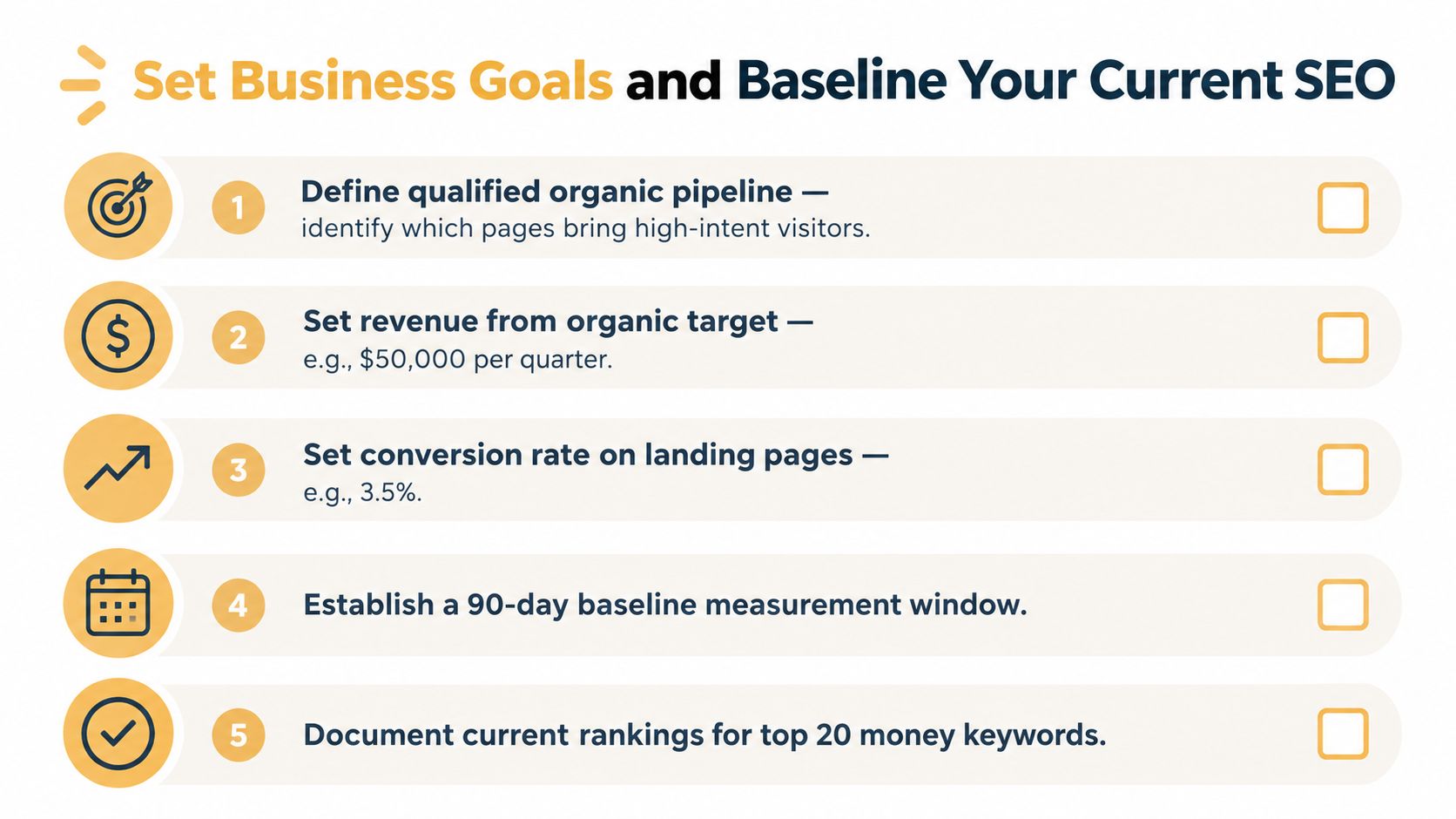
Start with the outcome the business needs, not a target ranking. For an ecommerce team, that may mean more qualified product-page visits and organic revenue. A local service business may care more about quote requests from service-area pages. A publisher may value subscriptions, registrations, or assisted conversions. Pick outcomes the team can track, and make clear which pages are expected to contribute.
Make the baseline useful
In Google Search Console, review queries, landing pages, impressions, clicks, click-through rate, and average position. Treat position as context, not a verdict: it doesn't show whether a visitor was qualified, whether a search feature changed click behavior, or whether a page generated revenue. In Google Analytics, check organic landing pages and the conversions that matter to your business. Make sure events and conversion tracking reflect actual actions rather than superficial engagement.
Then map the customer journey. A person may begin with a question, compare providers or products, and later search for a price, location, or specific solution. A useful plan gives each stage an appropriate page and a way to judge its contribution. A guide might introduce the problem; a comparison page can help the reader choose; a service or product page can make the next step clear.
For a quick audit, put your leading organic landing pages beside their Search Console queries and analytics conversions. Mark pages that get visibility but attract the wrong intent, pages that receive clicks but produce few qualified actions, and important pages that barely appear. This turns an SEO review into a set of specific decisions: update, strengthen internal links, consolidate, or investigate a technical problem.
Document the starting point before changing pages. A clear baseline lets you distinguish an actual shift from ordinary fluctuation and makes reporting more useful to people outside the SEO team. For a deeper walkthrough, use this guide to measure SEO ROI.
Map Keywords to Intent and Customer Stages
Keyword volume can help describe demand, but it doesn't tell you whether a searcher is ready to act or whether your page can offer something worth a visit. Classify queries by what the person is trying to do: learn, compare, buy, or find a nearby provider. Then connect each group to the right page and business outcome.
A useful distinction is click potential versus influence potential. A broad informational query may be answered partly in an AI summary, making a visit less likely. But a strong, credible answer can still shape what the searcher understands or remembers about your brand. A comparison query, local service search, or product query often has a clearer reason to visit, especially when your page offers specific details, evidence, pricing, availability, or a useful tool.
This isn't a choice between writing for people and writing for search systems. It's a choice about what success means for each query. Google's AI guidance emphasizes familiar foundations such as crawlability, internal links, important text, page experience, and accurate structured data, rather than a separate set of tricks (Google's guidance on AI features and your website). Google also reports that AI Overviews are associated with longer, more complex searches and that click quality has slightly increased even as overall organic click volume has remained relatively stable year over year. That makes it sensible to assess value by query type, not by a blanket assumption that AI search either eliminates or preserves every click.
Build a query map from customer language
Use keyword tools to find variations, then compare them with what customers ask in sales conversations, support tickets, and on-site search. A shopper might search for a product category, then a comparison, then a compatibility detail. Those phrases can point to distinct pages, or to sections of one useful page, depending on whether the searcher has a meaningfully different need.
For a structured way to think through terms and shopper intent, consider Online Brand Growth's keyword research approach. Once you have candidate queries, rate each on business fit, intent match, and competitive reality. Prioritize queries where you can serve the need well and have a credible reason to compete. Use this search intent analysis guide to make the classification more consistent across the team.
Build the Technical Foundation That Lets Content Win
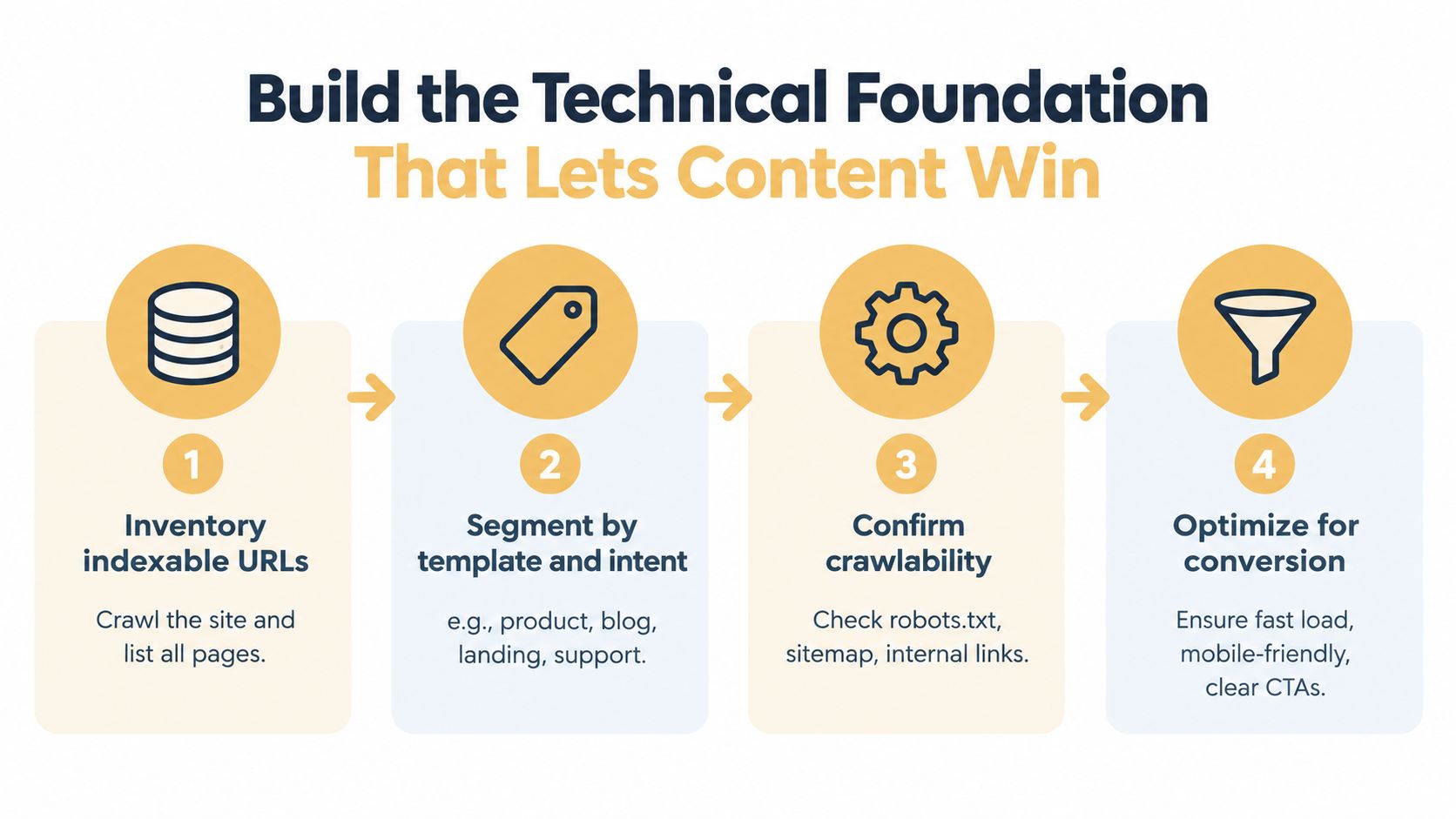
A product page that ranks but cannot load, index, or guide a visitor to the next step wastes the work behind it. Start by inventorying indexable URLs, then group them by template, intent, business value, and organic performance. This reveals whether priority searches lead to useful landing pages, near-duplicates compete for the same demand, or important customer needs have no suitable page.
Trace the crawl-to-conversion path
Check that priority pages are reachable through crawlable HTML links and that the XML sitemap lists only canonical URLs you want considered for search. A sitemap helps crawlers find preferred URLs; it does not guarantee indexing or resolve weak internal links, blocked resources, duplicate content, or low-value pages. Use URL Inspection in Search Console to test representative templates and investigate unexpected indexing or canonical selection.
Use robots.txt to manage crawling. To keep a page out of the index, apply a noindex directive or restrict access. For sites with many product or category variations, review faceted navigation and URL parameters carefully. Thin and duplicate pages can consume crawl attention while making it harder for useful pages to stand out. Google's SEO Starter Guide covers how links, sitemaps, and page structure support discovery.
For page experience, judge performance with real-user field data, not a lab score alone. Google recommends that important pages meet these Core Web Vitals targets at the 75th percentile: LCP within 2.5 seconds, INP below 200 milliseconds, and CLS below 0.1 (Google's Core Web Vitals guidance). Start with slow server responses and render-blocking resources. Then reduce unnecessary JavaScript and CSS, reserve space for images and embedded media, and improve responsive image delivery and caching.
Compare mobile and desktop field data, then connect technical work to organic landing-page conversions, query clicks, and indexation. A faster score matters only if priority pages load smoothly and make the next step clear. Our technical SEO audit checklist can help structure the review. Teams collecting search results can also consult this practical guide to google scraping.
Plan Content That Earns Clicks and Citations
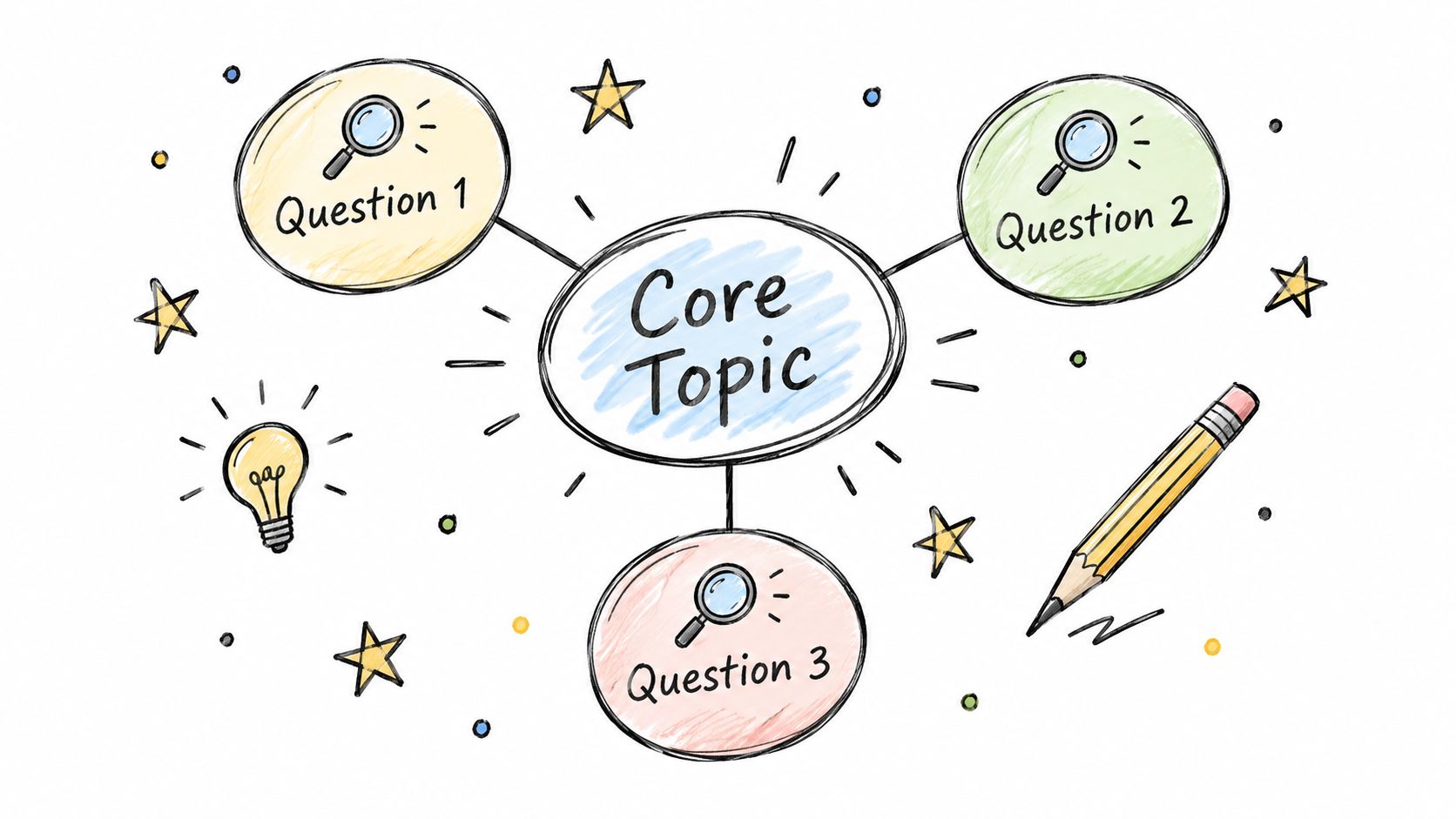
A content plan shouldn't be a publishing quota. Start with the questions that matter to your customers and business, then decide whether each needs a main resource, a supporting page, or an improvement to something you've already published. A topic cluster can help organize related questions around a central page, but the structure only helps if each page has a distinct purpose and the internal links make that relationship clear.
Apply an editorial test before publishing
A draft needs more than a target phrase and a clean outline. Ask whether it contains something a generic answer can't easily substitute: first-party research, original examples, detailed product specifications, local evidence, expert explanation, or an interactive tool. Then check whether the claims have support and whether the page helps a real buyer make progress. If the draft repeats commonly available definitions without adding useful detail, it may not deserve another URL.
Google's AI search guidance reinforces the value of making important content accessible, specific, and grounded in the page itself. For a business, that means putting useful information in text, supporting claims with verifiable evidence, and using structured data only when it accurately describes visible content. It also means accepting a trade-off: a broad explainer may be easy for answer engines to summarize, while a page with original proof or a practical decision aid gives readers a stronger reason to visit.
A short explainer can help a team visualize how to brainstorm a core topic and related questions:
Improve the library you already have
Before commissioning more articles, compare existing pages that target similar questions. If two pages answer the same need, they may compete with each other and split internal links. Consolidate overlapping material where it serves the reader better, or sharpen each page around a distinct intent. Update pages when products, policies, evidence, or customer questions change.
Plan internal links deliberately. A supporting article should guide readers to a relevant service, category, product, or central resource, while the central page should point to useful details rather than acting as a list of keywords. This keeps the content architecture useful to people and easier for search engines to understand.
Earn Links and Authority Through Distinctive Work
Link building works best when it follows something worth citing. A campaign that starts with a generic article and ends with a large list of cold pitches usually produces weak conversations. Start instead by asking what your team knows, measures, builds, or observes that a relevant publication or partner would have a reason to reference.
Useful assets vary by business. A software company might publish a carefully explained dataset or a calculator that helps buyers compare options. A local service company could create a visual guide based on practical expertise in its area. A publisher might interview knowledgeable practitioners and add original context, rather than assembling commentary that could have appeared anywhere.
Practical rule: Create an asset for a real audience first. Outreach should help that audience find it, not disguise a link request as a resource.
Make outreach specific and relevant
Identify the people who already cover the topic: editors, trade publications, industry associations, complementary businesses, and local organizations. Lead with the reason the asset could help their readers. A concise pitch can explain what's new, who it serves, and where the recipient can verify the details. If there's no clear audience benefit, don't send the pitch.
Follow up with restraint. A follow-up should add context or make it easy to assess the offer, not just repeat the first message. Partnerships and digital PR can be especially useful for smaller businesses that can't compete through publishing volume alone. A relevant collaboration, local resource, or expert contribution may build recognition and referral relationships alongside links.
Be selective about the result. A link from a relevant, editorially controlled page is more meaningful than a pile of unrelated directory placements or paid-looking mentions. Check the linking page's subject, whether it's accessible to readers, and whether the link makes sense in context. Don't treat every new referring domain as proof of progress.
Measure influence as well as visits
Organic sessions still matter, but they're not a complete account of search visibility. Alongside qualified conversions and revenue per organic session, track assisted conversions, branded-search growth, and citation frequency in AI answers where you can monitor it consistently. These measures help separate a page's direct traffic role from its influence on awareness or later demand.
Match metrics to the query's purpose. For a click-oriented product or local-service query, watch whether the landing page brings qualified actions. For an informational query that may be answered directly in search, visibility and influence signals can matter even when sessions are limited. Don't count an AI mention as a sale; use it as one signal alongside business outcomes.
Review the data on a regular schedule and make a decision each time: protect pages that bring valuable demand, improve pages with visibility but weak engagement, and investigate when rankings rise while click share falls. A traffic increase with a flat pipeline is a reason to check intent and conversion paths, not celebrate a chart in isolation. Likewise, falling clicks may reflect changes in result features, a page problem, or both. Diagnose before changing the content.
Your 90-Day SEO Strategy Rollout Plan
A useful rollout gives the team time to establish a baseline, ship improvements, and judge whether the work is attracting the right demand. Keep the scope realistic. A focused set of important pages is more useful than a sprawling plan nobody can maintain.
First 30 days
Agree on business outcomes and confirm that Search Console and analytics capture the actions that matter. Inventory priority URLs, group them by intent and template, and investigate crawlability, indexing, canonical selection, and page experience. Choose existing pages with clear opportunities, such as outdated information, weak internal links, or a mismatch between the query and landing-page content.
Days 31 to 60
Map customer queries to the pages that should serve them, separating click-oriented opportunities from queries where influence matters. Build a content cluster around a real business topic, then decide which existing pages to update, combine, or leave alone. Publish a focused set of useful content, and pitch a distinctive asset to relevant publications or partners.
Days 61 to 90
Compare performance with the baseline. Look at qualified actions and revenue alongside impressions, clicks, and landing-page behavior. If a page gains visibility but attracts poorly matched visits, revisit the intent and offer. If two pages overlap, decide whether to sharpen their roles or consolidate them. Expand the approaches that show business value, and stop investing in work that only improves a dashboard without helping customers or the pipeline.
After the rollout, keep a recurring review of technical health, content changes, query behavior, and conversions. A strategy compounds when the team learns from evidence and adjusts priorities, not when it repeats the same task list every month.
Up North Media helps businesses plan and execute data-driven SEO, including technical audits, keyword research, content strategy, link building, local SEO, and AI-focused optimization. If you want a strategy tied to qualified demand and measurable business outcomes, visit Up North Media to discuss your goals.