
SEO is worth it for most small businesses only when they can invest around $1,500 to $5,000 per month and wait roughly 9 to 11 months for break-even. If you need leads inside 60 days or can't sustain that investment, the math usually doesn't work.
That's the uncomfortable answer for the Omaha owner looking at a $2,400 monthly SEO proposal while wondering whether the same money should go into Google Ads. Paid search feels safer because the clicks start quickly. SEO feels risky because the bill arrives before the rankings, calls, and sales do.
The right question isn't “Is SEO worth it for small businesses?” as a general philosophy debate. It's whether your budget, timeline, market, and operating capacity fit the way SEO produces returns.
The Decision Every Small Business Faces
Picture a local shop owner in Omaha reviewing an SEO proposal, calculator open, and comparing a monthly retainer with the Google Ads budget he already understands. Paid ads can generate inquiries while they are funded. SEO aims to build a stronger organic position over time, but delayed results do nothing for payroll due this month.
Before signing, answer four questions.
- Can the business sustain the monthly spend? SEO requires funding for technical fixes, useful content, local optimization, and authority building. A business with less than $500 per month in total marketing budget usually has too little room to build meaningful momentum.
- Can the owner wait for payback? Recent benchmark summaries place break-even around 9 to 11 months, depending on the market and investment level. Early months may feel unproductive even when the work is sound.
- How difficult is the local market? A niche service in a smaller Omaha suburb faces a different entry point from a crowded category competing across the metro. Established competitors may already control the strongest pages, reviews, links, and brand recognition.
- Can the operation handle the leads? Better rankings have limited value if calls go unanswered, estimates take days, or the service area remains unclear.
Practical rule: If you need leads inside 60 days, use paid search for speed first. SEO is not an immediate cash-flow solution.
The decision comes down to budget and timeline fit. If you cannot fund sustained work, wait through a slow ramp, or convert inquiries into customers, SEO is the wrong investment right now. Visibility cannot compensate for weak follow-up or a poor customer experience.
SEO fits businesses that can fund the work, tolerate a slow start, and sell a service people actively search for. Local contractors, professional services, specialty retailers, and established B2B firms often meet those conditions. Pre-revenue businesses and owners seeking a cheap monthly task list usually do not.
Treat the decision as a testable investment, not a yes-or-no debate. Set the budget, define the acceptable payback window, assess local competition, and confirm the operation can serve new customers before committing. If those conditions do not line up, spend first on channels that match the business's immediate needs.
How SEO Works for Small Businesses
A $2,000 monthly SEO investment behaves more like buying a duplex than renting a billboard. The first month can feel expensive because the asset produces little return. By month six, the pages may begin attracting steady inquiries. By month twelve, the site can generate positive cash flow while the business still owns the underlying marketing asset.
Paid advertising behaves differently. Stop funding the campaign, and traffic generally stops with it. SEO builds pages, links, and authority that can continue attracting qualified visitors after the heaviest work is complete. Maintenance and improvement still determine how long that value lasts.
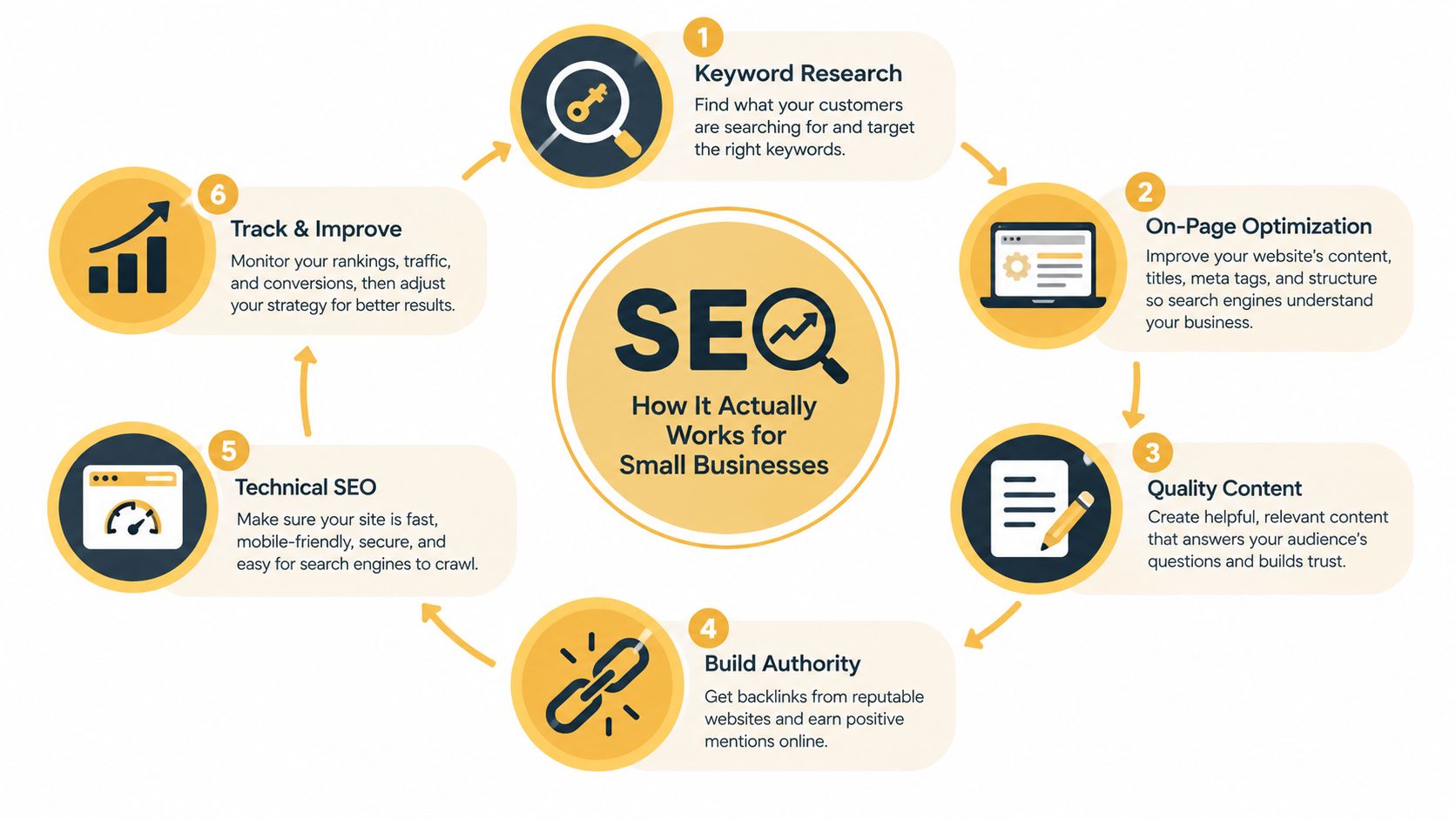
The assets you keep building
The first asset is a group of ranked pages. A well-built service page can keep attracting searches for a specific problem, location, or product category long after publication.
The second is inbound links and relevant mentions. References from credible, contextually appropriate sources can strengthen a site's ability to compete.
The third is domain authority. It grows as a business publishes useful material, earns references, and demonstrates expertise within a defined market. The practical principles in this guide to modern SEO for SMEs and startups explain how these parts support one another.
Consider a plumber serving Papillion. If the company pauses SEO for two months, rankings may soften and traffic may decline, but the site does not necessarily drop to zero. Its pages, links, reviews, and business information remain in place. That residual value separates an owned marketing asset from rented exposure.
Compounding requires upkeep. A neglected site can lose relevance, competitors can publish stronger pages, and search engines can change result layouts. Consistent investment gives the business the best chance to preserve and expand its visibility. Half-measures usually deliver half-results because no part of the system receives enough support.
The ROI and Conversion Numbers That Matter
The useful benchmarks aren't vague promises that “SEO pays off.” They're the relationship between qualified organic visits, conversion rate, customer value, and acquisition cost.
A 2025 benchmark reported an average SEO conversion rate of 2.4% across industries, while another benchmark placed organic search at 2.1% for B2C and 2.6% for B2B, as summarized by First Page Sage's SEO conversion comparison. A separate analysis places organic search broadly around 2.7% to 3.0%, with some channel-level results near 4.9%, according to Ruler Analytics conversion benchmarks.
Those figures are directional, not promises. An emergency plumber and a commercial software company won't behave alike. The plumber may capture urgent local demand, while the software company may need several conversations before a contract closes.
| Metric | Organic SEO | Paid Search (Google Ads) |
|---|---|---|
| Traffic behavior | Builds gradually and can continue after the initial work | Starts quickly while the campaign is funded |
| Conversion context | Captures existing search demand | Buys visibility for selected queries |
| Asset value | Ranked pages, links, and authority can retain value | Traffic generally stops when spend stops |
| Best fit | Businesses with patience and repeatable search demand | Businesses needing immediate, controllable traffic |
For a simple planning model, suppose a business closes 10 organic conversions per month from a $150 average job. That produces $18,000 in first-year revenue, while an annual SEO investment of $30,000 would still be ahead of revenue during the initial period. The business needs repeat customers, higher-value work, stronger margins, or continued growth in organic conversions for the economics to improve after the early ramp.
That's why a historical benchmark summarized by ResourceRa's SEO ROI statistics found a median SEO campaign ROI of 748% over three years, with break-even at about nine months. The same source reports another benchmark of 711% ROI for small and mid-sized firms, with break-even at 9.1 months, plus 74% of small businesses investing in SEO and average spending of about $497 per month. Treat those figures as historical benchmarks, not a guarantee for your company.
Use your own margin and close rate. If one customer is worth far more than the cost of acquiring them, SEO has room to work. If your average transaction is small and your retention is weak, the payback case is much harder.
For a practical measurement framework, use this guide on how to measure SEO ROI before you approve a contract.
Realistic SEO Timelines for Small Budgets
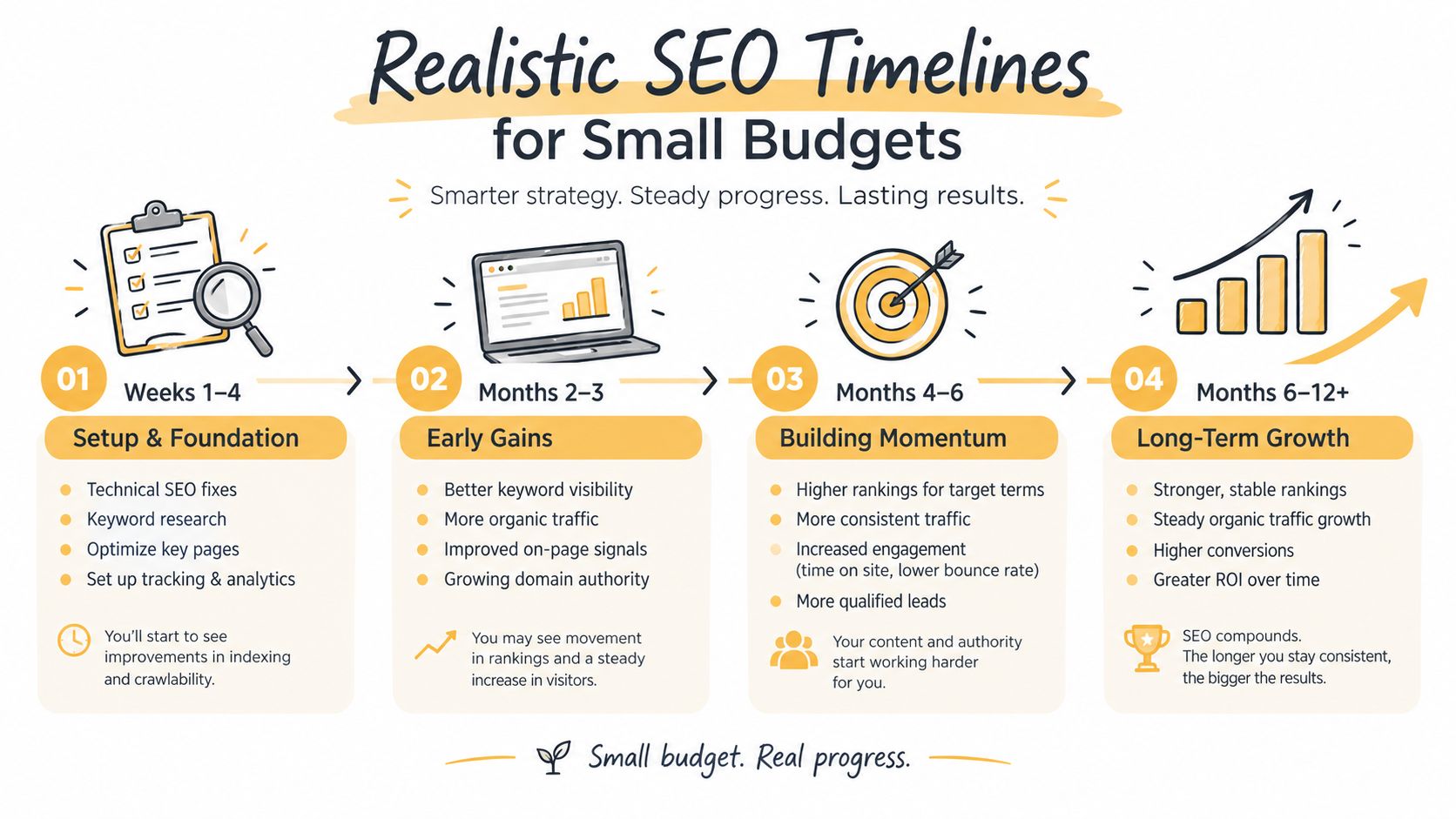
SEO timelines should be planned as a sequence of operating phases, not a promise that rankings will appear on a specific date. A business investing $1,500 to $5,000 per month can usually expect different work and signals at each stage, but competition, site quality, and search demand still control the pace.
Months one through three
The opening phase focuses on technical setup, crawl problems, page structure, tracking, local listings, and initial content. The team may fix broken internal links, consolidate weak pages, improve service descriptions, and publish material targeting specific customer needs.
Rankings may barely move. That doesn't mean the work failed. Search engines need time to recrawl changes, evaluate the content, and compare the site with established competitors.
Months four through six
Long-tail terms often provide the first visible movement. Impressions can rise while clicks remain modest because the pages are still climbing and may not yet earn prominent positions.
This is the period when owners often get impatient. Look for improving query coverage, better page indexing, stronger local relevance, and early inquiries rather than expecting a finished lead engine.
Months seven through twelve
The inflection window usually arrives when mid-priority terms begin reaching page one and more pages qualify for commercial searches. Lead volume can start becoming meaningful, but the business still needs strong calls to action, fast response times, and accurate service-area information.
Benchmark summaries place break-even around months nine through eleven, as reported in this guide to how long SEO takes to work. If a migration, content drought, major technical issue, or algorithm shift interrupts the program, the timeline can extend substantially. Build contingency into the plan instead of treating every delay as evidence that SEO is useless.
SEO Pricing for Small Businesses: What to Expect
The lowest SEO quote often buys activity, not progress. A small retainer may cover a report, a handful of edits, and generic blog posts, while leaving no budget for the technical, content, local, or authority work needed to compete.
Meaningful small-business SEO commonly falls between $1,500 and $5,000 per month. Retainers below $500 rarely create dependable results, according to QuickSEO's 2026 SMB SEO benchmarks.
| Monthly Budget | Typical Services | Expected Timeline to ROI |
|---|---|---|
| $500 to $1,000 | Basic on-page work, limited content, local listing maintenance, or guided DIY | Often too limited to create dependable momentum |
| $1,500 to $3,000 | Technical work, local SEO, service pages, content production, reporting, and selective outreach | Commonly requires a sustained timeline before break-even |
| $3,000 to $5,000 | More frequent content, technical improvements, competitive link acquisition, conversion work, and deeper analysis | Faster execution, but still dependent on market and site conditions |
Treat those tiers as planning ranges, not promises. A sensible allocation might direct 30% to 40% toward content, 20% to 30% toward links and outreach, 15% to 20% toward technical SEO, and 10% to 15% toward reporting and tools. A site with serious technical debt may need more technical work early. A strong site in a competitive market may need more authority development.
Your retainer may exclude a website rebuild, conversion-rate optimization, photography, professional copywriting, review generation, or developer time. Get those exclusions in writing before signing. For contractor comparisons, review SEO pricing for home improvement as a useful market reference.
Owners who can handle basic updates can use a hybrid model. You manage customer interviews and simple website changes, while an SEO specialist handles research, technical priorities, content briefs, and measurement. That lowers the cash cost, but it does not remove the execution requirement.
Choose the budget by matching it to your market, capacity, and timeline. If you need leads immediately, reserve money for paid acquisition while SEO builds an asset that can produce over time.
AI Overviews and the Zero-Click Problem
AI Overviews change the question from “Can I rank?” to “Will organic visibility create a useful next step?” A search result can earn exposure without sending a visitor to the website, especially when a user wants a basic definition, checklist, or general explanation.
A recent benchmark reports that, in the United States, only 360 clicks reach the open web per 1,000 Google searches, according to Do Better's small-business SEO statistics. That means traffic volume alone is a weak success measure. A small business needs visibility tied to calls, quote requests, purchases, appointments, and branded demand.
Where the clicks still matter
Bottom-funnel searches remain valuable because users want to compare providers, check pricing, review services, or take action. Local pack visibility, branded searches, product-category pages, comparison pages, and location-specific service pages give the searcher a reason to continue.
Structure content so it can be understood and cited in answer surfaces, but don't stop there. Include proof, service details, qualifications, pricing context, strong internal paths, and clear conversion actions. The goal is to become a credible answer and a credible provider.
Small businesses should also narrow their focus. The discussion of how to define your defensible niche is useful for identifying topics where a company has genuine experience instead of publishing generic material that an AI system can summarize easily.
Use this guide to optimizing for AI Overviews as a tactical reference, but evaluate it against business outcomes. A citation that produces no qualified demand may support visibility, yet it doesn't automatically justify the investment.
Metrics and Decision Criteria You Should Use
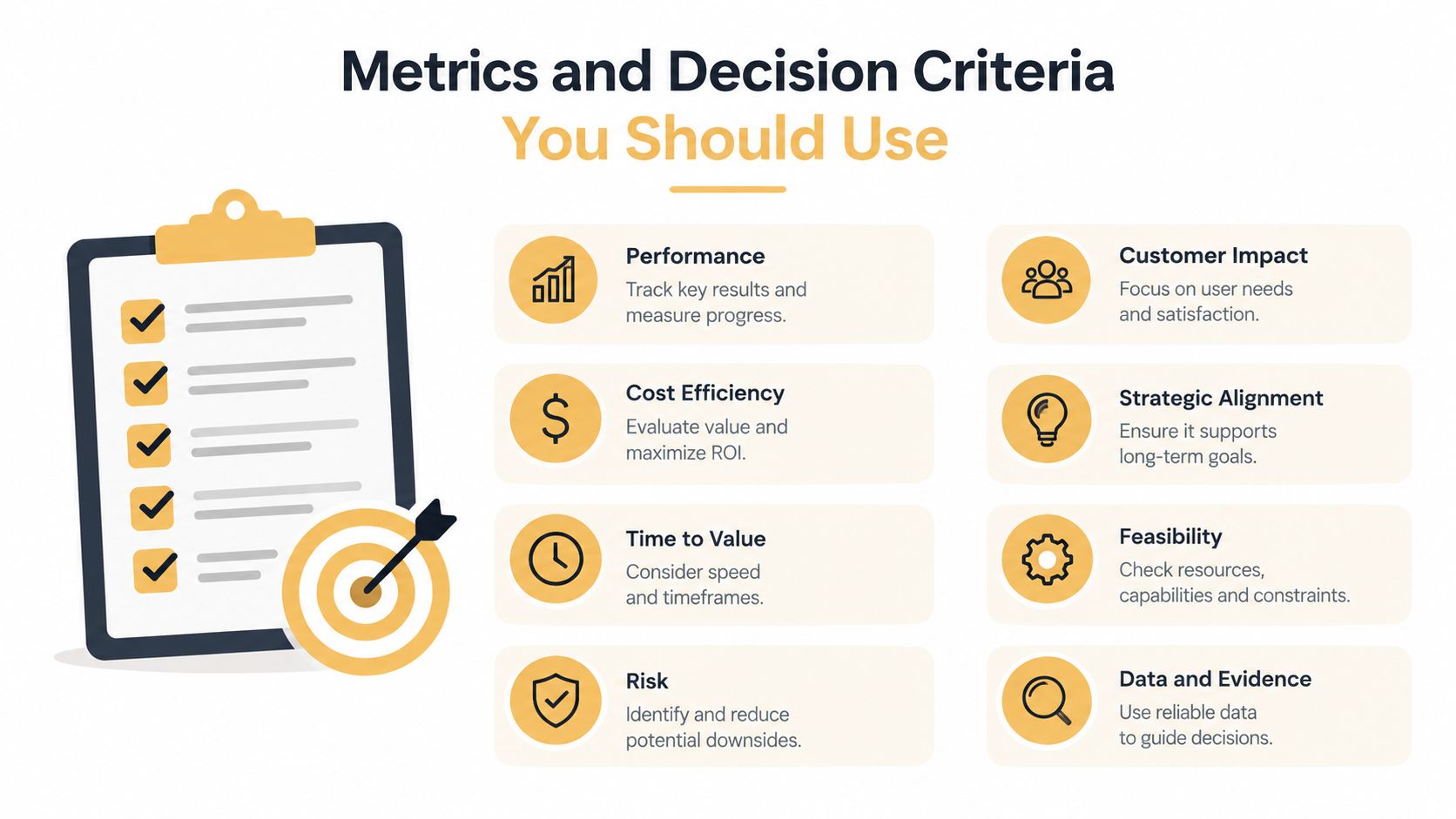
Don't judge SEO by impressions alone. Impressions can rise while the business receives no calls, no form submissions, and no revenue. Rankings matter because they explain visibility, but they remain an intermediate signal.
Track organic conversions first. Count completed forms, tracked phone calls, appointment requests, purchases, and other actions that represent genuine demand. Then measure organic-assisted revenue, including deals where search influenced discovery but another channel received the final attribution.
The dashboard that deserves your attention
- Organic conversions: Separate qualified calls and submissions from low-value contacts.
- Pipeline contribution: Record opportunities that originated through organic search, even when the final sale happens offline.
- Customer value: Compare the expected value of a new customer with the cost of acquiring them.
- Commercial page conversion rate: Review service, product, and location pages separately from informational content.
- Search visibility: Monitor relevant page-one terms and whether they match the services you sell.
- Response capacity: Track how quickly your team answers organic inquiries and whether it can serve the demand.
Use a warning system rather than one magic KPI. An organic conversion rate under 2% on commercial pages deserves investigation, as does having no top-10 keywords after six months or seeing a service business produce fewer than 25 leads per month once the program should be mature. Those thresholds are decision prompts, not universal laws. A high-value B2B lead may justify a lower volume, while a low-margin local service needs more activity.
Measure the money path: Search query, landing page, call or form, qualified opportunity, closed customer, revenue.
A ten-minute go or no-go audit
Answer these questions without optimism:
- Can you commit at least $1,500 per month for 12 months?
- Can the business absorb a 9 to 11 month payback period?
- Does customer lifetime value justify the expected acquisition cost?
- Do enough customers search for your service or product?
- Can your team respond to and fulfill new demand?
- Is the website clear, credible, and technically serviceable?
- Can you distinguish organic leads from other marketing sources?
- Will you keep investing after early rankings appear?
If several answers are no, pause. Spend the next budget on offer clarity, conversion improvements, paid demand capture, or operational fixes. SEO becomes more useful once those foundations are ready.
A Straightforward Verdict on Whether SEO Is Worth It
SEO is worth it when budget, patience, customer value, and execution capacity line up. It's a waste of money when an owner buys a low-cost retainer, expects immediate leads, and has no plan for answering or closing them.
My threshold is straightforward. Invest when you can support more than $1,500 per month, commit to at least 12 months, serve customers whose lifetime value is comfortably above $1,000, and handle the lead flow once visibility improves. That threshold isn't a promise of profit. It's the minimum operating environment in which the long-term model has a reasonable chance.
Skip SEO for now if you're pre-revenue, don't have a functional website, or need leads this quarter. Use paid search, direct outreach, partnerships, referrals, or a stronger offer to solve the immediate problem. You can return to SEO when the business has enough cash flow and evidence of search demand.
For businesses that qualify, the first 90 days should be concrete:
- Audit the site: Find indexation, speed, structure, duplicate content, and conversion problems.
- Improve the Google Business Profile: Verify categories, services, locations, photos, reviews, and contact details.
- Choose a tight local set: Start with 20 high-value keywords tied to services, products, and locations.
- Fix the money pages: Make every priority page answer the customer's problem and provide a clear next action.
- Install measurement: Track calls, forms, sales, assisted conversions, and lead quality before publishing at scale.
AI Overviews don't make focused SEO irrelevant. They make generic traffic less valuable. The small businesses that win will target commercial intent, prove local credibility, build pages worth citing, and connect visibility to a conversion path.
If you want a local partner to evaluate that fit, Up North Media offers data-driven SEO marketing, technical optimization, content strategy, and AI consulting for businesses that need measurable organic growth rather than a monthly activity report. Visit Up North Media to request a consultation and decide whether your budget, timeline, and market support an SEO investment.