

You're probably in one of two spots right now. Either you're paying for SEO and wondering whether it's producing real business value, or you're looking at traffic and rankings and still can't answer the question your owner, CFO, or sales team cares about: what did SEO return?
That confusion is common because most SEO reporting still hides behind activity metrics. Impressions went up. A few keywords moved. Organic sessions look better than last quarter. None of that is enough on its own. If you want to know how to measure SEO ROI, you need a system that connects search visibility to revenue, leads, and cost.
At Up North Media, this is the framework we use to report SEO performance in a way business owners can trust. It's practical, not theoretical. It works for a local Omaha service company trying to value phone calls and quote requests, and it works for an e-commerce manager who needs to tie organic sessions to actual orders.
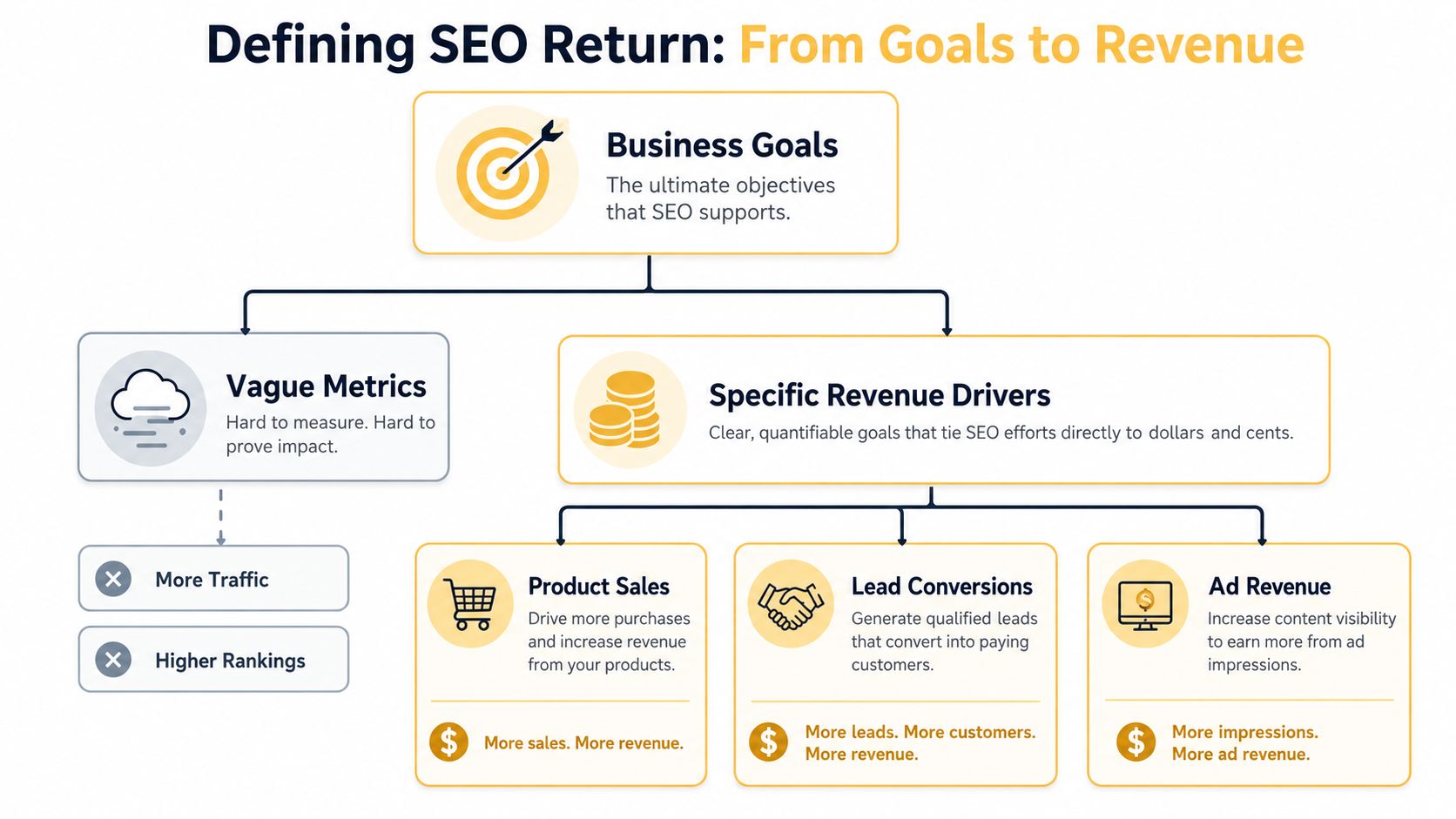
Defining What a Return Means for Your Business
Most businesses start in the wrong place. They ask whether traffic increased before they define what a return means.
A return isn't “more organic users.” A return is money created from organic search. That can come from direct product sales, booked consultations, form fills that turn into customers, phone calls that become jobs, or even ad revenue if your site monetizes attention. Until you assign a dollar value to those outcomes, you're not measuring ROI. You're just watching movement.
Start with the action that creates value
For an e-commerce store, this is straightforward. An organic visitor buys a product. The order has a clear value.
For a service business, the path is usually longer. A visitor lands on a page, submits a form, makes a call, or requests an estimate. That action is not revenue yet, but it still has value if you know what typically happens after the lead reaches your team.
Here's the simplest way to consider it:
- E-commerce businesses: Use organic purchase revenue tied to completed orders.
- Lead generation businesses: Assign a value to each qualified lead based on what that lead is worth to the business.
- Hybrid models: Track both. Some visitors buy immediately, while others enter a sales process.
Turn leads into a dollar value
If you run a law firm, HVAC company, med spa, roofing company, or B2B service in Omaha, your site probably doesn't close the deal by itself. It creates opportunities. That means your SEO return depends on the value of those opportunities.
A practical way to do that is to estimate lead value using your customer lifetime value or average customer value, then multiply by your lead conversion rate. That approach is part of the ROI framework described in SE Ranking's breakdown of SEO ROI, which notes that conversion value can be derived from lead value or customer lifetime value multiplied by lead conversion rate.
Practical rule: If your sales team wouldn't treat all leads as equal, your SEO report shouldn't either.
That matters a lot. A contact form from someone outside your service area shouldn't carry the same value as a qualified estimate request from a buyer your team can close. Good ROI reporting filters for business reality.
Use a fallback when direct revenue tracking is incomplete
Sometimes the tracking isn't clean enough yet. A store may have partial purchase attribution. A local business may know organic drives calls, but not every call is tagged perfectly. In that case, forecasting is still possible.
A more granular method for indirect ROI is to estimate SEO value as estimated traffic × average organic conversion rate × average organic order value, then subtract estimated SEO cost, as outlined by Precis in its SEO value framework. This works best when you use conservative assumptions and clean segmentation.
If you need a broader marketing framework around that logic, our guide to calculating marketing ROI helps connect channel-level returns back to business outcomes.
What doesn't count as return
A few things look impressive in a report but don't belong in your return calculation by themselves:
- Traffic without action: More sessions don't matter if visitors don't buy, call, or submit.
- Rankings with weak intent: Ranking for informational searches can help, but not every ranking drives revenue.
- Unqualified conversions: Spam forms, wrong-location calls, and junk leads distort the picture.
Define return with the same discipline you'd use for payroll, inventory, or sales reporting. If the number can't be defended in a business meeting, don't use it.
Tracking Your Total SEO Investment
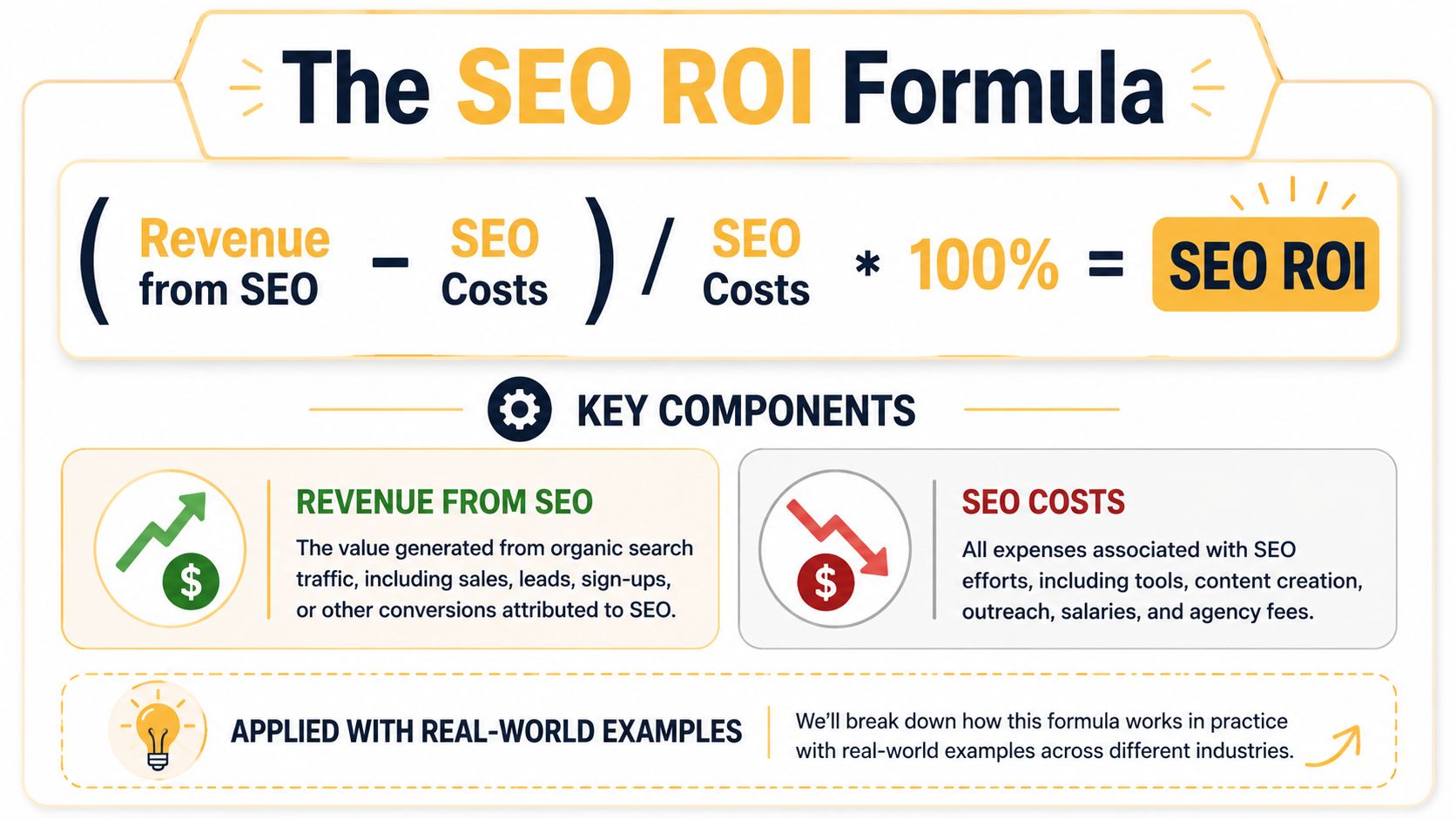
Most SEO ROI reports fail on the cost side, not the revenue side. They count the agency retainer and ignore everything else.
That inflates ROI and creates bad decisions. If you only compare organic revenue to one invoice, your numbers will look stronger than they really are. SEO costs include strategy, implementation, tools, content, and internal time. If your team spends hours reviewing pages, fixing templates, adding schema, or uploading content, that labor belongs in the calculation.
What should be in your SEO cost base
SE Ranking's ROI guidance specifically notes that costs should include agency fees, tools, and internal implementation time in a complete cost base, which is why we build reporting around full operational cost rather than vendor cost alone.
A realistic SEO investment usually includes several layers:
| Cost Category | Example | Monthly Cost Estimate |
|---|---|---|
| Agency or consultant | Ongoing strategy, technical audits, reporting, content planning | Varies by engagement |
| SEO tools | Ahrefs, Semrush, SE Ranking, Screaming Frog, Surfer, call tracking platforms | Varies by stack |
| Content production | In-house writer time, freelancer briefs, editing, product copy updates | Varies by publishing volume |
| Development support | Fixing crawl issues, page speed updates, template changes, schema work | Varies by backlog |
| Design support | Creating page assets, improving CRO elements, updating content layouts | Varies by need |
| Internal marketing time | Approvals, uploads, QA, publishing, cross-team coordination | Varies by team structure |
That table is intentionally simple because the exact dollar amounts differ by business. What matters is that you include every category that absorbs budget or labor.
The hidden cost most teams skip
Internal time is usually the missing line item.
If your marketing manager spends part of the month reviewing content, your developer fixes technical issues from the SEO backlog, and your operations team helps validate lead quality, those hours are part of SEO delivery. They might not show up on an invoice, but they still cost the business money.
The fastest way to overstate SEO ROI is to pretend implementation happens for free.
This is one reason I prefer cost tracking in a shared spreadsheet or dashboard instead of relying only on accounting exports. Accounting often catches software subscriptions and agency payments, but it rarely captures staff time tied to organic growth work.
Build a cost model that finance can understand
The cleanest structure is to group SEO costs into three buckets:
- Fixed outside costs such as agency retainers, consultants, and software.
- Variable production costs such as articles, landing pages, design assets, and video support.
- Internal labor costs tied to implementation, approvals, and maintenance.
This makes your ROI reporting easier to explain because each cost bucket maps to a real business function. It also helps when comparing SEO to other channels. If you already track paid media efficiency, our customer acquisition cost calculator guide is useful for thinking about where SEO fits in the broader acquisition mix.
What works and what doesn't
What works is conservative accounting. Include more costs than you think you need, then defend the result confidently.
What doesn't work is cherry-picking. If content creation is in one department, development is in another, and the owner occasionally steps in to approve changes, that fragmentation doesn't make the cost disappear. It just makes the report less honest.
Gathering Your Performance and Conversion Data
Once your return definition and cost base are in place, the next job is data collection. Most businesses become overwhelmed at this point, not because the tools are impossible, but because they pull different kinds of truth.
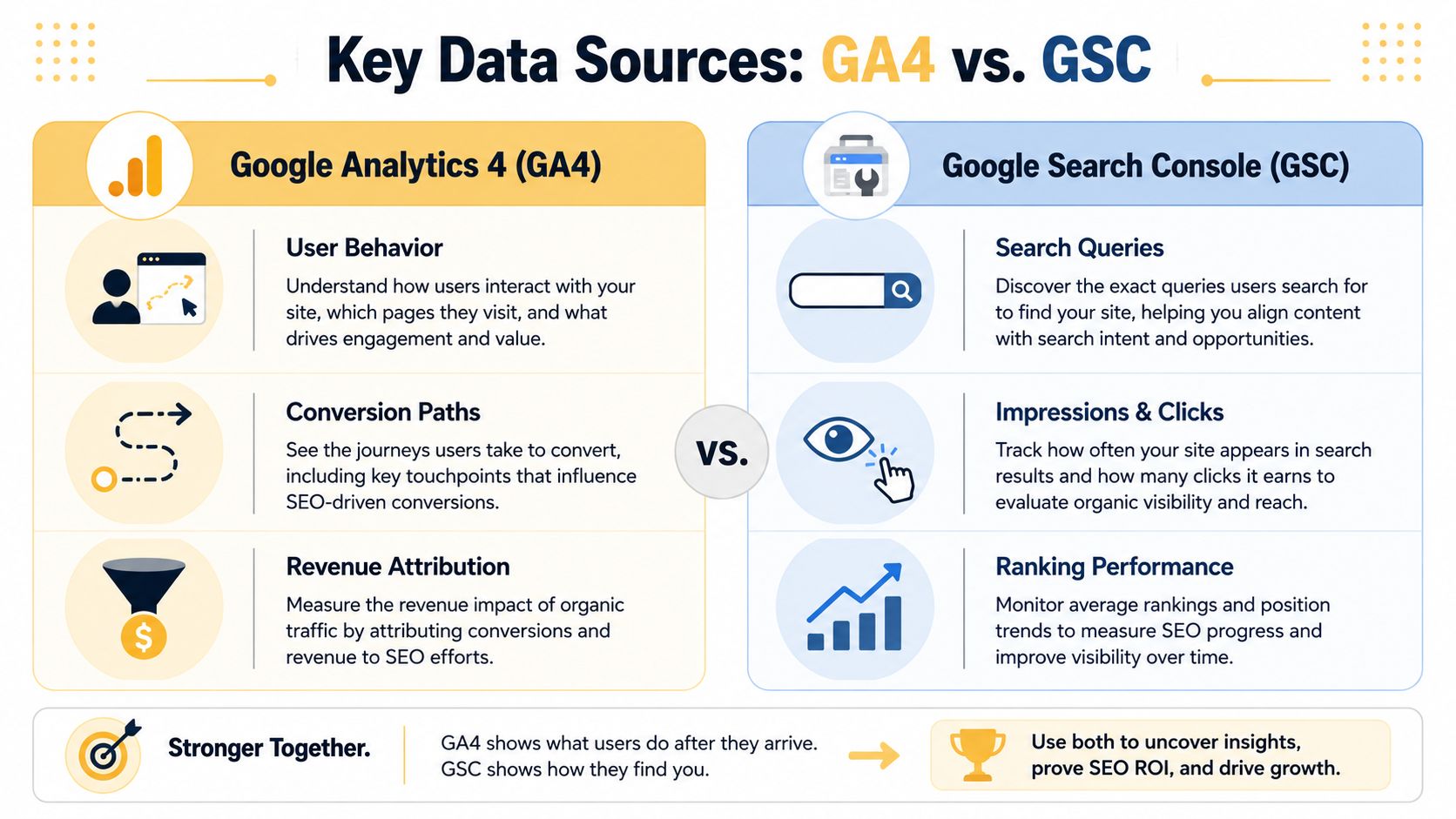
Google Analytics 4 tells you what users did on the site. Google Search Console tells you how people found you in search. You need both to understand how to measure SEO ROI properly.
A quick side-by-side helps clarify the roles.
What to pull from GA4
GA4 is where you look for business outcomes tied to organic traffic. Depending on your setup, that may include purchases, form submissions, phone click events, appointment requests, or other conversion events.
Focus on these questions:
- Which conversions came from Organic Search?
- Which landing pages assisted or drove those conversions?
- What revenue is attributed to organic if you sell online?
- Are mobile and desktop users behaving differently?
For e-commerce, this is usually cleanest because purchase events can be tied directly to the organic channel. For lead gen, the report becomes more useful when your forms, calls, and booking events are configured correctly in Google Tag Manager and GA4.
What to pull from Search Console
Search Console tells you how searchers interacted with your listings before they ever became a user in GA4.
Look at:
- Queries that bring in impressions and clicks
- Landing pages attracting search demand
- Click and impression trends by page type
- Performance shifts on service pages, category pages, and blog content
GA4 may tell you that a service page converts well. Search Console tells you whether that page is showing up for the right searches in the first place. Together, they explain both demand and outcome.
This video gives a useful walkthrough of the data relationship between search visibility and site performance.
Attribution changes the story
Attribution is where business owners often get blindsided. The same lead or sale can look more or less valuable to SEO depending on the attribution model you use.
Think of attribution like credit in a relay race. One runner started the race, another carried the middle, and a final runner crossed the line. If you only reward the last runner, you miss the effort that got the team there.
Common models include:
- First-touch attribution: Gives credit to the first channel that introduced the user.
- Last-touch attribution: Gives credit to the final channel before conversion.
- Linear attribution: Spreads credit across multiple touches.
- Data-driven attribution: Uses platform modeling to assign credit based on observed behavior.
Which model fits which business
A local emergency plumber may care more about the final click because the path to conversion is short. A B2B software firm in Omaha with long buying cycles should pay close attention to first-touch and assisted conversions, because blog posts and educational pages often start journeys that close later through direct, email, or branded search.
If your sales cycle is long, last-click reporting usually undervalues SEO content that created the opportunity in the first place.
If attribution still feels fuzzy, our explainer on marketing attribution models gives a practical breakdown of how to choose the right lens.
Calculating ROI with Real-World Examples
An Omaha business owner looks at the monthly SEO invoice and asks a fair question: what did this produce in dollars? That answer should fit on one page, and it should tie back to how the business makes money.
The formula is simple: SEO ROI = (SEO revenue − SEO costs) / SEO costs. The work is in assigning a realistic revenue number to organic traffic and making sure every cost is included. At Up North Media, we use the same reporting structure across local service clients and e-commerce accounts because leadership teams need a number they can defend, not a spreadsheet full of activity metrics.
Example one with a local Omaha service business
Take an Omaha plumbing company spending $3,500 per month on SEO, content, and technical updates. Organic search brings in phone calls and estimate requests, not online checkout revenue, so the revenue side has to come from lead value.
A practical calculation looks like this:
- Start with total monthly SEO cost.
- Pull only qualified organic leads for that same month.
- Apply the business's average close rate and average job value.
- Estimate revenue from those leads.
- Plug the numbers into the ROI formula.
Example:
- Monthly SEO investment: $3,500
- Qualified organic leads: 28
- Lead-to-customer close rate: 30%
- Average revenue per new customer: $900
Estimated SEO revenue = 28 × 30% × $900 = $7,560
SEO ROI = ($7,560 − $3,500) / $3,500 = 1.16, or 116%
That means the campaign generated an estimated $1.16 in return for every $1 spent during that reporting period.
This only works if the lead count is clean. Spam calls, repeat customers calling about an old invoice, and jobs outside the service area should be excluded before any value is assigned.
Example two with an e-commerce store
Now take an online apparel brand. The math is cleaner because the store can usually tie purchases and revenue to the organic channel inside GA4 or its e-commerce platform.
Example:
- Monthly SEO investment: $6,000
- Organic revenue for the month: $18,000
SEO ROI = ($18,000 − $6,000) / $6,000 = 2.0, or 200%
In plain English, organic search returned $2 for every $1 spent.
E-commerce teams still need judgment here. If returns, canceled orders, or heavy discounting cut into actual margin, reporting gross revenue alone can make SEO look stronger than it really is. For some stores, contribution margin is the better input than top-line sales.
Where businesses usually get this wrong
Common calculation errors include:
- Over-crediting revenue by counting every organic conversion, even when lead quality is poor.
- Under-counting costs by leaving out internal labor, developer hours, freelance content, or platform fees.
- Using mismatched time periods so this month's costs are compared against a different conversion window.
- Reporting precise numbers for rough estimates instead of labeling modeled revenue clearly.
For teams focused on measuring marketing's true impact, clarity matters more than false precision. A documented estimate based on real sales data is more useful than a polished report built on weak assumptions.
The reporting structure we actually use
Our client reports usually reduce this to four lines. If those four lines are right, the conversation stays grounded in business performance.
| Reporting Element | What it should show |
|---|---|
| Organic business outcomes | Sales, qualified leads, booked calls, or other primary conversions |
| Organic value or revenue | Direct revenue when available, estimated lead value when necessary |
| Total SEO investment | Agency fees, tools, content production, development support, and internal time |
| ROI interpretation | Positive return, break-even trend, or early traction that has not matured into revenue yet |
That structure keeps the reporting honest and easy to review with an owner, finance lead, or marketing manager. Up North Media uses this framework to show clients what organic search contributed, what it cost, and where the assumptions sit if revenue has to be modeled rather than tracked directly.
Common Pitfalls and Structuring Your SEO Report
A calculated number can still be misleading. I've seen businesses undervalue SEO because they only looked at last-click conversions, and I've seen others overstate performance because they counted every branded visit and every low-quality form fill as proof of success.
The fix isn't another dashboard. It's better judgment about what belongs in the report.

Pitfalls that distort SEO ROI
A few mistakes show up constantly:
- Brand-heavy reporting: If organic growth comes mostly from people already searching your company name, your report may exaggerate the impact of non-brand SEO work.
- Last-click tunnel vision: This is especially damaging for content-driven SEO. Educational pages often introduce the buyer long before a final conversion happens.
- Short reporting windows: SEO often compounds over time. Looking at a narrow slice can make strong work look weak.
- No lead qualification filter: Raw lead volume is not the same as revenue potential.
- Disconnected implementation costs: If content, dev work, and internal approvals are excluded, ROI gets inflated.
Good SEO reporting separates signal from noise. It doesn't just total up whatever the platform exports.
What a useful SEO ROI report includes
The best reports are concise. They tell a business story, not a data story.
A monthly or quarterly report should include:
-
Business outcomes from organic search
Show conversions that matter. For example, purchases, qualified leads, booked appointments, or sales opportunities. -
Revenue or estimated conversion value
Use direct organic revenue when available. If you're in lead gen, show how lead value was assigned. -
Full SEO cost base
Include outside services, tool costs, content production, and internal implementation time. -
Context from search performance
Include supporting indicators such as query visibility, landing page performance, and conversion paths, but only as context. -
Interpretation and next actions
Explain what changed, why it matters, and what the team should do next.
A simple report template you can adopt
If you want a structure that survives a real business review, use this format:
| Section | Purpose |
|---|---|
| Executive summary | One paragraph on whether SEO created business value in the period |
| Cost summary | Total SEO spend and any notable implementation investments |
| Organic outcome summary | Conversions, revenue, or estimated lead value from organic |
| Attribution notes | Whether the numbers are last-click, first-touch, or assisted |
| Key page insights | Which pages or content groups influenced outcomes |
| Action plan | The next priorities based on what the data actually shows |
That's the framework we trust because it keeps everyone focused on business impact. It also reduces the chances of SEO becoming a debate about rankings instead of a conversation about revenue.
Frequently Asked Questions About SEO ROI
What is a good SEO ROI
There isn't a universal benchmark that applies to every business, and I won't pretend there is. A good SEO ROI is one that exceeds your cost of acquiring customers through other channels and holds up under honest cost accounting.
For a local business, a good return might come from a steady flow of qualified calls and estimate requests. For e-commerce, it might come from organic revenue that keeps producing after the content or category work is done. The right comparison is usually your own economics, not an industry brag sheet.
How long does it take to see SEO ROI
That depends on your site, market, implementation speed, and how cleanly your conversion tracking is set up. Some businesses see useful leading indicators early, while revenue impact takes longer to become obvious.
What matters is separating early signals from final ROI. Early signals include better visibility on important pages, stronger click-through from search, and more qualified organic conversions. Final ROI requires those signals to translate into revenue or lead value over a reasonable time window.
Should local SEO and national SEO be measured differently
Yes. The formula can stay the same, but the inputs often differ.
A local SEO campaign usually revolves around calls, form fills, booked appointments, and service-area relevance. A national campaign may rely more on category revenue, broader content attribution, and longer customer journeys. The point is not to force identical reporting. The point is to use the same business logic while respecting different buying behavior.
Can you measure the ROI of a single blog post
You can, but you need to be careful. A single blog post may drive direct conversions, assisted conversions, email signups, or branded searches later. If you judge it only on last-click sales, you may miss its real value.
The better approach is to evaluate a post in context:
- Direct impact: Did the post drive tracked conversions from organic visitors?
- Assisted impact: Did readers later convert through another channel?
- Strategic role: Did the post support a larger content cluster or commercial page?
What if I can't track revenue directly from organic search
Use estimated value, but label it as estimated. That's where a lead-value model or the indirect SEO value approach discussed earlier becomes useful.
What doesn't work is refusing to measure anything until tracking is perfect. Most businesses can build a credible ROI model before their analytics setup is flawless. The key is to stay conservative and document your assumptions.
How often should I report SEO ROI
Monthly is useful for monitoring progress, but quarterly often gives a clearer picture of actual business impact. SEO rarely moves in a straight line, and short-term swings can distract from the trend that matters.
My recommendation is simple:
- Monthly: track outcomes, costs, and leading indicators
- Quarterly: review true ROI and strategic direction
What should I do if SEO looks unprofitable right now
Don't panic. Diagnose.
Ask these questions first:
- Are conversions being tracked correctly?
- Are you counting qualified outcomes or raw submissions?
- Is brand traffic masking weak non-brand performance?
- Are costs fully accounted for?
- Are you using the right attribution model for your sales cycle?
If those answers are solid and SEO still isn't producing value, then you have a strategy issue. That could mean weak targeting, poor page quality, slow implementation, or content that attracts the wrong audience. The fix starts with honest diagnosis, not softer reporting.
If you want help building a reporting system that ties SEO work to real business outcomes, Up North Media can help you structure the tracking, attribution, and ROI model around how your business makes money. That's usually the point where SEO stops feeling vague and starts becoming a channel you can manage with confidence.