

If you're an Omaha business owner, there's a good chance your keyword research currently lives in a few places at once. A note on your phone. A half-finished spreadsheet. Maybe a list of terms you think customers use, mixed with the names you use internally. Then you open a keyword tool, stare at a pile of phrases, and still don't know which ones belong on your site.
That's normal. It's also where a lot of small business SEO stalls out.
Good keyword research for small business isn't about finding the biggest terms. It's about matching the words real customers use with the pages that make you money. If you run a remodeling company in Dundee, a med spa in West Omaha, a boutique in Benson, or a lawn care company serving Papillion and Elkhorn, the process needs to reflect your market, your services, and the way local people search.
This is the process we use with local clients. It's practical, local, and built to help you stop guessing.
Lay the Groundwork Before You Search
Most keyword problems start before anyone touches Google Keyword Planner.
A business owner says they want "more traffic," but traffic by itself doesn't pay for payroll, materials, or rent. The first move is to decide what kind of search visibility is worth pursuing. A home services company in Omaha usually doesn't need more visits from random readers across the country. It needs qualified local searches that turn into calls, form fills, or booked jobs.
Start with a business goal, not a tool
Write down one concrete SEO goal tied to a service and a place. Keep it plain. For example:
- Remodeling company: Generate qualified leads for kitchen remodels in Dundee and Aksarben
- Family law firm: Attract consultations for divorce and custody work in Omaha
- Boutique retailer: Increase local visibility for gift and seasonal product searches in Benson and the Old Market
- Lawn care business: Win more estimate requests for lawn treatment and cleanup in West Omaha
That goal changes your keyword choices. If your target is kitchen remodeling leads, "DIY cabinet paint ideas" may bring visitors, but it probably won't bring the kind of prospect your sales process wants. On the other hand, a phrase tied to service, location, and urgency belongs much higher on your list.
Practical rule: If a keyword can't be connected to a real customer action, it doesn't deserve a primary place in your plan.
Build a simple buyer persona
You don't need a polished agency deck for this. You need a usable profile of the customer you're trying to reach. Think through three things:
- What problem are they trying to solve?
- What words would they type into Google?
- What would make them choose you instead of another Omaha business?
Take an Omaha roofing company as an example. The owner may talk about "composite shingle systems" and "hail restoration." The customer usually types something closer to "roof repair omaha" or "hail damage roof contractor near me." The language difference matters. Small-business SEO guidance consistently recommends starting with customer language instead of internal branding language, and using seed keywords to uncover search volume, competition, and long-tail opportunities in tools like Google Keyword Planner, which also shows search volume and competition levels for prioritization according to this small business keyword research guide.

A simple persona can fit on one page:
- Who they are: Homeowner in Midtown Omaha
- What they need: Fast quote for bathroom remodel
- What they care about: Trust, timeline, budget clarity, local experience
- What they search: "bathroom remodel omaha," "bathroom contractor dundee," "small bathroom renovation near me"
If you need help turning that into something more structured, our guide on how to create buyer personas gives you a usable framework without making it overly complicated.
Watch for the wrong starting assumptions
Here are the prep mistakes I see most often with small businesses in Omaha:
- Leading with your brand language: Customers rarely search the way your internal team talks.
- Choosing goals that are too broad: "Rank better" isn't actionable.
- Ignoring service profitability: Some keywords attract interest but not worthwhile jobs.
- Skipping channel fit: If you sell products online, your keyword planning should also reflect product category and collection structure. That's where resources on essential ecommerce SEO strategies can help, especially if your business mixes local and ecommerce search demand.
The groundwork isn't glamorous. It does prevent weeks of wasted effort.
Build Your Master Keyword List
Once the goal is clear, build the raw list. This is the messy part, and that's fine. At this stage, you want breadth before judgment.
For Omaha businesses, I usually start with services, locations, modifiers, and customer problems. That creates enough material to evaluate later without turning the process into a random brainstorm.
Start with seed keywords
A seed keyword is the core phrase a customer would use to describe what you offer. For a local business, that often combines a service with a city or neighborhood. The foundation matters because seed terms are what you expand inside research tools.
Examples for Omaha businesses:
- Plumber: plumber omaha, drain cleaning omaha, water heater repair omaha
- Boutique: women's boutique omaha, gift shop benson, baby gifts old market
- Attorney: divorce lawyer omaha, custody attorney omaha
- Med spa: botox omaha, lip filler omaha, med spa west omaha
That approach aligns with established small-business SEO practice: start with seed keywords, then use tools such as Google Keyword Planner to review search volume and competition levels so you can spot terms with demand that aren't dominated by larger competitors as described here.
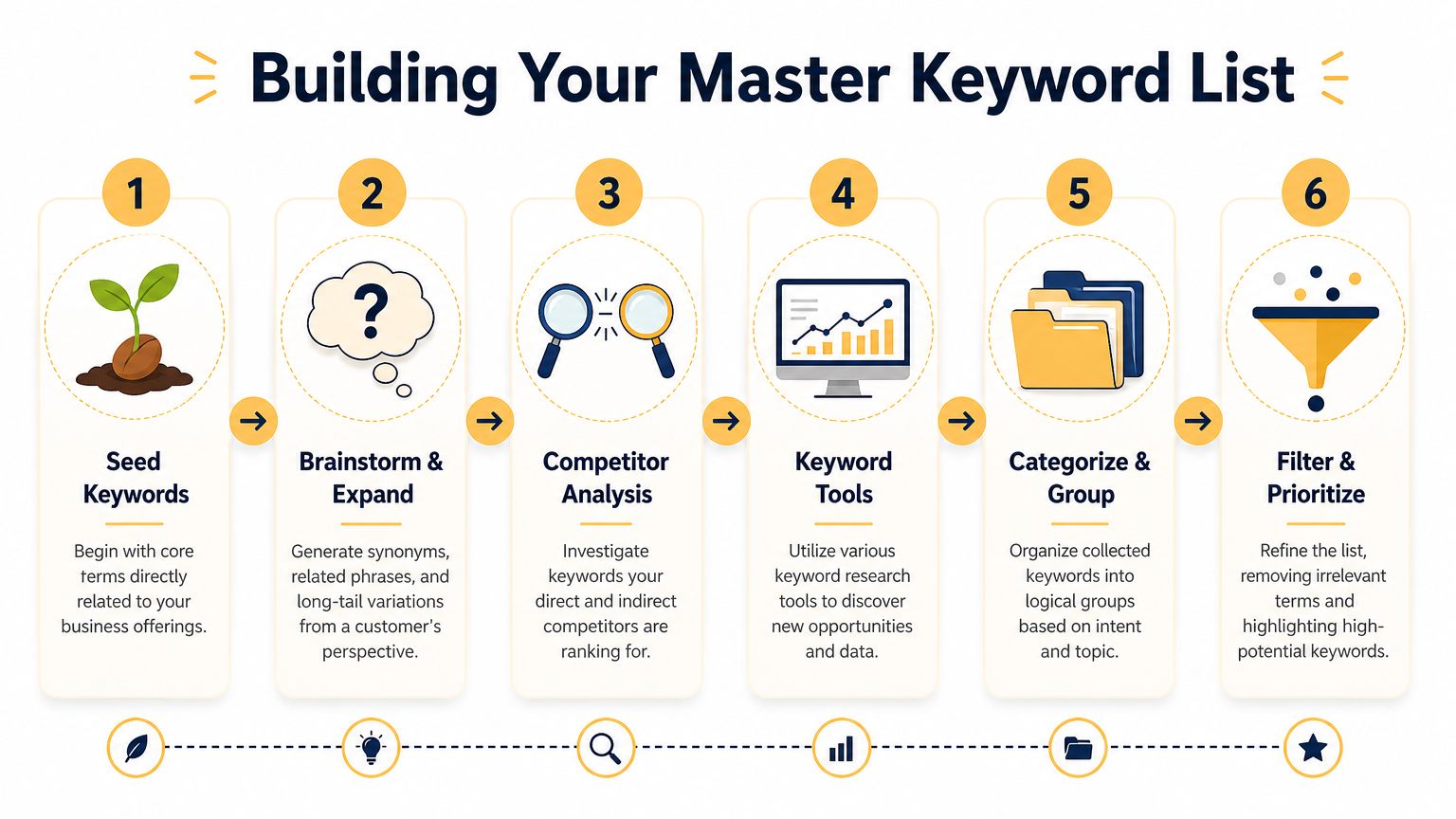
Expand from customer language
After seeds, expand in four directions.
- Service variations: emergency plumber omaha, same day plumber omaha
- Location modifiers: plumber elkhorn, plumber papillion, plumber midtown omaha
- Problem-based queries: clogged drain omaha, basement water problem omaha
- Specific long-tail phrases: emergency plumbing repair in west omaha
Long-tail keywords matter for small businesses because they're more specific and usually easier to compete for than broad head terms. They're often closer to action, especially when the search includes a problem, service type, or location intent as discussed in this guide for small businesses.
Don't stop at what your service is. Add how people describe the pain, the urgency, and the part of town.
A cosmetic dentist in Omaha shouldn't only list "cosmetic dentist omaha." They should also test phrases tied to outcome and concern, such as whitening, veneers, chipped tooth repair, and neighborhood-based modifiers.
Use tools, but don't let them think for you
Keyword tools help you expand and sort. They don't know your margins, your best jobs, or the neighborhoods you serve.
A practical workflow is to create 5 to 10 seed keyword categories, expand them with a tool, and keep everything in a spreadsheet so it can be sorted later by intent and business value. If you're deciding what software to use, our breakdown of SEO software options can help you compare the tools that make this process easier.
A typical category set for an Omaha HVAC company might look like this:
| Seed category | Example terms |
|---|---|
| AC repair | ac repair omaha, emergency ac repair omaha |
| Furnace service | furnace repair omaha, heating service west omaha |
| Installation | ac installation omaha, new furnace quote omaha |
| Maintenance | hvac tune up omaha, seasonal hvac maintenance |
| Indoor air | air purifier installation omaha, humidifier service |
Later, those buckets help you avoid chaos.
Here's a useful walkthrough if you want to see one process in action:
Check competitors the smart way
Competitor research doesn't mean copying another site's menu and calling it strategy.
Look at direct local competitors and a few adjacent businesses. If you're a wedding photographer in Omaha, inspect not only other Omaha photographers but also venues, planners, and event businesses that may be capturing useful search demand. The point is to find gaps.
Look for patterns like:
- Services they have pages for that you don't
- Neighborhoods they mention that you serve but never target
- Question-based content they rank for
- Terms they're using that match customer language better than yours
What's worked well in local campaigns is simple: collect broadly first, then cut aggressively. What doesn't work is creating dozens of near-duplicate keyword entries and treating each as its own strategy.
Prioritize Keywords That Actually Matter
A long spreadsheet feels productive. It usually isn't.
The hard part of keyword research for small business is choosing what deserves attention now, what can wait, and what should be cut. That's where owners often drift back toward vanity. They chase the phrase that sounds impressive instead of the term that matches intent and fits the website they have.
Use three lenses for every keyword
Every term on your list should be judged through three filters:
- Intent
- Difficulty
- Business relevance
Search volume belongs in the sheet too, but it doesn't get to make the decision alone.
Long-tail, lower-competition terms are widely recommended for small businesses because they're more specific, easier to rank for, and often convert better than broad terms. Guidance also stresses checking actual keyword difficulty, understanding search intent, and clustering related terms so multiple pages don't compete for the same query in this beginner-focused keyword research guide.
Read intent from the search itself
Intent is what the searcher wants. Four labels are enough for most small business planning:
| Intent | What it means | Omaha example |
|---|---|---|
| Info | Learning | when to reseed lawn in nebraska |
| Commercial | Comparing options | best wedding venue omaha |
| Nav | Looking for a brand | village pointe med spa hours |
| Trans | Ready to act | emergency electrician omaha |
A common mistake is treating all traffic the same. "How to unclog a shower drain" may fit a plumber's content strategy. It doesn't carry the same urgency as "24 hour plumber omaha." Both can be useful. They shouldn't get the same priority.
A good keyword list separates readers from buyers. A strong strategy knows how each supports the other.
Score for business value
Business relevance is the gut-check many spreadsheets miss. I use a simple scale from low to high value based on how closely the term connects to profitable work.
A few examples:
- High relevance: "commercial snow removal omaha"
- Medium relevance: "snow removal cost omaha"
- Lower relevance: "how often should sidewalks be salted"
That lower-relevance query can still be worthwhile as support content. It just shouldn't outrank your service pages in effort, copy budget, or internal linking.
Use a simple prioritization table like this:
| Keyword | Search Intent (Info/Commercial/Nav/Trans) | Monthly Volume | Difficulty (Low/Med/High) | Business Relevance (1-5) | Priority |
|---|---|---|---|---|---|
| bathroom remodel omaha | Commercial | Med | 5 | Now | |
| bathroom contractor dundee | Trans | Low | 5 | Now | |
| bathroom tile ideas | Info | High | 2 | Later | |
| remodel cost omaha | Commercial | Med | 4 | Next | |
| small bathroom layout ideas | Info | Med | 2 | Later |
You can leave volume blank until your tool gives you data. The point is the decision structure, not spreadsheet perfection.
Build Now, Next, and Later buckets
At this point, the list becomes usable.
Now should hold keywords that meet three conditions. They fit a core service, match clear intent, and are realistic for your current site.
Next includes strong terms that need better authority, more content support, or a new page.
Later is for broad informational topics, lower-fit searches, and ideas you don't want to lose.
For an Omaha personal injury firm, "car accident lawyer omaha" may be a core target, while "what to do after a rear-end collision in nebraska" might be a support piece. For a Benson retailer, "gift shop benson" may be immediate, while "best hostess gift ideas" belongs later.
What works is restraint. What fails is trying to publish against every phrase in the sheet at once.
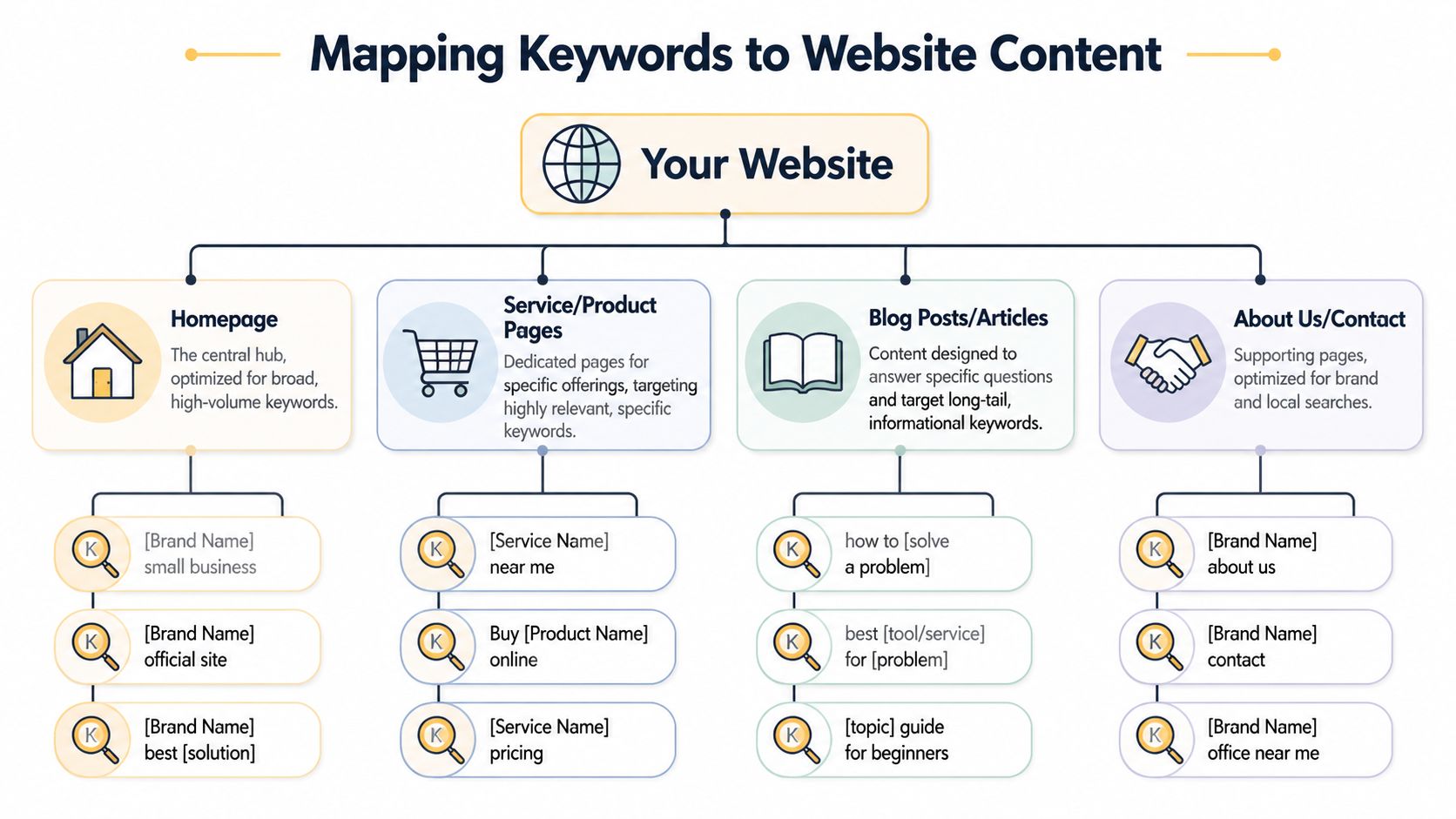
Map Your Keywords to Your Website Content
Keywords don't rank in a vacuum. Pages do.
Once priorities are set, each important term needs a home on your site. If you skip that step, you end up with three service pages and two blog posts all hinting at the same keyword. Then Google has to guess which page matters. Usually, it guesses wrong.
One keyword theme, one clear destination
For small businesses, a practical workflow is to build 5 to 10 seed keyword categories, expand them, segment them by intent in a spreadsheet, and then prioritize pages by business value and ranking difficulty. That process helps reduce keyword cannibalization and makes it easier to map terms to conversion pages versus supporting content as outlined in Kinsta's workflow.
That means every priority keyword cluster should map to one of a few page types:
- Homepage
- Service or product page
- Location page
- Blog or resource article
- About or contact page
Know your money pages and support pages
A money page is built to convert. A support page is built to attract and assist.
Here's how that looks for a local lawn care company:
| Page type | Best keyword fit | Example |
|---|---|---|
| Service page | High-intent service keyword | lawn care service omaha |
| Location page | Service + place | lawn care elkhorn |
| Blog post | Informational long-tail keyword | when to fertilize lawn in nebraska |
| Contact page | Brand and local queries | company name omaha contact |
If you run an ecommerce operation alongside local search, keyword mapping gets even more important because category, collection, and product pages can overlap fast. The same logic applies on marketplaces too. If you're trying to understand how tighter keyword-to-page alignment works in retail environments, Adverio's piece on how they optimized my listings on Amazon is a useful parallel.
Prevent cannibalization before it starts
Cannibalization happens when multiple pages chase the same term or the same intent. A few common examples:
- A homepage and a service page both target "Omaha med spa"
- Two blog posts cover nearly identical versions of the same question
- A service page and a location page both lean on the same primary phrase
The fix is usually structural, not magical. Choose the strongest page for the term, rewrite the weaker page around a different angle, and tighten internal links so each page has a clear role.
If two pages could rank for the same search and satisfy the same user, one of them probably shouldn't exist in its current form.
A clean map makes content planning easier too. You know which keywords belong on conversion pages and which ones support them from higher in the funnel.
Measure Success and Plan Your Resources
Keyword research isn't a one-time worksheet. It's an operating habit.
Businesses that treat it like a setup task usually plateau. They publish pages, glance at rankings once in a while, and then wonder why leads feel inconsistent. Search behavior changes, competitors publish new pages, and your own service priorities shift. Your keyword plan has to move with that.
Track the signals that connect to business results
For local businesses, adding geography-based modifiers like cities, suburbs, and neighborhoods helps narrow search visibility to high-intent nearby users. Guidance for small businesses also emphasizes measuring organic traffic, click-through rates, rankings, and conversions, which is why keyword work needs continuous review instead of a one-time setup according to this local SEO guide.
That gives you a practical KPI set:
- Rankings for target pages: Are core service pages moving for the terms you mapped?
- Organic traffic to those pages: Is search visibility turning into visits on the right URLs?
- Click-through rate: Are title tags and page intent aligned well enough to earn clicks?
- Conversions: Are users calling, submitting forms, or buying after landing there?
A page that climbs in rankings but never produces qualified leads isn't a win by itself.
Be realistic about resources
Most Omaha small businesses don't have a dedicated in-house SEO team. That means every keyword plan has to fit available time, content capacity, and technical support.
Here are the trade-offs:
- If you do it yourself: You'll save budget, but execution slows down.
- If you assign it internally: Someone needs clear ownership, not "marketing will get to it."
- If you use outside help: You still need internal input on sales quality, services, and seasonal priorities.
For teams building on WordPress and Elementor, a practical guide to SEO tools for Elementor can help streamline page optimization and workflow decisions.
This is also the one spot where tooling matters beyond research. Rank tracking, page-level reporting, and lead attribution all make the process easier to manage. One option local businesses may consider is Up North Media's SEO support, which includes tracking keyword rankings as part of campaign measurement.
Review on a schedule, not by mood
Set a routine. Monthly works well for most small businesses.
Use a review like this:
| Review area | What to ask |
|---|---|
| Rankings | Which priority keywords moved up, down, or stalled? |
| Pages | Which service and content pages gained useful traffic? |
| Leads | Which organic pages produced calls or form fills? |
| Gaps | Which valuable searches still don't have a strong page? |
If you want a cleaner way to connect this work to revenue, our guide on how to measure SEO ROI is a good next step.
The businesses that get the most from keyword research aren't doing more busywork. They're closing the loop between keyword choice, page performance, and lead quality.
Your Keywords Are Your Connection to Customers
Keyword research for small business is really about listening.
It tells you how Omaha customers describe their problems, how they compare providers, and when they're ready to act. That's why the process matters so much. You're not just assembling a list of phrases for a tool. You're building a cleaner connection between what you sell and what people are already searching for.
The practical version is straightforward. Start with a business goal. Build seed categories from customer language. Expand into local and long-tail terms. Cut the list based on intent, difficulty, and business value. Then map each important keyword to the page that should own it.
Keep it disciplined. A small business doesn't need hundreds of target keywords to get momentum. It needs the right terms, attached to the right pages, reviewed on a regular schedule.
If you're stuck, go back to the simplest question in the process: what would your best Omaha customer type into Google when they need you right now? Start there. That's usually where strategy begins.
If you want help turning this into a working keyword map for your Omaha business, Up North Media can help you align local search intent, page strategy, and performance tracking so your SEO work is tied to actual business goals.