

Hiring a web developer isn't something you just jump into. It all starts with a simple, foundational process: clearly define what you need built, figure out your budget, decide if you need a freelancer, an agency, or an in-house hire, and then turn your business goals into actual technical requirements.
Getting this groundwork right before you even think about posting a job is the single most important thing you can do to avoid costly mistakes and attract the right kind of talent from day one.
Laying the Groundwork Before Your First Hire
Before you start writing job descriptions or sifting through portfolios, you need to pause and build a real strategy. This initial planning phase is your best defense against scope creep, budget overruns, and hiring someone who just isn't the right fit. Getting brutally honest about what you actually need now will save you massive headaches later on.
Think of it this way: you wouldn't build a house without a blueprint. You shouldn't hire a developer without a clear plan, either. This means moving beyond a vague idea like "I need a website" and getting down to the specifics.
Define Your Technical Needs
First, you have to translate your business goals into technical requirements. Are you an Omaha-based retailer who just needs a simple Shopify site to start selling products locally? Or are you building a custom web application from scratch, complete with user accounts and complex databases? The developer you need for each of those projects is wildly different.
Break your project down into essential features. I always recommend my clients use this framework:
- Must-Haves: These are the non-negotiable functionalities. For an e-commerce store, this would be things like product pages, a shopping cart, and a secure checkout process. The site literally can't function without them.
- Nice-to-Haves: These are features that would be great but aren't critical for launch day. Maybe a customer review system or a loyalty program.
- Future Goals: These are the long-term ideas, like integrating an AI-powered recommendation engine, that will influence the initial architecture but won't be built right away.
This list directly tells you what kind of developer you're looking for. A front-end specialist is a master of user interfaces, a back-end developer builds the server-side logic and databases, and a full-stack developer can handle both. Knowing which one you need prevents you from paying for skills you won't actually use. If you're stuck, it's worth taking a moment to figure out how to choose the right tech stack for your project first.
Set a Realistic and Comprehensive Budget
Your budget is way more than just a developer's salary or hourly rate. A realistic financial plan has to account for all the associated costs to prevent nasty surprises down the road.
Your total investment should cover:
- Compensation: The developer's salary or project fee. This is the obvious one.
- Tools & Software: Licenses for development tools, project management software like Jira or Asana, or premium plugins.
- Hosting & Infrastructure: Costs for servers, domains, and security certificates (SSL).
- Ongoing Maintenance: You absolutely need a budget for updates, bug fixes, and security patches after the site goes live.
A common mistake I see small businesses make is underestimating these secondary costs. Factoring them in from day one ensures your project stays financially viable from development all the way through to its ongoing operation.
Choose Your Hiring Model
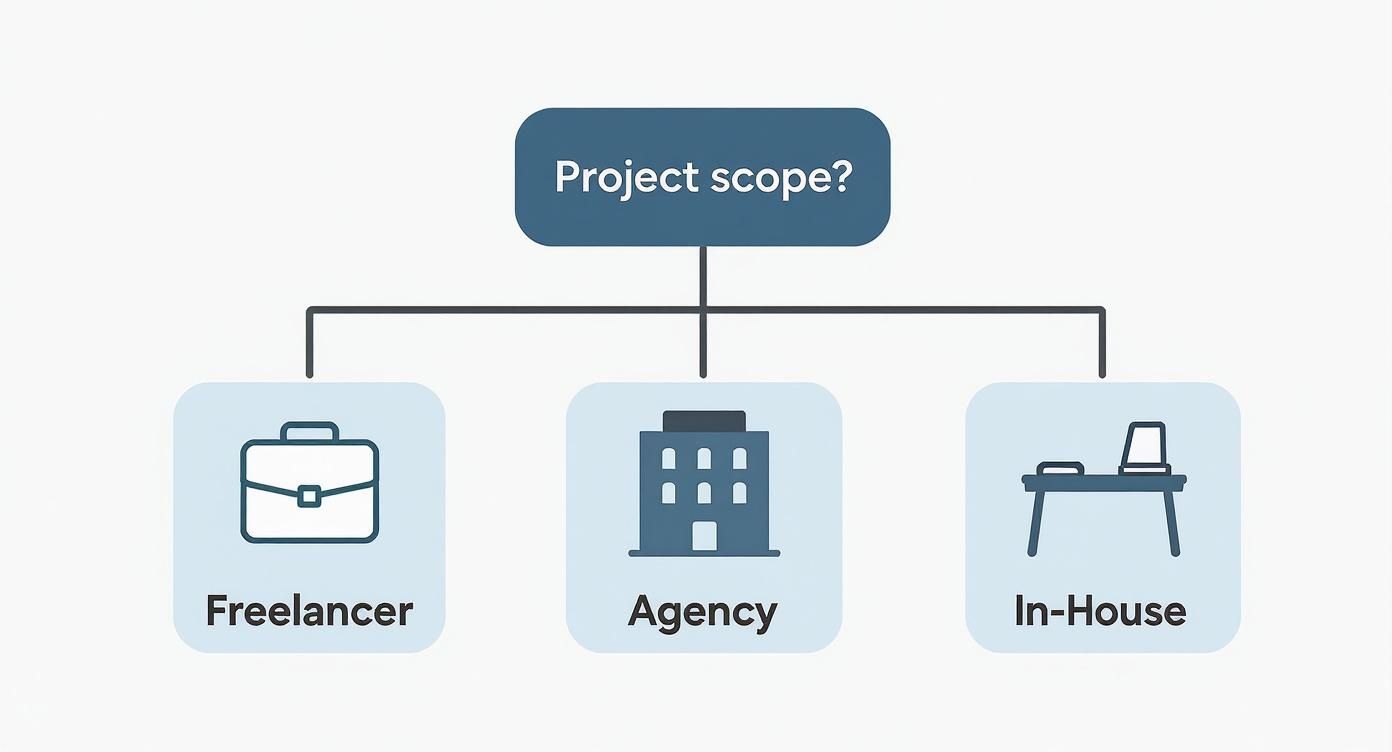
With your needs and budget defined, the next big decision is how you'll bring a developer onto your team. You generally have three options: hiring a freelancer, partnering with an agency, or bringing on a full-time in-house employee. Each model serves a different purpose.
This flowchart can help you visualize which path might be right for your project's scope.
Here's a quick cheat sheet to help you compare these options side-by-side.
Hiring Options At a Glance Freelancer vs Agency vs In-House
This quick comparison can help you decide which hiring model best fits your business needs, budget, and project complexity.
| Factor | Freelancer | Agency | In-House Employee |
|---|---|---|---|
| Cost | Lower cost, often hourly/project-based. | Highest initial cost, project-based or retainer. | Mid-to-high cost, includes salary + benefits. |
| Speed | Can start quickly on specific tasks. | Fast ramp-up with a full team ready to go. | Slower to hire and onboard. |
| Expertise | Specialized in a specific niche (e.g., Shopify). | Broad expertise across multiple disciplines. | Deep expertise in your specific business. |
| Flexibility | High. Great for short-term or one-off projects. | Moderate. Best for large, defined projects. | Low. A long-term commitment. |
| Best For | Small projects, specific tasks, budget constraints. | Complex projects needing diverse skills. | Long-term, core business needs. |
Ultimately, the right choice really comes down to your project's complexity and how long you'll need the help.
Finding the right talent isn't getting any easier. The demand for skilled developers is projected to grow by about 8% by 2033, making for a very competitive market. This growth is fueled by a global web development market that's expected to nearly double to $130.9 billion by 2032. For a deeper dive into the hiring landscape, this ultimate guide to hiring remote developers is a fantastic resource.
Writing a Job Post That Great Developers Actually Read

Alright, you've got a solid project scope and a budget. Now comes the tricky part: writing a job post that doesn't immediately get scrolled past by the exact developers you want to hire.
Let's be honest, a generic description loaded with corporate buzzwords is a surefire way to get ignored. The best developers are problem-solvers. They want to know what they'll be building, why it actually matters, and who they’ll be working with. Your job post is your first pitch—it needs to feel authentic and give them a real reason to care.
Go Beyond the Basic Job Description
A great job post is more than a laundry list of skills; it's a window into your company's soul. You have to sell the opportunity, not just the tasks.
Think about what a skilled developer is actually looking for:
- The Project Vision: What problem are you trying to solve? Instead of saying, "build an e-commerce site," try something like, "build a platform that helps local Omaha artisans reach a national audience." See the difference? One is a task, the other is a mission.
- Company Culture: Be real about your work environment. Are you a heads-down, focused team or a fast-paced, collaborative startup? Good developers are looking for a cultural fit just as much as a technical one.
- The Tech Stack: Get specific. List the actual languages, frameworks, and tools they’ll be using every day. This simple step helps a developer immediately see if their skills are a match, saving everyone time.
This level of detail signals that you've thought things through and respect their expertise. It makes your post stand out in a sea of vague corporate listings.
Key Takeaway: The best job descriptions focus on the mission, the team, and the technology. They answer the question, "Why would a talented developer choose to spend their valuable time working with us?"
Be Transparent About the Details
In today’s market, holding back key information just creates friction and makes you look sketchy. Transparency isn't a bonus; it’s a baseline expectation. Two things are non-negotiable.
Compensation Put the salary range in the post. Period. It is one of the single most effective things you can do. Study after study shows job posts with salary info get way more engagement. It immediately filters for candidates who are aligned with your budget. No more wasting time on interviews only to find out your numbers are worlds apart.
Work Policy Is the job fully remote, in-office here in Omaha, or some kind of hybrid model? State it clearly. Ambiguity on this point will cause you to lose a massive chunk of the talent pool right off the bat, especially since remote work is now a standard expectation for many developers.
Where to Post Your Opening for Maximum Impact
Tossing your job post onto big boards like LinkedIn or Indeed is a start, but the best developers often aren't doom-scrolling those sites. You need to meet them where they already are.
Think about posting in places like these:
- Niche Developer Communities: Sites like Stack Overflow Jobs and GitHub Jobs are filled with people who are passionate about their work, not just looking for any paycheck.
- Industry-Specific Slack Channels: Hunt down local tech communities (there are a few good ones for Omaha) or channels dedicated to specific technologies, like a React or PHP developer group.
- Personal Networks: Never underestimate the power of a good referral. Ask your colleagues, friends, and other business owners if they know anyone who'd be a great fit.
By strategically placing your well-crafted job post in these communities, you dramatically improve your odds of finding the high-quality developer you actually need.
How to Vet and Interview Developer Candidates

You’ve crafted the perfect job post, and now the applications are rolling in. This is where the real work begins. Getting a flood of applicants is easy; the true challenge is separating the genuine talent from those who just look good on paper.
This vetting process is your chance to dig deeper than a resume to uncover a candidate's real-world skills, problem-solving abilities, and cultural fit. The goal isn't to intimidate them with impossible brain teasers. Instead, you want a practical evaluation that gives you a clear picture of how they think, communicate, and code.
Remember, this stage is a two-way street. It’s as much about you assessing them as it is about them seeing if your company is a place they want to be.
Moving Beyond the Resume Screen
A resume is a starting point, not the final word. It tells you about past roles and listed skills, but their portfolio and public coding profiles are where you see their actual work. Think of it as the difference between reading a recipe and tasting the dish.
When you're evaluating a candidate's profile, look for these specific indicators:
- GitHub Activity: Look for more than just the number of repositories. Do they contribute to open-source projects? Is their code well-commented and organized? A clean, active GitHub profile is often a sign of a passionate and disciplined developer.
- Portfolio Quality: Don’t just look at the finished websites; dig into the details. Are the sites responsive and fast-loading? Check the developer console for errors. A portfolio should showcase their ability to build functional, polished projects.
- Project Relevance: Do their past projects align with what you need? If you're building an e-commerce site, experience with platforms like Shopify or custom payment gateway integrations is far more valuable than building gaming apps.
Asking Questions That Reveal True Skill
Once you move to the interview, your questions should probe for practical problem-solving skills, not just rote memorization of technical trivia. A great developer can explain complex concepts simply and talk through their thought process. This is particularly important when hiring for roles that blend different skills; for a deeper dive, our guide on what is full-stack web development explains the versatility needed.
Split your interview into two key areas.
Technical Problem-Solving Questions
These questions should be grounded in real-world scenarios you might actually face.
- "Describe a time you had to optimize a slow-loading webpage. What steps did you take, and what was the outcome?"
- "Walk me through how you would approach building a secure user login and registration system from scratch."
- "How do you ensure your code is maintainable and easy for other developers to understand?"
Behavioral and Cultural Fit Questions
Technical skills are only half the equation. You need someone who can collaborate, communicate, and handle challenges effectively.
- "Tell me about a difficult technical challenge you faced on a past project. How did you work through it?"
- "How do you handle feedback or criticism on your code from a colleague or manager?"
- "What kind of work environment helps you do your best work?"
Expert Tip: Pay close attention to how a candidate answers. Do they get excited when talking about a project they're proud of? Do they communicate their thought process clearly? Passion and communication are often as important as raw coding ability.
The Fair and Effective Technical Test
The final step before an offer should be a practical coding assessment. Whiteboard interviews are notoriously stressful and often don't reflect how developers actually work. A much better approach is a small, paid test project.
This method shows respect for the candidate's time while giving you invaluable insight. The ideal test project is:
- Small and Contained: It should take no more than 2-4 hours to complete.
- Relevant to Your Needs: The task should mirror the kind of work they would be doing daily.
- Paid: Always offer to pay them for their time, typically at their standard freelance rate.
For example, you could ask them to build a single, simple feature for your web app or fix a specific, isolated bug. Observing how they approach this task—how they communicate, organize their code, and deliver the final product—will tell you almost everything you need to know. It’s the most reliable way to confirm you’re about to hire the right person.
Structuring the Offer and Sealing the Deal
You’ve done it. After all the screening, the interviews, and the technical deep-dives, you’ve found the perfect developer. But this is where so many companies stumble. A clumsy offer or a vague contract can make all that effort vanish, sending your top choice walking right out the door. Nailing this final step is how you start things off on a foundation of trust and clarity.
Hiring a web developer right now means wading into a serious talent shortage and some intense salary competition. It's not uncommon for senior developers to pull in between $90,000 and $120,000 a year, and we've seen some segments jump by around 23% year-over-year. With software development jobs projected to grow 25% between 2022 and 2032, the demand is just running laps around the supply. That makes a strong, competitive offer more critical than ever.
Establishing Competitive Compensation
Before you even think about drafting an offer letter, you need to know what the market is actually paying. Guessing is a terrible strategy, and lowballing is a surefire way to get a polite "no, thank you." Your offer has to be fair, competitive, and in line with what that candidate brings to the table. This is where you need to understand what is salary benchmarking and put it to work.
Here’s a quick look at what you can generally expect to pay. Just remember, these are benchmarks. The final number can shift based on a developer’s specific tech stack and, of course, the local Omaha market.
Sample Web Developer Pricing Benchmarks (USD)
This table gives you an overview of typical hourly rates and annual salaries based on experience level. It's a great starting point for setting a realistic and competitive budget.
| Experience Level | Typical Freelance Hourly Rate | Typical Full-Time Annual Salary |
|---|---|---|
| Junior (0-2 years) | $40 - $75/hr | $60,000 - $85,000 |
| Mid-Level (3-5 years) | $75 - $125/hr | $85,000 - $115,000 |
| Senior (6+ years) | $125 - $200+/hr | $115,000 - $160,000+ |
These numbers give you a solid baseline. To get a more complete picture of your total investment, it’s also a good idea to dig into the factors that drive overall web application development costs, since that goes way beyond just the salary.
Pro Tip: Don't just focus on the dollar amount. For full-time hires, sweeten the deal with benefits like good health insurance, a retirement plan, and generous PTO. For freelancers, things like a reliable payment schedule or the promise of long-term work can be just as attractive as a higher hourly rate.
Formalizing the Agreement with a Solid Contract
A handshake just doesn't cut it. Your best defense against misunderstandings, scope creep, and future headaches is a well-drafted contract or Statement of Work (SOW). It’s not about mistrust; it’s about creating clarity and protecting both you and the developer.
Whether you're hiring a freelancer or a full-time employee, your agreement needs to lock down a few key things to avoid any confusion down the road.
- Scope of Work: Be specific. Instead of "build a website," write "develop a five-page responsive WordPress site including a contact form, blog functionality, and a photo gallery."
- Deliverables and Milestones: Break the project down into tangible pieces with clear deadlines. This makes it easy for everyone to see and track progress.
- Payment Terms: Spell it all out—the rate, the payment schedule (e.g., bi-weekly, upon milestone approval), and how invoicing works.
- Intellectual Property (IP) Ownership: This one’s a biggie. Make it crystal clear that your company owns all code and creative work produced for the project once final payment is made.
- Confidentiality Clause: An NDA is standard practice. It protects your business's sensitive information and gives you peace of mind.
- Termination Clause: Outline how either party can end the agreement. Include details on notice periods and what happens with the final payment.
Putting in the time to craft a thorough offer and a rock-solid contract isn't just about hiring someone. It’s about setting the stage for a great partnership that lasts.
Onboarding Your New Developer for Immediate Impact

The contract is signed and you’ve landed a developer. It's easy to breathe a sigh of relief and think the hard part is over, but your next move is just as critical. A deliberate, well-planned onboarding process is what turns a great hire into someone who actually makes an impact.
Dropping the ball on onboarding is a classic mistake. It leads to slow starts, mismatched expectations, and a new hire who feels disconnected right from the jump. A solid onboarding experience does more than get them up to speed—it proves they made the right choice joining your team and is a huge factor in whether they stick around. You want them contributing and feeling confident from day one, not lost in the woods.
Your Day One Success Checklist
Preparation is everything. Before your new developer even opens their laptop, you should have a game plan. This isn't just about HR paperwork; it's about giving them the tools and context they need to start solving problems, not creating them.
Here's what you need to have dialed in ahead of time:
- System Access Granted: Get them logins for everything they'll touch. That means the code repository (GitHub, Bitbucket), project management software (Jira, Asana, Trello), communication channels (Slack, Microsoft Teams), and any relevant databases or staging servers.
- Hardware and Software Setup: Make sure their machine is ready to rock or that they have crystal-clear instructions for setting up their own environment. Nothing kills first-day momentum like spending six hours fighting configuration files.
- Documentation Ready: Have your key documents organized and waiting. This should include your team’s coding standards, project architecture diagrams, and any wikis that explain the current state of the application.
A developer’s first day should be spent understanding the project, not fighting for access. Having everything ready beforehand shows you respect their time and sets a professional tone from the get-go.
Building Context and Connection
Getting the tech sorted out is only half the battle. The other, equally crucial piece is the human element—giving them the "why" behind the work. A developer who understands the business goals and the people involved will always build a better product.
During that first week, focus on laying this groundwork:
- Project Vision Kick-Off: Don't just send them a link to the project brief. Schedule a real meeting to walk them through the project's history, its core business goals, and who your customers are. Explain the problem you're actually trying to solve.
- Key Team Intros: An email chain isn't enough. Set up quick, 15-minute video calls with the key players—the project manager, a designer, another developer. This helps them put faces to names and figure out who owns what.
- Workflow and Process Walkthrough: Show them how work gets done around here. How does a task move from the backlog to production? What's your process for code reviews, QA testing, and deployments? A simple flowchart can work wonders here.
Assigning the First Task
The final piece of a great onboarding is the first assignment. Don't throw them into the deep end with a mission-critical feature. Instead, find a small, manageable first task. Think low-risk bug fix or a minor UI tweak.
This simple strategy achieves two huge things. First, it lets them navigate your entire development process—from pulling code to submitting a pull request—in a safe, low-stakes environment. Second, scoring a quick win builds their confidence and gives them an immediate sense of accomplishment. That positive momentum is gold as they start digging into more complex challenges.
Common Questions When Hiring a Web Developer
Even with a solid playbook, hiring your first web developer can feel like stepping into a minefield of "what-ifs." It’s totally normal to feel a bit out of your depth when you're navigating the technical world for the first time. Getting straight answers to the most common questions will give you the confidence to not just hire someone, but to actually manage them well and see your project succeed.
Let's unpack some of the biggest anxieties business owners have when they bring a developer into the fold. Think of this as your go-to FAQ for the entire hiring and management process.
How Do You Effectively Manage a Remote Developer?
Managing a remote developer doesn’t have to be a leap of faith. It just requires being intentional about communication and using the right tools. The goal isn't to recreate an office vibe online; it's to build a system based on absolute clarity and trust. You can't just stroll over to their desk, so you need solid processes in place.
Success really boils down to a few key habits:
- Daily Stand-ups: A quick, 15-minute call or even a structured Slack message each morning keeps everyone on the same page. The format is simple: what did you finish yesterday, what’s on your plate today, and is anything blocking you?
- Visible Task Management: Use a tool like Jira, Trello, or Asana to make all the work visible. Every single task needs a clear description, acceptance criteria (what does "done" look like?), and a due date. This tool becomes your single source of truth.
- Scheduled Check-ins: Beyond the daily updates, get a weekly or bi-weekly call on the calendar. This is for discussing the bigger picture, tackling challenges before they become disasters, and giving real feedback.
My Two Cents: The real secret to managing remote talent is to focus on outcomes, not hours. Trust your developer to get the work done and give them the space to do it, as long as they’re hitting deadlines and keeping you in the loop.
What Are the Biggest Red Flags to Watch For?
During the interview process, some signals can warn you of future headaches. You have to look past a polished resume and really tune into how a candidate communicates and solves problems. A few red flags are just too big to ignore.
One of the biggest is an inability to explain complex things simply. If a developer can't walk you through their thought process on a past project in a way you can actually follow, they’re going to be impossible to communicate with when real issues pop up. Another major red flag is a portfolio packed with flashy sites that are broken or painfully slow. That usually tells me they care more about looks than solid, functional code.
Finally, be cautious of anyone who trash-talks past clients or employers. While some projects are genuinely tough, a pattern of blaming others often points to a serious lack of accountability. A great developer owns their work—the wins and the losses.
How Do You Prevent Scope Creep?
Scope creep—that slow, silent killer of budgets and timelines—happens when a project’s requirements start to expand. The best defense is a rock-solid Statement of Work (SOW) from day one, like we talked about earlier. But what do you do when a genuinely good idea pops up mid-project?
You don't have to squash every new idea. You just have to manage the change formally.
- Acknowledge and Park It: When a new feature request comes in, thank the person for the idea and immediately document it. Stick it in a "Phase 2" or "Future Ideas" list in your project management tool.
- Assess the Damage: Take a hard look at the request. How much time will this add? What’s the real cost to the budget?
- Make a Conscious Call: Now, you can discuss the trade-offs. You can either approve the change with an official addendum to the contract—adjusting the timeline and budget accordingly—or you can agree to tackle it after the initial launch is complete.
This approach shows you value new ideas without letting them derail the entire project. It turns a potential conflict into a structured business decision, keeping your budget, timeline, and your relationship with the developer intact.
At Up North Media, we get that hiring a developer is just the first step. Our team provides the strategic guidance and technical expertise Omaha businesses need to build powerful web applications and execute successful digital strategies. Learn how we can help you accelerate your growth.