
You're probably in one of these situations right now. Your business shows up when someone searches your exact name, but not when a customer in Omaha searches for the service you provide. Or you rank for a broad term, but the calls you get are poor fits, outside your service area, or clearly price-shopping with no intent to hire.
That usually isn't a Google penalty problem. It's a keyword problem. More specifically, it's a local keyword targeting problem.
Good keyword research for local SEO isn't about finding the biggest list possible. It's about matching the way real people search in Omaha, then assigning those searches to the right asset, either your website or your Google Business Profile. When those two get mixed together, local visibility stalls fast.
Why Your Omaha Business Is Invisible Online
A common Omaha example looks like this. You run an HVAC company in West Omaha. Your technicians do solid work, reviews are good, and referrals come in. But when a homeowner in Dundee searches “emergency AC repair,” your company doesn't appear where it matters. A competitor with a weaker brand shows up first, gets the call, and books the job.
That gap is expensive because local search is already part of daily buying behavior. According to 2026 data, 84% of consumers search online for local businesses every single day (Forbes Advisor). If your business isn't visible for the terms people use every day, you're missing customers before they ever compare pricing, reviews, or availability.
Sometimes the issue is broader than keywords alone. If you're sorting through technical and profile-related causes too, this breakdown of why businesses don't appear on Google is useful because it separates visibility issues tied to listings, website authority, and local relevance.
Visibility fails when intent and location don't match
Local search isn't one channel. It's a mix of:
- Service intent: “water heater repair,” “personal injury lawyer,” “deck builder”
- Urgency: “same day,” “emergency,” “open Saturday”
- Geography: Omaha, Benson, Elkhorn, Midtown, Papillion
- Platform behavior: website clicks versus map results
Most small businesses target only the service term and city. That's too shallow. The customer usually searches with context. They need help now, they're in a specific part of town, and they often want a provider that feels close and relevant.
Practical rule: If your target keyword could apply to any company in any city, it's too generic to carry your local SEO strategy by itself.
A strong local strategy also depends on understanding how local discovery works. If you need a quick primer on the broader system behind rankings, local search marketing is the framework worth understanding first.
Laying Your Hyperlocal Foundation
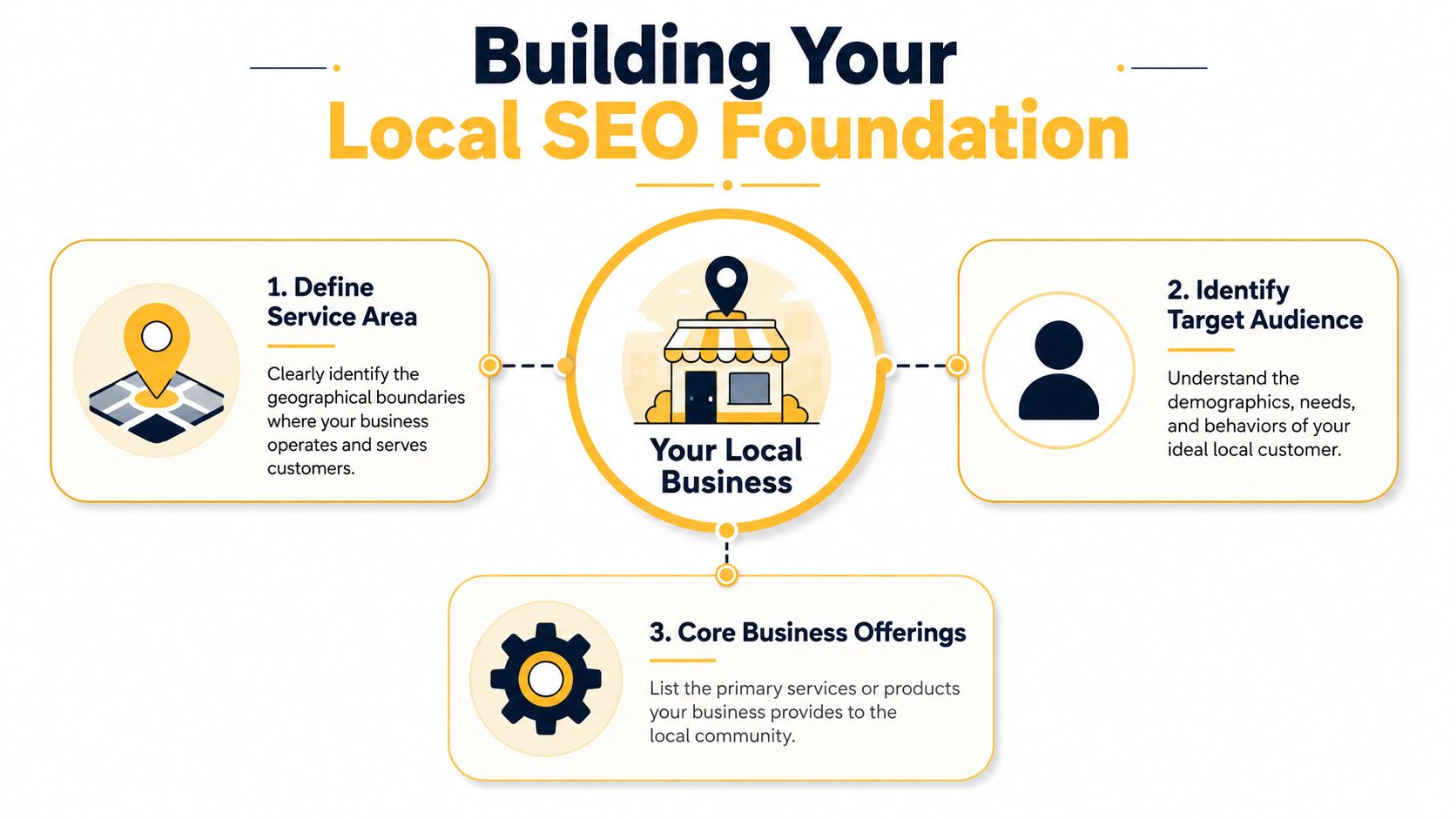
Most keyword mistakes happen before a keyword tool ever opens. The business owner says, “We serve Omaha,” then builds everything around that single label. But Omaha isn't one market in practice. Search behavior changes by neighborhood, urgency, and who's doing the searching.
Define where you actually want business
Start with service reality, not ego. If you're a roofing contractor based in Omaha but most profitable jobs come from Papillion, Elkhorn, Gretna, and Millard, those areas belong in your keyword foundation. If your crews rarely take jobs in Council Bluffs or only serve downtown commercial accounts by exception, don't build your content around those searches.
Write out your geography in layers:
| Layer | Omaha example | How to use it |
|---|---|---|
| Core city | Omaha | Homepage and top-level service pages |
| Priority areas | West Omaha, Midtown, Benson, Dundee, Elkhorn | Service-area sections and supporting pages |
| Adjacent markets | Papillion, La Vista, Gretna | Location-specific targeting if you truly serve them |
| Hyperlocal cues | ZIPs, neighborhoods, landmarks | Supporting language, not separate pages by default |
Local intent is massive. In the United States alone, there are over 5.9 million search keywords explicitly containing “near me,” generating approximately 800 million searches per month according to Semrush's 2024 analysis of the Keyword Magic Tool. That scale shows how strongly people rely on location-based searching and conversational modifiers when they're looking for nearby businesses.
Define the customer and the job they need done
A good local keyword list comes from customer problems, not just service labels.
An Omaha yard professional might offer “outdoor design,” but the actual searches often reflect the situation:
- Homeowner pain point: drainage issues after heavy rain
- Seasonal need: spring cleanup in West Omaha
- Property type: small backyard redesign in Dundee
- Buying stage: estimate, quote, near me, best company
A B2B example looks different. An AI consulting firm in Blackstone won't rely on “AI consulting Omaha” alone. Decision-makers may search for automation help, workflow integration, or custom AI solutions tied to specific operational problems.
The businesses that win local search usually describe problems the way customers describe them, not the way the owner describes the service internally.
Build a simple local business blueprint
Before you research anything, create one working document with these three lists:
-
Core services
List the main revenue drivers first. Not every minor add-on needs its own keyword cluster. -
Service areas
Include the city, priority neighborhoods, and nearby towns you actively want. -
Customer situations
Capture urgency, budget language, quality expectations, and special cases.
For an Omaha plumbing company, that blueprint might include sewer line repair, water heater installation, emergency plumbing, and drain cleaning. The local layer could include Aksarben, West Omaha, Benson, and Bellevue. The situation layer might include “same day,” “after hours,” “old home plumbing,” and “basement drain backup.”
That's the base. Without it, keyword research for local SEO turns into random tool exports and bloated spreadsheets that never turn into rankings.
Discovering How Omaha Customers Search
Once the foundation is clear, you can start building keyword ideas in a way that mirrors how customers search. This stage determines whether most business owners get traction or waste weeks chasing phrases that sound right but never become leads.
Start with seed keywords and expand them
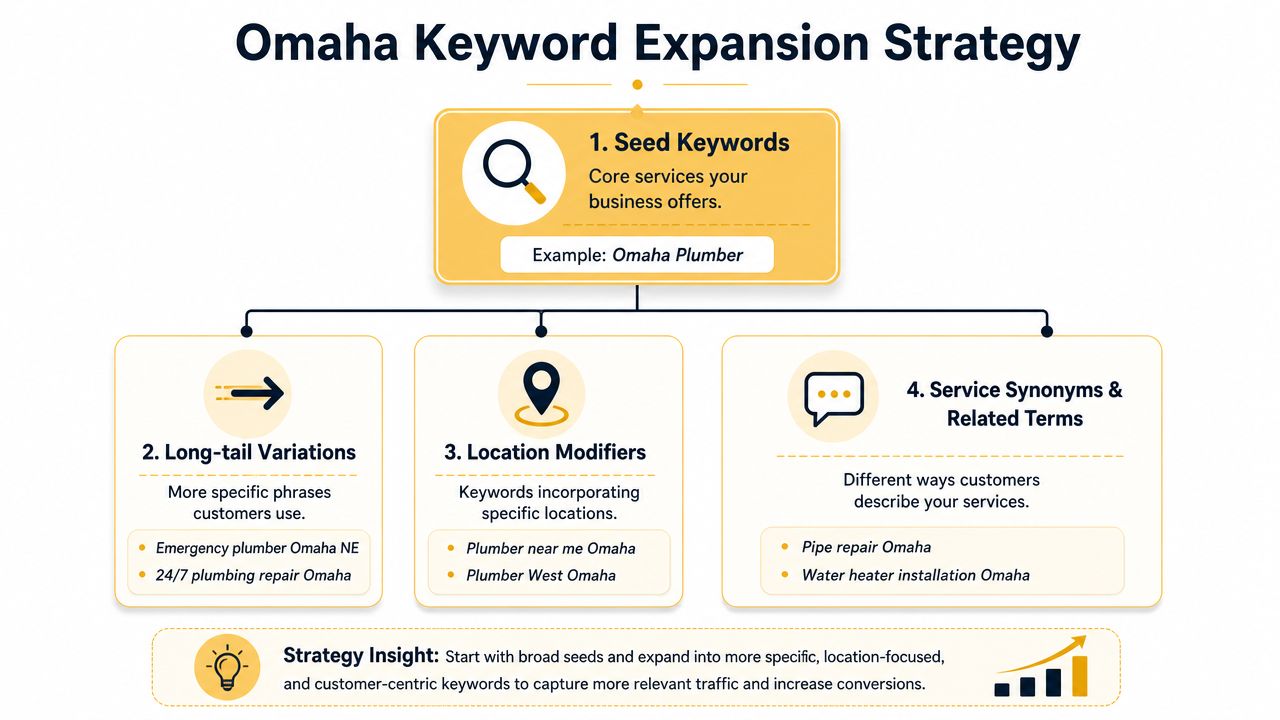
Your seed keywords are your core services. Keep them plain at first.
For an Omaha deck builder, the seed list might be:
- Primary service terms: deck builder, deck repair, custom deck design
- Related service terms: patio contractor, composite decking, wood deck replacement
- Commercial variants: deck estimate, deck company, deck installer
Then expand each seed with two additional layers:
- Location modifiers: Omaha, West Omaha, Elkhorn, Midtown, Papillion
- Intent modifiers: best, affordable, emergency, same day, quote, open now
That gives you combinations like:
- custom deck builder in Elkhorn
- deck repair Omaha
- affordable patio contractor West Omaha
- deck estimate Papillion
You can do this by hand, but spreadsheet automation is faster and cleaner when the list grows. One useful workflow is to place services in one column, modifiers in another, and locations in a third, then use formulas to generate combinations and remove duplicates. That approach saves time and helps you see patterns before you start validating terms.
Pull language from real Omaha conversations
Tool data matters, but natural language matters just as much. Local customers don't always search with textbook terms.
A few strong places to pull phrasing from:
- Competitor service pages: Look at headings, FAQs, and service breakdowns
- Google results: Review autocomplete, related searches, and People Also Ask
- Customer reviews: Notice repeated phrases customers use to describe the problem
- Community spaces: Threads in local forums and regional discussions often reveal plain-language wording
An Omaha pest control company may want to rank for “pest management,” but homeowners are more likely to think in terms like mice in attic, ants in kitchen, or spider treatment for basement. Those details shape better long-tail keywords than generic category terms.
For a broader refresher on process, Raven SEO has a helpful overview of effective keyword research strategies that pairs well with a local-first workflow.
A short visual can help if you want to see how keyword expansion works in practice:
Use AI for neighborhood-level ideas, then validate them
This is one of the more useful modern additions to local keyword work. AI is good at brainstorming combinations humans often overlook, especially at the neighborhood level.
According to 2025 data cited in the provided source, 45% of local SEO agencies now use AI for keyword generation, and pairing AI-generated ideas like “custom deck builder in Elkhorn” with validation can drive 30% higher conversion rates than broad city terms (
).The important part is the second half. Don't publish AI-generated keyword ideas just because they sound plausible.
Use AI to generate:
- neighborhood-service combinations
- service + urgency combinations
- special-situation searches
- question-based searches for FAQs and blog support
Then validate those ideas with tools like Google Keyword Planner before you assign them to a page.
A phrase can sound hyperlocal and still be useless. Validation is what turns brainstorming into strategy.
For Omaha businesses, this often surfaces overlooked terms tied to Benson, Dundee, Aksarben, or Elkhorn that competitors ignore because they only target “Omaha” at the city level.
Validating Keywords with Data and Competitor Analysis
Brainstorming creates options. Validation tells you which options deserve a page, a section, or no attention at all.
The fastest way to waste local SEO effort is to treat every keyword idea as equally valuable. They're not. Some terms have clear commercial intent. Others are informational. Some belong on a service page. Others are weak, redundant, or already covered by a stronger existing page.
Use data to narrow the list
Google Keyword Planner is the practical starting point for local businesses because it gives you baseline demand by location. For Omaha-focused terms, it helps answer simple but important questions:
- Are people searching this phrase in your market?
- Is the wording better at the city level or neighborhood level?
- Does one service variation clearly outperform another?
- Are “near me” and city-modified phrases both appearing in the mix?
Professional tools like Semrush, Ahrefs, or SE Ranking add more context around difficulty and ranking patterns. They're useful when you need to compare page-level opportunities, inspect SERP features, or see what competing domains already rank for.
If you're comparing tool depth and trade-offs, this breakdown of Ahrefs versus Pro tools is a practical reference for agency-style evaluation.
Read the SERP before you trust the metric
A keyword can look attractive in a tool and still be wrong for your business. Always search your short list manually.
Look for signs like:
| SERP signal | What it usually means |
|---|---|
| Local Pack dominates | Strong local intent, likely tied to map visibility |
| Service pages dominate | Good candidate for a commercial website page |
| Blog posts and guides dominate | Informational intent, better for supporting content |
| Mixed results | Keyword may need deeper clustering before assignment |
For example, “roof repair Omaha” usually signals direct service intent. “How long does roof repair take” is a different job. It belongs in educational content, not as the core target of a money page.
This is also where transactional intent matters. For service businesses, keywords with strong buying language often deserve priority because they map closer to quote requests, calls, and booked jobs. If you want another angle on that, this guide on optimizing for transactional searches in local services is worth reading.
Build a competitor content gap matrix
One of the most useful local SEO exercises is a simple matrix. Put competitor keyword themes on one axis and your current pages on the other. Then mark where competitors have complete coverage and your site only has a short mention or nothing at all.
That process often exposes gaps like:
- a competitor has a dedicated sewer repair page while you bury it inside a general plumbing page
- another competitor has a strong FAQ section for emergency service scenarios
- several local firms target neighborhood-specific service pages while your site stays city-only
Expert local SEO involves spreadsheet automation to generate keyword combinations and a competitor matrix to identify content gaps. A critical error to avoid is creating competing pages for the same keyword cluster; instead, assign clusters to single authoritative pages reinforced with schema (CausalFunnel).
Don't create five thin pages for five close variants of the same service term. One strong page usually beats a cluster of overlapping weak pages.
Sort keywords by role, not just volume
A local keyword list gets cleaner when you stop treating it like a leaderboard. Instead, assign each keyword one role:
-
Primary revenue keyword
Your core service phrase with local intent. -
Supporting long-tail keyword
A more specific version tied to urgency, customer type, or service variation. -
Informational support keyword
A question or educational phrase that can support the main page or become a blog post. -
Discard or merge
Redundant, weak, or mismatched terms that don't need standalone treatment.
Experienced local SEO operates differently from basic keyword collection. You're not trying to keep everything. You're trying to keep what helps your site rank without creating internal competition.
Mapping Keywords to Your Website and Google Business Profile
Local strategies usually break when a business gets a decent keyword list, then tries to use every phrase everywhere. The homepage gets overloaded, service pages overlap, and the Google Business Profile repeats website language without a clear purpose.
Website optimization and Google Business Profile optimization work together, but they are not the same job.
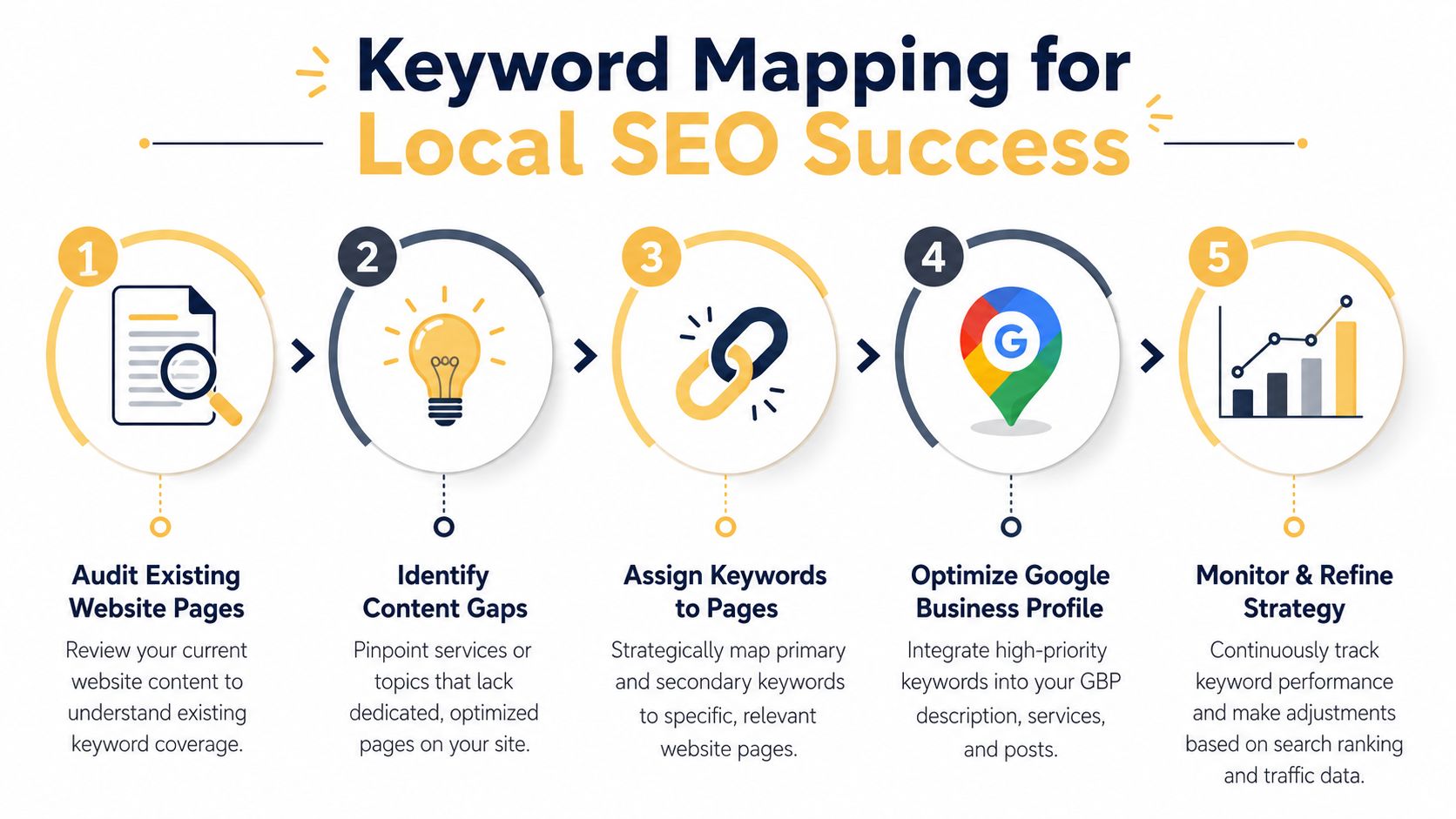
Put website keywords on pages built to rank
Your website should carry the terms that deserve deeper content and clearer page intent.
A simple mapping model looks like this:
| Asset | Best keyword type | Omaha example |
|---|---|---|
| Homepage | Broad core service plus city | Omaha web design agency |
| Service page | High-intent commercial term | kitchen remodeling Omaha |
| Location or area section | Service plus priority area | landscaping in West Omaha |
| Blog or FAQ | Informational support query | how much does stump removal cost |
| Contact or estimate page | Branded and conversion support terms | request a roofing estimate Omaha |
The homepage shouldn't try to rank for every service and every neighborhood. It should establish the business category, primary market, and strongest commercial relevance. Service pages should handle the revenue-driving terms. Blogs and FAQs support edge cases, objections, and question-based searches.
Keep keyword clusters on one authoritative page
In this situation, many local sites create cannibalization without realizing it.
If you have separate pages for:
- Omaha AC repair
- emergency AC repair Omaha
- air conditioning repair in Omaha
- same day AC repair Omaha
you may be splitting one intent cluster across multiple URLs when a stronger single service page could do the job better.
A better structure is:
- one main AC repair page
- strong subheadings for emergency, same-day, and after-hours scenarios
- internal links to related services like maintenance or replacement
That gives Google one clear page to rank and gives users a page that answers the full job they're trying to hire for.
Handle near me in Google Business Profile, not in body copy stuffing
This is the biggest local keyword confusion point.
A critical gap exists between optimizing for “near me” on Google Business Profile versus website content. While over 60% of local searches have implicit local intent, many guides wrongly advise stuffing “near me” into page content. This is a GBP optimization play, and confusing the two leads to misallocated resources (Seobility).
That means this is the wrong move:
- forcing “near me” into homepage headings
- adding awkward sentences like “we are the best plumber near me in Omaha”
- creating separate “near me” pages for every service
The right move is to strengthen the signals that help your Google Business Profile appear for proximity-driven searches:
- Primary and secondary categories: Choose the closest real categories
- Services section: Add your actual service lines clearly
- Business description: Use natural business language with core terms
- Posts and updates: Reinforce active services and current priorities
- Reviews: Encourage customers to mention the specific service provided
- Consistency: Keep service and location details aligned with the site
If your profile setup needs work, this guide on how to set up Google Business Profile is a solid operational reference.
Your website earns relevance and authority. Your Google Business Profile strengthens proximity and local pack visibility. Treating them like identical assets weakens both.
Use an Omaha-style mapping example
Take an Omaha personal injury firm.
A clean structure might look like this:
- Homepage: personal injury lawyer Omaha
- Car accident page: car accident lawyer Omaha
- Truck accident page: truck accident attorney Omaha
- FAQ article: what to do after a car accident in Omaha
- GBP services and profile language: accident attorney, injury claims, consultation availability, office location details
Now take a local landscaper.
- Homepage: landscaping Omaha
- Service page: retaining wall installation Omaha
- Area support section: landscaping in Elkhorn
- Blog article: best time for spring cleanup in Omaha
- GBP optimization: categories, services, posts, photos, and review themes tied to actual jobs
That separation makes the strategy cleaner. It also makes measurement cleaner, because you'll know whether a problem belongs to the website, the profile, or both.
Building Your Ongoing Local SEO Roadmap
Local keyword research isn't a one-time document. It's an operating system. Once the keywords are researched and mapped, the main work becomes prioritizing, publishing, measuring, and refining without overcomplicating the process.
That's good news for small businesses, because most don't need a giant keyword universe to win locally.
Most local businesses only need 20 to 40 highly targeted keywords to capture about 80% of their relevant search volume (Boulder SEO Marketing). The same source recommends choosing a few “north star” keywords per page, supporting them with long-tail variations, then monitoring for 3 to 4 months before re-optimizing.
Prioritize with a simple working order
Don't start with blog content if your core service pages are weak. Don't build location pages if the main service architecture is still vague.
A practical order looks like this:
-
Fix the core money pages first
Homepage, top service pages, and your main conversion paths come first. -
Support those pages with long-tail relevance
Add FAQs, sections, and supporting copy tied to real customer situations. -
Expand into nearby areas carefully
Only after the core structure is clear should you build out area-specific support. -
Use blogs to fill information gaps
Target questions, comparisons, and issue-based searches that support conversion pages.
Track what changes in Google Search Console
Search Console is one of the best free tools in this process because it shows what your site is already appearing for, even before you rank well.
Watch for patterns like:
- Impressions rising, clicks staying flat: title tags or page intent may be weak
- Queries appearing for the wrong page: keyword mapping may need cleanup
- Long-tail phrases gaining traction: these often justify expanding sections or FAQs
- Branded searches increasing: local visibility may be strengthening beyond one page
You don't need to react every week. In fact, most businesses hurt themselves by changing pages too often before enough data accumulates.
Working cadence: publish, monitor, wait, then refine. Local SEO rewards steady iteration more than constant rewriting.
Keep the roadmap small enough to execute
A sustainable roadmap for an Omaha business usually fits on one page:
- your top service pages
- your primary keyword for each page
- a few supporting variants
- your GBP priority fields and service terms
- monthly checks for rankings, clicks, and lead quality
That's enough to stay focused. The businesses that improve local visibility usually aren't doing flashy SEO. They're doing clear SEO, consistently, with the right separation between website targets and Google Business Profile targets.
If you keep that distinction clear, keyword research for local SEO becomes much easier to manage, and much more likely to turn into calls, forms, and booked work.
If you want help turning this into a working local search plan, Up North Media helps Omaha businesses build practical SEO, web, and AI strategies that are tied to actual growth, not bloated reporting.