
You're probably in one of two spots right now. Either your business does solid work but Google keeps sending calls to a competitor down the street, or you're getting some visibility and can't tell why certain pages pull leads while others sit there doing nothing.
That gap usually comes down to local SEO keywords.
For an Omaha plumber, cafe, med spa, roofer, or law firm, local keywords aren't abstract SEO jargon. They're the exact phrases people type when they need something nearby and don't want to waste time. “Emergency plumber Omaha.” “Coffee shop Dundee.” “HVAC repair Millard.” Those searches carry urgency, location, and buying intent in one phrase.
Most businesses don't have a traffic problem first. They have a matching problem. Their site and Google Business Profile don't clearly match the way local customers search.
Why Local Keywords Are Your Most Valuable Asset
A local business can have great service, fair pricing, and strong word of mouth and still lose online because the website targets the wrong phrases. I see this often with service companies that built a nice-looking site but wrote page titles around what they call themselves, not what customers search.
That matters because local search is massive. Over 5.9 million “near me” keywords have been identified in the U.S., generating approximately 800 million searches per month, and 46% of all monthly Google searches globally carry local intent, according to this roundup of local SEO statistics. If you serve a city, neighborhood, or metro, that's not a side channel. That's core demand.
Local keywords capture ready-to-act searches
Broad SEO can bring awareness. Local SEO keywords bring action.
A person searching “how does a water heater work” is researching. A person searching “water heater repair Omaha” is trying to solve a problem. The second query is usually the one that fills calendars and drives calls.
For trades and home services, that difference is especially sharp. If you want a good primer on how this works in practice for contractors, this guide on local search optimization for trades is a useful companion to the keyword process in this article.
Practical rule: If the keyword includes a service and a place, treat it like a revenue keyword until proven otherwise.
Why this matters in a market like Omaha
Omaha isn't New York, but it is competitive enough that vague targeting gets punished. If you're a plumber serving West Omaha, Elkhorn, and Papillion, “plumbing services” isn't precise enough. Google wants a clear signal about what you do and where you do it.
That's why local SEO keywords are an asset, not just a checklist item. They shape:
- Your service pages so Google understands the main offer
- Your Google Business Profile so you surface in map-driven searches
- Your content strategy so you stop publishing blog posts nobody in your market wants
- Your conversion path so searchers land on the right page instead of your homepage
Think of keywords like routing labels in a warehouse. If the labels are wrong, the package may still move, but it won't reach the right destination efficiently. Local SEO works the same way. Clear keyword signals help Google send the right searcher to the right page at the right time.
How to Find Your High-Impact Local Keywords
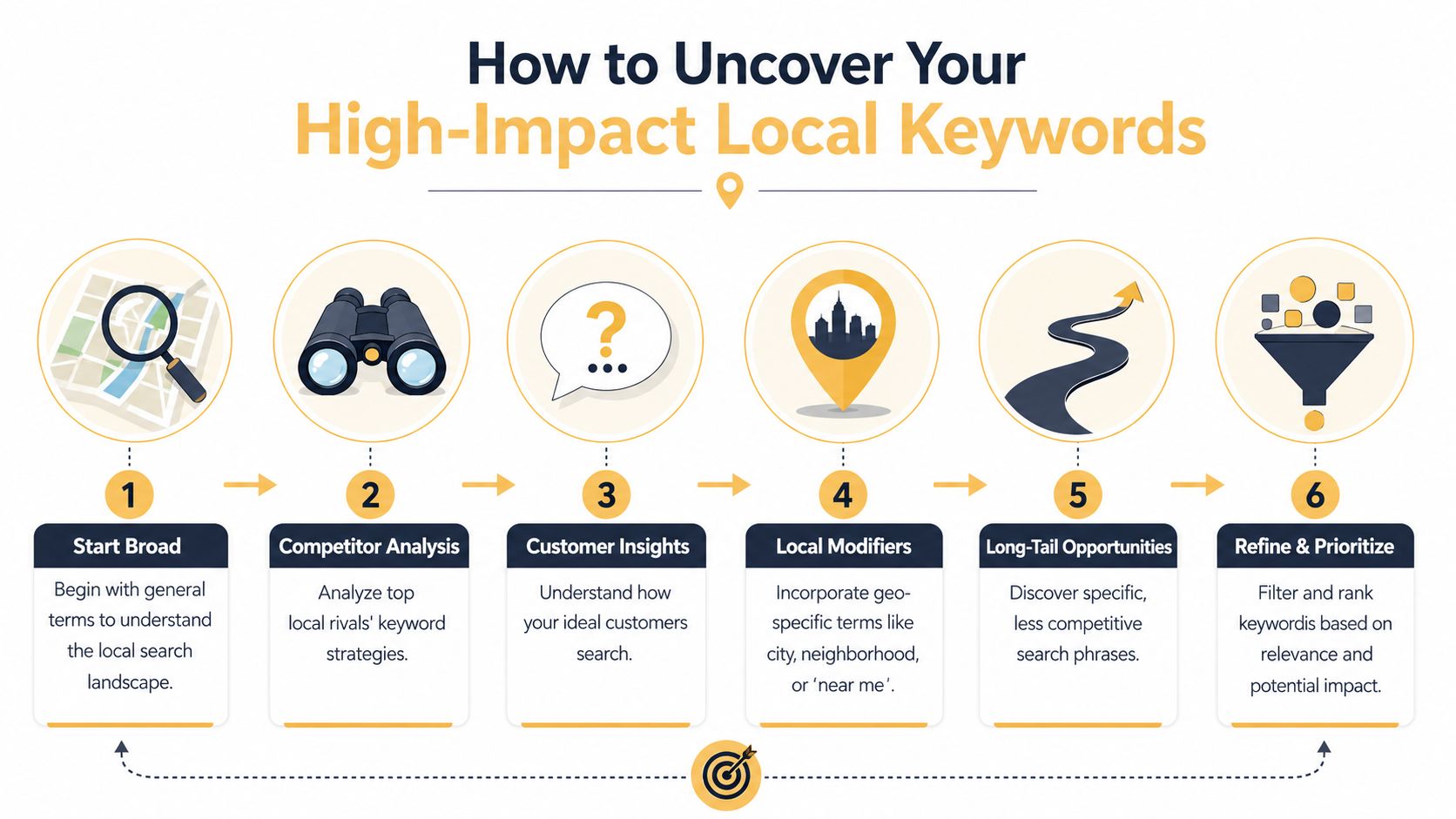
Most local businesses overcomplicate keyword research, then still end up with a weak list. The common failure is starting with tools before building a structure.
The cleaner way is to build a seed list in layers. That approach matters because 80–90% of local service businesses execute keyword research incorrectly, often by failing to build a three-layer seed list with service terms, modifiers, and geographic vectors, based on the methodology shared in this local keyword research breakdown.
Start with the visual workflow below, then build your list on paper or in a spreadsheet.
Build the list in three layers
Use a simple format:
- Service
- Modifier
- Location
For an Omaha plumber, that might look like this.
| Layer | Examples |
|---|---|
| Service | plumber, drain cleaning, water heater repair, sewer line repair |
| Modifier | emergency, same-day, affordable, licensed, residential |
| Location | Omaha, West Omaha, Dundee, Benson, Millard, Elkhorn |
Now combine them in realistic ways:
- Emergency plumber Omaha
- Drain cleaning West Omaha
- Water heater repair Millard
- Licensed plumber Elkhorn
- Residential plumber Dundee
Not every combination needs its own page. At this stage, you're generating possibilities, not publishing content.
Use search behavior, not your internal terminology
A lot of owners write from the inside out. They use terms customers rarely use.
A cafe might talk about “artisan espresso beverages.” The customer searches “coffee shop downtown Omaha.” A foundation company might say “structural remediation.” The homeowner searches “foundation repair Omaha.”
Use these inputs to collect real phrasing:
- Google autocomplete for raw demand language
- People also ask for question variants
- Google Business Profile categories for service wording
- Competitor title tags and headings for local patterns
- Customer calls and emails for plain-language wording
Here's a quick gut check. If your front desk has never heard a customer say the phrase out loud, be skeptical about making it a primary keyword.
A short video can help if you want to see local SEO concepts in a more visual format before building your list.
Keep the list tight enough to use
The goal isn't to collect hundreds of terms and admire the spreadsheet. It's to identify the phrases worth building pages, profiles, and content around.
A practical local keyword set usually includes:
- Core service terms that represent your money pages
- Urgent modifiers that signal strong intent
- Neighborhood and suburb variants only where you serve and can support with useful local relevance
- Question-based terms for blog or FAQ content
Don't chase every synonym. Chase distinct search behavior.
For a service business in Omaha, a focused list is easier to map, easier to track, and less likely to create duplicate pages later.
Prioritizing Keywords by Intent and Opportunity
Once you've got a list, the next job is pruning. Not all local SEO keywords deserve equal attention, even if they sound relevant.
The easiest mistake here is chasing volume without asking what the searcher wants. A phrase can look attractive in a keyword tool and still be a weak lead keyword if the intent is informational or too broad.

Separate intent before you score anything
For local businesses, I sort keywords into three practical buckets.
| Intent type | Example | What to do with it |
|---|---|---|
| Transactional | emergency plumber Omaha | Map to a service page or GBP-supported service area |
| Commercial investigation | best coffee shop in Benson | Use on a strong local landing page or comparison-style content |
| Informational | why is my water heater leaking | Use for blog, FAQ, or support content |
A transactional keyword usually has the strongest lead potential. It names the service and often the location. Informational keywords can still help, but they usually support the funnel instead of closing it.
Use a simple priority model
You don't need fancy scoring software. A practical review usually comes down to three questions:
- Relevance. Does this phrase directly match a service you want to sell?
- Intent. Is the searcher trying to hire, visit, call, compare, or just learn?
- Supportability. Can your business earn visibility for this phrase with the assets you have?
That third point gets ignored too often. Keyword targeting doesn't live in isolation. It depends on trust signals and business credibility. For example, Google Business Profile listings with 50+ reviews are 57% more likely to rank in top local results, according to this SEO statistics roundup. In plain terms, a high-intent keyword is more valuable when your business can back it up with strong local signals.
If two businesses target the same phrase, the one with better reviews, cleaner profile signals, and stronger page alignment usually has the easier path.
What wins in the real world
A lower-volume phrase often beats a broader one because it's closer to a lead.
Take these examples:
- “Plumber Omaha”
- “How to unclog a sink”
- “24 hour plumber Dundee Omaha”
The first is broad and useful. The second can help attract top-of-funnel visits. The third is the one that often turns into a phone call because the need is immediate and the location is narrow.
Voice search adds another layer here because spoken queries tend to sound more natural and locally specific. If you're refining phrases around conversational search patterns, this guide on how to optimize for voice search is worth reviewing alongside your keyword scoring process.
A practical short list
Before moving into page mapping, narrow your set to:
- Primary money keywords tied to core services
- Location variants with real business relevance
- Urgent and high-intent modifiers like emergency or same-day when accurate
- Supporting informational terms that answer buyer questions without cannibalizing service pages
That gives you a list you can execute against instead of a bloated inventory of ideas.
Mapping Keywords to Your Website and GBP
Many local SEO campaigns go sideways because businesses find decent keywords, then assign them poorly. They put everything on the homepage, create five weak location pages, and sprinkle “near me” all over the site like it's seasoning.
That doesn't help. It muddies the signal.
Give each page one clear job
A useful keyword map is simple. Every major page should have a primary target and a small group of closely related secondary phrases.
For a plumbing company, that often looks like this:
| Asset | Primary target | Secondary support |
|---|---|---|
| Homepage | plumber Omaha | plumbing company Omaha, local plumber Omaha |
| Service page | water heater repair Omaha | hot water heater repair Omaha, tank water heater repair Omaha |
| Service page | drain cleaning Omaha | clogged drain service Omaha, sewer drain cleaning Omaha |
| Location page | plumber Papillion | plumbing services Papillion, local plumber Papillion |
| Blog post | signs your water heater is failing | water heater leaking, when to replace water heater |
This is where discipline matters. Don't make the homepage rank for every service. Don't create multiple pages that all target the same city-service phrase with slightly different wording.
Stop putting near me on your website pages
This is one of the most persistent myths in local SEO. Businesses hear that people search “near me,” then they jam that exact phrase into page titles, H1s, and body copy.
That's usually the wrong move.
The phrase “near me” belongs in Google Business Profile optimization for proximity signals, not stuffed into website content, according to the guidance summarized from this discussion on local keyword misuse. On-site, people tend to search and respond better to specific service-location phrases. “Family dentist Omaha” is clearer than “dentist near me” as a page target.
Your website should speak in service-plus-location language. Your Google Business Profile should reinforce proximity, categories, services, reviews, and local engagement.
Treat your GBP like part of the keyword map
Your website and GBP shouldn't compete. They should support each other.
A simple setup looks like this:
- Website pages target service and city combinations
- GBP categories clarify core business type
- GBP services mirror your actual offerings
- GBP photos, posts, and reviews reinforce local relevance and trust
- Location pages support distinct service areas only when they're genuinely useful
If your profile setup is shaky, a practical walkthrough on how to set up Google Business Profile can help tighten the basics before you start measuring performance.
The goal is clarity. One keyword cluster, one primary destination, one reason for Google to trust that asset.
Creating Local Content That Ranks and Converts
Local content works when it sounds like it could only have been written by someone who understands the area. Generic city-swapped copy doesn't do that. It reads like a template because it is one.
The better approach is to build content around local situations, local service patterns, and local language. That's where a service business can separate itself from the pack.
Build content around city-service silos
Practitioners in the local SEO community report grouping terms like “plumbing CITY, plumbing services CITY, plumbing contractor CITY” into 4 to 8 term silos per page, while also using AI tools to brainstorm hundreds of localized ideas for each service-city combination, based on examples shared in this r/localseo discussion.
That structure is practical because it keeps a page focused without making it thin.
For example, an Omaha HVAC company might build one strong page around “AC repair Omaha” and support it with closely related phrases on the same page, instead of splitting hairs across multiple weak pages.
Content ideas that actually fit local search behavior
For a service business, these formats tend to work better than generic “top 10 tips” posts:
-
Neighborhood-specific service guides
“What homeowners in Dundee should know before replacing an older water heater” -
Problem-and-place stories
“Emergency furnace repair during a cold snap in West Omaha” -
Buyer decision content
“Boiler vs. forced air for older homes near Midtown Omaha” -
Local expectation-setting pages
“What same-day drain cleaning service looks like in Papillion and La Vista” -
Area-specific FAQ content
“Do I need sump pump backup protection in flood-prone parts of Omaha?”
A cafe can do this too. Instead of writing “our menu update,” write content around local intent. “Best quiet coffee spots for remote work in Aksarben” has context, audience, and local utility.
Good local content doesn't just mention Omaha. It reflects how people in Omaha search, shop, and make decisions.
Use AI for ideation, then edit like a local operator
AI tools are useful for generating angles, subtopics, and variants fast. They're less useful if you publish the first draft untouched.
A clean workflow looks like this:
- Use ChatGPT or Claude to brainstorm service-city combinations and FAQs.
- Check promising ideas against search behavior with Google autocomplete, Keyword Planner, SpyFu, or your preferred tool.
- Group related phrases into one page or post.
- Add specifics only a local business would know, such as neighborhoods served, common service issues, and realistic turnaround expectations.
This is one place where agencies and internal teams can save time with a structured process. Up North Media, for example, offers SEO marketing that includes keyword research, which fits this kind of local content planning workflow when a business wants help organizing its keyword map and content priorities.
The important part is the final human pass. Local content should sound like your dispatcher, technician, barista, or owner could stand behind every sentence.
Tracking Success and Avoiding Common Mistakes
The businesses that struggle with local SEO often aren't failing because they picked terrible keywords. They're failing because they measure the wrong outcomes and repeat the same execution mistakes.
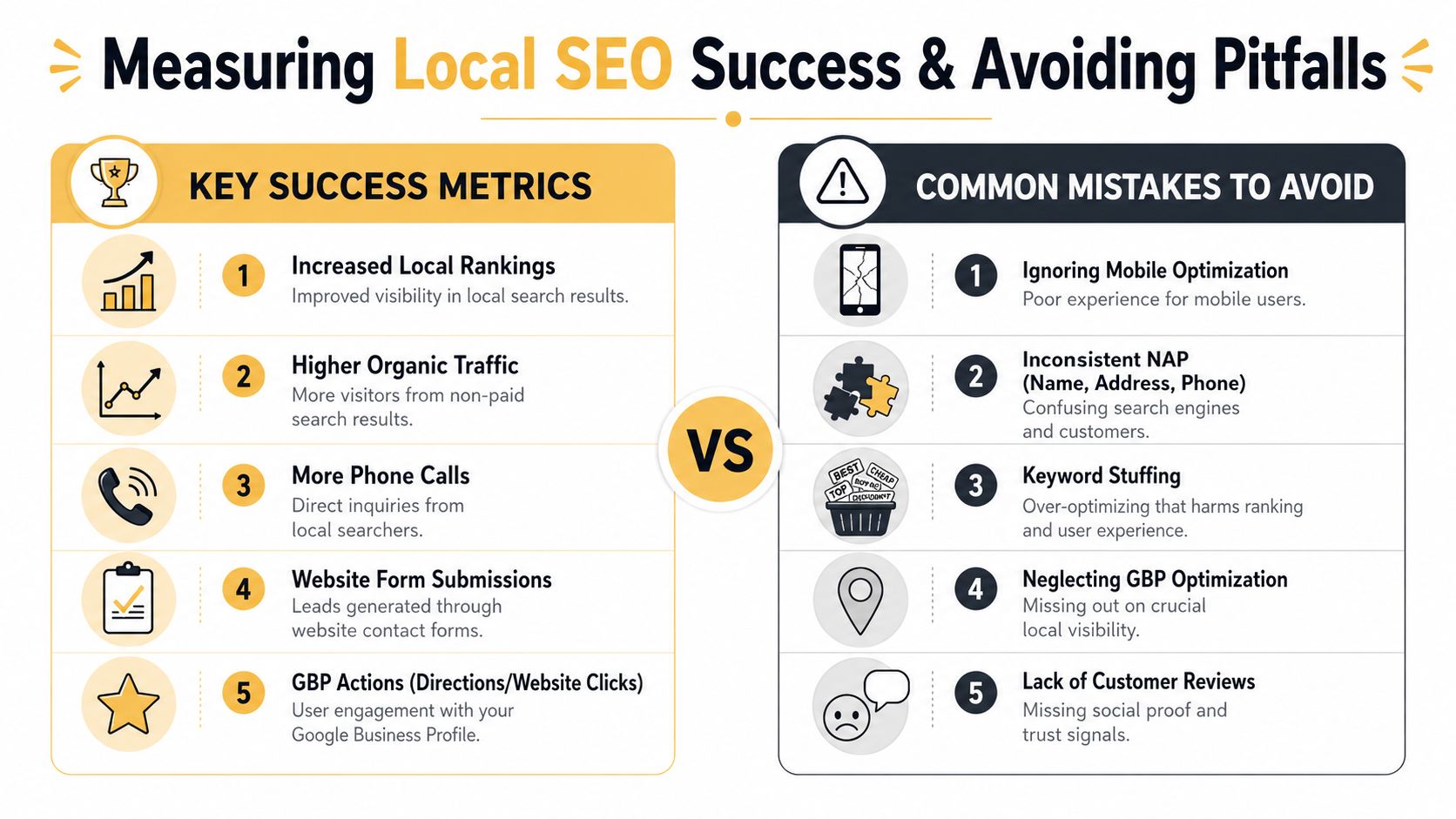
The biggest shift to make is this. Don't treat success as “my website got more visits.” Local search often converts before a click ever happens.
That's especially important because over 60% of local searches end without a website click, as users get information directly from the Local Pack, according to this local SEO tips article. If you only watch website traffic, you miss a large share of real local action.
What to track instead of vanity metrics
A local keyword strategy should connect to business outcomes:
- Calls from Google Business Profile
- Direction requests
- Form fills from service pages
- Booked jobs tied to specific service and city pages
- Visibility by neighborhood, not just one average rank
Geo-grid heatmaps are useful here because they show how rankings shift across areas instead of pretending you have one universal position in the city. That matters in a market like Omaha where visibility in Benson, Millard, and West Omaha can look very different.
If you want a practical measurement framework, this guide on how to measure SEO ROI is a good reference for tying rankings and local actions back to revenue.
Mistakes that keep showing up
Some errors are still common because they sound reasonable until they hurt performance.
-
Keyword stuffing pages
Repeating a phrase unnaturally makes content worse for users and usually weakens the signal. -
Duplicate location pages
Swapping city names into the same page template creates internal competition and low-value content. -
Ignoring review management
Local keyword work is stronger when your reputation signals support it. If you need a practical refresher on that side of the equation, this resource on improving your Google Business Profile is worth reading. -
Treating rankings as one-number truth
Local visibility changes by location, device, and result type. -
Forgetting search result changes
AI-generated results and map-heavy layouts can disrupt old assumptions about clicks and reporting.
The point of local SEO isn't to win a screenshot. It's to generate calls, visits, and jobs from the areas you serve.
A strong local keyword strategy is usually boring in the best way. Clear targets. Clean page mapping. Useful local content. Good reviews. Better tracking. That's what keeps working.
If your business serves Omaha or the surrounding area and you want help turning local SEO keywords into a working lead system, Up North Media can help map the right service-area terms, align them to your site and Google Business Profile, and build a measurement plan around actual business outcomes.