

Most small businesses should expect local SEO to cost between $500 and $2,000 per month. In the market, local SEO can run from $100 to $3,000+ monthly, but that middle range is where many Omaha businesses land when they want real ongoing work instead of a bare-bones setup.
If you're pricing local SEO right now, you're probably seeing wildly different proposals. One provider offers a low monthly fee. Another sends a retainer that looks closer to a part-time hire. A third talks in circles about “custom strategy” without telling you what you'll get.
That gap frustrates business owners because local SEO isn't one service. It's a stack of work tied to visibility in Google Maps, local search results, reviews, citations, content, and the condition of your website. The final price depends on how much of that stack your business needs.
For Omaha companies, that matters more than most agencies admit. A single-location shop with a solid site and a claimed Google Business Profile needs a different plan than a contractor competing across the metro, or a business trying to rank in multiple nearby service areas. The right budget isn't the cheapest number on the page. It's the one that matches the workload required.
Decoding the True Cost of Local SEO
An Omaha business owner gets three local SEO proposals in the same week. One comes in under $500 a month. Another is closer to $1,500. The third is higher and still vague about what happens after onboarding. The price gap looks irrational until you look at the work behind each proposal.
Local SEO pricing swings because "local SEO" is a label, not a fixed service. One provider may only clean up your Google Business Profile and a few directory listings. Another may be managing review generation, service area pages, technical fixes, citation consistency, local content, reporting, and conversion improvements on the site itself. Same label. Very different labor.
That is the part many proposals hide. The monthly fee usually reflects hours, skill level, and how many moving pieces need attention. It also reflects how competitive your category is in Omaha. A family dentist in West Omaha, a roofer serving the full metro, and a multi-location law firm are not buying the same amount of work.
A one-time setup rarely holds up for long. Rankings shift when competitors add new pages, collect more reviews, update their profiles, and improve their sites. Google also keeps reevaluating local signals. Businesses that stay visible tend to keep maintaining the assets that support visibility.
Here is the practical filter I use. If a low-cost plan sounds attractive, ask what is being done every month after the initial cleanup. If the answer is thin, the lower price usually makes sense. If the answer includes content, technical work, Google Business Profile management, review support, citation monitoring, and location page improvements, the higher retainer usually makes sense too.
For Omaha businesses, national pricing ranges are only useful as a starting point. The key question is how much work your market and business model require. A single-location shop with a solid website may only need a focused campaign. A service business trying to rank across Omaha, Bellevue, Papillion, La Vista, and Elkhorn usually needs broader coverage and more monthly production.
If you want to understand why one local campaign stays lean while another grows fast, these local SEO ranking factors for local search visibility explain the workload behind the price.
A fair local SEO budget should match the actual job. Cheap plans often leave out the work that drives traction. Expensive plans can still be bloated if the scope is padded or generic. The right number is the one tied to clear deliverables, realistic competition, and a market your provider understands.
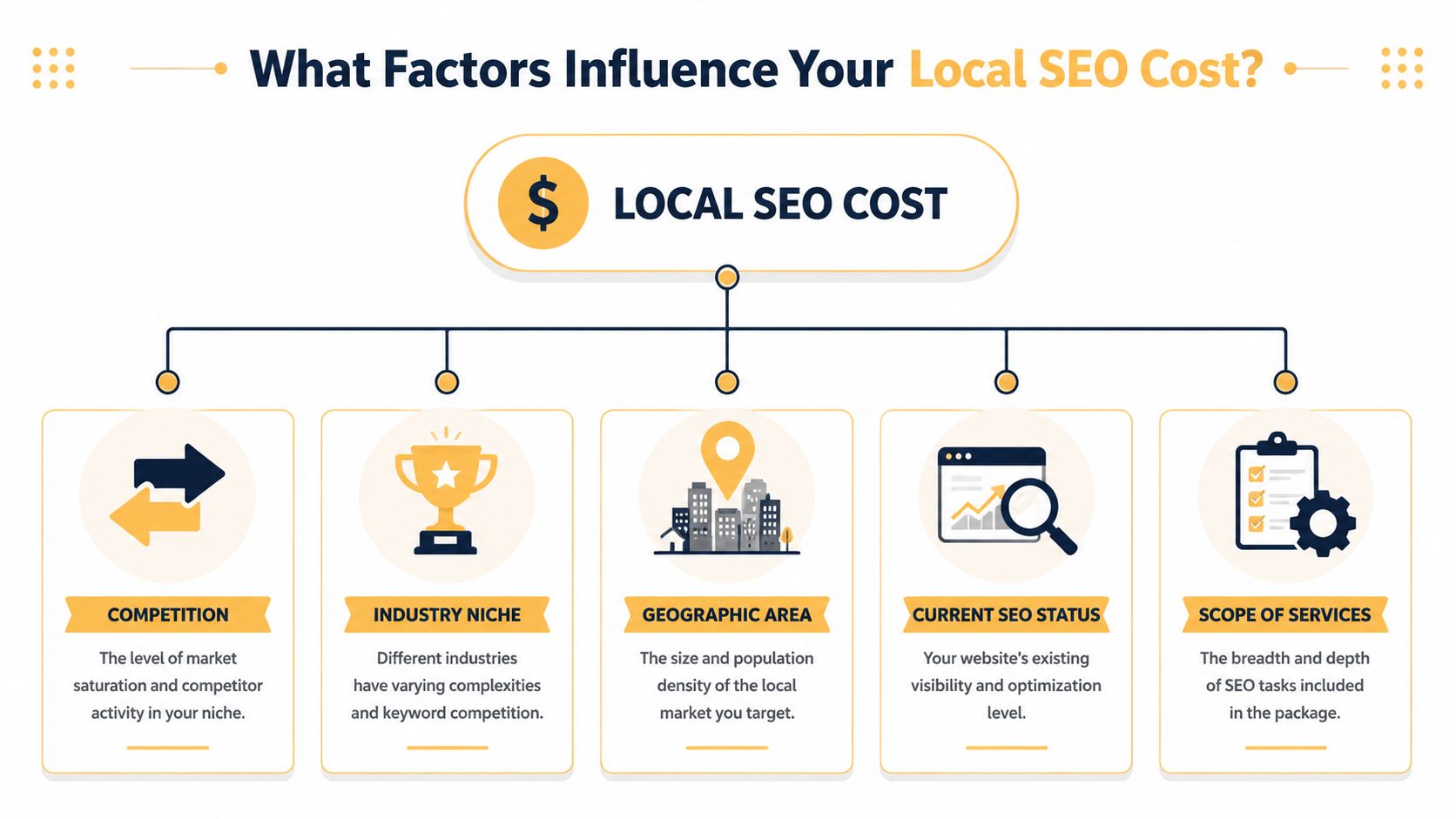
What Factors Influence Your Local SEO Cost
Think of local SEO like the overhead for a physical storefront. Prime corner retail space costs more because the foot traffic is better, the competition is stronger, and the expectations are higher. Local SEO works the same way. You're paying for the amount of work needed to earn visibility in a specific market.
Competition changes everything
A business in a crowded category has to do more than a business in a narrow niche. If you're a roofer, lawyer, med spa, or plumber, you're usually competing with companies that already invest in reviews, pages, links, and Google Business Profile activity. That means more labor each month.
In Omaha, this shows up fast. Some categories only need tight profile optimization and clean local signals. Others need a full campaign. If you want a better sense of what Google weighs in local search, these local SEO ranking factors help explain why some campaigns stay lean while others grow.
Location count multiplies the workload
A single-location business has one profile, one core service area, and one main set of local signals to maintain. A business with multiple locations doesn't just repeat the same work once or twice. It adds complexity.
Each location can require:
- Its own profile management: Categories, services, hours, photos, posts, and review responses need local attention.
- Location-specific pages: Copy should reflect that branch, not a duplicated template.
- Separate citation cleanup: Inconsistent data often appears across directories when businesses expand.
- Reporting by location: Otherwise you won't know which market is improving and which one is stalling.
Here's a useful video if you want a broader visual explanation of what drives local search performance:
Scope determines the monthly fee
At this point, proposals usually separate into honest and vague.
If a provider is only handling Google Business Profile optimization and basic citations, the cost will sit lower than a campaign that includes content creation, technical SEO, local landing pages, review management, and link acquisition. That's normal. More moving parts mean more hours, more coordination, and more accountability.
A low quote can be fair when the scope is narrow. It becomes a problem when the provider sells narrow work as if it's a complete growth strategy.
Your starting point matters
Two Omaha businesses can want the same outcome and need very different budgets. One has a healthy website, consistent listings, and solid reviews. The other has duplicate profiles, broken pages, weak service copy, and no local landing pages.
The second business isn't paying more because SEO firms feel like charging more. It's paying more because the cleanup phase is heavier. Local SEO cost rises when the foundation is weak.
Understanding Local SEO Pricing Models
A contractor in Omaha might call after getting three SEO quotes that all look different. One is a monthly fee. One is a fixed setup project. One is hourly advice only. The confusing part is that all three can be reasonable, depending on what needs to happen after the contract is signed.
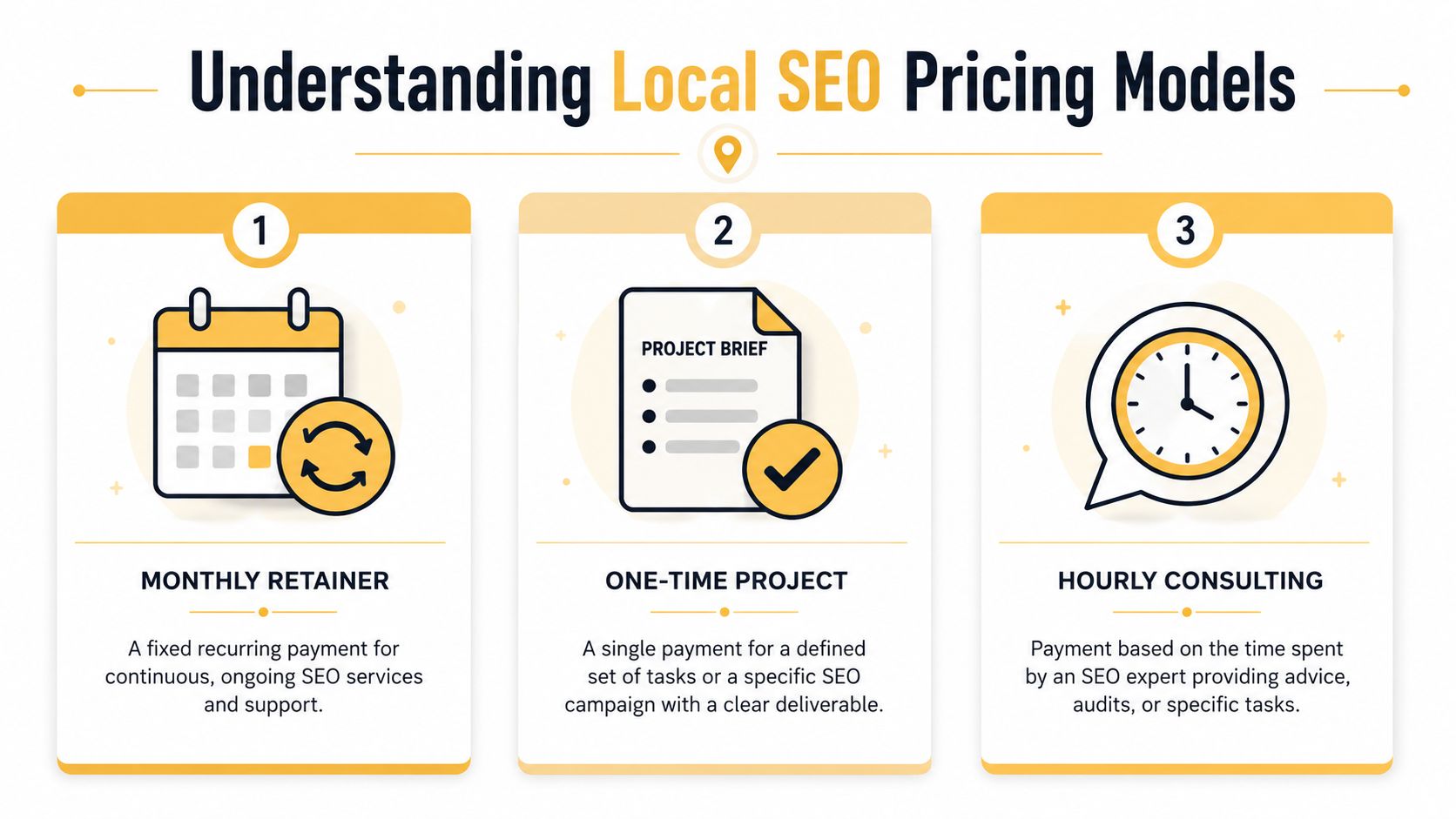
The pricing model matters because it changes what you are buying. A retainer buys ongoing attention. A project buys a defined body of work. Hourly consulting buys expertise without full execution. I usually tell Omaha business owners to choose the model that matches the problem first, then judge the price.
Monthly retainer
This is the standard model for businesses that need steady lead flow from local search. Local rankings shift, competitors make updates, reviews keep coming in, and Google Business Profile issues do not wait for a convenient quarter.
A monthly retainer works best when the provider is actively improving visibility, not just maintaining listings. That can include profile work, on-page updates, local content, review process improvements, citation corrections, and reporting tied to leads or calls.
Best fit: businesses that want ongoing execution and accountability.
Pros
- Predictable budgeting: easier to plan month to month
- Consistent work cadence: fixes and improvements happen before problems pile up
- Better follow-through: strategy, implementation, and reporting stay connected
Cons
- You need a clear scope: retainer proposals can look similar while including very different work
- Results take time: this model works best for owners who can commit long enough to measure progress properly
One-time project
A project fee makes sense when the work has a clear start and finish. Common examples include a local SEO audit, Google Business Profile setup, location page planning, citation cleanup, or a cleanup of duplicate listings after a rebrand or move.
For Omaha businesses, this is often the right first step when the foundation is messy. A strong example is a business that needs a full Google Business Profile audit for local visibility issues before deciding whether monthly management is worth it.
Best fit: businesses that need setup, cleanup, or a strategic reset.
Watch for: project proposals that stop at recommendations. If no one is assigned to implement the fixes, the value drops fast.
Hourly consulting
Hourly consulting works well when execution already lives somewhere else. Maybe you have an office manager updating profiles, an in-house marketer writing content, or a web partner handling technical changes. In that case, paying for targeted guidance can be more efficient than paying for a full-service retainer.
Rates vary because the work varies. Troubleshooting duplicate profiles, reviewing local page structure, or pressure-testing a reporting setup takes a different level of skill than basic directory submissions.
Best fit: businesses with internal support that need expert direction on specific issues.
Which model makes sense for your business
Use a practical filter:
- Need steady local lead generation and ongoing improvements: monthly retainer
- Need foundational cleanup or setup first: one-time project
- Need expert input while your team handles the work: hourly consulting
If you are comparing SEO with other recurring marketing channels, this breakdown of social media services pricing is useful for context. The same pricing logic shows up there too. Costs rise when the provider is responsible for both strategy and monthly execution.
Choose the model that matches the work. Then check whether the deliverables, timeline, and reporting make the price make sense.
Local SEO Costs and Expected Deliverables
A business owner in Omaha gets a proposal for $600 a month and another for $1,800. Both say "local SEO." The price gap usually comes down to one question. Who is doing the work each month, and how much of it is included?
That is the part many proposals gloss over. A monthly fee only means something if it ties to specific deliverables, clear priorities, and enough time to execute. In Omaha, I usually see lower-cost plans focused on cleanup and maintenance, while higher-cost plans include content, technical fixes, review systems, and market-specific competition work.
What a lower-budget package should include
At the lower end, good local SEO stays focused. It handles the few items that move visibility first instead of spreading effort across ten half-finished tasks.
That usually includes:
- Google Business Profile work: category review, service updates, description edits, photo checks, and routine monitoring
- Citation cleanup: correcting business name, address, and phone details across the listings that matter most
- Basic on-page updates: title tags, metadata, service page edits, and stronger location signals
- Simple reporting: calls, direction requests, rankings, and a short summary of what changed
This tier often fits single-location Omaha businesses with a decent website and a category that is not crowded by major brands or aggressive local competitors.
What a growth package should include
The middle tier is where local SEO starts producing stronger gains because the scope expands. The provider is no longer just maintaining listings. They are improving the full local search presence.
A stronger monthly package often adds:
- Ongoing content work: service-area pages, FAQ content, blog support, or updates to thin pages
- Review generation process: templates, staff workflows, follow-up timing, and response guidance
- Technical cleanup: indexation issues, internal linking gaps, mobile usability problems, and page speed fixes
- Stronger reporting: rankings, conversions, profile actions, landing page performance, and lead trends by service
If you are not sure whether the basics are even set up correctly, a proper Google Business Profile audit will usually show what belongs in scope before you commit to a monthly plan.
One practical test helps here. If a provider promises content, technical SEO, review work, and citation management for a very low fee, ask how many hours are assigned each month and who is doing the work.
What a top-tier local campaign usually covers
At the upper end, cost rises because the campaign gets more demanding. That often applies to law firms, medical practices, home service companies with several crews, and businesses targeting multiple parts of the Omaha metro.
Expect work such as:
- Local link building
- Location-specific content planning
- Competitor tracking
- Reporting by location, service, or lead type
- Recurring on-page and technical updates
- Coordination with web, content, and conversion improvements
This level of work takes planning and follow-through. It is harder to package into a cheap template because each location, service line, and competitor set needs its own approach.
If your company also sells online, local SEO may need to work alongside ecommerce SEO. In that case, it helps to understand what a trusted Shopify SEO agency handles differently from a local-only provider.
Local SEO deliverables by monthly budget
| Budget Tier | Typical Monthly Cost (Omaha) | Core Services Included |
|---|---|---|
| Starter | Lower end of the local market | Google Business Profile optimization, citation cleanup, basic on-page edits, simple reporting |
| Growth | Mid-range for active local campaigns | Everything in Starter, plus content support, review process setup, technical fixes, and better reporting |
| Market Leader | Upper end of local retainers and above | Everything in Growth, plus local link building, multi-location coordination, deeper strategy, and heavier competition support |
What does not work
Weak proposals usually share the same problems:
- Checklist packages with no priorities: every business gets the same task list, whether it needs citation cleanup or major service page work
- Reporting without execution: dashboards are fine, but rankings improve because someone fixed pages, built assets, and followed through
- Set-and-forget profile management: local results shift, competitors update, reviews come in, and categories change
- Big promises on a starter budget: enterprise-level output requires real hours and real specialists
The strongest proposals are specific. They explain what gets done, how often it gets done, who handles it, and what is outside scope. That clarity matters as much as the monthly fee.
Agency vs Freelancer vs In-House SEO
A common Omaha scenario looks like this. A business owner gets one proposal from an agency at a few thousand dollars per month, one quote from a freelancer at a much lower rate, and then wonders whether hiring internally would cost less over time. The right answer depends on what has to get done each month, how competitive the local market is, and who will own follow-through.
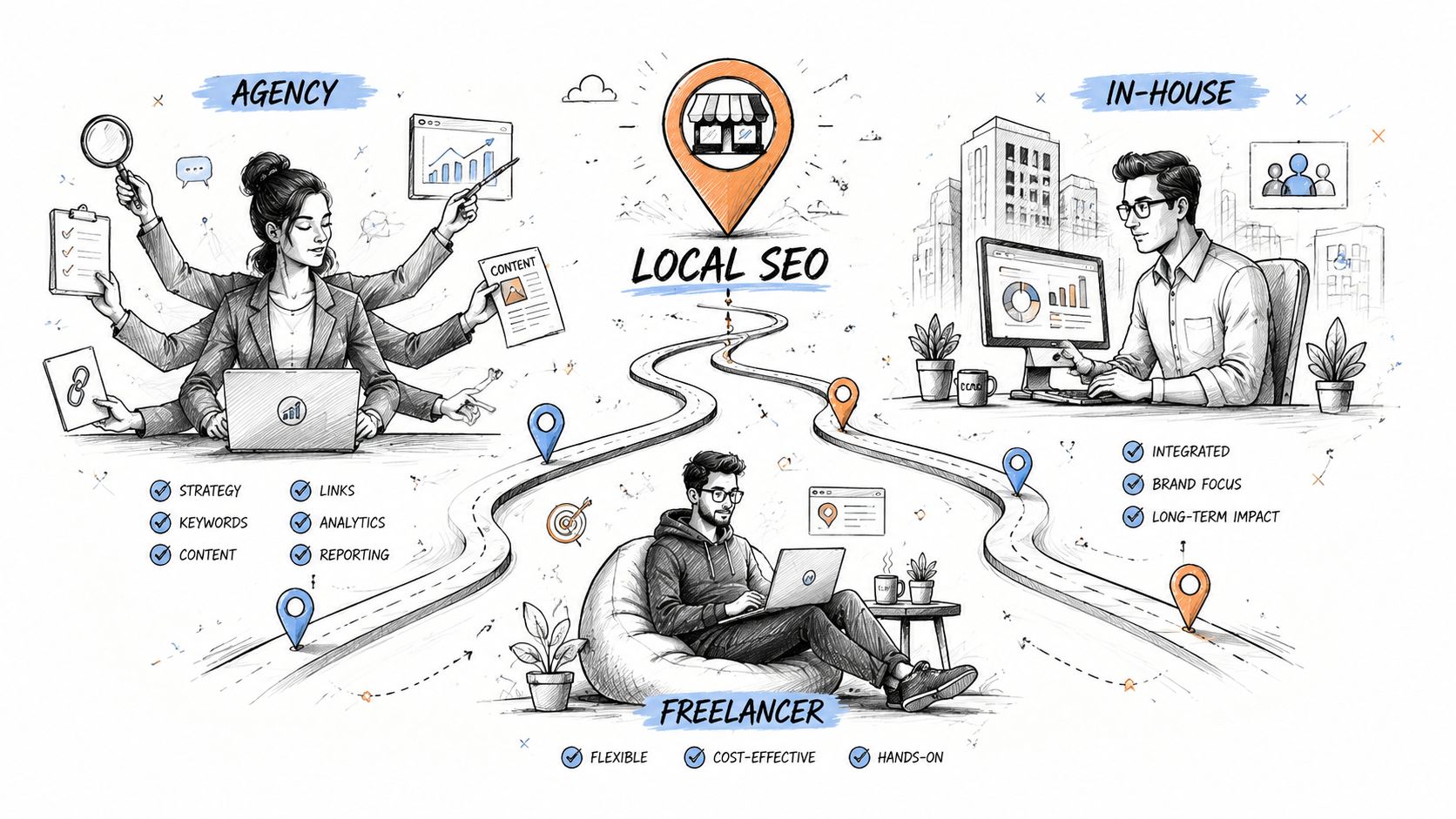
In Omaha, the pricing gap usually reflects depth of service, not just markup. A freelancer may be enough for a single-location company that mainly needs Google Business Profile work, citation fixes, and light page updates. An agency usually costs more because it can cover strategy, technical issues, content, reporting, and coordination with your web team. An in-house hire gives you direct control, but total cost rises quickly once salary, benefits, tools, and training are part of the picture.
Agency
An agency is the best fit when local SEO has several moving parts and missed coordination would slow progress. That often means multiple service lines, several locations, a competitive map pack, or a site that needs technical fixes alongside content work.
What you are paying for is coverage. One team handles strategy, execution, reporting, and project management, which reduces the chance that a good plan stalls because nobody owns the next step.
Agency is usually the right call if:
- Your market has aggressive local competitors
- You need content, technical fixes, and Google Business Profile work at the same time
- You have more than one location or want to expand into nearby service areas
- You want one accountable partner instead of managing several contractors
The trade-off is straightforward. Agencies cost more, and some build process that a very small business may not need. The upside is consistency.
Freelancer
A freelancer can be the most efficient option when the scope is narrow and well defined. For example, a local service business in Omaha might hire a freelancer to clean up duplicate listings, improve service pages, and tighten local keyword targeting without paying for a full retainer.
This model works best when the owner already knows the priorities. It works less well when the campaign needs technical SEO, content planning, review generation, conversion tracking, and regular strategy adjustments. One person rarely excels at every part of local SEO, and even very good freelancers have capacity limits.
Freelancer is usually the right call if:
- You have one location
- You need a short list of specific fixes
- Your budget is limited
- You can manage the relationship closely and review work quality yourself
The risk is not that freelancers are weaker. The risk is mismatch. Hiring a listings specialist for a website architecture problem will waste months.
In-house
In-house SEO makes sense when local search is important enough to justify daily attention. A larger home services company, healthcare group, or multi-location business may benefit from having someone inside the organization who understands margins, seasonality, service priorities, and internal bottlenecks.
Control is the main advantage. The business sets priorities directly, and knowledge stays in-house. The drawback is breadth. One employee may handle page updates and reporting well, but still need outside help for development, design, advanced technical audits, or content production. For many Omaha businesses, in-house plus outside support is more practical than expecting one hire to cover everything.
A practical way to choose
Choose based on operational fit, not ego.
- Choose an agency if your campaign needs several specialties working together every month.
- Choose a freelancer if the job is clearly scoped and you know what success looks like.
- Choose in-house if local SEO is central to revenue and you can support the role with enough work, tools, and cross-team access.
Before you decide, map the cost against expected return. A higher monthly fee can still be the cheaper option if it produces qualified leads faster and with less internal drag. This guide on how to measure SEO ROI helps frame that decision the right way.
If your business also sells online and you are comparing specialist partners, this guide to choosing a trusted Shopify SEO agency is useful because the same screening logic applies. Look for clear scope, relevant case experience, and proof that the provider understands your platform, your market, and the work required to win locally.
Budgeting for SEO and Measuring ROI
The biggest budgeting mistake is treating local SEO like overhead with no return model. A better approach is to tie the investment to customer value, lead quality, and close rate. Local SEO doesn't need to be cheap. It needs to pay for itself.
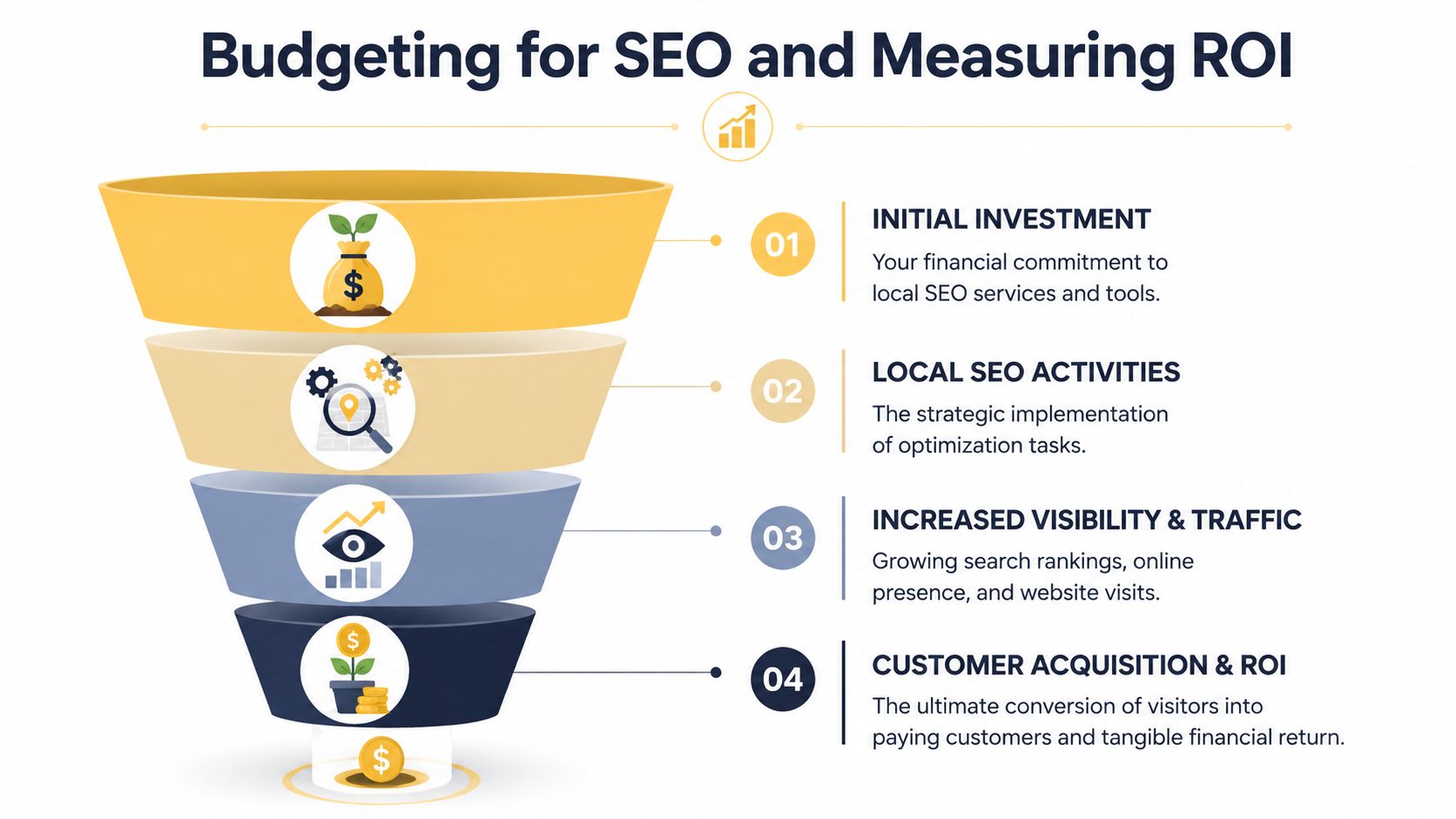
Start with customer value
Before you review proposals, answer a few practical questions:
- What is one new customer worth? Use real revenue, not hope.
- How many qualified local leads can your team handle?
- Which services drive the best margins?
- Which locations matter most?
Those answers shape the right budget more than broad industry averages. A business that only needs a handful of new qualified leads each month may justify a retainer quickly. A lower-margin business may need tighter scoping and sharper prioritization.
Measure the right things
If local SEO reporting only shows rank changes, it's incomplete. Rankings matter, but they're an input. You need output metrics too.
Useful measurements include:
- Google Business Profile actions: calls, direction requests, website clicks
- Form submissions and booked appointments: tied back to local landing pages where possible
- Call quality: not just volume, but whether the calls fit your service area and intent
- Lead source patterns: which pages and profiles are producing actual inquiries
For a deeper framework, this guide on how to measure SEO ROI gives a practical way to connect traffic and visibility back to business outcomes.
Review proposals like an operator
A solid local SEO proposal should answer three things clearly:
- What work happens every month
- Who is responsible for implementation
- How success will be measured
If any of those are fuzzy, the price is impossible to judge.
“Cheaper” isn't safer if the work is vague. A defined scope at a higher fee is usually easier to evaluate than a low retainer wrapped in general promises.
Negotiate scope, not fantasy
Business owners often negotiate local SEO the wrong way. They push the monthly number down without reducing the workload, then end up with a diluted campaign.
A better move is to ask:
- Can we start with one location instead of all locations?
- Can we prioritize service pages before adding blog content?
- Can we fix technical blockers first, then expand into link building?
- Can reporting focus on leads and profile actions instead of vanity metrics?
That keeps the work realistic. It also makes it easier to tell whether the provider can execute.
ROI from local SEO usually shows up because the business chose a scope it could sustain, then measured the right outcomes long enough to see the compounding effect.
Frequently Asked Questions About Local SEO Costs
Can I do local SEO myself
Yes, especially if you have one location, a simple website, and time to learn the basics. Many owners can handle profile updates, review responses, service descriptions, and some citation cleanup.
Where DIY usually breaks down is consistency. The work doesn't just need to be done once. It needs follow-through, judgment, and prioritization. If you're managing operations all day, local SEO tends to slide to the bottom of the list.
Are long-term contracts a red flag
Not automatically. Ongoing local SEO often works best with a recurring relationship because rankings, reviews, listings, and pages all need maintenance.
The main issue is whether the contract protects the provider more than the client. If the scope is vague, the reporting is thin, and the off-ramp is painful, that's a problem. A fair agreement should pair commitment with clear deliverables and accountability.
What should I watch for in a proposal
A few warning signs are common:
- Guaranteed rankings: no one controls the search results completely
- Undefined deliverables: if “optimization” is doing too much work in the proposal, ask for specifics
- Template packages: local strategy should reflect your market, not a generic checklist
- Too-good-to-be-true pricing: extensive work takes real labor
- Reporting without business metrics: if the provider can't connect activity to leads, the campaign may drift
How long does it take to see results
Some fixes can produce early movement, especially if your profile is incomplete or your listings are messy. But local SEO usually works best when you treat it like compounding visibility, not instant advertising.
The timeline depends on your starting point, competition, and how much work is being done each month. A weak website in a crowded category will take longer than a well-built site that only needs local refinement.
Is a cheap local SEO package ever worth it
Sometimes, if the scope is narrow and accurately described. A lower-cost package can be reasonable for profile management, citation cleanup, or a single-location business in a lighter market.
It becomes a bad deal when the provider sells it as a full growth engine. Cheap setup work can be useful. Cheap promises usually aren't.
Should Omaha businesses budget differently than national brands
Yes. Local SEO should be budgeted around local market conditions, service area goals, and operational capacity. Omaha businesses don't need a national enterprise playbook. They need a plan sized to their market, their margins, and the amount of local competition they face.
If you want a clear opinion on what your business should budget, Up North Media can help you pressure-test proposals, define the right local SEO scope, and build a plan that fits Omaha market realities instead of generic national advice.