
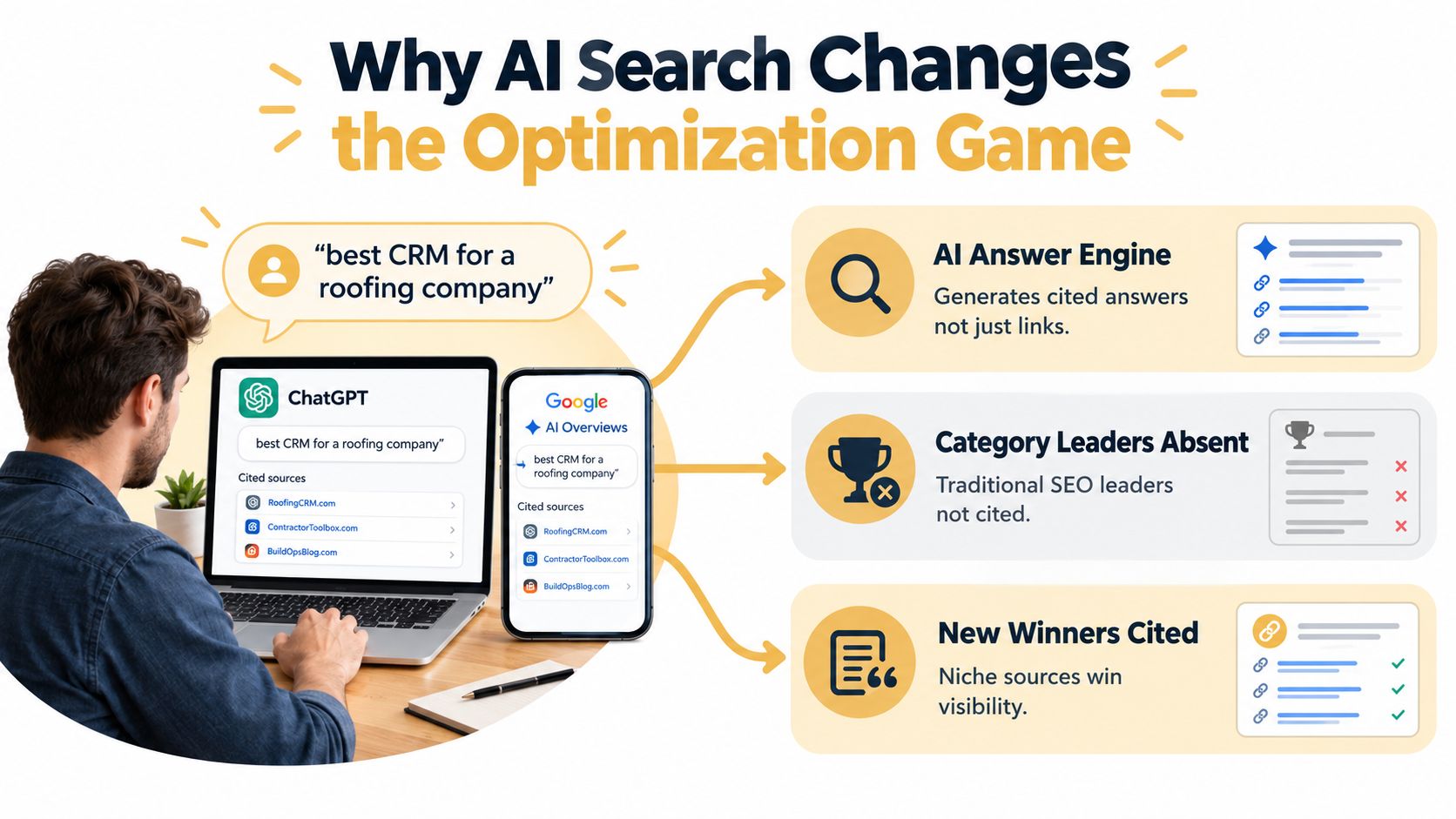
A prospect asks ChatGPT, “What's the best CRM for a roofing company?” Google's AI Overviews receives a similar question. The answers include three sources you've never seen before, while the companies dominating the traditional search results don't appear at all. Your team checks rankings, finds strong positions, and still can't explain why another site gets named.
That confusion comes from treating AI search as a redesigned results page. It isn't. How to optimize for AI search requires a different operating model, one that accounts for retrieval, citation, synthesis, and measurement across several answer engines.
Search behavior is shifting quickly. A 2026 industry report estimated that AI-related search usage represented 28% of traditional search worldwide and 17% in the United States, while total search usage across search engines and large language models increased 26% globally. The same report found that monthly AI sessions had reached 56% of traditional search worldwide and 34% in the U.S., with around three in four American respondents using AI for search weekly. Position Digital's AI search statistics report provides the underlying figures and context.
Why AI Search Changes the Optimization Game
The central shift is simple: AI search separates being found from being used. Traditional SEO largely asks whether a page can win a position among ranked results. AI search first asks whether a retriever should include the page as a candidate source, then asks whether a language model can extract, trust, and synthesize useful evidence from it.
Stage one selects the sources
Retrieval systems may use search indexes, real-time web results, entity databases, feeds, or other source collections. They gather candidate passages for a prompt such as “best CRM for a roofing company.” At this stage, your page either enters the evidence pool or it doesn't.
A page that isn't retrieved can't be absorbed into the answer. Strong writing won't rescue a document that crawlers can't access, a canonical signal that points elsewhere, or content buried inside a rendering layer a fetcher can't process. Source selection is the first gate, and it's invisible when you only monitor rankings.
Stage two absorbs the evidence
Once sources are retrieved, the model decides which facts to include, how to compare them, and which URLs to cite. It may quote one page for a definition, use another for product details, and select a niche publisher for a practical comparison. The model becomes a downstream filter between your content and the user.
Google's AI Overviews expansion illustrates why the distinction matters. One 2026 roundup reported that AI Overviews appeared on approximately 15.69% of all searches in November 2025, compared with 6.49% in January 2025. Another data set reported appearances on 86.7% of business-intent searches in April 2026, compared with 56.9% in April 2025. Taylor Scher's AI SEO statistics roundup also reported that only 17% of AI Overview citations came from pages already ranking in the organic top 10.
That doesn't make classic SEO irrelevant. It means ranking is no longer a sufficient explanation for visibility. A source can qualify for retrieval because it offers a clear, specific answer, then win absorption because its evidence is easy to summarize accurately.
Practical rule: Optimize every important page twice. First, make it discoverable and eligible for retrieval. Then, make its claims easy for a model to extract without losing meaning.
A rigorous Princeton-backed GEO benchmark found that generative-engine optimization could increase visibility in AI responses by up to 40%. The research supports a workflow built around both source selection and source absorption, using concise headings, explicit definitions, crawlable text, and cited claims that function as usable evidence. The benchmark is available in the published arXiv HTML version.
Classic SEO vs AI Search Optimization
Classic SEO and AI search optimization share infrastructure, but they compete for different outcomes. Blue-link SEO competes for ranked URLs. AI search optimization competes for inclusion in an answer and attribution within that answer. A publisher that treats those as identical goals will measure the wrong wins and miss the reasons a competitor gets cited.
| Lever | Classic Blue-Link SEO | AI Search Optimization |
|---|---|---|
| Unit of competition | Ranked URLs competing for search positions | Cited sentences, passages, entities, and source combinations |
| Authority | Backlinks, topical relevance, site reputation, and page-level signals | Retrieval eligibility plus evidence quality, entity clarity, and third-party corroboration |
| Content structure | Long-form pages organized around topics and keywords | Independent evidence blocks that answer narrow questions without surrounding context |
| Keyword targeting | Head terms, variants, and supporting phrases | Natural questions, conversational language, comparisons, and likely follow-up prompts |
| Structured data | Helps search engines interpret page type and features | Helps retrievers disambiguate entities, relationships, authorship, products, and page purpose |
| Primary metrics | Impressions, rankings, clicks, and organic conversions | Citation frequency, prompt share of model, citation framing, and assistant referrals |
| Main failure | A page doesn't rank prominently enough | A page is never retrieved, or is retrieved but its evidence is not absorbed |
Backlinks still matter. They can support discovery, authority, and entity confidence, but they're no longer the complete strategy. Independent GEO research identifies machine scannability and justification as core levers, while also warning that big-brand bias can disadvantage smaller sites. The AIrops research on AI search metrics recommends compensating with earned-media mentions, authoritative third-party citations, and content variants suited to specific engines or audiences.
Keep the SEO foundation
Crawlability, internal linking, descriptive metadata, author information, and credible external references remain useful because AI systems still need accessible, understandable sources. A technically blocked page can't be cited, regardless of how carefully its prose is written. A disconnected page also gives retrievers fewer topical relationships to follow.
The emphasis changes in three places:
- Write for extraction: Replace long narrative-only passages with concise claims, definitions, lists, tables, and supporting evidence.
- Clarify entities: State who publishes the page, what an organization does, which product is being discussed, and how related concepts differ.
- Expand reporting: Keep search-console metrics, but add citation and mention tracking across the answer engines your buyers use.
This is an additive discipline, not a replacement. Strong technical SEO gives your content a route into the source pool. AI-focused structure gives the model a reason to select and use the passage once it gets there.
Technical Foundations for AI Crawlers and Retrievers
Technical access comes before content persuasion. A retriever can't cite what it can't fetch, and a model can't absorb a passage that exists only after a fragile client-side interaction.
Start with access and indexing
Review robots.txt for the major user agents relevant to your distribution choices, including GPTBot, ClaudeBot, PerplexityBot, Google-Extended, and Applebot-Extended. Whether you permit each crawler is a policy decision, but it should be deliberate rather than accidental. If you want to communicate content policies to AI systems, evaluate whether an llms.txt file fits your governance approach.
Keep XML sitemaps current, submit them through the appropriate webmaster tools, and make sure canonical tags identify the preferred version of each page. For a practical implementation reference, follow these XML sitemap best practices. A duplicate page with conflicting canonicals can split signals and make retrieval less predictable.
AI-answer engines and classic search engines differ in important ways, as the answer engine vs search engine explained guide makes clear. The operational takeaway is that you should test access from the perspective of both ranked search and answer retrieval.
Make the page readable without fragile rendering
Many retrieval pipelines work with raw HTML or simplified fetched content. Put essential copy in semantic HTML, including headings, paragraphs, lists, tables, and article content. Don't make the definition, product specifications, or primary answer depend entirely on JavaScript execution.
Audit more than the visual page. Compare the rendered experience with the initial HTML response, inspect what unauthenticated fetchers receive, and check whether navigation exposes related pages through ordinary links. A page that looks complete in a browser can still deliver an incomplete evidence set to a retrieval system.
Use structured data to remove ambiguity
Choose schema.org types that match the content, such as Article, FAQPage, HowTo, Product, Organization, and Person. Validate the markup with Google's Rich Results Test and Schema.org's validator, but don't treat validation as proof that the content deserves a citation. Structured data supports interpretation. It doesn't replace useful evidence.
Keep entities consistent across the site. The organization name, author identity, product names, service descriptions, and relevant profiles should not change unpredictably from page to page. Internal linking should reinforce those relationships through topical hubs, descriptive anchor text, and related articles that point toward a clear entity cluster.
Prepare stable documents for retrieval
Use clean HTML, stable URLs, meaningful heading levels, useful page titles, descriptive image alt text, visible update information, and metadata that preserves context. These choices help chunkers split a document without separating a claim from its definition or source.
A technically polished page still needs a clear answer. Technical foundations create eligibility, not citation demand.
Designing Content That AI Engines Can Quote
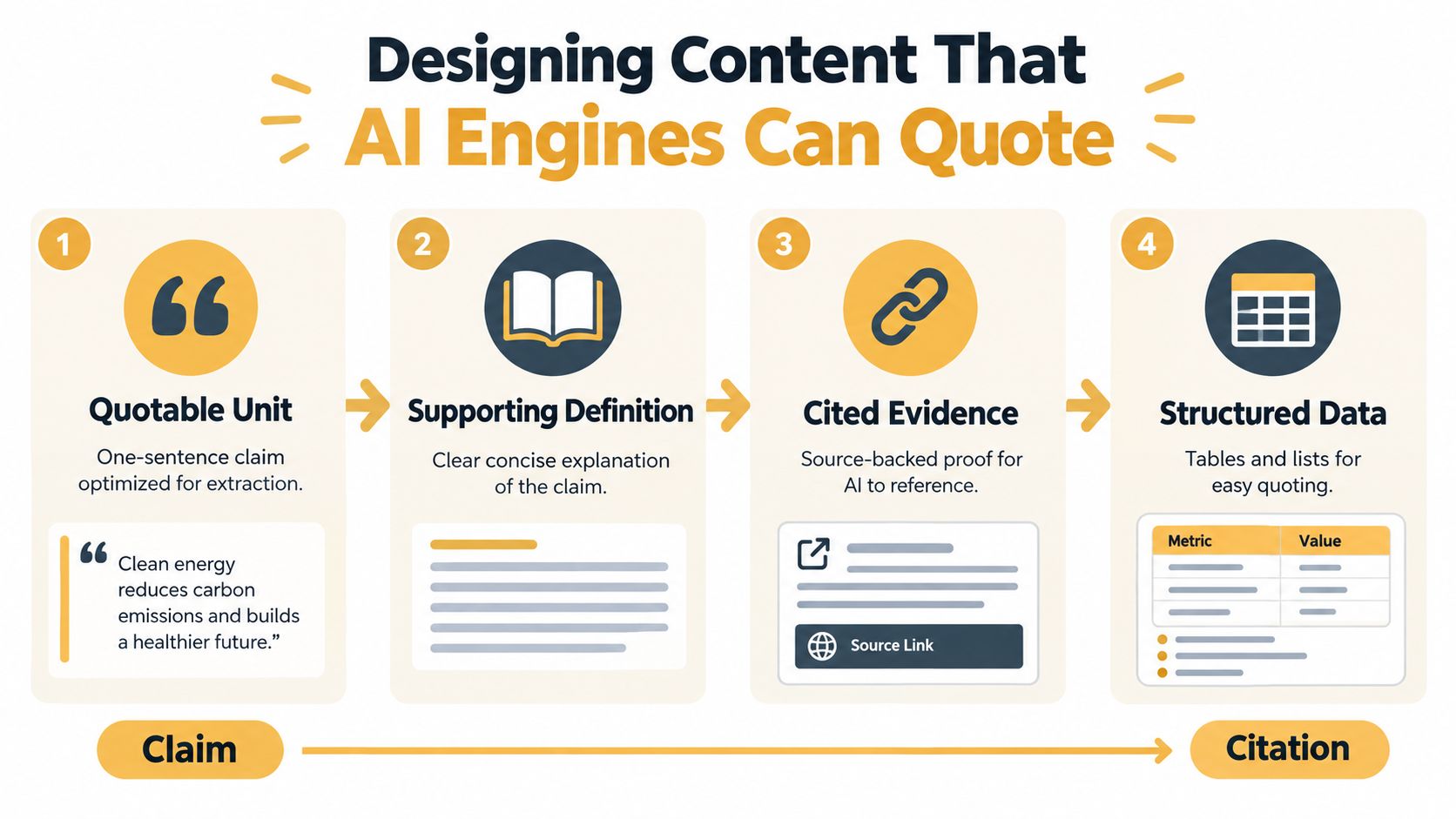
AI-friendly content isn't a collection of robotic fragments. It's a human-readable page built from self-contained evidence blocks. Each block should answer one question, preserve its own context, and give an answer engine enough support to summarize the claim responsibly.
Build a quotable unit
A reliable unit has four parts:
- Claim: State the answer in one direct sentence.
- Definition: Explain the key term or distinction immediately.
- Evidence: Add a cited fact, source, example, or qualification.
- Application: Tell the reader what the information changes in practice.
For example, a section answering “What is AI search optimization?” should define the term before discussing tactics. The first paragraph shouldn't begin with broad commentary about digital transformation. Put the answer near the top, then develop the nuance below it.
Descriptive headings improve retrieval because they identify the question the following passage answers. “How does schema help AI search?” gives a model more context than “Structured data considerations.” Front-load the definition in the opening portion of the page, then use short paragraphs that can stand alone when extracted.
Give models clean spans to absorb
Short paragraphs are easier to parse than walls of text, especially when every paragraph tries to answer a different question. Keep most evidence blocks focused and separate comparison criteria into tables or lists. A table works well for product differences, process stages, service options, and “when to use” decisions because the relationships are explicit.
Avoid hedging that obscures the conclusion. “There are many factors that may potentially influence whether a page could perhaps be cited” gives the model nothing precise to reuse. State the condition, explain the limitation, and identify the action.
- Burying the answer: Put the direct conclusion before the background.
- Blending unrelated ideas: Keep one intent per block.
- Using unsupported certainty: Cite factual claims and label analysis as analysis.
- Publishing generic summaries: Add distinctions, procedures, and source-backed reasoning.
Treat FAQs as real answers, not filler
An FAQ line should address a genuine decision question and provide a complete answer. Don't create a list of keyword variations with thin responses. If a page covers CRM selection for roofing companies, useful questions might distinguish scheduling, estimate management, mobile access, integrations, and service-area workflows. The answer should explain the criterion, not just repeat the product category.
For a complementary guide focused on Google's answer surface, see how to optimize for AI Overviews. The same answer-first habits help across platforms, but each engine can retrieve and display the evidence differently.
A page earns absorption when a model can lift a passage without inventing connective tissue. Write each important section so a reader, search crawler, or answer engine can identify the claim, its basis, and its practical meaning immediately.
Embeddings, Chunking, and RAG Readiness
Retrieval-augmented generation turns a document into searchable pieces before a model ever writes an answer. Publishers building internal assistants, knowledge bases, or customer-support systems can influence that pipeline through chunk boundaries, metadata, freshness, and source hygiene.
Choose chunk boundaries that preserve meaning
A semantic chunk should contain one coherent idea, not an arbitrary slice of a page. Paragraph-level chunking works well for tightly edited guides. Sliding-window approaches can preserve context when a definition and qualification sit across paragraph boundaries. Larger sections may work for reference material, but they increase the risk that the retriever returns too much irrelevant text.
There is no universal chunk size. Test the approach against real prompts and inspect whether retrieved passages answer the question on their own. Add overlap when a concept regularly crosses boundaries, but avoid repeating so much text that retrieval results become redundant.
| Strategy | Typical chunk size | Best for |
|---|---|---|
| Semantic chunking | One complete idea or topic unit | Guides with clear headings and tightly related paragraphs |
| Sliding window | A bounded passage with contextual overlap | Material where definitions and qualifications span boundaries |
| Paragraph-level | One or several related paragraphs | Editorial pages, FAQs, policies, and concise knowledge bases |
The table uses qualitative guidance rather than invented universal ranges because chunk performance depends on the embedding model, prompt length, document type, and retrieval implementation.
Attach context to every chunk
Store the heading path, page title, canonical URL, author, publication date, update date, content type, and entity labels with each chunk. Include alt text and image captions when they carry meaning. A sentence such as “It supports mobile dispatch” loses context if the system doesn't know which product or service “it” refers to.
Stable URLs and visible timestamps also support freshness review. Expose XML sitemaps or content feeds that your retrieval layer can consume, and establish a process for removing outdated chunks when a page changes. A current page with stale indexed fragments can produce contradictory answers.
Select infrastructure based on the workload
An SMB with a modest content library often doesn't need a complex vector platform on day one. A hosted vector store can reduce maintenance and provide filtering, backups, and scaling, while a simple retrieval layer over existing content may be easier to audit and cheaper to operate for a smaller corpus. Teams should compare embedding-model quality, dimensionality, query cost, latency, and vendor lock-in before committing.
For teams experimenting with language processing and semantic content analysis, this guide on how to use Python for NLP and semantic SEO offers a practical direction. The key is to evaluate retrieved passages with real user questions, not just confirm that documents successfully entered a vector index.
RAG design principle: If a chunk needs the previous paragraph to make sense, either add the missing context or change the boundary.
Measuring AI Visibility Across Engines
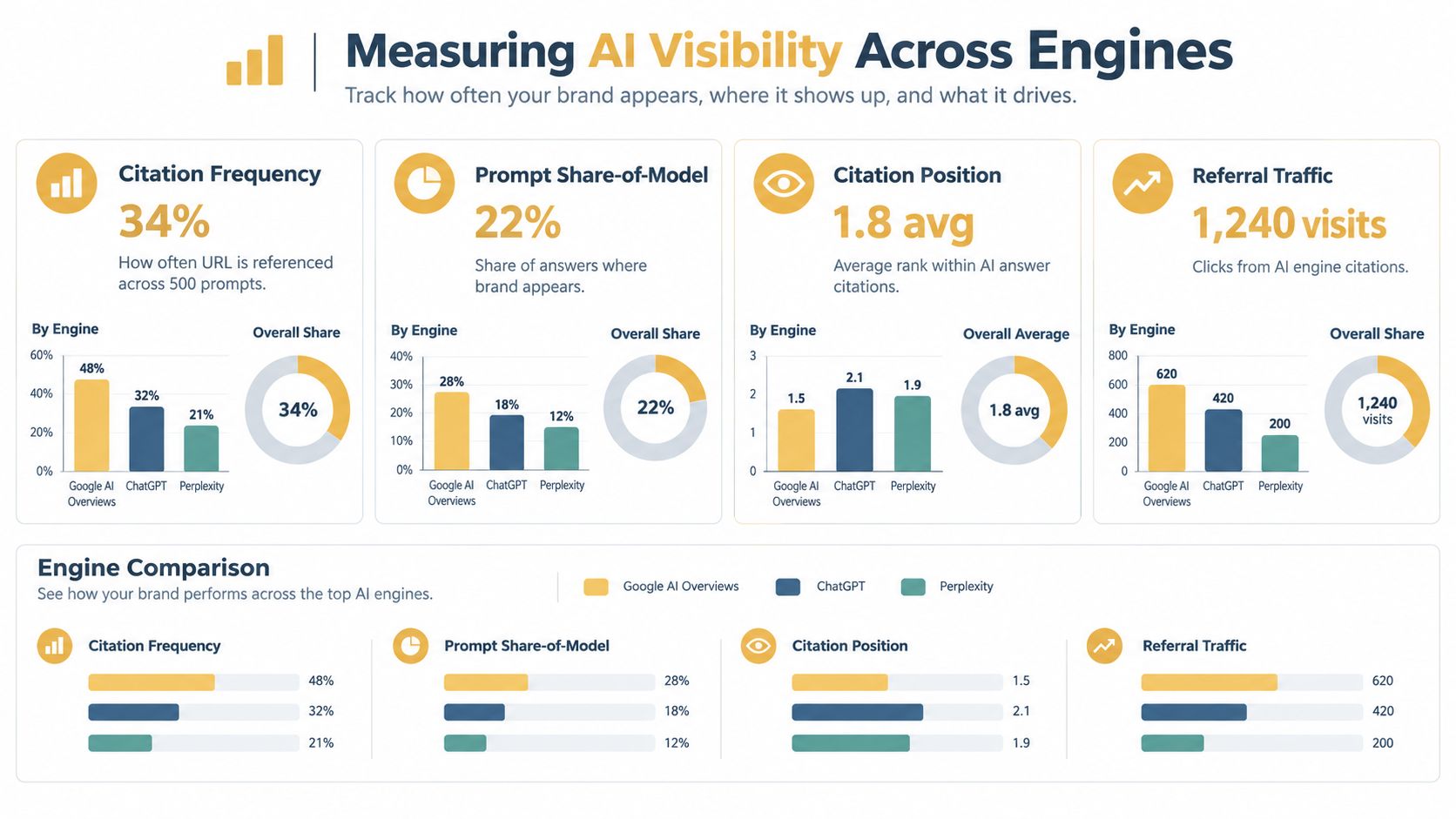
AI search visibility isn't one channel, so one blended score won't tell you much. Google AI features, ChatGPT, Perplexity, and Gemini can surface different sources, use different citation formats, and send different amounts of referral traffic.
Track four separate outcomes
Citation frequency measures how often a URL appears as a cited source for a defined prompt set. Prompt share of model measures how often your brand or page appears in answers compared with competitors. Referral traffic captures visits from assistant interfaces, while citation framing records whether the engine describes your business accurately, positively, neutrally, or with a material omission.
A brand can increase mentions without receiving clicks. Another brand can receive fewer citations but attract more qualified visits because the citation appears beside a high-intent recommendation. SparkToro's 2026 clickstream data reported that 68% of U.S. Google searches ended without a click to the open web, while separate 2026 retail data reported that AI-referred visits converted 42% better than non-AI traffic in March 2026, after being 38% worse a year earlier. Search Engine Journal's analysis of the two studies shows why traffic quality matters more than a simple “AI reduces clicks” narrative.
Build a repeatable prompt log
Run the same commercially relevant prompts on a consistent schedule across Google AI Overviews, ChatGPT, Perplexity, and Gemini. Record:
- Prompt: The exact question and any location or audience qualifier.
- Engine: The platform and feature used.
- Cited URL: The page named or linked in the answer.
- Brand presence: Whether your organization, product, or author appears.
- Framing: The description, recommendation, or caveat attached to the mention.
- Date: When the test occurred.
Use UTM tagging where assistant links preserve referral parameters, then supplement analytics with server logs and referral reports. Keep classic ranking and conversion data in the same reporting view so you can separate an AI visibility gain from a simultaneous organic change.
Survey data shows why this discipline matters. 47% of respondents didn't know what content AI platforms were using, 51% weren't sure their AI visibility approach was correct, and 56% couldn't distinguish AI search optimization from SEO, according to Scrunch's 2026 AI search survey guide. A basic prompt log won't solve every attribution problem, but it gives a team a shared baseline and a way to detect changes.
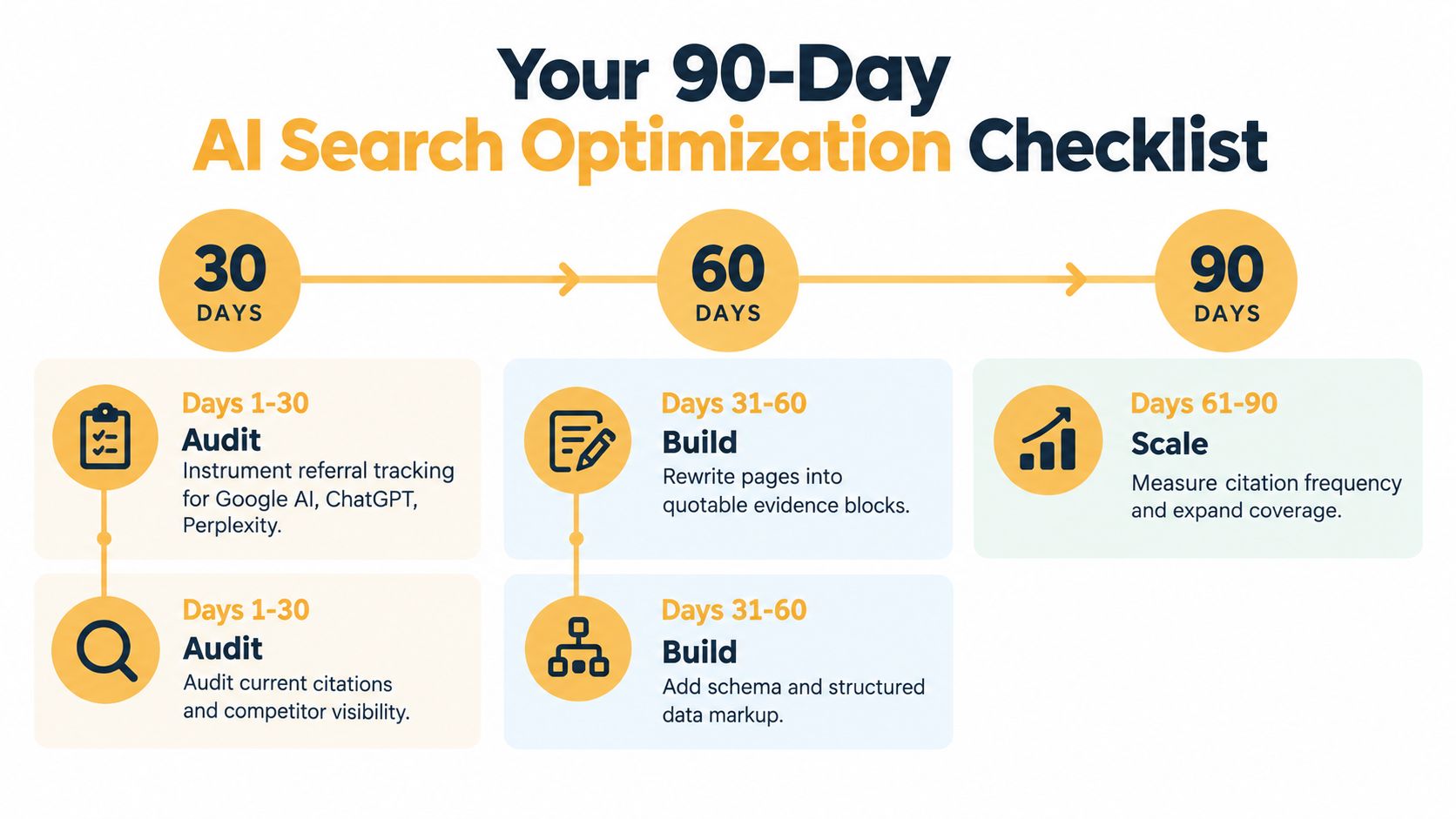
Your 90-Day AI Search Optimization Checklist
A small team doesn't need to rebuild its entire marketing system to start. Assign one owner for measurement, one for technical implementation, and one for editorial changes. Keep the work tied to priority prompts, revenue pages, and topics where competitors already appear in AI answers.
Days 1 through 30 focus on the audit
The deliverable is a baseline report. Test representative prompts across Google AI features, ChatGPT, Perplexity, and Gemini, then record cited URLs, brand mentions, framing, and referral sources. The measurement owner should also check analytics tagging, server logs, and current citation frequency.
The technical owner audits robots.txt, relevant AI user agents, llms.txt policy decisions, XML sitemaps, canonicals, JavaScript rendering, and indexation. The editorial owner inventories existing Article, FAQPage, HowTo, Product, Organization, and Person schema, then maps priority pages to the entities and questions they should answer.
Proof that the audit worked: the team can reproduce the prompt tests, identify current citations, name access problems, and explain which priority pages lack usable structured evidence.
Days 31 through 60 build the foundation
Close crawl and rendering gaps first. Add or correct schema where the page qualifies, validate it, and improve internal links around related entities. Then reshape the top 20 URLs into citable evidence blocks, with direct definitions, question-based subheadings, cited factual claims, comparison tables where appropriate, and complete FAQ answers.
The editorial owner should approve each rewrite for accuracy and human usefulness. The technical owner should verify that the published HTML contains the intended content and that canonical, sitemap, and schema signals agree.
Proof that the build worked: priority pages are accessible, semantically clear, internally connected, and ready for repeatable prompt testing.
Days 61 through 90 measure and scale
Teams building their own retrieval layer can now test chunking, metadata, embeddings, freshness rules, and source filters against actual questions. The measurement owner launches the first recurring comparison, using the original prompt set and adding prompts where competitors or third-party sources appear.
Review citation frequency, prompt share of model, referral traffic, and citation framing against the baseline. Don't optimize toward mentions alone. A useful citation is one that accurately represents the business and reaches a relevant audience.
Proof that the scale phase worked: the team has a recurring dashboard, documented prompt methodology, assigned refresh owners, and a prioritized backlog based on observed citation gaps.
Don't wait for a perfect industry benchmark. AI answers change, sources rotate, and platform behavior differs. A disciplined baseline, technically accessible content, and evidence blocks that models can absorb will give your team a more useful advantage than chasing a single universal ranking signal.
Up North Media helps businesses plan and execute AI search visibility work, including prompt testing, citation measurement, crawlability reviews, structured content improvements, and broader SEO strategy. Visit Up North Media to discuss an AI-search audit or a practical optimization plan for your website.