

A flash sale starts, traffic surges, and an Omaha retailer watches checkout slow to a crawl. The catalog still loads, the blog is available, and customers can browse products, but the payment flow is competing for the same application resources as every other feature. The team can't patch checkout safely because the release also touches promotions, account pages, and content.
That's the point where architecture stops being a developer preference. It becomes a business decision about revenue protection, release risk, engineering capacity, and total cost of ownership. Microservices architecture benefits can be substantial, but only when they solve an expensive problem that a simpler structure can't handle.
A monolith may still be the right answer for a small product, a stable workload, or a team without the operational capacity to run distributed systems. If the issue is slow database queries, inefficient caching, or a poorly designed deployment process, you might fix it without a rewrite. If every release requires coordination across unrelated teams, high-demand features can't scale independently, and one failure takes down unrelated customer journeys, a structural rethink deserves serious attention.
When a Growing App Starts Holding You Back
The Omaha retailer in this scenario doesn't necessarily need a full migration. First, the team should identify whether checkout is slow because of database contention, overloaded infrastructure, an external payment provider, or an architectural coupling problem. Those causes need different remedies. More servers won't fix a release process that forces every team to deploy together.
The symptoms that matter
A structural change becomes easier to justify when the same pain repeats across business cycles:
- Revenue-critical contention: Search, checkout, authentication, or order processing consumes capacity needed by lower-priority features.
- Release coordination: A small payment fix waits for catalog, content, and account changes to clear testing.
- Wide failure impact: A recommendation widget or background job can destabilize the storefront.
- Ownership confusion: No team can change a capability without understanding the whole application.
- Modernization paralysis: The company can't replace one capability without reopening the entire codebase.
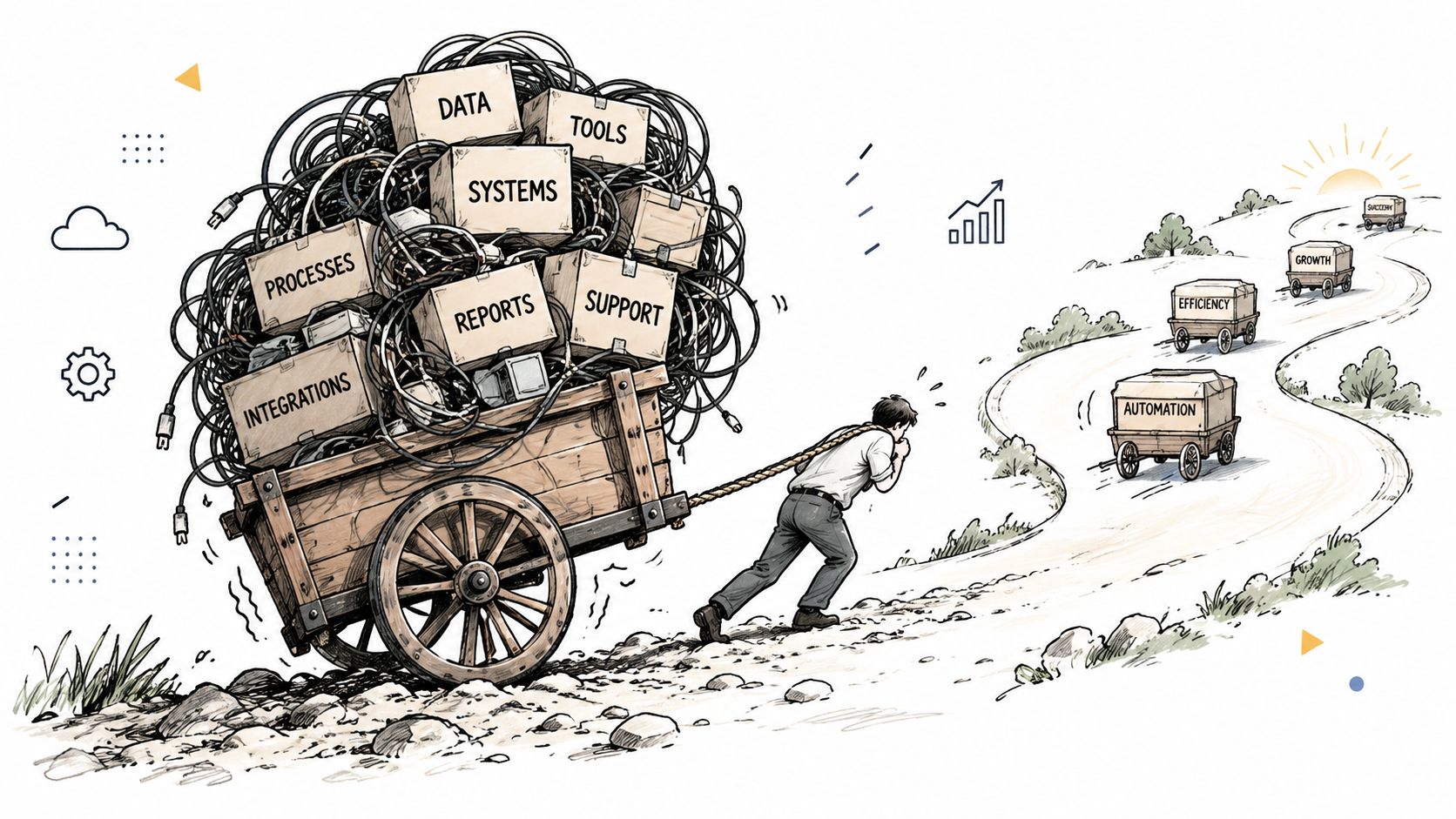
A legacy system modernization strategy can address several of these problems without forcing an all-at-once rewrite. The practical question is whether the application needs independent deployment, selective scaling, fault isolation, or incremental replacement, not whether microservices are fashionable.
A survey of 122 software professionals found that easier maintenance, optimized scalability, and independent automated deployment were the leading perceived benefits of microservices, reported by 81.1%, 79.2%, and 75.4% of respondents respectively, according to the practitioner survey on microservices benefits. Those findings don't prove that every business should decompose its application. They show which operational problems experienced teams associate with the architecture.
Decision rule: Don't migrate because the codebase feels old. Migrate when a specific business capability needs to scale, ship, or fail independently.
The rest of the decision depends on what sits behind those symptoms. Microservices can separate the pressure points, but they also introduce more systems to operate. Understanding that exchange starts with the architecture itself.
What Microservices Actually Are
Think of a restaurant with one giant kitchen. Every cook shares the same preparation area, equipment, ingredients, and service line. If the fryer breaks, the kitchen manager changes the menu, or a large order arrives, the disruption spreads across the operation.
Microservices use a different model. The application becomes more like a food hall, with independent stations for distinct responsibilities. A grill station handles grilled items, a salad station owns salads, and a payments station processes transactions. Each station has a defined job, communicates with the others through agreed interfaces, and can receive more capacity or change its process without closing the entire building.
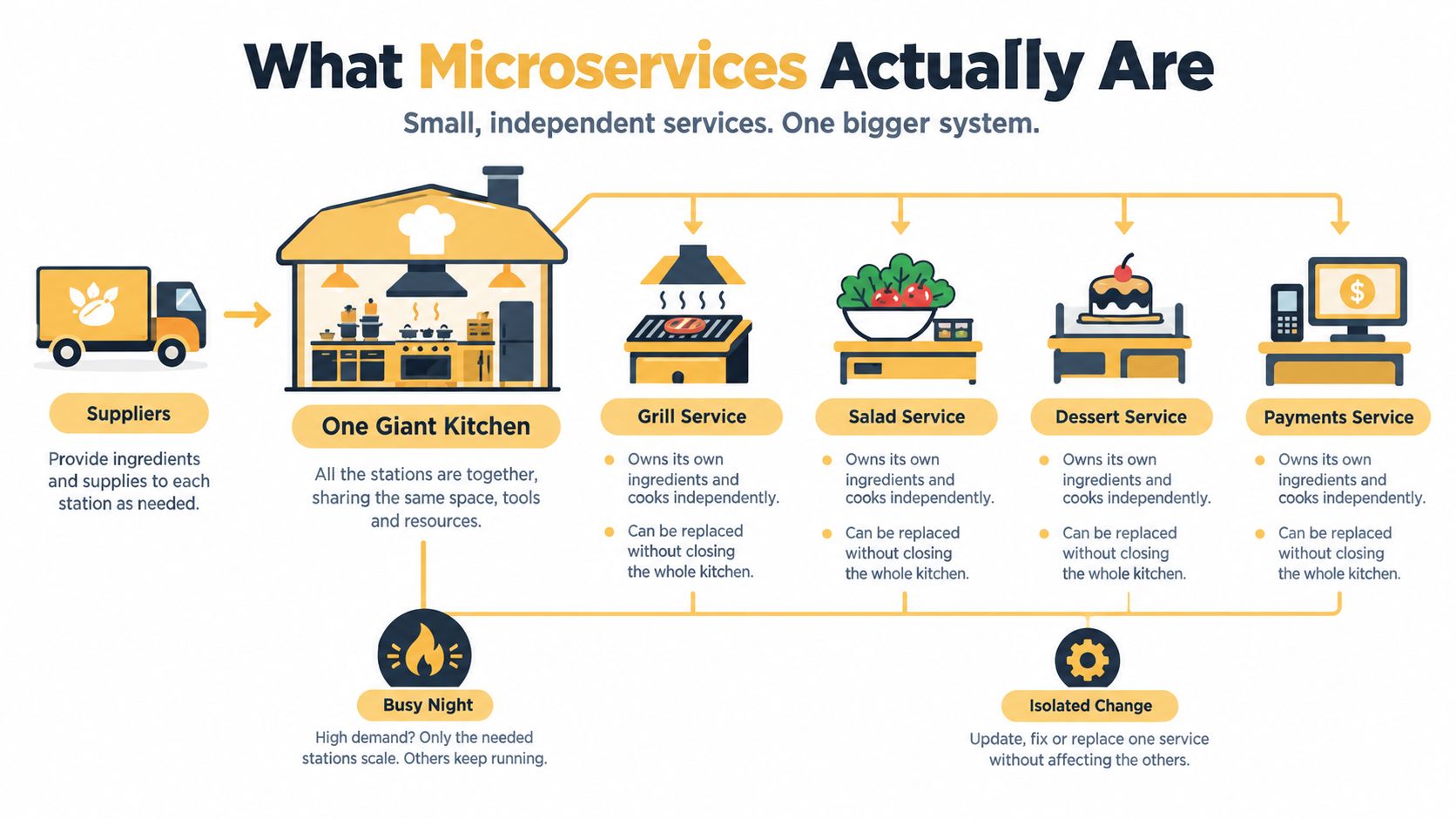
Technically, microservices architecture is an application made of small, independently deployable services, with each service responsible for a defined business capability. Services communicate through APIs or messaging, and each one can be developed, deployed, monitored, and scaled separately.
A monolith puts those capabilities inside one deployable application. The code may still have internal modules, but production treats the application as one unit. A change to account management can require the same build and deployment process as a change to checkout.
The one-sentence explanation
Tell a non-technical co-founder this:
A monolith is one application that scales and ships as a unit. Microservices split it into independently operated capabilities that work together through contracts.
That distinction matters more than the number of services. A poorly divided system can become a distributed monolith, with separate deployments that remain tightly dependent. A well-designed system gives each service clear ownership, controlled communication, and a reason to exist.
For teams evaluating building scalable commerce platforms, the useful starting point is the business domain. Product catalog, search, checkout, identity, fulfillment, and content may have different traffic patterns and release needs. They shouldn't be split automatically, but their differences can reveal where separation would create value.
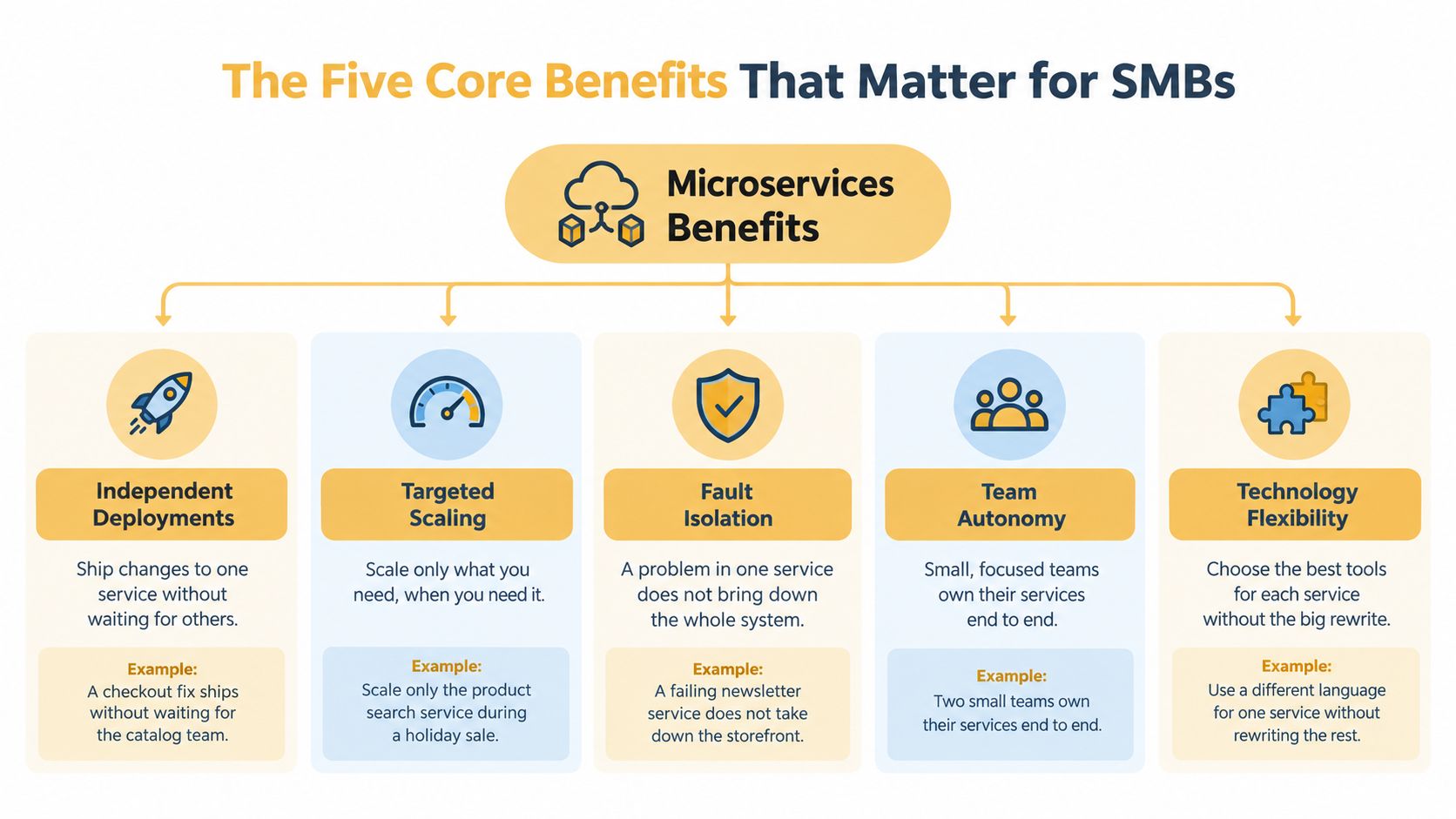
The Five Core Benefits That Matter for SMBs
Microservices earn their complexity through specific operational gains. For an SMB, the strongest case usually combines several benefits rather than relying on scale alone.
Independent deployments
A payments team can ship a provider fix without waiting for the content team to finish a campaign. A publisher can update its subscription service without redeploying the article archive. That separation reduces coordination and limits the blast radius of a bad release.
The practitioner survey cited earlier reported independent automated deployment as a leading perceived benefit, at 75.4% of respondents. The business value is shorter approval chains and fewer unrelated changes bundled into revenue-critical releases.
Selective scaling
An e-commerce site doesn't experience demand evenly. Search and checkout may become hot during a promotion while account management and archived content remain steady. Independent services let the team direct additional capacity toward the overloaded path instead of duplicating the entire application.
A 2025 empirical comparison measured improvements of 8.59% to 12.34% in Sock-Shop and 7.30% to 11.97% in Hotel-Reservation services, with the results tied to independently scaling high-demand services in those benchmark applications, as reported in the empirical microservices comparison. Those are measured outcomes from specific systems, not a promise for every platform.
Fault isolation
If recommendations fail, shoppers should still be able to search, sign in, and complete an order. A separate newsletter service shouldn't take down the storefront. Microservices create the structure for that containment, but teams still need timeouts, health checks, retries, circuit breakers, and graceful degradation.
Technology diversity
A single stack can simplify operations, but it can also force every capability into the same technical shape. Separate services let a team choose tools suited to a particular workload, provided the organization can support that variety. The benefit isn't collecting languages. It's avoiding a platform-wide rewrite when one capability needs a different approach.
Faster delivery through focused ownership
A small team that owns search end to end can improve indexing, caching, APIs, and deployment without coordinating every storefront change. That autonomy can shorten delivery cycles, but only when service boundaries match team responsibility.
You likely need a serious architecture review if your team has faced three or more of these problems recently: coordinated releases, uneven scaling, cross-feature outages, unclear ownership, or technology constraints. If none apply, a modular monolith may provide the same discipline with less overhead.
How Microservices vs Monolith Compare Under Real Load
Traffic changes the answer. At lighter workloads, a monolith often benefits from direct in-process calls and a simpler deployment path. As demand concentrates around a few functions, microservices can direct capacity toward those functions instead of scaling everything together.
A benchmark found that below 2,000 requests per second, the monolith measured roughly 25 to 30 milliseconds of latency, compared with 35 to 40 milliseconds for microservices. Above 10,000 requests per second, the monolith reached approximately 120 to 150 milliseconds, while the microservices implementation stayed around 80 to 90 milliseconds, according to the comparative performance benchmark.
| Traffic Level | Monolith Latency | Microservices Latency | Better Choice |
|---|---|---|---|
| Below 2,000 requests per second | Approximately 25 to 30 ms | Approximately 35 to 40 ms | Monolith, if other needs are modest |
| Above 10,000 requests per second | Approximately 120 to 150 ms | Approximately 80 to 90 ms | Microservices, when hot services scale independently |
The lesson isn't that a particular request rate automatically triggers a migration. Request volume is only a proxy for the key question: does one part of the application need capacity, release speed, or reliability that the rest doesn't?
A high-traffic site with simple, uniform workloads may remain efficient as a well-tuned monolith. A smaller commerce platform with severe checkout spikes may benefit from separating checkout even before the whole application reaches extreme load.
Network calls create the low-load penalty. Each service boundary adds serialization, routing, connection management, and another potential failure point. Teams evaluating API boundaries should also understand the practical trade-offs in a GraphQL versus REST API comparison, especially when client flexibility can increase backend coordination.
Practical rule: Use microservices where workload patterns differ. Don't distribute a workload that behaves uniformly just to claim a modern architecture.
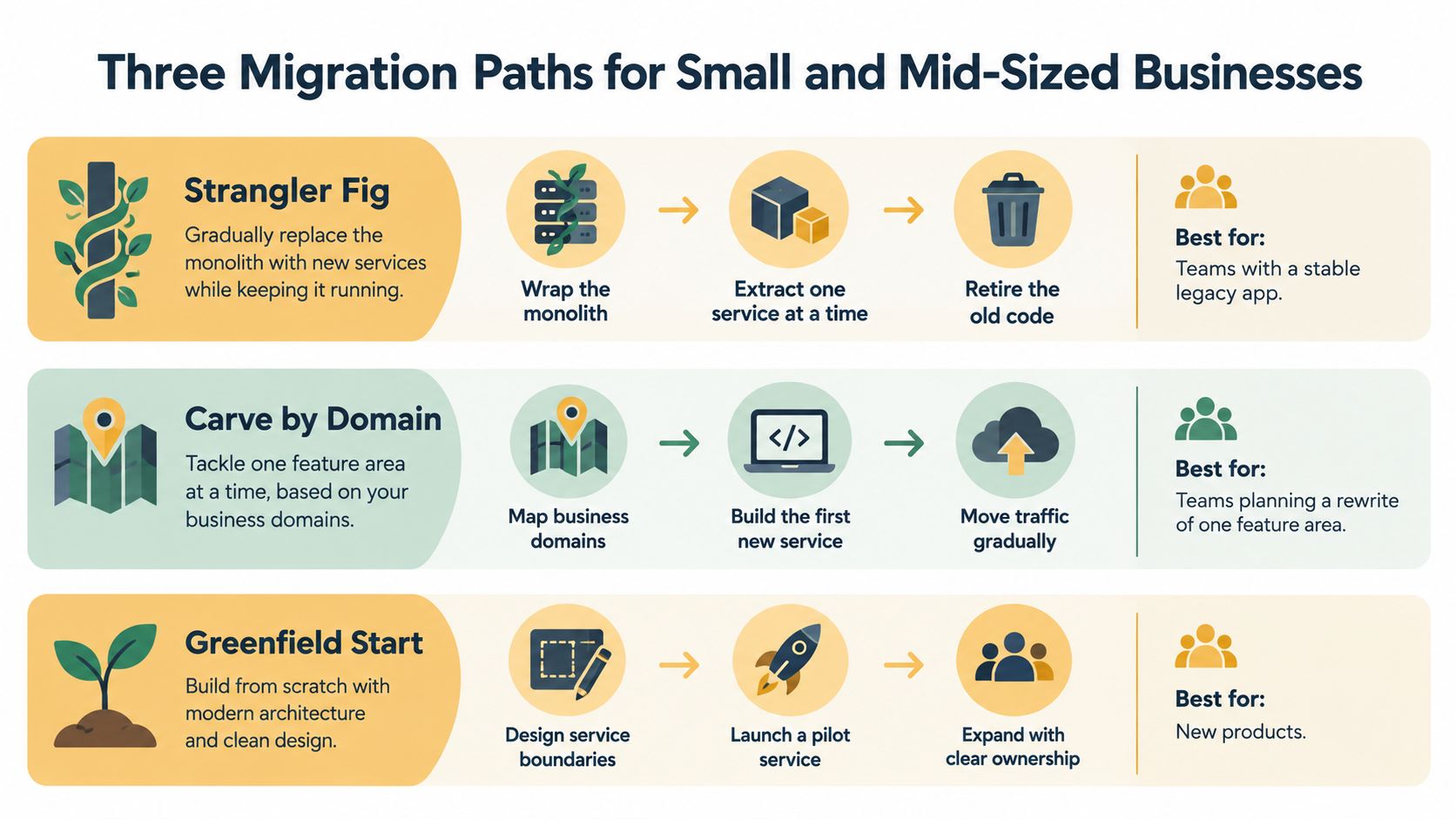
Three Migration Paths for Small and Mid-Sized Businesses
Most SMBs shouldn't throw away a functioning application. They should choose a migration path that preserves revenue while creating room for targeted change.
Strangler fig for established platforms
Build new capability around the monolith, route selected traffic to the new service, and retire the old path after the replacement proves reliable. This works well for an established retailer or publisher that can't pause operations for a rewrite.
Start with one domain, such as search, customer identity, or order notifications. The danger is building a second system without a retirement plan. Define ownership, traffic cutover, data synchronization, and the condition for deleting legacy code before implementation starts.
Modular monolith for early-stage teams
A modular monolith keeps the deployment simple while enforcing internal boundaries. Separate modules by business capability, restrict dependencies, and give each module a clear owner. This creates future options without asking a small team to manage distributed networking and multiple production environments today.
Choose this path when the product is still changing rapidly, traffic is relatively uniform, or the team lacks dedicated operations capacity. A technology stack selection framework can help evaluate maintainability and hiring constraints before architecture becomes an expensive commitment.
Selective extraction for one expensive bottleneck
Extract only the capability with a compelling business case. Search may need a different scaling profile. Checkout may require stricter release controls. Media processing may consume resources that shouldn't compete with customer-facing requests.
This path is usually easier to fund because the target is visible. It also limits learning to one service boundary, one deployment pipeline, and one operational model.
The 2018 practitioner study found that microservices support incremental modernization, allowing a business to replace or expand one capability while preserving the rest of the application, a pattern suited to organizations with limited engineering capacity, as described in the study of incremental modernization.
Before choosing a path, confirm that you have:
- A named business bottleneck: The team can identify the capability causing cost, release, or reliability pain.
- An accountable owner: Someone owns the service after launch, including incidents.
- A delivery pipeline: Builds, tests, and deployments run consistently.
- Observability: Engineers can trace errors and latency across boundaries.
- A retirement plan: The migration won't leave duplicate legacy and new paths forever.
The Trade-Offs Most Articles Skip
Microservices can cost more than they return. The mistake is adopting them before pricing the operating model.
A monolith gives a small team fewer moving parts: one application, one deployment unit, one primary debugging surface, and fewer network boundaries. Cost-of-ownership research shows that steady workloads often favor the monolith financially. Container, orchestration, load-balancing, monitoring, and communication costs must be funded before microservices produce enough business value to repay them.
The hidden bill
Your business pays for more than compute:
- Engineering time: Teams maintain service contracts, deployment pipelines, and compatibility rules.
- Operations: Someone manages alerts, dashboards, scaling policies, and incident response.
- Data coordination: Workflows crossing services need explicit consistency strategies.
- Security controls: Each endpoint and service identity expands the security surface.
- Debugging: A customer request may cross several services and require distributed tracing.
- Platform work: Containers, orchestration, load balancing, and secrets management need clear ownership.
Poor isolation can erase expected performance gains. In one deployment benchmark, separating components across virtual machines or hosts produced slowdowns ranging from roughly 14 to 16 times to 65 to 68 times, depending on topology. Treat those figures as a warning about network placement and engineering discipline, not as a forecast for every production system.
For an Omaha SMB with modest, stable demand and a small engineering team, a modular monolith is often the better financial choice. Keep the system modular when it scales vertically, releases do not create costly coordination, failures remain contained, and the company cannot fund observability and on-call responsibilities.
CFO test: Compare the annual cost of additional services with the revenue protected by better uptime, the engineering time recovered through independent releases, and the cost avoided through targeted scaling.
Choose selective decomposition when one capability has an unmistakable business case. Choose full microservices only when several independently operated domains can justify the permanent operational burden. A practical decision weighs traffic, team capacity, and total cost of ownership together, rather than treating peak scalability as the default goal.
Measuring ROI Beyond Peak Scalability
A board approves architecture when leaders can connect engineering work to revenue, risk, and operating cost. Peak scalability alone rarely makes that case.
Start with measures tied to customer and financial outcomes:
- Deployment frequency: Count production releases by capability. Faster independent releases matter only when they reduce delays for revenue-producing work.
- Mean time to recovery: Record how quickly engineers identify and restore failed functionality. Isolation has value only when the team can act on the failure.
- Revenue per engineer: Compare completed revenue-critical work with available engineering capacity. Focused ownership should reduce coordination overhead.
- Conversion under demand: Track checkout completion and errors during promotions, not only average uptime.
- Infrastructure cost per request: Compare the cost of serving high-demand flows with scaling the full application.
The earlier microservices practitioner research provides context for independent deployment, but your own baseline should decide whether that benefit appears in the business.
Use a concrete comparison. A retailer that tags checkout requests before extracting that capability can compare pre- and post-migration error rates during its next flash sale. Pair those results with completed orders, support contacts, and deployment records. That turns an engineering metric into a revenue discussion leadership can act on.
An SMB does not need a new measurement platform before starting. Tag requests by capability, record latency and errors at service boundaries, track deployment events in the existing CI system, and connect incidents to affected customer journeys. A focused dashboard covering checkout errors, release frequency, recovery time, and infrastructure spend is enough for an informed architecture decision.
Set the baseline before extraction. Otherwise, the team may celebrate a successful migration without knowing whether it reduced incidents, improved delivery, protected conversion, or merely increased the number of systems it operates. Compare the results against the modular monolith and selective decomposition options, then fund the path that produces the clearest business return.
Pitfalls, Best Practices, and Your Next Step
The most expensive microservices mistakes are predictable. Teams split code before assigning ownership, preserve tight coupling through a shared database, and deploy services without enough visibility to diagnose failures.
Avoid these failure modes
- Distributed monolith: Services require synchronized releases and constant synchronous calls. Define bounded responsibilities and versioned contracts.
- Shared database dependency: Every service writes to the same tables. Move ownership toward the service controlling each business capability, then plan data transitions deliberately.
- No observability: Logs sit in separate systems and requests lack correlation. Add centralized metrics, logs, and tracing before the first extraction.
- Premature decomposition: The team creates services because the code feels messy. Start with a measurable bottleneck and a clear owner.
- Platform overreach: The organization adopts complex orchestration before it can operate basic deployments reliably. Choose the simplest platform that meets current requirements.
Set service-level objectives for acceptable latency, availability, and error behavior for every extracted capability. Contract testing protects API compatibility. Timeouts, retries with backoff, circuit breakers, and health checks limit the effect of dependency failures and help prevent cascading outages.
The operating model matters as much as the code. In a DevOps and Platform Engineering comparison, focus on who will own deployment tooling, service templates, observability, and developer support. Microservices without clear operational ownership move complexity into incidents and emergency work.
Your team also needs a rollback path. Document data ownership, define who approves releases, rehearse restoring a failed service, and record the customer journey affected by each dependency. These controls make a selective extraction safer without forcing the organization to build a large platform first.
Book an architecture review this quarter. Map the dependencies behind the slowest revenue path, identify the team responsible for each boundary, and price one candidate extraction against a year of on-call and observability costs. Compare that estimate with strengthening the modular monolith, then approve work only when the expected business result and operating responsibility are clear.
Up North Media helps Omaha SMBs and e-commerce brands evaluate modular monoliths, selective decomposition, and microservices migrations around real growth and operating goals. Visit Up North Media to discuss your current bottlenecks and build a practical web application or modernization plan with measurable next steps.