
Most product roadmap development advice is backwards. It tells you to build a polished roadmap deck, defend it in meetings, and treat the result like a promise. That mindset kills credibility fast, because a roadmap isn't a presentation artifact, it's a decision system for volatile markets, shifting customer needs, and limited capacity.
If you want a roadmap people trust, stop obsessing over the document and start obsessing over the logic behind it. For a plain-English starting point on the core concept, what is a product roadmap for founders gives a useful framing, but the core work is making the roadmap operate well under pressure. A credible roadmap doesn't predict the future, it shows how your team will make good calls as the future changes.
The best evidence for that comes from roadmap time horizons. A major 2018 ProductPlan survey of more than 500 product professionals found that the most common horizon was one year, followed by 4 to 6 months, then 2 to 3 months. The same research reported that teams planning only 4 to 6 months ahead had 20% more prioritization success than teams planning more than 3 years ahead, which is exactly why static long-range roadmaps lose trust so quickly. For a digital transformation planning lens that matches this operating mindset, the internal guide on a digital transformation roadmap is worth comparing against your own process.
Why Most Product Roadmaps Fail Before the First Quarter Closes
Most roadmaps don't fail because the team is lazy. They fail because the roadmap was built as if the world would stay still long enough to honor it. In SMBs, that's fantasy. A customer escalates, a competitor ships, a developer flags a dependency, and suddenly the “final” roadmap looks like it came from another company.
The three failure modes that keep showing up
The first failure mode is internal opinion disguised as strategy. Teams fill the roadmap with the loudest requests in the room instead of evidence from customers, usage, or business goals. The second is fixed-date overcommitment, which makes every change feel like a betrayal instead of a routine update. The third is treating completion as a vanity metric, where the team celebrates shipping whatever was on the list, even if the list itself was wrong.
Practical rule: if a roadmap only survives when nothing changes, it's not a roadmap. It's a wish list.
The better framing is simple. A roadmap should function as a living decision log that answers what matters now, what's next, and what gets cut when reality changes. If you want a useful grounding for the founder side of that thinking, Backlog prioritization guide is a decent companion read because it reinforces the difference between deciding and merely collecting ideas.
Credibility comes from decision quality, not polish
A pretty roadmap deck can still be a bad roadmap. If the logic behind it is weak, your team will stop believing the slides, then stop believing the process. Once that happens, every stakeholder review turns into negotiation theater.
Credibility comes from three things. First, your inputs are real. Second, your time horizons are honest. Third, you can explain why an item moved, changed, or got killed. That last point matters most, because roadmaps that can't absorb change without drama are roadmaps built for blame, not for shipping. For teams trying to align roadmap thinking with broader organizational change, the digital transformation roadmap lens helps keep the conversation strategic instead of feature-obsessed.
Defining the Inputs That Actually Drive Roadmap Decisions
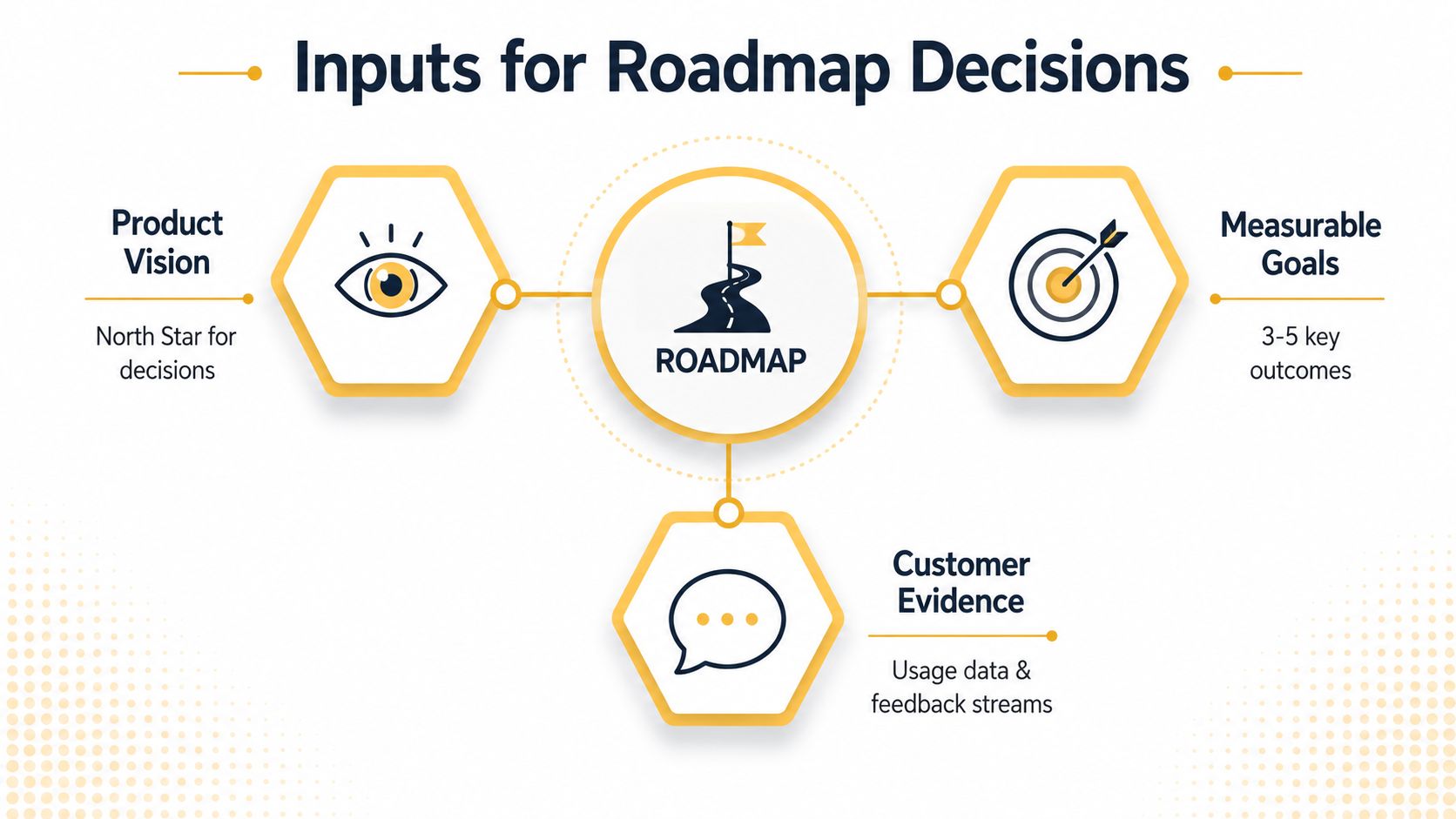
A roadmap without strong inputs is just organized guessing. The three inputs that matter are vision, measurable goals, and customer evidence. If any one of those is fuzzy, your prioritization process turns into a debate club.
Write the vision so it can actually steer decisions
Your vision should be one paragraph, not a manifesto. It needs to say who the product serves, what problem it solves, and why the business should care. If you can't connect the vision to revenue, retention, pipeline, or operational efficiency, it isn't a working vision, it's branding copy.
The strongest SMB visions are narrow enough to guide trade-offs. They don't try to inspire everyone. They tell the team what kind of value the product is supposed to create so you can reject work that doesn't fit. That's the whole point of product roadmap development, giving the team a filter before the spreadsheet ever opens.
Turn goals into outcomes, not output lists
From that vision, define 3 to 5 quarterly goals in outcome language. “Launch new dashboard” is an output. “Reduce time spent finding key account data” is an outcome. One is a delivery activity, the other gives you a reason to prioritize.
If you're a founder or agency PM without a research department, don't overcomplicate the inputs. Use what you already have, customer calls, support tickets, churn reasons, win-loss notes, product analytics, and direct sales feedback. The trick is to distinguish signal from noise. A single loud customer request is noise unless it repeats, points to a material problem, or aligns with your current goals.
If the evidence doesn't change a decision, it probably doesn't belong on the roadmap.
Use the right kind of evidence for the job
Qualitative interviews beat usage data when you need to understand why users are stuck. Usage data beats interviews when you need to know where friction shows up at scale. Most SMB teams need both, but not in equal amounts every week. Interviews surface hidden needs. Analytics prevents you from overreacting to anecdotes.
For a practical investor-side view on what strong product thinking looks like early, top product design investors is a useful external reference because it shows how product conviction gets evaluated by people who fund and scale it. The point isn't to impress investors, though. It's to build a roadmap that can survive scrutiny from the people paying for it and the people shipping it.
Choosing Between RICE and MoSCoW for Your Team
Don't pick a prioritization framework because it sounds mature. Pick one because it matches your data quality and your decision style. For most SMBs, the choice is between a scoring model that can support debate and a ranking model that can force trade-offs.
| Dimension | RICE | MoSCoW |
|---|---|---|
| Best for | Teams with usable data and active pushback in the room | Quarterly commitment conversations with executives or clients |
| Strength | Makes trade-offs explicit when you can estimate reach, impact, confidence, and effort | Keeps the discussion focused on must-have versus non-essential work |
| Risk | False precision, especially when the inputs are weak | “Must” expands until everything feels critical |
| Best use case | Internal product teams that need a defensible ranking | Client-facing or leadership planning where directional clarity matters |
My recommendation is blunt
Use RICE when your team can estimate with some confidence and will challenge the scoring. If your delivery team argues with the numbers, good. That means the framework is forcing the right conversation. Use MoSCoW when the job is to create a shared understanding of what gets done this quarter and what gets cut.
The backlog prioritization guide is useful here because it reinforces the core mistake to avoid, which is pretending a framework can replace judgment. It can't. It can only make judgment more visible.
Watch the failure pattern of each framework
RICE fails when people think the score is truth instead of a rough decision aid. If your reach and impact estimates are pulled from thin air, you're not prioritizing, you're decorating uncertainty with decimals. MoSCoW fails when every stakeholder stuffs items into Must because nobody wants to say no.
The cleanest SMB pattern is to use MoSCoW for the executive or client conversation, then translate the approved set into RICE internally if the team needs a sharper sequence. That keeps the leadership discussion simple without stripping the delivery team of rigor.
Building a Rolling Roadmap With the Right Time Horizons
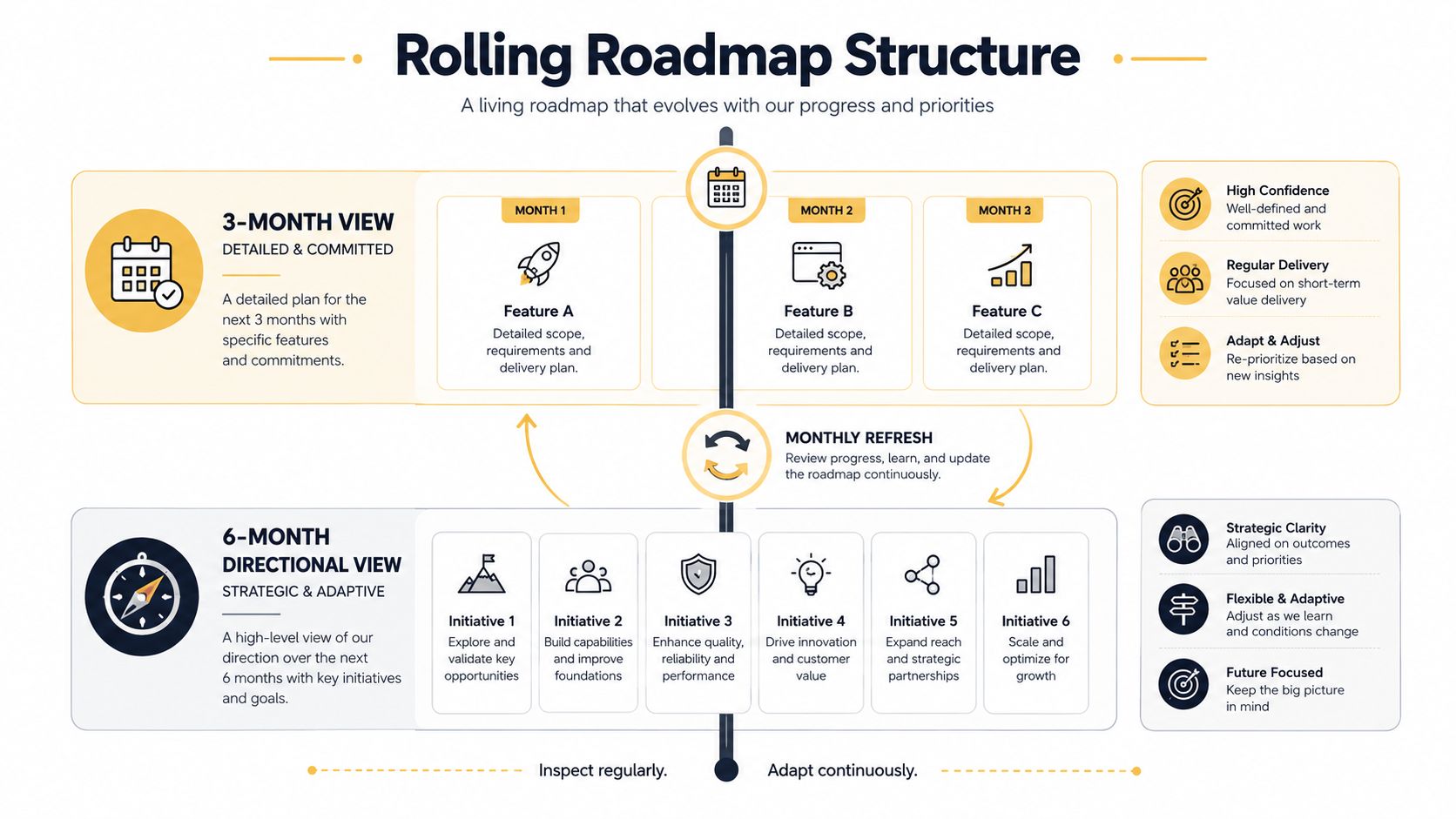
A roadmap that holds up under change needs two views, not one. Use a 3-month detailed view for committed work and a 6-month directional view for bets that still need refinement. Anything beyond that belongs in strategy notes, not in a plan people will be judged against.
Keep the structure tight and the buffer real
A rolling roadmap works because it separates commitment from direction. The near-term window gets specific owners, sequencing, and constraints. The farther window stays directional, which gives you room to adapt without pretending certainty you don't have. Reserve about 20% buffer for unplanned work, because reality always shows up.
The monthly update cadence matters more than many teams admit. If you only revisit the roadmap when someone complains, the plan will drift until it's no longer useful. A fixed monthly refresh keeps the roadmap honest and makes changes look like governance, not panic.
Use completion rate as your health check
The most underused health metric in SMB roadmap development is completion rate. A practitioner benchmark says the industry average roadmap completion rate is 60% to 70%, with below 50% suggesting the roadmap is too aspirational and above 80% suggesting possible sandbagging. That's not a vanity metric. It's a credibility signal.
If your team keeps missing low, you're overpromising, overloading, or both. If you keep hitting too high, you're likely playing it safe or stuffing the plan with trivial work. The sweet spot forces a real operating rhythm, one that includes learning, capacity, and negotiation.
Practical rule: if the roadmap is always perfect, it's probably not ambitious enough.
Make the spreadsheet reflect reality
Every item in the detailed window should have a reason to be there. The directional window should only hold items that still need discovery, sizing, or sequencing. Anything that can't survive a monthly review with a straight face doesn't belong on the roadmap yet.
Running a Weekly Discovery Loop on Every Active Bet
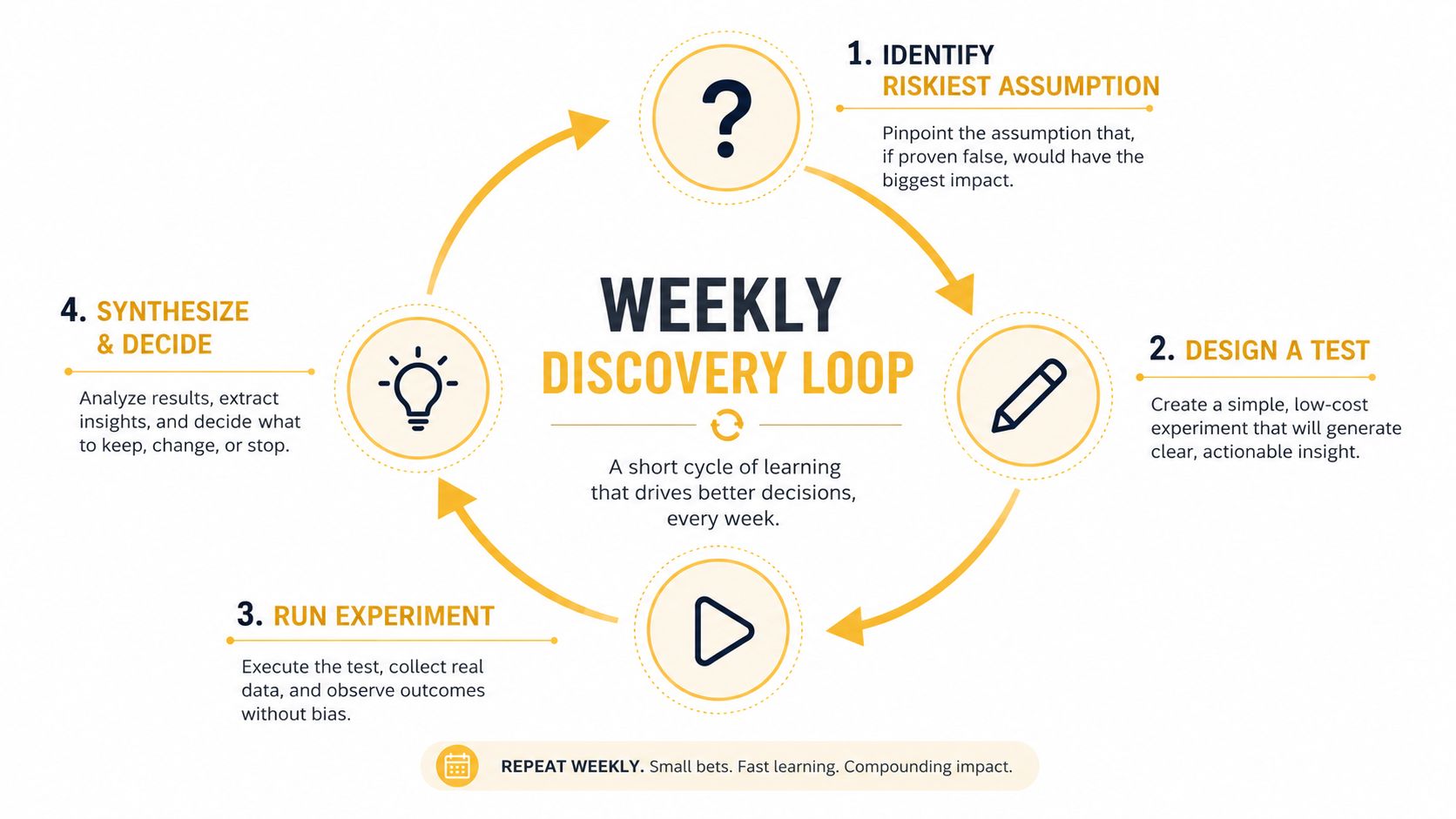
A team in mid-quarter trouble usually doesn't need a new roadmap. It needs a better way to decide which bets deserve to stay alive. The fix is a weekly discovery loop on every active bet, especially when the item is risky, expensive, or politically sensitive.
A real pivot is cheaper than a fake commitment
A small agency product team I'd trust would do this every week on Monday. They'd take each active bet, identify the riskiest assumption, design the smallest test, run it fast, and update confidence before the next planning conversation. If the evidence says proceed, they proceed. If it says pivot, they pivot. If it says kill, they kill.
That kind of discipline protects trust. The executive team doesn't want optimism, it wants decisions that are visible, reasoned, and revisable. When you kill an item early because the assumption failed, you're not losing momentum. You're saving capacity for something that has a real shot.
Keep the loop small enough to run every week
The loop has four moves. Identify the riskiest assumption. Design the smallest experiment. Collect evidence. Decide whether to proceed, pivot, or kill. That's it.
For product risk, use evidence that tests demand. For usability risk, use evidence that shows whether people can complete the task. SMBs don't need a research lab to do this well. They need one owner, one hypothesis, one test, and a written decision.
The minimum viable product guide pairs well with this mindset because it keeps the team focused on proving value before overbuilding. The roadmap gets stronger when every active bet has a clear assumption behind it.
Build the habit into the cadence
Log the decision in the same place every week so the next prioritization round starts with evidence, not memory. If the team is honest, the discovery log becomes a map of what the market told you. That's a much better input than the story people wish were true.
Tailoring the Same Roadmap for Executives, Teams, and Clients
One roadmap should not be forced to do three jobs the same way. Executives need strategic clarity. Delivery teams need execution detail. Clients and external stakeholders need confidence without false precision. If you show each audience the same view, you're hiding the information they need and exposing the parts they don't.
Executives want themes and trade-offs
For leadership, strip the roadmap down to themes, outcomes, and the consequences of delay. They do not need a feature parade. They need to know what business problem the roadmap is solving, what got left out, and what you're betting on next.
A Now, Next, Later format works well here because it keeps attention on direction instead of date anxiety. Pair it with a short narrative on risk, capacity, and why certain items moved. That's the language of decision-making, not just delivery.
Delivery teams need sequencing and dependency truth
Engineering, design, and operations need the committed view. Give them the items in time order, the dependency chain, and the assumptions that could break the sequence. If there's a blocker, surface it early. Hiding dependencies to make the plan look cleaner only creates fire drills later.
The roadmap transitions from a communication tool to an operating contract. The team requires sufficient detail to coordinate work without transforming the roadmap into a backlog clone. Maintain a clear boundary.
Clients need ranges, milestones, and honesty
External clients and customers should see ranges or milestones, not rigid dates. A fixed date that slips once becomes a trust tax you keep paying. A range, paired with clear scope language, gives you room to adjust without looking sloppy.
The product roadmap FAQ guide is especially useful on this point because it makes the audience distinction explicit. Internal roadmaps can carry dates. External roadmaps should stay higher level. That's not hedging, it's responsible communication.
Short version: never confuse the roadmap you use to decide with the roadmap you use to reassure.
Metrics, Iteration, and Tools to Keep the Roadmap Alive
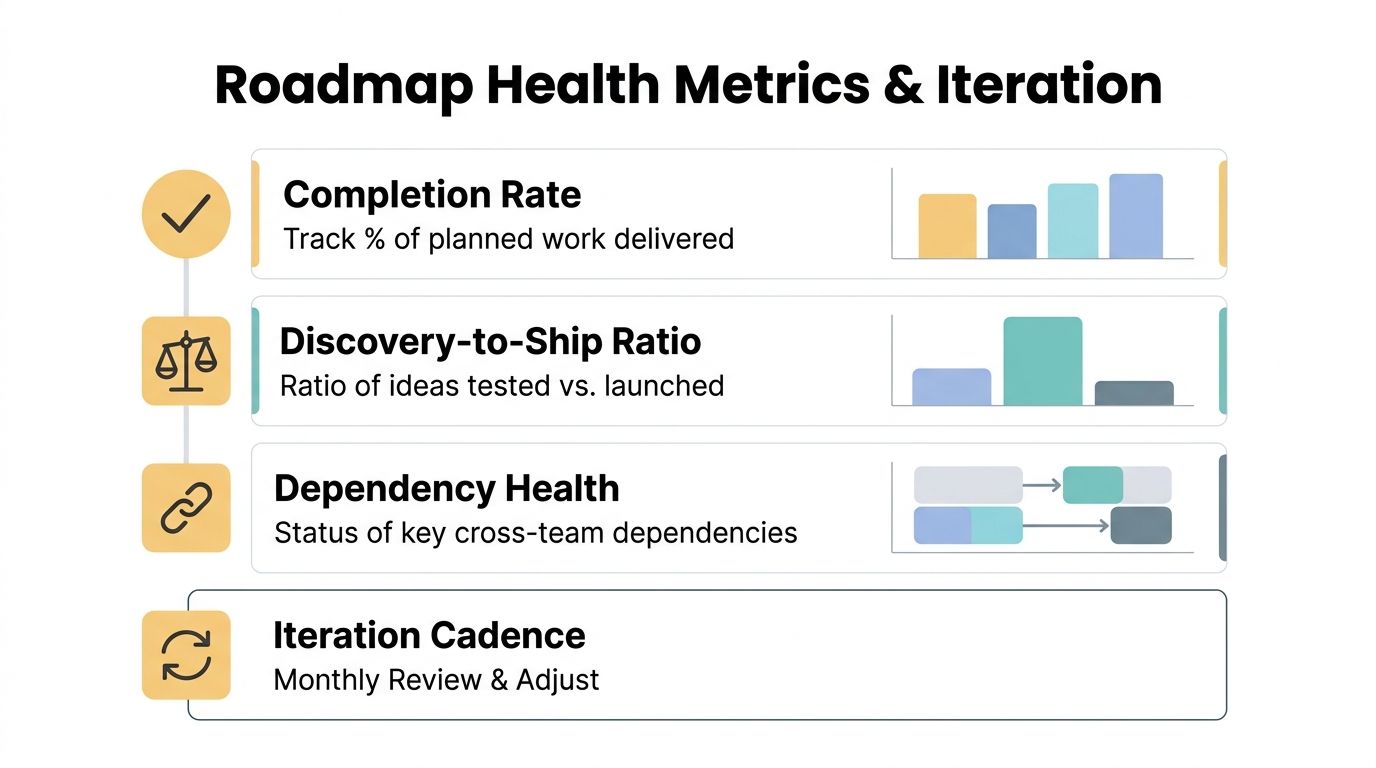
A roadmap dies when nobody measures whether it's still telling the truth. Track completion rate, discovery-to-ship ratio, dependency health, and iteration cadence. If you ignore those, you'll end up with a roadmap that looks active but behaves like dead weight.
The operating checklist is simple
Completion rate tells you whether the team is consistently delivering what it said it would. Discovery-to-ship ratio tells you whether the team is testing enough ideas before committing development time. Dependency health tells you whether cross-team blockers are being surfaced early or discovered too late.
If you want the roadmap to stay credible, pair those metrics with a rhythm. Run weekly discovery, do a monthly roadmap refresh, and reset strategy quarterly. That cadence keeps the plan connected to reality instead of trapped in an annual planning ritual.
Pick tools that match your stage, not your ego
Early-stage teams can run a credible roadmap with a spreadsheet, Slack, and a disciplined owner. That's often enough if the team is small and the product surface area is limited. As complexity grows, tools like Notion, Productboard, and Aha! earn their keep because they help organize inputs, dependencies, and updates without drowning everyone in status meetings.
For teams adding automation into the mix, the AI implementation roadmap is a useful adjacent reference because it shows how structured sequencing matters when the work itself is unfamiliar. The same principle applies here. New capability without a roadmap discipline usually turns into scattered effort.
Steal the templates, not the theater
Use a one-page rolling roadmap. Use a Now, Next, Later board for leadership. Use a discovery log for active bets. Don't build a giant governance machine if a simple operating rhythm will do the job better.
Your action list for next week is straightforward. Rewrite the vision as one paragraph, reduce the roadmap to a 3-month detailed view and a 6-month directional view, and add a weekly discovery checkpoint to every active bet. Then check whether your completion rate is telling the truth about your planning discipline.
If your roadmap needs to be more than a pretty planning file, Up North Media can help you turn it into a practical operating system for product, web, and growth decisions. Visit Up North Media to talk through a roadmap, build the right digital foundation, and ship with more clarity this quarter.