
The most popular advice about a digital transformation roadmap is also the most dangerous: start with tools, then build a timeline around them. That sounds decisive, but it usually creates a plan that looks neat in a slide deck and collapses in execution because the business never mapped the actual dependencies underneath it. A roadmap only works when it behaves like an operating model, not a shopping list.
That's why the strongest roadmaps organize work across people, process, technology, and content rather than around software categories alone, a principle reflected in a published framework on digital transformation roadmapping (Earley whitepaper on transformation roadmaps). The market context also matters, because digital transformation is no longer a side project. It's a major business investment category, with the global market projected to grow from about USD 1,107.06 billion in 2025 to USD 1,864.94 billion by 2031, a 9.1% CAGR projection (MarketsandMarkets projection). That kind of spending pressure forces leaders to care about sequencing, governance, and measurable ROI, not just implementation velocity.
Why Most Digital Transformation Roadmaps Fail Before They Start
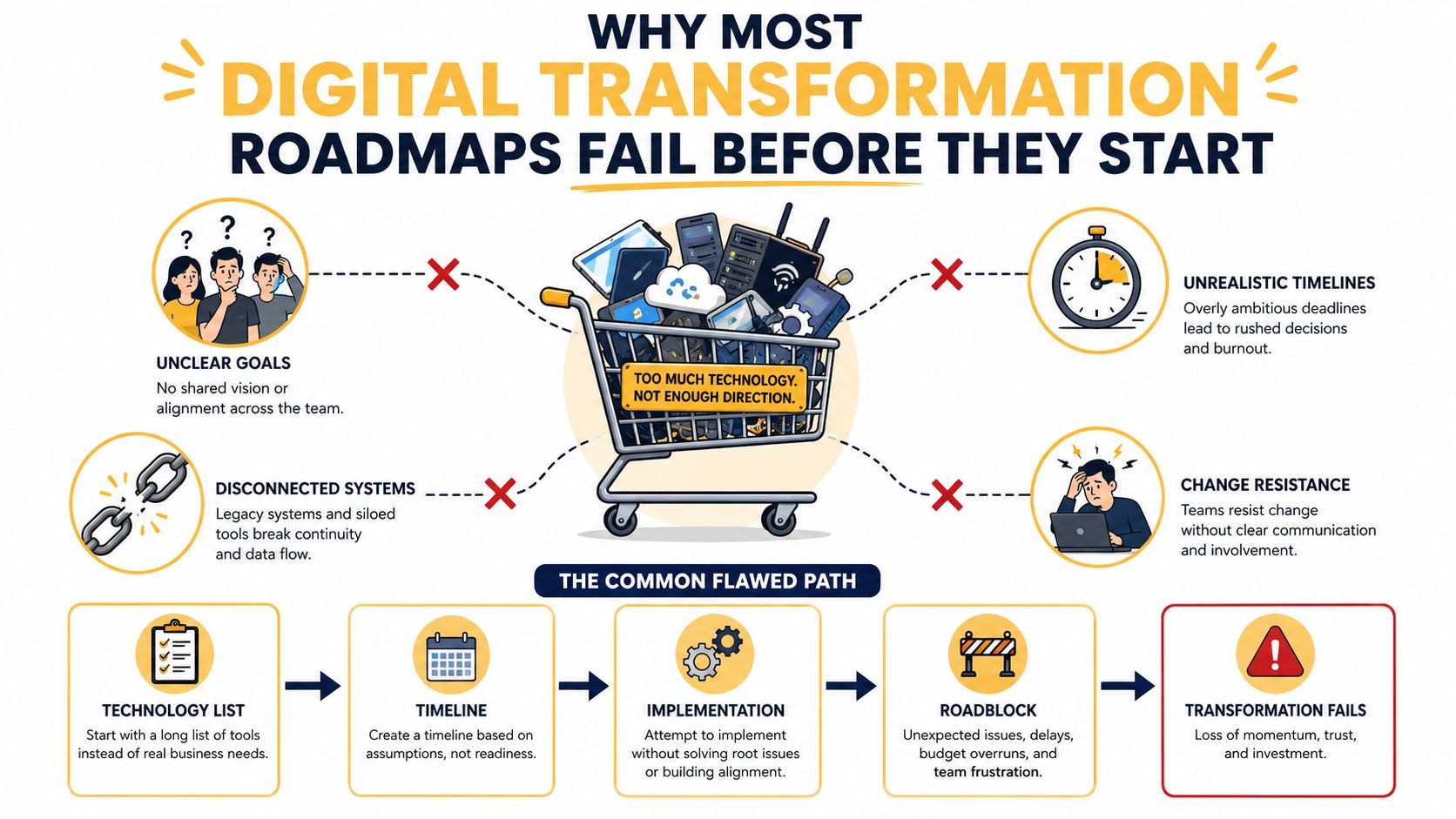
Most roadmaps fail because teams confuse intent with sequence. They write down a future state, assign a few software projects, and call it a plan. Then the first cross-functional dependency shows up, usually data quality, workflow ownership, or frontline adoption, and the whole structure starts to wobble.
The deeper problem is that leaders often treat transformation as a technology decision when it's really an operating-model change. A published framework recommends planning across people, process, technology, and content, which is the right lens because transformation touches how work gets done, how decisions get made, and how knowledge gets shared (Earley whitepaper on transformation roadmaps). If one of those tracks is missing, the organization usually compensates with manual workarounds, extra approvals, or shadow processes.
The hidden failure pattern
The same pattern shows up across SMBs and mid-market firms. A department wants better reporting, so someone buys an analytics tool before the underlying data definitions are aligned. Sales wants faster follow-up, so the team migrates the CRM before the lead routing rules are standardized. Operations wants automation, but nobody has documented the current workflow enough to know what should be automated.
Practical rule: if a roadmap starts with vendor demos, it's already late.
A modern digital transformation roadmap has to do three jobs at once. It needs to define the business problem, build capability in the workforce, and establish governance so the work doesn't drift as priorities change. That's why the best plans read less like project schedules and more like controlled change programs with measurable checkpoints.
Assessing Your Current State Before Choosing Any Technology
Before any software gets shortlisted, the organization needs a blunt read on how work happens today. That means documenting current-state processes, customer journeys, and revenue drivers with the same discipline a finance team would use for a close process. Without that baseline, every later decision turns into an argument based on opinion instead of evidence.
A strong roadmap starts with that assessment, then moves into prioritized planning, pilot implementation, and optimization. Deckary roadmap model lays out that sequence clearly. The order matters. Teams that jump straight to tooling usually end up reworking the implementation later because they skipped the part where they identified bottlenecks, manual handoffs, and the customer touchpoints that affect performance.
What to map first
Start with the work that consumes the most time or creates the most friction. Interview frontline staff, not just managers, because they usually know where the unofficial workarounds live. Compare the documented process to the actual one, then note where approvals, duplicate entry, or handoff delays keep showing up.
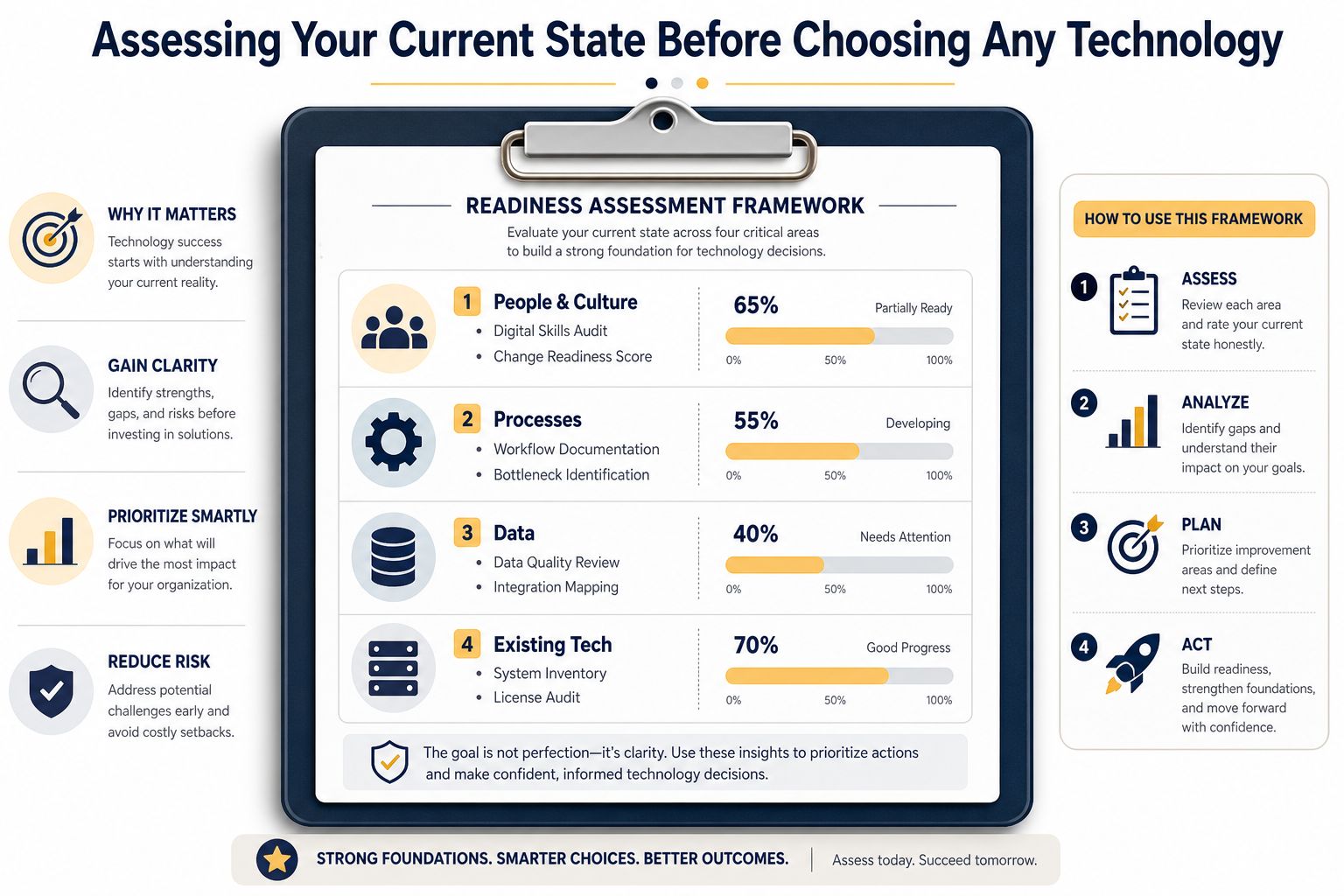
A practical readiness scan usually covers four areas:
- People and culture, meaning digital skills, change readiness, and who will absorb the new workflow.
- Processes, meaning workflow documentation and bottleneck identification.
- Data, meaning quality issues and integration points between systems.
- Existing tech, meaning system inventory and license utilization.
Once that baseline exists, the roadmap becomes easier to defend. It gives leadership a point of comparison for every pilot, rollout, and process redesign. It also helps teams distinguish between a real technology gap and a process problem that should be fixed first through business process optimization.
A good assessment doesn't try to prove the company is “ready.” It shows where readiness is missing and what that gap will cost later.
Mapping Dependencies and Sequencing Initiatives Correctly
Many roadmaps often break when teams pick a launch date before they map the dependency chain. They then discover that half the plan depends on clean data, stable master records, or a standard workflow that still doesn't exist. The result is not just delay. It's rework, frustration, and a loss of credibility for the whole program.
Independent guidance recommends mapping dependencies before timelines, running delay scenarios, and separating initiative-level delivery metrics from outcome-level business metrics (ITONICS roadmap guidance). That distinction is essential. A project can hit every delivery milestone and still fail the business if the upstream sequence was wrong.
Why sequencing beats urgency
Leaders often ask whether the roadmap should start with strategy or capability gaps. In practice, the answer is both, but capability gaps decide what can move first. If customer data is fragmented, the CRM migration may need to wait until data cleansing and process standardization are complete. If the service team doesn't share a common intake process, automating ticket routing just automates confusion.
Delay scenarios prove helpful. If one upstream initiative slips, ask what it blocks next. Then ask which teams share resources, because a roadmap can look parallel on paper while being serial in reality. That's the hidden bottleneck most Gantt charts miss.
A simple sequencing discipline helps:
- Map prerequisite work first, including data cleanup, standard definitions, and decision rights.
- Identify shared resources, especially subject matter experts who are assigned to multiple projects.
- Test delays, so leaders can see what happens if a critical initiative slips.
- Split metrics cleanly, so delivery tracking doesn't get confused with business results.
If the roadmap can't survive a two-week slip in one upstream workstream, it's not a roadmap yet, it's an assumption.
The same logic applies when teams choose modernization paths. A separate guide on legacy system modernization strategies can help frame which systems deserve replacement, integration, or containment before the roadmap locks in sequence.
Designing a Phased Rollout with Measurable Milestones
A phased rollout is how you find the cracks before they spread. The first wave should test the roadmap with a limited group of users and representative workflows, then compare results against the baseline established in the assessment phase (Breakthrough3X pilot guidance). In practice, that means you are looking for early signal on adoption, process friction, and hidden exception handling before the full business is exposed to the new design.
The mistake I see most often is treating rollout like a launch date instead of a sequence of learning loops. One mid-market company I worked with pushed a new service workflow to every location after a short pilot, only to find that escalation rules had been built for the pilot team's reporting structure, not the regional teams that had to use it. Tickets piled up, managers created side channels to keep work moving, and the rollout lost credibility because the operating model had not been stress-tested outside the first group. A structured phased program avoids that kind of failure by using each wave to decide what should be fixed, repeated, or stopped before the next expansion (Deckary phased program model).
What to measure in each wave
The milestone structure has to separate process proof from business proof. Early waves should show whether people are using the new workflow, whether handoffs are clean, and whether exceptions are being handled without constant intervention. Later waves should confirm whether the new operating pattern is improving the business result, not just producing activity in a new system.
A practical rollout scorecard usually tracks:
- Operational adoption, meaning whether users are completing work in the new process.
- Process reliability, meaning whether handoffs, rework, and delays are falling.
- Business outcomes, meaning whether the change is moving a meaningful business metric.
- Decision cadence, meaning whether leadership is reviewing evidence and adjusting the sequence on a regular basis.
The scorecard only works if leaders are willing to act on what it shows. Quarterly reviews help because they force a decision: expand, correct, pause, or re-sequence. If a pilot exposes a training gap, that gap needs to be closed before the next wave. If the new workflow creates a bottleneck in approvals or data entry, scaling should wait until that pressure point is removed. Otherwise the company just spreads the same problem faster.
Where lighthouse projects fit
Lighthouse projects matter because they create a visible standard for what good looks like. They also give skeptical teams something concrete to react to instead of abstract transformation language. The first wave should be owned by a strong delivery team that can handle the messy parts, because the first visible result often decides whether the rest of the organization leans in or works around the change.
Making Your Roadmap People-Led Instead of Technology-Led
Technology fails when the people side is treated as a support task. Teams can deploy the software, connect the APIs, and still miss the outcome because employees never changed how they make decisions, route work, or handle exceptions. That's why change management has to be a dedicated workstream, not a side note inside project management.
Industry guidance says organizations with a strong cultural focus are 5x more likely to achieve breakthrough results in digital transformation, and it recommends giving change management its own workstream, budget, owner, and adoption KPIs (StartUs Insights roadmap guidance). The point isn't to create bureaucracy. It's to protect adoption from being squeezed out by technical delivery pressure.
What people-led execution looks like
Training should cover the workflow shift, not just the interface. A new CRM isn't valuable because staff can click buttons. It's valuable when sales, marketing, and service use the same definitions, follow the same handoff logic, and trust the same data.
That requires visible ownership. Internal champions matter because peers listen to peers, especially when the change affects daily routines. It also requires role redesign, because some teams need less manual work while others need new decision rights or escalation paths.
Change sticks when managers inspect behaviors, not just status slides.
If you're evaluating support for the people side of transformation, some firms bring in a specialist agency or advisor to help define adoption plans, training content, and governance rhythms. Up North Media, for example, works on AI consulting and process automation for SMBs, but the right external partner is the one that helps the team change behavior, not just install tools.
Integrating AI and Governance Into Your Execution Framework
AI should sit inside the roadmap, not beside it as a separate innovation lane. That matters because AI tools only create value when they sit on top of clean data, stable processes, and clear decision rights. If ownership is unclear or the inputs are messy, automation usually makes the problem faster, not better.
The broader market still points in the same direction. MarketsandMarkets projects the digital transformation market to keep expanding over the next several years, which means more teams will be buying tools, more vendors will be pushing pilots, and more internal pressure will land on leaders to show progress. The companies that hold up under that pressure will not be the ones that buy the most software. They will be the ones that can govern change without losing control of the work.
How AI fits the sequence
AI works best after the basics are in place. If customer records are inconsistent or process steps vary by team, the model will just scale that inconsistency. If the workflow is standardised, AI can speed up work such as classification, routing, summarisation, or first-pass qualification.
For teams exploring applied AI, a practical use case is automate lead qualification, especially when lead volume is high and sales teams are spending too much time on repetitive triage. The boundary still matters. AI should support a defined workflow, not substitute for one.
Governance has to move with the AI plan. Someone needs to approve budget changes, decide whether a pilot can expand, and determine when an experiment has become part of the operating model. Without that decision-rights structure, AI programs turn into disconnected tests that never reach scale.
A useful planning lens is the AI implementation roadmap, because it ties use-case selection to readiness instead of hype. That sequencing is where many SMBs go wrong. They start with a tool decision, then try to fit governance around it after the fact, which usually creates friction across operations, IT, and the business teams that have to live with the change.
The Earley whitepaper on digital transformation roadmapping makes a similar point about planning discipline. The roadmap has to show who owns the change, which process comes first, and what has to be true before the next layer of automation is added. If those dependencies are not mapped, AI becomes another layer of complexity on top of an already strained organisation.
What the First 90 Days of Execution Actually Look Like
The first month is usually about friction, not momentum. Teams forget steps, managers ask for exceptions, and the project group spends too much time explaining why the old process can't remain in place forever. That's normal. The question is whether leaders respond by tightening governance or by reopening scope every time someone complains.
Around week six, the novelty wears off and the work starts. Adoption slows because users stop treating the change like a pilot event and start using it as part of their day job. Change owners need to inspect behavior, fix the most painful workflow breaks, and resist the urge to add new features before the core process is stable.
By week ten, the pilot data should force a decision. If the metrics show the process is improving, the company should prepare the next wave with confidence. If the data shows that a dependency is blocking progress, leadership should re-sequence instead of pretending the original plan still works.
A solid 90-day checklist is simple:
- Confirm the baseline before week one so every pilot has a comparison point.
- Review adoption weekly so friction shows up early.
- Escalate dependency issues fast instead of letting them pile up.
- Use pilot feedback to adjust training and process design before scaling.
- Keep scope controlled until the first wave is stable.
That first quarter usually tells the truth about the roadmap. If the organization can hold the sequence, absorb feedback, and keep governance intact, the rest of the program has a real chance.
If you need a roadmap that survives real-world dependencies, not just slide-deck logic, Up North Media can help with process optimization, AI integration, and digital execution planning. Visit Up North Media to talk through your current state, identify the bottlenecks that are slowing delivery, and build a transformation plan that's built for actual adoption.