
You're probably getting pulled in two directions right now.
On one side, every software vendor says AI belongs in your business immediately. On the other, your actual day looks like staffing issues, sales targets, customer follow-up, and a pile of disconnected systems that barely talk to each other. That gap is where most small and mid-sized companies get stuck.
The good news is that you don't need an enterprise lab, a research team, or a giant budget to start. You need an AI implementation roadmap that matches the way SMBs operate. It should start with one real business problem, use the data you already have, and give you a clear way to decide whether the project deserves more investment.
That matters because AI adoption is accelerating, but smaller firms are still behind. While 55% of large enterprises in the EU use AI, only 17% of small enterprises do, which shows how much roadmap complexity still favors larger organizations according to this adoption analysis. A lot of small businesses aren't losing because AI is too advanced. They're losing because the guidance they find assumes enterprise budgets, enterprise teams, and enterprise tolerance for long rollouts.
A practical roadmap fixes that. It strips out the theater and focuses on a few decisions: what problem matters most, what data is available, whether you should buy or build, how to test the idea safely, and what success looks like in business terms.
If your leadership team needs a more technical companion resource, TekRecruiter's AI guide for CTOs is a useful parallel read. If you want a simpler baseline before getting into implementation decisions, this primer on what artificial intelligence means in business helps align the vocabulary.
Your Introduction to a Smarter Business Strategy
Most SMB owners don't need more AI terminology. They need a way to decide what to do next.
A good AI implementation roadmap starts with a blunt question: where is work repetitive, slow, expensive, or inconsistent enough that software could help? That's the right entry point. Not “How do we use AI?” but “What's costing us time or money every week?”
Start with the business problem
The first pass should stay non-technical. Look across your operation and list friction points like:
- Customer service overload that forces your team to answer the same questions all day
- Manual content production that slows marketing output
- Inventory uncertainty that causes stockouts or over-ordering
- Lead qualification bottlenecks where staff spend time sorting weak inquiries from strong ones
- Reporting delays caused by copying data between systems
The strongest first projects usually have three traits. The process already exists. The pain is obvious. The result matters enough that leadership will care if it improves.
Practical rule: If you can't describe the problem in one sentence without mentioning AI, you're not ready to solve it with AI.
Build a simple business case
For a first project, skip the long slide deck. Use a one-page decision memo with five lines:
| Decision point | What to write |
|---|---|
| Business problem | What's broken or too manual today |
| Current cost | Time loss, delay, inconsistency, or missed revenue stated qualitatively |
| Proposed AI use | Summarize the workflow change in plain English |
| Owner | Name the person responsible for results |
| Success test | State the business outcome that would justify scaling |
That discipline matters more than model selection early on. It forces everyone to agree on why the project exists before anyone starts comparing tools.
Keep the scope smaller than you want
SMBs usually get the best results by improving one workflow, not trying to redesign the entire company. If your first use case touches every department, every customer touchpoint, and multiple core systems, it's too broad.
The smarter move is narrow and useful. Pick one process. Improve it. Learn from it. Then decide what deserves a second round.
Assess Your Business Readiness for AI
A lot of AI projects fail before the pilot even starts. The issue isn't the model. It's that leadership hasn't agreed on the outcome, the team doesn't know who owns the project, and the company treats AI like a vague innovation exercise instead of an operating decision.
That's especially common in SMBs. A common roadblock is leadership alignment; 63% of SMB executives cannot articulate AI's business value beyond vague "transformation" goals, and 54% of SMB AI projects stall due to this misalignment, based on Pythian's roadmap discussion.
What readiness actually means
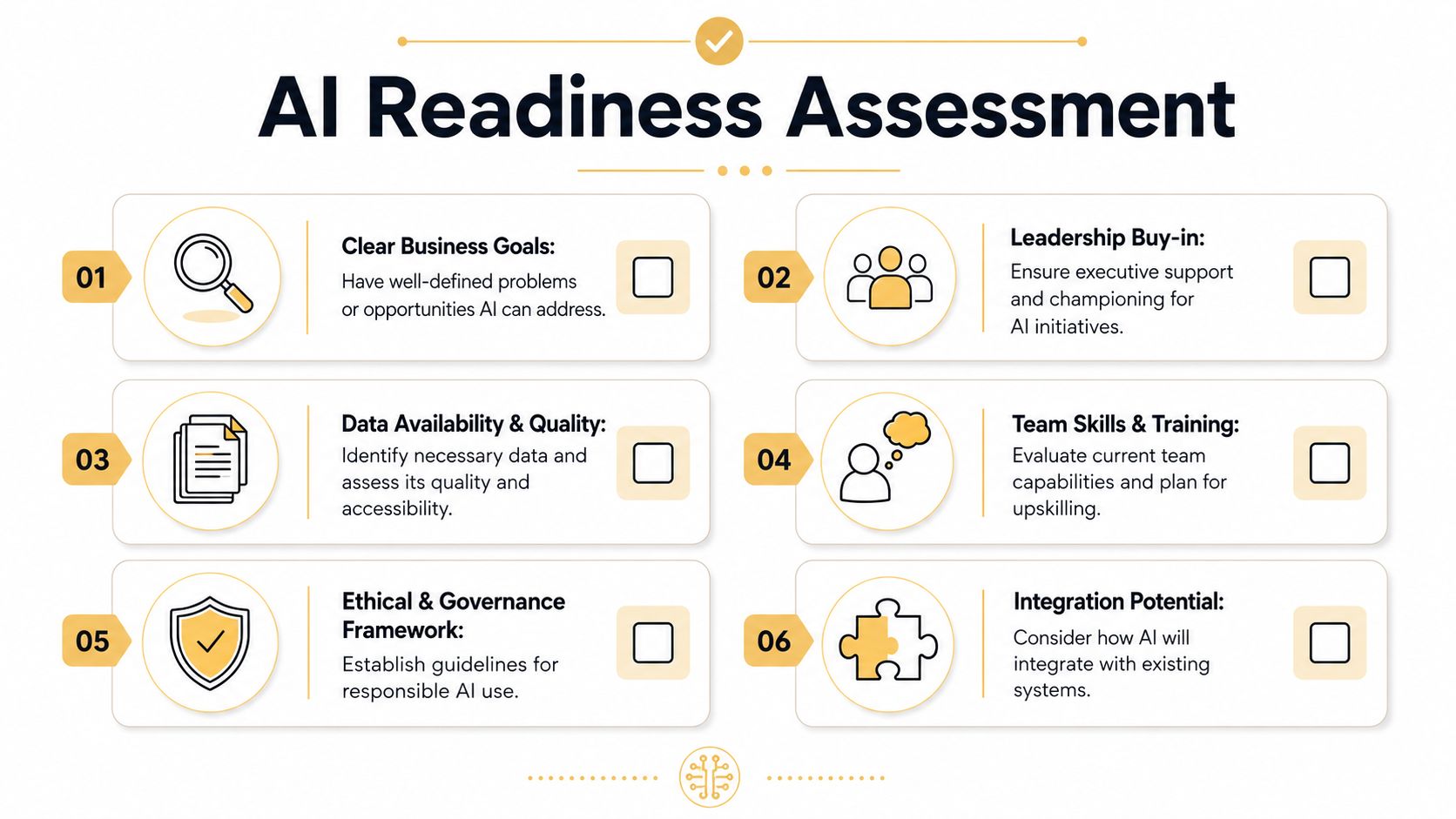
Readiness isn't about having an in-house data science team. For an SMB, it usually comes down to six practical checks:
- A clear business goal. The project should tie to service speed, sales efficiency, fulfillment accuracy, content throughput, or another concrete outcome.
- Leadership support. Someone with budget authority has to back the project when trade-offs appear.
- Usable data. Not perfect data. Usable data.
- A workflow owner. AI projects drift when IT owns the tool but operations owns the pain.
- Basic governance. Decide what data the system can use, who can access it, and where human review is required.
- Integration realism. If your systems are fragmented, your roadmap has to account for that instead of pretending it doesn't matter.
Use an impact versus effort filter
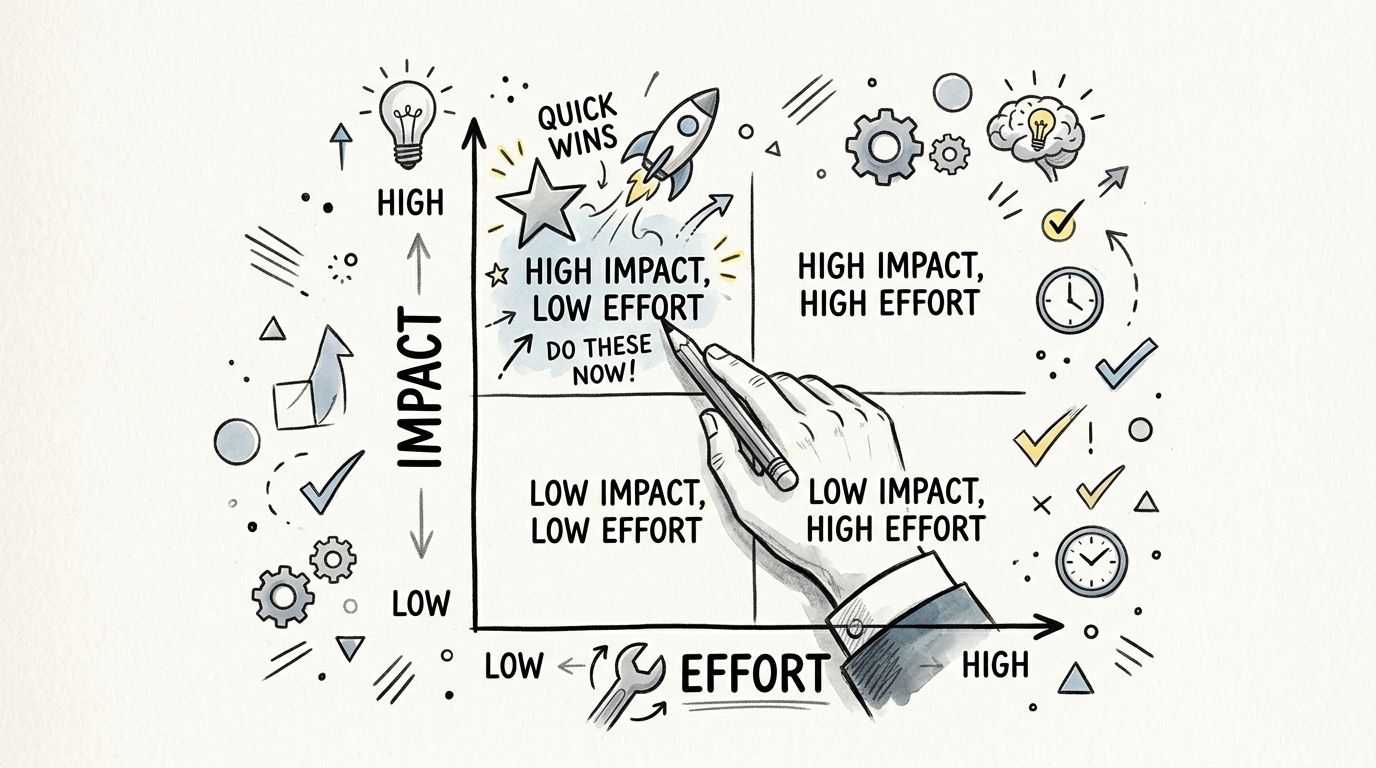
Here's a simple way to avoid the wrong first project. Score candidate ideas using two questions:
- If this works, does the business care?
- Can we launch a pilot without rebuilding our systems?
That creates four rough buckets:
| Impact | Effort | What to do |
|---|---|---|
| High | Low | Start here |
| High | High | Park for later |
| Low | Low | Only do if it supports another priority |
| Low | High | Skip |
For example, an FAQ assistant trained on your support documentation may be a strong first use case. A fully custom AI forecasting platform that requires years of historical cleanup and system integration probably isn't.
Don't ask whether AI can do something. Ask whether your company can support it operationally for the next year.
The one-page approval template
If your CEO or leadership team isn't technical, pitch the project in operational language:
- What process are we improving
- What manual work goes away
- What risk gets reduced
- What team uses it first
- What happens if the pilot fails
That last point matters. A contained failure is healthy. A vague project with no decision criteria isn't.
Choose Your First High-Impact AI Project
The first project should feel a little boring. That's usually a good sign.
The wrong first choice is often flashy, broad, and hard to measure. The right one tends to be narrow, repetitive, and easy to compare against current performance.
What a strong first project looks like
For SMBs and mid-market teams, good first projects usually fall into a few patterns:
- Customer support assistance using a knowledge base, ticket history, or canned responses
- Marketing workflow acceleration for first-draft product descriptions, email copy, or content briefs
- Sales admin automation that summarizes calls, drafts follow-up emails, or qualifies inbound leads
- E-commerce merchandising support such as product tagging or catalog cleanup
- Internal search and retrieval for SOPs, policy docs, or training materials
A lot of teams start with content because the barrier is low. If that's your path, tools built for guided content workflows can help you test the business process before investing in something custom. The Nuwtonic AI SEO Content Generator is one example of a buy-first approach when the use case is structured content production.
Run the idea through a reality check
Before greenlighting any use case, ask:
- Do we already have examples of the work? AI performs better when you can show it the kind of output you want.
- Can one team own the pilot? Shared ownership kills momentum.
- Will people use it weekly? If usage is occasional, learning will be slow.
- Can we test it with real users quickly? If the answer is no, the project may be too early.
Don't skip the data audit
A data audit sounds technical, but the first version is simple. You're checking whether the inputs exist, whether they're accessible, and whether they're messy enough to break the result.
For a support chatbot, that means reviewing help docs, saved replies, unresolved tickets, and product policy pages. For a pricing or inventory workflow, it means checking whether your product, order, and stock data are consistent across platforms.
This short video gives a useful visual overview of how teams think through that prioritization and planning work:
Build versus buy
Most SMBs should buy first unless the workflow is highly specific to their business.
Use this rule of thumb:
| Option | Best fit | Trade-off |
|---|---|---|
| Buy a tool | Common use cases like support, content, transcription, summaries | Faster launch, less control |
| Low-code platform | Moderate customization with limited engineering help | Good middle ground, can get messy later |
| Custom build | Unique workflow, strong internal process knowledge, real integration needs | More control, more setup and maintenance |
For a first AI implementation roadmap, the winning move is usually the one that gets you to a clear decision faster.
Prepare Your Data and Tech Stack
Most SMB AI problems start upstream. The model gets blamed, but the inputs were incomplete, inconsistent, or trapped across tools from the start.
That's why the data foundation isn't a side task. A staggering 89% of SMBs attempting AI implementation skip foundational data audits, which contributes directly to a 67% pilot failure rate within just 6 months. A dedicated "Build Data Foundation" phase is a critical differentiator, according to Flugia's roadmap analysis.
What a data audit means for an SMB
For a first project, you don't need a full enterprise data program. You need a practical inventory.
Start with four checks:
- Where the data lives. CRM, Shopify, Google Sheets, help desk, email platform, ERP, shared drive.
- Who owns it. If nobody owns the source, nobody fixes issues.
- How clean it is. Look for duplicates, missing fields, outdated records, naming inconsistencies.
- Whether it matches the use case. Not all available data is useful data.
If you're unsure how your current systems fit together, a broader review of how to choose a tech stack helps frame the decisions around compatibility, cost, and maintenance.
Good enough data versus ideal data
SMBs frequently overcorrect. They assume the data has to be perfect before they can test anything. It doesn't.
For an early pilot, “good enough” often means:
| Data question | Good enough for a pilot |
|---|---|
| Is it accessible? | A team can export it or connect to it without weeks of engineering |
| Is it recent? | It reflects the current business, not a past workflow |
| Is it consistent enough? | Key fields use the same logic most of the time |
| Is it relevant? | It directly supports the user task being tested |
If your data fails one of those checks, fix that first. Don't hand bad inputs to a model and hope prompting will save it.
Clean enough to test is the target. Perfect enough to impress an architect is not.
Pick a tech stack that won't trap you
For SMBs, the best stack is usually the simplest one that can support production use if the pilot works.
That often means a combination like:
- A model provider such as OpenAI, Anthropic, or Google for language capabilities
- A workflow layer like Zapier, Make, or a low-code tool for automation
- Your core systems such as HubSpot, Shopify, Klaviyo, Zendesk, or QuickBooks
- A lightweight database or document store if the workflow needs memory or retrieval
- Monitoring and access controls so the tool doesn't become invisible after launch
Up North Media is one option some businesses use during this stage because its AI consulting includes discovery, process mapping, pilot planning, and implementation planning as part of a structured engagement. For teams without internal product or engineering capacity, that kind of outside support can reduce false starts.
Structure the pilot for a real decision
The stack should answer a business question, not just prove technical feasibility. A useful pilot setup includes:
- One workflow
- One user group
- A known input source
- A review process for outputs
- A stop or scale decision at the end
That last piece matters. A pilot should tell you whether to continue, revise, or kill the idea. If it can't do that, it's a demo, not a pilot.
Run a Pilot to Validate Your AI Solution
The pilot is where organizations either gain confidence or lose months.
A lot of companies treat the pilot like a sandbox with no operating discipline. That's why so many projects stall. An estimated 95% of AI pilots fail to reach production, not due to model flaws, but because of a lack of organizational readiness and scalable infrastructure. Adopting a "production mindset from day one" is key to avoiding this, based on Elevates.ai's breakdown of pilot failure.
Define the pilot before you build it
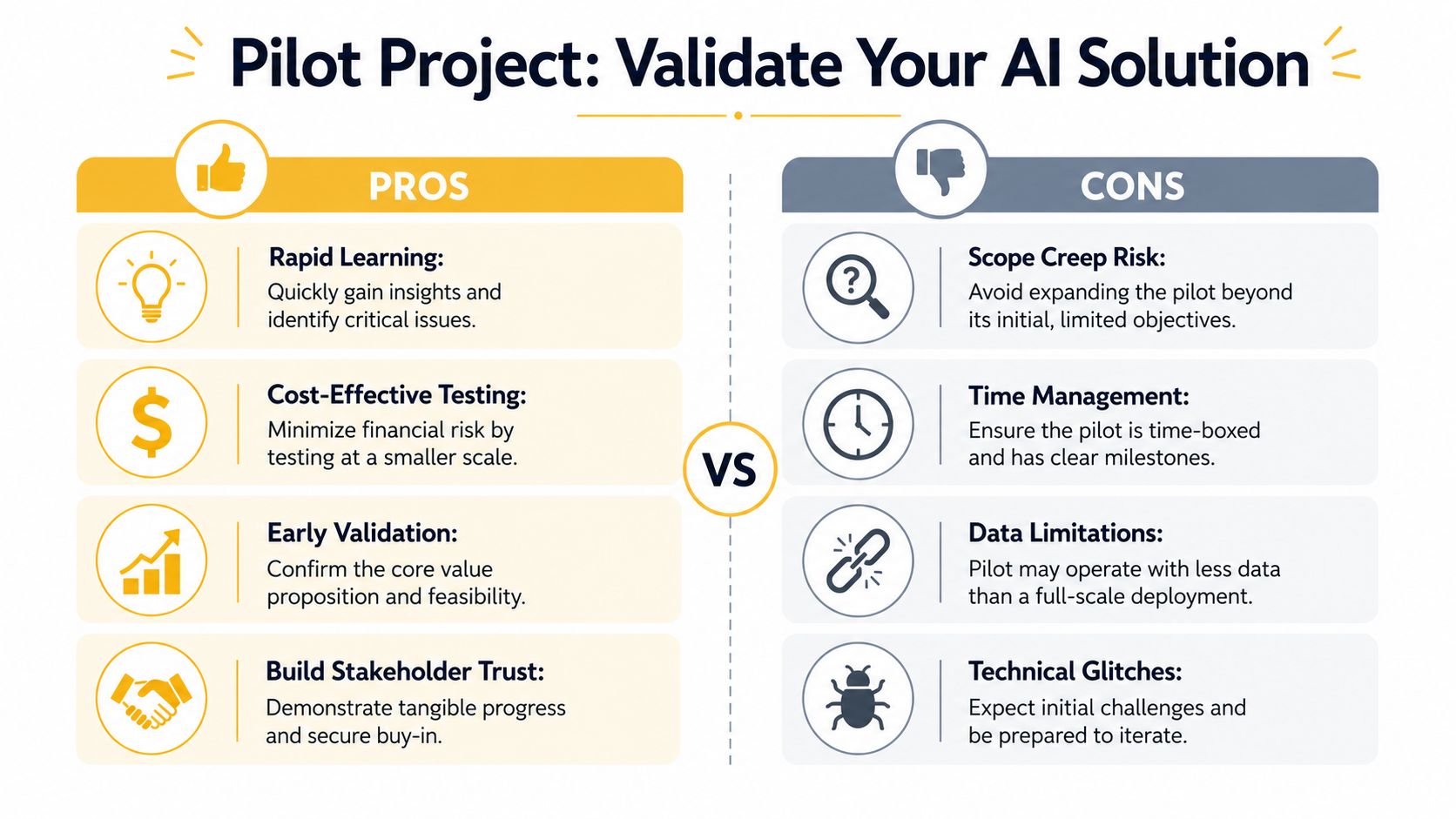
A pilot needs boundaries. Otherwise, every stakeholder adds requests and the team ends up testing five things badly instead of one thing well.
Set these rules in writing:
- Who uses it first
- What task it supports
- What data it can access
- What human review is required
- What outcome determines success
A good pilot doesn't aim to replace a department. It proves that a specific workflow improves under controlled conditions.
Use real users, not internal assumptions
If the pilot is for support reps, let support reps use it. If it's for marketing, give it to marketers doing real work under normal deadlines.
That's the fastest way to find the issues that matter:
- outputs that sound fine but miss context
- slow handoff between systems
- prompts that only one power user understands
- edge cases no one considered in planning
- staff resistance because the tool adds steps instead of removing them
A pilot that looks good in a meeting but fails in live workflow is giving you useful information. Treat that as signal, not embarrassment.
Production mindset means planning for access, review, monitoring, and ownership before the pilot starts.
Set a go or no-go gate
One practical way to structure this is like a minimum viable product. You're not trying to perfect the system. You're trying to learn whether the workflow deserves a production version. This guide on how to build a minimum viable product aligns well with that decision style.
Use three gates before you scale:
| Gate | Question |
|---|---|
| Results | Did the pilot meet the business target you set at the start? |
| User workflow | Did the team say the tool improved the work, not just the novelty? |
| Scale logic | Does the expected return justify the added software, training, and maintenance? |
If one of those is missing, slow down. Scaling a weak pilot usually magnifies the weak parts.
Tie deployment, governance, and change together
SMBs don't need heavy governance documents, but they do need operating rules.
At minimum, define:
- Who approves changes to prompts, automations, or source data
- Who watches for failure when outputs drift or systems break
- When humans must review AI-generated output
- How users report issues
- What gets documented for onboarding and repeatability
That combination is what turns a pilot from an experiment into a tool people can rely on.
Scale, Govern, and Manage Your AI System
A pilot can prove value. It can't carry the business on its own.
The next phase is where companies either build a usable operating system around AI or create one more fragile internal tool that nobody fully owns. The teams that sustain adoption usually sequence projects to build internal capability, not just chase the fastest near-term return. Companies that sequence AI initiatives for "organizational learning" rather than just immediate ROI achieve 3x higher long-term adoption rates, as 60% of AI pilot failures stem from a lack of organizational readiness, according to AI Assembly Lines.
What scaling looks like in a smaller company
For an SMB, scaling doesn't mean rolling AI out everywhere at once. It means making one use case dependable enough that the team trusts it.
That usually requires a few lightweight practices:
- Assign an internal AI champion. Not necessarily a developer. Often it's the operations lead or department manager who owns the workflow.
- Create short documentation. One page on how to use the tool, what not to trust blindly, and how to report problems.
- Track changes. If prompts, integrations, or source documents change, someone should log it.
- Review outputs on a schedule. Especially for customer-facing workflows.
Keep governance practical
Governance sounds like a big-company word, but at SMB scale it's mostly about preventing avoidable mistakes.
A practical governance checklist includes:
| Governance area | Simple SMB version |
|---|---|
| Access | Limit who can edit workflows and connect data sources |
| Privacy | Define what customer or internal data the tool can use |
| Review | Require human approval for sensitive outputs |
| Monitoring | Check output quality and workflow reliability regularly |
| Escalation | Decide who acts when something goes wrong |
If your team needs a clearer framework for the cloud side of governance, Server Scheduler's cloud governance framework is a useful reference for translating broad controls into operating practices.
The companies that get long-term value from AI don't just deploy tools. They teach teams how to work with them.
Budget and timeline categories that matter
When leaders underestimate AI cost, they usually focus only on software. The actual budget tends to spread across a few buckets:
- Software and API usage
- Integration work
- Data cleanup and preparation
- Training time
- Ongoing monitoring and support
The same goes for timeline. A pilot may launch quickly, but the work after the pilot often determines whether the investment pays off. Documenting, training, governance, and workflow redesign are part of implementation, not afterthoughts.
Map Your Timeline, Budget, and Success Metrics
Most SMBs don't need a multi-year transformation plan for a first use case. They need a realistic schedule, a budget model that includes hidden work, and metrics that leadership can understand.
A traditional implementation rhythm is still useful as a benchmark. A traditional AI pilot phase can last 8–16 weeks, followed by a scaling phase of 6–18 months. Successful projects achieve more than 70% user adoption and document efficiency gains of 30–40% within the first 90 days of production deployment, based on Helium42's AI implementation roadmap.
A practical SMB planning table
Use the ranges below as planning categories, not fixed quotes.
| Phase | Typical Timeline | Estimated Cost Range (USD) |
|---|---|---|
| Strategy and use case selection | Short discovery period | Varies by internal capacity, software evaluation, and advisory support |
| Data foundation and cleanup | Several weeks | Varies based on data quality, integration complexity, and staff time |
| Pilot build and validation | 8–16 weeks | Varies based on vendor choice, API usage, workflow complexity, and testing needs |
| Production rollout and scaling | 6–18 months | Varies based on training, monitoring, support, governance, and broader deployment |
What to measure
Don't overload the first project with too many KPIs. Pick a small set that connects system behavior to business value.
For example:
- Operational metrics such as turnaround time, queue reduction, or task completion speed
- Usage metrics such as active user adoption and repeat usage
- Quality metrics such as error rate, escalation rate, or approval rate
- Business metrics such as reduced support load, faster content output, or improved conversion support
If you only measure model quality and not workflow impact, leadership won't know whether the project deserves expansion.
Keep the roadmap alive
An AI implementation roadmap shouldn't be a static document created at kickoff and ignored later. Update it after the pilot. Note what broke, what users resisted, what data needed cleanup, and what should happen next.
That's how an SMB avoids enterprise-level complexity while still making disciplined decisions.
If you want help turning an AI idea into a workable roadmap, Up North Media works with businesses on AI consulting, implementation planning, web applications, and digital growth strategy. A practical engagement usually starts with the business problem, current systems, available data, and a pilot plan that fits your team's budget and operating reality.