
You've just launched a product, sent the press release, and watched the inbox stay quiet. A few people may have opened it, but nobody booked a demo, asked for a quote, or mentioned it to a buyer. That experience is common because public relations strategy isn't a publishing calendar. It's the operating system that connects a business objective with a credible story, the audience that cares about it, and the channels that can move attention toward action.
For a small or mid-sized business, that distinction matters. You can't afford broad campaigns that generate impressive coverage but leave sales unable to explain where the opportunities came from. You need a practical system that makes every story, pitch, interview, and measurement decision answer a harder question: what business outcome is this supposed to influence?
What a Public Relations Strategy Actually Does for an SMB
A press release announces something. A public relations strategy decides whether that announcement deserves attention, who should receive it, what they should understand, and what should happen after they do.
That difference separates tactics from strategy. A tactic might be pitching a journalist, publishing a founder article, responding to a review, or distributing a customer story. Strategy comes first. It defines the business problem, the audience affected by it, the message that can earn belief, and the evidence that supports the claim.
Public relations has developed through clear historical milestones, moving from publicity toward a more formal management discipline. A widely cited history places the first publicity bureau in Boston in 1900, Ivy Lee's major press-release-style intervention after a Pennsylvania Railroad accident in 1906, and Edward Bernays's first public relations course at New York University in 1923. The Public Relations Society of America adopted the first PR ethics code in 1950, another step toward accountability and professional standards. (Short History of Public Relations)
Start with the business outcome
Before you build a media list, choose one primary job for the program:
- Revenue: Create qualified demand in a defined market or support sales conversations with third-party credibility.
- Reputation: Make the company more trusted in a category where buyers need reassurance.
- Retention: Give existing customers evidence that the business understands their problems and continues to improve.
- Recruitment: Help the right candidates understand the company's mission, expertise, and working environment.
Your strategy shouldn't promise that every story will accomplish all four. Small teams get better results when they choose a priority and use the others as supporting outcomes.
A useful working definition is: public relations strategy is a repeatable system for earning attention and trust from audiences who can influence business performance. Complete this mission statement before choosing a channel:
“We'll use PR to help [specific audience] believe [important message], so they take [business action], measured by [KPI].”
A plumbing company might use social listening to identify recurring homeowner complaints before creating local stories or service content. A resource on social listening for plumbers can help make that listening more deliberate. The point isn't to publish more. It's to find a meaningful problem, develop a useful position, and make it easy for the right people to repeat.
Map Your Audiences and the Media That Reach Them
Most SMBs begin with outlets instead of people. They collect every journalist who covers their industry, then send the same announcement to all of them. That approach creates a large spreadsheet and a weak explanation for why any recipient should care.
Build the map in three layers. Customers come first, segmented by use case and buying trigger. A B2B software company might distinguish operations leaders dealing with manual reporting from finance leaders concerned about cost control. A local HVAC business might separate homeowners facing an urgent breakdown from property managers planning seasonal maintenance.
The second layer includes people who shape customer opinion without making the final purchase. These may be analysts, consultants, trade association leaders, podcast hosts, community organizers, or respected practitioners. The third layer covers journalists and creators whose beats overlap both your customer problem and your available story.
Build a one-page media map
Use Google News to find recent coverage, LinkedIn to study who publishes consistently, podcast directories to identify relevant hosts, and trade publication lists to locate specialist outlets. Record the following for each target:
- Audience fit: Who reads, watches, or listens?
- Story fit: Does the outlet cover the problem, or only the broad industry?
- Format fit: Does the contact prefer reported articles, expert commentary, data, interviews, or customer examples?
- Relationship status: Have you engaged with their work, or are you a complete stranger?
- Business value: Could attention from this audience support a sale, referral, hire, or retention goal?
You can use broader research on actionable audience insights for startups to sharpen customer segments before you evaluate outlets. For buyer-persona structure, the buyer persona guide provides a useful planning reference.
Score relevance over raw reach
Create three tiers rather than chasing a huge contact database.
| Tier | Target type | Selection rule |
|---|---|---|
| Tier one | Highly relevant trade or local outlets | Direct overlap with your buyer and current story |
| Tier two | Adjacent publications, podcasts, and creators | Strong audience fit, broader editorial angle |
| Tier three | Larger or aspirational outlets | Worth monitoring, but not the first place to spend limited time |
Aim for a starter list of 20 to 30 qualified targets, divided across those tiers. A B2B SaaS company selling to operations leaders might prioritize operations publications, workflow podcasts, and reporters covering productivity. A local services business might focus on neighborhood outlets, regional business journals, homeowner publications, and community newsletters.
The best media map is small enough to maintain. If you can't explain why each contact matters, the list is too broad.
Craft Messaging and Storylines People Will Repeat
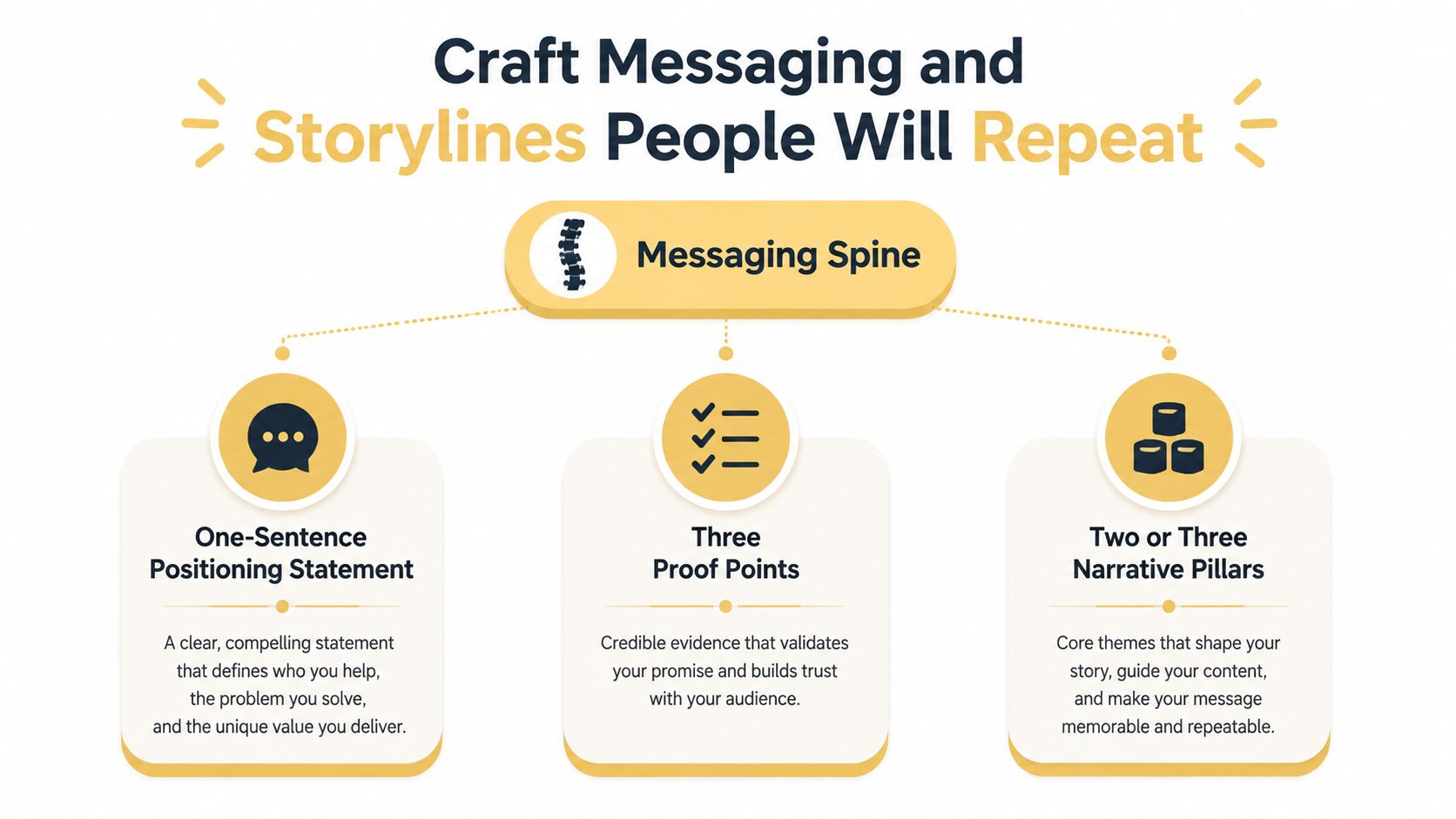
A strategy without a messaging spine becomes a collection of disconnected announcements. Your sales team says one thing, your founder says another, and every pitch introduces the company from scratch.
Build the spine in three layers. First, write a one-sentence positioning statement that names the audience, problem, and distinctive approach. Second, choose three proof points that make the statement credible. Third, develop two or three narrative pillars that turn the positioning into stories people can cover or share.
Turn features into news
“New dashboard released” is a feature announcement. It gives a reporter little reason to care unless the product connects to a wider problem.
A stronger version might be: “Operations teams are replacing disconnected spreadsheets with a single workflow because delayed reporting is slowing decisions.” The product remains part of the story, but the story now has a market tension, a customer consequence, and a reason for a trade publication to explore the issue.
Useful news pegs include:
- Product launches: Frame the launch around a changing customer need, not the feature list.
- Customer milestones: Explain what changed for the customer and why the result matters to the market.
- Original data: Publish a transparent finding that helps an audience understand its own behavior.
- Contrarian views: Challenge a familiar assumption, then support the position with experience or evidence.
- Executive perspective: Give leaders a specific opinion on a problem they've earned the right to discuss.
Your proof points shouldn't all be product claims. Combine customer evidence, operational experience, documented methodology, and relevant market observations. Avoid unsupported superlatives such as “leading,” or “best.” They create resistance when the reader can't verify them.
Create a reusable story backlog
For the next quarter, draft four to six storyline angles. One can support a byline, another a podcast interview, another a customer quote, and another a social post. The wording can change by channel, but the central message should remain stable.
For example, a cybersecurity consultant might position the firm as a practical security partner for growing businesses. Proof points could include a clear assessment process, plain-language executive guidance, and experience translating technical risks into operational decisions. Storylines could cover why small companies delay security work, what founders misunderstand about incident readiness, and how customer trust changes after a breach.
A good message survives adaptation. If it only works in a press release, it isn't a message yet. Teams that need to step away from an account or platform can also access the logout page when managing external workflows, but the communications principle remains the same: keep the core position clear wherever the audience encounters it.
Plan Channels Across Owned, Earned, and Paid Media
Owned, earned, and paid media perform best when they share the same storyline instead of running on separate tracks. Owned media gives your company space to explain a problem in depth. Earned media supplies independent credibility. Paid media puts a tested angle in front of a defined audience when organic discovery is too slow or limited.
For a small business, channel choice should follow the business outcome. Owned assets can include customer stories, practical resource pages, executive articles, or a quarterly data report. They support search visibility, sales conversations, and follow-up after a prospect hears about the company elsewhere. Earned activity can include trade coverage, podcast appearances, expert quotes, and local business features. Paid support might include targeted LinkedIn amplification, sponsored newsletter placement, or retargeting for people who visited a story page.
The trade-off is timing and proof. Paying to distribute a weak story will not make it newsworthy. Waiting for organic coverage on an important niche topic can leave useful material unseen. Test the angle through owned or earned activity, then put budget behind the version that draws meaningful engagement from the intended audience.
A workable 90-day mix
A three-to-five-person team can use this cadence:
- Weekly: Publish or improve one owned asset, then extract short insights for sales and social channels.
- Every two weeks: Run a focused batch of media outreach or schedule one expert conversation.
- Monthly: Add one customer proof point, podcast appearance, or executive perspective to the content library.
- Quarterly: Produce one substantial asset, such as a data report, benchmark, or buyer guide, that can support earned coverage.
One quarterly report can become a landing page, reporter briefing, podcast topic, sales enablement document, and targeted LinkedIn campaign. Reusing the asset protects a constrained team from creating separate material for every channel. A practical content distribution strategy helps assign each asset a destination, owner, and reuse plan.
| Lane | Channel | Best For | Minimum Team Capacity |
|---|---|---|---|
| Owned | Customer stories and resource pages | Searchable authority and sales support | One writer or subject-matter contributor |
| Earned | Trade press and podcasts | Independent credibility and category visibility | One researcher and spokesperson |
| Paid | Targeted social amplification | Extending proven angles to defined audiences | One campaign owner |
| Owned and earned | Original data report | Creating a repeatable news hook | One analyst plus a subject expert |
Choose fewer channels than the team can maintain reliably. A system with a clear weekly owner will produce more usable leads, sales support, and measurable audience response than an ambitious plan that depends on spare time.
Run Outreach That Earns Replies, Not Just Opens
PR outreach behaves like a low-yield precision process, not a broadcast email channel. Industry reporting cited in 2026 places average pitch success at about 3% to 5%, while first-time campaigns often fall to 1% to 3%. (PR outreach benchmarks)
That means a campaign sending 100 generic pitches may earn only 1 to 5 positive responses, based on the reported range. The planning implication is straightforward: improve relevance before increasing volume. A journalist's beat, recent coverage, deadline, preferred format, and audience should shape the pitch.
Use a five-step workflow
- Tighten the angle: Reduce the pitch to one newsworthy idea.
- Research one journalist: Read recent work and confirm the topic fits.
- Personalize the opening: Explain why the story belongs with that person.
- Lead with the news peg: Put the event, finding, customer issue, or expert access near the top.
- Follow up once: Add new information, not “just checking in.”
Attach proof that reduces reporting work. That might be a customer willing to speak, original data with a clear methodology, a subject expert who can respond quickly, or a concise background document. Don't bury the useful material beneath company history.
Practical rule: If you can replace the journalist's name and beat without changing the email, the pitch isn't specific enough.
Adaptable pitch templates
Initial pitch
Subject: A source for your coverage of [specific topic]
Hi [Name],
Your recent article on [specific article or issue] made me think of a related development. [Company or expert] has [specific news peg], and [one sentence explaining why it matters to your audience].
We can provide [expert access, data, customer perspective, or documentation]. The most useful angle may be [focused storyline]. Would that fit anything you're working on?
Best, [Name]
Follow-up
Subject: New detail for [story angle]
Hi [Name],
One useful update since my note: [new fact, available customer, data point, or timely development]. If [specific angle] is still relevant to your coverage, [expert] can respond by [time or format].
If it's not a fit, no reply is needed.
Best, [Name]
The second note should add value or stop. Repeated nudges protect neither the relationship nor the sender's reputation.
Measure PR Against Business KPIs and Budget Honestly
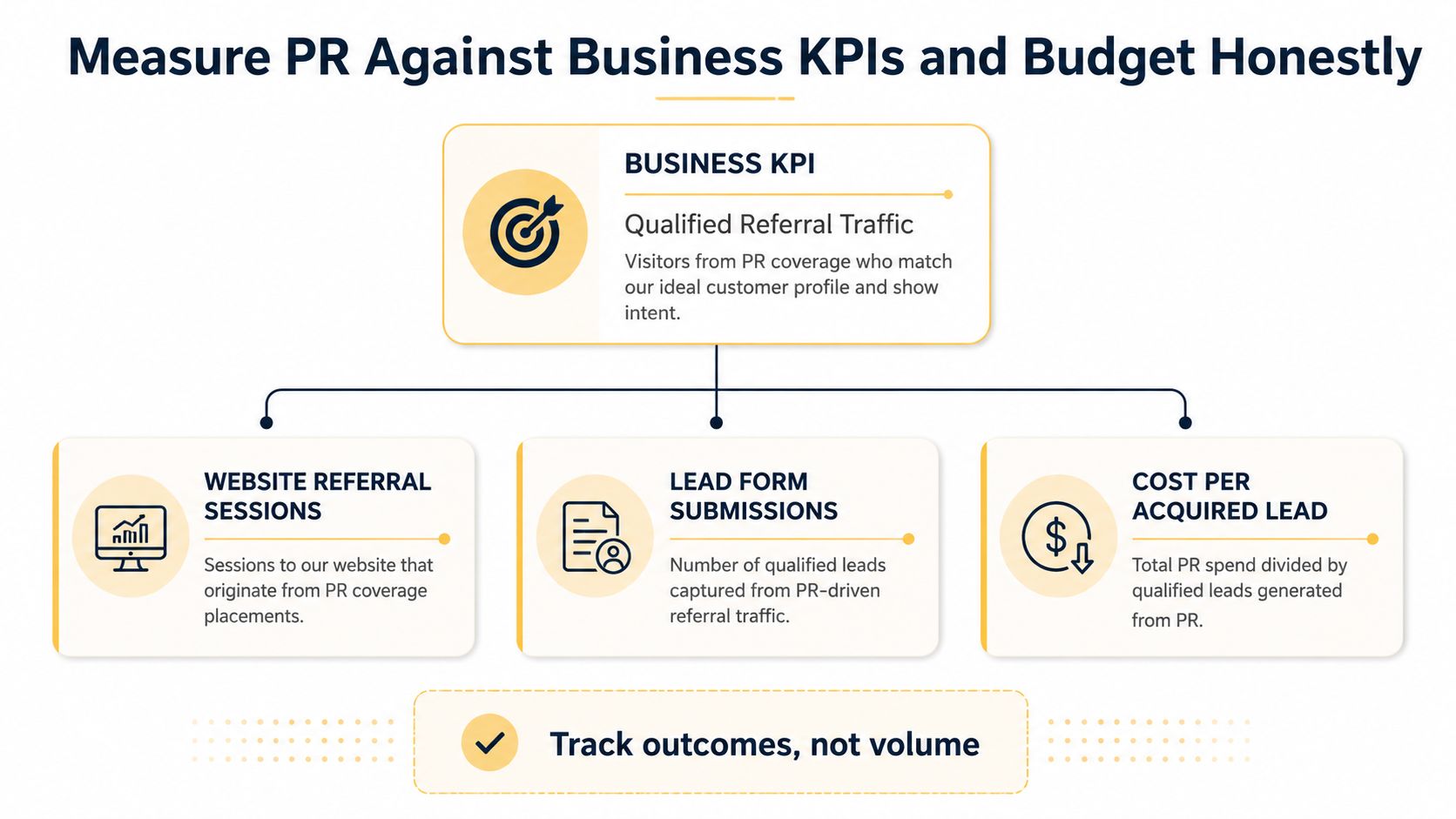
PR measurement usually breaks at the metric-design stage. Teams count placements, mentions, impressions, or opens because those numbers are easy to collect, then struggle to explain whether the activity supported revenue.
A 2025 communications report found 44% of respondents struggle to align PR metrics with revenue or business KPIs, while two-thirds of teams have access to a dedicated data analyst and 96% rely on data more than ever. (Communications measurement report) The gap isn't necessarily a missing enterprise platform. It's often a failure to define the business question before selecting the dashboard.
Build a small KPI map
Start with one business outcome, then select three leading indicators.
- Business outcome: Qualified opportunities, retained accounts, completed consultations, or another owner-level priority.
- Referral quality: Sessions from relevant coverage, evaluated by audience and behavior rather than volume alone.
- Message pull-through: Whether prospects repeat the intended problem, value proposition, or differentiator during sales conversations.
- Assisted conversion: Whether people exposed to coverage later appear in the conversion path, even when PR wasn't the final touch.
Track share of voice against named competitors only when the comparison helps a decision. A large mention count can be commercially irrelevant if the audience doesn't match the buying group.
Allocate the budget around constraints
For an SMB spending $2,000 to $10,000 per month, the right allocation depends on whether the bottleneck is strategy, production, access, or measurement. Don't assign money evenly by channel.
| Budget area | Use the money for | What to protect |
|---|---|---|
| Strategy and outreach | Planning, media research, pitching, relationship work | Relevance and consistency |
| Content production | Customer stories, data reports, executive articles | Evidence and editorial quality |
| Media access | Research databases or specialist support | Accurate targeting |
| Distribution | Selective paid amplification or event support | Audience fit |
| Measurement | Analytics setup, dashboards, attribution review | Connection to business KPIs |
A smaller budget may need to prioritize strategy and one strong owned asset over broad distribution. A larger budget can add production capacity and selective amplification, but it still shouldn't use paid reach to compensate for an unconvincing angle. The marketing ROI calculation guide offers a useful way to connect activity costs with the outcomes leadership already reviews.
Review the KPI map monthly. Keep indicators that help you make a decision, remove vanity measures that only decorate a report, and document which stories generate useful sales conversations.
Prepare for Crises and Learn from Real SMB Playbooks
A launch plan helps you earn attention. A crisis plan helps you avoid improvising when attention arrives for the wrong reason.
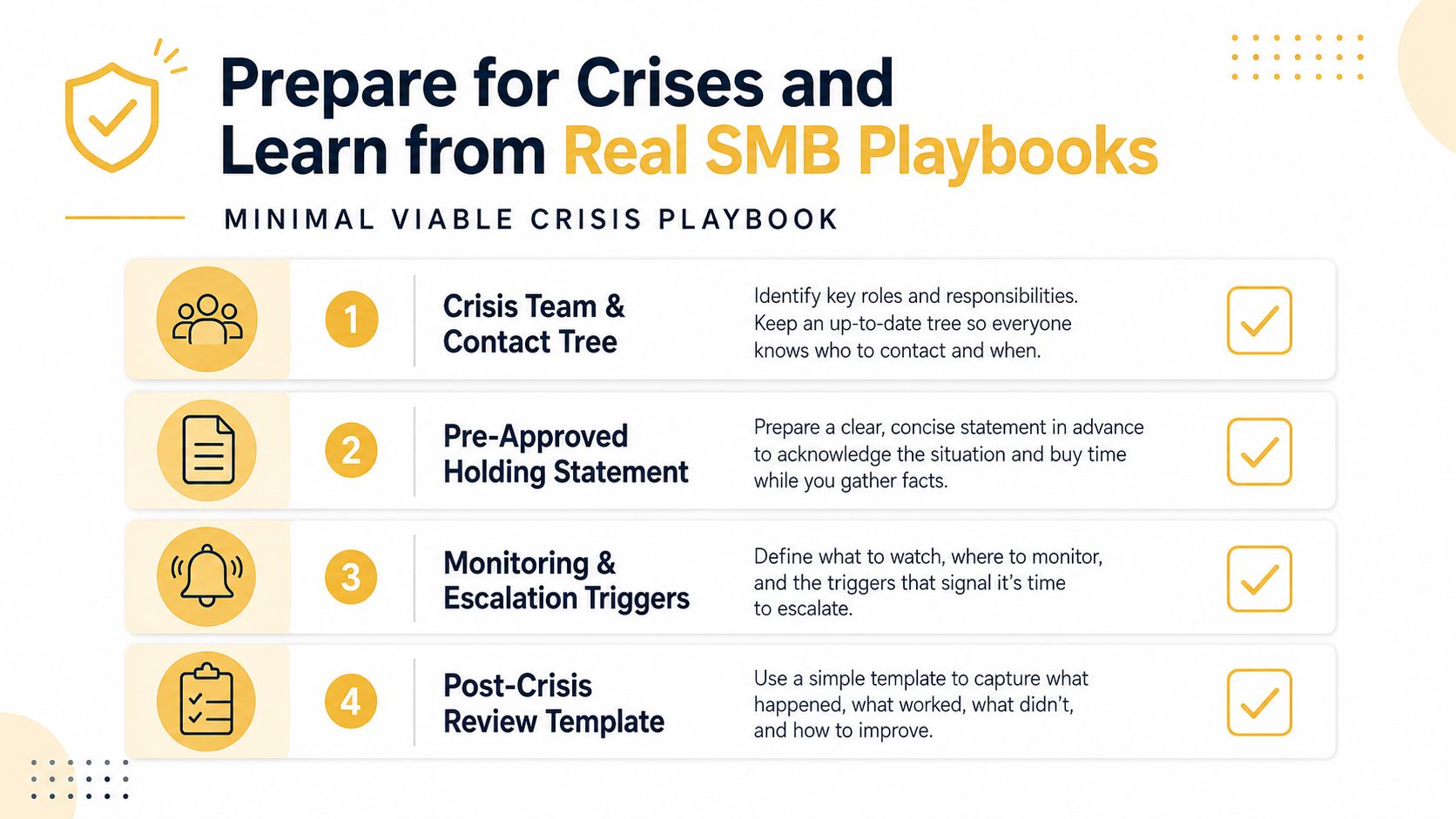
Every SMB should have a one-page response matrix for likely scenarios such as a product outage, executive misstep, customer data incident, or viral complaint. Assign a spokesperson, identify the person who can approve a response, prepare a holding statement framework, and define what must happen within the first day.
Build the minimum viable playbook
Your matrix should answer four questions:
- Who responds: Name the spokesperson and backup. Don't leave this to whoever notices the complaint first.
- What can be said immediately: Prepare a factual holding statement that acknowledges the issue without guessing at causes.
- When the issue escalates: Define triggers for legal, security, executive, customer-success, or technical involvement.
- How the team learns: Record what happened, which messages worked, and which process failed.
The statement should be short, human, and updateable. “We're aware of the issue, we're investigating it, and we'll share verified information through this channel” is a framework, not a substitute for facts. Never promise a resolution time the team can't support.
Two patterns SMBs can copy
A small team facing a public customer complaint can respond visibly, acknowledge the specific failure, move the conversation to a useful support channel, and publish the resolution once verified. That approach may turn a negative interaction into evidence that the company listens and takes responsibility. It doesn't require a dramatic campaign. It requires speed, accuracy, and a named person accountable for the response.
Another SMB pattern uses original data instead of a paid media budget. A founder can collect relevant observations, explain the methodology plainly, offer a useful interpretation, and give trade journalists access to the findings. The story earns attention because it helps the market understand a problem, not because the company describes itself as important.
Use a 30-60-90 launch checklist
Days 1 to 30: Set the business goal, audience map, messaging spine, proof points, spokesperson list, and crisis matrix.
Days 31 to 60: Build the first storyline backlog, publish one owned asset, prepare personalized outreach, and begin conversations with relevant journalists, podcast hosts, and community voices.
Days 61 to 90: Review referral quality, assisted conversions, message pull-through, and sales feedback. Retire weak angles, improve the strongest one, and run a crisis drill so the response matrix works before a real incident tests it.
Up North Media offers web development, SEO marketing, AI consulting, social media, and public relations support for businesses that want communications connected to digital growth. Visit Up North Media to discuss a revenue-aligned PR and digital strategy, then bring your KPI map, audience list, and first storyline to the conversation.