
A one-star review lands in your inbox at 8:12 a.m. Your stomach drops. Someone calls your team rude, says the product broke, or claims billing was a mess. The first instinct is usually the wrong one. Fight back, hide, ignore, or fire off a quick apology before you know what happened.
That moment needs process, not panic.
Businesses that handle criticism well don't treat responding to negative reviews as a customer service side task. They treat it as a visible trust exercise, an operations signal, and sometimes a legal or PR issue. The public reply matters. The private fix matters more. The internal follow-through matters most.
Why Every Negative Review Is a Marketing Opportunity
A negative review feels like damage because it is public. But the public part is also why it can work in your favor.
Over 94% of customers report that a bad review has influenced them to avoid a business, yet 95% of unhappy customers will return if the business resolves their issue effectively according to negative review behavior data. That gap tells you something important. The review itself isn't the whole problem. The bigger problem is what buyers infer from your response, or your silence.
Prospects read your reply as a service sample
Readers of a bad review aren't emotionally invested in the complaint. They're evaluating your judgment. They want to know whether you stay calm, whether you listen, and whether you fix real issues.
If your reply is generic, defensive, or absent, the reader fills in the blanks. They assume support will be slow. They assume accountability is weak. They assume they'll have to fight to get help.
If your reply is measured and specific, the same review can do the opposite. It can show that your business owns mistakes, communicates clearly, and has adults in charge.
Practical rule: A negative review is often the only time a prospect gets to see how your business behaves under pressure.
That's why I tell clients to stop thinking of review responses as damage control copy. It's public evidence of how the company operates.
The review is feedback, content, and market research
A bad review can expose a broken handoff between sales and support, weak shipping communication, poor front-desk training, or confusing billing language. That's free operational intelligence. If the same complaint shows up more than once, it's not a review problem. It's a business process problem.
Strong teams build that insight into customer experience work. If you need a practical complement to that thinking, this guide on improving customer experience is worth reviewing alongside your response policy. For a broader operational view, these Sift AI reviews management insights are useful because they connect reviews to larger customer systems instead of treating them like isolated comments.
What doesn't work
Three reactions fail repeatedly in practice:
- Ignoring it: Silence reads as indifference.
- Over-explaining: Long public defenses make you look rattled.
- Copy-paste empathy: Reviewers and prospects can spot canned language immediately.
The best response doesn't try to win an argument. It shows control, care, and a clear path to resolution. That's what makes a negative review a marketing opportunity instead of a conversion leak.
Your First 24 Hours A Triage and Response Framework
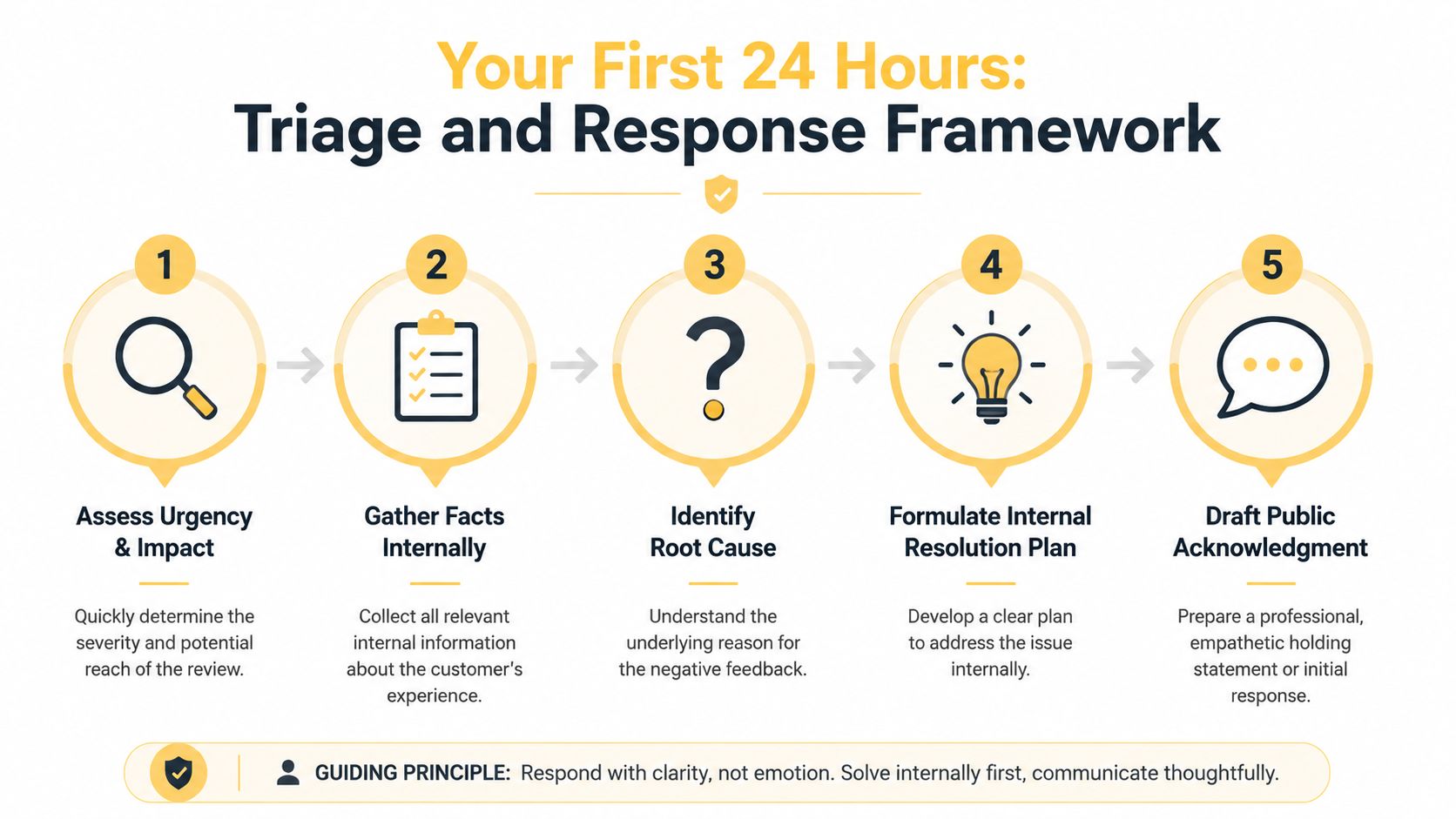
The first day after a negative review should run like a playbook. Not every complaint is equal. Some need a simple service recovery. Some expose a training issue. Some involve safety, billing, discrimination claims, or threats and need immediate escalation.
The HEARD framework, Hear, Empathize, Apologize, Resolve, Diagnose, provides a structured approach, and negative reviews must be addressed within 24 hours to maximize the probability of converting the customer's opinion based on this review response strategy guidance.
Start with triage, not typing
Before anyone writes a reply, answer five questions internally:
-
Is the complaint identifiable?
Can you match the person to an order, booking, support ticket, or visit? -
Is the issue operational or reputational?
A delayed shipment is different from an accusation of fraud or harassment. -
Is the claim plausible on first review?
You don't need certainty yet. You need enough context to avoid saying something careless. -
Who owns the fix?
Customer support, operations, store manager, finance, legal, or leadership. -
What can be offered now?
Clarification, callback, replacement, refund review, escalation, or a holding response.
If your business depends on local visibility, make sure the review channel itself is set up correctly. A clean Google Business Profile setup makes ownership, notifications, and response workflows much easier.
Use HEARD as an internal filter
HEARD works best when teams use it before drafting the public reply.
- Hear means capture the complaint in plain language. Strip out the emotion and identify the actual service failure or disputed claim.
- Empathize means recognize why the person is upset. Even when details are incomplete, frustration is usually real.
- Apologize means apologize for the experience. That doesn't require admitting legal fault.
- Resolve means define what your business can do next. Not what you'd like to do eventually.
- Diagnose means move specifics offline when account details, medical information, billing records, or personnel issues are involved.
A fast response with no real understanding often creates a second problem. The customer now feels dismissed, and everyone else can see it.
A practical first-day workflow
Here is the sequence I recommend for most small and mid-sized businesses:
- First review scan: Log the platform, timestamp, star rating, and issue type.
- Internal fact check: Pull order notes, call logs, support transcripts, or staff recollections.
- Severity call: Flag anything involving threats, defamation, safety, discrimination, or confidential information.
- Resolution owner assigned: One person should own the response and follow-up.
- Public acknowledgment posted: Even if the full resolution needs more time, the customer should see that you're engaged.
A same-day public acknowledgment can be short. It only needs to do three things well: recognize the issue, show professional concern, and point toward a real next step.
What to avoid in the first 24 hours
The most common mistakes aren't dramatic. They're procedural.
| Mistake | Why it hurts | Better move |
|---|---|---|
| Replying from memory | Details are often wrong | Check records first |
| Letting multiple staff respond | Tone gets inconsistent | Assign one owner |
| Arguing in public | The thread becomes the story | State concern, move offline |
| Promising too much | Operations can't fulfill it | Offer only what you can execute |
The businesses that handle negative feedback well aren't improvising. They have a response lane, an escalation lane, and an internal fix lane. That's what keeps one review from turning into three more.
Crafting the Perfect Response Tone and Structure
Once facts are in hand, the public response needs discipline. Good intent isn't enough. Structure matters because buyers scan review threads quickly, and sloppy replies send the wrong signal.
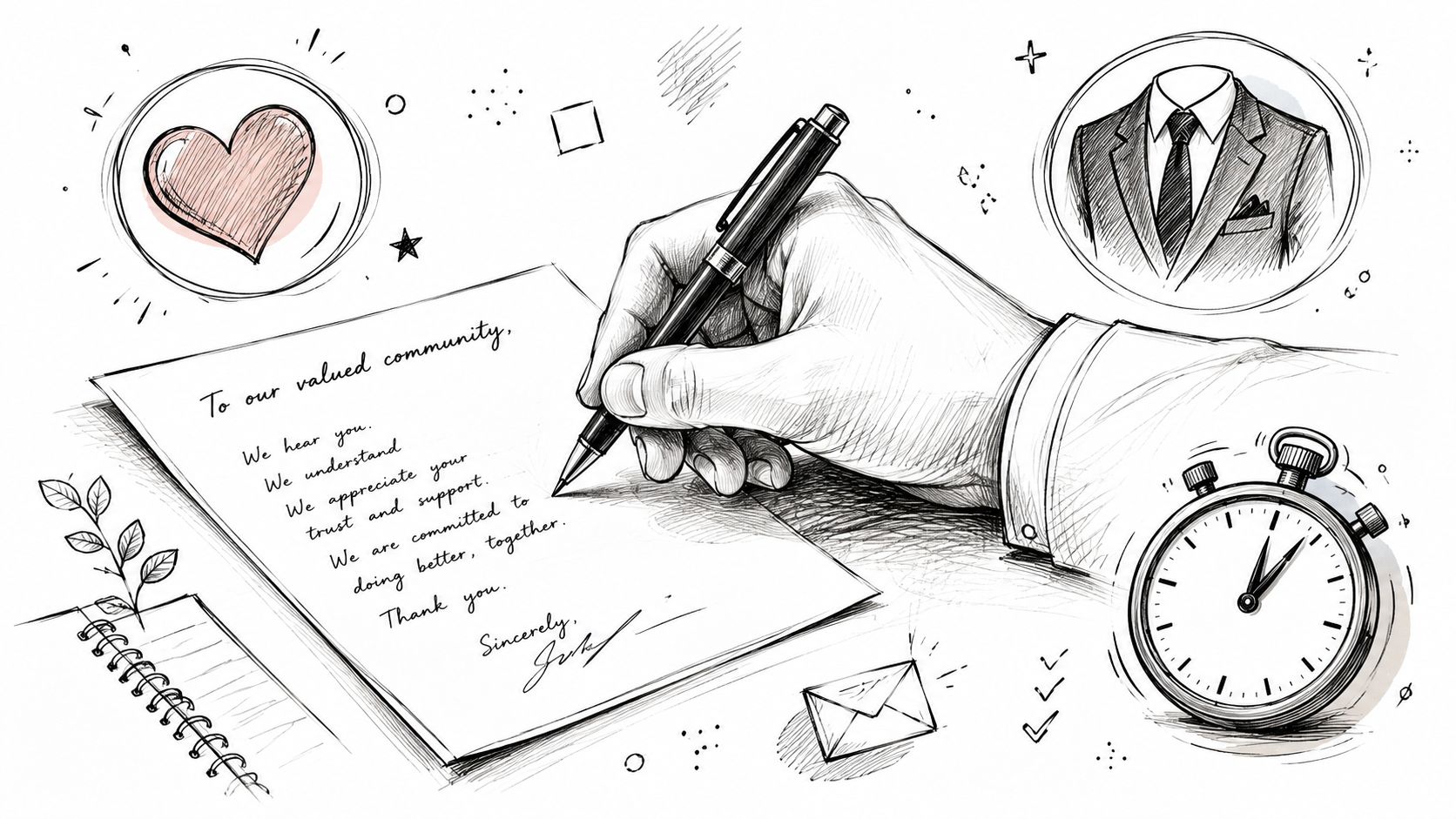
A high-impact response follows a six-step template: name the reviewer, acknowledge the specific issue, describe a specific remediation, sign with a human's name and role, keep it under 150 words, and post within 48 hours based on this negative review response template research.
The six parts that should almost always be there
A strong review reply usually includes these components in this order:
-
Use the reviewer's first name
This lowers the temperature and signals that a person read the review. -
Acknowledge the exact issue
Don't say "We're sorry you had a bad experience" if the complaint was about a late refund or rude host. Name the issue. -
State what you've already done or are doing
Specific remediation beats vague intention. "We've reviewed the order notes and escalated this to our billing lead" works better than "We'll look into it." -
Move the details offline
Offer a clear next step through support, phone, or email. Keep private details out of the thread. -
Sign with a real human and role
People trust accountable names more than brand signatures. -
Stay concise
Under 150 words forces clarity and helps readers absorb the point quickly.
Tone is calm, not soft
Many businesses misunderstand empathy. They think empathy means sounding passive. It doesn't. It means sounding grounded.
A good response can be firm and still respectful. It can protect the business and still acknowledge frustration. If your team struggles with de-escalation language, this piece on resolving challenging interactions is a useful companion for support managers training frontline staff.
Here is the difference in practice:
| Weak tone | Strong tone |
|---|---|
| "Sorry for any inconvenience caused." | "I'm sorry your order arrived damaged." |
| "Please contact us if you'd like." | "Please email our support team so we can replace this for you." |
| "We always strive for excellence." | "We've shared this with our store manager and are reviewing what happened." |
A workable response formula
Use this simple build:
Hi [First Name], I'm sorry about [specific issue]. We've [specific action already taken]. Please contact [channel] so we can [clear resolution path].
[Name], [Role]
That formula keeps teams from wandering into legal admissions, emotional rebuttals, or marketing language.
A short visual example helps some teams internalize the cadence:
What weakens an otherwise good reply
Even experienced teams make these mistakes:
- Defensive phrasing: "That's not what happened" is almost never the right opener.
- Brand boilerplate: Corporate slogans don't belong in review recovery.
- Unowned language: "Mistakes were made" avoids responsibility.
- Wall-of-text responses: Long rebuttals suggest you care more about being right than helping.
Keep the public response readable. The real work happens in the private follow-up and the internal correction.
When you're responding to negative reviews consistently, readers start to notice a pattern. That's the point. You're not trying to sound clever. You're trying to sound reliable.
Ready-to-Use Templates for Common Scenarios
Templates work when they preserve judgment, not replace it. The biggest mistake I see is teams copying a response line-for-line and creating the exact same apology for a broken product, a billing dispute, and a rude employee report. That makes the business look automated at the wrong moment.
Use templates as scaffolding. Customize the specific issue, the action taken, and the next step.
Negative review response templates
| Scenario | Core Strategy | Template Example |
|---|---|---|
| Product arrived damaged | Acknowledge the failure and offer a concrete remedy | Hi [First Name], I'm sorry your order arrived damaged. We've flagged this with our fulfillment team and want to make it right. Please contact us at [support channel] with your order details so we can arrange a replacement or review the appropriate next step. [Name], [Role] |
| Shipping delay | Own the communication gap, not just the delay | Hi [First Name], I'm sorry the delivery timing and updates missed the mark. We've reviewed the shipment status and are checking where communication broke down. Please reach out at [support channel] so we can help with your order directly. [Name], [Role] |
| Poor in-store service | Address conduct and show management involvement | Hi [First Name], I'm sorry you were treated that way during your visit. We've shared your feedback with store leadership and are reviewing the interaction internally. Please contact us at [support channel] if you're open to speaking further so we can address this properly. [Name], [Role] |
| Billing dispute | Stay precise and move quickly offline | Hi [First Name], I'm sorry for the frustration around your billing concern. We've asked our finance team to review the account history and we'd like to confirm the details directly with you. Please contact us at [support channel] so we can resolve this securely. [Name], [Role] |
| Appointment or service no-show | Recognize the time cost to the customer | Hi [First Name], I'm sorry we missed your appointment window. We've reviewed the scheduling record and are looking into what caused the breakdown. Please contact us at [support channel] so we can make this right and discuss a new service arrangement. [Name], [Role] |
| Software bug or outage complaint | Confirm the issue and explain next action without overpromising | Hi [First Name], I'm sorry you ran into this issue. Our team is reviewing the problem and checking whether your experience matches a known incident. Please contact us at [support channel] with your account details so we can investigate your case directly. [Name], [Role] |
| Quality complaint after use | Avoid debate, focus on resolution | Hi [First Name], I'm sorry the product didn't perform as expected. We've documented your feedback and would like to review the order so we can help with the best next step. Please contact us at [support channel]. [Name], [Role] |
| No-detail one-star review | Invite specifics without sounding skeptical | Hi [First Name], thank you for the feedback. I'm sorry we didn't meet expectations. We'd like to understand what went wrong and see if we can help. Please contact us at [support channel] with more detail if you're open to it. [Name], [Role] |
Why these templates work
Each one does three things well:
- It names the issue clearly.
- It shows internal action has started.
- It opens a private path to resolution.
That combination reassures the reviewer and the silent audience reading along.
Platform nuance matters
A template should also fit the platform:
- Google reviews: Keep it concise. Most readers skim.
- Yelp: Professional restraint matters. Avoid sounding promotional.
- Facebook: Expect back-and-forth. Invite private messaging early.
- App stores: Reference the product issue directly and route to support with enough specificity that a user can continue the conversation.
If you need a house rule, use this one. Standardize the structure, not the wording. That keeps your brand consistent without sounding robotic.
Handling False Unfair and Malicious Reviews
Most review advice falters at this point. While it suggests businesses avoid argument, a notion that is generally sound, it offers little utility when a review is objectively false and damaging.
A major gap in reputation management advice is the lack of structured templates for responding to objectively false reviews. While sources warn against being defensive, they fail to provide a method for concise, evidence-based rebuttals that preserve trust as noted in this Forbes discussion of false review responses.
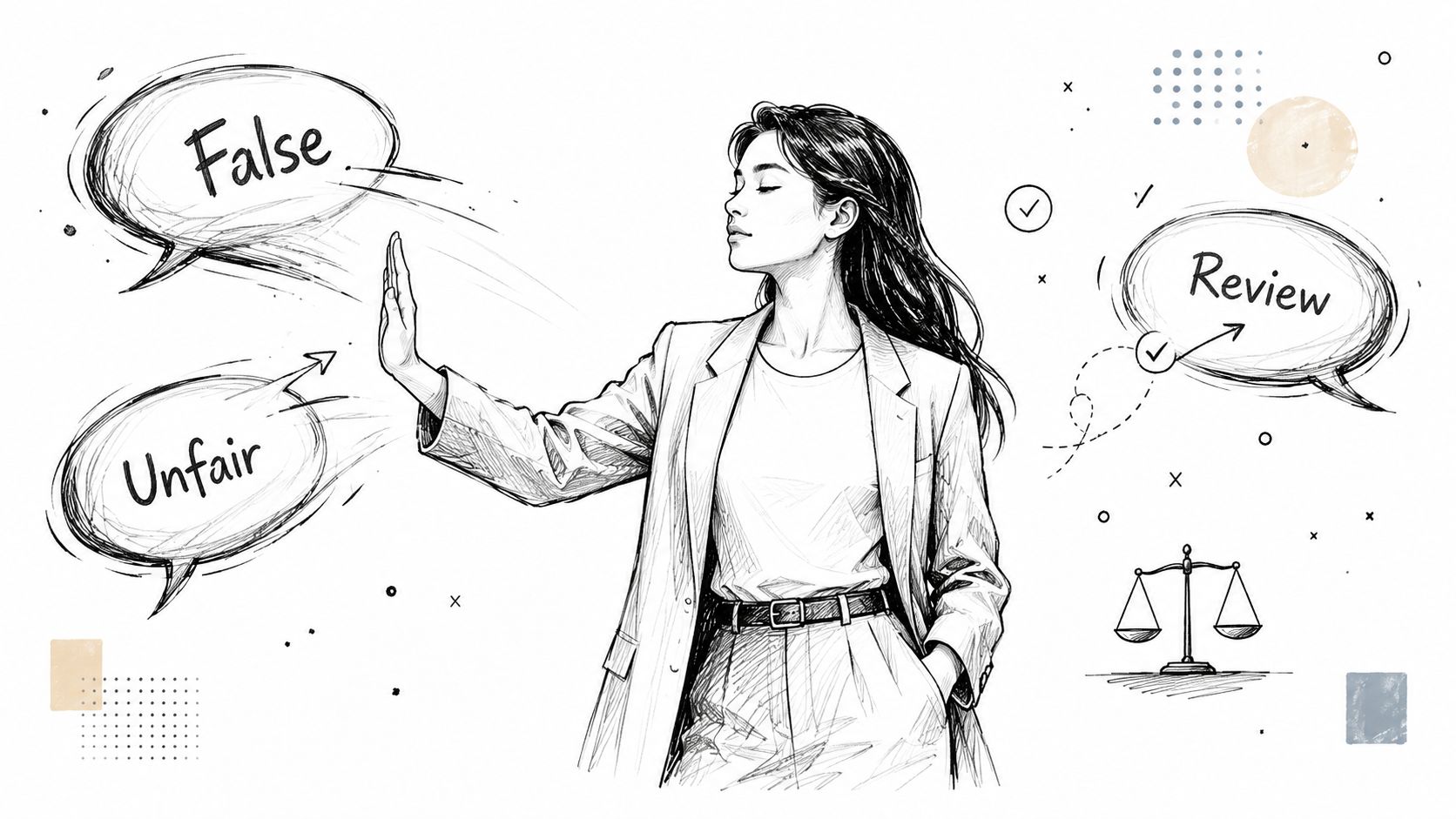
Don't argue. Correct.
There is a difference.
Arguing makes the reviewer the opponent. Correcting focuses on the facts and the process. The frame should be us versus the unresolved issue, not business versus reviewer.
That means your response should avoid sarcasm, accusation, or detailed public evidence dumps. You don't need to "win" the thread. You need to protect trust.
A four-part framework for false claims
When a review appears false, use this structure:
-
Acknowledge the concern publicly
Start with respect, even if the claim is wrong. -
State the verification gap
Say you haven't been able to match the review to an account, order, booking, or case. -
Invite direct contact for investigation
Give a real path for verification. -
Avoid private facts in public
Never post account details, screenshots, health information, or staff names to prove your point.
If your response reads like a courtroom brief, you've already lost the optics.
Sample templates for unfair or false reviews
Use these as starting points.
When you can't verify the person
Hi [First Name], we take feedback seriously, but we haven't been able to match this review to a recent order or support case. Please contact us at [support channel] with the relevant details so we can investigate properly. If something went wrong, we want to address it. [Name], [Role]
When the complaint contains a factual error
Hi [First Name], we're sorry to hear you left with that impression. Based on the information currently available to us, parts of your review don't match our records. We'd welcome the chance to review the details directly with you at [support channel] so we can clarify what happened and help if needed. [Name], [Role]
When the review is malicious in tone
Hi [First Name], we take concerns like this seriously and are reviewing the matter carefully. To protect privacy, we won't discuss account details here, but we invite you to contact us at [support channel] so we can verify the situation and respond appropriately. [Name], [Role]
When to escalate beyond a standard reply
Some reviews don't belong solely with support or marketing.
Escalate internally when the review includes:
- Defamation concerns: Statements presented as fact that your team believes are false and damaging
- Threats or extortion: Demands tied to review removal or reputational pressure
- Privacy risk: Requests or accusations that could tempt staff to reveal protected information
- Coordinated attacks: Multiple suspicious reviews repeating the same claim pattern
For businesses that need a broader framework to manage your online presence, it helps to connect review handling with brand monitoring, identity protection, and platform reporting workflows.
The key trade-off is simple. If you stay silent on falsehoods, readers may accept them. If you overreact, readers may distrust you more. The middle path is calm factual correction, limited public detail, and disciplined escalation in more serious situations.
Escalation Remediation and Measuring Success
A review response program is only credible if it feeds the business back end. Public replies are the visible layer. The system behind them determines whether customers come back and whether the same complaint shows up next week.
89% of consumers prefer businesses that respond to every review, and 56% are influenced by the content of the reply, according to these Google review response statistics. That makes review handling a measurable business function, not a courtesy task.
Build an escalation ladder
You need a simple internal routing model.
- Support team: Order issues, shipping complaints, product defects, service misunderstandings
- Operations or store leadership: Repeated process failures, staffing complaints, scheduling problems
- Finance: Refund disputes, charge confusion, invoice issues
- Legal or PR: Defamation, threats, privacy claims, media-sensitive complaints
This doesn't need to be complex. It needs to be clear. Teams that want faster routing often pair review workflows with the same systems they use for service automation. A practical starting point is reviewing how to automate customer service without turning sensitive cases into bot-handled mistakes.
Track what actually matters
Most businesses focus too much on star averages and not enough on operational signals. Measure things your team can improve.
| KPI | What it tells you |
|---|---|
| Response time | Whether the team is meeting its service standard |
| Response coverage | Whether reviews are being answered consistently |
| Resolution rate | Whether public replies lead to private fixes |
| Recurring complaint themes | Where operations are breaking down |
| Updated or revised reviews | Whether recoveries are changing sentiment |
The best ROI from responding to negative reviews usually comes from preventing repeat failures, not from polishing the public thread.
Close the loop internally
Every meaningful negative review should end with one internal question: what needs to change so this complaint becomes less likely next month?
Sometimes the answer is staff coaching. Sometimes it's packaging, fulfillment messaging, service scripts, or billing language. Sometimes it's leadership realizing the same complaint keeps surfacing because nobody owns that part of the customer journey.
If your business treats review management as a performance channel, not just a reputation chore, the value compounds. You improve customer retention, sharpen operations, and give future buyers a better reason to trust you.
If your team needs help building a review response system that connects customer service, SEO visibility, automation, and reputation protection, Up North Media can help. They work with growing businesses that need more than canned replies. They help build the underlying digital processes that make stronger customer experiences possible.