
You're probably dealing with this right now. A trade show is coming up in Omaha, a local event sponsor packet just got approved, or your sales team suddenly needs brochures, table signs, and updated business cards by next week. The website is live, your social channels are active, and then print enters the conversation and slows everything down.
That's where a lot of business owners get stuck with ABC Printing and Graphics. The phrase sounds simple, but the actual decision isn't. You're not just picking a vendor to put ink on paper. You're deciding how your brand shows up in the world, how fast changes can be made, and whether the finished piece supports the rest of your marketing or works against it.
Print also isn't frozen in the past. Some providers trace their roots to blueprinting as early as 1982, and companies that started in that era now offer digital document management and broader print services across industries including retail and construction, as described by ABC Imaging's company background. That shift matters because it explains why a modern print partner can help with far more than flyers and copies.
For Omaha businesses, the smart move is to treat print as part of a full marketing system. A brochure should support a sales conversation. A direct mail piece should push people to a landing page. Event signage should match the site people visit after they scan a QR code. When print and digital work together, the money you spend offline has a better chance of producing measurable action online.
Your Introduction to Printing and Graphics
A local business owner gets a booth at an Omaha expo. They need a retractable banner, handouts, branded folders, and a one-page leave-behind for follow-up meetings. The first printer quotes fast but asks almost nothing about the job. The second asks where the materials will be used, how many version changes are likely, and whether the handout needs to match a landing page campaign.
That second conversation is usually the better one.
ABC Printing and Graphics isn't just about ordering printed items. It's about translating your brand into physical form without wasting budget, time, or attention. If you've ever approved a design on screen and then felt disappointed when the finished piece arrived, you already know the gap. Print has its own rules, its own production constraints, and its own opportunities.
Why businesses get confused
Many owners hear “graphics” and think design. They hear “printing” and think presses, paper, and turnaround time. In practice, those two pieces are tied together. The design choices affect production. The production method affects cost. The deadline affects what kind of finish or paper stock is realistic.
Practical rule: If your printer never asks how the piece will be used, they're treating your project like a commodity instead of a marketing asset.
That's the core issue. Most businesses don't need a list of services. They need someone to help them decide what format fits the job. A sales sheet for an in-person meeting isn't the same as a menu insert, a mailer, or a banner meant to be read from across a room.
What good print guidance looks like
In Omaha, practical buyers usually want three things:
- Clear recommendations: What stock, format, and print method fit the job.
- Honest trade-offs: Where quality matters most, and where you can trim cost without hurting results.
- Marketing alignment: How the printed piece connects to your website, follow-up process, or campaign.
When you look at print that way, it stops being a line item you tolerate and starts becoming a tool you can use well.
What a Modern Print and Graphics Provider Does
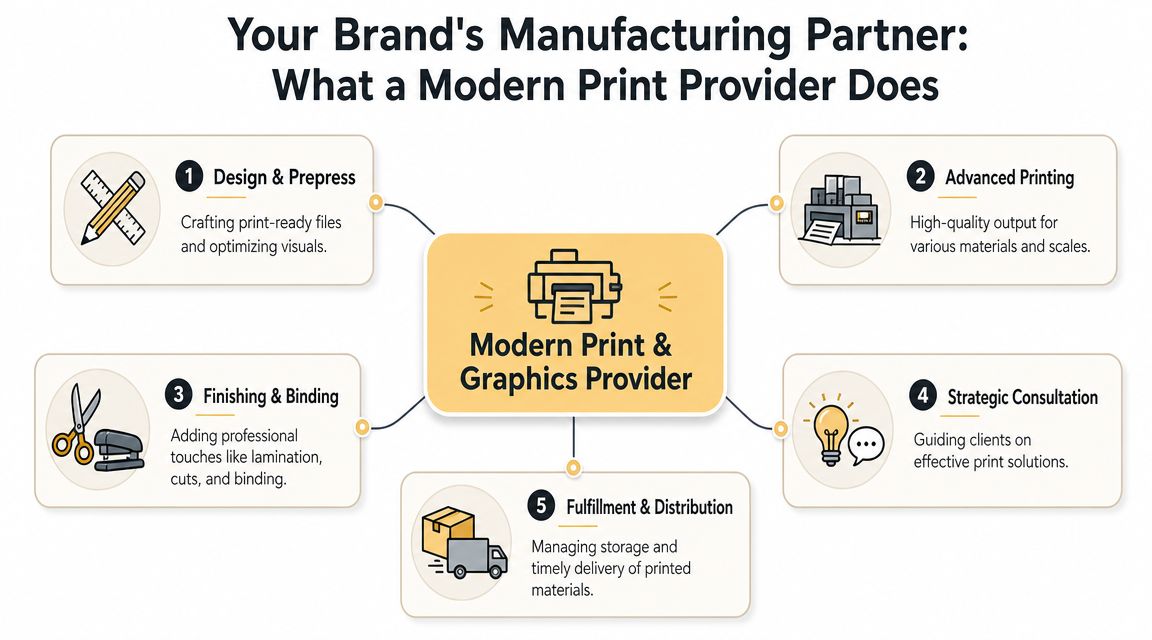
A modern print shop is closer to a manufacturing partner for your brand than a copy counter. They take the digital assets you already have, logo files, layouts, photography, messaging, and turn them into physical materials that people can hold, see at a distance, mail, post, or carry into a meeting.
They don't just print
The best providers handle decisions that most buyers don't want to guess at.
A strong print partner looks at your file and notices the photo resolution won't hold up at banner size. They flag a fold line that will cut through a headline. They tell you when a coated stock looks better for one job and when an uncoated stock feels more appropriate. That's not upselling. That's preventing expensive mistakes.
They also help you sort through production realities:
- Design and prepress: Checking file setup, color mode, bleed, margins, and image quality.
- Production choice: Matching the job to digital, offset, or large-format equipment.
- Finishing: Trimming, scoring, folding, binding, laminating, mounting, and packaging.
- Fulfillment: Shipping to one office, multiple locations, or an event venue.
- Consultation: Recommending the most sensible path based on deadline, quantity, and use case.
Why long-running shops still matter
Many local printers have deep roots in their communities. Some, like ABC Printing Company in Vero Beach, were founded in 1975 and are still identified as locally owned and operated in the Indian River County Chamber listing. That kind of longevity matters because it shows the business adapted through major workflow changes instead of disappearing when the industry shifted.
A shop that has lived through analog paste-up, digital prepress, and web-to-print ordering has usually learned something important. Equipment changes. Client pressure doesn't. Buyers still want reliable color, realistic deadlines, and materials that make them look professional.
What this means for Omaha businesses
If you run a company here, don't think of print as a commodity purchase unless the job is basic. For anything tied to brand perception, events, direct sales, or local outreach, your provider should act like a production advisor.
Good print vendors save money by stopping bad decisions before they hit the press.
That's the difference between “we can print that” and “here's how to make this work better.”
A Menu of Common Printing and Graphics Services
Many want to know what they can buy from ABC Printing and Graphics. Fair question. The answer covers more ground than most expect, because print services span production method, file prep, finishing, and specialty applications.
Print methods that solve different problems
The first decision is usually the production method.
Digital printing works best when you need a shorter run, quick changes, or multiple versions of the same piece. It's a practical fit for sales sheets, flyers, postcards, short-run booklets, event handouts, and test batches. In modern workflows, artwork is built as electronic text-and-image documents, and on-screen proofs can be reviewed and corrected in minutes, which makes revisions much easier before output, as explained in the Fiery guide to designing for print.
Offset printing is the traditional press method for larger, static runs. If the content won't change and the volume is high, offset often becomes the better production choice. It's common for jobs like larger brochure runs, stationery systems, and other repeat materials where consistency across a long run matters.
Large-format printing covers banners, posters, signs, wall graphics, trade show displays, window graphics, and vehicle applications. This category has different file and production demands than standard sheet printing, so it shouldn't be treated like “just a bigger flyer.”
Digital vs. Offset Printing at a Glance
| Factor | Digital Printing | Offset Printing |
|---|---|---|
| Best fit | Short runs and fast changes | Larger runs with stable content |
| Versioning | Easy to change names, offers, or locations | Better when every piece stays the same |
| Proofing workflow | Quick on-screen review and correction | More setup planning before production |
| Speed | Strong for rush jobs | Better suited to planned production |
| Common uses | Flyers, short-run brochures, handouts | High-volume brochures, stationery, repeat collateral |
Design and prepress services
Many print jobs go wrong here.
Prepress means preparing your file so it can be produced cleanly. That includes bleed, trim area, safe margins, image resolution, color setup, and font handling. If your designer built something for social media dimensions and sends it straight to a printer, there's a good chance the result will disappoint.
A few basics matter a lot:
- Bleed: Extra image area beyond the trim edge so you don't get white slivers after cutting.
- Safe area: The margin inside the trim line where logos and text should stay.
- Proof: A review version used to catch layout, copy, or color issues before production.
- Print-ready file: A file exported correctly for press, not just something that looks right on your monitor.
If you're tightening up brand assets before sending anything to print, it helps to review how your visual identity is built in the first place. This guide to Omaha logo design is useful because weak logo files and inconsistent brand standards create print problems long before the printer touches the job.
Finishing and specialty pieces
Finishing is what gives printed materials their final form. That includes folding brochures, binding booklets, trimming cards, laminating menus, mounting foam boards, scoring heavy stock, or adding specialty cuts for labels and packaging.
Sticker and label work is a good example. It sounds simple until you're choosing between indoor and outdoor use, different adhesives, contour cutting, and finish options. If you're comparing label concepts or promotional sticker applications, this overview on how to get custom stickers in the UK is a helpful outside example of the kinds of choices buyers often overlook.
If a product will be handled, mailed, folded, or displayed, finishing isn't cosmetic. It affects performance.
Key Factors That Affect Pricing and Turnaround
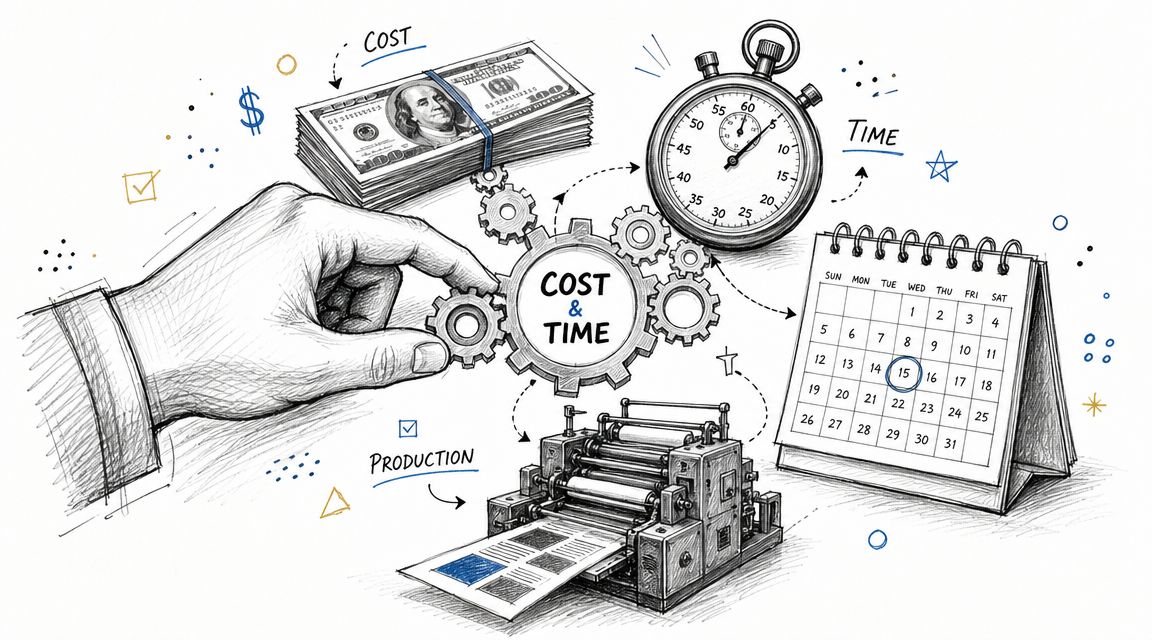
A print quote usually looks mysterious until you know what's driving it. Most of the cost and timing comes down to production choices you can control, at least partly.
The print industry is still a major market. One industry source projects the global print market at about $834 billion in 2024, which is a reminder that businesses continue to rely on print even while they demand better efficiency and clearer buying decisions, according to this print market overview.
What pushes a quote up or down
Quantity matters, but it's only one piece. The same job can price very differently based on stock, color requirements, setup complexity, finishing, and delivery logistics.
Here's what usually moves the number most:
- Quantity: More pieces can lower the unit cost, but only if the production method fits.
- Format: A standard postcard is simpler than a folded mailer, mounted sign, or multi-page booklet.
- Paper or substrate: Lightweight paper, premium cover stock, vinyl, rigid board, and specialty materials all change cost.
- Color approach: Full-color process work is different from simpler color setups.
- Finishing: Lamination, die cutting, binding, scoring, and hand assembly add labor and time.
- Shipping and distribution: Sending to one office is simpler than splitting a run across several locations.
What speeds production up
The fastest jobs usually start with the cleanest files.
A print-ready file reduces back-and-forth, keeps prepress simple, and gives the shop a better chance of hitting your deadline. The slowest projects often aren't delayed by the press itself. They get delayed by missing fonts, low-resolution images, last-minute copy changes, or a PDF exported incorrectly.
Buyer's shortcut: Ask your provider for their file checklist before design starts, not after the artwork is “done.”
Rush timing also changes what's realistic. If you need something tomorrow, you may need to accept a simpler stock, fewer finishing steps, or a digital run instead of a more elaborate production path. That's not a compromise if the piece still does its job.
What sustainability really means in practice
Small businesses ask about sustainability more often now, but the useful conversation isn't abstract. It's operational.
You reduce waste when you print the right quantity, avoid obsolete messaging, choose formats that can stay in circulation longer, and use proofing well enough to prevent reruns. In many cases, the greener choice is the one that avoids overproduction and unnecessary revisions. That's why good planning saves more than budget.
How to Choose the Right Omaha Print Partner
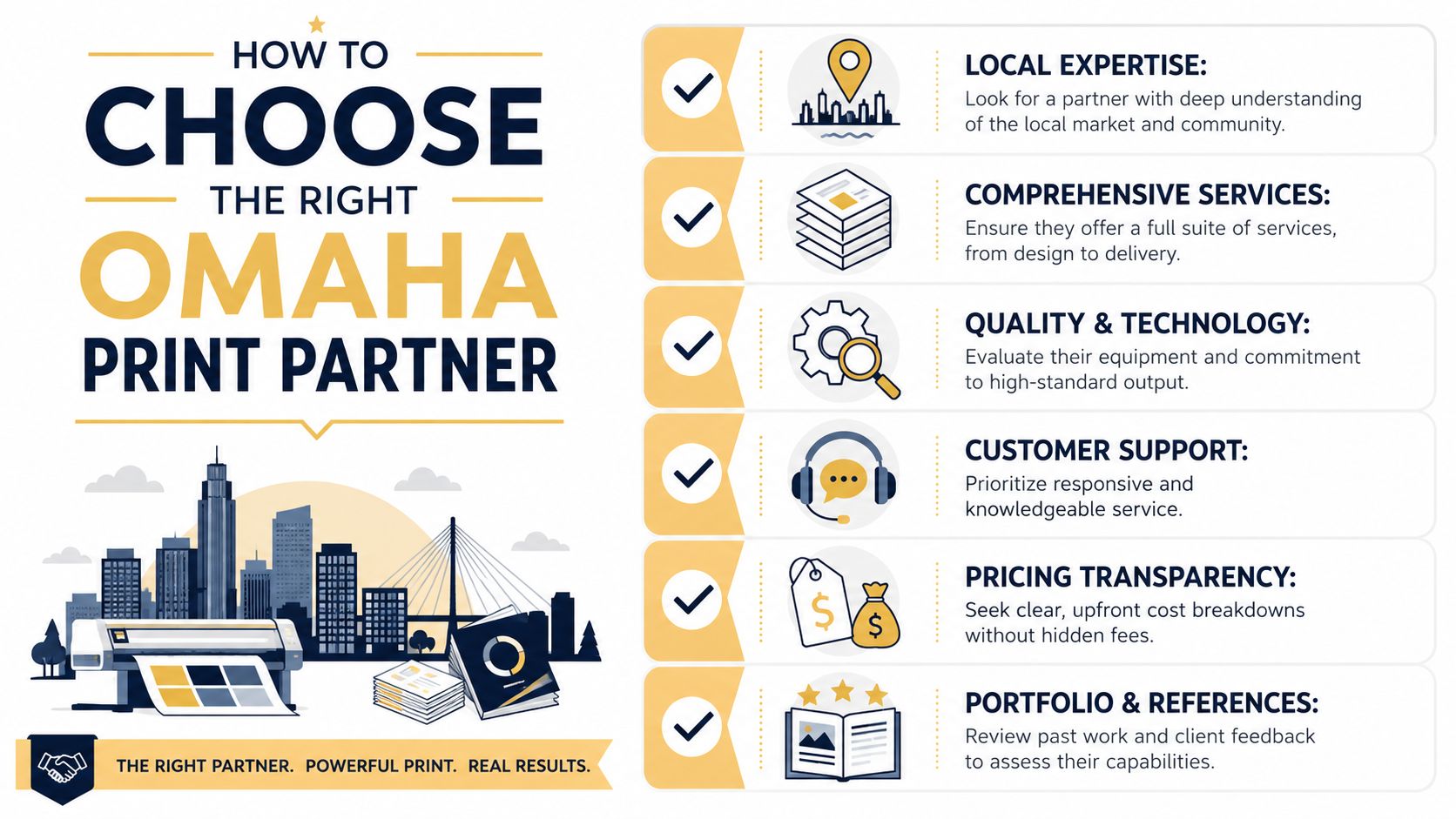
The best Omaha print partner isn't always the cheapest quote or the shop with the longest service list. It's the one that can handle your actual workload, communicate clearly, and support the way your business markets and sells.
Questions worth asking before you sign off
A useful print conversation sounds specific fast. Ask direct questions and see how concrete the answers are.
- How do you handle proofs? You want to know whether they offer digital proofs, physical proofs when needed, and who checks final approval.
- What kinds of jobs do you produce in-house? This helps you understand what they control directly and what may be outsourced.
- How do you advise on material choices? Good shops explain why one stock or finish fits better than another.
- What happens if a file isn't print-ready? You need to know whether they'll fix it, flag it, or let it go through and bill later.
- Can you support local deadlines and local delivery? That matters for events, multi-location businesses, and last-minute changes.
Why local context helps
Working with a local Omaha provider has a practical advantage. You can often review samples, solve issues quickly, and make calls that are harder to make over email with an out-of-market vendor.
That becomes even more important for displays and event work. Large-format graphics have to be engineered for bigger media, and viewing distance affects how files should be prepared so color and resolution still hold up at full size, which aligns with the production realities described by ABC Imaging's grand-format printing overview.
If your business also needs trade show structures or more involved exhibition builds, it helps to understand how print fits with fabrication and installation. For that side of the process, this resource on stand builders gives useful context on the broader event environment beyond the printed graphics alone.
A simple business card workflow
A small project tells you a lot about how a printer works.
You send a logo, preferred copy, and a rough idea of the look. The shop checks whether the logo file is usable, confirms dimensions, asks about stock thickness and finish, and returns a proof. You approve it after checking names, titles, and contact details. Then the shop prints, trims, boxes, and delivers.
That sounds basic because it should be. If a provider makes a straightforward job confusing, they probably won't make a complex one easier.
For businesses that want a partner mindset across branding, production, and digital execution, it also helps to understand what a broader creative partner handles. This overview of full-service design agencies gives a useful framework for thinking beyond one-off vendor relationships.
Choose the printer who asks the clearest questions, not the one who talks the most about equipment.
Integrating Print with Your Digital Marketing Strategy
Print works better when it has somewhere to send people. That's the difference between a brochure that gets glanced at once and a brochure that starts a trackable customer journey.
A lot of Omaha businesses still treat print and digital as separate budgets with separate goals. That creates weak handoffs. The postcard doesn't match the landing page. The event banner uses a slogan that never appears on the website. The QR code sends people to a generic homepage instead of the offer they were promised.
Where print should connect to digital
The cleanest integrations are simple.
A flyer for a local promotion should drive to a dedicated page, not your main navigation. A direct mail piece should carry a single call to action. In-store signage should point people toward a form, giveaway, menu, scheduler, or product page that matches the printed message exactly.
Some common connections work well:
- QR codes on print pieces: Useful for menus, event handouts, direct mail, and product inserts.
- Short campaign URLs: Easier to remember when someone doesn't want to scan.
- Landing pages tied to offers: Better than sending traffic to a homepage and hoping people hunt.
- Brand consistency: The same offer language, colors, and design cues should carry from print to page.
- Follow-up systems: If a printed piece generates leads, your email and CRM process should already be ready.
If you're building that connection from scratch, this guide on how to create a digital marketing strategy is a strong planning reference because it helps tie channel decisions back to business goals instead of treating every campaign as a one-off.
Physical touchpoints that support online action
Print can also support digital marketing in places businesses forget to look. Product packaging inserts can encourage reviews. Counter cards can promote appointment booking. Event signage can move attendees to a specific page for follow-up assets or demos.
Even simple branded items can work when they're tied to a campaign instead of handed out randomly. Hospitality and event brands, for example, often explore packaging and beverage touchpoints for that reason. If you want another perspective on how branding extends into physical experience, this article on custom printed paper cups is a useful example of how everyday materials can reinforce a message.
One point matters more than any tool. Print shouldn't ask the customer to figure out the next step. It should direct them there.
Here's a quick visual example of how digital assets support the printed side of marketing.
What doesn't work
Businesses waste print budget when they do any of the following:
- Sending to the homepage: That creates friction and lowers the odds of action.
- Using mismatched branding: Customers notice when the print piece and website feel unrelated.
- Printing before the page is ready: Offline traffic should never land on a placeholder.
- Offering too many choices: One printed piece should usually drive one next action.
A printed piece is strongest when it plays one role well and hands the user to a digital destination built for conversion.
Conclusion Making Print a Powerful Asset
Print still matters because businesses still need physical touchpoints that build trust, support sales, and create visibility in physical environments. What's changed is the standard. Buyers don't just need output. They need good judgment on format, file prep, material choice, turnaround, and how the finished piece connects to the rest of their marketing.
That's why ABC Printing and Graphics should be approached as a strategy question, not just a purchasing task. A modern print partner helps you avoid production mistakes, choose the right method for the job, and create materials that work in context. A brochure should help a sales conversation. A banner should stop the right person. A mailer should move someone to a specific page and action.
For Omaha businesses, the biggest opportunity is integration. The companies that get the most from print aren't using it as an isolated expense. They're using it to support lead generation, event marketing, local brand visibility, and better campaign follow-through.
If that's how you want to use print, start by tightening the handoff between offline and online. Make sure every printed piece has a clear purpose, a clear audience, and a clear next step. Then make sure the digital experience on the other side is ready to carry the momentum.
If you want help connecting print campaigns to landing pages, SEO, custom web tools, or a sharper digital strategy, talk with Up North Media. They help Omaha businesses turn disconnected marketing efforts into systems that are easier to measure, easier to improve, and more useful for growth.