
If you're running an Omaha business, this probably sounds familiar. You know you need stronger online visibility, but every option competes for your attention at once. SEO, Google Ads, email, social, video, AI tools, content calendars, analytics dashboards. It gets messy fast.
A digital marketing strategy isn't a giant document. It's a working plan for how your business gets found, earns trust, and turns attention into revenue. If it doesn't help you decide what to do this quarter, it isn't strategy. It's just marketing paperwork.
For small and mid-sized businesses, the challenge isn't lack of ideas. It's choosing the few moves that matter, putting numbers behind them, and sticking with them long enough to learn what works.
Your Starting Point Beyond the Buzzwords
Most business owners don't need more marketing terminology. They need clarity.
A useful strategy answers three questions:
- Where are we now
- Where are we trying to go
- How will we get there with the resources we have available
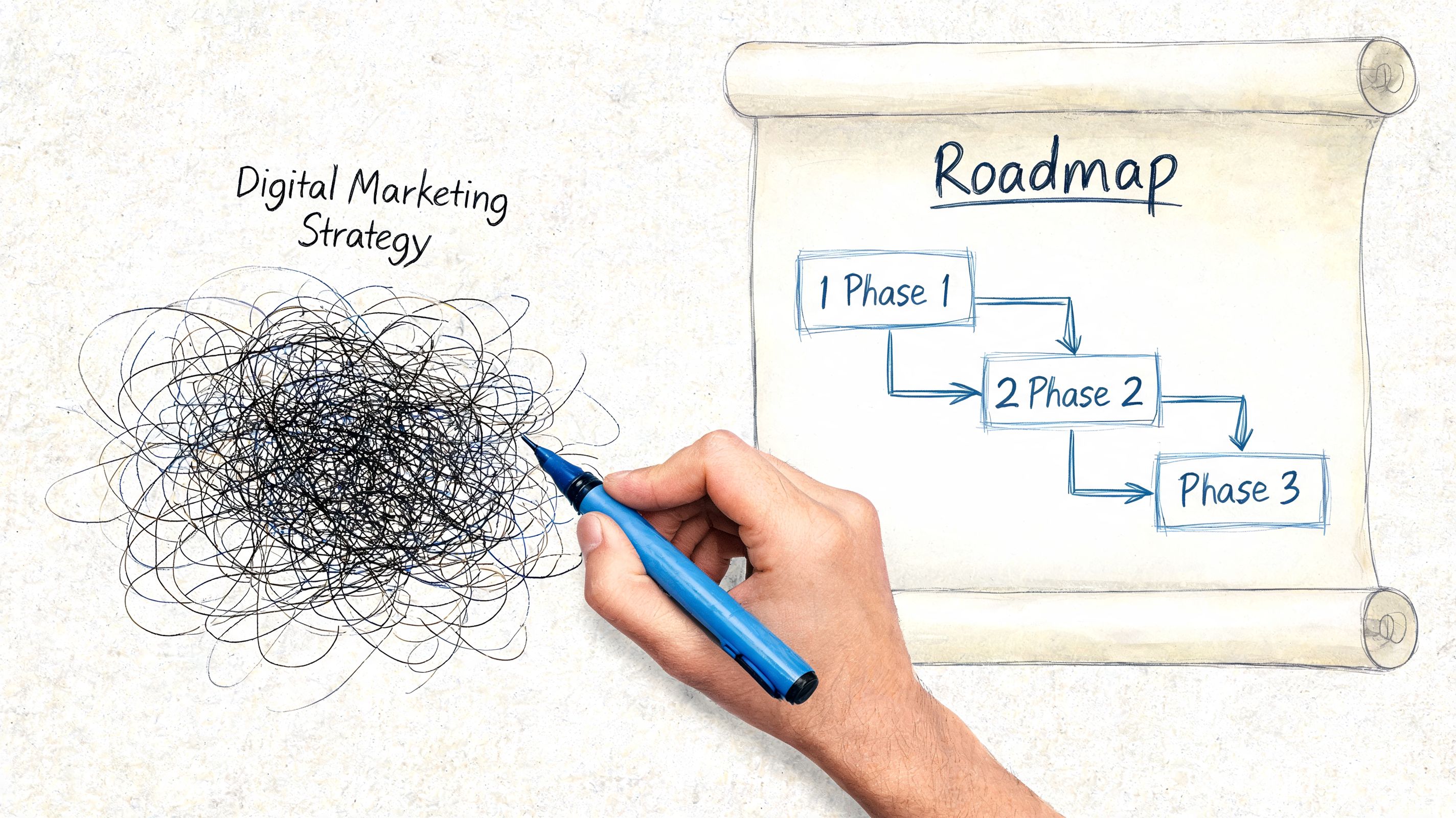
That's it. Strip away the buzzwords and you're left with a roadmap.
What strategy means in practice
For a local service business in Omaha, strategy might mean showing up when someone nearby searches for help, getting that person to call, and following up well enough to win the job.
For an e-commerce brand, it might mean improving product page traffic from search, capturing email subscribers, and increasing repeat purchases through segmented campaigns.
For a publisher or content-heavy site, it usually means building search visibility around topics that attract qualified readers, then converting that traffic into subscribers, leads, or ad revenue.
Those are very different businesses. But the structure is the same. You assess the current position, define the target, and pick channels that support the target.
Practical rule: If a tactic can't be tied back to revenue, lead quality, retention, or pipeline, it belongs lower on the priority list.
What doesn't work
Resource-constrained SMBs usually lose money in one of four ways:
- Copying bigger brands: National brands can afford broad awareness plays. Most local businesses can't.
- Doing every channel halfway: An abandoned Facebook page, sporadic email sends, and one blog post a quarter won't build momentum.
- Confusing activity with progress: More posts doesn't automatically mean more customers.
- Changing direction too early: Good channels often look slow before they compound.
One of the clearest dividing lines between disciplined teams and reactive ones is planning. Marketers who plan their digital campaigns strategically are 356% more likely to report success, and 72% of total marketing budgets are now allocated to digital channels, according to these digital marketing planning statistics.
The right way to start
Before touching tactics, gather what you already know:
- Your sales data: Which services or products produce the best customers?
- Your website data: Which pages already attract traffic or inquiries?
- Your customer conversations: What do people ask before they buy?
- Your competitive reality: Who owns visibility in Omaha for the terms that matter?
If you want to know how to create a digital marketing strategy that holds up in the actual world, start there. Not with trends. Not with a channel list. Start with the business.
Laying Your Foundation with Goals and Audience Insights
The fastest way to waste a marketing budget is to set a vague goal like "get more traffic." Traffic by itself doesn't pay salaries. Qualified traffic can.
A strong strategy starts with a business outcome and works backward. More booked calls. Better leads. Higher repeat purchase volume. Shorter sales cycles. Those are goals a team can build around.
Turn business goals into marketing goals
SMART goals still work because they force discipline.
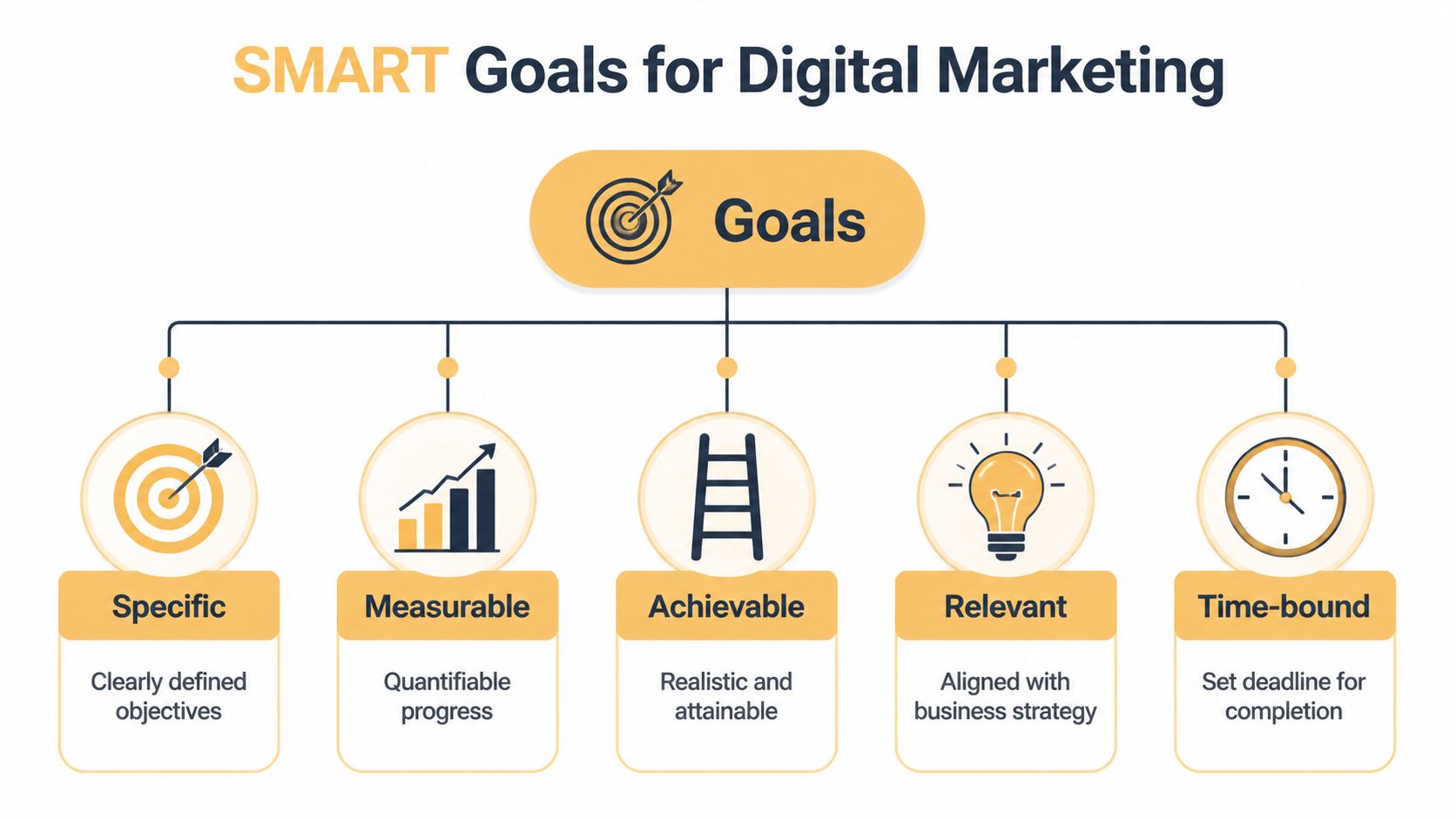
A weak goal sounds like this: "Improve our online presence."
A useful goal sounds like this: increase qualified leads from organic and local search over the next six months, or increase repeat purchases through email from existing customers within the next quarter.
The point isn't perfect wording. The point is making the goal specific enough that someone can measure progress every month and know whether the work is paying off.
A practical way to frame goals is:
- Revenue goal: What business result are you chasing?
- Marketing goal: What must marketing influence to support it?
- Channel goal: What does each channel need to deliver?
For example, an Omaha HVAC company may care less about raw traffic and more about service requests from homeowners in specific neighborhoods. That changes the plan immediately. Their strategy should favor local landing pages, Google Business Profile activity, reviews, and mobile-first conversion paths over broad social posting.
Build audience insights from real signals
Most SMB buyer personas are too generic to help. "Busy mom." "Small business owner." "Health-conscious shopper." That's not enough to shape channel choices or messaging.
Use first-party data instead:
- Google Analytics and Search Console: Look at landing pages, device mix, search queries, and location patterns.
- CRM or sales notes: Pull objections, common questions, and language customers use.
- Customer surveys: Ask why they chose you, what nearly stopped them, and what alternatives they considered.
- Review platforms and social comments: These often reveal the buying triggers your website ignores.
If you need a structure for documenting what you find, this guide on how to create buyer personas is a practical next step.
Here's a simple audience filter that works better than most persona templates:
| Audience factor | What to identify | Why it matters |
|---|---|---|
| Problem | What urgent issue are they trying to solve | Drives search intent and ad copy |
| Context | Where they are located, what device they use, when they need help | Shapes local SEO, mobile UX, and timing |
| Buying criteria | Whether they care most about speed, trust, price, or expertise | Changes your positioning |
| Friction | What makes them hesitate | Informs landing pages and follow-up |
A short explainer can also help align your team on the SMART framework before you write anything into a plan:
The businesses that get traction usually aren't guessing about their audience. They're listening closely enough to hear patterns their competitors miss.
When the audience work is done well, channel decisions get easier. You stop asking, "Should we be on every platform?" and start asking, "Where does this buyer show intent?"
Choosing Your Marketing Channels the Smart Way
Channel selection is where a lot of strategies fall apart. Businesses keep adding platforms because they don't want to miss opportunities. In practice, that spreads the team thin and weakens execution everywhere.
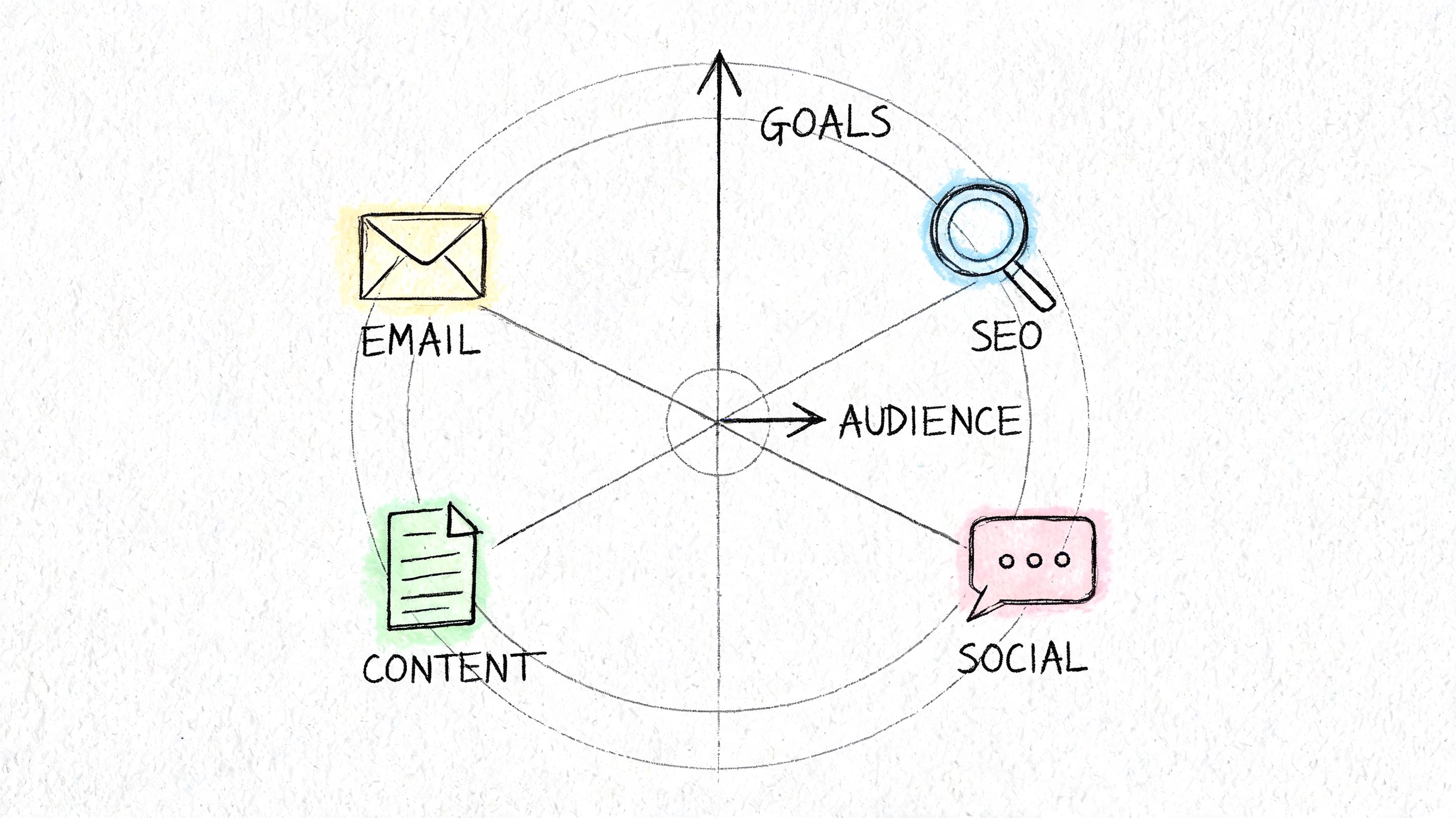
The better approach is to build a channel mix around job roles. One channel captures demand. One nurtures it. One can accelerate it when needed.
Start with SEO
For most Omaha SMBs, SEO should be the foundation. It's the closest thing digital marketing has to durable visibility. SEO is the primary driver for 93% of all web traffic, 46% of Google searches have local intent, and more than 90% of clicks go to the first page, according to these SEO and local search benchmarks.
That matters because local businesses don't need broad awareness across the country. They need to be visible when buyers nearby are actively looking.
If you're a roofer, dentist, law firm, med spa, contractor, or specialty retailer, local search is often the highest-intent traffic you can earn. National chains often underinvest in neighborhood-level relevance. Local firms can win there with better service pages, cleaner location signals, stronger reviews, and better mobile usability.
What each channel is really for
Not every channel deserves equal weight. Here's the practical version.
| Channel | Best use | Main trade-off | Best fit |
|---|---|---|---|
| SEO | Long-term visibility and qualified inbound traffic | Takes time and consistency | Local services, publishers, e-commerce |
| Content marketing | Education, authority, search support | Requires subject matter depth | B2B, complex services, high-consideration offers |
| Email marketing | Nurture, retention, repeat sales | Needs a list and steady follow-up | E-commerce, service businesses, publishers |
| PPC | Immediate visibility and testing | Costs rise fast without discipline | New offers, local lead gen, branded defense |
| Social media | Trust, proof, community, remarketing support | Easy to overinvest without clear return | Visual brands, community-driven businesses |
Email is often underused
SMBs tend to overlook email because it feels old compared with newer platforms. That's a mistake.
Email marketing delivers $36 to $40 return for every $1 spent, with 10.1% conversion rates, according to these email marketing ROI benchmarks. That makes email one of the most efficient channels for businesses that already have traffic, leads, or customers but aren't following up well.
For a local business, email can handle seasonal reminders, quote follow-up, referral requests, and reactivation campaigns. For e-commerce, it should carry cart recovery, post-purchase flows, replenishment prompts, and segmented promotions.
If your website gets traffic but your inbox strategy is weak, you're probably paying to reacquire people who already showed interest.
Paid media has a role, but not as a substitute for strategy
Paid ads are useful when you need speed. They're also useful for testing offers and landing page messaging before you commit to a larger content or SEO push.
But PPC is rented attention. The meter runs the whole time. If the landing page is weak, the offer is unclear, or conversion tracking is broken, paid media just helps you waste money faster.
That doesn't mean avoid it. It means use it deliberately:
- Launch support: Good for new services, promotions, or seasonal pushes
- Gap filling: Helpful while SEO is still maturing
- Testing: Fast feedback on search terms, offers, and headlines
- Remarketing: Useful for bringing back non-buyers
A smart Omaha channel mix
For many local SMBs, a practical setup looks like this:
- Core engine: Local SEO and service-page content
- Retention layer: Email automation for leads and customers
- Acceleration layer: Paid search on highest-intent terms
- Trust layer: Social proof, review generation, and selective social posting
That's usually stronger than trying to publish daily on every platform. The point of learning how to create a digital marketing strategy isn't choosing more channels. It's choosing fewer with more conviction.
Budgeting Staffing and Building Your Calendar
At this stage, strategy becomes real. Good plans fail all the time because no one decides who owns the work, how often it gets done, or what gets funded first.
You don't need a massive budget. You need a clear order of operations.
Build the budget around priorities
Start with the channels most tied to intent and conversion. For local SMBs, that often means website improvements, local SEO, core service pages, email setup, and a small paid budget if immediate lead flow matters.
Don't spread money evenly across everything. Equal distribution feels fair, but it usually isn't effective. If search is your primary opportunity, fund that first. If repeat business is the margin lever, fund email and CRM follow-up first.
A useful budgeting rule is to split spending into two buckets:
- Core execution: The channels already tied to business goals
- Testing: A smaller pool for experiments, new offers, or new audiences
Keep the testing budget contained. Small businesses get in trouble when experiments slip into becoming recurring expenses.
Decide who should do the work
There are three common staffing models.
In-house works when you need daily proximity to the business, fast approvals, and someone who can coordinate across sales, service, and marketing. It struggles when one person is expected to be strategist, writer, designer, analyst, and ad operator all at once.
Freelancers or specialized contractors work well for discrete needs like copywriting, design, video editing, or paid media setup. The downside is coordination. Someone on your side still needs to manage the system.
Agency support makes sense when the work spans strategy, execution, analytics, and technical implementation. One option in Omaha is Up North Media, which offers SEO marketing, web app development, and AI consulting for businesses that need help connecting strategy to execution.
If you're trying to stretch budget without hiring full-time, many SMBs also look at distributed staffing options. For repeatable marketing tasks like design production, admin support, campaign coordination, or research, Hire LATAM talent can be a practical resource to explore.
Use AI where it saves labor, not where it replaces judgment
For SMBs, integrating AI into the planning process can reduce marketing costs by 30% to 50%, according to Adobe's write-up on AI in digital marketing strategy. That's useful when staffing is tight.
The best AI use cases are usually operational:
- Persona drafts: Summarize customer patterns from notes and survey responses
- Content support: Outline articles, repurpose copy, and suggest email variants
- Research cleanup: Cluster FAQs, organize competitors, and tag recurring objections
- Workflow speed: Draft briefs, campaign checklists, and reporting summaries
What AI shouldn't do is decide your market position for you. It can speed up thinking. It can't replace it.
A lean team gets more value from AI when they use it to shorten production time and analysis time, not when they ask it to invent strategy from scratch.
Build a 90-day calendar you can actually keep
Most SMB content calendars are too ambitious. They look good in a planning meeting and collapse by week three.
A workable calendar fits your capacity. If your team can only publish two meaningful pieces a month and send one strong email every two weeks, build around that.
Use a spreadsheet, Notion, Airtable, or Asana. The tool matters less than the consistency. For structure, this guide on how to create a content calendar is a useful reference.
At minimum, your calendar should include:
| Item | What to include |
|---|---|
| Content piece | Topic, keyword or audience intent, owner, due date |
| Email send | Audience segment, purpose, offer, send date |
| Campaign | Channel, target page, CTA, launch date |
| Review point | What metric will decide whether to continue, revise, or stop |
If the plan can't survive your actual workload, it isn't strategic. It's aspirational.
Measuring What Matters and Optimizing with AI
Once campaigns are live, most businesses either overmeasure or undermeasure. They drown in dashboards, or they look at almost nothing.
The better approach is tighter. Track a small number of metrics that tie directly to the goal. Ignore vanity metrics unless they clearly support a conversion path.
Match KPIs to the business goal
If your goal is lead generation, impressions alone won't tell you much. If your goal is retention, raw traffic won't either.
Use this as a starting point:
| Business Goal | Recommended Channel | Primary KPI to Track |
|---|---|---|
| Generate qualified local leads | SEO and local search | Qualified form submissions or calls |
| Increase repeat purchases | Email marketing | Repeat purchase rate |
| Validate a new offer quickly | PPC | Landing page conversion rate |
| Grow awareness in a niche market | Content marketing | Engaged organic visits |
| Improve social engagement quality | Social media | Clicks to site or inquiry actions |
The key is choosing KPIs that someone can act on. If a number goes up or down and no decision changes, it probably doesn't belong on the main report.
For a deeper framework, this guide on measuring digital marketing performance lays out practical reporting categories without overcomplicating them.
What to review every month
A monthly review doesn't need to be fancy. It needs to be honest.
Focus on these questions:
- Traffic quality: Did the right people arrive?
- Conversion efficiency: Did they take the action we wanted?
- Channel contribution: Which sources influenced outcomes, not just visits?
- Page performance: Which pages pull their weight and which don't?
- Follow-up quality: Are leads and customers getting timely next steps?
If you use GA4, define conversions around business actions, not pageviews. For local businesses, that usually means call clicks, form submissions, booked appointments, quote requests, or store-direction actions. For e-commerce, it means revenue events, product performance, and repeat order behavior.
Why data discipline matters
A data-driven strategy is no longer optional. 84% of marketers now use AI, up from 29% in 2018, and teams that track effectively report 89% SEO success, according to these analytics and AI adoption benchmarks.
That doesn't mean every business needs complex attribution modeling on day one. It means you need enough tracking to avoid common mistakes:
- Last-click bias: Giving all credit to the final touchpoint
- Channel favoritism: Keeping a tactic because you like it, not because it performs
- Weak definitions: Calling every inquiry a lead even when most never close
- Reporting lag: Looking so infrequently that problems stay hidden too long
The goal of measurement isn't to prove marketing is busy. It's to show which actions deserve more investment and which ones need to stop.
Use AI to improve decisions, not just outputs
In this context, AI becomes useful beyond copy generation.
AI can help summarize patterns across campaigns, spot shifts in conversion behavior, cluster search terms, identify drop-off pages, and surface anomalies in performance data faster than a manual review. That's especially helpful for SMBs that don't have a full-time analyst.
It also helps with testing. You can use it to generate headline variants, email subject lines, ad copy angles, and content briefs, then let actual performance decide which direction survives.
For teams trying to tighten their social reporting, a practical companion resource is this article on using social media analytics for growth, especially if social is part of your support layer rather than your main acquisition engine.
A solid optimization rhythm looks like this:
- Review one month of performance
- Identify one bottleneck
- Form one test
- Launch the change
- Measure the result
- Keep, revise, or remove
That cycle is how strategy stays alive. Without it, the plan turns into a document no one trusts.
Your Digital Marketing Strategy FAQ
How often should a digital marketing strategy be updated
Review the strategy monthly at the KPI level and in more detail every quarter. Monthly reviews catch execution issues. Quarterly reviews are where you decide whether the channel mix, budget split, offer positioning, or audience assumptions still hold up.
A strategy shouldn't be rewritten every few weeks. But it also can't sit untouched while the market, your team, and your sales data change.
What's the biggest mistake small businesses make
Setting channel goals before setting business goals.
If the first conversation is "we need to post more on Instagram" or "we should try Google Ads," the planning is already backward. Start with the business outcome, then choose the channel based on fit.
The second-biggest mistake is chasing vanity metrics. More traffic, more followers, and more impressions can all look encouraging while lead quality stays flat.
Can you build a strategy with little or no ad spend
Yes. Many SMBs can start with organic search, local SEO, email follow-up, on-site conversion improvements, and better content around high-intent customer questions.
That said, "no ad spend" doesn't mean "no investment." Someone still has to write, optimize, publish, track, and follow up. Time is a budget.
If cash is tight, put effort where intent is highest and the shelf life is longer. For many local companies, that means improving pages that rank, tightening Google Business Profile activity, and building email sequences for existing leads before buying more traffic.
How should an Omaha business strategy differ from a national brand strategy
It should be narrower and more local.
For SMBs in local-dominant markets, generic strategy templates often miss the mark. 78% of SMBs struggle with measurable ROI, while hyper-local SEO can lift regional traffic by 25% to 35%, and voice search drove 55% of local queries last year, according to these local strategy observations.
In practice, that means:
- Own neighborhood intent: Build pages and listings around the locations you serve
- Use local proof: Reviews, testimonials, local references, and relevant service detail matter
- Write for real questions: Especially the kind people ask by phone or through voice search
- Stay close to revenue: Local businesses usually need booked work, not broad awareness
How many channels should a small business focus on
Fewer than most think.
Two or three channels executed well usually beat six done inconsistently. For many Omaha SMBs, the most reliable mix is a strong website, search visibility, and a follow-up channel like email. Paid media can be layered in when the fundamentals are working.
How long before a strategy starts working
Some channels show signals quickly. Others take patience.
Paid campaigns can generate feedback fast. SEO, content, and local authority take longer but often produce more durable returns. The right expectation isn't instant results. It's measurable learning followed by compounding gains.
If your team needs a clearer plan, sharper measurement, or help turning scattered marketing activity into a focused growth system, Up North Media works with Omaha businesses on SEO, AI consulting, and digital strategy execution built around measurable outcomes.