

Most advice on keyword research is stuck in an older version of search. It tells you to find a term with decent volume, sprinkle close variants into headings, and hope Google connects the dots. That approach breaks down fast when the results page is rewarding pages that solve a topic, not pages that repeat a phrase.
The better question isn't “Which keyword should we target?” It's “What does a searcher need, and what related ideas must a credible page cover to satisfy that need?” That's where semantic keyword research becomes useful. It gives you a way to move from isolated terms to entities, subtopics, intent, and the content structure that makes a page feel complete.
Beyond Keywords What Is Semantic Research Really
The simplest way to explain semantic research is this. Traditional keyword research acts like walking into a library and asking for one exact book title. Semantic research acts like describing the problem you're trying to solve and letting the librarian guide you to the right shelf, the right references, and the right supporting material.
That shift didn't happen by accident. Semantic keyword research became foundational after Google's 2013 Hummingbird update, which prioritized the meaning behind queries over simple keyword matching, pushing search toward context, entities, and relationships rather than literal density, as explained by DinoRANK's overview of semantic keywords and Hummingbird.
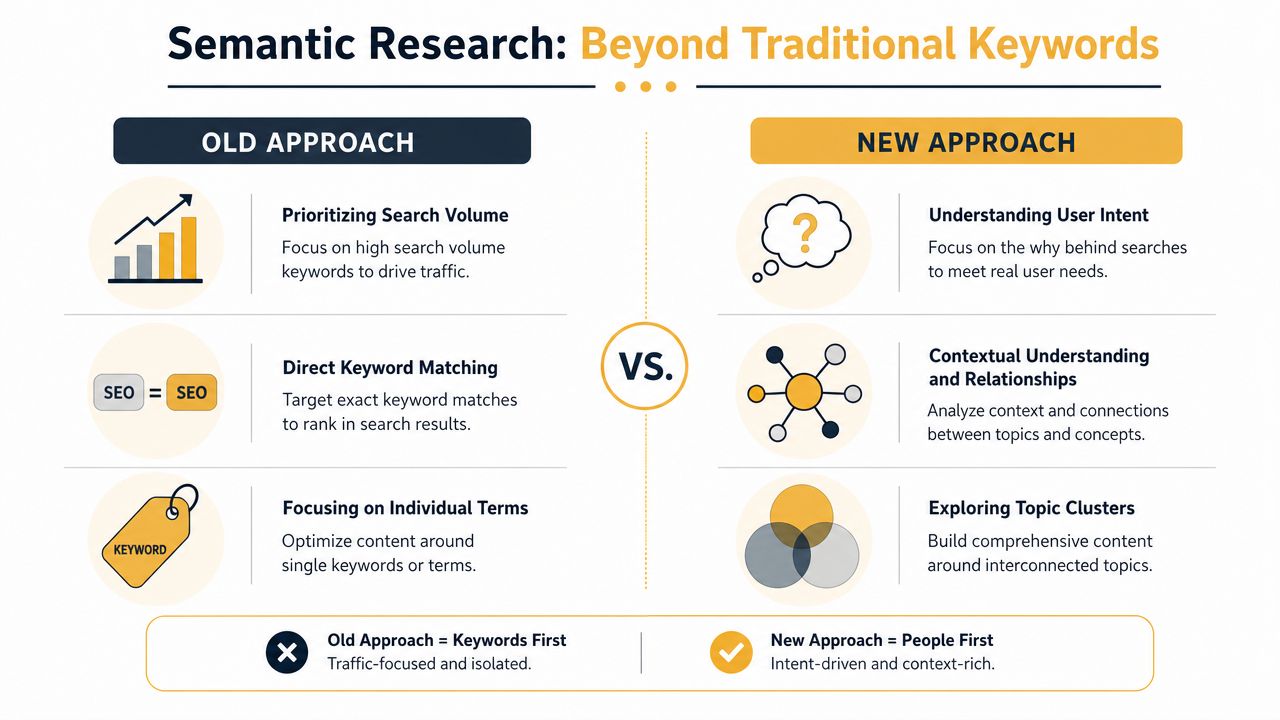
What changes when you accept that shift
Once you stop treating a keyword as the unit of SEO, your research process changes immediately.
- You stop chasing single phrases: One page rarely succeeds because it uses the exact term more often. It succeeds because it covers the topic in the way searchers expect.
- You look for relationships: Synonyms, related entities, product attributes, comparison angles, use cases, and common follow-up questions all become part of the target.
- You care more about fit than volume: A phrase can look attractive in a tool and still be a poor target if the intent doesn't match your offer or the expected content format.
For retailers, this is also where first-party understanding matters. If you want a practical way to think about audience signals beyond third-party SEO tools, Quikly's take on customer data insights for retailers is useful because it reinforces the same principle: your own audience signals often tell you more than generic platform estimates.
What semantic research is not
It's not a fancy word for “add synonyms.”
It's also not an excuse to generate giant keyword dumps from AI and call it strategy. Good semantic keyword research asks harder questions:
| Old question | Better question |
|---|---|
| What keyword has traffic? | What problem is the searcher trying to solve? |
| What term should go in the H1? | What entities and subtopics make this page complete? |
| How many times should we use the phrase? | What proof, examples, and structure will satisfy intent? |
Practical rule: If your research output is just a spreadsheet of phrases, you haven't finished the job. A useful semantic brief should tell a writer what the page must explain, compare, define, and prove.
That's why semantic keyword research works best as a mindset first, then a workflow. When teams treat it as a content planning discipline instead of a keyword expansion trick, the page quality goes up and the strategy gets more durable.
Your Semantic Research Workflow from Start to Finish
Teams often make semantic research harder than it needs to be. They jump between tools, export huge lists, and end up with noise. A cleaner workflow starts with a seed topic, studies the search results thoroughly, then builds clusters around what the results reveal about intent and coverage.
A strong process often starts with the top results themselves. Orbit Media describes a proven method: extract the top-10 ranked results for a seed topic, pull their related phrases and subtopics, and rank those semantic terms by how often they appear across those results. Their explanation is useful because it ties the process to how Google looks for pages that cover relevant subtopics, synonyms, jargon, and grammatical variants in a way that feels complete to the searcher, as shown in Orbit Media's methodology for ranking for multiple keywords.
Start with the SERP, not the tool export
Before opening a clustering tool, search your seed topic manually. The result page usually tells you four things quickly:
- Intent type: Are you seeing guides, product pages, category pages, comparison pages, or local results?
- Depth expectations: Do top pages answer the query briefly or go broad with detailed subtopics?
- Commercial pressure: Are the results informational with light conversion paths, or heavily transactional?
- Language patterns: What concepts keep repeating in titles, subheads, People Also Ask prompts, and related searches?
That SERP review prevents a common mistake. Teams often build clusters around tool suggestions that have lexical similarity but don't belong on the same page.
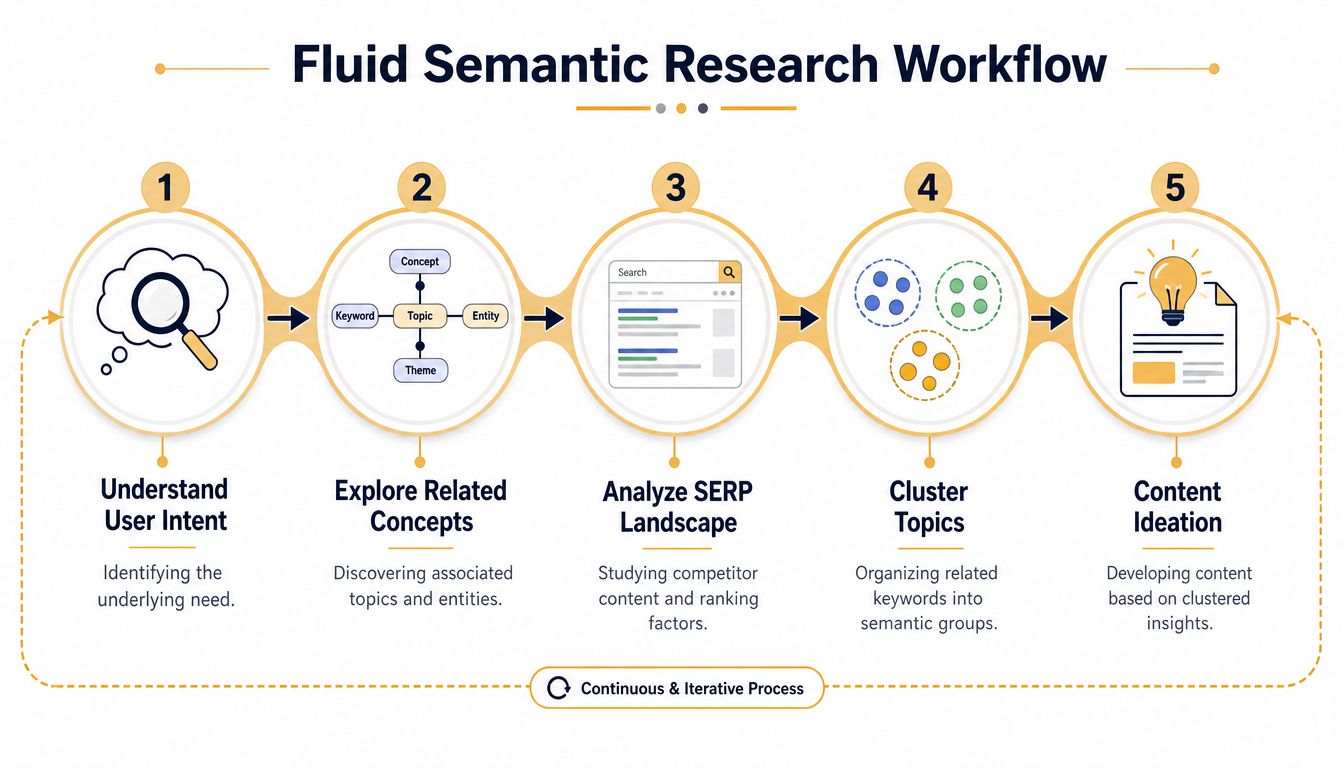
Expand from terms into entities and subtopics
After the SERP review, pull candidate phrases from several places: top-ranking pages, headings, FAQ sections, People Also Ask results, and related searches. Don't think of these as “keywords to insert.” Think of them as signals about what a searcher expects to encounter on the page.
Useful outputs at this phase usually include:
- Core entities: brands, products, materials, features, locations, audience types
- Modifiers: best, affordable, local, beginner, enterprise, same-day, comparison
- Decision angles: cost, pros and cons, setup, alternatives, examples, reviews
- Support topics: definitions, process explanations, troubleshooting, use cases
A page targeting “email automation for retailers,” for example, may need more than phrase variants. It may need entities such as segmentation, triggered campaigns, first-party data, abandoned cart flows, SMS coordination, and reporting expectations.
To see the process in motion, this walkthrough is worth watching:
Cluster by intent before you cluster by wording
Experienced teams distinguish themselves by understanding this concept. A good cluster isn't just a bucket of similar phrases. It's a set of queries that can be answered by the same page without forcing mixed intent.
Use a simple lens:
| Cluster type | What belongs there | What usually doesn't |
|---|---|---|
| Informational | definitions, how-to queries, examples, frameworks | pricing or product-led terms |
| Commercial investigation | comparisons, alternatives, reviews, “best” queries | beginner education with no buying intent |
| Transactional | service, product, category, local conversion terms | broad educational questions |
Don't cluster phrases together just because a tool says they're close. Cluster them if the same page can satisfy them without confusing the searcher.
Turn clusters into content decisions
A semantic cluster should end with editorial direction, not just labels in a sheet. For each cluster, decide:
- Primary page type: guide, service page, category page, landing page, comparison page
- Required subtopics: the concepts that top results consistently cover
- Proof elements: examples, screenshots, process details, testimonials, FAQs
- Internal link targets: which supporting pages should reinforce the main topic
That last part matters. Research only becomes valuable when it tells you what to build, how deep to go, and where each topic belongs on the site.
The Modern Toolkit for Semantic Analysis
The best toolkit for semantic keyword research isn't a single platform. It's a stack with distinct jobs. One tool helps you discover opportunities, another helps you read the SERP, another helps you validate with first-party data, and AI helps you speed up synthesis.
Teams get into trouble when they expect Ahrefs or Semrush to do all of it. That shortcut usually produces clusters that look tidy in a spreadsheet but drift away from what users search.

Use each tool for a specific job
Here's a practical way to split the work.
- Discovery tools: Ahrefs, Semrush, and Google Keyword Planner are useful for gathering seed terms, variants, and competitor topic ideas.
- SERP inspection: The search results page itself, plus browser-based review of headings and page structure, helps you understand expected content format.
- First-party validation: Google Search Console is critical because it shows the queries your site already earns impressions and clicks for. Marketing Illumination notes that over-reliance on a single tool like Semrush or Ahrefs without Google Search Console leads to mismatched intent and lower conversion quality, and calls Search Console the most underused source because it reveals what audiences search for in practice, as discussed in their guide to advanced keyword research pitfalls.
- Content intelligence: Tools like Clearscope or Surfer can help compare topic coverage, though they should support judgment, not replace it.
- NLP workflows: If your team wants to do more custom analysis, this guide on using Python for NLP and semantic SEO is a strong next step.
AI prompts that actually help
Generic prompts produce generic clusters. You'll get better output when the prompt forces structure and constraints.
Try prompts like these:
Review the following list of queries and group them by search intent, not by word similarity. For each group, label the likely page type, the main user need, the supporting subtopics required, and any queries that should be separated because they imply a different funnel stage.
Analyze these competitor headings for the topic below. Extract recurring entities, decision factors, and missing subtopics. Return the result as a content brief with sections, FAQs, and internal linking suggestions.
Compare these Search Console queries with this third-party keyword list. Identify overlaps, gaps, and terms that appear tool-generated but unsupported by first-party demand.
What AI should and shouldn't do
AI is excellent at organizing raw language, spotting recurring patterns, and turning messy exports into working drafts. It's weak at judging whether a cluster deserves its own page, whether the commercial intent is real, or whether a local business can credibly compete in that SERP.
Use AI to accelerate synthesis. Don't use it as your final authority.
A simple rule keeps the output clean:
- Let AI extract patterns
- Let human review decide page intent
- Let Search Console settle disputes
That sequence is usually the difference between a strategy that looks advanced and one that truly maps to buyer behavior.
How to Validate Your Findings and Avoid Common Traps
Most semantic keyword research fails at the validation stage. The clusters look reasonable. The deck sounds smart. Then the content underperforms because no one checked whether those entities, modifiers, and subtopics match how real users move through search.
That's the step many guides skip. Wix points out that most content doesn't show how to validate semantic clusters with first-party user data instead of relying only on third-party suggestions, even though semantic research depends on real-world user behavior and search query sequences rather than simple metric prioritization, as covered in Wix's guide to combining semantic and traditional keyword research.
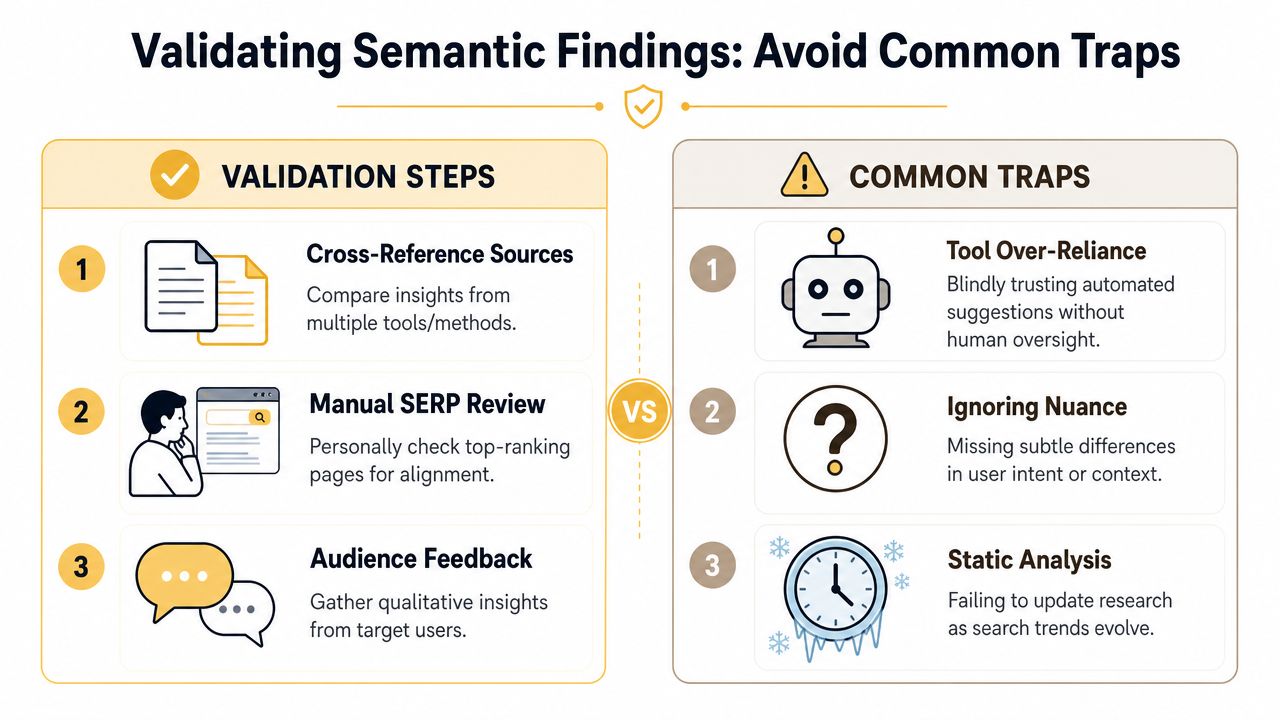
A practical validation framework
If you want clusters you can trust, pressure-test them against your own data.
Start in Google Search Console. Look for pages that already get impressions around the topic. Then examine the query mix. If a page about one subject is already attracting adjacent queries, that's often a strong signal that the cluster reflects actual search behavior.
Then move into GA4 or your analytics stack and ask a different question. Do users who land on these pages engage the way you'd expect for that intent? A page that attracts informational searches but has poor downstream behavior may have a content-quality problem, or it may be targeting the wrong cluster entirely.
A useful validation routine looks like this:
- Check query overlap: Compare your proposed cluster against Search Console queries already tied to relevant pages.
- Review landing-page behavior: Look at engagement patterns to see whether the traffic aligns with the page's intended role.
- Inspect assisted paths: For commercial topics, see whether these pages contribute to later conversion activity, not just clicks.
- Manually review the SERP again: If your cluster says “one page,” but the SERP splits the topic into different page types, trust the SERP.
Common traps that waste time
The first trap is keyword cannibalization. Teams create multiple pages around closely related phrases because the tool output makes them look distinct. In reality, Google often wants one stronger page with clearer scope.
The second is tool loyalty. If all your decisions come from one platform, you'll inherit that platform's blind spots.
The third is difficulty obsession. A phrase can look “easier” while still being strategically weak if it doesn't fit a meaningful topic or buyer journey.
Validation rule: A cluster is only real if your first-party data, the SERP, and the intended page type all agree.
When to split and when to merge
Use this quick decision guide:
| Situation | Better move |
|---|---|
| Same audience, same intent, same expected content type | Merge into one page |
| Similar wording, but different funnel stage | Split |
| Same product family, distinct use case or buyer concern | Usually split with internal links |
| One page ranks for many adjacent queries naturally | Expand that page before creating a new one |
That discipline keeps your site from bloating with thin pages and helps each asset carry a clearer semantic role.
Putting Semantic Research into Action on Your Website
Research matters only when it changes what goes live. The most practical implementation model for semantic keyword research is a pillar and cluster structure. One strong pillar page covers the broad topic, and supporting pages handle narrower intents, specific use cases, or comparison angles.
This approach fits how modern search behaves. Ahrefs explains that search engines use query expansion to broaden searches with synonyms and related terms, which means content has to align with meaning rather than exact-match wording, and also match the expected content format and platform for the query, as described in Ahrefs' overview of semantic search.
Build one topic map, not a pile of pages
Take a local service business as an example. If the broad topic is “commercial roofing repair,” the pillar page might cover the service, process, common problems, service area expectations, and when to repair versus replace. Supporting cluster pages could focus on emergency repair, flat roof leak diagnosis, insurance considerations, maintenance planning, or material-specific issues.
That structure helps in three ways:
- Content clarity: Each page has a distinct job.
- Internal linking: Supporting pages reinforce the main topic and send clear contextual signals.
- Navigation logic: Users can move from education to evaluation without hitting dead ends.
If you want a deeper framework for planning these relationships, this guide to topic cluster strategy is a practical companion.
Match the page to the intent
One of the easiest ways to waste a semantic cluster is to publish it in the wrong format.
A few examples:
- Informational cluster: publish a guide, glossary, or how-to page
- Commercial investigation cluster: publish a comparison page, buyer's guide, or service explainer
- Transactional cluster: publish a category page, location page, or conversion-focused service page
This sounds obvious, but many sites still target comparison-style queries with generic service pages or try to rank category pages for educational searches. The page can be well written and still miss because the format is wrong.
A semantic strategy isn't complete until every cluster has a page type, an internal link role, and a conversion expectation.
Measure success by topic performance
Single-keyword rank tracking has limited value here. What matters more is whether the topic cluster gains visibility, attracts the right audience, and supports business goals.
Watch for:
- Broader query coverage: Are pages earning impressions for adjacent terms you intended to capture?
- Engagement quality: Do users continue into the site, read supporting pages, or take the next step?
- Content gaps: Are there recurring queries in Search Console that still lack a proper destination page?
If you're applying this to social and editorial distribution as well, XBurst has a useful perspective on how to grow your X audience with data. The reason it matters here is simple. Topic strategy works best when the same audience insights shape search content, supporting posts, and distribution choices together.
The Future of Search Is Semantic
The long-term shift in SEO isn't from one tool to another. It's from keyword targeting to topic understanding. Businesses that keep treating SEO as a phrase-matching exercise will keep publishing pages that feel thin, interchangeable, and easy to outrank.
Semantic keyword research is more durable because it mirrors how people search. They don't think in isolated keywords. They think in problems, comparisons, constraints, and next steps. The sites that win are the ones that answer those needs clearly, in the right format, with the right supporting context.
That matters even more as search keeps moving toward answer-focused experiences. If you haven't explored that shift yet, this piece on answer engine optimization is worth reading because it connects semantic coverage to the way search systems increasingly surface direct answers, summaries, and entity-driven results.
The practical takeaway is straightforward. Build fewer pages with stronger topical coverage. Validate clusters with first-party data before you publish. Use AI to speed up synthesis, not to replace judgment. Organize your site so related pages reinforce each other instead of competing.
Businesses that do that build an SEO asset that compounds. Not because they found a loophole, but because they got closer to how search and customer behavior already work.
If you want help turning semantic keyword research into a working content architecture, Up North Media helps businesses plan, validate, and implement data-driven SEO strategies that align with real search behavior, stronger site structure, and measurable growth.