
Answer engine optimization is the practice of structuring your content so search engines, AI chatbots, and voice assistants can use it as the direct answer. That matters now because 13.1% of all U.S. desktop queries triggered Google AI Overviews as of March 2025, up from 6.5%, and brands cited in those answers earned 35% more organic clicks and 91% more paid clicks than competitors that weren't cited.
If your marketing playbook still treats success as “rank the page and hope for the click,” there's a gap in the strategy. Search is shifting from a list of blue links toward answer boxes, AI summaries, chatbot responses, and spoken replies from voice assistants.
Traditional SEO tries to win the shelf space. Answer Engine Optimization (AEO) tries to become the recommendation handed to the customer. For a business owner in Omaha, that's the difference between being listed in the directory and being the company the customer hears first when they ask, “Who can help me with this?”
That doesn't make SEO obsolete. It changes the finish line. You still need useful pages, technical health, and authority. But now your content also needs to be easy for AI systems to extract, trust, and cite.
Beyond Blue Links An Introduction to AEO
The old search model was simple. Someone typed a query, scanned ten blue links, and chose one. That model still exists, but it's no longer the only game on the field.
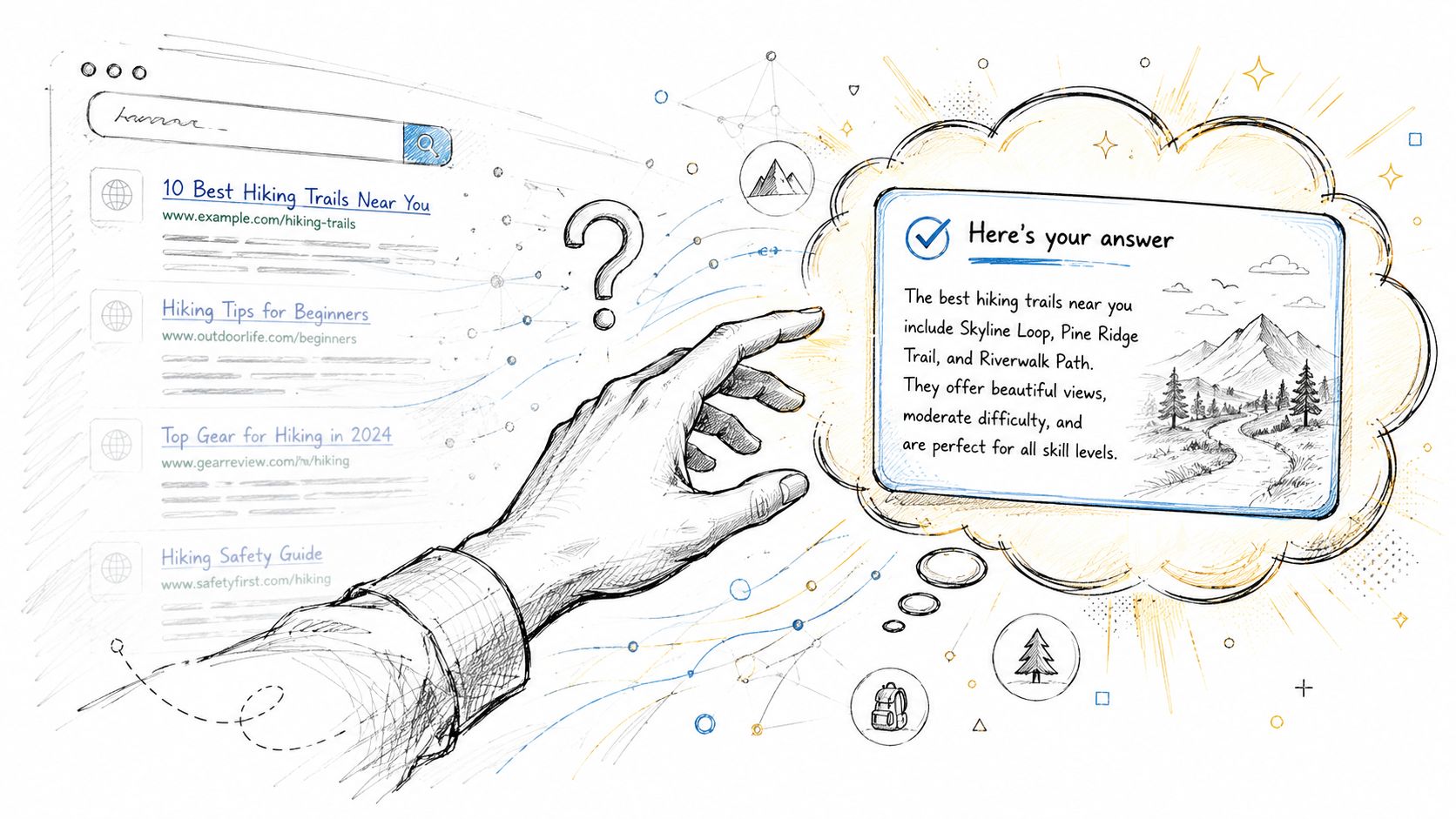
AEO is the discipline of optimizing content to become the answer itself, not just one option in a list. Google AI Overviews, ChatGPT, Gemini, Copilot, Siri, and Alexa all reward content that answers a question clearly, quickly, and in a format machines can interpret without guesswork.
Why this matters to revenue
This isn't a theoretical shift. As of March 2025, 13.1% of all U.S. desktop queries now trigger Google's AI-generated overviews, up from 6.5% in the prior measurement period. Brands cited inside those AI answers have been documented to earn 35% more organic clicks and 91% more paid clicks than non-cited competitors (Content Marketing Institute).
That tells you two important things.
- AI answers are already common: A meaningful share of searchers now sees a direct response before they ever consider clicking a website.
- Citation has business value: When a brand is included in the answer, visibility improves across both organic and paid channels.
A lot of business owners still ask whether they should focus on SEO or AI search. That's the wrong question. The more useful question is whether your content is written in a way that gives modern search systems confidence to quote you.
Practical rule: If your page makes a human work hard to find the answer, an AI system usually won't do that work for them.
AEO is an evolution of SEO, not a replacement
The strongest AEO programs usually start with solid SEO fundamentals. Crawlable pages, clear topic targeting, internal links, and useful content still matter. If you need a refresher on that foundation, this primer on what search engine optimization is is a good baseline before you layer on answer-first tactics.
Then the job changes. Instead of only asking, “Can this page rank?” you ask:
- Can an AI system extract a direct answer from the first few lines?
- Does the page clearly define what it's about?
- Would a voice assistant be comfortable reading this out loud?
- Would a buyer trust this answer without needing extra interpretation?
If you want another practical angle on implementation, this guide to strategies for winning AI search answers is useful because it approaches AEO as a visibility problem, not just a formatting exercise.
AEO vs SEO Understanding the Key Differences
A simple analogy helps here.
Traditional SEO is like getting your book listed in the library card catalog. You want your title filed correctly so people can find it.
AEO is like becoming the librarian who gives the answer directly. The user may never browse the shelves if the librarian already solved the problem.
That's the strategic shift.
The core difference in one sentence
SEO optimizes pages to rank. AEO optimizes passages, entities, and answers to get cited.
That distinction matters more because Gartner predicts traditional search volume will drop 25% by 2026 as AI answer engines grow in adoption and capability (Try Profound). If fewer searches end with a click through a standard results page, businesses can't measure success only by rankings.
AEO vs. Traditional SEO at a Glance
| Aspect | Traditional SEO | Answer Engine Optimization (AEO) |
|---|---|---|
| Primary goal | Rank pages in search results | Get cited in direct answers |
| Main unit of optimization | Whole page | Specific answer block or section |
| Content style | Often comprehensive and keyword-led | Answer-first and question-led |
| Query focus | Keywords and topics | Natural language questions and intent |
| Technical support | Crawlability, metadata, site structure | Structured data, extractable formatting, entity clarity |
| Success metric | Rankings, traffic, click-through | Citations, answer presence, AI visibility |
What works differently in practice
A page built only for traditional SEO often opens with a long introduction, broad context, and a slow lead-in. That can work for ranking. It often fails for AEO because the answer is buried.
A page built for AEO usually does a few things differently:
- Leads with the answer: The section starts by resolving the question.
- Uses plain language: It sounds closer to how customers speak.
- Breaks ideas into chunks: Short paragraphs and lists are easier to extract.
- Signals meaning clearly: Headings, schema, dates, and bylines help machines interpret trust and context.
SEO says, “Visit my page.” AEO says, “Use my explanation.”
For teams trying to adapt product pages, service pages, and editorial content, Shoptank's guide on how to appear in AI search results is a useful complement because it translates the shift into page-level changes you can make.
The trade-off most teams miss
AEO usually rewards clarity over cleverness. That's a trade-off some brands resist.
A punchy headline, a dramatic intro, or a highly stylized page can still help human engagement. But if the content hides definitions, avoids direct statements, or mixes multiple ideas into one section, answer engines have less to work with. You don't need bland content. You need content with a clear spine.
How Modern Answer Engines Actually Find Answers
Why does one business get quoted by AI tools while a competitor with similar services gets ignored?
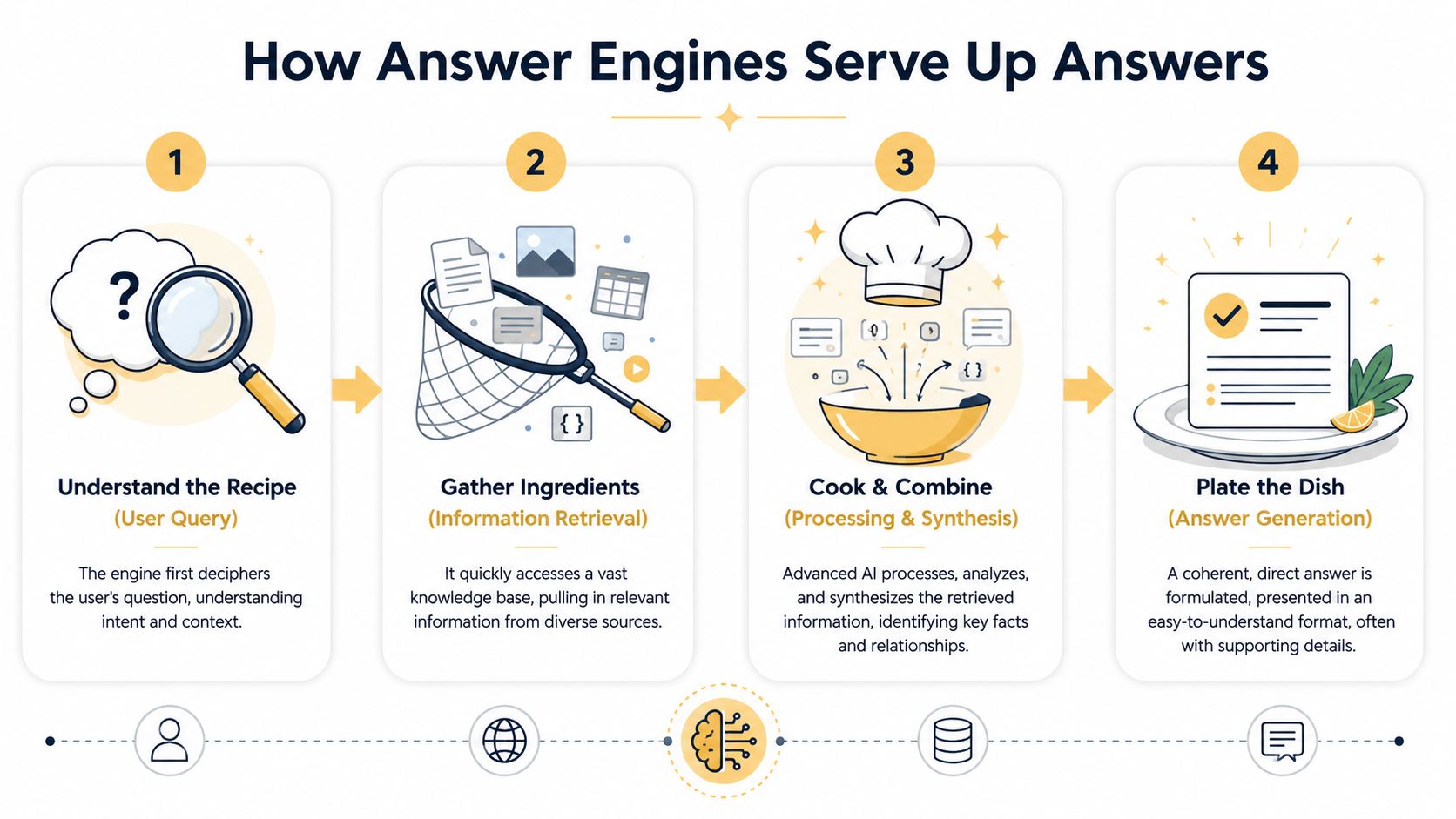
The answer usually comes down to how easy your content is to interpret, trust, and reuse. Modern answer engines work more like research assistants than traditional search indexes. They break a question into intent, pull passages that appear to answer it directly, compare those passages across sources, and assemble a response that sounds coherent to the user.
They retrieve, interpret, and compress
A business owner in Omaha might ask, “Who installs commercial security cameras near me?” An answer engine does not scan the web like a person reading ten tabs. It tries to identify the type of request first. Is this local? Is the user comparing vendors? Do they want a definition, a shortlist, or a direct recommendation?
Then the system looks for passages it can lift with minimal cleanup. That is why a page with a clear service description, location details, pricing context, and a direct answer often beats a more polished page that buries the point under branding copy.
If you want the mechanics behind that language interpretation, this guide on what natural language processing is explains the part of the process that maps words, context, and intent.
What answer engines reward on the page
Answer engines look for usable blocks of information. Pages tend to perform better when they include:
- Question-matched headings that reflect how customers ask
- Standalone sections that answer one topic cleanly
- Direct definitions near the top instead of delayed intros
- Consistent naming for products, services, and categories
- Clear source information such as dates, bylines, and visible business details
Those signals reduce guesswork. If a model has to infer who wrote the content, what the page is about, or whether the business still operates in that market, it has less reason to reuse your wording.
I see this problem often on local service sites and mid-market e-commerce catalogs. The company knows its offer cold, but the page mixes sales copy, FAQs, brand story, and technical specs into one long block. A human can work through that. An answer engine usually prefers the competitor whose page is easier to quote.
If your content makes a good salesperson work hard to summarize it, an answer engine will have the same problem.
Why this matters for ROI
This is not just a visibility issue. It affects conversion quality.
When AI systems pull the right summary from your page, the customer arrives with better context. They already know what you do, who you serve, and why you may fit their needs. That often means fewer low-intent visits and more qualified calls, form fills, or product page sessions. For small-to-mid-sized businesses, that efficiency matters more than vanity traffic.
There is a trade-off. Highly stylized copy can help brand differentiation, and there is still room for it. But your core answers need to be plain enough for a machine to extract and accurate enough for a buyer to trust.
A practical way to test what engines can use
Run the same customer question through ChatGPT, Gemini, or Copilot. Then compare the answer to your page. If the tool cannot summarize your offer cleanly, your content probably needs sharper structure or clearer language.
That testing process gets better when your team knows how prompts shape outputs. If you want a hands-on resource for that, Prompt Builder's article on learn AI prompt engineering with Prompt Builder is worth reviewing because it helps marketers inspect how AI systems frame topics, compare sources, and summarize competitors.
The Four Pillars of an Effective AEO Strategy
What makes one page easy for an answer engine to cite while another gets ignored, even when both target the same topic? In practice, the difference usually comes down to four execution details. These are the pieces I focus on first when helping local service companies and e-commerce brands turn AI visibility into better leads, cleaner traffic, and stronger conversion paths.
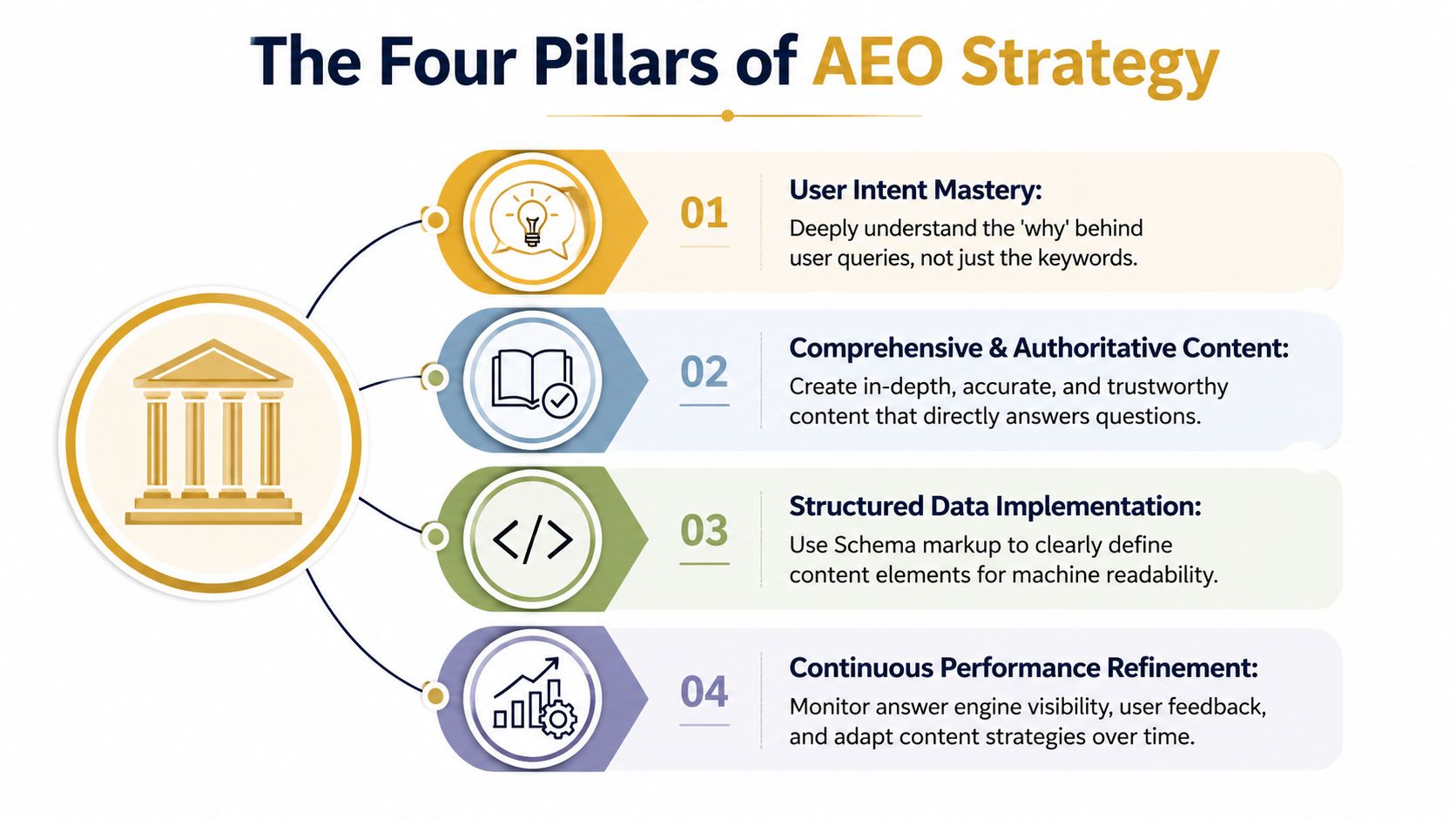
Pillar 1 Answer-first structure
Answer engines reward pages that get to the point quickly.
Meltwater notes that strong AEO pages place the core answer near the top, then support it with short paragraphs and scannable formatting like bullets and subheads (Meltwater). That structure improves extraction because the model does less work to identify the main point.
A weak opening sounds like this:
“Many businesses are trying to understand how digital marketing is changing and what that means for their strategy.”
A stronger opening sounds like this:
“Answer engine optimization is the practice of structuring content so AI systems can extract, summarize, and cite it in direct answers.”
That shift sounds small. It changes how the whole page performs.
For SMBs, this is often the fastest win because it does not require a full redesign. It requires tighter writing, clearer hierarchy, and fewer intro paragraphs that delay the answer. The trade-off is that brand storytelling needs more discipline. Keep the personality, but put it after the answer instead of before it.
Here's a useful walkthrough before you implement at scale:
Pillar 2 Technical clarity
Clear content helps humans. Clear markup helps machines.
Schema gives answer engines explicit context about what a page contains, especially for question-and-answer content, tutorials, and articles. For a business owner, the simplest comparison is a barcode on inventory. The product may be obvious to a person standing in the warehouse, but the barcode lets the system identify it quickly and correctly.
For small and mid-sized businesses, the practical use cases are straightforward:
- FAQPage: Best for service questions, policy questions, and support content
- HowTo: Best for step-by-step processes
- Article: Best for educational pages, guides, and thought leadership
Technical clarity also includes page titles, heading structure, author details, crawlability, and internal linking. If an answer engine has to guess what a page is about, citation odds drop. This is one place where user behavior matters too. Pages with clean structure and clear next steps usually create better engagement signals, and user behavior analytics for content performance can show where visitors get stuck before they convert.
Pillar 3 Entity authority
AEO also depends on whether the engine can confidently connect your brand to a topic.
That means your company name, service names, product categories, author bios, and supporting pages should all point in the same direction. A local HVAC company in Omaha should not call the same service "AC replacement," "cooling system upgrade," and "home comfort install" across key pages unless those terms are intentionally explained. Inconsistent naming creates ambiguity, and ambiguity lowers trust.
A practical baseline looks like this:
- Standardize service and product names across core pages
- Use real author or reviewer bylines where expertise matters
- Keep important pages updated when pricing, process, or scope changes
- Build topic clusters around the questions customers ask before they buy
The pages that earn citations most often are usually the clearest and the easiest to verify.
Pillar 4 Conversational relevance
Buyers ask longer, messier questions now. Your content has to match that behavior.
A page built only around short keywords can still rank in classic search, but it often misses the phrasing people use in ChatGPT, Gemini, Copilot, and AI Overviews. Good AEO pages mirror natural prompts and answer them in plain language.
Examples:
- “How much does a website redesign cost for a small business?”
- “What CRM works best for a local service company?”
- “How can I tell if SEO is producing leads?”
Write the heading the way the customer would ask it. Then answer the question directly in the first paragraph of that section.
What usually hurts performance:
- Long intros before the answer
- Dense text with no scannable structure
- Headings that sound clever but hide the topic
- Sections that mix definition, opinion, and process without clear separation
What usually improves performance:
- One clear question per section
- One direct answer near the top
- One logical next action, such as a call, form fill, or product page visit
This pillar matters for ROI because relevance affects lead quality, not just visibility. If your page answers the true buying question clearly, the visitor arrives with better context and a higher chance of converting. That is the point of AEO for SMBs. Better answers should produce better business outcomes.
Measuring AEO Success Beyond Keyword Rankings
How do you know AEO is working if your rankings look flat?
Use a scorecard tied to visibility, engagement, and revenue, not just SERP positions. A page can sit in the same organic spot and still start showing up in AI Overviews, Copilot answers, product comparisons, or cited responses inside chat tools. For a business owner in Omaha, that difference matters because buyers may get their shortlist before they ever click a blue link.
The KPI that matters most
The clearest top-line KPI is AI citation frequency. Track how often your brand, product page, service page, or article is referenced when people ask the questions that lead to a sale.
That metric is not perfect. Answer engines change often, and citation behavior is still inconsistent across platforms. But it gives SMBs a much better read on AEO progress than watching one keyword move up or down a few spots.
If I were reporting this to a local service company or an e-commerce brand, I would pair citation frequency with pipeline impact. Visibility is useful. Visibility that produces qualified calls, form fills, or assisted sales is what earns budget.
What to track in the real world
A practical AEO scorecard usually includes:
- AI citation frequency: How often your business or page appears in generated answers
- Prompt coverage: Which buying questions include your brand, and which are dominated by competitors
- Featured answer appearances: Whether your content shows up in AI Overviews, snippets, or other direct-answer placements
- Referral patterns: Traffic from AI tools, where tracking is available
- On-page trust signals: Clear authorship, review dates, source information, and contact details
- Conversion quality: Calls, leads, sales, and assisted conversions from answer-first pages
That last point is where many teams miss the plot. AEO is not a visibility project alone. It should improve business outcomes.
For example, if an Omaha HVAC company starts getting cited for “why is one room hotter than the rest of my house,” that is interesting. If the answer-first page also drives more estimate requests from homeowners with that exact problem, the value is easy to defend.
How to measure without overcomplicating it
Start with a fixed prompt set. Use the same questions in ChatGPT, Gemini, Copilot, and Google's AI-generated search features. Run them on a schedule, log the results, and look for patterns over time.
Record:
- Which brands appear
- Which URLs get referenced
- How your offer is described
- Which competitors own high-intent questions
- Whether the answer leads users toward a click, a call, or no action at all
Then compare that visibility data with on-site behavior. A page that earns more engaged sessions, stronger lead rates, or better assisted conversion value after an answer-first rewrite is usually doing two jobs well. It is easier for answer engines to use, and easier for buyers to act on.
If you already review on-site engagement, this guide to user behavior analytics for marketers is a practical next step for connecting answer visibility with real business outcomes.
One caution. Do not build a reporting system so complicated that nobody trusts it or uses it. For SMBs, a simple monthly scorecard is usually enough: prompt coverage, citations, assisted traffic, and conversions from the pages you optimized for answers.
Rankings show where a page appears. AEO metrics show whether your business gets included in the answer and whether that visibility turns into revenue.
AEO in Action Examples for Local and Online Businesses
AEO can sound abstract until you map it to real businesses. Here's how it plays out for three common models.
Local service business in Omaha
An Omaha plumbing company wants more high-intent leads. Traditional SEO would target service pages like “water heater repair Omaha” and “emergency plumber Omaha.”
AEO adds another layer. The company creates short, direct-answer content around questions customers ask before they call:
- How do I know if a pipe leak is urgent
- What should I do before the plumber arrives
- Why is my water pressure suddenly low
Each page opens with a direct answer, uses plain language, and includes a concise checklist. That gives AI systems something quotable and gives the customer immediate value. The business outcome is simple. More local visibility at the exact moment a homeowner needs help.
E-commerce retailer
Now take an online store selling running shoes.
Classic SEO focuses on category pages, product filters, and keyword-rich buying guides. AEO improves the odds of appearing in AI-generated comparisons by creating answer-first sections for questions such as:
- Best running shoes for flat feet
- What's the difference between stability and neutral running shoes
- How should running shoes fit for long-distance training
The key is not writing generic “ultimate guides.” It's structuring product and editorial content so each section can stand alone. A concise answer, a short explanation, then a bulleted list of considerations. That format works better for AI extraction and also helps shoppers make decisions faster.
Publisher or niche content brand
A food blog or recipe publisher has another opportunity. Recipe pages already lend themselves to structured answers because they involve steps, ingredients, timing, and common troubleshooting questions.
AEO improves performance when the publisher:
- Uses question-based headings like “Can you substitute butter for oil in banana bread”
- Structures the answer near the top of the section
- Applies HowTo and Article schema where appropriate
- Keeps author information and update dates clear
That makes the content more usable for voice assistants and answer engines that need a direct response, not a long preamble.
The common thread
These businesses are different, but the operating principle is the same.
They don't just publish information. They package expertise in a form that machines can quote and customers can trust. That's where measurable growth comes from. Not because AEO is a gimmick, but because it reduces friction between the question and the answer.
Your AEO Implementation Checklist
Most businesses don't need a massive AEO overhaul on day one. They need a disciplined first pass on the pages that already matter.
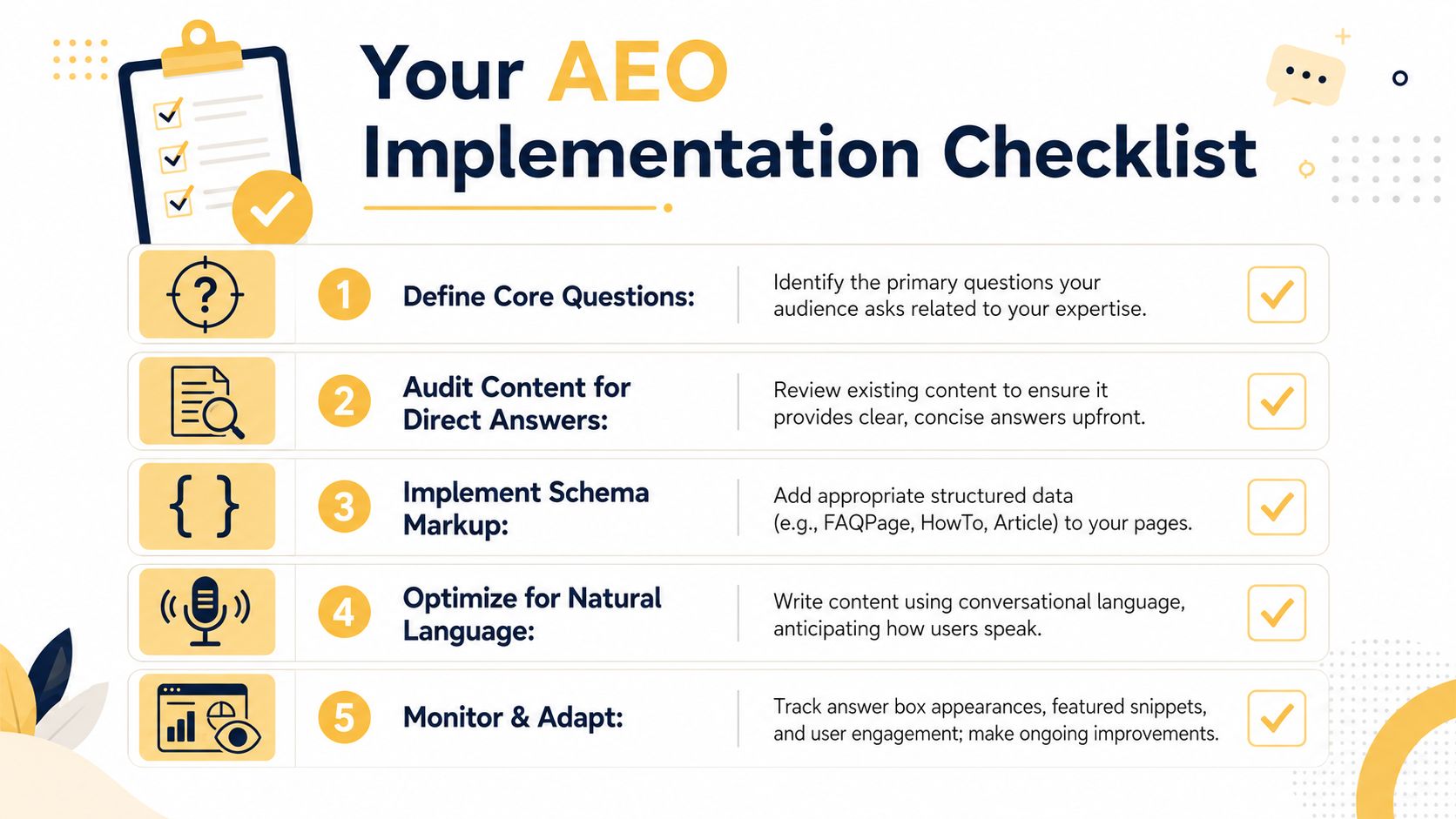
Start with this sequence
- List your real customer questions: Pull them from sales calls, customer service logs, reviews, and search queries. Focus on questions tied to buying intent, service urgency, or product comparison.
- Audit your top pages for direct answers: Check whether each important page answers its core question in the first 40 to 60 words. If it doesn't, rewrite the opening section.
- Break long sections into atomic chunks: Use question-based H2s and H3s, short paragraphs, and bulleted lists so each section can stand on its own.
- Add the right schema: Use FAQPage, HowTo, and Article where they fit the content naturally.
- Review trust signals: Add or refine author bylines, update dates, and clear business identity details.
- Run prompt tests monthly: Ask leading answer engines the questions that matter to your business and track whether your brand appears.
- Prioritize pages with commercial value: Start with service pages, product comparisons, FAQs, and educational content that supports buying decisions.
What to do this week
If you want momentum without getting buried in a big project, do these first:
- Rewrite the introduction on your top five traffic pages
- Turn vague headings into question-based headings
- Add one scannable bullet list to every key page
- Implement schema on your most important service or editorial templates
- Document a baseline set of prompts for future testing
AEO rewards consistency more than novelty. The businesses that win usually aren't the ones chasing every AI headline. They're the ones making their best content easier to extract, easier to trust, and easier to cite.
If your team wants help turning SEO content, service pages, or product content into answer-ready assets, Up North Media can help you build an AEO strategy that supports measurable growth. From technical implementation to content restructuring and AI-informed search strategy, they work with businesses that want more than impressions. They want visibility that leads to revenue.