
You're probably in one of two places right now. You either have a project in mind and you're trying to figure out which architect can turn a strong idea into a buildable reality, or you're looking at architecture firms online and realizing that a polished portfolio doesn't tell you much about what it's like to work with them.
That gap matters. Anyone can post beautiful photography. The harder question is whether the firm can balance design ambition with the plain, stubborn realities of construction, budget pressure, material limitations, and the day-to-day decisions that shape how a building performs after move-in.
In Omaha, Steven Ginn Architects stands out because the firm's identity isn't built around volume. It's built around design judgment. That changes the client experience, the process, and the type of projects that fit best. It also offers a useful case study for how a small architectural practice can build a strong local reputation through thoughtful work and clear positioning.
The Philosophy of a Boutique Omaha Architect
A client hires a boutique architect for a different reason than they hire a large production firm. The goal usually is not speed alone. It is authorship, judgment, and a design process that stays connected to real site conditions, budget limits, and the way people will use the space once construction is finished.
Steven Ginn Architects fits that boutique model in a credible way. The firm was established in 2005 in Omaha, and Steven Ginn's background includes a Master of Architecture from Washington University in St. Louis and years spent studying indigenous architecture before opening the practice, as noted on Steven Ginn's team profile. That kind of training often shows up less in visual style than in priorities: respect for place, attention to materials, and plans that need to work in daily life, not only in photographs.
“Boutique” should mean something concrete in architecture. It usually means a smaller roster of projects, direct access to the lead architect, and fewer handoffs between concept and decision-making. For clients, that can be a real advantage, but it also comes with responsibility. A more design-led firm often asks for clearer feedback, more patience during early iterations, and more honest conversations about trade-offs between ambition, cost, and buildability.
That trade-off matters. Some clients need a fast, familiar process and a standard delivery path. Others want a house, renovation, or commercial space with more point of view, and they are willing to spend more time getting the fundamentals right. Boutique firms tend to serve the second group better because they can spend more attention on proportion, circulation, site response, and detail before the drawings head into construction.
In Omaha, longevity still matters because architecture is a referral business shaped by trust, builder relationships, and finished work that has to hold up over time. Steven Ginn Architects, which celebrated its 20-year milestone in 2025, has had time to prove that its approach can last through changing tastes and changing construction conditions. That helps explain the firm's market position. It reads less like a generalist office chasing volume and more like a selective practice for clients who want design leadership with practical discipline.
The same principle applies to professional services more broadly. Firms with the strongest positioning usually define their process clearly, show the kind of work they want more of, and make it easy for the right clients to recognize themselves. For agencies and design-focused service businesses, this guide to full-service design agencies is a useful example of how service structure shapes client expectations. Architectural firms can also borrow a practical lesson from digital presentation. Clients often need help understanding space before they can approve it, which is one reason it helps to compare floor plan design tools and choose visual methods that support better decisions instead of prettier sales material.
From Concept to Construction Services and Process
The strongest architectural processes make the invisible visible early. That's where Steven Ginn Architects appears to be disciplined. The firm specializes in schematic design using hand sketches, physical scale models, and 2D/3D rendering to produce precise drawings and solutions for energy-efficient homes, according to its Houzz profile.
Why mixed design tools still matter
A lot of clients assume digital rendering is the process. It isn't. It's one tool inside the process.
Hand sketches tend to help at the earliest stage because they're fast, loose, and good at testing proportion or circulation before anyone gets attached to cosmetic detail. Physical models help when massing, roof relationships, and site orientation are hard to understand on a screen. Then 2D and 3D renderings tighten the work, clarify decisions, and help align the client, architect, and builder before construction starts.
Here's the practical value of that mix:
| Tool | Best use | What it helps avoid |
|---|---|---|
| Hand sketches | Early concept exploration | Overcommitting too soon |
| Physical models | Massing and spatial relationships | Misreading scale |
| 2D drawings | Technical coordination | Field confusion |
| 3D rendering | Client visualization | Late-stage surprises |
A process like this doesn't eliminate change. It reduces the kind of change that hurts most, namely decisions discovered too late.
Where good design meets buildability
Many firms separate at this point. Bold architecture is easy to admire in concept and much harder to execute well. The architect has to translate an idea into geometry, details, and coordination that a contractor can build without guesswork.
That's why schematic design isn't just about aesthetics. It's where questions get pressure-tested. Does the floor plan support the way the client lives? Will the glazing strategy make sense on the site? Are transitions between spaces elegant or just dramatic in renderings? Can the roof form be detailed cleanly? Does the energy-efficiency goal show up in orientation and envelope thinking, not just in equipment specs?
Good architects don't only ask, “Does this look strong?” They ask, “Can this be explained clearly enough that it gets built the way it was intended?”
For homeowners trying to understand plan development before hiring a designer, it can help to compare floor plan design tools and see how different visualization methods shape decision-making. Even simple planning tools reveal how quickly circulation, room adjacencies, and furniture logic affect the quality of a layout.
What works and what doesn't
What works is a process that invites iteration early and precision later. What doesn't work is relying on glossy imagery to carry weak planning.
Energy-efficient design fits this same pattern. It works best when it's integrated from the beginning, not added as a marketing phrase at the end. A house can be visually striking and still underperform if the fundamentals weren't resolved early. The firms that handle this well make performance part of the concept, not a postscript.
A Portfolio of Bold and Thoughtful Designs
A strong residential portfolio should answer a practical question. Can the architect produce memorable work without creating expensive headaches in detailing, sequencing, or daily use?
Steven Ginn Architects reads well on that test. The work shows range, but it does not feel restless. Projects appear shaped by client priorities, site conditions, and how the house will be lived in, which is usually the difference between a home that keeps its value and one that dates itself fast.
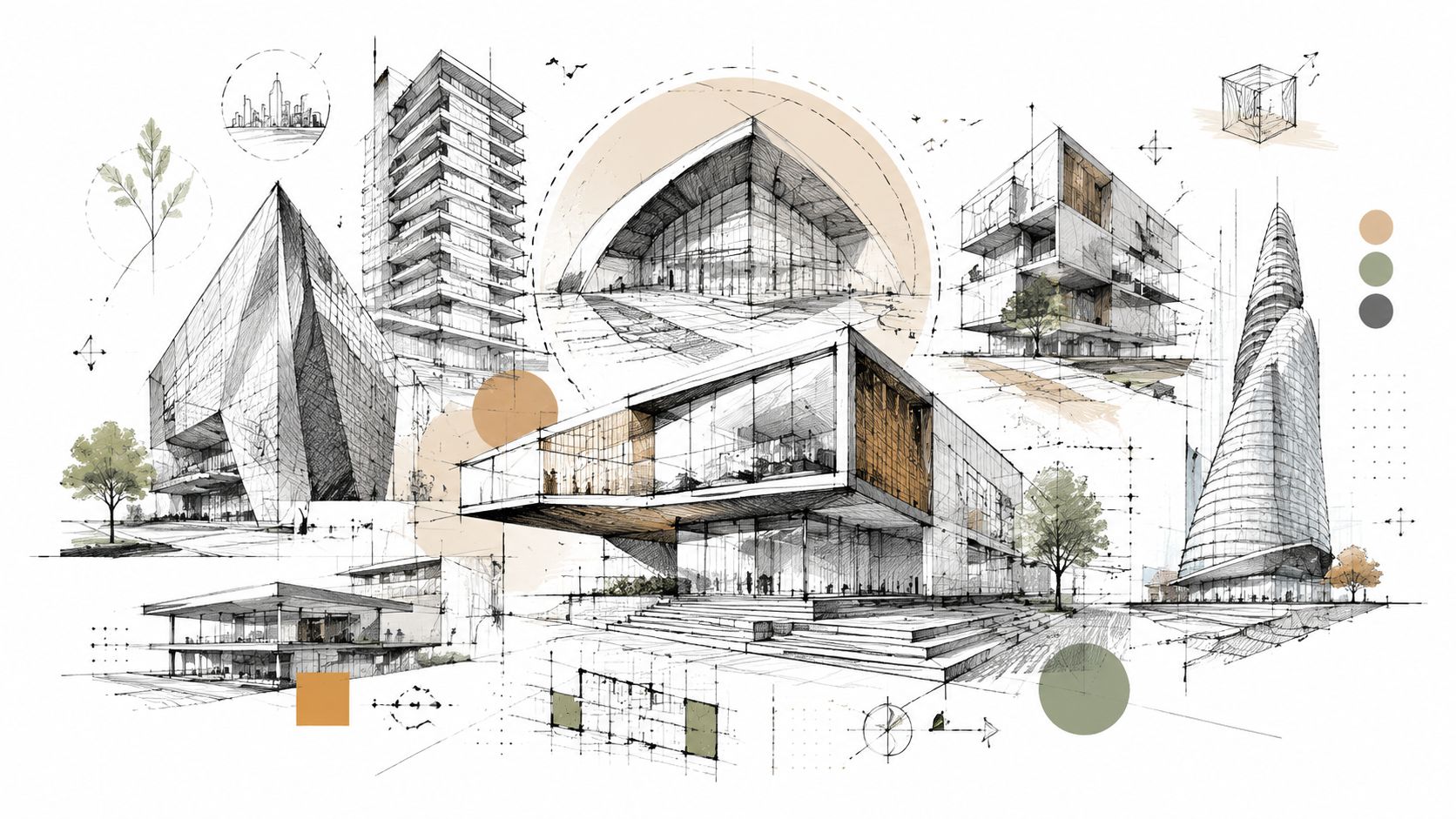
A useful example is the Cedar St. Remodel. Publicly available project descriptions note custom shelving, revised lighting, and muted neutral finishes designed to support the client's art and wine collection. That kind of scope sounds quiet on paper. In practice, it takes discipline.
Residential remodels often go wrong when every surface competes for attention. Here, the design choices appear calibrated to frame what the client already values. Built-in storage gives collections a permanent place in the architecture. Lighting changes how those objects read during the day and after dark. Restrained finishes keep the room from feeling overdesigned.
That balance matters in construction too. Bold design is easy to praise before pricing comes back. Controlled design usually holds up better once bids, lead times, and field conditions start applying pressure. Firms that understand this tend to produce spaces with a stronger shelf life because they are editing, not decorating.
The portfolio also suggests stylistic flexibility. One published residence has been described elsewhere as carrying a Japanese-Californian influence. The label itself matters less than what it implies. Steven Ginn Architects appears comfortable drawing from multiple traditions without letting references turn into a theme exercise.
That is a useful distinction for clients in Omaha's upper-end residential market. A house can be distinctive without becoming hard to build, hard to furnish, or hard to live in. The best boutique architects know where to push and where to stay disciplined. Builders focused on execution look for the same alignment. This overview from CJMC Build for custom homes is a useful companion read because it shows how design intent and construction planning need to stay connected from the beginning.
There is also a business lesson here for other design firms. A portfolio should do more than display pretty images. It should signal fit. Firms that want better-qualified leads should organize project stories around client type, project constraints, and outcomes, much like the audience framing used when creating buyer personas for service businesses. That gives prospective clients enough context to recognize themselves before they ever make contact.
A short video gives a better sense of how that design thinking translates into space and form.
The best residential work earns its visual impact by resolving the practical parts well. Proportion, light, storage, materials, and constructability all need to hold together.
Defining the Ideal Steven Ginn Architects Client
A couple hires a boutique architect because they want a home with presence. Three meetings in, they realize its true value is not just style. It is having someone who can say no to expensive bad ideas, protect the parts that matter, and keep a distinctive concept buildable. That is the kind of client relationship Steven Ginn Architects appears built for.
In Omaha, that position is specific. This is the kind of practice that tends to attract clients who want more than permit drawings and finish selections. They want an architect with a point of view, and they are prepared for the fact that strong design brings trade-offs. A dramatic roofline may affect structure and cost. A large opening to the outdoors may change energy performance, detailing, or furniture layout. Good boutique work handles those tensions early instead of pretending they do not exist.
Who fits this firm best
The best-fit client usually values judgment as much as aesthetics. They are not shopping for the fastest route to a set of plans. They are looking for a design partner who can shape the project, question assumptions, and keep ambition tied to construction reality.
That often includes clients who:
- Want design authorship. They expect the architect to contribute ideas, not just document instructions.
- Have a project with real constraints. Site conditions, an intricate remodel, historic context, budget priorities, or a desire for something outside the usual residential formula all benefit from careful architectural thinking.
- Can handle honest feedback. The process works better when the architect can challenge a weak layout move, an overbuilt detail, or a feature that adds cost without improving daily life.
- Care how the house lives. They pay attention to circulation, daylight, privacy, storage, views, and material durability, not just curb appeal.
This last point matters. Many clients say they want a custom home, but what they seek is a familiar plan with a few cosmetic changes. That is a valid goal. It is a better fit for a different kind of firm.
Who should consider a different model
Some projects need efficiency more than authorship. If the priority is a standard plan, a quick permit package, or a lower-touch process, a production-minded residential designer may serve the client better.
Here is the practical distinction:
| Client priority | Better fit |
|---|---|
| Standard plan with minimal customization | Higher-volume residential design provider |
| Deep collaboration and tailored design | Boutique architect |
| Fastest possible path to permit set | Production-oriented process |
| Unique remodel or design-forward custom home | Design-led practice |
Neither model is automatically better. Each solves a different business and design problem.
Client test: If you want your architect to improve your brief, not just accept it, a boutique firm is probably the right category.
“Discerning” is often used loosely in architecture marketing, so it helps to define it in plain terms. In practice, discerning clients usually make decisions with care, ask better questions, and understand that restraint can be as valuable as spectacle. They are willing to spend time on the structure of the house itself, not only on finishes layered on top.
There is also a useful lesson here for other service firms. Clear positioning helps pre-qualify leads before the first call. This guide on creating buyer personas for service businesses is a good reference because it shows how to describe fit in terms of behaviors, priorities, and budget expectations, not vague labels. For architecture and design firms trying to improve SEO, that clarity also gives you better page structure, better service copy, and fewer inquiries from people who were never a match.
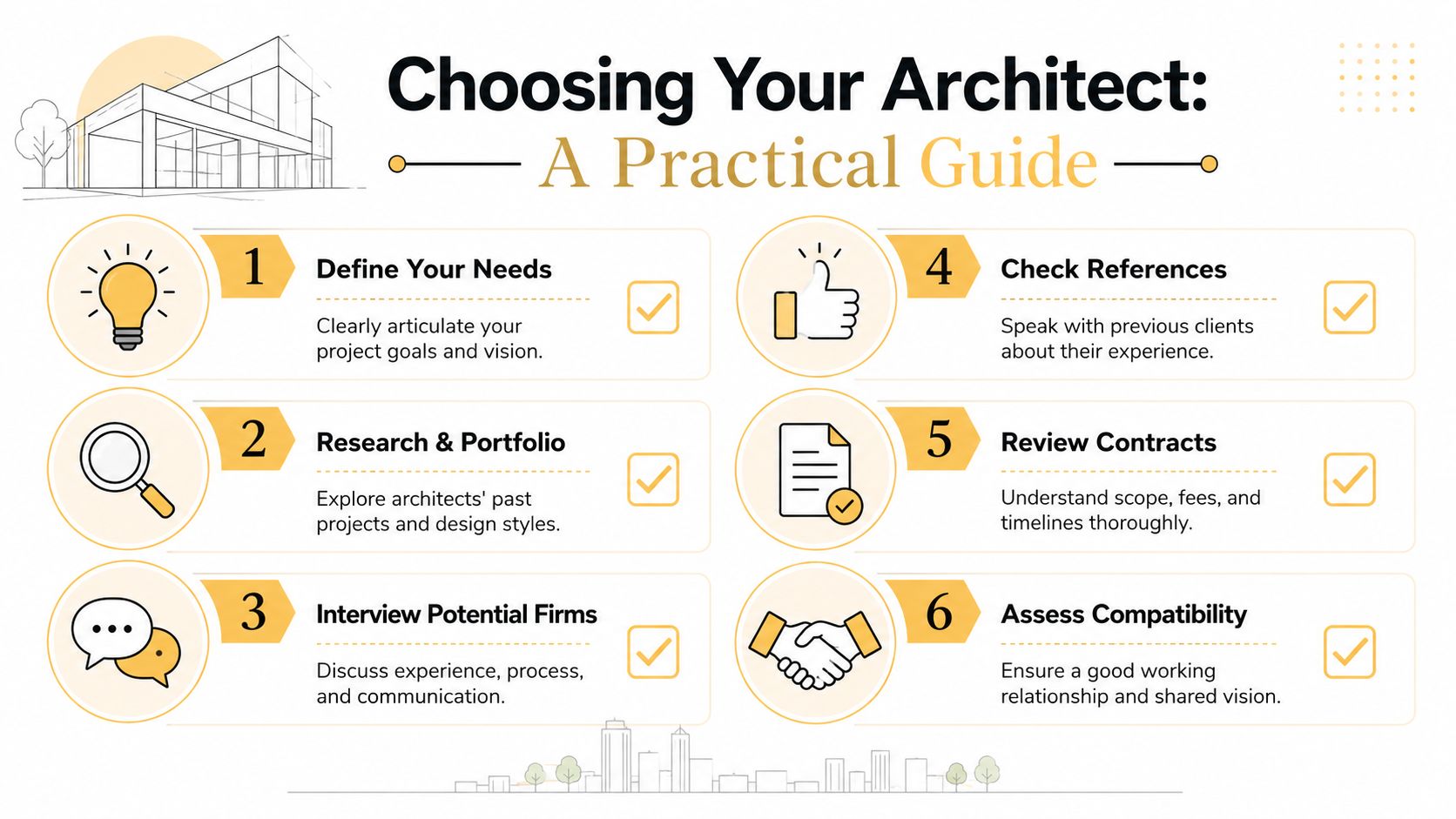
A Practical Guide to Choosing Your Architect
Hiring an architect goes better when you treat it like a design and communication decision, not just a style decision. Portfolio images matter, but they shouldn't lead the entire evaluation.
What to ask beyond the portfolio
A strong portfolio can still hide a weak process. During early conversations, ask questions that reveal how the firm thinks under constraints.
Start with these:
-
What kinds of projects are most aligned with your practice?
You're listening for focus. Firms that know themselves usually answer clearly. -
How do you move from concept to technical documentation?
This tells you whether they have a real process or just an aesthetic vocabulary. -
What parts of the project typically need the most client input?
Good architects know where owner decisions matter most and can explain that. -
How do you handle design ideas that look good but create construction problems?
This question separates image-makers from problem-solvers.
How to read an architect's body of work
You don't need architectural training to evaluate patterns. Look for consistency in judgment, not sameness in style.
A useful checklist:
- Look for planning intelligence. Are rooms connected in ways that seem livable?
- Study restraint. Does the architect know when to simplify?
- Check project diversity. Can the firm adapt to different conditions without losing quality?
- Notice material discipline. Are finishes doing too much, or do they support the architecture?
If a portfolio feels impressive but hard to imagine living in, pause there. Great residential design should feel resolved, not merely dramatic.
Red flags clients often miss
Some warning signs are subtle. They don't always show up in the first meeting.
| Red flag | Why it matters |
|---|---|
| Vague answers about process | Confusion later during design and construction |
| Heavy emphasis on visuals only | Risk of weak technical follow-through |
| No clear explanation of collaboration | Misaligned expectations |
| Defensive response to practical questions | Poor fit for real-world problem solving |
One practical issue worth raising early is roof complexity. Clients often notice this before architects do because they're imagining maintenance, not just form. A public client comment connected to Steven Ginn Architects raised concern about multiple roof angles and valleys that can be prone to leaks. That concern is worth taking seriously, not dismissing.
Ask direct questions such as:
- How is the roof being simplified or detailed to reduce vulnerable intersections?
- What coordination happens between architectural intent and waterproofing strategy?
- How will the design account for long-term maintenance, not just initial appearance?
A good architect won't be annoyed by practical questions. They'll welcome them because durable design depends on them.
What a good selection process feels like
You should leave initial meetings with more clarity than you had before. Not just excitement.
The right architect helps you understand trade-offs. They explain why certain moves improve the project and why others add cost, complexity, or risk without enough payoff. When that conversation is working, you feel both inspired and grounded. That's the sweet spot.
Local SEO Insights for Architectural Firms
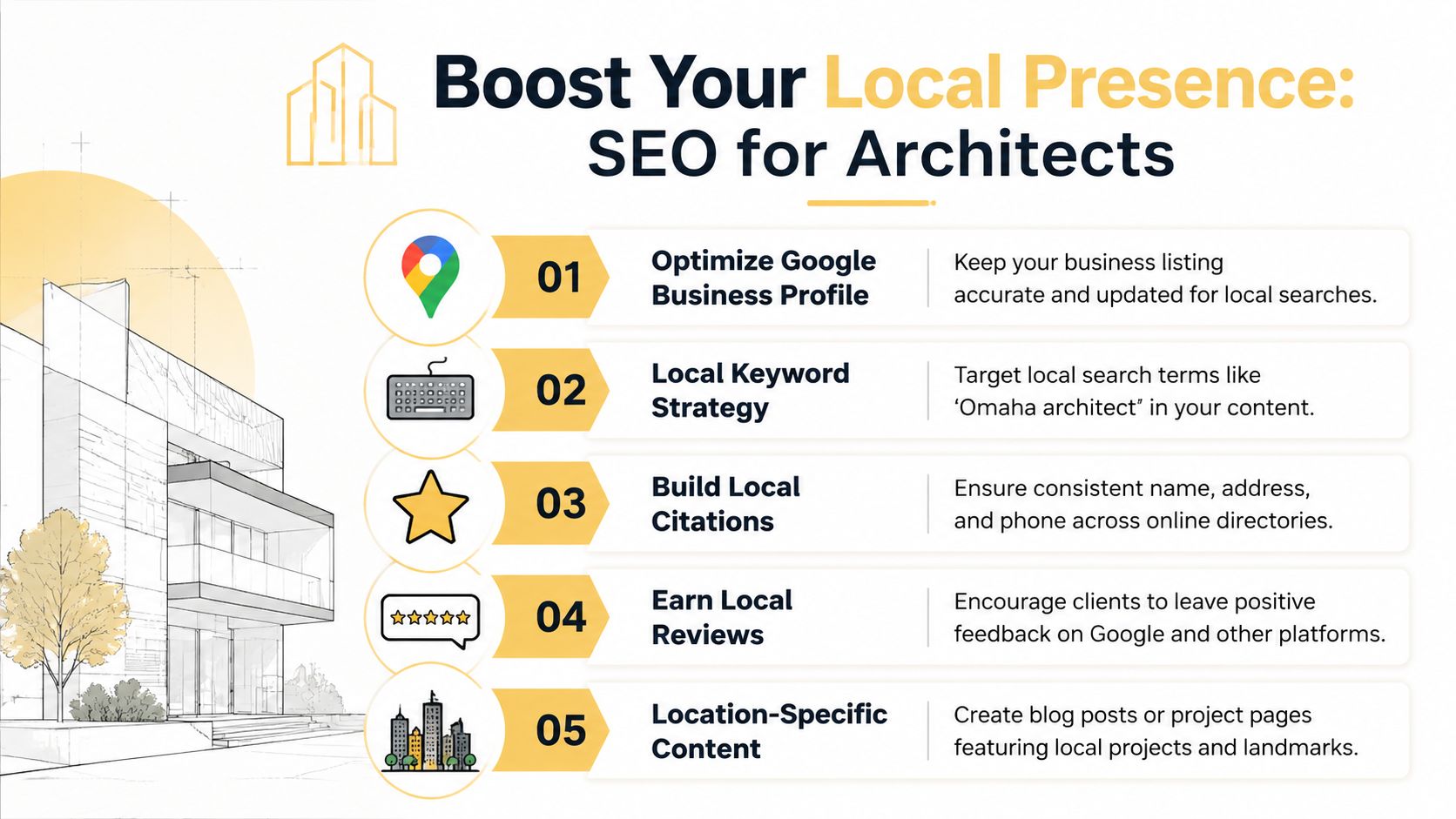
Architecture firms often invest heavily in photography and underinvest in explanation. That's a missed opportunity online. The firms that win local search attention usually don't just show finished work. They answer the practical questions prospects are already asking.
Turn client concerns into search assets
A strong example comes from a common concern around complex roof forms. A client concern tied to Steven Ginn Architects noted the potential for leaks in designs with multiple valleys. As discussed in an Omaha Magazine Facebook post, proactively publishing content that explains mitigation techniques and engineering standards can build trust and authority online.
That insight matters far beyond one firm. If clients repeatedly ask about drainage, roof valleys, glazing heat gain, remodeling disruption, or energy performance, those topics belong on your site. Not hidden in email. Published.
What architectural firms should do instead of posting only project galleries
Many architecture websites make the same mistake. They create elegant project pages with minimal text, no local framing, and no explanation of the problems solved. Search engines have little context, and prospective clients have little guidance.
A better structure looks like this:
- Use project pages as case narratives. Explain the site condition, client brief, design choices, and buildability decisions.
- Create FAQ content from real sales conversations. If clients ask it on calls, they'll search it too.
- Name locations naturally. Neighborhoods, cities, and regional conditions help local relevance.
- Write image alt text that describes the project. “Modern Omaha home exterior with layered roofline” is better than “IMG_2048.”
Reviews, citations, and profile maintenance
For service firms, local visibility often depends on consistency. That means keeping your business information aligned across major profiles, using the same name, address, and phone formatting, and keeping your project descriptions current.
Architects should also pay attention to niche profiles. Houzz, LinkedIn, and project galleries aren't just credibility tools. They can reinforce topical relevance when they're complete and consistent with the firm's website messaging.
Search lesson: The goal isn't more content. It's more useful content tied to real client intent.
Local firms in Omaha that want a stronger framework for this can study practical approaches to local SEO in Omaha. The underlying principle is simple: trust grows faster online when a business answers specific local questions with clear expertise.
For architecture practices, that usually means publishing less fluff and more professional judgment. Explain trade-offs. Explain constraints. Explain why a bold design still has to shed water, manage light, and work in daily life. That's the content prospects remember.
Connect with Steven Ginn Architects
A homeowner usually reaches this stage after saving images for months, talking through ideas at the kitchen table, and realizing the project is bigger than finishes or square footage. The primary question becomes whether the architect can protect the idea once budgets, site limits, and construction details start pressing on it. That is where Steven Ginn Architects appears well positioned in Omaha.
The firm serves clients who want strong design and understand that strong design still has to be built well. That combination matters. Plenty of firms can produce attractive drawings. Fewer can hold onto a clear architectural point of view while working through pricing, detailing, coordination, and the ordinary compromises that show up during construction.
Steven Ginn Architects is a full-service architecture and interior design practice in Nebraska, located at 6173 Center St, Omaha, NE 68106, with phone number (402) 991-1599. The best next step is to visit the Steven Ginn Architects website and use the firm's contact process to start a conversation about your project.
Come prepared. Bring site information, inspiration photos, a realistic budget range, your timeline, and a short list of priorities in order. I always tell clients to separate must-haves from preferences before the first meeting. That single step leads to a better discussion about scope, cost, and whether the architect is the right fit.
This is also a useful lesson for other service firms. Clear positioning wins twice. It helps the right clients reach out, and it filters out poor-fit leads before time gets wasted. That is the same principle Up North Media applies through Up North Media for SEO, web development, and digital strategy for Omaha businesses that need their online presence to reflect the quality of their actual work.