

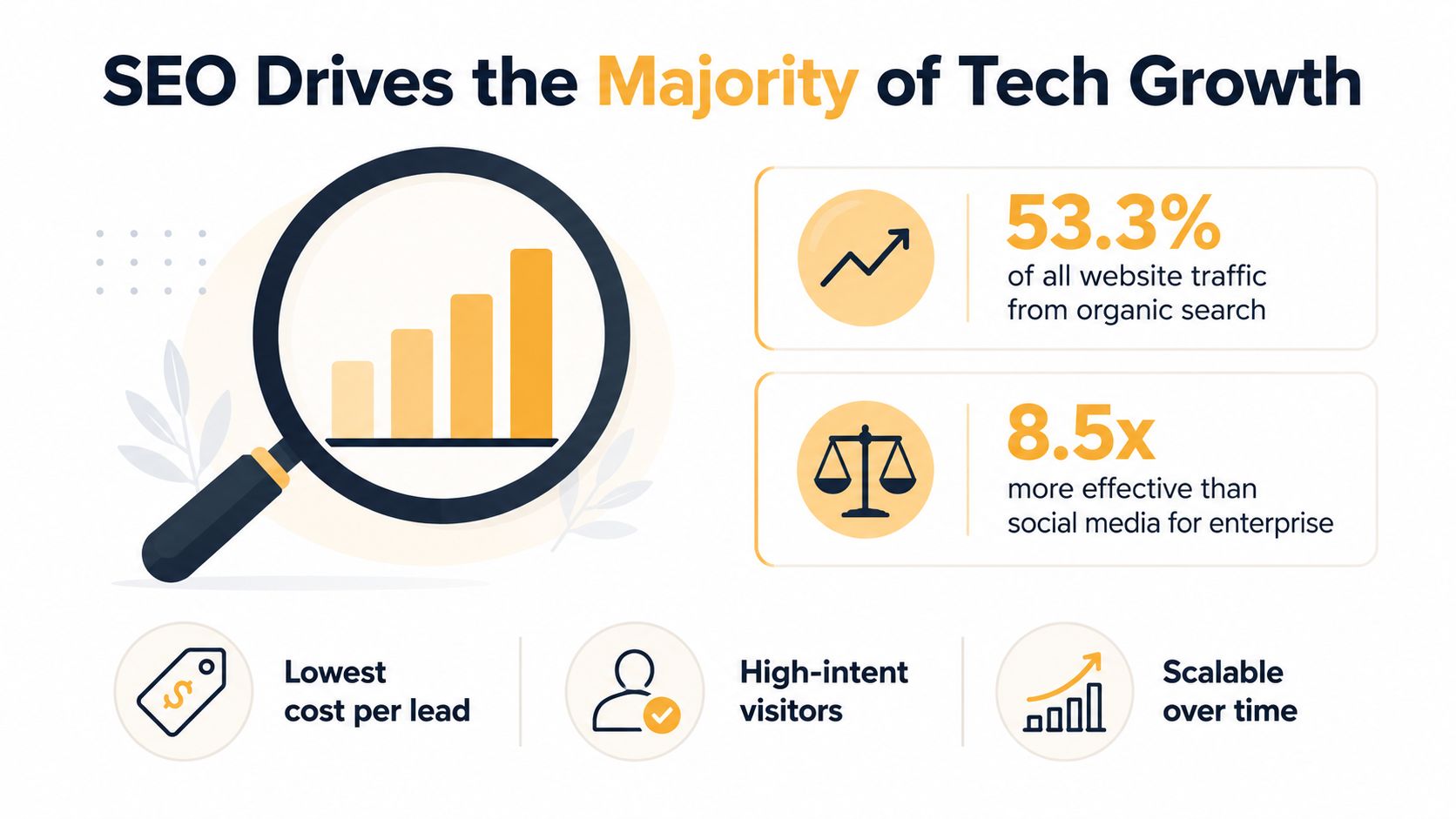
53.3% of all website traffic from organic search changes the conversation immediately, and for enterprises SEO is reported to drive 8.5x more traffic than social while 93% of enterprise organizations say SEO drives more than 50% of their traffic (enterprise SEO statistics). For tech companies, that isn't a marketing footnote. It's a signal that search is often the most dependable path to product discovery, buyer education, and repeat demand.
Most tech teams still treat SEO like a blog program. That works poorly because the pages that shape growth are usually the product pages, docs, changelogs, integration pages, and support content that live outside the editorial calendar. If engineering, product, and documentation own the right parts of the search surface, SEO stops being a campaign and starts behaving like a system.
Why SEO Is a Core Growth Channel for Tech Companies
Search works well for software because the intent is already there. A buyer comparing platforms, a developer looking for a fix, or a technical evaluator reviewing documentation is usually much closer to action than someone scrolling a social feed. Organic search keeps showing up as a core acquisition channel in enterprise environments, and the reason is simple, it reaches people when they are already trying to solve a problem.
For tech companies, the advantage is not just traffic volume. It is the shape of the traffic. Search can capture people at different stages, from early problem exploration to vendor evaluation to implementation questions, so it supports demand generation, product discovery, and post-sale education without forcing those jobs into separate channels. That matters because the strongest growth teams do not treat SEO as a campaign, they treat it as a way to make the whole product surface easier to find and easier to trust.
Search rewards product truth, not marketing polish
Tech audiences are quick to reject fluff. They want feature details, integration constraints, implementation paths, and edge cases. Pages that answer those questions well tend to earn the right kind of visibility because they match how real buyers and users search.
The mistake is to confine SEO to the content team. That creates a blog that talks around the product while the actual buying signals sit in the product UI, docs, and support journeys. A better model is to treat SEO as a product surface, which means engineering owns crawlability, product marketing owns positioning, and docs teams own the long-tail technical demand that marketing pages usually miss. I have seen this work best in SaaS and developer-tools companies where shipping fixes into product pages and documentation creates more search impact than publishing another top-of-funnel article.
Practical rule: if a page exists to help a buyer decide, a user implement, or a customer troubleshoot, it is part of SEO whether the marketing team wrote it or not.
That shift matters because tech companies have more searchable assets than they usually realize. Product pages, use-case pages, API docs, release notes, knowledge base articles, comparison pages, and integration hubs can all rank if they are structured well and linked properly. The blog still matters, but it should support the product surface, not carry the whole program on its back. For teams trying to operationalize that across engineering and content workflows, a technical SEO audit process from Up North Media's technical SEO audit services is a practical starting point, and broader monitoring setup can also be paired with SEO bot tools for founders when the site changes often.
Running a Technical SEO Audit That Actually Ships Fixes
Most audits die in a slide deck. The better version is a sprint backlog, because technical SEO for tech companies is mostly about reducing friction between what Google can crawl and what the site means to show. Google's own starter guidance leans on a crawl-first workflow, with sitemaps, internal links, accessible resources, canonicalization, and Search Console monitoring as the core pattern (SEO starter guide).
Start with discovery and indexation before touching copy. If Google can't find the right URLs, or if it finds too many versions of the same page, the rest of the work doesn't matter yet. Then move into rendering, especially on JavaScript-heavy stacks where blocked resources or delayed rendering can hide important content from crawlers.
A sprint sequence that engineering teams can absorb
A useful order is simple. First, fix crawl and index issues. Second, verify rendering. Third, clean up performance problems on product and docs pages. Fourth, tighten buyer-intent pages that deserve ranking priority.
That order matters because large documentation hubs and parameterized URLs can bloat crawl budget, especially on fast-moving product sites. A page can be live, useful, and still underperform if the site architecture keeps search engines busy in the wrong places. Internal links, canonical tags, and sitemap hygiene do more than clean up reports, they tell Google what deserves attention.
For teams who want a tighter operating rhythm, a good reference point is the technical SEO audit service approach that maps crawlability, indexation, metadata, and Core Web Vitals into one review. If you want a lightweight way to monitor repeated issues, the Fundl guide to SEO bot tools for founders is useful as a tool survey, especially for smaller teams that need to watch multiple surfaces without creating a giant manual process.
A practical audit output should never be “sitewide issues found.” It should be a ticket list with an owner and a ship date.
- Crawl fixes: sitemaps, internal links, canonicals, and parameter handling.
- Render fixes: blocked resources, JavaScript rendering gaps, or content hidden behind client-side logic.
- Performance fixes: slow product pages, docs templates, or heavy scripts on key templates.
- Page fixes: rewrites or structural changes on pages tied to buying intent.
If you hand engineering a list like that, they can slot it into normal sprint planning instead of treating SEO as a special project.
Keyword Research for Product, Feature, and Documentation Intent
Generic keyword tools usually overfeed tech teams with broad, low-context terms. The better lens is intent. For software and developer-tools companies, four buckets matter most, category, comparison, integration, and problem. Each one points to a different user state, and each one deserves a different page type.
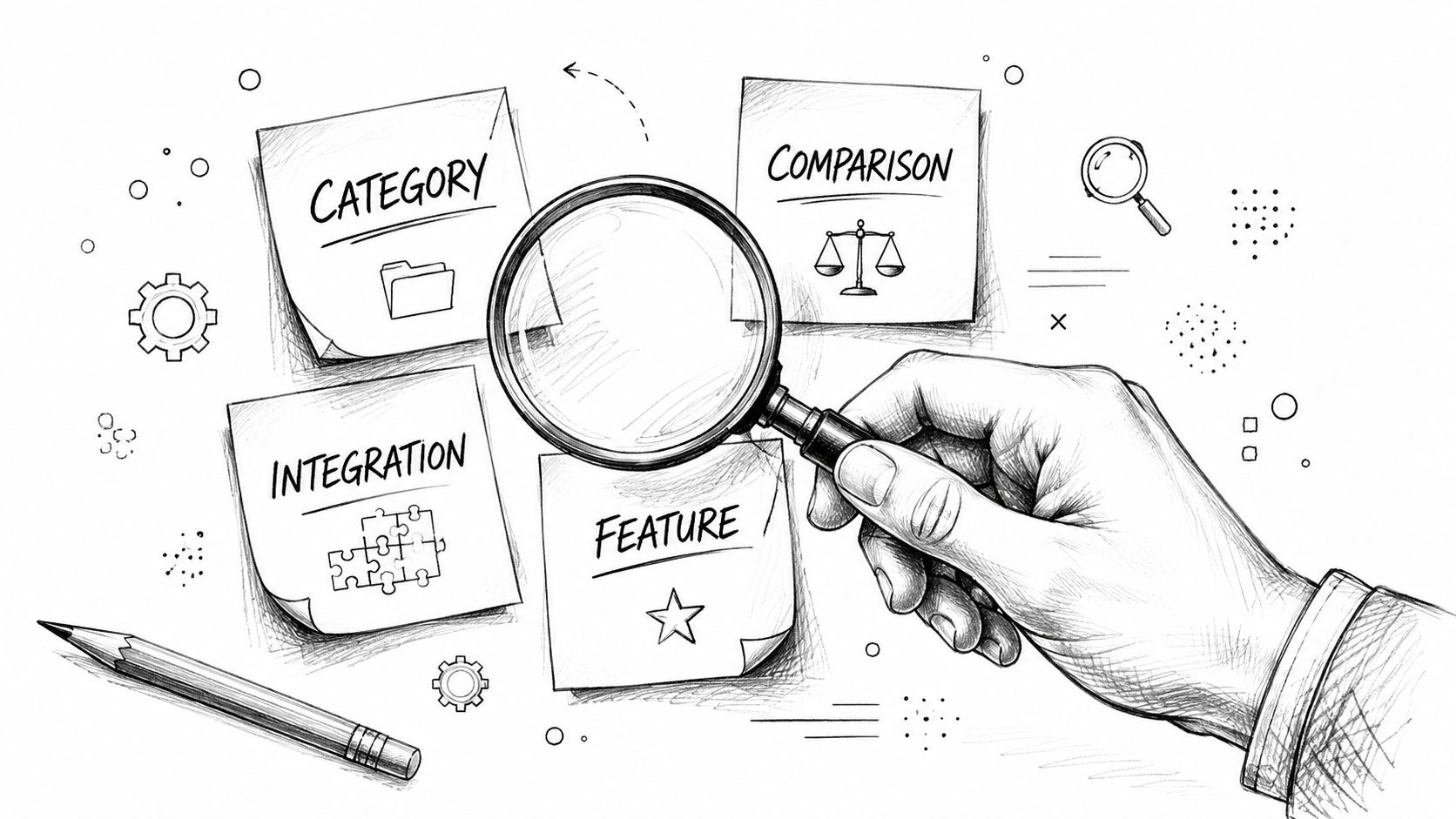
Category queries belong to product or homepage-level assets. Comparison queries usually need a dedicated page that's honest about trade-offs. Integration queries belong in hub pages or documentation. Problem queries are often best answered in guides, troubleshooting docs, or implementation notes.
Mine the language from inside the company
The highest-value phrases rarely come from brainstorming alone. Product usage data shows what people try to do. Sales calls reveal how buyers describe their own problems. Support tickets expose the phrases customers use when something breaks. Developer search logs, if you have them, are especially useful because they show real implementation language instead of marketing language.
The goal is to turn that raw language into a keyword-to-page matrix that product, content, and engineering can all use. A marketing writer can own the draft, but the owner of the page should be the person closest to the underlying user problem. That keeps the page aligned with the roadmap instead of drifting into generic SEO prose.
A good internal reference for this kind of mapping is semantic keyword research, especially if you're trying to move from isolated keywords to topic groups that reflect how people search.
The strongest tech keyword map is the one your sales team recognizes, your product team can support, and your docs team can maintain.
A comparison page doesn't need to sound salesy to work. It needs to show fit, limits, and differences clearly. A docs page doesn't need to be entertaining. It needs to answer the actual question that brought the user there. When keyword research is built around intent buckets instead of volume alone, the content plan gets cleaner and the ownership gets clearer.
Building a Content System for Product Pages and Developer Docs
Most tech companies leave their biggest SEO gains inside pages they already own. Product pages, integration hubs, docs, and release notes can all rank if they're written for search without losing technical accuracy. The trick is to design a content system where marketing and product expertise reinforce each other instead of competing.
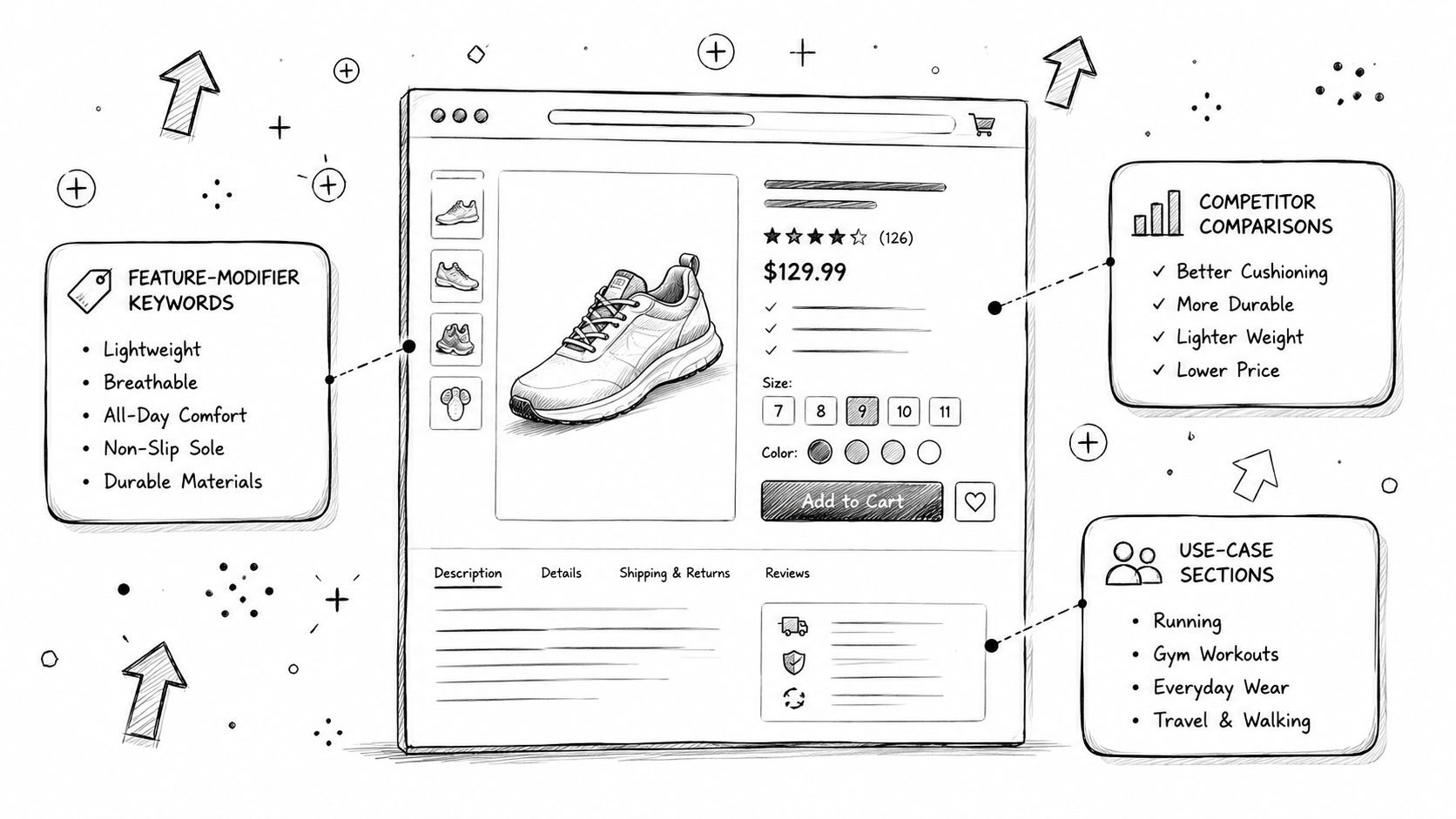
A generic integrations page usually fails because it lists logos and stops there. A better version groups integrations by use case, explains setup friction, includes internal links to docs, and gives search engines enough structure to understand the page. The same logic applies to product pages. Feature-modifier language, competitor comparisons, and use-case sections help the page satisfy both buyers and crawlers.
Pages that deserve a rewrite first
Start with the pages closest to revenue or adoption. Product landing pages should answer “what is it, who is it for, and why this over the alternative.” Docs pages should answer “how do I make this work.” Changelogs should answer “what changed and what should I do next.”
Release notes are underrated because they can capture emerging demand before the category gets crowded. If the product team ships a new capability, the corresponding note, docs update, and support article can all reinforce the same term set. That's much more efficient than waiting for a blog brief after the market has already moved.
A useful pattern is to pair a marketing writer with a developer advocate or product specialist on the same asset. The writer handles structure, search intent, and clarity. The technical partner checks accuracy, terminology, and implementation detail. That avoids the common failure mode where a page is readable but vague, or precise but invisible in search.
The topic cluster strategy framing is also useful here because it forces the page family to work as a unit. A strong cluster might include a hub page, a comparison page, a setup guide, and a troubleshooting doc, all linked in a way that makes sense to both humans and crawlers.
If a developer would bookmark it and a buyer would forward it, the page is probably close to right.
README files can also be turned into top-of-funnel assets when they explain use cases, setup, and constraints in plain language. That doesn't mean watering down the technical detail. It means structuring it so searchers can find the answer faster. The best tech content usually feels written for practitioners, not for marketing review.
Engineering and Content Workflows That Keep SEO Moving
SEO slows down when it sits outside the normal operating cadence. The fix is to wire it into the same rituals that already move product work forward. Backlog grooming, design reviews, release planning, and support triage all create natural entry points for search improvements if someone owns the connection.
The cleanest ticket format is simple. Define the intent, name the target page, write acceptance criteria, assign an owner, and set a ship target. That sounds basic, but it prevents the most common failure, which is a loose suggestion that nobody can implement.
A workflow that doesn't wreck velocity
One part-time SEO lead, one product owner, and one developer advocate can cover a surprising amount of ground if they work from a shared backlog. The SEO lead should identify the opportunity. The product owner should decide whether it aligns with roadmap priorities. The developer advocate or technical writer should help translate the page into something accurate and discoverable.
Use a light review cadence, not a heavy committee. A weekly check on new tickets and a monthly look at regressions is usually enough to catch problems before they spread. That keeps SEO from becoming a blocker while still making it visible when pages slip.
A small dashboard helps leadership see the work without turning the program into vanity metrics. The right view shows what changed, what shipped, and what it affected. It should also show which templates are weakening over time, because template-level problems are often easier to fix than isolated page issues.
Practical rule: if an SEO recommendation can't be turned into a ticket with acceptance criteria, it isn't ready for engineering.
Release notes and incident retros can do more than document changes. They can surface new content ideas, expose broken assumptions in docs, and identify product language that should be adjusted on high-value pages. That's the kind of operational SEO work that compounds because it keeps feeding the system from inside the company instead of waiting for external inspiration.
Link Building and Developer Outreach That Earns Real Mentions
Cold directory submissions and mass outreach don't fit tech audiences well. They feel transactional, and tech buyers can tell. The link-building motions that work better for software and developer-focused companies usually come from participation, utility, and original insight.
One useful reference point is SaaS link building that works, especially for teams deciding where to spend effort first. The strongest tactics tend to be the ones that produce something useful before they ask for a link.
Prioritize tactics that create public value
Open-source contributions can earn natural mentions because they solve real problems in public. Free tools do the same thing when they remove friction for a narrow audience. Original benchmarks and research pieces attract citations when they give other writers something they can't easily recreate. Developer communities matter because real participation often leads to references without a hard ask.
Digital PR still matters for launches, but it works better when there's a concrete story attached to the product change. Podcast guesting can work well too, especially when the conversation is about a technical problem the audience already cares about. Customer stories are useful when they're co-marketed, specific, and grounded in implementation detail instead of generic praise.
The priority order should reflect effort-to-link yield, not ego. Publish something useful first. Then distribute it through the channels where practitioners already gather. Then follow up with people who have a real reason to reference it.
The best backlink is usually a byproduct of being useful in public.
For tech brands, that often means docs, tools, and technical commentary will outperform polished outreach copy. The more closely the asset matches a real practitioner need, the more likely it is to earn mentions from people who know the space.
KPIs, Measurement, and a 90-Day Roadmap to Scale
Tech-company SEO needs a measurement system that can survive a skeptical CEO and a busy product org. The four KPIs that matter most are qualified organic sessions, pipeline influenced, indexable-to-indexed ratio, and Core Web Vitals pass rate. Together, they show whether the program is attracting the right audience, contributing to revenue, keeping the site healthy, and avoiding technical drag.
| KPI | What It Measures | Primary Tool | Cadence |
|---|---|---|---|
| Qualified organic sessions | Search traffic that matches target buyer and user intent | Analytics platform and Search Console | Weekly |
| Pipeline influenced | Search-assisted contribution to opportunities | CRM plus analytics | Monthly |
| Indexable-to-indexed ratio | Whether important pages are getting into the index as expected | Search Console and crawl tools | Monthly |
| Core Web Vitals pass rate | Template health across key page types | Search Console and performance tools | Monthly |
The roadmap should move in phases. First, stabilize the technical foundation so search engines can crawl the right pages cleanly. Second, ship the first wave of product and docs pages that already have clear intent. Third, expand link earning and measurement once the core surfaces are healthy enough to benefit from the extra attention.
A realistic 90-day sequence
Days 1 to 30 should focus on crawl, indexation, and rendering issues. Days 31 to 60 should target the highest-intent product and docs pages. Days 61 to 90 should widen distribution, tighten internal links, and validate which page types are gaining traction.
The point isn't to chase a perfect scorecard. It's to build a repeatable system where engineering, product, and content can move together. Once that rhythm is in place, SEO becomes less about periodic launches and more about how the company ships information.
If your team wants to turn this framework into an operating plan, Up North Media offers SEO marketing that covers keyword research, on-page optimization, content strategy, link building, and technical SEO, along with technical SEO audits that review crawlability, indexation, metadata, and Core Web Vitals. For a practical next step, visit Up North Media and start with the pages that shape your product discovery, docs, and pipeline.