
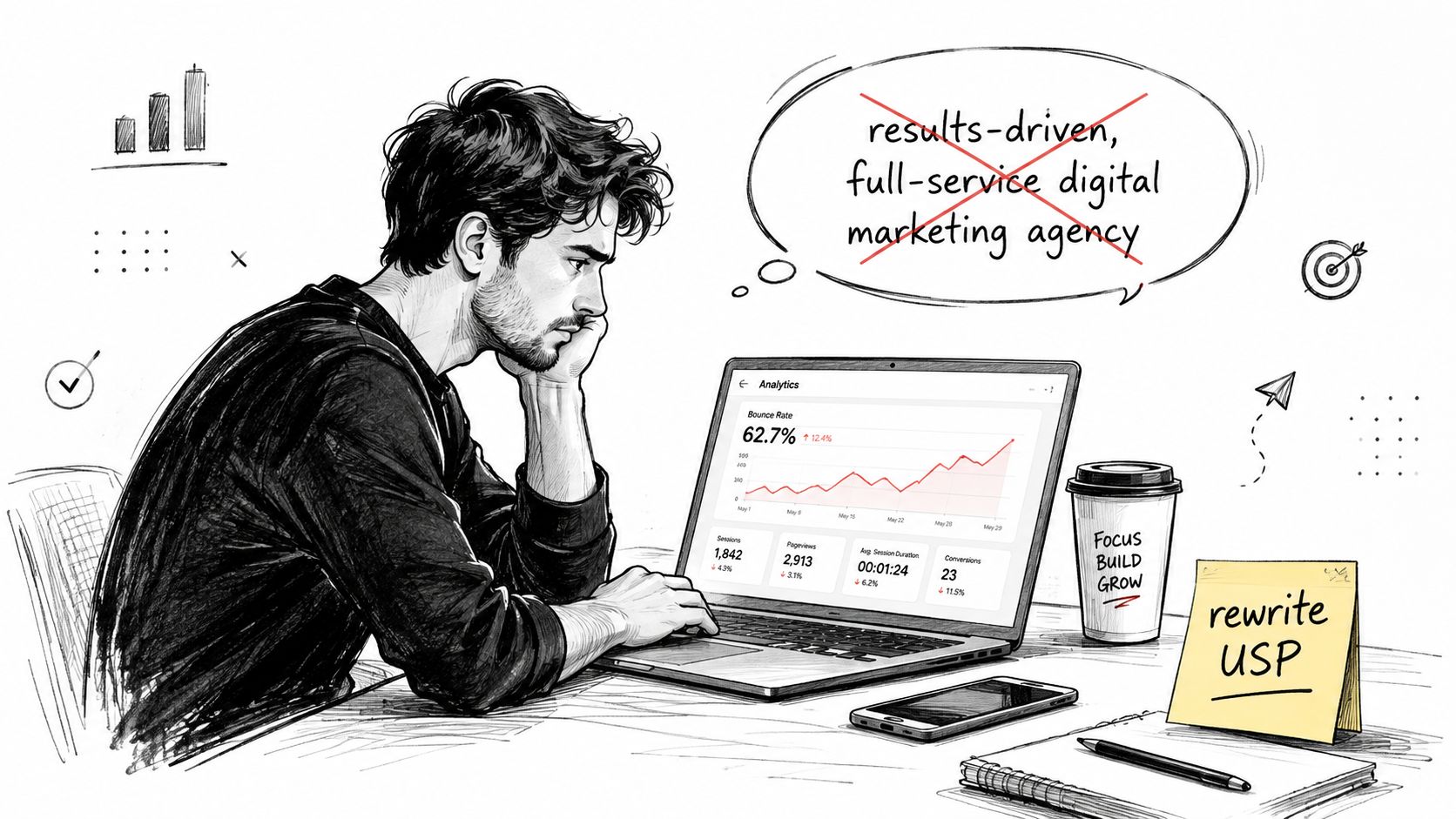
You launch a new homepage, announce that your agency is “results-driven,” and wait for the qualified leads to arrive. Instead, visitors skim the hero section, compare your pricing with three competitors, and leave. Your team worked hard on the site, the ads, and the offer. The problem is that the message could belong to almost anyone.
A unique selling proposition fixes that problem only when you treat it as more than polished copy. It should act as the operating claim behind your homepage, paid ads, sales conversations, onboarding, and product experience. Every customer-facing surface should reinforce the same reason to choose you, and your team should be able to defend that reason with evidence.
The Tagline That Stops Clicks and Kills Sales
The founder in this scenario usually has good intentions. They want to sound capable without excluding potential customers, so they choose familiar language: “full-service digital marketing,” “results-driven strategies,” or “solutions for modern businesses.” The phrases feel safe because no prospect can immediately disagree with them.
That safety is the problem. A buyer can't tell who the agency serves, what outcome it owns, or how its approach differs from the next agency in the search results. The visitor doesn't see a reason to continue the conversation. They see another vendor asking to be evaluated on vague promises and price.
Effort isn't the same as clarity
Most weak positioning doesn't come from lazy teams. It comes from describing the business from the inside out. The founder lists services, capabilities, tools, and values, then expects the buyer to assemble the benefit.
Buyers don't want to solve that puzzle. They want a clear answer to a practical question: Why should I choose you instead of the alternatives I already know?
Practical rule: If a competitor can paste your USP onto its own website without changing a word, you don't have a USP yet.
A useful USP names one meaningful customer benefit, identifies the buyer who cares about it, and connects the benefit to a mechanism your business can substantiate. It isn't necessarily the final headline. It is the claim that shapes the headline, the proof below it, the sales script, and the delivery experience.
That distinction matters even more for service businesses. An SEO firm, web app studio, or AI consultant sells an outcome customers can't fully inspect before buying. Specificity gives the prospect something concrete to evaluate. Proof lowers the perceived risk of trusting an intangible service, a relationship emphasized in guidance from MECLABS Institute.
The rest of this guide treats your USP as an operating asset. You'll define the claim, attach a mechanism, test it against competitors, and deploy it across the places where buyers form opinions.
What a Unique Selling Proposition Actually Means
A unique selling proposition is a single, customer-observable claim that explains why a specific buyer should choose your business over a credible alternative. It should describe an outcome the customer values and a reason your company can legitimately own that outcome.
Think of it as a contract. You promise something meaningful, and the buyer gets a clear standard against which to judge your work. “We help Omaha service companies turn local search demand into booked consultations through intent-led SEO and conversion-focused landing pages” creates a different expectation from “We provide marketing support.”
The USP is also the sentence a salesperson must be able to say without flinching. If the sales team needs several paragraphs to explain what the company does, or if delivery can't prove the promise, the statement is decoration rather than positioning.
Rosser Reeves formalized the marketing concept in the early 1940s at Ted Bates & Company and later popularized it in Reality in Advertising, published in 1961. His approach moved advertising toward a single concrete consumer benefit that brands could repeat and defend, as described in the history of the unique selling proposition.
The three tests every candidate must pass
Specificity means the claim contains an observable result or a sharply defined benefit. “Better marketing” fails. “Qualified consultation requests from high-intent local searches” gives the buyer something more tangible.
Customer anchoring means the statement starts with the buyer's situation, not your internal capabilities. “Our team uses advanced analytics” describes you. “For publishers losing organic reach to interchangeable content” describes the customer's problem.
Defensibility means competitors can't make the same claim without changing their business. A proprietary workflow, a focused vertical, a distinctive delivery model, or verifiable proof can support defensibility. The mechanism matters because a slogan alone is easy to imitate.
Use this quick filter:
| Candidate statement | Specific | Customer-anchored | Defensible |
|---|---|---|---|
| “We deliver innovative solutions” | No | No | No |
| “Custom web apps for retailers that need conversion-focused buying journeys” | Partly | Yes | Partly |
| “We help specialty retailers simplify complex buying journeys through custom commerce applications built around their catalog data” | Yes | Yes | Yes, if the process and proof support it |
A claim is not unique because it sounds different. It is unique when the business model, audience, and evidence make the claim believable.
Why Differentiation Now Drives Growth and Pricing Power
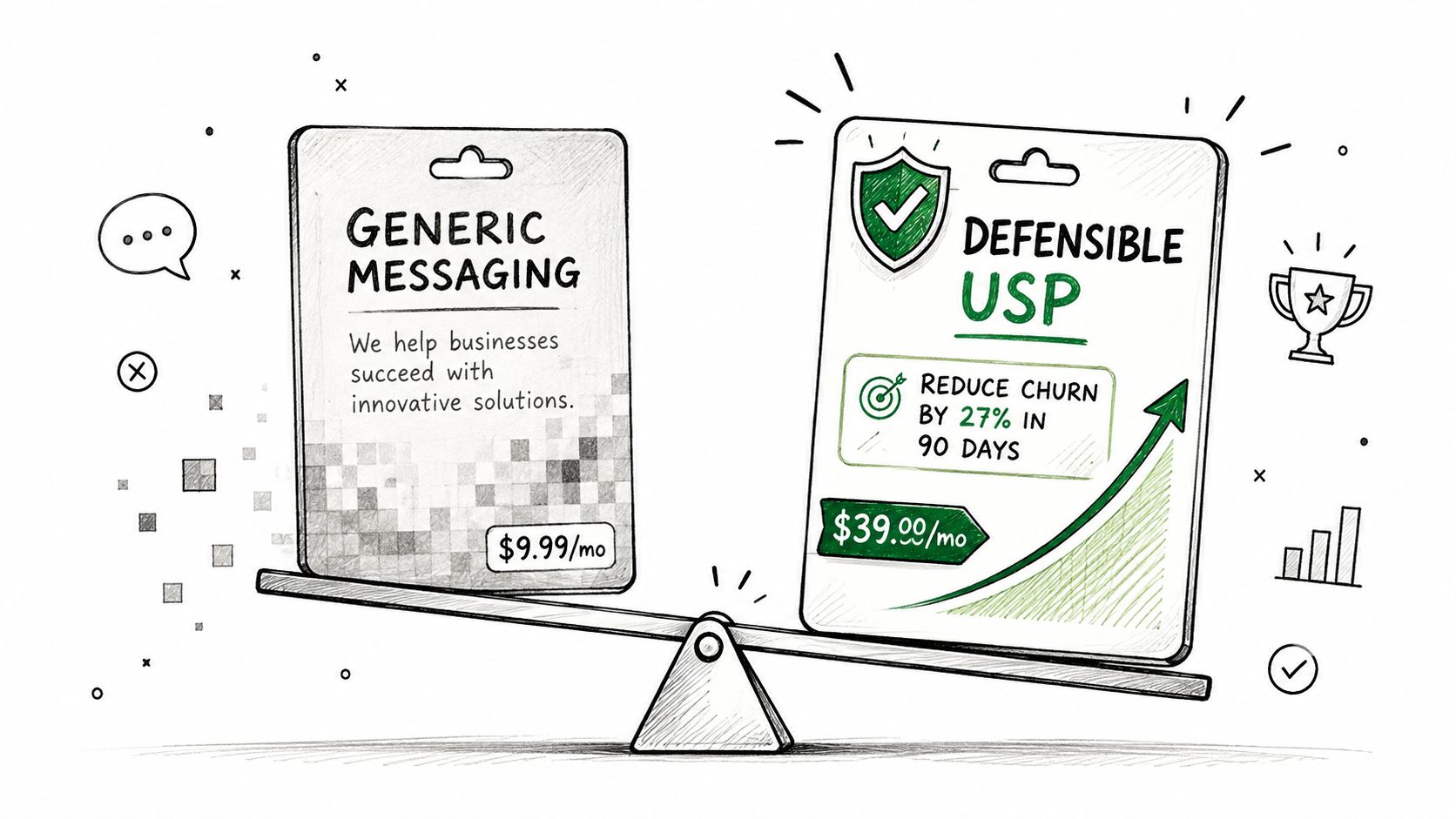
Generic messaging has become cheap to produce. A founder can ask an AI tool for polished copy and receive paragraphs filled with phrases such as “scalable” and “customer-centric.” The output may read smoothly, but smooth writing doesn't create a reason to buy.
That creates a difficult environment for agencies and software companies. If every provider describes itself as strategic, responsive, and results-focused, buyers compare the remaining visible differences. They look at price, delivery speed, reviews, or perceived familiarity. A business that fails to communicate a defensible difference gives the buyer fewer reasons to value its expertise.
Google and Kantar's 2025 analysis says differentiation drives 57% of future growth and pricing power. That differentiation research supports a strategic point that many service businesses underestimate: differentiation isn't a branding exercise separate from commercial performance. It influences whether buyers see your offer as interchangeable.
Local expertise still needs a sharp claim
An Omaha agency doesn't need to imitate a national firm. It needs to explain the advantage a local or specialized buyer values. That might involve familiarity with a regional market, a focused service model, a particular technical mechanism, or a closer connection between strategy and implementation.
The claim has to survive contact with the buyer's decision process. A small business owner may need a website that converts local demand. An e-commerce operator may need a buying journey that handles complex products. A publisher may need an organic growth system that connects editorial work with technical SEO. “We help businesses grow online” gives none of these buyers a useful reason to continue.
Operational differentiation matters as well. If your company promises responsiveness, prospects should see clear communication standards. If it promises personalization, the discovery process should demonstrate that behavior. If it promises measurable outcomes, the reporting and proof architecture should make those outcomes easy to inspect.
For teams building customer-facing automation, a resource such as Expressify AI's 24/7 assistant can help illustrate how a specific operational capability becomes part of a broader customer promise. The tool itself isn't the USP. The USP is the customer benefit created by the capability and the evidence that the business can deliver it consistently.
Before writing copy, review how to conduct competitor analysis. Your goal isn't to collect clever phrases. It's to identify which promises competitors repeat, which buyer concerns they ignore, and which mechanisms your business can defend.
A Four-Step Framework and Template to Write Your USP
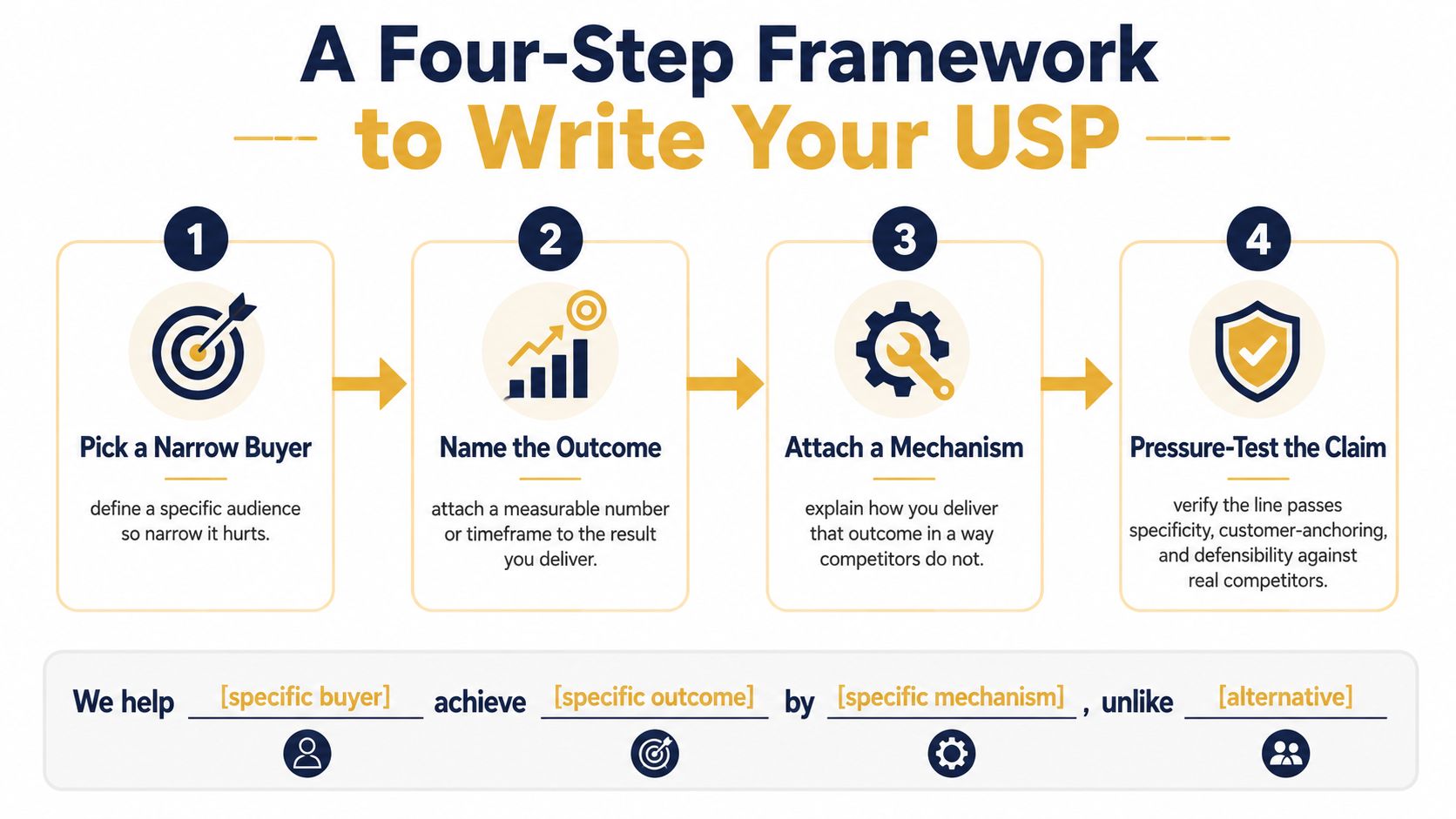
Start with one sentence:
We help [specific buyer] achieve [specific outcome] by [specific mechanism], unlike [alternative they would otherwise use].
This sentence is a working document, not necessarily your final homepage headline. It forces you to connect the buyer, outcome, mechanism, and competitive alternative.
Step one narrows the buyer
“Businesses” is not a useful audience. “Omaha service companies” is better, but you can often sharpen it further by identifying the type of buyer, business model, or urgent problem. Choose a group whose needs you understand well enough to describe without resorting to generic language.
Use customer interviews, sales notes, support conversations, and your CRM to find patterns. For a practical starting point, build buyer personas that connect audience traits with real purchasing problems.
A narrow audience doesn't mean you refuse every other customer. It means your primary message has a clear center of gravity.
Step two names the outcome
Benefits become persuasive when the customer can recognize them in operational terms. “Improve visibility” is weak. “Generate qualified consultation requests from high-intent local searches” is stronger because it identifies the business effect.
Use a number or timeframe only when you can support it. If you can't substantiate a precise result, name the outcome qualitatively and connect it to a measurement method. For example, “make product discovery easier to measure across search and onsite behavior” is more credible than an unsupported promise of dramatic growth.
Step three attaches the mechanism
A mechanism answers the buyer's next question: How do you produce that outcome? It might be a specialized workflow, a technical architecture, a research process, or a service model that competitors don't use in the same way.
“We build fast apps” describes a capability. “We turn complex catalog data into conversion-focused commerce applications” explains what the capability does for a defined buyer. The second statement becomes defensible when the studio can show its discovery process, technical approach, and relevant work.
Step four pressure-tests the claim
Put the draft beside competitor statements and ask:
- Can rivals copy the sentence? If yes, identify the underlying mechanism that makes your version harder to imitate.
- Would the ideal buyer recognize the problem? If not, replace internal language with customer language.
- Can sales and delivery prove it? A promise that marketing can make but operations can't support will damage trust.
- Does it name one primary reason to choose you? Multiple competing claims create a feature list, not a USP.
A fictional rewrite
A fictional Omaha web app studio starts with: “We build fast, scalable apps for growing businesses.” The line sounds competent, but it targets everyone and offers no reason to believe the promise.
The studio reviews its strongest work and discovers that it repeatedly helps regional service businesses replace fragmented intake tools with custom client portals. Its revised draft becomes:
“We help regional service businesses turn manual client intake into trackable self-service portals by connecting custom web apps to their existing workflows, unlike generic form builders.”
That line still needs proof. The studio should show the workflow audit, explain the integration approach, and demonstrate how users move from intake to follow-up. But it gives the entire team a sharper operating direction.
Four USPs Done Right Across Different Industries
A useful USP changes with the buyer and the business model. The same phrase shouldn't serve a local service company, an e-commerce retailer, a SaaS platform, and a digital publisher. Each needs a claim that reflects its customer's decision criteria and its own delivery mechanism.
Omaha small and mid-sized services
Weak version: “We provide premium marketing for local businesses.”
Stronger version: “We help Omaha professional services firms turn high-intent local searches into consultation opportunities through location-specific SEO and conversion-led landing pages.”
The stronger line anchors the audience geographically and commercially. It names a customer outcome, then connects that outcome to a mechanism. The firm must support the claim with search strategy, landing page work, reporting, and examples relevant to professional services.
The shortcut to avoid is “personalized service.” Every small agency can say it. Explain what personalization changes in the work instead.
E-commerce retail
Weak version: “Premium products, delivered with exceptional service.”
Stronger version: “We help shoppers choose technical products confidently through guided product comparison, transparent specifications, and conversion-focused support.”
This USP doesn't rely on “premium,” a word that describes the seller's opinion. It focuses on buyer friction, especially uncertainty during selection. The defensible element may be the retailer's product education system, comparison tools, or specialized support process.
If the store competes on a distinctive product attribute, name that attribute. If it competes through the buying experience, prove the experience at every touchpoint.
B2B SaaS
Weak version: “A platform that streamlines business operations.”
Stronger version: “We help revenue teams keep customer and sales data usable across disconnected workflows through automated syncing and role-specific visibility.”
The revised statement moves from inflated category language to a concrete operational problem. It tells the buyer what becomes easier and identifies the mechanism that makes the improvement possible.
A SaaS company should ensure that onboarding, integrations, permissions, and product education all reinforce the same promise. If the homepage claims simplicity but setup feels confusing, the product contradicts its USP before the customer reaches value.
Digital publishing
Weak version: “Thought leadership for a changing world.”
Stronger version: “We help specialist readers make confident decisions through reported explainers, clear source trails, and practical editorial guidance.”
The target reader may care less about the publisher's ambition than about the usefulness and reliability of the information. The mechanism includes reporting standards, editorial structure, and transparent sourcing. The publisher can reinforce the claim through article formats, author pages, citations, and consistent topic focus.
These examples pass the core tests because each one answers three questions: Who is this for? What changes for that buyer? Why should the buyer believe this company can deliver it?
Five USP Mistakes That Make Buyers Skeptical
Some phrases should be removed from your homepage before you debate typography. They consume valuable attention while communicating almost nothing.
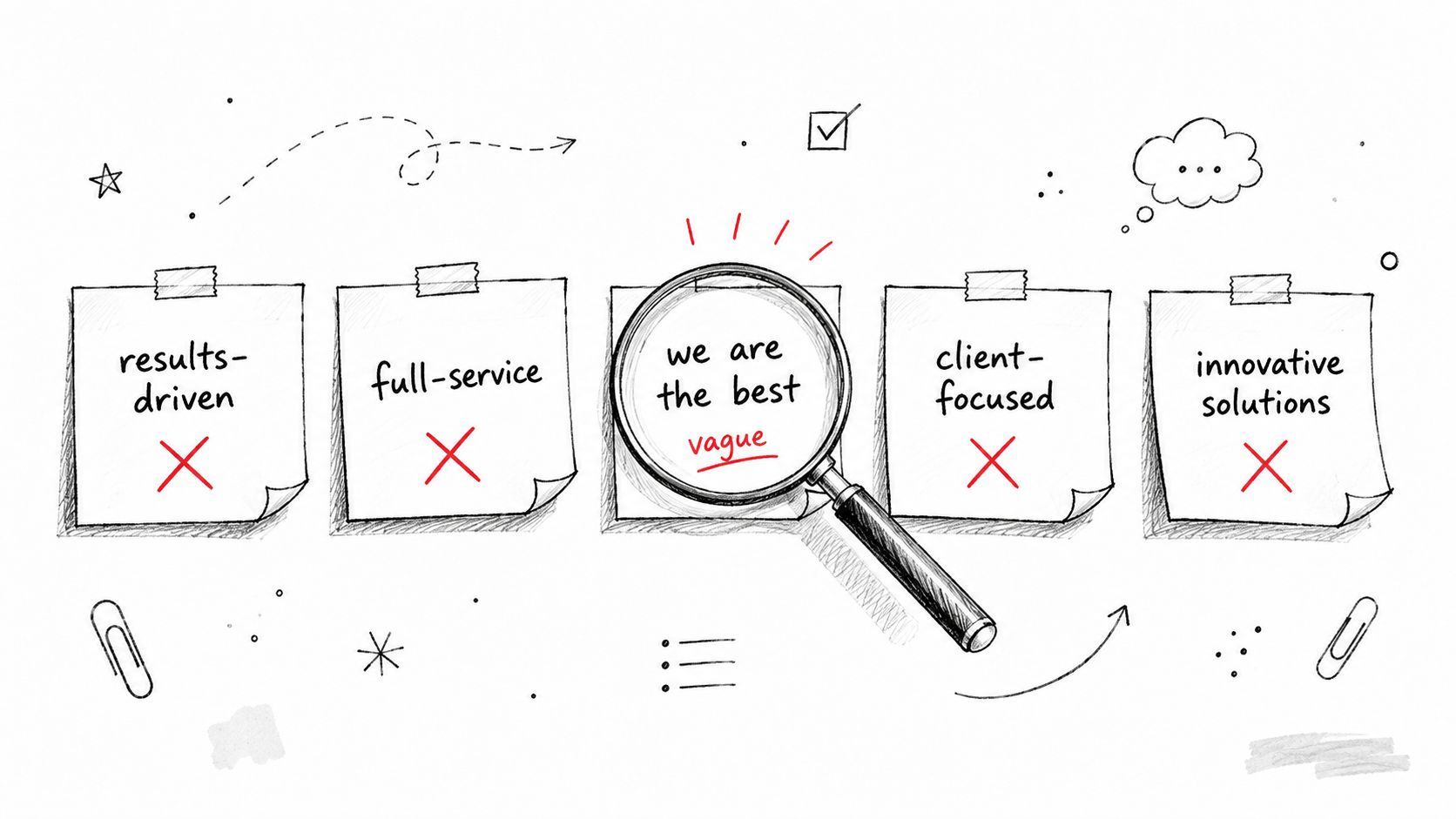
“Results-driven”
Results are the reason buyers hire you. Calling yourself results-driven doesn't identify which results, for whom, or through what method.
Replace it with: a defined customer outcome and the reporting system used to track it.
“Full-service”
Full-service often means the agency will do many things. Buyers don't automatically see that as an advantage. They may instead wonder whether the team has a sharp specialty.
Replace it with: the problem you solve end to end, including the specific handoffs your process removes.
“We are the best”
This is a conclusion, not evidence. Buyers trust proof they can inspect, not a ranking you assign yourself.
Replace it with: a verifiable capability, relevant credential, transparent process, or customer evidence. Research on weak USPs shows that credibility depends on the recommendation context, and weak claims can reduce purchase intentions when buyers perceive the source as biased. The findings are discussed in research on consumer responses to weak unique selling propositions.
“Client-focused”
Every service business claims to care about clients. The phrase becomes useful only when you describe the behavior that demonstrates it.
Replace it with: a concrete delivery commitment, such as shared decision logs, defined approval stages, or reporting tied to the client's commercial priorities.
“Innovative solutions”
Innovation without a problem is theater. Buyers don't purchase novelty. They purchase a better way to resolve a costly or frustrating situation.
Replace it with: the customer problem, the mechanism you use, and the practical change the buyer can observe.
These clichés also create a second problem. AI-generated copy tends to reproduce familiar business language because it is statistically safe. If your brand sounds like every auto-generated agency page, buyers have less reason to believe a human specialist understands their situation.
Use this kill list on every major page:
- Remove empty superlatives: Delete “best,” “leading,” and “world-class” unless you attach evidence.
- Translate capabilities into outcomes: Explain what the feature changes for the customer.
- Delete audience fog: Replace “businesses of all sizes” with the buyer you serve most effectively.
- Expose the mechanism: State how the team delivers the promised benefit.
- Add proof beside the claim: Link the statement to evidence rather than isolating it in a hero banner.
Testing Your USP Across Every Customer Touchpoint
A USP fails when the homepage makes one promise, the ad makes another, and onboarding introduces a third. Buyers don't experience your positioning as a sentence. They experience it as a sequence of signals.
Start with four surfaces:
- Homepage hero: State the buyer and primary outcome immediately. Put the mechanism or a concise proof cue close enough that the claim doesn't float unsupported.
- Paid ad headline: Compress the same idea without swapping in generic clickbait. The ad should pre-qualify the right audience, not attract everyone.
- Cold outreach opening: Lead with the buyer's recognizable problem and connect it to your specific mechanism. Don't begin with your company history.
- Product onboarding: Show the promised outcome through the first meaningful action. A SaaS USP about visibility should guide the user toward useful visibility quickly.
Use a simple review checklist:
- Specificity: Can a stranger identify the buyer and benefit?
- Proof: Is there a nearby case example, process explanation, demonstration, or relevant evidence?
- Focus: Does one primary claim dominate the surface?
- Consistency: Do the words match the actual experience?
- Distinctiveness: Could a direct competitor use the same copy?
Run a controlled copy test against your current version using comparable traffic and one primary conversion action. Don't change the offer, audience, design, and message at the same time. Record qualitative feedback from sales calls as well, because buyers often reveal which part of the promise made the company feel relevant.
Map the complete experience with customer journey mapping, then review the USP quarterly and whenever your audience, offer, competitors, or delivery model changes. The statement should guide decisions, not sit untouched in a brand folder.
Your Next Three Moves and a Closing Checklist
Take three actions over the next month:
- Audit your copy. Search every major page for “results-driven,” “full-service,” “best,” “client-focused,” and “innovative.”
- Draft the claim. Use the buyer, outcome, mechanism, and alternative template.
- Test one surface. Replace the current homepage hero or paid ad message, keep the conversion action stable, and gather buyer feedback.
Before you publish, confirm:
- The buyer is narrow enough to recognize itself.
- The outcome matters commercially.
- The mechanism is real and explainable.
- The claim has adjacent proof.
- The customer experience reinforces the promise.
If video is part of your proof system, use a practical B2B video production guide to plan demonstrations, customer stories, or process explainers that make the USP visible.
Up North Media helps businesses turn unclear positioning into sharper website messaging, conversion-focused copy, data-driven SEO, custom web applications, and practical AI consulting. Visit Up North Media to request a consultation and build a USP your ads, website, sales team, and customer experience can defend.