

The most popular advice in the AI agent vs chatbot debate is to choose an agent because it can do more. That's the wrong starting point. A system that can change an order, issue a refund, or update a customer record can also make a more expensive mistake than one that answers a question.
Start with the consequence of failure, then decide how much autonomy the workflow can safely carry. For an Omaha service business or an online retailer, the right solution might be a conversational chatbot, a tightly constrained agent, or a person who reviews a proposed action before anything changes.
AI Agent vs Chatbot at a Glance
An agent isn't just a smarter chatbot. The operational difference is what the system is allowed to do between messages, including which tools it can use and which records it can change.
These are useful purchasing categories, not rigid product labels. A chatbot interface can sit in front of an agent, and a conversational assistant can retrieve live information without having broad permission to act.
Chatbot and agent compared on core criteria
| Criterion | AI Chatbot | AI Agent |
|---|---|---|
| Primary job | Answers questions within a conversation | Pursues a goal across several steps |
| Systems it can touch | Chat text and knowledge base | CRM, order, billing and file systems through permissioned tools |
| Autonomy | Waits for each prompt | Acts between prompts within set permissions |
| Typical output | A reply the customer reads | A completed action plus an audit log |
| Main failure | A wrong answer the customer can see | A wrong change in a live system |
| Evaluation metric | Answer quality and resolution | End-to-end task success and recovery rate |
| Typical cost driver | Model usage and knowledge upkeep | Model usage plus integration, monitoring and approval design |
Read the Failure Row First
A wrong answer can still cause harm. A chatbot that misstates a return policy may create a customer dispute, so informational work isn't automatically harmless.
An agent adds another exposure: it can apply the wrong answer directly to a live system. If it cancels the wrong subscription, a fluent apology doesn't restore the customer's access or repair the billing record.
Practical rule: Buy the smallest amount of autonomy that completes the job safely.
The evaluation row matters just as much. A chatbot can produce a useful explanation while leaving execution to a person. An agent hasn't succeeded until the intended change is confirmed, exceptions are handled, and the customer receives an accurate result.
The shorthand is a chatbot answers, an agent does. Before choosing either, ask whether completing the workflow requires changing a system of record. If not, start with a bounded conversational solution; if it does, identify the exact write permissions and confirmation checks before comparing vendors.
How Each System Handles a Request
Say a customer asks to move a delivery to a different address. A conventional chatbot reads the request, retrieves the shipping policy, generates a response within the conversational turn, and waits. It may explain how to request a change, but that explanation doesn't mean the shipping record changed.
An agent needs an execution loop. The process below separates a generated answer from work performed against live systems.
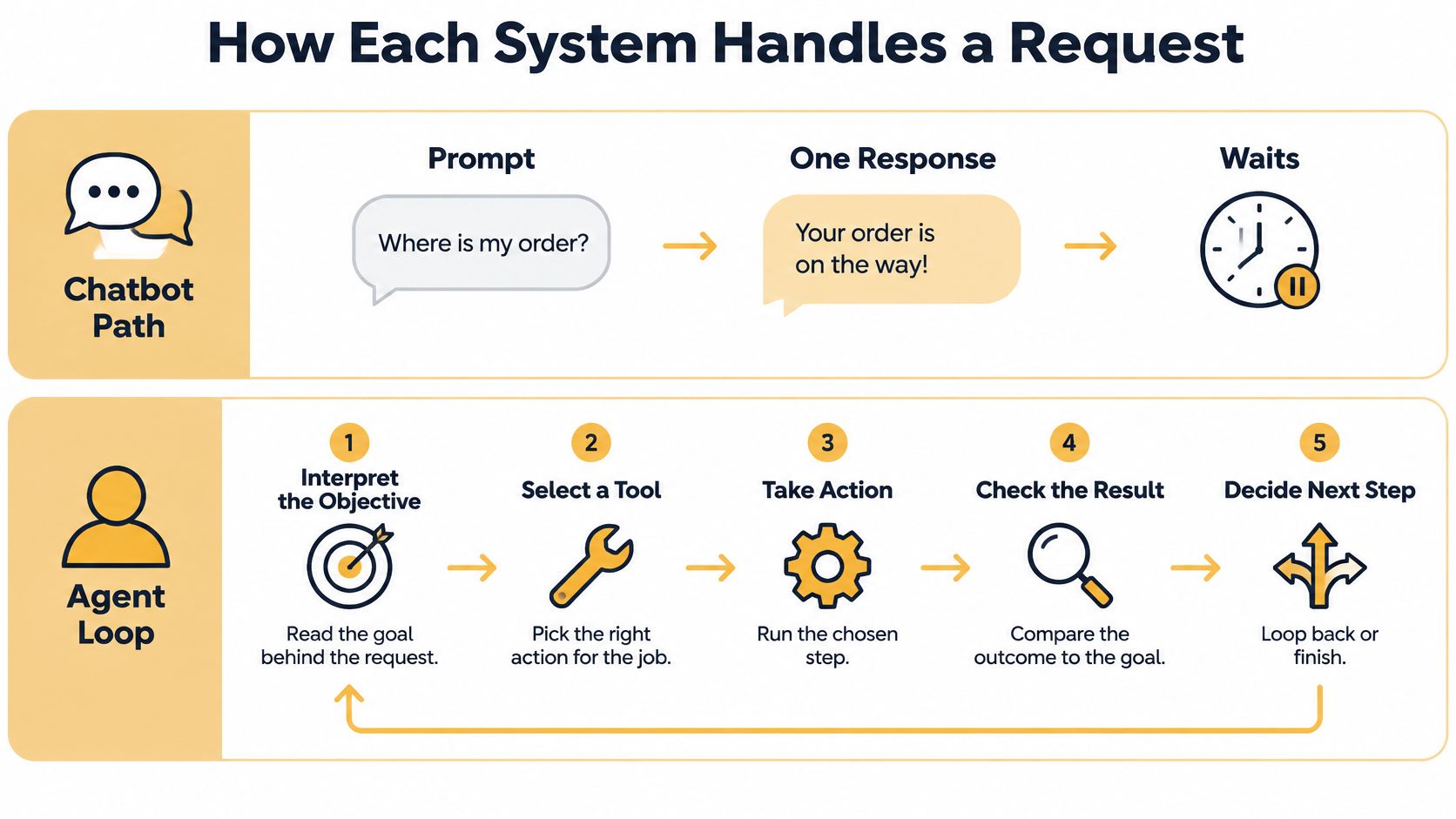
Follow the Address Change Through the Loop
- Interpret the objective. The customer wants the package delivered elsewhere, not merely an explanation of shipping rules. The agent must establish which order they mean and verify their authority to change it.
- Select and invoke a tool. It calls an order lookup rather than guessing from the conversation. The returned order identifier becomes the reference for subsequent actions.
- Observe the returned state. The order system might show that the warehouse has already released the parcel. That result determines whether an address update remains possible.
- Revise the plan. If the order is editable, the agent validates the proposed address and requests the permitted update. If it isn't, it prepares an exception for a person instead of repeatedly attempting the same write.
- Continue or stop. The agent checks whether the saved address matches the approved request. It finishes only after confirmation, or stops with a clear handoff when the workflow exceeds its permissions.
The same distinction applies to telephone support. When evaluating whether a call should end with information, a booking request, or a completed action, Estimatty on AI call handling offers relevant context for assessing the voice interface separately from the underlying workflow.
Keep Capability Claims Within Their Boundaries
In complex machine-learning engineering tasks, Stanford University's 2025 AI Index reports that leading AI systems scored approximately four times higher than human experts during a two-hour window, while human experts outscored AI systems roughly two to one at 32 hours.
That isn't a retail-support benchmark. It does illustrate why rapid, bounded tool work and sustained investigation shouldn't be treated as interchangeable capabilities.
Before implementation, write down the objective, required tools, state the system must inspect, and stopping condition. If you can't describe what confirmed completion looks like, you're not ready to delegate execution.
Autonomy Levels and the Risk Line
Removing people from a workflow can raise throughput while removing the control that prevented expensive errors. The reviewer who pauses an unusual refund may be the control, not the bottleneck.
The useful question is which decisions the system can make without someone checking them, and what happens when it is wrong. Market interest does not settle that boundary: Pragmatic Coders' report on Blue Prism's survey figures says 29% of organizations were already using agentic AI in 2025, while 44% planned implementation within the following year.
Assign Autonomy by Consequence
- Informational assistance. Use a chatbot for bounded retrieval, such as store hours or a published service-area policy. Give it an approved source and a way to decline when the answer is unavailable. The likely failure is a bad answer, so the cost stays containable.
- Constrained execution. Use an agent for a defined transaction, such as an eligible refund within an approved limit. The permission should describe the action, eligible records, business conditions, and approval threshold. The likely failure is a transaction, so the limit has to make it reversible.
- Human-reviewed decisions. Require a person for account-access changes, exceptional pricing, or other high-impact actions. Let the system gather evidence and prepare the proposed change without applying it.
Containment rate needs the same consequence test. If containment rises because the system refuses hard cases, quality may look better while risk moves into queues. If it rises because writes are succeeding, audit those completions before treating the number as success.
The boundary belongs in permissions, data access, and system connections. That is why how AI integration connects an assistant to live systems matters more than prompt wording.
Willingness to delegate is narrow. The G2 AI agents report describes nearly 50% of respondents being willing to grant agents full autonomy in low-risk workflows. Outside that low-risk zone, keep the default posture conservative and make expanded authority a deliberate policy decision.
Make the Boundary Enforceable
Approval thresholds need an owner who can change them. Audit logs should record the request, evidence, proposed action, authorization, and result. Rollback procedures must explain what can be reversed, and escalation rules must identify who receives an unresolved case.
An instruction to be careful is not an access control.
Run a concrete test before launch: can the system update inventory, issue refunds, alter customer records, or contact leads without a person approving the action? If yes, establish an explicit approval threshold or require human review before enabling that permission.
Cost, Latency and Reliability Trade-offs
Reliability and speed by configuration
The following comparison comes from a 2026 NBER working paper; its constrained agent achieves higher task success but takes roughly four times as long as the chatbot configuration.
| Configuration | Task success | Average completion time |
|---|---|---|
| Chatbot | 83.7% | 9.2 seconds |
| Chatbot with self-repair | 93.3% | Not specified in the cited comparison |
| Constrained agent | 97.4% | 34.8 seconds |
The chatbot result illustrates the speed advantage of a simpler execution path. Self-repair improves completion in this comparison, but the available timing information doesn't support assigning it a completion time. The constrained-agent result shows why better completion and faster service aren't the same promise.
These are configuration-specific results, not a forecast for your store. Test your own policies, APIs, customer requests, and failure conditions before using benchmark performance in a business case.
Route Work Before Adding More Reasoning
Send informational requests to a fast retrieval-based chatbot. Reserve agent execution for requests that need state changes or coordination across systems.
Then constrain the execution path:
- Typed tool schemas. Require explicit fields and valid values rather than accepting free-form instructions as API inputs.
- Least-privilege credentials. Allow access only to the records and operations the workflow needs.
- Explicit workflow states. Distinguish proposed, approved, submitted, confirmed, and failed actions.
- Step limits. Stop repeated attempts instead of allowing an unresolved loop to consume resources.
- Pre-action validation. Check identity, eligibility, and current record state before a write.
- Sensitive-action approval. Gate refunds, price changes, account access, and publication according to the workflow's risk.
Budget Beyond the Model Bill
Integration work includes authentication, field mapping, API error handling, test cases, and monitoring. A poorly maintained product catalog or inconsistent customer identifier can make an otherwise capable agent unreliable.
Separate support-platform licensing from automation costs. DataLunix's guide to Freshdesk cost per agent is a useful budgeting reference, but a human support seat and an autonomous execution workflow aren't equivalent cost units.
Cache stable policy answers, not sensitive account data indiscriminately. Run longer jobs asynchronously when the customer doesn't need to remain in the chat, and show truthful progress messages rather than a generic loading indicator.
Measure cost and latency per completed business outcome. For a subscription change, include retries, approval time, exception handling, and verification that the billing system saved the correct result.
Choosing Between a Chatbot and an Agent by Workflow
Choose against the actual request, not the channel it arrives through. A website chat, phone call, or messaging conversation can contain either a simple question or a consequential transaction.
The customer-facing interaction is only the visible part of the service workflow.
Order Status and Store Policies
A customer asks whether a delayed order can still arrive before an event. A chatbot can retrieve the current tracking status, explain the published delivery policy, and distinguish the carrier's estimate from a guarantee.
The decision point arrives when the customer asks the business to intervene. Requesting a replacement shipment or changing the delivery service requires more than an informational answer.
Verdict: start with a chatbot and read-only access. Route missing parcels, contradictory tracking events, and requests for compensation to a person with the order details attached. Don't let the chatbot invent a delivery commitment to keep the conversation contained.
At Up North Media, our AI chatbots provide instant 24/7 support, answer common questions, qualify leads, and route complex inquiries to human agents. That combination is useful when customers need access outside office hours without granting the system broad transactional authority.
Lead Qualification and Routing
A homeowner asks an Omaha contractor whether the company handles a particular renovation. The chatbot can collect the project type, location, desired timing, and contact preference, then pass a complete record to sales.
The important decision isn't whether the conversation sounds natural. It's whether the business has enough information to route the inquiry without making promises the sales team can't honor.
Keep qualification criteria explicit. A request outside the service area should receive a clear answer, while an unusual project should reach someone who can assess it.
Verdict: use a chatbot for collection and routing, then add constrained automation where justified. The request moves up a tier when the system starts changing CRM ownership, booking scarce appointments, or initiating outbound contact. Our integrations connect chatbots with clients' CRM and support systems for reliable data flow, but each permitted write still needs a defined purpose.
Refund Eligibility
A shopper requests a refund for a damaged item. The agent retrieves the order, checks payment and fulfillment status, applies the relevant policy, and determines whether the request fits the authorized workflow.
This is a stronger agent use case because the customer needs a completed transaction, not a paragraph about returns. Still, the agent must separate eligibility from authorization: an eligible refund may require approval because of its amount or circumstances.
A duplicate request should not produce another refund. Use the payment system's transaction reference and an idempotent operation, where repeating the request doesn't repeat the financial effect.
Verdict: use a constrained agent for eligible refunds within the approved boundary. Escalate exceptions with the order history, policy basis, proposed amount, and reason approval is needed. Never tell the customer a refund is complete until the payment system confirms it.
The following video provides an additional format for considering customer-service automation.
Inventory and CRM Updates Across Systems
Say a retailer needs to replace an unavailable item, update the order, adjust reserved inventory, and record the resolution in its support platform. A chatbot that explains those steps still leaves an employee to perform the work.
An agent is justified when it can execute the permitted sequence and verify each result. The difficult part is partial failure: the order update may succeed while the inventory adjustment fails.
Design a recovery path before enabling writes. Decide whether the system should reverse the completed step, hold the transaction for review, or create a clearly marked reconciliation task. Don't let it report success because the first API call worked.
Verdict: choose an agent with transaction-aware recovery. Changes involving mismatched customer identities, conflicting inventory counts, or unavailable rollback options should stop for human review.
Multilingual and Voice Support
A customer calls to ask about opening hours, available services, or a return window in their preferred language. A multilingual or voice-enabled chatbot can handle the routine exchange without needing authority to change records.
Voice introduces a specific decision point: the system may have misunderstood a name, address, or product code. Require confirmation of critical details before using them in any downstream transaction.
Our Omaha team develops intelligent chatbots that can handle up to 80% of routine customer interactions. That's a capability statement about routine interactions, not a reason to remove escalation or assume every caller's issue is resolved.
Verdict: use conversational automation for the routine load. Move account-sensitive questions and requested transactions into authenticated workflows. Our guide to automating customer service can help translate those boundaries into channel and handoff decisions.
Set the Guardrail Before Selecting the Product
Which option fits which situation
| Situation | Better Fit | Guardrail to Set First |
|---|---|---|
| High-volume FAQs with bounded answers | AI chatbot | Retrieval-based answers with human handoff |
| Lead qualification and routing | AI chatbot, agent later | Handoff rules and CRM sync |
| Order changes or refunds within set limits | AI agent | Least-privilege access and approval above the threshold |
| Multi-system updates across CRM and commerce | AI agent | Logged tool calls and rollback procedure |
| Irreversible or high-impact decisions | Neither alone | Mandatory human review |
Turn the decision into work your team can complete this week:
- Inventory requests. Pull representative support tickets and name the actual job behind each conversation.
- Classify consequences. Separate incorrect information, reversible record changes, financial effects, and access-control decisions.
- Start with bounded retrieval. Fix missing policy content and launch the lowest-risk conversational use case.
- Pilot constrained execution. Select an auditable workflow with limited permissions, a named owner, and an approval threshold.
- Instrument the outcome. Record completion, exceptions, repeat contacts, and correction effort from launch.
Metrics That Show Whether Either One Pays Off
High containment is a warning sign when you can't explain what happened afterward. A customer who closes the chat without reaching a person may be satisfied, confused, or giving up. Containment alone can't distinguish those outcomes.
Outcome metrics beyond containment
| Metric | What It Reveals | Why Containment Misleads |
|---|---|---|
| First-contact resolution | Whether the issue was solved in one interaction | A contained chat can still leave the issue open |
| Net revenue per interaction | Revenue gained or lost per automated conversation | Deflection ignores revenue effects |
| Error cost | The cost of wrong actions such as incorrect orders or refunds | Errors often sit outside the containment count |
| Refund or cancellation rate | Whether automated answers push customers away | A contained customer may still leave |
| Time to safe completion | How long a task takes to finish correctly | Fast responses can hide incomplete work |
| Customer lifetime value | Long-term effect on retention | Short-term deflection can reduce future purchases |
Separate Fast Access From Resolution
A customer-service study found that chatbot users generally waited less than one minute, yet successful resolution was 34%–42% for chatbots, compared with approximately 79%–87% for live agents. Those findings concern the study's service settings, not a universal ceiling for conversational automation.
The operational lesson is straightforward: measure what customers accomplished after receiving a quick response. Connect conversation records to subsequent tickets, cancellations, order corrections, and customer feedback rather than treating the end of a session as success.
Measurement standard: Count a task as complete only when you can verify the intended outcome.
For agents, test the whole workflow under normal and adverse conditions. Include expired credentials, unavailable APIs, duplicate requests, conflicting records, and customers who change their minds during execution.
A useful acceptance test checks whether the right record changed, the action was authorized, the customer received an accurate confirmation, and any exception reached the right person. Log correction costs as part of the result rather than excluding them as maintenance.
When planning AI-powered business process automation, assign an operational owner to each outcome metric. Compare completed work and its error cost against the existing process, not against how convincing the automated message sounds.
The agent earns its additional complexity only when it completes valuable work safely. The chatbot earns its place when customers get dependable answers without unnecessary integration risk.
Up North Media offers AI consulting, custom chatbots, and workflow automation integrated with existing CRM and support systems. Visit Up North Media to request a chatbot demo or discuss a specific workflow, including which actions should remain human-approved and how you'll measure a successful outcome.