
Behavioral targeting serves ads based on what people do, and a 2009 study found that behaviorally targeted ads generated 2.68 times as much revenue per ad as non-targeted run-of-network ads. That's why it matters now, when privacy rules are tighter and the old cookie-heavy playbook is getting harder to rely on.
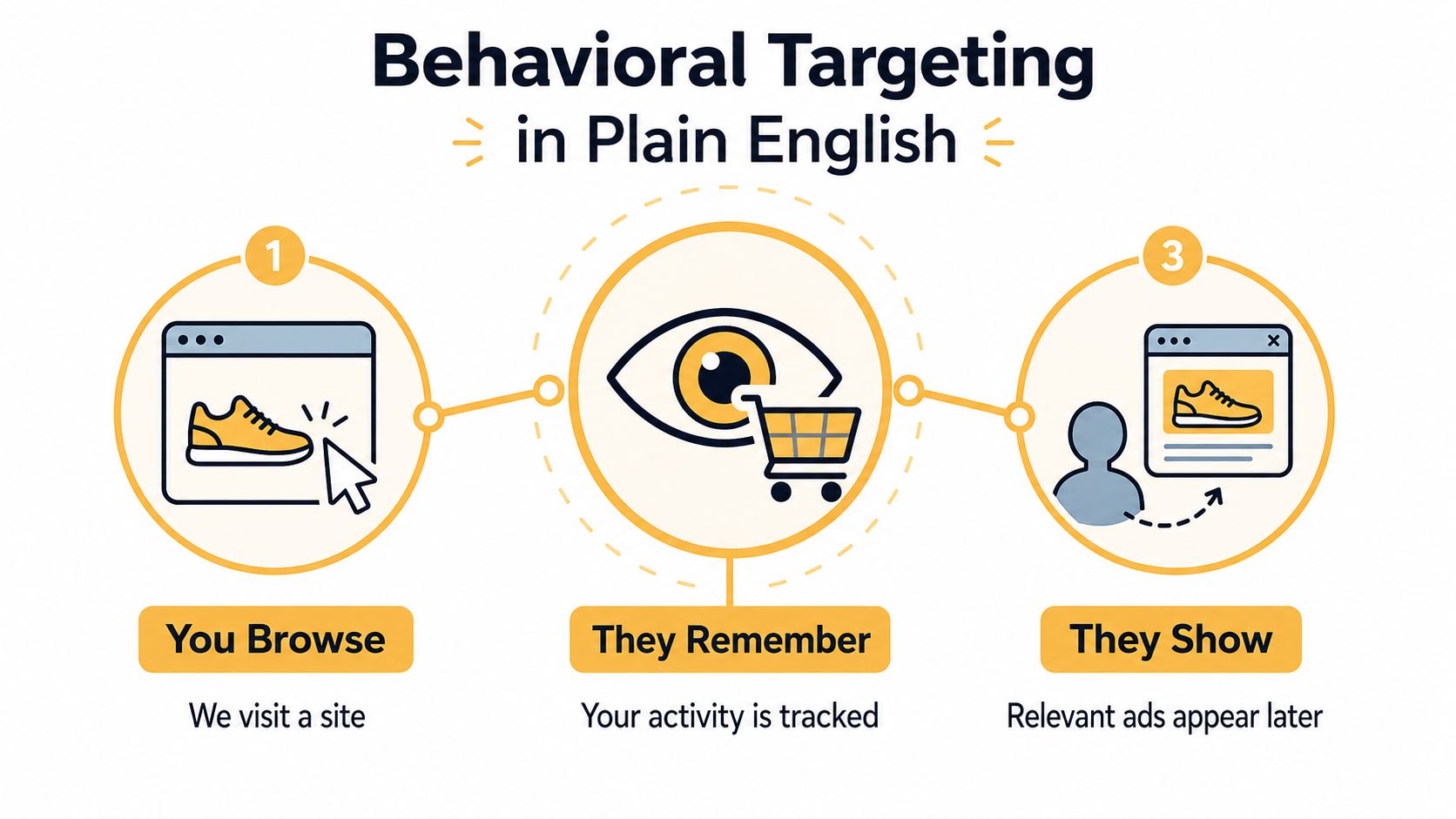
You've probably seen it already. You browse a pair of running shoes, leave the site, then those shoes seem to follow you around the web. That follow-you effect is the visible tip of behavioral targeting, a system that reads signals from browsing and other online actions, then uses them to decide which ad to show next.
Behavioral Targeting in Plain English
Behavioral targeting is serving ads based on observed user actions, not on broad guesses like age or gender alone. If someone compares two shoe brands, reads a pricing page, and returns to the site twice in a week, that behavior tells a stronger story than a demographic label ever could. The ad system uses that story to make the next impression more relevant.
A simple way to think about it is a memory loop. The site notices what you do, the ad system stores that behavior as a signal, and later it uses that signal to decide whether you belong in an audience group. The result is usually a more specific message, such as a reminder about the exact product you viewed or a related offer.
Why the distinction matters now
The old version of this tactic leaned heavily on third-party cookies and cross-site tracking. That's exactly why the definition matters in a privacy-first market, because marketers now have to separate the idea of “using behavior” from the old habit of “tracking everything everywhere.” Modern behavioral targeting still exists, but the data sources, consent rules, and measurement methods are changing.
That shift also changes how you explain the tactic to stakeholders. Behavioral targeting isn't magic personalization, and it isn't just demographic targeting with a fancier name. It's a signal-pipeline system that turns actions into audiences, then audiences into ad decisions.
If you can't explain where the signal came from, you can't explain why the ad appeared.
For marketers, the practical questions are simple. What signals are being collected, how fresh are they, how are they grouped, and how do they turn into spend? If you're mapping the concept internally, it helps to pair this definition with a broader view of user behavior analytics, because both disciplines depend on reading action patterns instead of assumptions.
If you want a research lens for observing those actions before they become ad signals, the behavior research methods guide is a useful companion resource. It's especially helpful when you're trying to separate what people say they do from what their actions show.
How Behavioral Targeting Actually Works
Behavioral targeting works in stages, and each stage depends on the quality of the one before it. A shopper who visits a running shoe page, clicks a comparison chart, returns later, and abandons a cart leaves behind a trail of behavior that can be collected and turned into a segment. The system then decides whether to bid for that user when the next ad opportunity appears.
From event capture to audience profile
The first layer is data capture. Platforms collect event-level signals from cookies, pixels, tags, server logs, and first-party interactions. That might include a pricing-page visit, a demo click, a search term, a repeat visit, or cart activity. The value isn't just that the event happened, it's that the system can attach meaning to it.
Those raw events are then normalized into profiles. In practice, that means the platform groups related actions into a session or user history, then assigns the person to an audience segment. The better the signal density, the more precise the segment usually becomes, because the system has more context and less guesswork.
From segment to ad decision
Once a segment exists, it can be sent to an ad platform, matched against available inventory, and activated in real time. That's the part most explainers flatten into “the ad follows the user,” but the mechanism matters. The ad exchange is deciding whether the person in front of the impression fits the rules for the campaign, and the creative that wins the auction is the one the bidder thinks is most likely to convert.
Practical rule: freshness matters as much as volume. A lot of stale signals are weaker than a smaller set of recent, high-intent signals.
This is why a shopper researching one category one day can be a very different prospect a week later. Browsing behavior, cart activity, and repeated visits all carry different levels of intent, and the system performs better when it treats them differently. For a broader view of how these signals are organized in practice, the article on first-party data collection is a useful companion to this one.
If you're comparing the analytical side with the ad-tech side, a solid overview of behavioral targeting mechanics shows how data capture, segmentation, and delivery fit together. That same pipeline logic is why marketers should pay attention to signal quality, not just platform choice.
The point is simple. Behavioral targeting only looks smart on the outside. Underneath, it's a chain of small decisions about what to collect, what to trust, and what to bid on.
Audience Segments That Drive Real Results
The best behavioral segments are the ones tied to a clear business action. A cart abandoner audience serves a different purpose than a repeat visitor group, and a category-affinity segment is not the same thing as a high-lifetime-value segment. If you build all of them the same way, you'll waste budget and blur the message.
The segments worth building first
A strong starting set usually includes a few high-signal groups:
- Cart abandoners: These users added something to the cart and left. They're best for retargeting and recovery offers, but they age quickly, so they need regular refreshes.
- Product-page viewers: These users showed interest without committing. They work well for reminders, testimonials, or comparison content.
- Repeat visitors: These people have returned often enough to signal active interest. They're useful when you want to move from awareness into consideration.
- Search-term intent audiences: Their searches reveal direct intent, which makes them good candidates for high-relevance creative.
- Category affinity groups: These users browse a theme repeatedly, which helps for cross-sell and broader prospecting.
- High-value customer groups: Existing buyers can be targeted for win-back or expansion, especially when they keep engaging after purchase.
The mistake often made is over-segmenting too early. A dozen tiny audiences may look advanced, but small segments can fragment spend so badly that auctions become inefficient. A few well-fed groups usually beat a complicated taxonomy that nobody has the budget to sustain.
How to think about priority
Start with segments that match a clear point in the funnel. Cart abandoners are close to purchase, repeat visitors need the next nudge, and category browsers give you room to test broader messaging. If a segment doesn't change the offer, the timing, or the creative, it probably isn't useful enough yet.
For a practical framework on how campaign audiences are grouped and prioritized, segmenting audiences for campaigns is a helpful resource. It pairs well with behavioral work because segmentation is where abstract data turns into a usable campaign plan.
The best question to ask isn't “Can we segment this?” It's “Will this segment change what we say, when we say it, and how much we bid?” If the answer is no, keep it simpler.
Real Business Examples of Behavioral Targeting
Behavioral targeting becomes easier to trust when you see how the signals and outcomes connect. The useful pattern is always the same, a behavior triggers a segment, the segment triggers a message, and the message supports a specific business action. The exact creative changes, but the logic stays consistent.
E-commerce recovering abandonment
A shopper browses running shoes, compares two products, then leaves before checkout. That behavior can trigger a dynamic product ad that shows the same shoes later on another site, often alongside a reminder or a small nudge back to the cart. The signal is simple, recent product intent.
That's where the 2009 Network Advertising Initiative findings matter. The study reported that users who clicked a behaviorally targeted ad were more than twice as likely to complete a transaction, with conversion rates of 6.8% versus 2.8% on run-of-network inventory, and behaviorally targeted ads generated 2.68 times as much revenue per ad as non-targeted ads (NAI study). For retailers, that combination of response and downstream sale is the reason retargeting budgets exist.
SaaS retargeting demo visitors
A SaaS buyer often visits a pricing page, reads the comparison page, and clicks into the demo form before leaving. That's a stronger signal than a generic homepage visit, so the follow-up ad should usually match the stage of interest, not just the product category.
In practice, the creative can lean on comparison content, customer proof, or a demo reminder. The point isn't to repeat the homepage message, it's to answer the question the user already seems to be asking. If the user was pricing-conscious, a feature comparison can work better than a broad brand ad.
Local services prioritizing repeat visits
A local services firm may not have carts or product pages, but repeated visits still matter. If someone comes back to a service page, checks a quote form, and returns again from a search, that's often a high-intent signal worth elevating.
In that setup, behavioral targeting can help the team prioritize lead follow-up or ad spend around users who have already shown urgency. The result is less about flashy personalization and more about not treating every visitor like a cold lead. That's the business value, better timing.
When Behavioral Targeting Underperforms
Behavioral targeting is powerful, but it isn't automatically the best choice. Sometimes the signal is stale, sometimes the audience is too saturated, and sometimes the user's past behavior says less than the page they're on right now. That's where contextual targeting can win.
Behavioral versus contextual and demographic targeting
Behavioral targeting uses past actions. Contextual targeting matches ads to the current page content, and it doesn't depend on personal history in the same way. Demographic targeting uses broad descriptors like age or location, which can be useful, but it's usually a weaker proxy for immediate intent than either behavior or context.
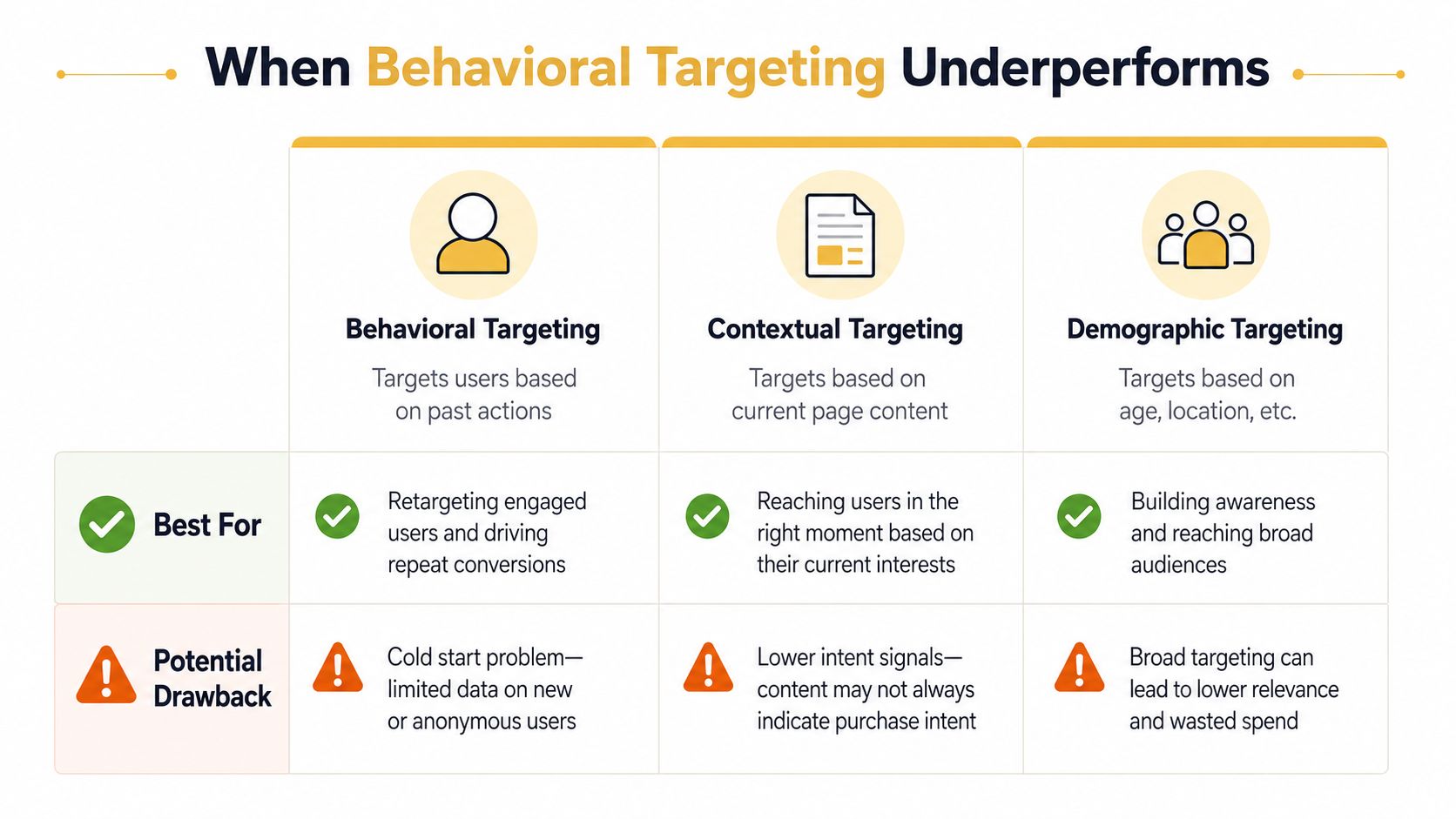
The clearest place behavioral targeting underperforms is when past curiosity gets mistaken for current intent. A person who researched a product last month may no longer be in market, especially in fast-moving categories. In those cases, contextual signals can be cleaner because the page itself tells you what the person is reading right now.
Where the signal gets weak
Privacy changes also create a measurement problem. As cookie-based tracking gets harder, audience pools can become less complete, which makes some behavioral segments noisier than they used to be. The market has responded by leaning more on first-party data and consented audiences, but that doesn't erase the fact that some behavioral setups now have weaker reach than they once did.
A good diagnostic question is whether the campaign is failing because the signal is stale, the creative is fatigued, or the auction is too competitive. Those are different problems, and they need different fixes. If the signal itself is weak, no amount of bid adjustment will rescue it.
Behavioral targeting isn't always better. It's better when the behavior is fresh, relevant, and consented, and when the message matches the user's actual stage.
The best teams use contextual targeting as a complement, not a fallback. It can be the smarter choice when the content environment is highly predictive, when the audience is broad, or when privacy constraints limit how much behavior you can safely use.
Implementing Behavioral Targeting Step by Step
A workable rollout starts with what you already know, not with a platform purchase. If your data foundation is thin, the campaign will be thin too. The cleanest sequence is to audit, wire consent, choose activation tools, then test creative and measurement together.
Start with the data you already have
Begin by listing the events you already capture on-site and in-product. That usually includes page views, clicks, form starts, purchases, demo requests, and repeat visits. The gap analysis matters because behavioral targeting depends on signal quality, and you can't improve what you don't log.
Put identity and consent in order
After the audit, make sure the identity layer is defensible. That usually means first-party identifiers, server-side tagging where appropriate, and consent handling that matches the markets you operate in. If you're trying to understand the technical side of that stack, server-side tracking explained is a useful reference.
Choose where activation lives
Next comes platform selection. Some teams activate through ad networks, some through a DSP, some through a CDP, and some through a mix of all three. The choice should follow your data maturity, not the other way around. If your audiences are small, simple activation can beat a more complex setup that takes months to stabilize.
Then build the sequence of offers. A first visit may deserve a broader reminder, while a later visit can justify a tighter retargeting message. Keep the creative aligned to the signal so the ad feels like a continuation of the session, not a random interruption.
Privacy Rules Every Marketer Must Respect
A marketer can have the cleanest audience model in the world and still run into trouble if the privacy layer is weak. Behavioral targeting now sits inside a consent and compliance framework, which means GDPR, CCPA, and similar rules shape how data is collected, stored, and activated. If the path from event capture to audience use is not defensible, the campaign is not either.
Consent is part of the operating model, not an afterthought. Teams need to know what data they collect, why they collect it, how long they keep it, and whether the user agreed to that use. Data minimization matters for the same reason a cluttered filing cabinet causes mistakes, collecting less data often reduces risk and makes review easier.
First-party data gives marketers a cleaner basis for consented audiences because the relationship is direct and easier to explain. It does not solve every privacy issue, but it gives you a better foundation than depending on opaque third-party identifiers that are harder to justify and harder to audit. Contextual targeting still has a place for that reason, since it relies less on personal data and more on the meaning of the page or placement.
The tracking stack also needs to match the privacy story you are telling. server-side tracking explained is a useful companion if you want to separate what is technically possible from what is defensible in a review.
Consent management platforms help here because they turn policy into a live workflow. Instead of assuming a banner or preference center is enough, teams can use a CMP to record choices, control activation, and keep those choices aligned across the tools that receive the data. That is the part many marketers miss. A compliant audience strategy is not just about collection, it is also about making sure downstream partners respect the same rules.
Behavioral targeting should also be checked against the market it runs in. What is acceptable in one region or product flow may be too aggressive in another, especially where users have not clearly signaled permission. If the audience cannot be used with confidence, the safer move is usually to narrow the scope, rely more on contextual signals, or delay activation until the consent record is clear.
Measurement and Best Practices That Actually Move Revenue
Behavioral targeting should be judged by what it changes, not by how busy the dashboard looks. The core metrics are incremental lift, conversion rate by segment, cost per acquired customer, signal decay rate, and consent rate. Those tell you whether the audience is fresh, whether the message fits, and whether the channel is paying its way.
Clean attribution matters more now that third-party cookies are weaker. If you need a structured view of how touchpoints are credited across the journey, HelpWithMetrics on multi-touch attribution is a solid place to compare models and terminology. The main thing is to avoid giving all the credit to the last click when behavioral targeting often works as a sequence.
The best practices are straightforward. Lead with first-party data, prioritize high-intent signals over demographic guesses, refresh audiences often, and use contextual targeting as a complement when behavior is stale or incomplete. Sequence creative by funnel stage, and document consent at every step.
Behavioral targeting is still a strong growth lever when it's built on quality signals, not surveillance theater. If you want help shaping a privacy-respecting targeting plan, improving audience quality, or connecting behavioral data to real revenue goals, visit Up North Media and start a conversation about your next campaign.