
BrightLocal's 2025 Consumer Search Behavior study, which surveyed about 1,000 U.S. adults, found that 39% estimate at least 41% of their searches are dedicated to finding information about local businesses (BrightLocal). Read that as a contractor and it stops sounding like a marketing statistic. Almost four in ten of your future customers spend close to half their search time looking for somebody nearby.
That single number explains why some roofers and plumbers get a phone that won't stop ringing while competitors with better websites sit quiet. SEO for contractors isn't about being everywhere. It's about being findable at the exact moment a homeowner's problem becomes urgent, and then being believable enough to call.
What follows is the order I'd spend the money in, the tasks most contractors skip because they're boring, and an honest read on timelines.
Why Local Search Decides Whether Contractors Get Calls
A homeowner in a west Omaha suburb hears water spreading across the laundry room floor at 7:10 on a Sunday morning. Phone out, one query typed or spoken, and Google returns a map with three pins. They tap the listing with the rating that looks safe and a phone number they can hit without scrolling. Total elapsed time: under a minute.
Every step in that minute is a place a contractor wins or loses. A thin star rating ends the visit. No photos of finished work creates doubt. A profile that says "plumbing services" but never mentions water heater repair leaves the searcher unsure they've found the right company. The website repeats the problem: land on a homepage that lists twelve services in two lines each, and the visitor has to do detective work to confirm you do the one thing they need today.
That's why a single generic homepage can't match a query like emergency plumbing repair in a specific suburb. The query carries a service, a place and a situation, and the page that wins it answers all three with evidence from that trade and that area. Local intent that heavy means location-specific visibility isn't a side channel, it's the main one.
Contractor SEO shows up in three places, and they fail independently:
- Organic search pages: your service and area pages ranking in the standard results.
- Map listings: the Google Business Profile feeding the three-pack and Maps.
- Reputation signals: reviews, mentions and directory references that tell Google and buyers you're established.
A contractor with a polished homepage and a half-finished profile loses the Sunday emergency to the company with recent reviews and a phone number above the fold.
Different trades, same structure. Painters chasing finding a home decorator nearby searches are solving an identical problem: one service, one place, one obvious next step. The rest of this guide tests the three surfaces above so you can see which one is costing you the most work right now.
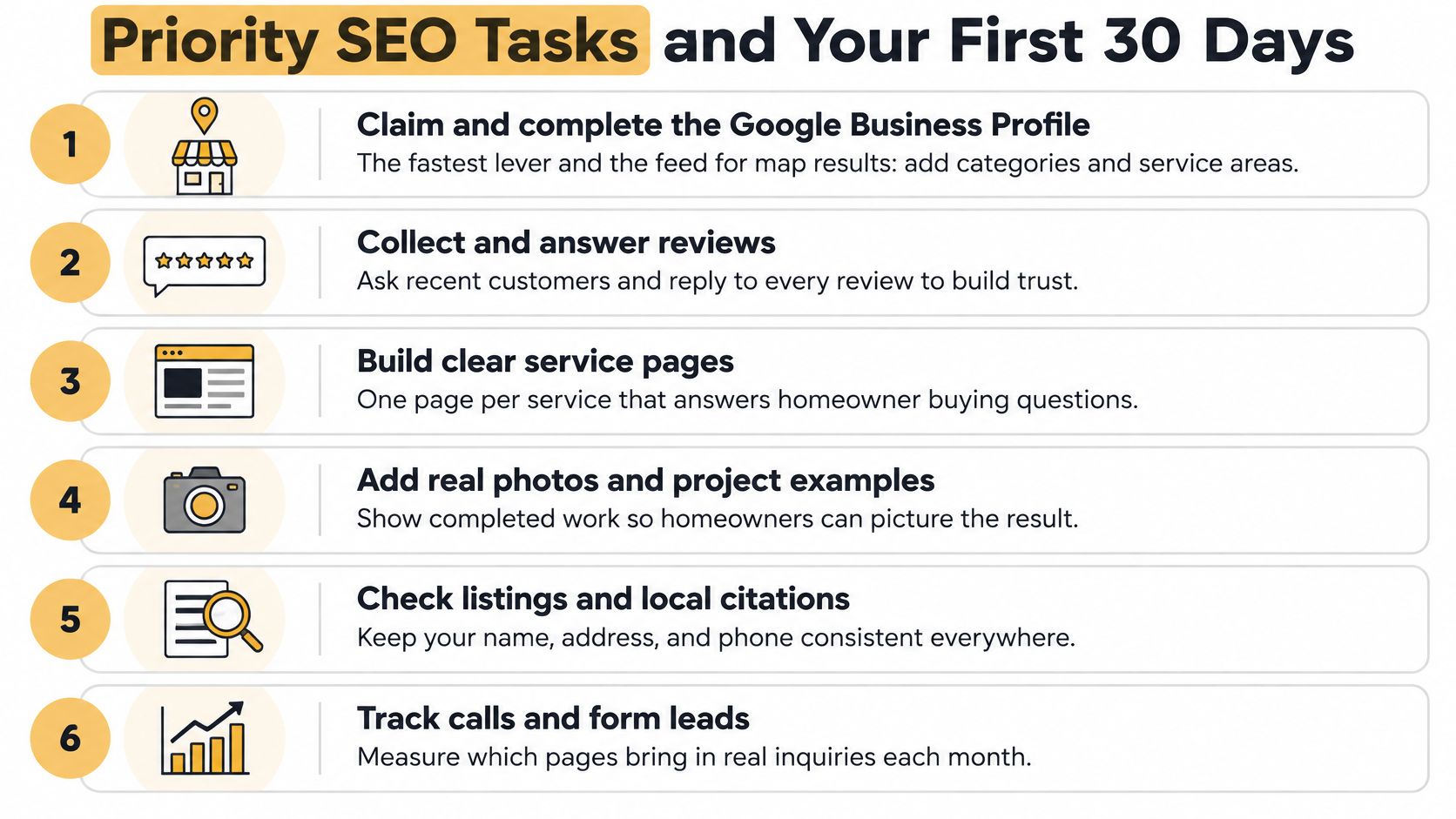
Priority SEO Tasks and Your First 30 Days
Most contractors start with the website because it's the visible thing. The fastest returns usually come from somewhere duller. Rank the work by how quickly it can move a phone call, then by effort, and the order looks like this.
| Task | Problem It Fixes | Time to See Results | Effort |
|---|---|---|---|
| Claim and complete the Google Business Profile | Missing or thin map listing | 2-4 weeks for early changes, 3-6 months for full results | Low |
| Fix name, address and phone consistency | Conflicting listings confuse matching | A few weeks, as each directory refreshes | Low |
| Build one page per core service | No match for service-plus-city searches | 3-6 months | Medium |
| Add service-area pages with real project proof | Thin or duplicated city pages | 3-6 months | Medium |
| Run a review request process | Weak prominence and few recent reviews | Ongoing | Medium |
| Fix crawl and indexing problems | Pages search engines cannot find or rank | Days to weeks once the fix is live | Low to medium |
Where the first three tasks pay off
The profile is the feed for map results, so categories, services, description, hours, service areas and photos of finished work all belong in it. Pick the most specific primary category available, add secondary categories for the other work you take, and name each service the way customers name it, not the way your supplier names it.
Row two is unglamorous and usually half-finished. Your name, address and phone need to match everywhere, down to the suite number and whether the street is written "St." or "Street." Conflicting listings give search engines a reason to doubt which version is current, and doubt costs you placements you've already earned.
Row three is the one that takes real work. A dedicated page per core service, whether that's drain cleaning, panel upgrades or roof replacement, describes the job, the situations that trigger the call, the area served and the proof that you've done it before.
What actually moves: In our local SEO process, Google Business Profile optimization is the step that shows movement inside 2-4 weeks, with fuller results over 3-6 months. Service pages and area pages take longer because they need content, internal links and time to accumulate signals.
Row four is where contractors overreach. A service-area page earns its place only when it carries project evidence, local conditions, travel limits and genuine answers. Swap the city name in a template and you've built a doorway page, not a lead source.
Turning the list into 30 days
Week 1: Audit the profile field by field and check name, address and phone across your main directories, including your own site's footer and contact page.
Week 2: List your core services and flag any without a dedicated page that contains real project proof. That flag list is the next three months of content work.
Week 3: Start the review request routine and reply to every review you've received in the past 90 days. Details on the process come later in this guide.
Week 4: Build a tracking sheet with three columns: calls from the profile, form fills per service page, and monthly rankings for your main service-and-city queries. One tab, updated monthly, beats a dashboard nobody opens.
If you check only one number next Monday, check the call count in your profile's performance report. It tells you whether the cheapest work landed before you spend anything on the expensive work.
How Google Chooses Which Contractors to Show
Map visibility comes down to three variables, and Google names them directly: relevance, distance and prominence (Google Business Profile Help).
- Relevance measures how closely your profile and website match the query. Your primary category, services list, business description and on-site service pages all feed it.
- Distance reflects where the searcher is relative to your address. You can't move the shop, so this one is only partly yours to control.
- Prominence covers the broader reputation picture: review volume and score, links, articles and directory references. Google states plainly that review count and score can influence local ranking.
The mechanism is entity matching, not keyword density. Clearer service-to-market relevance improves the odds your business matches a query, and stronger prominence signals increase confidence that you're established and trustworthy. Those are two different problems with two different budgets.
Consider a plumber based in one suburb who serves three others. In the nearest town, distance works in his favor and relevance does most of the lifting. Ten miles out, distance drags him down the pack, and one page naming all four towns spreads his relevance thin across every one of them. A dedicated page per area, with jobs completed there, common local problems such as older housing stock and galvanized pipe, travel limits and a few locally relevant FAQs, gives each market something to match on.
Proximity is the variable you can't buy. Relevance and prominence are the ones you can.
That's also why templated city pages fail. If two pages differ only by a place name, they're competing with each other for the same signals and giving a buyer nothing. Unique proof of work is what separates a service-area page from a doorway page.
For the deeper mechanics of how these signals interact, this breakdown of local SEO ranking factors is worth an hour. Budget accordingly: relevance and prominence respond to work you do, distance responds mostly to where you're located.
Service Pages That Answer Buying Questions
The "near me" page isn't the highest-value page on a contractor's site. The page that wins the job is usually the one that answers the question a homeowner is too polite to ask out loud, such as what happens when the crew finds rot behind the siding.

Homeowners don't decide fast. A 2025 home-services research summary put the share who spend one to five hours researching a contractor at 51.61%, with nearly 30% expecting to spend more than 10 additional hours (Rynoss). That's a long window, and most contractor sites spend it saying "family owned since 1998" instead of answering anything.
Map the questions to the project stage
Early-stage questions cover scope, permits, timelines and materials. Mid-stage questions cover warranties, financing, change orders and insurance. Late-stage questions ask what evidence to request before signing: license numbers, certificate of insurance, lien waiver practice, payment schedule.
A kitchen remodeler should answer all of it on one page. What does a typical project timeline look like, week by week? Who pulls the permit and who pays for it? What happens when a homeowner changes the cabinet order mid-job, and what does that change order cost in time? What's excluded from the quote?
Roofing makes the case clearly. A homeowner weighing tile against asphalt wants the tile roof replacement cost broken down before they'll take a call, because the number decides whether the conversation is worth having.
Every service page carries the same proof set:
- Before-and-after documentation of real jobs, shot from the same angle.
- Project constraints you've worked around, such as a narrow driveway or a slate roof that can't take foot traffic.
- Service-area limits stated plainly, including towns you decline.
- Review context so a five-star quote links to the full review it came from.
- A clear estimate process naming who visits, what they check and how fast a written number follows.
The video below walks through the same decision-stage thinking if you'd rather watch than read.
Track leads, not sessions
Rankings and organic sessions tell you what happened at the top of the funnel. They don't tell you which page sells. Track qualified calls, completed forms, booked inspections, close rate and revenue by landing page, so the page that generates ten tire-kickers stops outranking the page that generates two signed contracts.
You can separate the two by the question asked. A scope or permit question signals early research. A request for a price and a booking window signals someone ready to act.
Turning Reviews Into Ranking and Trust Signals
Reviews do two jobs at once, and most contractors only appreciate the first. BrightLocal's 2025 Local Consumer Review Survey, run on a representative panel of 1,026 U.S. adults, found that 96% of consumers were open to writing a business review, that 29% had written one in the previous year, and that 48% turn to local news outlets as sources for local business reviews (BrightLocal). The first two numbers say the supply is there. The third says buyers look beyond your site for it.
Job one is prominence. Reviews feed the reputation side of map ranking, and recency matters as much as volume.
Job two is language. A review that mentions a same-day furnace repair in a named town hands search engines and buyers the exact words they were already thinking. No amount of copywriting on your own service page reproduces that.
The routine is short and repeatable. Ask within 48 hours of finishing the work, while the relief is fresh. Send a direct review link by text, not a paragraph of instructions. Follow up once, then stop. Never suggest a rating.
Reply template for a complaint: "Thanks for saying this, and I'm sorry about the crew's arrival window. We texted at 8am and then didn't update you, which is on us. I've credited the second visit and changed our dispatch reminder. If you'll have us back, I'll send the same lead you had."
Two mistakes show up constantly. Asking only after jobs that went well skews the record and makes a perfect wall of five-star reviews look staged. Copying the same phrasing into requests gets you identical wording from different customers, which reads as manufactured.
Reviews left on local news sites and directories count too, so keep your business details identical across every source you're listed on. Each month, verify four things: new reviews on each platform, unanswered reviews older than a week, your score trend, and whether your name, address, phone and hours match everywhere. For the full protocol on handling the hard ones, this guide to responding to negative reviews covers the tone that protects you without sounding scripted.
Appearing in AI Answers When No Map Pack Shows
A map pack isn't guaranteed anymore. Research across 540 local-business queries in Houston, Phoenix and Denver found Google AI Overviews in 68% of them, with traditional local-pack results appearing far less often in the same study (Whitespark). Broader industry studies tracking far larger query sets point the same direction: AI Overviews now surface on a substantial share of local-business searches.

The practical meaning is uncomfortable. A homeowner can get a written answer naming three companies, with links, and never see a map. The question changes from "how do I rank locally" to "how does a roofing or HVAC company become the source an AI answer cites." This is a lead-quality problem before it is a ranking problem, because a citation that reaches a ready-to-book homeowner outperforms ten city pages nobody reads.
What gets a contractor cited
Consistent entity details. Same name, address, phone, hours and service list on your site, your profile and every directory. Machines reconcile across sources, and mismatches cost you.
Independently verifiable project evidence. Case studies with location, materials, constraints and outcome, published on pages a third party can link to. A single documented job with real detail outweighs a stack of thin service-area pages here.
Structured service information. Clear service descriptions and accurate business markup, so a machine can read what you do and where.
Visible topical expertise. A page that explains how ice dam damage forms in Nebraska beats a page that lists "storm damage" in a bullet.
Reviews with specifics. Language from customers about a particular job gives an answer engine quotable material.
A monitoring routine you can run monthly
- Run five to ten natural-language prompts per service and city, phrased the way a homeowner would say them out loud.
- Split branded prompts from nonbranded ones, and record them separately.
- Note every source cited in the answer, including whether your profile data or a third-party directory appears instead of your site.
- Track lead quality alongside ranking, since a citation in an answer that never produces a call is a vanity metric.
The evidence here is recent and varies by query intent, so measure in your own markets before moving budget. One consistent finding cuts against old habits: proximity still matters, but AI answers appear to weigh distance less than traditional local results do. Contractors willing to publish real project detail travel further than their service radius used to allow. The mechanics of getting cited, from markup to content structure, are covered in this guide to how to optimize for AI Overviews.
Up North Media builds local SEO programs for contractors around exactly this order of work: profile and citation cleanup, service and area pages that carry real project evidence, review management, and monthly reporting that connects rankings to calls and booked estimates. If you're not sure which of the three surfaces is costing you the most leads, an audit of the profile, the pages and the citations comes before you spend another dollar on ads. Book a free consultation at Up North Media.