
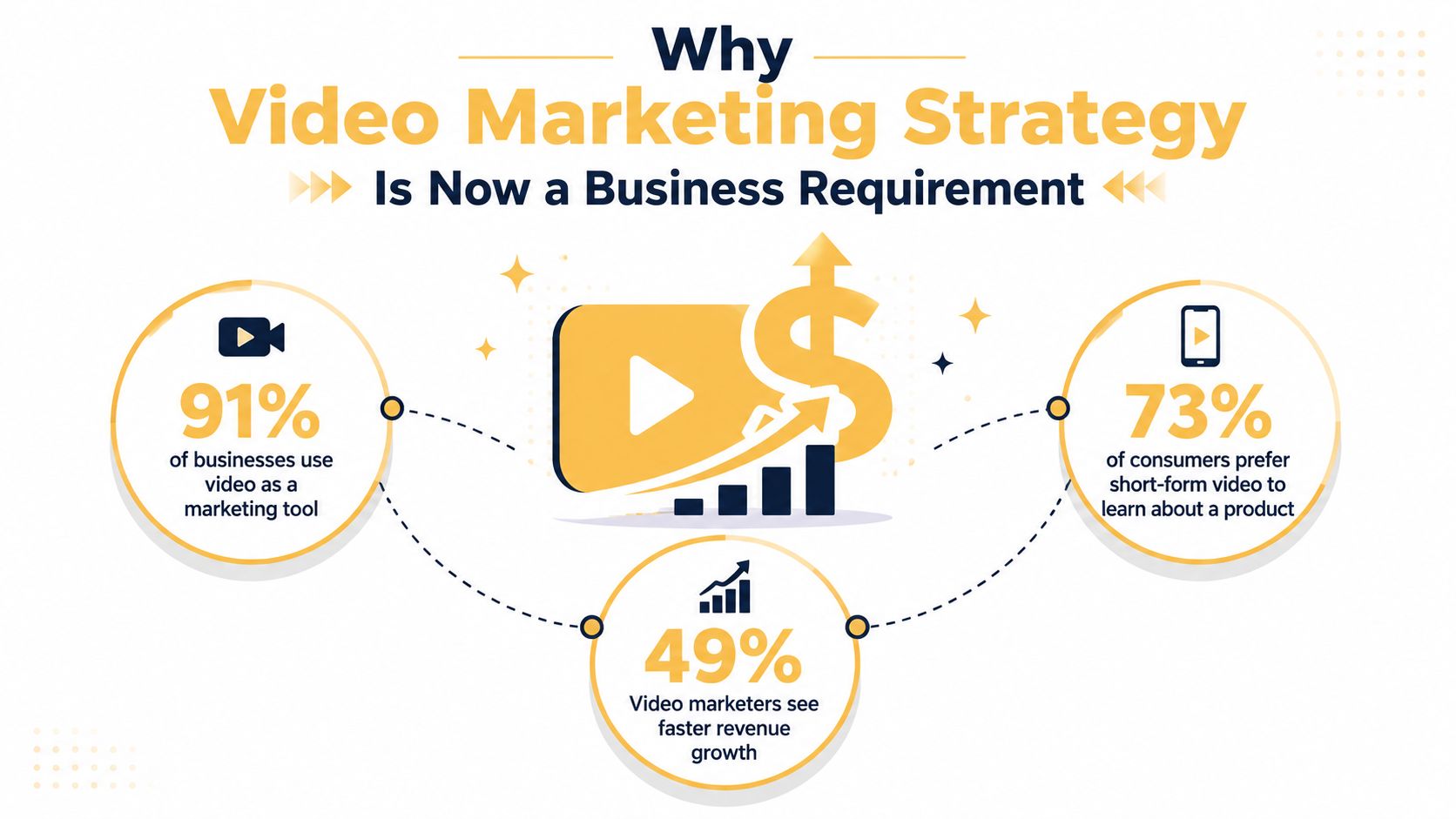
Video marketing has shifted from a side experiment to a default operating model. By 2026, about 91% of businesses were using video in marketing, up from 61% in 2016, and 93% of marketers said video was a key part of their overall strategy, which tells you this is no longer a novelty channel, it's infrastructure for modern campaigns (Siege Media). For SMBs and e-commerce teams, that shift changes the job. The question isn't whether to make videos. It's how to build a video marketing strategy that gets seen, gets measured, and earns its keep.
The mistake I see most often is treating video like a production challenge. Teams obsess over lighting, lenses, and motion graphics, then launch a polished asset that nobody finds, nobody finishes, and nobody ties back to revenue. The better model is to treat video as a distribution and measurement problem first, then make production decisions that support that system.
A useful way to think about the work is simple. The most effective teams plan video the same way they plan SEO and paid media, with a business goal, a target audience, a channel plan, and analytics that are set before filming starts. For a broader framework on aligning content with business objectives, the AI-driven marketing strategy guide is a solid companion read.
Why Video Marketing Strategy Is Now a Business Requirement
The strongest reason to take video seriously is that the market already has. In the latest tracking, 93% of marketers identified video as a key part of their overall strategy, and earlier reporting showed 89% of businesses using video in marketing and 95% saying it mattered to their business. That level of adoption means competitors are no longer debating whether video belongs in the mix, they are deciding how it fits into the funnel and how much budget should go to promotion instead of polish (Siege Media).
Video also solves a practical communication problem. Product pages, email sequences, landing pages, and social feeds all ask for faster explanations than text alone usually delivers. Teams that build video into core campaign planning can show products in motion, answer objections sooner, and support conversion without forcing buyers to do all the work themselves.
The real reason many teams still underperform
Most SMBs do not lose because their videos look bad. They lose because they launch with no distribution plan, no event tracking, and no follow-up use for the asset. A single polished video posted once is not a strategy. It is an expensive file.
Practical rule: if a video cannot be reused on a landing page, in email, on social, and in retargeting, the team probably overpaid for polish and underinvested in reach.
That is why the channel has to be managed like a system, not a creative one-off. The business requirement is to map video to a goal, distribute it on purpose, and measure the revenue effect. When that is missing, even good content gets buried.
The fastest way to make video useful is to start with the audience's questions, not the brand's opinions. Customer support tickets, sales-call objections, and search queries all reveal what buyers want to understand before they buy. If your team needs a practical persona exercise before mapping those questions, the internal guide on how to create buyer personas is worth using as a working document.
Build the goal before the video
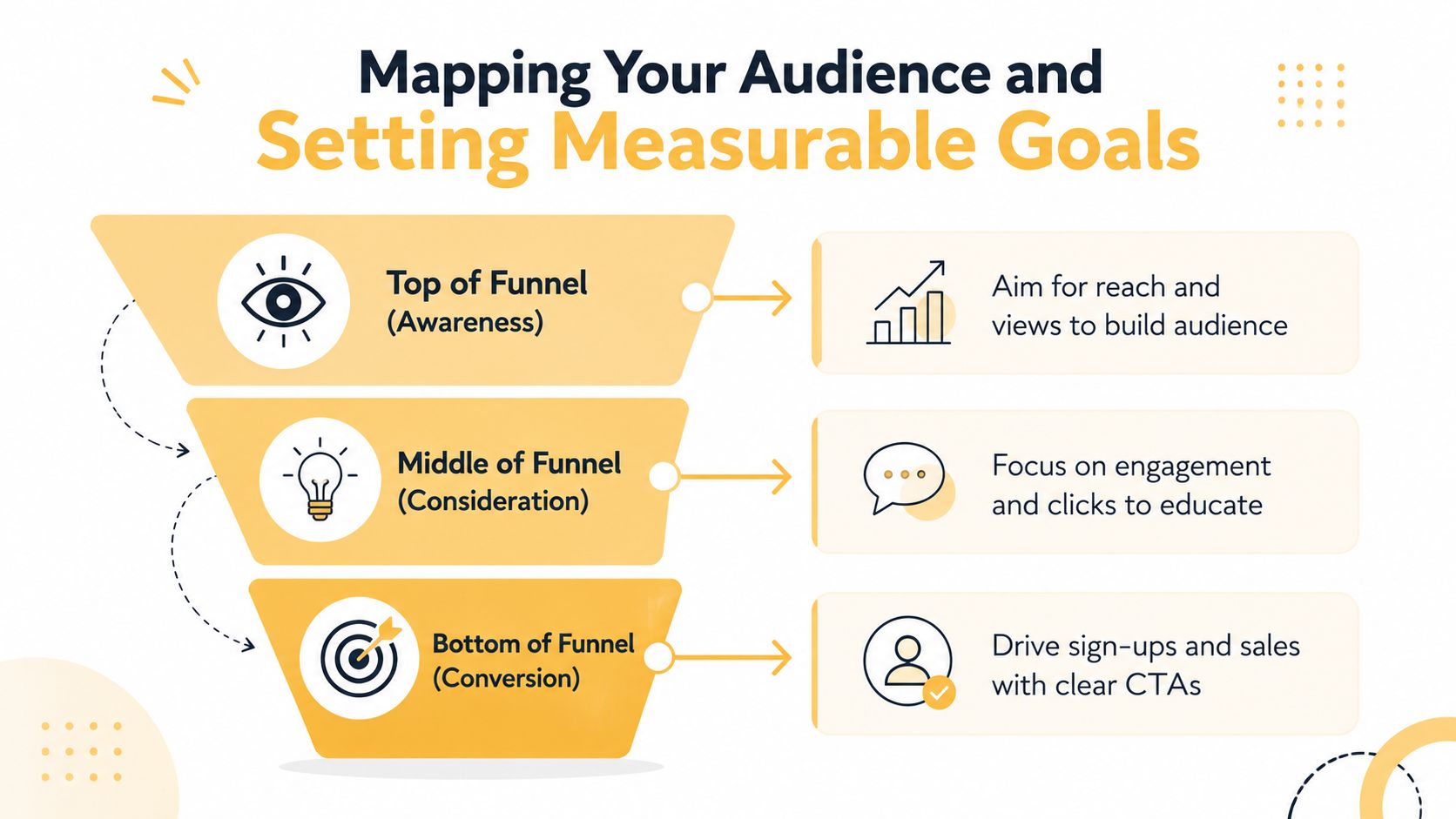
A video goal should connect to one stage of the funnel and one business result. Awareness videos need reach and engagement. Consideration videos need clicks, watch time, and product understanding. Conversion videos need form fills, demo requests, or sales-assisted revenue.
That structure keeps the work honest. A team cannot claim success just because a clip got views if the clip was meant to drive product-page action. The more specific the goal, the easier it is to decide what the video should say, where it should live, and how aggressively it should be promoted. For planning that sequence against broader campaign goals, the AI-driven marketing strategy guide is a useful companion.
Choosing the Right Video Formats for Your Budget
Video budgets stretch further when every format has a clear job. A product demo, a testimonial, and a short social clip can all support the same campaign, but each one solves a different problem and needs a different level of production effort. The practical choice is to match the format to the sale stage and the decision you want to move.
For B2B and higher-consideration purchases, demos and testimonials usually carry the most weight because buyers want proof they can trust. That fits the broader research showing 73% of B2B buyers prefer video to learn about a product or solution, and 96% watch videos before committing to a purchase, especially demos and testimonials (Levitate Media). For SMBs, that makes a strong case for spending on content that answers objections and lowers uncertainty before a sales conversation stalls.
Format by format, what's worth the spend
| Video Format Comparison for SMBs | |||
|---|---|---|---|
| Format | Production Cost | Best Funnel Stage | Ideal Use Case |
| Product demo | Moderate | Consideration, conversion | Showing how the product works and why it solves a specific problem |
| Customer testimonial | Low to moderate | Conversion | Building trust near the decision point |
| Explainer video | Moderate | Awareness, consideration | Simplifying a service, software flow, or offer |
| Behind-the-scenes content | Low | Awareness, loyalty | Humanizing the brand and giving buyers context |
| Short-form social clip | Low | Awareness | Fast platform-native reach and top-of-funnel discovery |
| Personalized sales video | Low to moderate | Conversion | One-to-one outreach, follow-up, or high-intent lead nurturing |
The biggest trade-off is specificity versus reach. Explainer videos can clarify a broad offer, but they rarely close a deal on their own. Testimonials are faster to produce and often deliver stronger trust signals because they sound closer to the buyer's own doubts. Personalized videos make the most sense when the sales cycle runs longer and a rep needs a way to stand out without building a separate campaign for every prospect.
The main reason many teams still underperform
In practice, many SMB video campaigns miss because distribution and testing get too little budget, while production gets too much. A polished asset posted once can still disappear fast if it never gets a real test across channels, audiences, or hooks. That is an expensive file that goes unnoticed.
AI-assisted production shifts the economics for smaller teams. It does not replace the need for a sharp message, but it can reduce the friction around editing, captions, localization, and personalization. That matters because budget should buy more iterations and more placements, and AI-driven video production essentials is a useful reference point for planning leaner execution.
A useful filter is this. If a format helps the buyer decide faster, it deserves budget. If it only makes the brand look more cinematic, it is probably not the first dollar you should spend.
Building a Lean Production Workflow
Lean video production starts with a simple constraint, make more usable assets in less time. That means scripting for clarity, batching filming, and editing with reuse in mind. It also means accepting that a video can be effective without being overproduced.
Build once, reuse many times
The best small-team workflow starts before the camera turns on. Write a short script, define the hook, and decide where the clip will live, a product page, email, LinkedIn, or a paid social test. Then batch multiple videos in the same session so the setup cost gets spread across several assets.
One practical benchmark is to batch 4 to 6 videos per session, which keeps throughput moving without burning out the team (SFGATE Marketing). That approach works because the core setup, lighting, framing, backdrop, and templates, stays constant while the messaging changes.
Operational rule: capture the cleanest version first, then grab the variations, not the other way around. Teams waste the most time when they chase perfection before they've captured enough usable footage.
The editing phase should focus on speed and consistency. Reuse intro cards, lower thirds, outro CTAs, and caption styles so each piece doesn't require a fresh design pass. Subtitles matter because a lot of mobile viewing is silent, and the first seconds of the clip need to land before the scroll takes over.
Distribution begins immediately after export, not after the team gets bored of the project. A lean workflow should also set a hard timeline. Concept and script on day one, filming in a single block, edit and captions soon after, then publish while the topic still matters to the audience. That's the difference between a content pipeline and a pile of forgotten drafts.
The core mistake to avoid is overbuying gear. Better framing, clearer audio, and tighter editing usually move performance more than a more expensive camera body does. For most SMBs, the money should flow toward repeatable production and fast distribution, not premium gear that sits in a drawer.
Distribution and Promotion Tactics That Drive Results
Distribution deserves more budget than production, plain and simple. A well-made video that reaches too few people is a sunk cost, while a decent video with strong distribution can still generate clicks, leads, and sales. The first money should go to the places where your audience already spends time, then to testing, then to polishing what proves itself.
Put the first post where momentum matters
Native posting on the primary platform should happen first, then repurposing to secondary platforms should follow within a short window to preserve momentum. That sequencing matters because platform algorithms tend to reward content that gets early engagement, not content that arrives late after the conversation has moved on.
YouTube is still the strongest home for searchable educational content, especially when titles, descriptions, and thumbnails are built around intent. If YouTube is part of your mix, the internal guide on YouTube SEO best practices is a useful companion for metadata and discoverability. LinkedIn works better for B2B authority and sales-adjacent content, while Instagram and TikTok reward shorter, faster hooks and native formatting.
Paid amplification should start small and only after an organic post proves it can hold attention. A limited test on your strongest clip tells you far more than boosting an unproven concept. The goal is to buy more learning on the message that already has traction, rather than just buying views.
Where the budget usually goes wrong
Common failures are easy to spot.
- Too much spend on production: the team creates one polished asset, then has nothing left for promotion.
- No platform-specific versioning: the same cut gets posted everywhere, even when the audience behavior is different.
- Weak thumbnail and caption work: the video never gets the click because the wrapper did its job badly.
- No email or partner lift: the asset sits in social alone when it could also support owned channels and co-marketing.
Email is especially underrated because it reaches people who already know the brand. Partner distribution and community sharing can also expand reach without a large media bill, but only if the content gives those partners a reason to share it. The distribution plan should be written before the shoot, not after the edit.
Budget discipline matters here more than polish. SMBs and e-commerce teams usually get better returns by funding distribution tests, thumbnail variations, audience targeting, and a few strong follow-up edits than by chasing a more expensive finish on one hero video.
Measuring What Matters and Proving ROI
Measurement is what turns video from a content expense into a business asset. If the dashboard only shows views, the team will keep optimizing for attention that may never turn into revenue. The better approach is to track the right metric at each funnel stage and connect those numbers to the sales system.
Match KPIs to intent
Awareness metrics tell you whether people noticed the content. Consideration metrics tell you whether they stayed with it and took a next step. Conversion metrics tell you whether the video influenced action.
Analytics discipline matters. Build tracking before launch with UTM parameters, platform-native analytics, and CRM integration so video touches can be connected back to leads and opportunities. If the team launches first and tracks later, the data gets messy fast, and stakeholders start questioning whether the channel is worth the trouble.
The cleanest video report is the one that ties a specific asset to a specific audience action, then follows that action into the pipeline.
The useful KPIs are the ones that fit the business model. For an e-commerce brand, that may mean product-page engagement, click-through behavior, and assisted revenue. For a B2B team, it may mean lead quality, pipeline contribution, and whether video-influenced opportunities advance more reliably than those that never touched video.
What a useful dashboard should answer
A good dashboard should let a leader answer three questions quickly.
- What content got attention?
- What content moved buyers closer to a decision?
- What content can be credited, even partially, to revenue?
That framing forces the team to stop celebrating vanity metrics as if they were proof. It also makes optimization easier, because you can identify where viewers drop off, which clips generate action, and which formats deserve another round of testing. Video proves itself when the data connects to business outcomes, not when the play count looks impressive in isolation.
Your 90-Day Video Marketing Implementation Plan
The first 30 days should build the foundation. Define the goal, document the audience pain points, choose the first two or three formats, and write a content calendar that maps each video to a funnel stage. If you need a practical scheduling structure, the internal guide on how to create a content calendar is a good starting point.
Days 31 to 60 should focus on production and testing. Batch the first set of videos, publish them on the primary platform first, then repurpose quickly across the secondary channels. Watch which hooks, topics, and CTAs earn attention, then cut the weak ideas fast.
Days 61 to 90 should go into scaling and refinement. Put paid support behind the best organic performers, update the dashboard, and use the early data to decide which formats deserve more budget. That's also the right time to lean harder into short-form, cross-channel publishing, and AI-assisted personalization, because the channel is moving toward faster iteration and more individualized execution.
The teams that win with video don't make the fanciest content. They build a system that keeps shipping, keeps learning, and keeps tying each asset back to a real business result.
If you want help turning video into a measurable growth channel, Up North Media can help you build the strategy, distribution plan, and tracking setup that make the work pay off. Visit Up North Media to talk through a practical plan for your next campaign, whether you're trying to improve e-commerce conversion, strengthen SEO, or launch a leaner video program that drives revenue.