
You may be in this exact spot right now. Someone told you the fastest way to rank in Omaha, Lincoln, Papillion, Council Bluffs, and every nearby market is to publish a separate page for each city, swap the city name in the headline, and let Google do the rest.
That advice can wreck a site.
Business owners usually don’t set out to use spam. They’re trying to solve a legitimate problem: how to show up for more local searches without opening an office in every city or writing dozens of pages from scratch. The trouble starts when a useful local SEO tactic turns into a doorway page strategy.
If you’ve asked “what are doorway pages?” the short answer is this: they’re pages built mainly to capture search traffic, not to help the person who lands on them. They often look like location pages, service pages, or product variation pages, but they offer little unique value and push visitors toward the same destination. That’s why they sit in a dangerous gray area for local businesses.
An Introduction to Doorway Pages
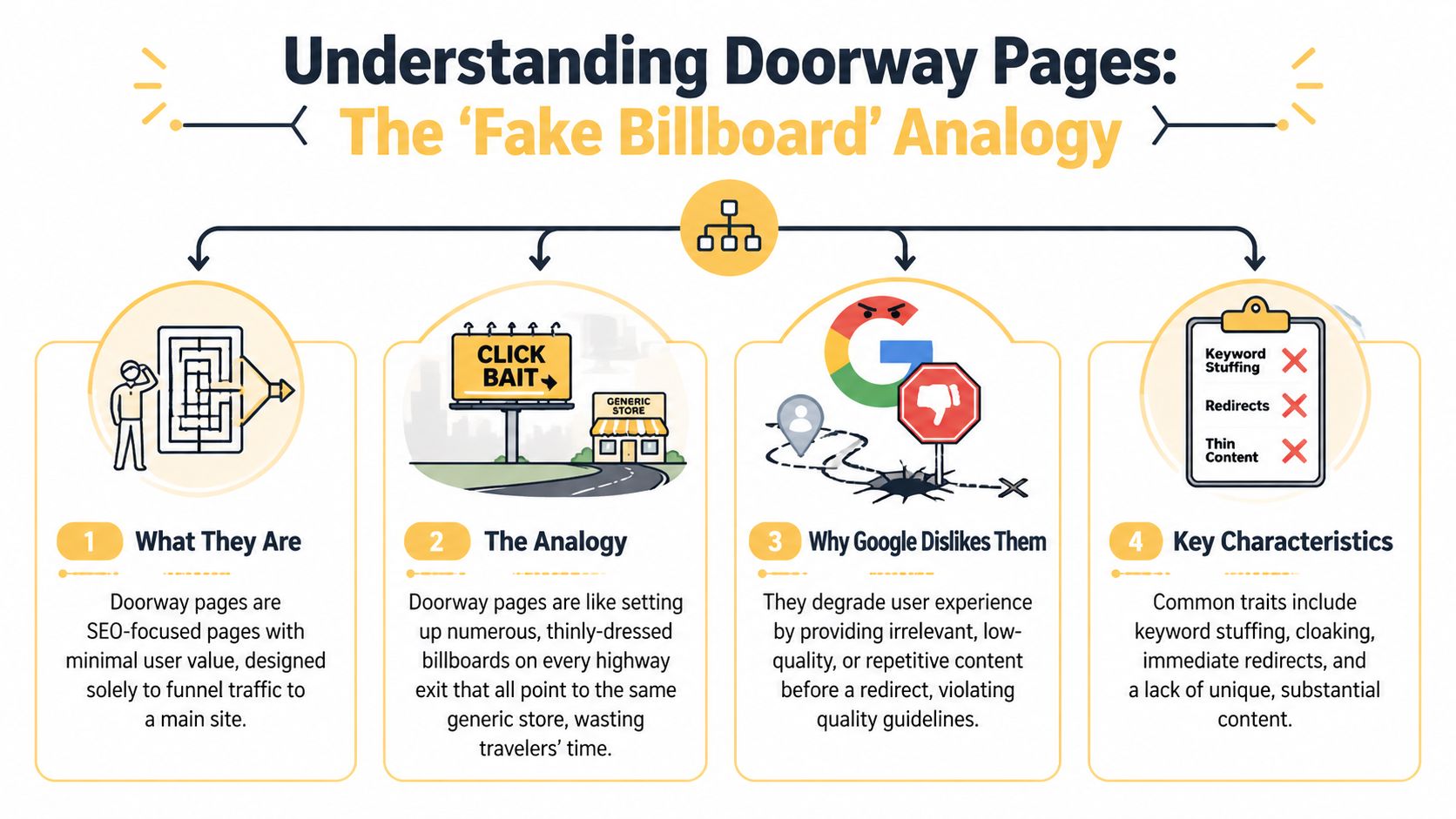
A doorway page is a low-value page created to rank for a narrow keyword variation and funnel the visitor somewhere else. Sometimes that “somewhere else” is a direct redirect. Sometimes it’s a generic service page, a form page, or a nearly identical page elsewhere on the site.
Here's a simple analogy: a business sets up dozens of fake billboards on every highway exit. Each billboard promises something highly specific. “Best plumber in Omaha.” “Emergency plumber in Bellevue.” “Drain repair in Papillion.” But every billboard points to the same small shop with the same pitch and no meaningful difference for the traveler. The billboards aren’t there to help people choose. They’re there to intercept traffic.
What a doorway page usually looks like
Doorway pages tend to share a few patterns:
- Minimal original value that says little beyond the target keyword
- Duplicated structure across many pages with only light edits
- Funnel behavior that pushes users to one main page, one form, or one conversion point
- Search-first writing that sounds engineered for rankings rather than written for buyers
The core problem isn’t just duplication. It’s intent. A page can be short and still be useful. A page can target a city and still be legitimate. A page crosses the line when it exists mainly to capture one more query without adding anything meaningfully different for the user.
If someone lands on the page and learns nothing they couldn’t have learned on five other pages on your site, you’re already close to doorway territory.
That’s why doorway pages aren’t a clever shortcut. They’re closer to a trapdoor. They may get indexed, they may even surface for some long-tail terms for a while, but they create weak user experiences and expose the site to avoidable risk.
Why Doorway Pages Violate Google Guidelines
Google treats doorway pages as spam because they clutter results with pages that don’t serve distinct user needs. The searcher expects one thing, clicks, and often lands on a thin page, a near-duplicate, or a redirect path that wastes time.
The user experience problem
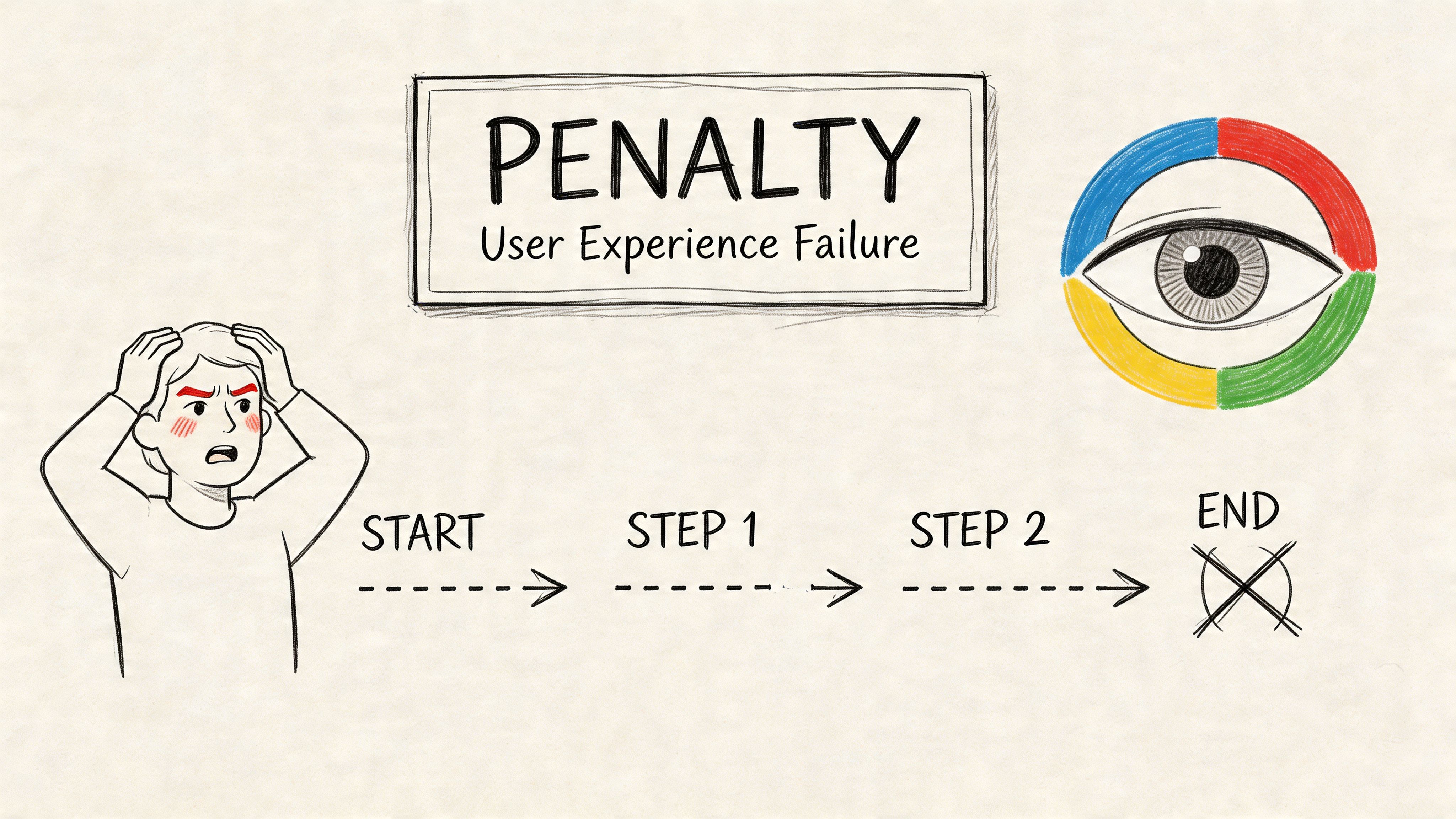
Google’s spam policies focus heavily on whether a page offers real value. Doorway pages fail that test because they create an extra step between the search and the answer. Instead of helping the person solve a problem, the page exists to occupy search result real estate.
That creates a poor experience in a few common ways:
- Mismatch of intent because the page promises a highly specific answer but delivers generic copy
- Repetition because several pages on the same site say the same thing with tiny wording changes
- Forced navigation because the visitor has to click again to reach the actual useful page
- Low trust because the page feels manufactured, vague, or disconnected from the rest of the site
This is also why doorway pages often show up alongside other manipulative tactics. If a team is willing to mass-produce low-value pages, they may also rely on redirects, cloaking, or deceptive internal linking. For a useful broader look at how manipulative search behavior can damage trust and visibility, Ilias Ism's SEO insights are worth reading.
Google has enforced this for years
This isn’t a gray rule that appeared last week. Google formalized its fight against this tactic with the Doorway Page Update on October 21, 2015, and some affected sites reportedly saw drops of up to 90% in organic traffic when manipulative pages were demoted or de-indexed, according to Manning Marketing’s summary of the Doorway Page Update.
That date matters because it tells you something practical. Doorway pages aren’t a temporary loophole. They’ve been a known violation for a long time, and search systems have had years to improve at spotting large-scale patterns.
Practical rule: If an SEO tactic depends on publishing many pages that are nearly the same, assume you need a stronger reason than “more rankings.”
A lot of business owners get burned because the pages don’t look obviously spammy at first glance. They have branding. They have headings. They may even have a few paragraphs of copy. But if the pages are built for query capture rather than user value, they sit on unstable ground.
If you want the safer baseline to compare against, this SEO best practices checklist is a solid reference for what a healthy, user-first site structure should look like.
Spotting Doorways in the Wild
Most doorway pages don’t announce themselves. They hide behind familiar page types. Local service pages are the classic example, but e-commerce filters, affiliate pages, and franchise microsites can all drift into the same pattern.
A common version looks like this. A home service company creates pages for “roof repair Omaha,” “roof repair Lincoln,” “roof repair Fremont,” and “roof repair Bellevue.” Each page uses the same paragraph order, the same testimonial block, the same calls to action, and the same service list. The only real change is the city name. Every page pushes the visitor toward one estimate form on the main service page.
Three examples that should raise concern
-
City-swap service pages
These pages change the place name but not the substance. They’re especially risky when the business has no local proof, no market-specific details, and no meaningful difference in the offer. -
Product variation sprawl
An e-commerce site creates many pages for tiny keyword variants even though the shopper ends up at the same product set. If the page doesn’t help someone choose, compare, or understand the variation, it starts behaving like a doorway. -
Lead gen funnels with generic copy
Some sites create large sets of pages around keyword permutations, then push all traffic into one quote form. If the pages exist only to rank and route users onward, that’s the same problem in a different costume.
Doorway page vs quality landing page
| Characteristic | Bad Doorway Page | Good Location/Landing Page |
|---|---|---|
| Purpose | Captures a keyword variation and funnels traffic onward | Answers a specific need for a specific audience |
| Content | Thin, repetitive, lightly edited from a template | Unique, useful, and tailored to local or topic-specific intent |
| Destination | Sends users to the same generic service or contact page | Stands on its own and can convert without another forced step |
| Local relevance | Mentions the city name repeatedly | Includes real service-area detail, local proof, and market context |
| Site integration | Often weakly linked or orphaned | Connected to navigation, related services, and supporting content |
| User value | Little reason to exist as a separate page | Clear reason for the page to exist independently |
The gray area that confuses local businesses
Not every location page is a doorway page. That’s the part that trips people up.
A legitimate location page earns its place by helping a person in that area make a decision. It might mention neighborhoods served, explain logistics, show examples from that market, answer local objections, or clarify service availability. A spammy version only changes the city name and keeps everything else interchangeable.
The fastest test is this: if you removed the location name, would the page still be distinct from the others on your site?
If the answer is no, don’t assume “local SEO” protects it. Search engines look at page purpose, uniqueness, and user value, not just whether the keyword has a city attached.
How to Audit Your Website for Doorways
If you suspect you have doorway pages, don’t start deleting URLs blindly. Audit first. You need to find patterns, identify your strongest pages, and decide which pages deserve improvement versus consolidation.
Start in Google Search Console
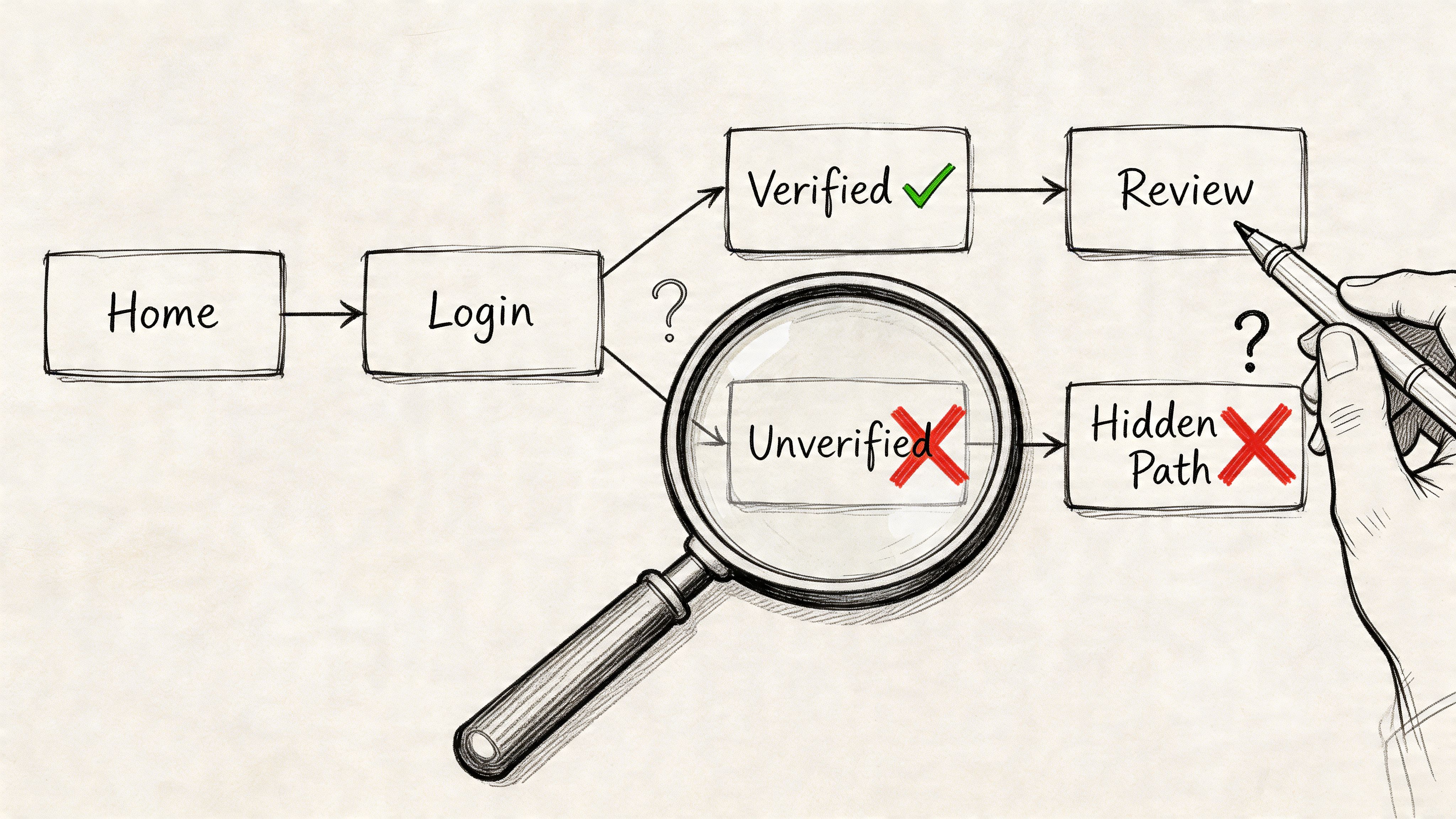
Google Search Console gives you the clearest first pass because it shows where Google is seeing pages and how users respond.
Look for clusters of URLs that target similar terms but underperform. Pay special attention to pages with impressions but weak clicks, especially if several pages compete around the same service and geography. That often signals pages that are visible enough to be crawled but not compelling enough to win traffic.
Check the Indexing reports too. If you see many similar URLs with weak indexation, that’s a clue the site may be publishing more pages than search engines want to keep.
Crawl the site with Screaming Frog
Next, run a crawl in Screaming Frog SEO Spider. You don’t need an enterprise setup for this. Even a basic crawl can reveal doorway patterns quickly.
Focus on these signals:
- Thin pages with limited body copy. A common red flag is under 300 words paired with high keyword density, and some franchise sites using this tactic saw traffic drops of up to 70% after a Google update, according to LCN’s overview of doorway page risks.
- Duplicate or near-duplicate title tags across city or service variants
- Highly similar H1s and URL structures that differ only by location or keyword order
- Orphaned pages that aren’t well integrated into the site’s normal navigation
You can also export page text and compare clusters manually. If ten pages look interchangeable when opened side by side, trust that signal.
Review page purpose, not just page metrics
Numbers alone won’t tell the whole story. Open the pages and read them as a customer would.
Ask:
- Would this page help someone choose us?
- Is there any information here that doesn’t exist elsewhere on the site?
- Does this page stand on its own without pushing the visitor somewhere else?
- Would I keep this page if search engines didn’t exist?
That last question is harsh, but useful.
For a walkthrough on indexation issues that often appear alongside weak content clusters, this guide on how to fix crawled currently not indexed pages is a helpful companion.
A short visual explainer can help if you’re auditing with a team and need everyone aligned on what counts as low-value page architecture:
A simple audit outcome
At the end of the audit, sort every questionable page into one of three buckets:
- Clearly valuable and distinct
- Borderline, but fixable
- Redundant or manipulative
That makes the cleanup much easier and stops the common mistake of treating every weak page the same way.
A Step-by-Step Remediation Plan
Once you’ve found doorway-like pages, the cleanup usually falls into three actions: consolidate, improve, or remove. The right choice depends on whether the page has unique demand, unique value, and any reason to survive as a standalone asset.
Consolidate weak clusters
Consolidation works best when several pages target the same underlying intent. If you have multiple thin city pages that all describe the same service in the same way, combine the strongest material into one stronger regional or service page.
Use one clear primary page as the destination. Fold in any useful details from weaker pages, then redirect those weaker URLs so users and crawlers reach the better resource. This is often the best move for local service businesses that expanded page count faster than they expanded substance.
A good consolidation target usually has:
- Clear search intent alignment
- The strongest backlink and internal link support
- The best conversion path
- Enough room to absorb useful local context without turning bloated
Improve pages that are close to legitimate
Some pages aren’t spam. They’re just unfinished.
A location page can often be rescued if it serves a real audience and you can add distinct value. That might mean clarifying service logistics in that area, adding market-specific examples, addressing local objections, or integrating proof that the business genuinely serves the location.
Keep the page if you can explain why a visitor from that city needs this page instead of your generic service page.
Improvement usually beats deletion when the page fills a valid user need and can become part of a coherent site structure.
Remove pages that never deserved to exist
Some pages aren’t worth saving. If a page was created solely to rank for a keyword permutation and offers no standalone value, remove it.
That includes pages with no useful content, no real traffic quality, no conversion purpose beyond funneling, and no credible path to becoming distinct. Letting low-value pages disappear is often healthier than keeping them alive with cosmetic edits.
If the cleanup is broad, treat it like a site architecture project rather than a content-only project. Decisions about redirects, navigation, templates, and user flow often matter as much as copy rewrites. This broader guide on how to redesign a website is useful when the doorway issue reflects a larger structural problem.
The decision framework
Use this quick filter:
- Consolidate when several pages compete for the same intent
- Improve when the page has a real audience and can gain unique value
- Remove when the page exists only for search capture
Don’t keep a page just because it’s indexed. Indexed doesn’t mean helpful, and it doesn’t mean safe.
Building High-Value Alternatives That Drive Growth
The better alternative to doorway pages isn’t “fewer pages at any cost.” It’s pages with a clear reason to exist.
That matters most for local businesses, because the original goal behind doorway pages is usually valid. A company really does want to rank in multiple service areas. The fix is to create pages that deserve those rankings.

What a strong local page includes
A legitimate local landing page doesn’t just say “we serve Omaha.” It proves the business understands what a buyer in Omaha needs to know.
For example, a page targeting web development in Omaha could include:
- A locally relevant intro that explains the kinds of Omaha businesses the team works with
- Service-specific detail tied to the local market, not generic agency boilerplate
- Real proof elements such as testimonials, examples, or project context from that area
- Practical buying information like timelines, process, service boundaries, or FAQs
- Internal links to related services, industries served, and educational content
That kind of page can rank for local intent because it satisfies local intent.
The threshold is unique value
Many geo-page strategies fail. Publishing fifty similar pages feels efficient, but efficiency isn’t the same as usefulness. According to Ahrefs’ glossary entry on doorway pages, after the March 2024 Core Update, sites with over 50 similar geo-pages saw traffic drops of around 40%, while content-rich local pages with unique insights held up better. The same source also notes a 25% surge in AI-generated geo-pages, which makes shallow page networks even easier to spot.
That doesn’t mean you should avoid local pages. It means you should stop thinking of them as fill-in-the-blank templates.
A city page should answer “why choose us here?” not just “what keyword do we want here?”
Topic clusters beat doorway sprawl
For many businesses, a better structure is a topic cluster anchored by a strong service page and supported by selective local or educational content.
Instead of building many weak pages around keyword variants, build:
- One authoritative core page for the main service
- A limited set of high-value local pages where you can add genuine differentiation
- Supporting articles that answer related questions, objections, and comparisons
- Clear internal links that help users move naturally from learning to buying
This creates a cleaner site, stronger relevance signals, and a better user path.
If you’re refining the writing side of that approach, this guide on mastering content SEO is a useful complement because it focuses on making pages rank without flattening them into keyword shells.
What works and what doesn’t
Here’s the practical trade-off.
What doesn’t work well long term: mass-produced location pages, AI-written geo pages with light edits, service-area pages with no local proof, and orphan pages built only for search capture.
What does work: fewer pages with stronger intent match, richer local detail, clear internal linking, and a page structure that makes sense even if no one ever sees your XML sitemap.
If a page can help a real buyer trust you faster, it has a future. If it only exists to catch one more query, it’s a liability.
Monitoring and Future-Proofing Your SEO Strategy
Doorway page issues rarely stay isolated. They usually point to a larger habit of publishing for volume before value. That’s why future-proofing isn’t just about cleaning up risky URLs. It’s about changing how pages get approved in the first place.
What to watch every month
Use Google Search Console and your analytics platform to review:
- Location and service pages with high impressions but weak clicks
- Pages with low engagement after landing
- Indexation patterns across similar URL clusters
- Internal linking gaps that leave pages disconnected from the main site
If a page isn’t earning engagement, trust, or conversions, ask whether it deserves to remain standalone.
For businesses that want a second set of eyes on page quality and site structure, Refact's expert SEO review is a useful example of the kind of audit process that can surface hidden risk before it turns into a visibility problem.
The long-term rule is simple. Build pages for users first, search engines second. When a page has clear purpose, unique value, and a natural place in the site, algorithm changes become less threatening because the page is solving a real problem.
If your site has a cluster of thin location pages, overlapping service URLs, or indexation issues that feel hard to untangle, Up North Media can help you audit the problem, clean up risky content, and build stronger location and service pages that support long-term growth.