

You’re probably in one of two spots right now.
Either your firm has already hired an SEO agency and you’re tired of hearing about impressions, keyword movements, and “brand visibility” while your intake team still isn’t seeing enough qualified consultations. Or you’re about to hire a law firm seo agency and you can already tell every proposal sounds polished, every agency says it understands legal marketing, and nobody wants to say what usually goes wrong.
Here’s the blunt version. The right agency can become a long-term growth partner. The wrong one can burn a year, create compliance risk, and leave you with a prettier report instead of a stronger pipeline. The firms that make good hires usually do three things well: they define business goals before the sales calls start, they vet agencies on strategy and ethics instead of charm, and they track ROI like operators, not spectators.
Aligning Your Firm's Goals with SEO Realities
Most firms start with the wrong brief.
They tell agencies they want “more traffic,” “better rankings,” or “more visibility.” Those aren’t business goals. They’re inputs. If you hire a law firm seo agency on that basis, you’re giving them too much room to look successful without contributing to the firm’s growth.

Start with matters, not marketing metrics
A useful SEO goal sounds like this:
- Practice-area specific: More qualified family law consultations, not more website visits.
- Geographically anchored: Stronger visibility in the city or region you serve.
- Operationally tied: Better lead quality for the intake team, not just more form fills.
- Financially grounded: Growth that makes sense against expected case value and close rates.
That changes the conversation fast.
A family law firm may need stronger local visibility and better consultation quality. A PI firm may care more about competitive non-brand queries and intake volume. A business law practice may want authority-building content that attracts higher-value matters with a longer decision cycle.
Practical rule: If an agency can’t map SEO work to signed cases, practice-area growth, and intake quality, you’re not discussing strategy. You’re discussing activity.
Set the budget after you define the outcome
Budget shouldn’t come first, but it does need to get real.
Law firms allocate an average of 45% of their total marketing budget to SEO, and that investment produces an average three-year ROI of 526%, an average annual organic traffic increase of 21%, and reaches break-even in an average of 14 months according to First Page Sage’s law firm SEO statistics.
That data matters for one reason. It resets expectations. SEO is not a cheap side project for most firms. It’s often the core growth channel because it compounds, unlike paid media that shuts off the moment spend stops.
Build your scorecard before you take agency meetings
Use a simple internal scorecard before you talk to anyone:
-
Identify the practice areas that matter most.
Not every service line deserves equal investment. -
Define what a qualified lead means.
Your intake manager should help set this, not just marketing. -
Know your growth horizon.
Are you trying to build steady demand, expand into a new market, or recover lost visibility? -
List the current friction points.
Weak local rankings, thin practice pages, poor lead tracking, slow site performance, low review velocity, or all of the above.
What to avoid at this stage
A few mistakes create bad agency relationships before the work even starts:
- Chasing vanity terms: Ranking for broad phrases feels good, but it doesn’t always produce retainable cases.
- Ignoring intake quality: If the phone rings but the cases are poor, SEO didn’t solve the problem.
- Setting impossible timelines: SEO can move fast in pockets, but legal search usually rewards consistency.
- Treating every market the same: Omaha isn’t Manhattan. A local family firm and a multi-office PI firm need different playbooks.
A strong hiring process starts when the partnership is anchored to business outcomes instead of vague visibility goals.
How to Find and Properly Vet Potential Agencies
Most firms find agencies the same way consumers find lawyers. They search, skim, shortlist, and book calls.
That’s fine as a starting point. It’s not enough as a hiring method.
Legal SEO is full of agencies that can talk about title tags and backlinks but can’t explain intake quality, conflict handling, or bar-rule risk. The agency you want doesn’t just know SEO. It understands legal marketing pressure, local competition, and the consequences of sloppy claims.
Where to look beyond a basic search
Start with a mix of channels:
- Peer referrals: Ask firms outside your geographic market but within similar practice areas.
- Legal-industry specialists: Prioritize agencies that already work in law, not broad “small business SEO” shops.
- Published case studies: You want firms willing to show process and results, not just logos.
- Strategic fit: Some agencies are built for local practices, others for aggressive multi-market growth.
Specialized law firm SEO agencies have documented 300% to 566% increases in case acquisitions and revenue within 12 to 18 months, and one personal injury firm saw a 340% organic traffic rise and a 566% revenue surge in 18 months according to Website Depot’s roundup of law firm SEO companies and legal SEO results. The takeaway isn’t that your firm will get the same outcome. It’s that specialized legal SEO can produce meaningful business results when the execution is strong.
Ask questions that expose how they think
A sales deck won’t tell you much. Their answers to hard questions will.
| Category | Question to Ask | What a Good Answer Looks Like |
|---|---|---|
| Legal compliance | How do you handle content and local SEO within bar advertising rules and ABA Model Rule 7.1? | They speak clearly about avoiding misleading claims, supervising review language, and building compliant local content. |
| Strategy | How do you prioritize practice areas and local markets in the first six months? | They explain sequencing, trade-offs, and why they won’t chase everything at once. |
| Local SEO | How do you approach Google Business Profile optimization for a single office versus multiple offices? | They talk about legitimate location signals, consistency, and avoiding manipulative location tactics. |
| Reporting | What do you report monthly beyond rankings? | They include qualified leads, call quality, form quality, consultation trends, and business impact. |
| Ownership | Who owns the website assets, content, analytics, and profiles if we part ways? | They say the firm owns them, in writing. |
| Communication | What does client communication look like when performance is flat or a plan changes? | They give a real cadence, escalation path, and examples of transparent communication. |
| Link acquisition | How do you earn backlinks for legal sites? | They talk about editorial quality, legal relevance, and avoiding spammy volume tactics. |
| Conflict policy | Will you work with a direct competitor in our market? | They answer directly and explain boundaries. |
One overlooked tell is communication maturity. If you want a simple framework for evaluating how an agency communicates during onboarding and ongoing reporting, this guide on client communication best practices is worth reviewing before you sign anything.
You can also compare an agency’s answers against a broader hiring framework like this guide on how to choose an SEO company, especially if your shortlist includes both legal specialists and generalist agencies.
Watch for the red flags early
Here are the warning signs I’d take seriously:
-
They guarantee rankings.
No credible agency controls search results. -
They avoid compliance talk.
If they dismiss ethics as “legal’s problem,” walk away. -
They report only top-line metrics.
Traffic without lead quality is a distraction. -
They can’t explain prioritization.
An agency that wants to do everything in month one usually lacks discipline.
A good agency answers uncomfortable questions directly. A weak one redirects you back to the slide deck.
Vet the team, not just the brand
Ask who will run the account.
You want to know whether strategy, content, technical SEO, local optimization, and reporting are handled by people with real ownership. Many firms buy the senior salesperson and get handed to a junior coordinator with a checklist.
That’s not always a deal breaker. It is a problem when no one can make decisions, challenge assumptions, or connect SEO work to signed cases.
Decoding Agency Proposals and Common Pricing Models
Most SEO proposals are harder to compare than they should be.
One agency sends a sleek pitch with broad language about authority and visibility. Another sends a dense scope with line items, audits, and content deliverables. A third offers a lower monthly price but avoids specifics. If you compare those by monthly fee alone, you’ll make a bad decision.
What a solid proposal should include
A proposal worth taking seriously usually has these components:
- Initial audit findings: Clear diagnosis of technical, content, and local issues.
- Strategic roadmap: What happens first, what waits, and why.
- Monthly deliverables: Content, optimization work, reporting, review support, GBP work, link outreach, or technical fixes.
- Measurement plan: Which KPIs matter and how they’ll be tracked.
- Timeline language: Realistic pacing, not instant-win fantasy.
If a proposal is vague about deliverables, it’s usually vague by design.
The main pricing models and how they differ
| Pricing model | How it works | Best fit | Main risk |
|---|---|---|---|
| Monthly retainer | Ongoing work for a recurring fee | Firms that want sustained growth and iteration | Can become bloated if deliverables stay fuzzy |
| Project-based | Fixed scope for a specific outcome | Site migrations, audits, GBP cleanup, content overhauls | Stops before momentum builds |
| Performance-based | Fees tied to agreed outcomes | Rarely clean in legal SEO because attribution is messy | Incentives can push bad behavior or shallow KPIs |
For most law firms, a retainer is the most practical structure because SEO requires compounding work. Technical fixes, content development, local visibility, and reporting don’t happen cleanly in a one-and-done sprint.
A project can make sense if your site is structurally broken, your local listings are a mess, or you need an audit before committing to longer engagement.
A performance model sounds attractive, but law firm attribution is often too messy for it to stay fair. Intake quality, response times, consultation handling, practice-area fit, and close rates all affect outcomes. That’s not all under the agency’s control.
Compare value, not price tags
Say Proposal A is cheaper but includes “ongoing optimization” with no specified output. Proposal B costs more but includes technical remediation, practice-area content, GBP management, and reporting tied to lead quality.
Proposal B may be the better buy, even if the fee is higher, because you can tell what the agency will do.
The cheapest proposal often becomes the most expensive one when six months pass and nothing important changed.
Proposal red flags that should stop the deal
- Guaranteed rankings or timelines
- No mention of lead tracking
- No ownership language for assets
- Heavy focus on traffic with no business KPIs
- Link-building promises with no explanation of quality
- No clarity on who approves legal content
A strong proposal makes the agency easier to hold accountable. A weak one protects the agency from accountability.
The SEO Services That Actually Move the Needle for Firms
A law firm seo agency should be doing more than publishing blogs and sending ranking reports.
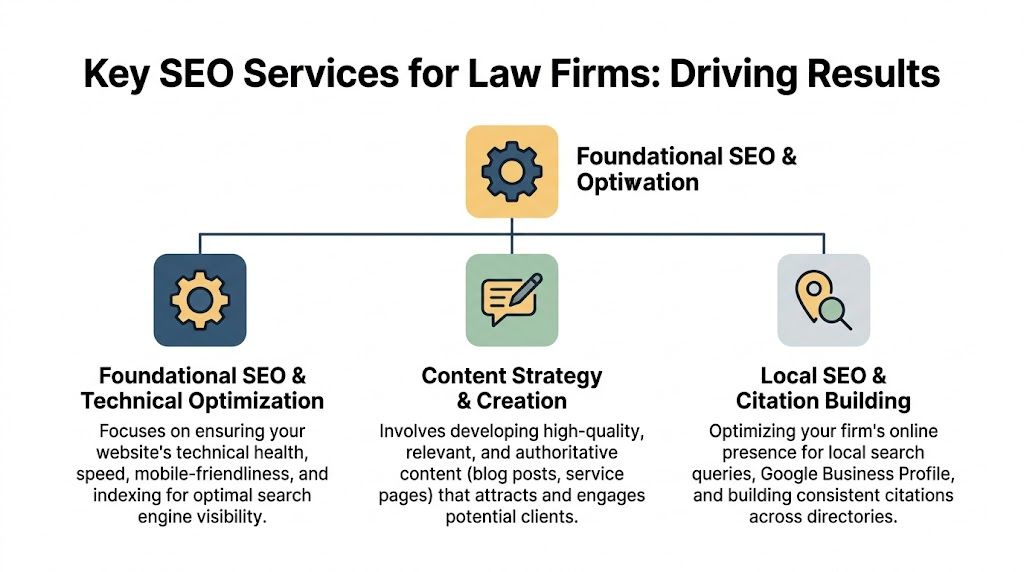
The work that matters usually falls into three buckets: technical foundations, content that earns trust and demand, and local visibility that converts searchers into consultations. If one of those buckets is missing, growth tends to stall.
Technical work that removes hidden drag
Technical SEO isn’t glamorous, but weak foundations undermine everything else.
For law firms, that usually means site speed, crawlability, indexing health, mobile usability, internal linking, and proper schema for legal services and attorneys. If the site is slow, disorganized, or hard for search engines to interpret, even strong content won’t perform as well as it should.
A serious agency will also look at conversion infrastructure. Call tracking, form routing, thank-you page measurement, and page-level engagement all matter because legal SEO is useless if you can’t connect traffic to consultations.
Content that actually earns cases
A lot of agencies still produce legal content that sounds like it was written to satisfy a checklist. Thin FAQs. City pages with swapped-out place names. Generic blog posts that no partner would ever be willing to sign.
That content rarely builds trust.
What works better is a structured publishing plan tied to practice areas, search intent, and attorney credibility. A structured six-month SEO action plan that delivered two optimized content pieces per month led one law firm to a 4,300% annual traffic increase, according to this Trial Guides case study on a law firm SEO content strategy.
The lesson isn’t “publish two articles and traffic explodes.” It’s that disciplined execution, aligned to the right topics and supported by site improvements, can outperform random content volume.
Useful legal content usually includes:
- Practice pages with depth: Not brochure copy. Real guidance on claims, process, timing, and next steps.
- Attorney-reviewed publishing: Bylines, factual accuracy, and credible legal framing.
- Intent mapping: Content for urgent, local, high-intent searches and content for longer research cycles.
- Internal linking: Clear paths from educational content to service pages and consultation pages.
If you want a practical outside perspective on strategies for generating leads for lawyers using SEO, that resource complements this point well, especially around converting visibility into actual inquiries.
Local SEO that wins the right searches
For many firms, local SEO is where the money is.
That includes Google Business Profile management, review strategy, local landing pages, citation consistency, and proximity-sensitive search visibility. It also includes restraint. Firms get into trouble when agencies push manipulative location tactics that don’t reflect the firm’s real footprint.
One thing I’d ask any agency is how they handle local plus practice-area intent together. Ranking for your brand name is easy. Winning searches from someone looking for a specific lawyer in a specific city is harder and far more valuable.
If local visibility is central to your growth plan, a service set like local SEO for professional service firms should include technical cleanup, GBP management, location-page strategy, and review operations, not just citation submissions.
Strong legal SEO usually looks boring from the outside. Consistent content. Clean technical work. Real local signals. Tight reporting. That’s what tends to stick.
One advanced tactic more firms should ask about
Most agencies talk about backlinks in generic terms. Fewer talk about data-driven PR.
For law firms, that can mean turning anonymized internal case trends, regional claim patterns, or legal process insights into stories that local media or niche publications want to cite. Done well, that creates better links and better credibility than buying placements or blasting guest posts.
It’s harder work. It’s also closer to real authority building.
Contracts, Onboarding, and Measuring True ROI
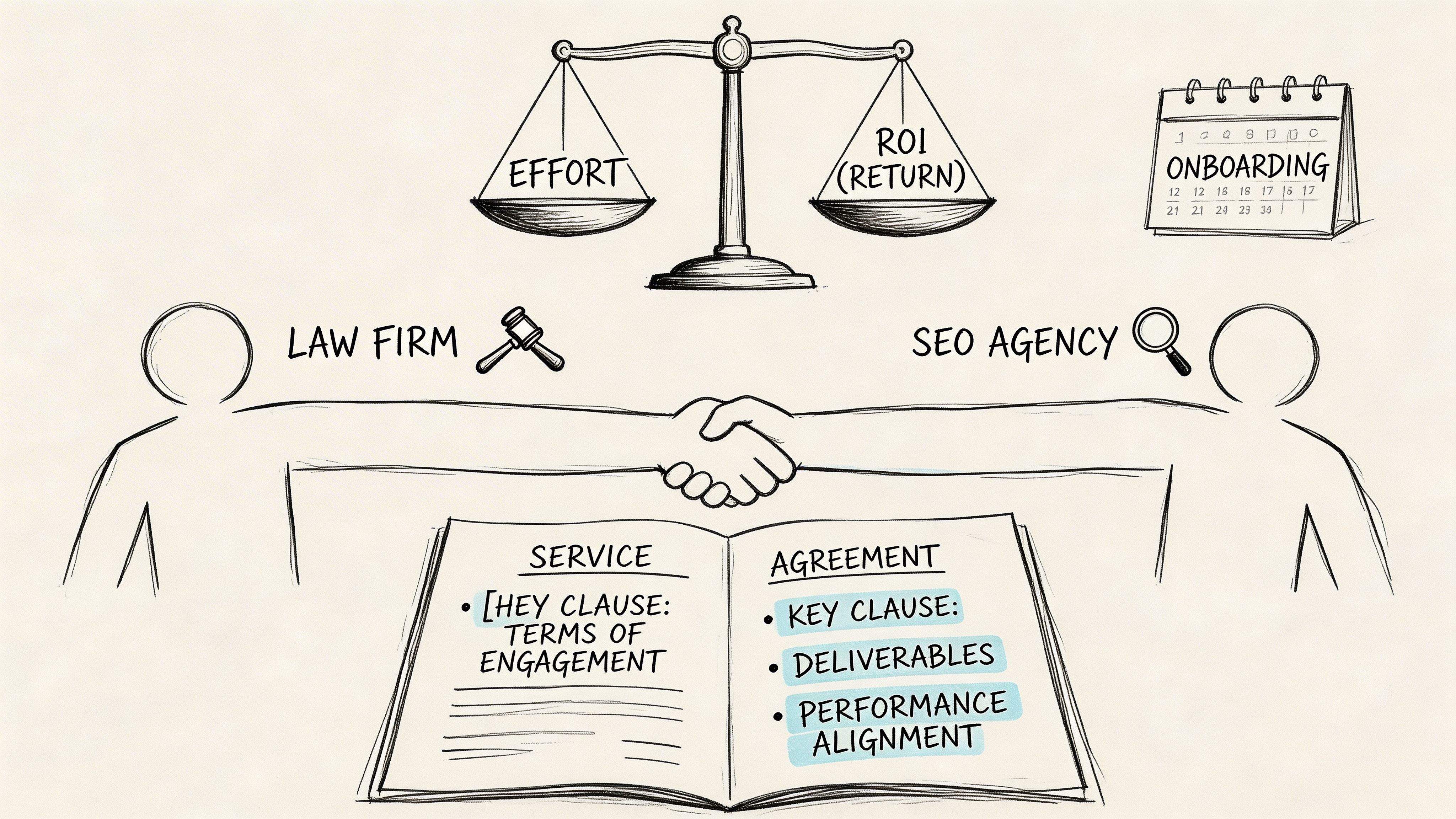
The partnership doesn’t become real when you choose the agency. It becomes real when the contract is signed, access is shared, and both sides agree on what success means.
That’s where a lot of otherwise promising engagements start drifting.
Contract terms worth reading closely
Don’t treat the agreement like procurement paperwork.
Check these items carefully:
- Term length: Know whether you’re locked into a long commitment or working month to month.
- Exit terms: Understand notice periods, offboarding support, and what happens to unfinished work.
- Asset ownership: The firm should own website content, analytics access, tracking setups, and business profiles.
- Approval workflow: Legal content and claim language need a clear review path.
- Scope boundaries: Know what is and isn’t included before the first “that’s extra” email appears.
If asset ownership is vague, fix that before signing.
A clean onboarding process saves months
Law firm SEO campaigns typically show initial results in 3 to 6 months, with significant lead generation impact in 6 to 12 months, according to McDougall Interactive’s law firm SEO timeline analysis. That timeline assumes the basics happen promptly. Delays in approvals, access, intake setup, or content review push results out.
A good onboarding process usually includes:
-
Kickoff with decision-makers present
The managing partner, intake lead, and marketing contact should all be aligned. -
Baseline measurement setup
Rankings matter, but lead tracking matters more. -
Access transfer and verification
Analytics, Search Console, CMS, call tracking, GBP, and form systems should be sorted early. -
Editorial and compliance workflow
Decide who reviews legal accuracy and who approves claims. -
Shared KPI dashboard
Everyone should be looking at the same scorecard.
For firms that need a cleaner way to think about measurement, this breakdown of how to calculate marketing ROI is useful because it forces the conversation back to business impact instead of vanity metrics.
Measure the economics, not the excitement
The practical ROI formula is (Organic Leads x Avg. Case Value x Conversion Rate) / SEO Cost, based on the same McDougall source above.
That formula matters because it forces discipline.
An agency may celebrate traffic growth. You should care about whether organic search is creating qualified consultations, whether those consultations are turning into signed matters, and whether the economics beat your alternatives.
Here’s a useful gut check. If reporting never reaches the level of lead quality, close quality, and cost relative to acquired matters, the firm is still too far from the money.
This video gives a helpful framing for thinking about partnership accountability and performance over time:
Operator mindset: Your agency shouldn’t just prove that SEO is happening. It should prove that the firm is getting closer to profitable growth.
Answering Your Toughest SEO Agency Questions
What if we’re six months in and not seeing enough?
Don’t jump straight to “SEO doesn’t work.”
Start by looking at three things. First, did the agency complete meaningful work, or just report activity? Second, was the firm slow to approve content, fix intake, or provide access? Third, are you seeing leading indicators that haven’t translated yet, like stronger non-brand visibility or better local placement for the right searches?
If the work is thin and the answers are slippery, it’s probably an agency problem.
When should we fire an agency?
Fire them when trust breaks, not just when progress slows.
That usually happens when they dodge questions, hide behind jargon, miss deliverables repeatedly, or keep shifting the definition of success. A temporary plateau is manageable. Dishonest communication isn’t.
What if we disagree on strategy?
Good. Some disagreement is healthy.
You hired a specialist to challenge assumptions. But the agency should be able to explain the trade-offs plainly. If they can’t explain why they’re prioritizing one practice area, one market, or one content cluster over another, that’s not strategic disagreement. That’s weak planning.
Where are the ethical lines in local SEO?
Here, firms need to stay firm.
A key ethical boundary in local SEO for law firms involves ABA Model Rule 7.1, which prohibits false or misleading claims. Aggressive tactics like keyword stuffing in Google Business Profiles can trigger penalties, and manual actions hit 20% of PI firms in late 2025 according to Attorney at Law Magazine’s discussion of ethics and local SEO.
That means no inflated claims, no deceptive location tactics, and no review language that creates advertising risk.
Should we hire a general SEO agency if they’re cheaper?
Only if they can prove they understand legal compliance, local search complexity, and intake-driven reporting.
A generalist can be competent. But law firms don’t need generic competence. They need a partner who can grow visibility without creating ethical or operational problems.
If your firm is evaluating a law firm seo agency and wants a second opinion before signing, Up North Media can help you pressure-test the proposal, the ROI model, and the reporting plan so you know exactly what you’re buying and how success should be measured.