
Natural Language Processing (NLP) is one of those tech terms you hear a lot, but what does it actually do? At its core, NLP is a field of artificial intelligence that gives computers the ability to understand, interpret, and generate human language. It’s the magic behind the everyday tools we already use, like chatbots, voice assistants, and automatic translation services.
Think of it as bridging the massive gap between how we communicate and how computers process information.
Decoding How Computers Understand Language
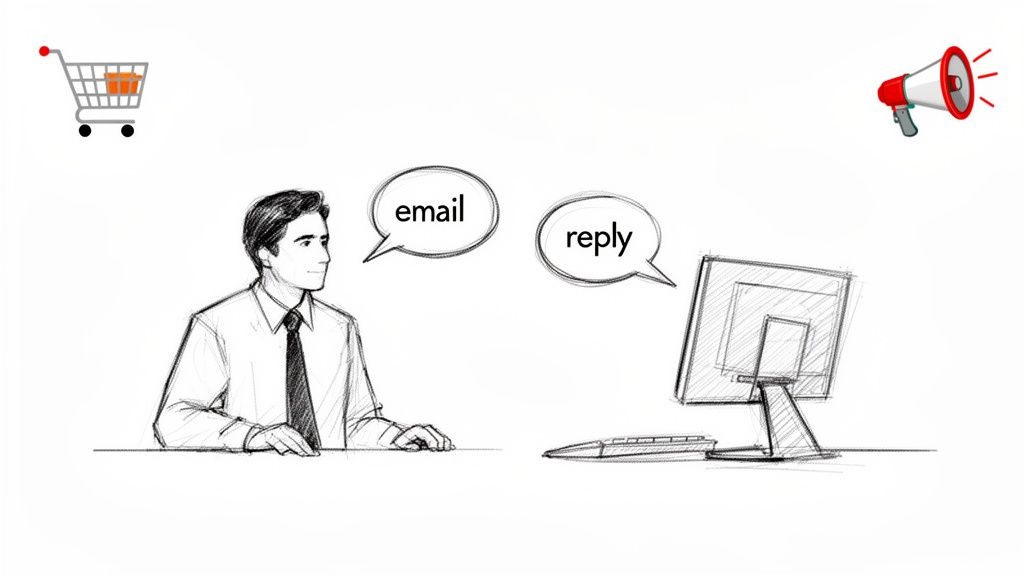
A good way to picture NLP is to imagine you're teaching a new, impossibly fast employee how to handle all your company’s communications. This "employee" learns to read customer emails, listen to feedback calls, and even draft responses, but it does so by processing data instead of just hearing words. It’s a powerful tool that transforms unstructured text and speech into business intelligence you can actually act on.
This isn't some far-off, futuristic concept. It’s already a critical asset for businesses trying to get a real competitive edge. E-commerce stores use it to analyze thousands of product reviews in minutes, and marketing teams use it to automate content creation. NLP is actively reshaping how companies operate right now.
Why NLP Matters for Your Business
When you get down to it, NLP is a bridge to your customers. It allows you to make sense of the massive amounts of language-based data you collect every single day. Instead of someone manually sifting through thousands of reviews or support tickets, NLP automates the whole process, pulling out valuable insights in seconds.
This unlocks some pretty significant benefits:
- Increased Efficiency: You can automate repetitive tasks like sorting emails, answering frequently asked questions, and summarizing long documents.
- Enhanced Customer Experience: Provide 24/7 support with AI-powered chatbots and personalize customer interactions based on their own feedback.
- Improved Data Analysis: Finally unlock the insights hidden in unstructured data from places like social media comments, surveys, and call transcripts.
The global natural language processing market is projected to hit $158.04 billion by 2032. This explosive growth shows just how much businesses are relying on NLP to drive smarter decisions and create more responsive customer experiences.
The Building Blocks of NLP
To really get a handle on NLP, it helps to see it as a combination of different capabilities all working together. The system first needs to understand language (the input), and then it needs to generate a response (the output). It’s a sophisticated process, but for business leaders, what really matters are the practical outcomes. If you want a deeper dive into the technical nuts and bolts, this resource offers a practical guide to Natural Language Processing.
For now, let's break down what NLP means in a business context with a quick cheat sheet.
NLP at a Glance for Business Leaders
Here’s a simple table to cut through the jargon and show you what NLP is, who it's for, and why it's something you should be paying attention to.
| Concept | Simple Explanation | Business Impact |
|---|---|---|
| Natural Language Processing (NLP) | Teaching computers to read, understand, and respond to human language. | Automates communication, analyzes feedback, and improves customer service at scale. |
| Who It's For | E-commerce, marketing, customer service, and any business with large volumes of text data. | Provides a competitive advantage by turning customer language into actionable insights. |
| Why It's a Vital Technology | It extracts value from unstructured data, which makes up over 80% of business information. | Enables data-driven decisions, boosts productivity, and enhances customer satisfaction. |
Ultimately, NLP gives you the power to listen to your customers, employees, and the market at a scale that was never possible before. It's about turning words into data, and data into better business decisions.
From Simple Rules to Smart AI: A Quick History Lesson
To really get what natural language processing can do for a business today, it helps to know this isn't some brand-new trend. NLP is the result of decades of steady, hard-won innovation. We've gone from rigid, instruction-following machines to the adaptable AI we have now, which is why it's finally a mature and reliable tool ready for real business investment.
The whole story starts back in the 1950s, a time when computers were seen as giant calculators, not potential conversation partners. The first stabs at language understanding were entirely rule-based. Programmers would manually write out massive, complicated sets of grammatical rules—think "if you see a noun followed by a verb, then..."—just to help a machine make sense of a single sentence.
Imagine trying to teach someone a language by only giving them a dense grammar book, with no real-world examples to go off of. That's what this approach, known as symbolic NLP, was like. It was incredibly tedious to build and broke easily. A single slang word or a slightly weird sentence structure could throw the entire system off.
The Big Shift to Learning from Data
The first major turning point was the move to statistical NLP. Instead of trying to hand-code every single rule of language, researchers started using machine learning algorithms to chew on huge amounts of text. The computer began learning language patterns on its own, kind of like how a kid learns to speak by listening to people talk, not by memorizing a grammar textbook.
This statistical approach made NLP systems way more flexible and tough. They could finally handle the messiness and variation of human language because they learned from real examples, not just a programmer's perfect instructions. This breakthrough led to huge improvements in things like machine translation and search engines.
This whole period was shaped by pioneers like Alan Turing, whose work laid the groundwork for testing machine intelligence, and Noam Chomsky, who figured out ways to translate human sentences into formats computers could actually process. The first NLP conference at MIT in 1969 really got the ball rolling, creating a collaborative spirit that fueled the field for decades. For a deeper dive on these early milestones, check out the historical evolution of NLP from 1950.
From Statistics to Actually Understanding
The most recent—and by far the most powerful—phase in NLP's journey is all about deep learning and neural networks. These models, which are loosely inspired by the structure of the human brain, can grasp context and nuance in ways that were pure science fiction just a decade ago.
This is the tech that powers the smart AI we use every day. It’s what lets an AI assistant understand that "book a flight" is a command with a clear goal, not just three random words strung together.
Here’s the simple version of how we got here:
- The Rule-Based Era (1950s-1990s): Computers followed strict grammar rules programmed by humans. Super limited, and couldn't adapt to new lingo or phrasing.
- The Statistical Era (1990s-2010s): Machines started learning from big piles of text, spotting patterns and probabilities. This made them more flexible but still without any real sense of context.
- The Neural Network Era (2010s-Present): AI models now learn context and meaning. This allows them to figure out intent, write human-like text, and tackle complex language tasks with impressive accuracy.
Understanding this journey is important for any business leader. It shows that today's NLP isn't an overnight fad; it's a battle-tested technology built on a solid foundation. Each step in its evolution has unlocked more practical and powerful ways for businesses to use it, leading to the reliable tools that can drive real efficiency and growth right now.
How a Computer Actually Learns to Understand Language
So, how does a computer go from seeing a jumble of letters to figuring out what a customer really means? It’s not magic, but a pretty clever process of breaking our messy human language down into pieces a machine can work with.
Think about a simple sentence you might see in a customer review: "The new floral dress in our Omaha store is selling fast." To you, that’s easy. To a computer, it’s just data. The very first step is to slice that sentence into smaller, bite-sized chunks. This is a process called tokenization.
It's a lot like chopping vegetables before you make a soup. The sentence gets broken down into individual words, or "tokens": "The," "new," "floral," "dress," "in," "our," "Omaha," "store," "is," "selling," "fast." Suddenly, the machine isn't staring at a long, confusing string of text. It has individual pieces it can start to analyze one by one.
Spotting the Important Details
Once the sentence is chopped up, the next job is to figure out what the important bits are. For this, NLP uses a technique called Named Entity Recognition (NER). The best way to think about NER is as a digital highlighter that automatically tags the key details for you.
In our sentence, NER would instantly flag:
- "Omaha" as a Location.
- "floral dress" as a Product.
This one capability is a game-changer for businesses. It lets a system scan thousands of customer reviews and instantly categorize feedback by product, location, or even competitor names, all without a single person having to read through them manually. If you have developers on your team, learning https://upnorthmedia.co/blog/how-to-use-python-for-nlp-and-semantic-seo is a great starting point for building this kind of functionality.
Natural language processing isn't about teaching a computer to think like a human. It's about giving it a structured, step-by-step process to deconstruct language, identify patterns, and extract meaning in a predictable, scalable way.
From there, the system can go even deeper. It analyzes grammar to see how words relate—recognizing that "dress" is the main subject and "floral" is describing it. This groundwork is what makes more advanced tasks, like translation or answering questions, possible. To get a real sense of the complexity involved, it's worth looking into how AI translation for books works.
From Simple Words to Complex Context
The real breakthrough in modern NLP, though, has been the ability for AI to finally understand context. Think about the word "bank." It means something totally different in "river bank" versus "money bank." Early systems were completely stumped by this, but newer AI models—especially something called the transformer model—have changed everything.
This infographic shows the journey from rigid, rule-based systems to the more intuitive AI we have today.
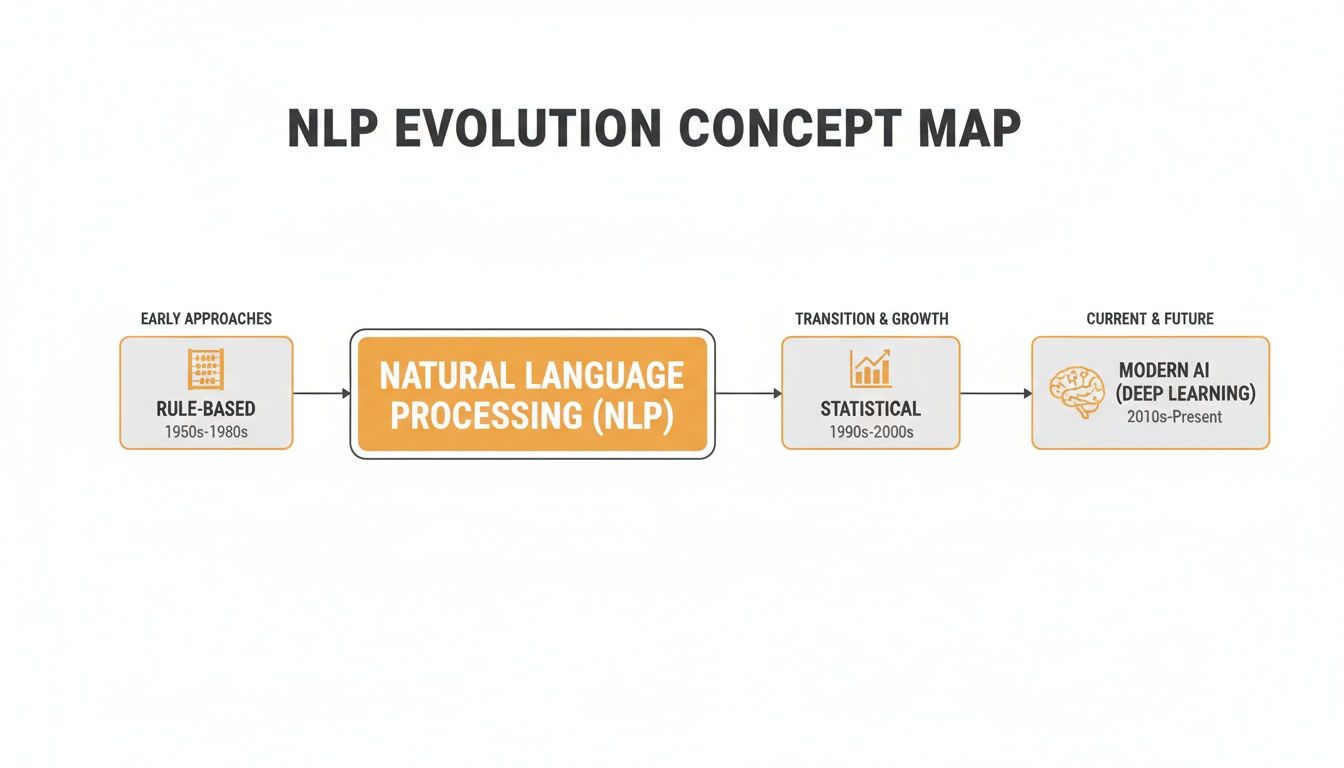
As you can see, we've moved from manually programming grammar rules to building systems that learn patterns from huge amounts of text. This is what gives modern AI such a deep grasp of language.
The transformer model, first introduced back in 2017, was a massive leap forward. It's the engine behind heavy-hitters like Google’s BERT and OpenAI's GPT series. It paved the way for GPT-3 in 2020, a model with an incredible 175 billion parameters, which showed a stunning ability to generate fluent, context-aware text.
To give you an idea of the core techniques driving these business applications, here’s a quick rundown of what they do in simple terms.
Core NLP Techniques and Their Business Functions
| NLP Technique | What It Does (Simple Terms) | Example Business Use Case |
|---|---|---|
| Tokenization | Breaks text into smaller units (words, sentences). | Preparing customer reviews for analysis by separating each word. |
| Named Entity Recognition (NER) | Identifies and categorizes key information (names, places, products). | Automatically tagging support tickets with product names and locations. |
| Sentiment Analysis | Determines the emotional tone (positive, negative, neutral). | Gauging public opinion of a new product launch on social media. |
| Text Classification | Assigns predefined categories to text. | Routing incoming emails to the correct department (e.g., Sales, Support). |
| Language Translation | Converts text from one language to another. | Providing real-time multilingual customer support on a website chatbot. |
| Text Summarization | Creates a short, coherent summary of a longer document. | Generating executive summaries of long market research reports. |
Each of these techniques acts as a building block. By combining them, you can create sophisticated systems that automate tasks, uncover insights, and create better customer experiences.
By understanding these fundamental concepts—from simply slicing up sentences to grasping complex context—you get a much clearer picture of what NLP can realistically do for your business. It's the first step to making smart decisions about where and how to put this technology to work.
Putting NLP to Work with Real-World Business Applications
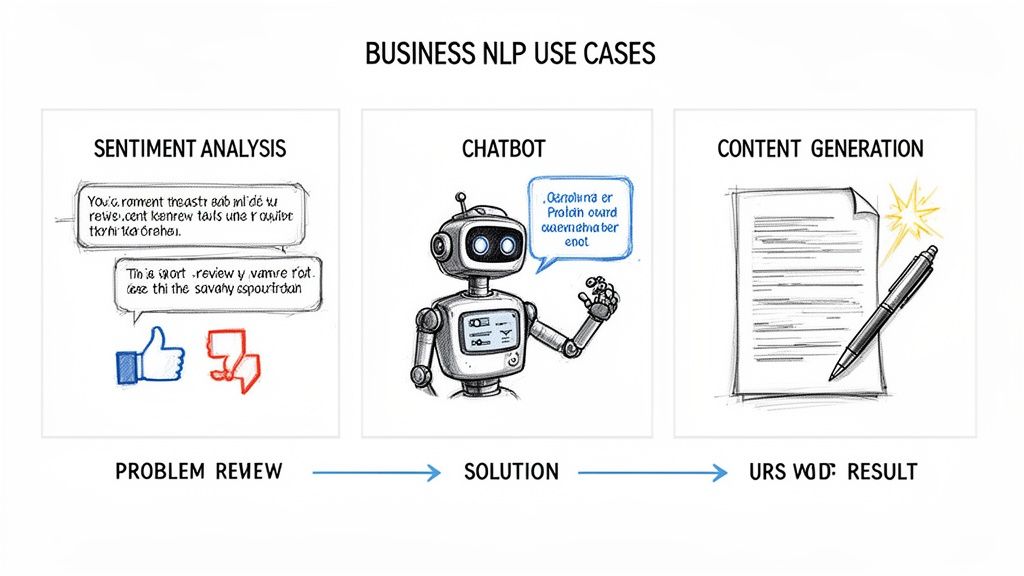
Knowing the nuts and bolts of natural language processing is one thing, but seeing it solve actual business problems is where it really clicks. This isn't just theory for tech giants—it’s a set of practical tools that can drive real growth and efficiency for businesses of any size, especially in e-commerce, marketing, and customer service.
So let’s shift from concepts to reality. Here’s how NLP takes raw language data and turns it into a powerful asset that addresses common pain points and delivers a measurable return.
Instantly Understand Your Customers with Sentiment Analysis
Imagine you just launched a new product. The reviews are pouring in across your website, social media, and Amazon. Manually sifting through thousands of comments to get a read on public opinion would take your team days, if not weeks.
This is exactly where sentiment analysis shines.
- The Problem: You’re drowning in unstructured customer feedback, making it impossible to quickly gauge satisfaction or spot urgent problems.
- The Solution: An NLP model scans every review, comment, and social post, automatically flagging the emotional tone as positive, negative, or neutral.
- The Result: In minutes, you have a clear, data-backed snapshot of customer sentiment. You can instantly see if a wave of negative feedback is tied to a shipping delay or pinpoint the features customers absolutely love, allowing you to make fast, informed decisions.
Provide 24/7 Support with AI-Powered Chatbots
Customer expectations have shifted. People want answers now, whether it's 2 PM on a Tuesday or 3 AM on a Sunday. Staffing a human support team around the clock is a huge expense and often isn't practical for small to mid-sized businesses.
AI-powered chatbots, driven by NLP, offer a smart, scalable fix. These aren't the clunky, easily confused bots of the past; modern chatbots actually understand context and intent.
Modern chatbots can provide human-like conversational experiences, and 70% of CX leaders believe they are becoming key architects of personalized customer journeys. This shift allows businesses to automate support without sacrificing quality.
An intelligent chatbot can handle tons of common questions, from "Where is my order?" to "What's your return policy?" This frees up your human agents to tackle the complex, high-value conversations that really need a personal touch. Exploring the different AI solutions for small businesses shows just how accessible and effective this technology has become.
Fuel Your SEO with Automated Content Generation
Consistently creating high-quality content is a major grind for most marketing teams. It’s time-consuming and resource-intensive to churn out blog posts, product descriptions, and ad copy that actually connects with an audience and ranks on Google.
The arrival of sophisticated Large Language Models (LLMs) like GPT-4, Llama 3, and Claude 3 completely changed the game. These models are incredibly good at generating text, enabling powerful tools for automated content creation.
With these tools in your corner, you can generate first drafts of articles, brainstorm dozens of topic ideas, or create hundreds of unique product descriptions in a fraction of the time. It doesn't replace human creativity—it supercharges it. This lets your marketing team scale its content strategy without burning out, freeing them up to focus on high-level planning and refinement.
Your Roadmap to Implementing NLP in Your Business
Bringing natural language processing into your business might sound like a massive project, but it’s far more approachable when you have a clear game plan. The secret isn't a huge, company-wide overhaul. It's about starting small, proving the value, and then building on that success.
The journey doesn't kick off with technology—it starts with a real-world business problem. Think about the repetitive, language-based tasks that are slowing your team down or frustrating customers. Nailing down the right pain point is the single most important first step.
Start by Identifying a High-Impact Problem
Before you even glance at a tool or a model, you need to find a clear opportunity where NLP can make a measurable difference. Don't try to boil the ocean. Zero in on a single, well-defined issue that’s begging for a smarter solution.
Good starting points often look like this:
- Automating Support Tickets: Are your agents spending half their day answering the same questions over and over, like "Where's my order?" An NLP-powered chatbot can handle those instantly, freeing up your team for more complex issues.
- Personalizing Product Recommendations: Want to suggest products that customers actually want to buy? NLP can sift through thousands of product reviews and browsing histories to spot patterns you’d never see on your own.
- Analyzing Customer Feedback: Drowning in survey responses or online reviews you can't possibly read through? Sentiment analysis can give you a bird's-eye view of what customers love (and hate) in minutes.
Choosing a focused problem gives you a clear target. It makes success easy to measure and helps you demonstrate a tangible return on investment (ROI) before you ask for a bigger budget.
Prepare Your Data and Choose the Right Tools
Once you know what you're trying to solve, the conversation shifts to data. NLP models are only as smart as the information they learn from. This means gathering relevant text—like past support emails, customer reviews, or product descriptions—and making sure it’s clean and organized.
With your data ready, it’s time to pick your tech. And here’s some good news: you don't always have to build a custom model from the ground up.
Your approach here really depends on your resources and goals. For a lot of businesses, starting with a user-friendly API is way more practical than diving into custom development. The aim is to get a working solution off the ground quickly.
Here are your main options, from simplest to most complex:
- Third-Party APIs: Services from companies like Google, Amazon, or OpenAI offer incredibly powerful, pre-trained NLP models. You can plug them into your systems with minimal coding, making them perfect for a first project.
- Open-Source Libraries: Tools like spaCy or NLTK give you more control if your team has some development chops. They're a great middle ground between off-the-shelf APIs and a fully custom build.
- Custom Models: For highly specific or sensitive tasks, you might decide to build and train your own model. This takes significant data and expertise but gives you the most tailored results possible.
For a wider view on how this fits into a larger strategy, it helps to learn more about how to implement AI in business in general.
Launch a Pilot Project and Measure Your Success
The smartest way to get NLP into your workflow is by starting with a small pilot project. Think of it as a limited-scope test run designed to prove your solution works and delivers real value. For instance, you could launch a chatbot that only handles the top five most common customer questions.
During the pilot, you need to track key performance indicators (KPIs) that tie directly back to the business problem you identified. This could be the percentage of support tickets deflected from human agents, the lift in conversion rates from personalized recommendations, or the hours saved on manual data analysis.
This data-driven approach lets you build an undeniable business case for doing more. Once you’ve proven the ROI on a small scale, you can scale your solution with confidence, integrate it deeper into your existing systems, and start tackling your next high-impact challenge.
A Realistic Look at the Risks and Limitations of NLP
While it's easy to get excited about what natural language processing can do, a smart investment means going in with a clear, balanced view. The technology is powerful, but it’s not magic. Understanding its limitations is the first step to building a robust AI strategy that actually works—and avoids some common, messy pitfalls.
One of the biggest hurdles is algorithmic bias. NLP models learn by chewing through enormous amounts of text written by humans. That text, unfortunately, is full of our own hidden societal biases related to race, gender, and culture. If you’re not careful, your AI can learn and even amplify those prejudices, leading to some seriously skewed outcomes in things like sentiment analysis or content moderation.
This isn't just a theoretical problem. A biased model might completely misinterpret feedback from a specific customer demographic or start generating content that reinforces harmful stereotypes. It's a real-world issue with real consequences.
Navigating AI Hallucinations and Data Privacy
Another thing you absolutely have to watch out for is the phenomenon of "hallucinations." This is when a large language model generates information that sounds completely confident and factual but is actually wrong or totally made up. For businesses using AI for content creation or customer support, this can be a huge liability.
Imagine an AI chatbot confidently telling a customer the wrong return policy or citing a product feature that doesn’t exist. These confident falsehoods can wreck customer trust and create a logistical nightmare for your team.
And beyond accuracy, data privacy is a massive consideration.
- Sensitive Information: When you feed customer emails, support chats, or internal documents into an NLP system, that data has to be protected. You must have a plan for keeping sensitive personal or proprietary information locked down.
- Compliance: Data privacy regulations are getting stricter by the day. Using any NLP tool requires a firm grasp of how it handles data, so you can stay compliant and protect your customers' information.
The right way to think about NLP is as a powerful assistant, not an infallible expert. The goal is to play to its strengths while building in guardrails to manage its weaknesses.
How to Implement NLP Responsibly
The good news is that these risks are manageable if you have the right strategy. The point isn’t to shy away from NLP but to implement it with your eyes open. A proactive approach will help you build a reliable and ethical AI framework that helps your business without creating a mess.
Here are a few practical tips to get you started:
- Obsess Over Data Quality: The best way to reduce bias is to start with clean, diverse, and representative training data. Take a hard look at your data sources and do the work to remove obvious biases before they ever get near the model.
- Always Keep a Human in the Loop: Don't hand over the keys completely, especially for critical tasks. Use AI to write a first draft, do an initial data analysis, or handle routine questions, but have a person review and approve important outputs before they go live.
- Start Small and Test Everything: Before you go all-in, pilot your NLP solution in a controlled environment. Test its performance across different scenarios and user groups to catch potential issues with bias or accuracy early on.
By acknowledging these limitations and actively working to address them, you can tap into the real power of natural language processing and build a system that is effective, safe, and trustworthy.
Got Questions About NLP? We’ve Got Answers.
Jumping into any new technology like natural language processing is bound to bring up a few questions. That's perfectly normal. We've put together some straightforward answers to the questions we hear most often from business owners, so you can clear up any confusion and feel confident moving forward.
Is NLP the Same as AI or Machine Learning?
This is a classic point of confusion, and it’s a good question. The easiest way to think about it is like a set of Russian nesting dolls.
Artificial Intelligence (AI) is the biggest doll—it's the whole field of making machines smart. Inside that, you have Machine Learning (ML), which is a way to achieve AI by teaching computers to learn from data instead of just following instructions.
Natural Language Processing (NLP) is another doll inside the AI family. It’s a specialized branch of AI that’s all about teaching computers to understand, interpret, and respond to human language. While a lot of modern NLP uses machine learning to get the job done, they're not the same thing. NLP is the what (understanding language), and ML is often the how (one of the tools to make it happen).
How Much Technical Skill Do I Actually Need to Use NLP?
The answer to this has changed a lot in just the last few years. A decade ago, you’d need a whole team of data scientists and engineers to even get started. Today, things are much, much easier.
You've got a few paths to choose from:
- Low-Code/No-Code Tools: Plenty of platforms now offer powerful NLP features you can use with drag-and-drop interfaces. Think sentiment analysis or chatbots that you can set up with zero coding.
- Third-Party APIs: Services from companies like Google, Amazon, and OpenAI give you access to incredibly powerful, pre-trained models. A developer can plug these into your systems without a massive project.
- Custom Models: Building an NLP model from the ground up still requires some serious technical chops. But honestly, this is usually only necessary for highly specialized or sensitive tasks.
For most businesses, starting with a user-friendly tool or an API is the smartest way to go.
Here's the key takeaway: you don't need to be an AI genius to get value from NLP. The real challenge is identifying the right business problem to solve—the tools to handle the tech side are more accessible than ever.
What's the Difference Between NLP and an LLM?
Another great question. A Large Language Model (LLM), like the tech behind GPT-4, is a specific—and very advanced—type of NLP.
Think of NLP as the entire field of music. An LLM is like a world-class symphony orchestra within that field.
Traditional NLP might focus on specific tasks, like identifying nouns in a sentence or figuring out if a review is positive or negative. LLMs, on the other hand, are masters of generating incredibly human-like text and understanding the subtle nuances of a conversation. For your business, this means LLMs are the engine behind the most sophisticated chatbots, content creation tools, and conversational AI assistants out there today.
Ready to see how AI and NLP can solve real business challenges? Up North Media offers expert AI consulting to help you integrate intelligent automation, streamline your operations, and drive measurable growth. Book a free consultation today!