

Programmatic SEO is a strategy that uses data and automation to create hundreds or even thousands of search-optimized pages at once. Think of it like building with LEGOs: you have a dataset (the colorful blocks) and a page template (the instruction booklet). By combining them, you can mass-produce unique, valuable pages that target a massive number of long-tail keywords. It’s a way to turn your company’s unique data into a powerful traffic-generating machine.
Unlocking SEO At Scale
Imagine you run a plumbing business and want to rank for every city you serve. You'd need pages for "plumber in Omaha," "plumber in Lincoln," "plumber in Bellevue," and so on. Creating hundreds of these by hand would be a nightmare. This is the exact problem programmatic SEO was designed to solve.
It's not about pumping out spam or low-quality content. It’s a smart way to answer very specific user questions that are simply too numerous to tackle one by one. The approach combines a structured dataset—like a list of cities, product features, or service types—with a flexible page template. An automated process then merges the two, spitting out a unique page for each item in your data. For a more detailed explanation of programmatic SEO, HostAI has a great resource that breaks down the mechanics.
The Power Of Long-Tail Keywords
Most traditional SEO efforts chase broad, high-volume keywords. If you're new to the basics, our guide on what search engine optimization is offers a great starting point. Programmatic SEO, on the other hand, is built to capture traffic from thousands of long-tail keywords—those longer, more specific search phrases people use when they know exactly what they want.
While a term like "homes for sale" is incredibly competitive, a real estate site using a programmatic approach can create pages for hyper-specific searches like:
- "3 bedroom homes for sale in Austin TX under $500k"
- "apartments for rent near downtown Denver with a pool"
- "new construction townhomes in Charlotte NC school district 7"
Each of these keywords might only get a handful of searches per month. But when you multiply that by tens of thousands of potential combinations, the total traffic becomes enormous. This is exactly how giants like Zillow and TripAdvisor built their online empires.
Programmatic SEO fundamentally transforms how websites generate search-optimized content by automating the creation of thousands or even millions of pages, targeting long-tail keywords at scale. Popular platforms such as Zillow, TripAdvisor, and Yelp pioneered this approach by systematically generating pages for every possible search variation, enabling massive organic traffic growth.
Programmatic SEO vs Traditional SEO A Core Comparison
To really get what makes this strategy different, it helps to put it side-by-side with the old-school way of doing things. The table below lays out the core differences in strategy, scale, and focus.
| Aspect | Traditional SEO | Programmatic SEO |
|---|---|---|
| Scale | One page at a time (manual) | Thousands of pages at once (automated) |
| Keyword Focus | Broad, high-volume keywords | Hyper-specific, long-tail keywords |
| Content Creation | In-depth, handcrafted articles | Data-driven, template-based pages |
| Effort Model | High upfront effort per page | High upfront effort for the system |
| Primary Goal | Rank for a few competitive terms | Rank for thousands of niche terms |
The distinction is pretty clear: traditional SEO is like artisanal craftsmanship, while programmatic SEO is more like a high-tech assembly line. Both create valuable things, but they work on completely different principles of scale and efficiency. Zillow is a perfect example—they use this exact method to create a unique page for nearly every address and neighborhood in the United States.

This image really nails the core idea: you take a valuable data asset, combine it with a repeatable template, and build something massive.
The Three Pillars Of A Programmatic SEO System
A successful programmatic SEO strategy isn't something you can just wing. It’s a carefully engineered system built on three core pillars that have to work together perfectly. Get one part wrong, and the whole thing grinds to a halt.
Think of it like building a car. You need the fuel, the chassis, and the engine. Let’s pop the hood and see what makes a real programmatic SEO project run.
Pillar 1: The Data Asset
First up, and honestly the most important part, is your data asset. This is the high-octane fuel for your entire programmatic engine. It's not just a messy spreadsheet; it's a clean, structured, and unique collection of information that you either own or can reliably get your hands on.
In this database, every single row is a potential webpage, and each column holds a specific piece of information. The quality of your data directly impacts the quality of your pages.
So, what does a data asset actually look like?
- For an e-commerce site: Think of a massive database of products, with columns for color, size, material, brand, and even user reviews.
- For a real estate company: A list of every property, broken down by city, neighborhood, price, number of bedrooms, and square footage.
- For a digital publisher: A dataset of movies, complete with columns for actors, directors, release years, genres, and audience ratings.
A rich, detailed dataset is your secret weapon. It lets you create incredibly specific pages that perfectly answer niche search queries—the kind of queries your competitors aren't even thinking about.
Pillar 2: The Page Template
If your data is the fuel, the page template is the car’s chassis and body. This is the master blueprint that lays out the structure, design, and all the crucial SEO elements for every single page you generate. It's way more than a generic layout. It's a strategic framework designed to deliver a consistent experience while dynamically pulling in your data to make each page feel unique.
A solid template is the foundation for keeping both users and search engines happy. It needs to be flexible enough to handle variations in your data without breaking, all while maintaining a coherent structure.
A great template doesn't just display information. It presents it in a way that’s immediately useful, answers the visitor's specific question, and nudges them toward a conversion.
Key components include placeholders for dynamic content like page titles, headings, images, and product specs. You'll also have static elements that appear on every page, like your site navigation, footer, and calls-to-action. Critically, a robust internal linking strategy has to be baked right into the template itself. This prevents your thousands of new pages from becoming isolated islands that Google can't find.
Pillar 3: The Generation Engine
The final piece of the puzzle is the generation engine. This is the technical process that fuses the first two pillars together. The engine grabs a row of data from your asset, plugs it into the right spots in your page template, and pushes a complete, live webpage out into the world. It’s the assembly line, systematically building and launching thousands of pages at scale.
This "engine" can look very different depending on your team's technical skills and budget. For those new to the concept, it helps to see how this fits into the bigger picture of the best SEO marketing strategies out there.
The tech stack for a generation engine can vary widely:
- Custom-Coded Solutions: Developers can write a script (using something like Python or JavaScript) that pulls from a database and either generates static HTML files or populates a CMS directly.
- No-Code Platforms: Tools like Webflow are becoming powerhouses here, especially when you pair them with a database like Airtable and a syncing tool. This lets non-developers build some seriously sophisticated programmatic sites.
- CMS Plugins: If you're on WordPress, there are plugins built specifically to create pages from spreadsheets or other external data sources.
Ultimately, the tool you choose depends on your project's complexity and your team's comfort zone. No matter what you use, its job is the same: to automate the process of turning raw data and a smart design into a massive library of valuable, search-optimized content.
How Industry Leaders Use Programmatic SEO
It’s one thing to talk about programmatic SEO in theory, but seeing it in the wild is where you really grasp its power. The biggest brands in the world don’t just dabble in this strategy; they build entire digital empires on it. They take massive, often complex datasets and spin them into millions of hyper-specific landing pages that absolutely dominate search results for countless long-tail keywords.
These giants prove that programmatic SEO isn’t about pumping out low-effort content. It’s about delivering exactly what a user is looking for, but at a scale that would be unthinkable with a team of human writers. They provide the ultimate blueprint for turning raw data into a traffic-generating machine.
The Travel Aggregator Model
Travel websites are the classic, textbook example of programmatic SEO done right. Companies like Booking.com have perfected the art of mashing up location data with user-generated content—like reviews and ratings—to create a page for nearly any travel query you can dream up. They don't just have a page for "hotels in Paris." They have pages for "boutique hotels in Le Marais with a balcony" or "family-friendly apartments near the Eiffel Tower."
This all comes down to a simple, repeatable formula.
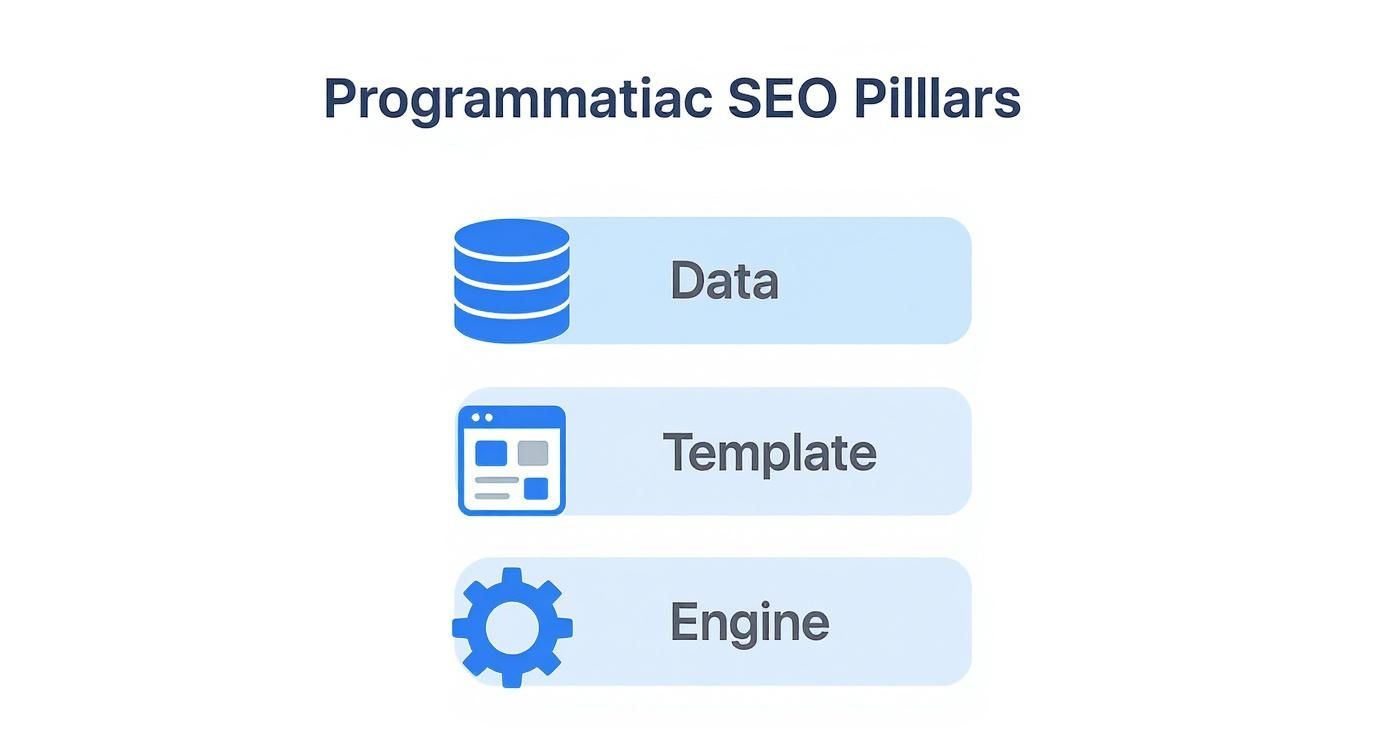
This diagram breaks it down perfectly: a solid data foundation gets styled by a template and then published at scale by some kind of generation engine.
Booking.com is a prime example of this model in action, attracting over 70 million monthly visitors by running more than 8 million keyword-targeted pages for property rentals across the globe. It's a staggering number, and you can dig deeper into how they pull it off by exploring these programmatic SEO insights on Omnius.so.
E-commerce And Product Variations
E-commerce giants like Wayfair deal with a similar, but slightly different, challenge: an insane number of product variations. A single sofa might come in dozens of colors, fabrics, and sizes. Manually creating a unique page for a "blue velvet 3-seater chesterfield sofa" is just not going to happen.
So, they use their product database as the core data asset. Each attribute—color, material, style, brand—becomes a variable that can be mixed and matched to generate a specific landing page. This lets them capture extremely targeted, high-intent searches from customers who already know exactly what they want.
Their system can spin up pages for queries like:
- Industrial-style bar stools with metal legs
- Round pedestal dining table for 4 people
- Mid-century modern accent chairs in green
This strategy effectively turns every possible product combination into a unique doorway for organic traffic, blanketing the search results for their entire inventory.
The key takeaway from these leaders is that their programmatic pages provide genuine value. A page showing all available hotels in a specific neighborhood is incredibly useful, as is a page displaying every red armchair a store sells.
Directories And Local Services
Local directories and service marketplaces like Yelp or Thumbtack live and die by their ability to show up for "near me" searches. Their data asset is a massive collection of business listings, each one packed with location details, service categories, hours, and user reviews.
These platforms prove how a rich dataset of local information can be programmatically assembled to answer hyper-local questions. They generate millions of pages targeting every conceivable combination of service and location, from "plumbers in Brooklyn" to "best coffee shops in downtown Omaha."
Each page is a valuable resource, giving the user exactly the information they were looking for. And that’s precisely why Google rewards them with such high rankings.
Your First Programmatic SEO Campaign: A Step-by-Step Guide

Knowing what programmatic SEO is and actually building a project are two different things. It can feel like a huge leap, but with a clear process, you can turn your unique data into a serious traffic engine. I'll break down the entire journey into five manageable stages, giving you a practical playbook for launching your first campaign.
Think of this as a series of well-defined steps, not a mad dash to the finish line. Each stage builds on the last, making sure you have a solid foundation before you move on. From digging into keywords to actually generating pages, this is your roadmap.
Step 1: Discover And Validate Your Head Term
Before you build a single page, you need a blueprint. In programmatic SEO, that blueprint is your head term. This is the core keyword pattern you plan to target at scale. Think of Zapier's famous "{tool} and {tool} integration" or TripAdvisor's "things to do in {city}". Your goal is to find a repeatable formula that can spin off hundreds or even thousands of unique, valuable search queries.
Start by brainstorming. What are the common questions your customers ask? What patterns already exist in your internal data? Put yourself in their shoes and imagine what they'd type into Google. Once you have a few solid ideas, it's time to see if they hold water.
Use a keyword research tool to check a sample of the keywords your pattern would create. You're hunting for two key things:
- Low Keyword Difficulty: Ideally, you want to find phrases the big players have overlooked. Aim for terms with a difficulty score below 30.
- Sufficient Search Volume: While any single keyword might have low volume, you need to be sure that the total traffic potential across all of them is significant.
Honestly, this research phase is the most critical part of the entire process. A strong, validated head term is the foundation of a successful programmatic SEO project. Get this wrong, and the rest won't matter.
Step 2: Gather Your Data And Build Your Database
With your keyword strategy locked in, your next job is to gather the data that will actually bring these pages to life. This is where you compile all the "LEGO blocks" for your project. The data you collect has to be structured, clean, and directly related to your head term.
For example, if your head term is "best {service} in {city}," your database will obviously need columns for the service type and the city name. But to create pages that are genuinely useful, you need to go deeper. Consider adding columns for:
- Unique descriptions
- Pricing information
- Customer reviews or ratings
- Relevant images or videos
Your database can be as simple as a Google Sheet or as robust as a dedicated setup in Airtable. The tool isn't as important as the quality of the data itself. Every single row in your database is going to become a unique webpage, so each piece of data you add makes the final product that much better.
Step 3: Design A High-Performance Page Template
Now it's time to design the "instruction booklet"—your page template. This is the master layout that will house all your data. A good template needs to do two things well: provide a great user experience and be perfectly optimized for search engines.
Your template will have static elements that appear on every page, like your logo, navigation, and footer. But more importantly, it has to contain dynamic placeholders where the data from your database will be injected. These placeholders will populate everything from the page title (H1) and meta description to the body content and images.
Your template isn't just a container for data; it's a strategic tool. A well-designed template guides the user, answers their query clearly, and encourages them to take the next step, whether that's making a purchase or contacting you.
Focus on a clean layout, fast load times, and mobile responsiveness. Crucially, bake your internal linking strategy directly into the template. For instance, you can include a section that automatically links to other related pages, which is a massive help for getting Google to discover your entire network of content.
Step 4: Choose Your Tech Stack And Generate Your Pages
You've got your data and a template. Now you need an engine to put it all together. The technology you pick will depend on your budget, technical skills, and how complex your project is. There are a few common ways to approach this.
Choosing Your Programmatic SEO Technology Stack
Picking the right tools is a critical decision. Some paths are faster but less flexible, while others offer total control at the cost of time and money. Here’s a quick breakdown to help you decide which approach fits your situation best.
| Approach | Best For | Pros | Cons |
|---|---|---|---|
| No-Code Platforms | Marketers & non-developers | Fast to launch, visual interface, cost-effective. | Can be less flexible for highly complex projects. |
| CMS with Plugins | Teams using WordPress | Leverages an existing platform, many plugin options. | Performance can be an issue at massive scale. |
| Custom Code | Teams with developers | Ultimate flexibility and control, highly scalable. | Higher upfront cost and longer development time. |
For many first-timers, a no-code stack like Webflow combined with Airtable is a fantastic starting point. You can then use tools like Whalesync as the bridge, which automatically syncs your Airtable data to your Webflow template to generate thousands of live pages without writing a single line of code.
Step 5: Launch, Monitor, And Optimize
Once you flip the switch and your pages go live, your job isn't over. The final stage is all about monitoring performance and optimizing based on real-world data. Keep a close eye on Google Search Console to track your indexation rate—that’s the percentage of your pages Google has successfully crawled and added to its index.
Jump into Google Analytics and see what's happening with your traffic. Pay special attention to which pages are driving the most engagement and conversions. Programmatic SEO is not a "set it and forget it" strategy. It's a cycle: launch, learn from the data, and refine your approach to build a powerful and sustainable source of organic traffic.
How To Measure The Success Of Your Campaign
Launching thousands of new pages is really just the start. If you don’t have a clear way to measure what’s working, you're essentially flying blind. You can't prove that all this effort is actually paying off. Success isn't just about watching the traffic numbers go up; it's about tracking the right key performance indicators (KPIs) that connect your content to actual business results.
The first and most foundational metric you need to watch is your indexation rate. This is simply the percentage of pages you created that Google has actually found, crawled, and added to its search index. If this number is low, it’s a red flag for technical problems, like poor internal linking or thin content that Google doesn't see as valuable enough to show people.
You can find this data right inside Google Search Console. A healthy indexation rate—somewhere above 80-90%—is a good sign. It confirms that Google can see and understand the massive new library of content you’ve built. This is the first hurdle. Get this right, and you’re ready for the next step.
Tracking Organic Performance At Scale
Once your pages are indexed, the real work begins. You need to isolate their performance from the rest of your website's traffic. The easiest way to do this is by creating a dedicated segment in Google Analytics that only includes the URLs from your programmatic campaign. This gives you a clean view of organic traffic, keyword rankings, and user engagement for this specific set of pages.
Don't get too hung up on tracking individual keyword rankings. With programmatic SEO, the game is different. Instead, you want to monitor the total number of long-tail keywords your pages are ranking for. A successful project should see this number climb into the thousands over time, capturing an enormous amount of highly specific search queries.
Here are the main metrics to keep an eye on:
- Organic Traffic: The total number of visitors landing on your programmatic pages from search engines.
- Total Keyword Rankings: The sheer volume of keywords your pages are appearing for in search results.
- Click-Through Rate (CTR): The percentage of people who see your page in search results and actually click on it. This tells you how well your titles and descriptions are resonating with what people are looking for.
For a deeper look into this topic, you can check out our complete guide on measuring digital marketing performance.
Connecting Traffic To Business Outcomes
At the end of the day, traffic is just a vanity metric if it doesn’t lead to conversions. The final layer of measurement is about tying your programmatic SEO campaign directly to business goals—things like leads, sales, or sign-ups. This is where you calculate the true return on investment (ROI).
Make sure you have conversion tracking set up properly in Google Analytics. This lets you see how many visitors from your programmatic pages actually complete a desired action. From there, you can analyze your conversion rate and even calculate the cost per acquisition (CPA) for these users.
A successful programmatic campaign doesn’t just generate traffic; it generates profitable customer actions at scale. By connecting impressions to conversions, you can prove that your automated content is a powerful engine for business growth.
We’re seeing some incredible results from this approach, especially in B2B SaaS marketing. Companies like Zapier and Wise are perfect examples of its massive potential. For many businesses, a data-driven content strategy like this can triple or even quadruple marketing-qualified leads compared to more traditional methods. You can find more examples of how B2B companies are finding success with this strategy on GenesysGrowth.com.
Zapier is the classic case study. They built their authority by programmatically creating a landing page for every single software integration they offered. This move was genius because it perfectly matched what users were searching for, allowing them to capture a huge volume of traffic from people who were at the very bottom of the funnel, ready to connect their tools.
Common Mistakes That Can Derail Your Project
Programmatic SEO is an incredible way to scale your organic traffic, but let’s be real—this high-reward strategy comes with some serious risks. One wrong move can leave you with thousands of junk pages, a mountain of wasted resources, and even a nasty penalty from Google.
Knowing the common pitfalls is the first step to building something that actually lasts.
The Thin Content Trap
One of the most common and damaging mistakes is publishing thin or duplicate content. This is what happens when your data is shallow, causing your templates to spit out pages that are basically carbon copies of each other. Just swapping a city name in a headline isn't going to cut it. If the guts of each page are identical, Google will see it as low-value and might not even bother indexing your pages.
This mistake often leads to the dreaded "traffic cliff," where a site’s organic traffic suddenly plummets after a Google update flags all that templated, low-quality content. It’s a brutal lesson to learn.
Creating Orphan Pages
Another killer mistake is completely forgetting about your internal linking structure. When you publish thousands of pages without a clear plan for how they connect, you risk creating a massive graveyard of orphan pages. These are pages with no internal links pointing to them, making it almost impossible for Google's crawlers to find them, let alone figure out where they fit in your site.
A smart programmatic SEO setup bakes internal linking right into the page templates from day one. This way, every new page is woven into the fabric of your site, creating a clear path for both users and search engines. A few great ways to do this are:
- Breadcrumbs: Show people where they are (e.g., Home > Services > Plumbers in Omaha).
- Related Links: Automatically link to other relevant pages (e.g., links to plumbers in nearby cities).
- Hierarchical Links: Link up to a main category page and down to more specific sub-pages.
The 'spray and pray' approach of launching thousands of pages and hoping for the best is a recipe for failure. Every single page needs a clear purpose and has to provide real, unique value to earn its keep with users and search engines.
Forgetting About the Human on the Other Side
Finally, a ton of projects fail because they get so focused on the machine that they forget about the human. Even if your pages are technically perfect, they’ll tank if they don't solve for user intent. Your template has to be designed for a good user experience—that means fast load times, a clean mobile-friendly layout, and clear, direct answers.
Think about it: if someone lands on your page for "best coffee shops in downtown Omaha" and gets a slow, cluttered mess that doesn't actually list any coffee shops, they're gone. High bounce rates send a powerful negative signal to Google that your pages just aren't helpful. Always build your templates with the end user's goal in mind and make sure your data is presented in the most useful way possible.
Frequently Asked Questions About Programmatic SEO
Diving into programmatic SEO usually brings up a few common questions. Let's tackle them head-on so you can get a clearer picture of how it all works.
Is Programmatic SEO The Same As Spam?
Not at all, and it's a great question. While both use automation, their purpose is completely different. Programmatic SEO is about creating genuinely helpful, specific pages from a unique dataset to answer very precise user searches. Think of it as scaling value.
Spammy, auto-generated content, on the other hand, is just noise. It lacks a quality data source, offers zero real value, and is exactly the kind of stuff Google penalizes. A solid programmatic strategy is always built around a great user experience.
How Quickly Can I Expect To See Results?
Like any good SEO effort, this isn't an overnight fix. You’ll likely see the first trickles of traffic within 3 to 6 months as Google starts to discover and index all your new pages. It takes time for the bots to crawl thousands of URLs.
The real, meaningful results—the kind that moves the needle—typically show up after 9 to 12 months. This gives the pages enough time to marinate, build a bit of authority, and start ranking for the huge variety of long-tail keywords they were designed to capture.
The key here is consistency. Programmatic SEO is a long-term asset that builds on itself over time, not a quick traffic hack. The real growth kicks in once your pages are established.
What Is The Typical Cost To Implement This?
The cost can swing wildly depending on how you go about it. A fully custom-coded solution built from scratch by developers can be a serious investment, often running into tens of thousands of dollars for a big, complex project.
But it’s become way more accessible lately. Using no-code tools like Webflow and Airtable or specialized WordPress plugins has brought the price down significantly. With these tools, you could get a project off the ground for anywhere from a few hundred to several thousand dollars, depending on how big and complex it is.
What Types Of Businesses Benefit The Most?
Honestly, any business sitting on a large, structured dataset is a perfect candidate. The opportunities are massive across a bunch of different industries.
- E-commerce Sites: Think of businesses with thousands of products, each with attributes like color, size, brand, and material.
- Aggregators: Real estate or travel sites that have tons of listings organized by location, price, and features are a natural fit.
- Digital Publishers: Companies with databases full of information—like movie stats, financial data, or game wikis—can turn that data into traffic.
- Local Services: Any service business targeting tons of locations, like "plumber in [city]" or "electrician in [zip code]," can scale their reach like crazy.
Ready to see how programmatic SEO could work for your business? At Up North Media, we specialize in building these data-driven SEO engines that generate massive organic traffic and revenue. Schedule your free consultation today, and let's talk about building your growth machine.