

You're probably in one of two situations right now. Your business has outgrown a weak connection, or you're opening or expanding in a part of Nebraska where fiber and cable still aren't straightforward options. In both cases, the same question comes up fast: is Big Red Communications just another local ISP name, or is it a practical fit for how your company operates?
That's the right question. Businesses don't buy internet as a vanity purchase. They buy uptime for phones, card processing, cloud apps, security cameras, remote support, guest Wi-Fi, file syncing, and all the boring but critical systems that stop working the second the connection becomes unreliable.
For Nebraska companies, Big Red Communications matters because it plays an infrastructure role in places where wired options can be limited or uneven. It's not the same kind of decision as choosing a web developer, an SEO partner, or an AI consultant. This is a foundational utility choice. Get it right and your team stays productive. Get it wrong and every other investment sits on a shaky base.
An Introduction to Big Red Communications
Big Red Communications is a Nebraska internet provider with a local footprint that's centered on the state, not scattered across a national map. According to the BBB profile for Big Red Communications LLC, the company is a Nebraska-based LLC in Denton and has been in business for 12 years. That matters more than it sounds like on paper. A local provider with a long operating history usually understands the terrain, the permit realities, and the service expectations of nearby towns better than an out-of-state brand working from a generic playbook.
Its market appears concentrated across Nebraska communities, including major hubs and surrounding areas. That gives Big Red a practical place in the regional connectivity stack, especially for businesses outside the easiest fiber corridors.
Why local businesses keep running into this name
If you've looked for service in Lincoln, Grand Island, Hastings, Beatrice, York, or nearby areas, you've probably seen Big Red Communications show up in the mix. It's a provider businesses evaluate when standard wired broadband isn't the clean answer, or when a wireless option may solve a location problem faster.
That distinction is important. Big Red isn't mainly a “flashiest consumer internet” story. It's a “can we get this site connected well enough to run the business” story.
A local ISP earns attention when it can serve the places national providers treat as edge cases.
A second point gets missed in these conversations. Internet access and business growth are different problems. One gets your systems online. The other turns that connectivity into leads, sales, and operational advantage. If you're also reviewing how your company gets found in your service area, this primer on local search marketing for small businesses helps frame the difference.
For companies with distributed teams or international operations, communications planning also matters alongside connectivity. A practical example is this guide to the best business phone system in Australia, which shows how telecom decisions intersect with broader business operations even when the provider category is different.
Decoding Big Red's Core Services and Pricing
The simplest way to evaluate Big Red Communications is to start with what it markets, then map those plans to business behavior instead of marketing language. Publicly listed plan data shows a tiered lineup of 10 Mbps for $39.99/month, 20 Mbps for $59.99/month, 40 Mbps for $79.99/month, 75 Mbps for $89.99/month, and 100 Mbps for $99.99/month at InMyArea's Big Red Communications listing.
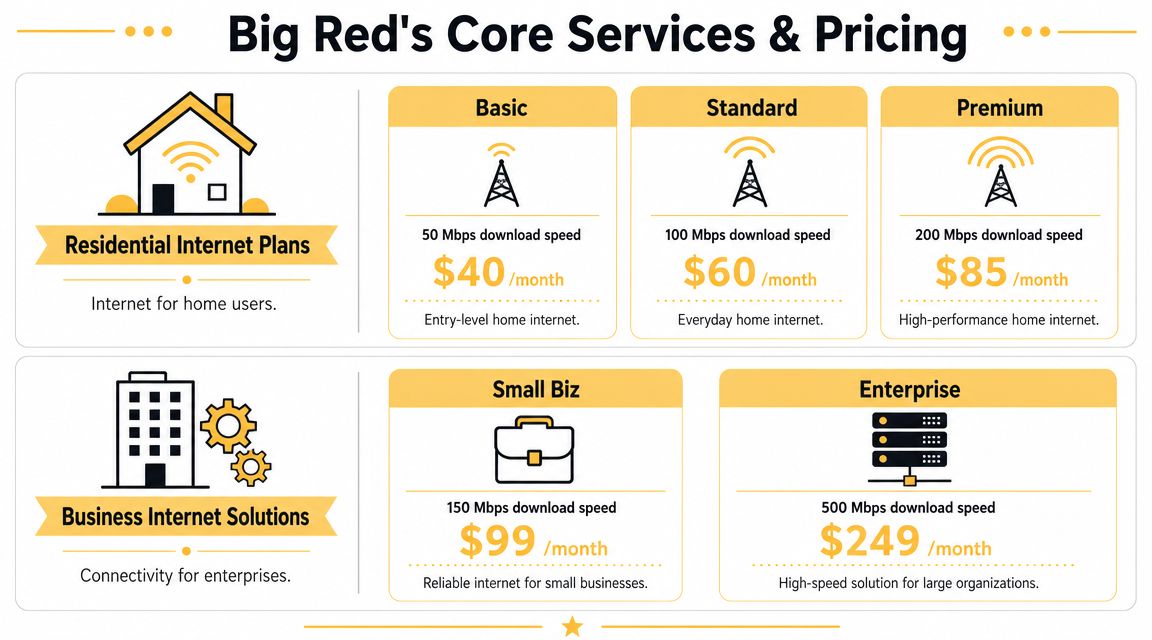
What those speed tiers mean in practice
A lot of owners see speed numbers and still don't know what they're buying. Here's the practical read.
- 10 Mbps works for a very light-use site. Think a tiny office, basic email, web browsing, and low-intensity back-office work. It's not a plan I'd choose if your team depends on frequent video calls or shared cloud platforms all day.
- 20 Mbps can support a small operation with modest traffic. This is closer to “functional” for a few users, but heavy file syncs or simultaneous meetings will still expose the limits.
- 40 Mbps starts to feel workable for many small offices. If your staff mostly uses browser-based tools, accounting software, CRM access, and occasional conferencing, this may be enough.
- 75 Mbps is where a lot of real businesses get breathing room. It gives more headroom for customer Wi-Fi, more concurrent calls, and fewer arguments over who's eating the bandwidth.
- 100 Mbps is the top published tier in the surfaced data, and it's the one I'd look at first for a company that relies on cloud workflows as normal operating behavior, not as an occasional convenience.
Why fixed wireless pricing needs context
Monthly price matters, but it's only one buying factor. You're not just buying megabits. You're buying fit for your location, installation feasibility, and whether the connection profile matches your daily workload.
That's why I usually tell businesses to compare business internet options in terms of workload type, not just package labels. A retail shop, a clinic, a farm office, and a fabrication facility can all have very different traffic patterns even if they employ a similar number of people.
Here's the practical translation:
| Plan | Best fit | Where it starts to struggle |
|---|---|---|
| 10 Mbps | Single-user or very low-demand site | Video calls, cloud backup, guest access |
| 20 Mbps | Small admin office | Multiple concurrent meetings |
| 40 Mbps | Small team with routine online operations | Heavier sync and shared media workflows |
| 75 Mbps | Active office with several connected systems | Larger teams with constant cloud usage |
| 100 Mbps | Stronger option for cloud-first small business use | Very high-throughput or fiber-grade expectations |
The business question behind the pricing
The price ladder tells you something useful. Big Red is serving customers who need practical internet choices, not premium urban fiber positioning. That can be an advantage when your biggest issue is getting a location online reliably and without the constraints of older phone-line-based services.
If you're evaluating the connection as part of a broader tech stack, it also helps to separate network service from hosting. They solve different problems. A company choosing an ISP should also understand how to choose a web hosting service, because fast internet at the office won't fix a slow website hosted on the wrong platform.
The Technology Behind Their Network
A business on the edge of town often faces a different internet decision than one in a downtown office park. The question is not whether wireless sounds modern. It is whether the network design fits the site, the workload, and the cost of getting service there in the first place.
Big Red Communications is built around directed fixed wireless links rather than a buried last-mile cable. At the customer site, an antenna and radio connect back to the provider network, then hand service off to the business through Ethernet. That matters because it changes the installation problem. A location that would be expensive or slow to reach with new wired infrastructure may be serviceable without trenching or relying on older phone-line assumptions.
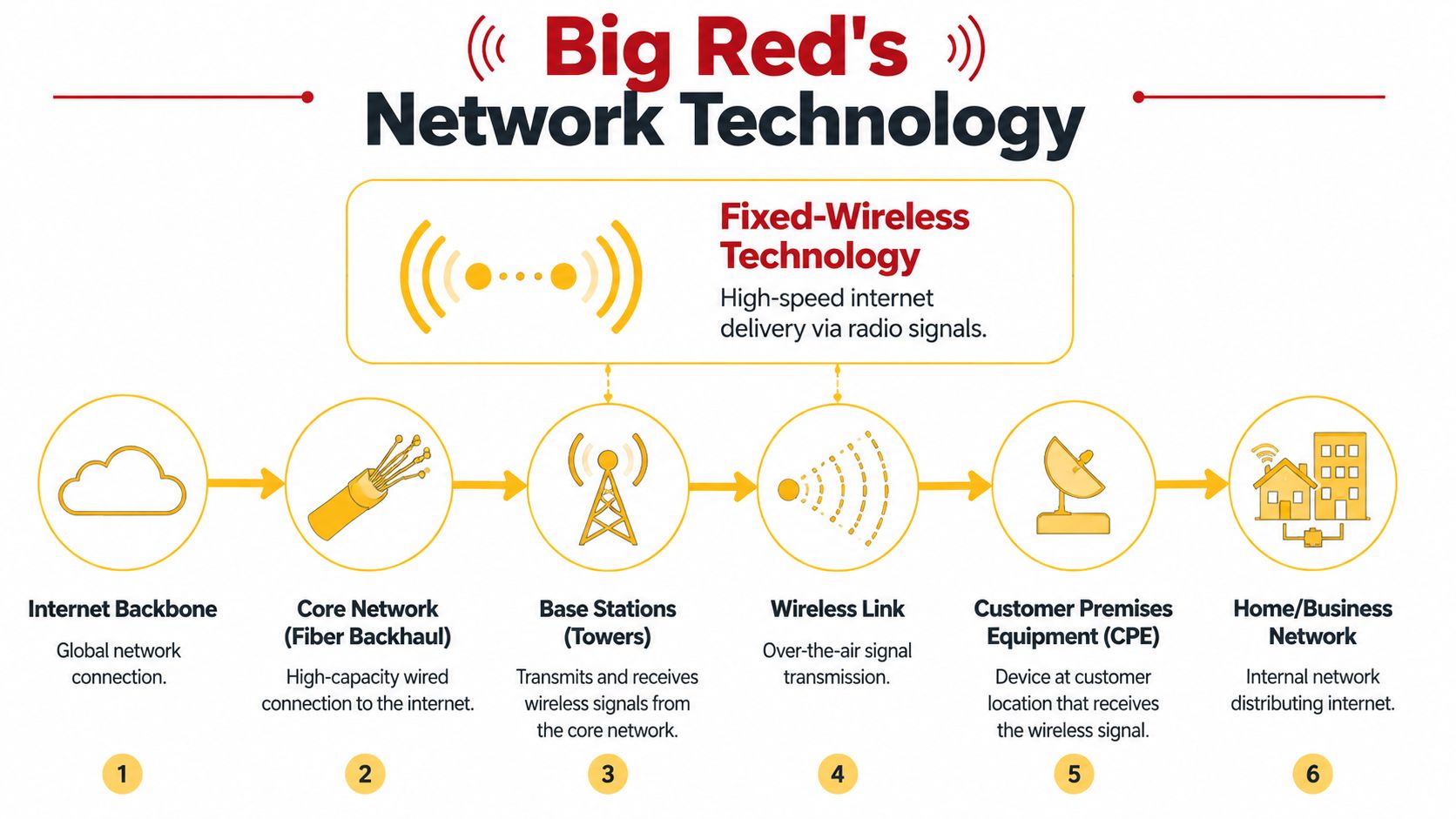
How the network model works in practice
The best way to understand this setup is as a dedicated radio path from the provider to your building. Once the signal reaches your premises equipment, your router and internal network handle the rest just like they would with another business internet service.
For the right site, that is a practical design.
Big Red also describes multiple Gigabit upstream connections, point-to-point links, and network cross-connect capabilities. Those details suggest a provider that is doing more than selling basic internet access to single-location offices. They point to infrastructure that can also support traffic between sites, private business links, or other setups where the connection itself is part of operations.
That distinction matters more than many buyers realize. If a company only needs internet for email, browsing, and cloud apps, the technical story can stop at reliability and available speeds. If the company needs to connect facilities, support a specialized workflow, or reduce dependence on consumer-grade access methods, the underlying network design starts to matter a lot more.
Why this architecture can fit Nebraska
Fixed wireless is often strongest where wired buildout is uneven, delayed, or hard to justify economically. That is a real business condition in Nebraska. A rural office, ag operation, light industrial site, or edge-of-town facility may care less about winning a headline speed comparison and more about getting a dependable business connection without waiting through a long construction cycle.
That does not make fixed wireless automatically better than fiber. Fiber is still the cleaner answer when it is available at a reasonable cost and timeline. But many businesses are not choosing between perfect options. They are choosing between a workable connection now, a costly build later, or staying stuck on an access method that no longer fits the job.
The strategic takeaway
This clarifies the choice between an ISP and a digital agency. Big Red solves an infrastructure problem. It gets a location connected and can support certain network-level business needs. Up North Media solves growth problems such as site performance, web development, search visibility, and AI workflow improvements. Those are different layers of the stack, and businesses get in trouble when they expect one vendor to fix issues that belong to the other.
A faster office connection will not repair a slow customer experience caused by poor hosting, bloated site code, or weak technical SEO. Teams sorting out that difference should read this guide to cloud hosting for growing businesses before blaming the ISP for application or website problems.
My view is simple. Big Red's technology makes sense when the hard part is reaching the property or supporting a network-specific business use case. If the connection is already adequate and the main bottleneck is lead generation, web performance, or online visibility, a growth-focused partner such as Up North Media is usually the better investment.
Strengths and Weaknesses An Honest Assessment
A business owner in a rural shop or edge-of-town office usually is not asking for the perfect connection. They are asking for a connection that works, gets installed on a sane timeline, and does not create weekly operational headaches. That is the frame that makes Big Red easier to assess.

Where Big Red makes strong business sense
Big Red stands out when the main constraint is access. If a property sits outside the areas that wired providers serve well, fixed wireless can be a practical business tool rather than a compromise. That applies to rural sites, agricultural operations, smaller facilities outside core commercial zones, and multi-site businesses that need connectivity without waiting on a construction-heavy build.
There is also a business case beyond basic internet access. Services such as point-to-point links and cross-connect options matter for companies with traffic that needs to move between locations or across a defined network path. That is a narrower use case, but for the right operation it can matter more than headline download speed.
Installation can also be the deciding factor. If the site has the right conditions, antenna-based delivery can be faster and less disruptive than waiting for trenching, pole work, or legacy line upgrades.
Practical rule: Big Red makes the most sense when the problem is getting dependable business connectivity to a location that wired carriers have not prioritized.
Where the caution flags show up
The trade-off is predictability. Fixed wireless depends on actual conditions at the property, not just a service map. Sight lines, mounting options, surrounding structures, weather exposure, and future obstructions can all affect the result. A business should treat the site survey as part of the buying decision, not as a formality after the contract is signed.
The second issue is buyer clarity. Big Red may be a fit, but the website does not answer every procurement question a business team will want settled in advance. Public-facing materials do not spell out enough detail on pricing structure, install variables, service tiers, or what support looks like under pressure. That does not make the service weak. It does mean the sales conversation has to carry more of the burden.
That matters because choosing an ISP is only partly about internet service. It is also a risk decision. If the provider can reach the building but the terms, expectations, and upgrade path stay vague, the business still has planning work left to do.
This is also where the difference between Big Red and a company like Up North Media becomes useful. Big Red solves the access layer. Up North Media solves growth problems such as site performance, web development, SEO, and AI workflow improvements. If the office cannot get a stable connection, Big Red may be the right call. If the connection is acceptable and the company is still struggling to generate leads or improve online performance, an infrastructure provider is not the fix.
Questions I'd ask before signing
Use this filter before signing any agreement:
- Performance expectations: Ask what speeds, uptime expectations, and response times are documented in writing.
- Site requirements: Confirm mounting location, power needs, equipment ownership, and any property conditions that could delay install.
- Support process: Ask who answers after-hours issues, how escalation works, and what maintenance communication looks like.
- Upgrade path: Get a clear answer on what happens if usage increases after expansion, new software adoption, or seasonal demand.
- Fit with business goals: Decide whether the problem is connectivity to the building or growth from the website and marketing stack.
I would not rule Big Red out because it is a fixed wireless provider. I also would not hire them to solve problems that belong to your web platform, search visibility, or conversion pipeline. Businesses get the best results when they separate infrastructure decisions from growth decisions, then buy each service for the job it does.
Big Red Communications vs Local Alternatives
When businesses compare Big Red Communications with local alternatives, they often compare unlike things. They put fixed wireless, cable, and fiber in one bucket and ask which is “best.” That's too broad to be useful.
The better comparison is: which technology fits this address, this workload, and this growth plan?
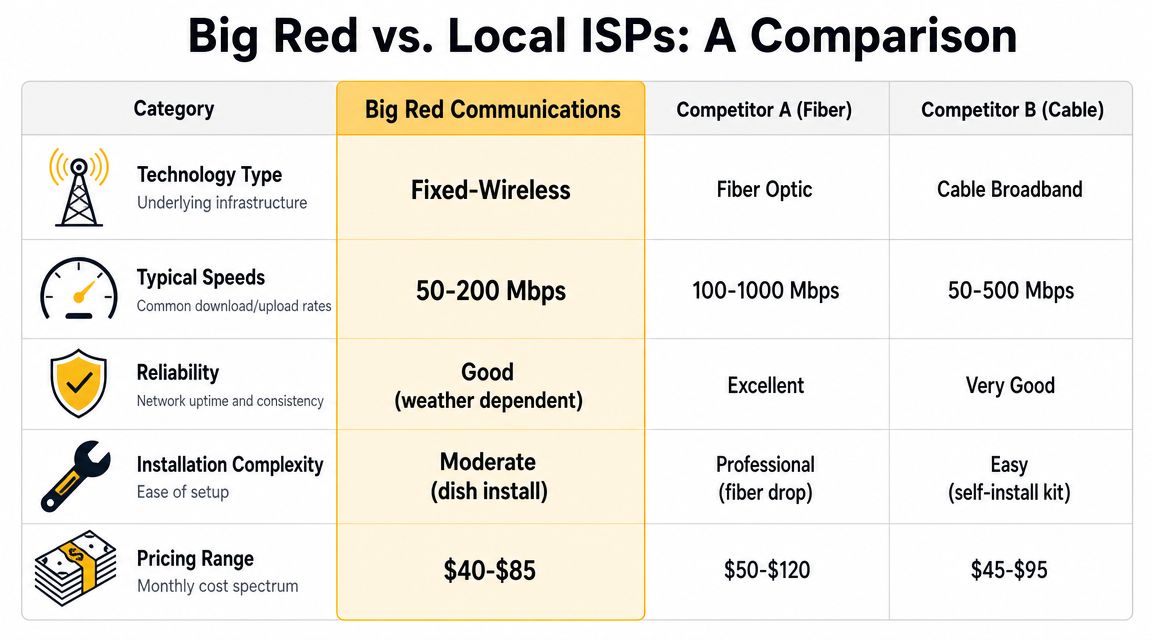
Compared with fiber and cable
Fiber is usually the first choice when it's readily available, priced reasonably, and installed without drama. It tends to suit high-throughput businesses, larger offices, media-heavy workflows, and companies that want the strongest long-term headroom.
Cable often lands in the middle. It can work well for many small and midsize businesses, especially in established commercial areas, but service quality depends a lot on the specific local plant and congestion patterns.
Big Red sits in a different lane. Its access model uses an antenna and radio that connect through standard Ethernet and don't require a separate phone line. That makes it a practical alternative when DSL-style legacy wiring isn't attractive and when a business needs a last-mile option that doesn't depend on copper. In that sense, Big Red often competes less with ideal-case fiber and more with “whatever can realistically serve this building.”
Here's the strategic shorthand:
| Option | Usually strongest when | Usually weaker when |
|---|---|---|
| Fiber | High performance and long-term capacity are top priorities | Buildout is unavailable or delayed |
| Cable | You need conventional broadband in served commercial areas | Consistency and upstream demands are more critical |
| Big Red fixed wireless | Wired choices are limited, delayed, or poor-fit for the site | You need the most robust wired profile available |
The comparison most owners miss
Big Red is an infrastructure provider. It gives you the pipe. That matters a lot. But the pipe doesn't create demand, fix weak conversion paths, or improve how your site performs in search.
A lot of businesses make a category error here. They spend weeks debating internet service and almost no time on the systems that turn traffic into revenue. The better operating model is to separate these decisions cleanly:
- Choose an ISP for availability, reliability, install feasibility, and network fit.
- Choose a digital growth partner for website performance, SEO visibility, conversion optimization, and automation.
- Coordinate both so your internal operations and customer-facing systems support each other.
Better internet helps your team work. Better digital strategy helps customers find and choose you.
That's why Big Red and a digital agency aren't direct substitutes. If your location problem is connectivity, Big Red may be part of the answer. If your problem is low search visibility, poor lead quality, weak web conversions, or disconnected marketing systems, the internet connection itself won't solve that.
For many Nebraska companies, the winning stack isn't one vendor that does everything. It's one provider for dependable connectivity and another partner for revenue-driving digital work.
Who Should Choose Big Red Communications?
Big Red Communications makes the most sense when the business problem is physical connectivity first. Not branding. Not lead generation. Not online conversion rate. Actual location-based internet access.
Best fit profiles
A few business types stand out as strong candidates.
- Rural and semi-rural operators: If your office, shop, yard, or facility sits outside the easiest wired footprint, Big Red belongs on the shortlist.
- Multi-building properties: If your operation needs a point-to-point or private connection between buildings, Big Red's network posture appears more relevant than a basic consumer ISP.
- Redundancy-minded businesses: Some companies don't want one connection type to be the only thing between them and downtime. A wireless provider can make sense as part of a backup strategy.
- Operational environments with specialized needs: Big Red's broader strategy appears to extend beyond consumer broadband into private networks, which can be useful for industrial sites or secure workflow environments, as discussed in this analysis of Big Red's private network direction.
Probably not the best fit
Some businesses should look elsewhere first.
If you're in a well-served metro corridor with straightforward fiber access and your operation depends on the highest-performance wired service available, start there. If your main bottleneck is ecommerce conversion, local SEO, paid acquisition efficiency, application UX, or workflow automation, internet service is only the background utility. It matters, but it isn't the lever that moves growth.
That's also why broad shopping guides can help frame the market before you narrow to one provider. If you're weighing connectivity in a less-served area, this roundup of the best rural internet options for 2026 is a useful starting point for comparing categories.
The simple decision rule
Choose Big Red when your business needs a location-savvy connectivity solution and wired alternatives don't cleanly solve the problem.
Pass on Big Red when premium wired service is already available and your bigger issue is what happens after customers get online and find you.
A lot of Nebraska businesses need both. They need dependable internet at the building, and they need stronger digital systems on top of it. Those are separate buying decisions, and treating them that way usually leads to better outcomes.
If your business has the connectivity side handled but still needs a website that converts, stronger organic visibility, or practical AI systems that remove manual work, Up North Media is worth a look. They help Nebraska businesses turn solid infrastructure into measurable growth through web development, SEO, and AI consulting.