You open Instagram, check yesterday's post, and the numbers don't make sense. Your followers still see your content, but discovery has fallen off. Hashtag traffic looks weak. Explore reach seems to have vanished. If you run a business, that kind of drop feels personal because it hits pipeline, sales, and confidence at the same time.
The first question most owners ask is simple. Can you be shadowbanned on Instagram? The honest answer is yes, but not in the dramatic way social media folklore describes it. What is commonly referred to as a shadowban is usually a recommendation problem, a content-level eligibility issue, or a policy filter that limits where Instagram will surface your posts to non-followers.
That distinction matters because businesses need a fixable model, not a rumor. If you understand how Instagram suppresses distribution, you can diagnose what changed, clean up the likely causes, and reduce the odds of it happening again.
The Truth About the Instagram Shadowban
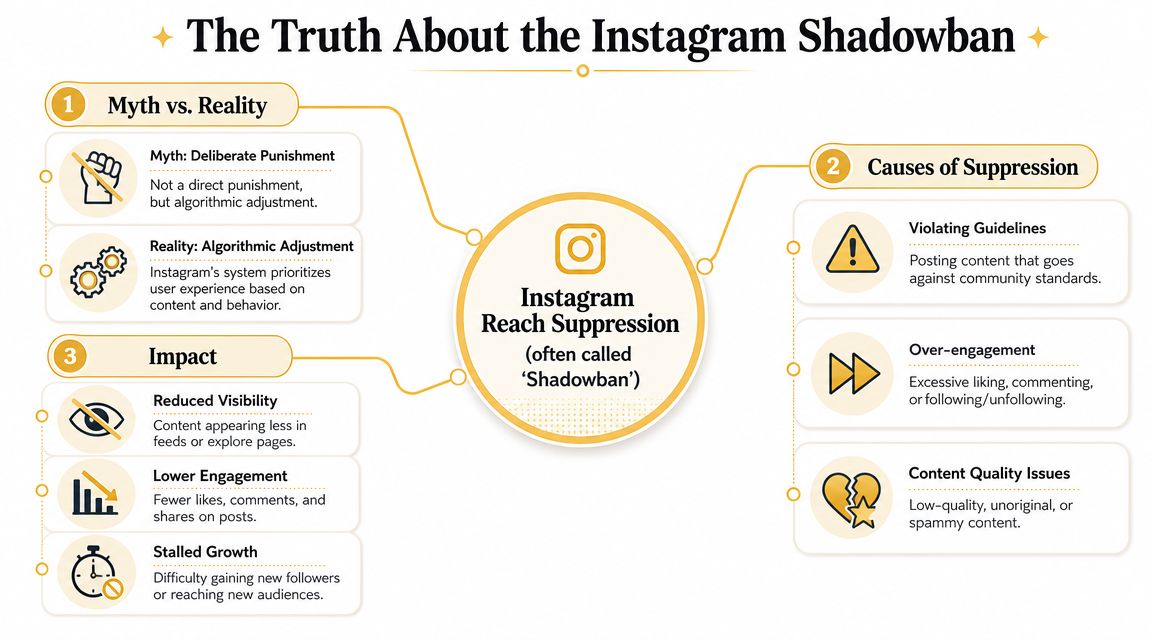
The word shadowban makes it sound like someone at Instagram flipped a hidden switch on your account. That's usually not what's happening.
Instagram's own behavior is better understood as recommendation suppression. In 2022, Instagram publicly acknowledged that some content would be shown less often across recommendation surfaces like Explore, Reels, and hashtags when it violated certain guidelines or was considered lower quality, as explained in Kofluence's breakdown of Instagram shadowban policy changes. That matters because it moved the topic out of rumor territory and into operational reality.
Myth versus mechanism
A real business problem gets buried when people treat every reach dip as a secret punishment. Sometimes a post underperforms. Sometimes your audience is less responsive. But sometimes Instagram is actively limiting where that content can appear.
Here's the cleaner way to consider it:
| Situation | What it usually means | What you'll notice |
|---|---|---|
| Normal weak performance | The post didn't earn strong distribution signals | Reach falls broadly, but there's no clear restriction pattern |
| Recommendation suppression | The content or account isn't eligible for some discovery surfaces | Non-follower reach drops sharply, especially from Explore or hashtags |
| Removal or direct enforcement | The content broke a rule strongly enough to trigger a visible action | The post, caption, or account status shows an enforcement signal |
That middle category is what most businesses mean when they ask if they can be shadowbanned on Instagram. The account may still be active. Your followers may still see your posts. But discovery can shrink fast because Instagram is no longer recommending that content as broadly.
Practical rule: If your biggest loss is non-follower exposure, think recommendation problem first, not audience problem first.
What this means for a business account
For a local brand, publisher, clinic, retailer, or service business, suppression doesn't just hurt vanity metrics. It affects discovery. That means fewer new people finding your offers, your expertise, and your products.
The most useful mental model is this:
- Followers can still see you even when discovery weakens.
- Non-followers are the first place pain shows up when recommendation surfaces stop working.
- The issue may be post-specific, not a lifetime ban on the account.
That's why “can you be shadowbanned on Instagram” isn't really a yes-or-no question. It's a distribution question. Which surfaces are still sending reach, and which ones have gone quiet?
What not to assume
Don't assume a shadowban means permanent damage. Don't assume every low-performing post is enforcement. And don't waste time on unofficial “shadowban checker” sites. Instagram still doesn't provide a public shadowban checker or direct notice, so the work has to happen inside your account and analytics.
A calm diagnosis beats panic every time.
How to Test for a Shadowban in 2026
If your reach drops, don't guess. Run a simple diagnostic.
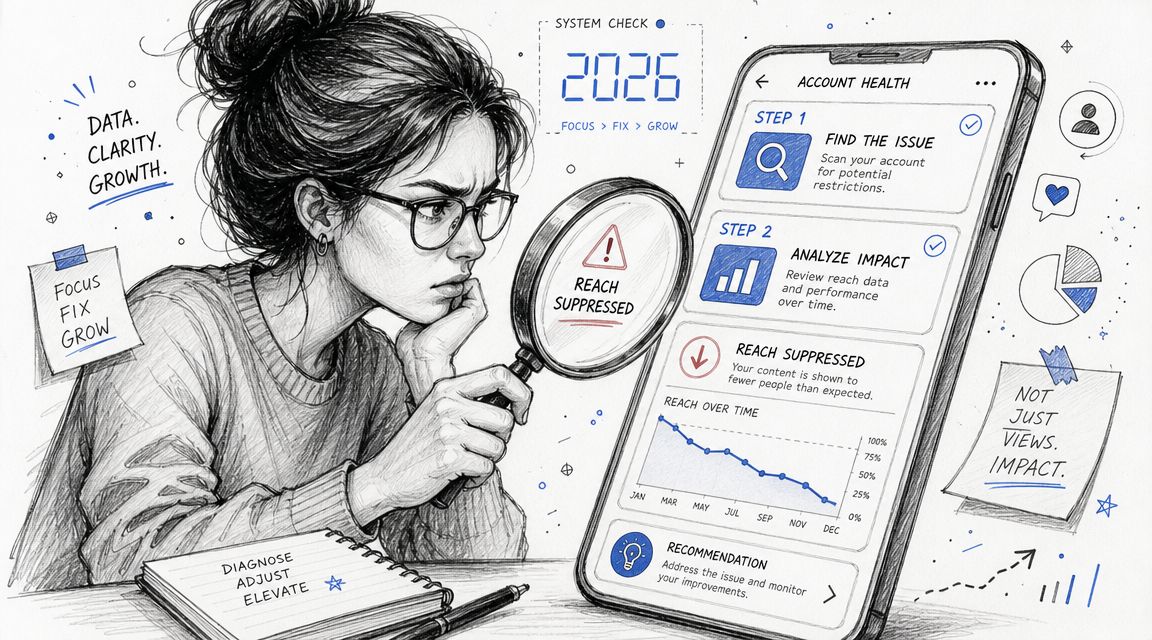
Start with Instagram's own account-health view, then use a real-world visibility test that checks whether non-followers can find your content. That combination gives you a much better answer than reading comments from frustrated creators online.
Check Account Status first
Instagram gives users a built-in place to review account health. Go to Settings and activity > More info and support > Account status.
Look there for two kinds of signals:
- Removed or flagged content
- Recommendation eligibility issues affecting whether content can be shown to non-followers
Instagram doesn't treat all reach problems as one blanket account ban. Instead, sometimes a specific post is the problem, and sometimes the account has a broader recommendation issue. If Account Status shows a limitation, start there before changing your entire content strategy.
Run the hashtag visibility test
The most practical technical test is straightforward. Publish a new post using a low-risk, less crowded hashtag. Then ask an account that does not follow you to search that hashtag and look for your post in Recent.
According to Tailwind's explanation of Instagram shadowban signals and hashtag invisibility, if the post doesn't appear for a non-follower, the likely issue is recommendation suppression or a hashtag-level restriction rather than an ordinary performance dip. Tailwind also notes that visibility drops often show up as a sudden decline in impressions outside the follower base.
If follower impressions hold relatively steady while non-follower impressions collapse, you're not looking at a normal creative slump. You're looking at a discovery problem.
Read your analytics like an operator
A lot of businesses look at total reach and stop there. That's too blunt. Break it apart.
Focus on these comparisons over time:
- Non-follower reach versus follower reach
- Hashtag discovery versus home feed exposure
- Explore visibility versus direct profile visits
If all traffic sources dip together, the problem may be broader content fatigue or a weak post. If discovery-specific sources fall off while your audience base is still responding, suppression is a stronger possibility.
Avoid bad tests
Some common “tests” don't tell you much:
- Asking followers if they saw your post doesn't isolate discovery issues
- Using highly competitive hashtags makes the test noisy
- Checking too late after publishing can muddy the result
- Using random online checker tools won't give you official restriction data
A practical diagnosis workflow
Use this sequence:
| Step | What to do | Why it helps |
|---|---|---|
| Step one | Review Account Status in the app | It shows official content or recommendation issues |
| Step two | Post with a niche, low-risk hashtag | It creates a cleaner visibility test |
| Step three | Have a non-follower search that hashtag | It checks whether your post is discoverable |
| Step four | Compare follower and non-follower reach trends | It separates suppression from ordinary underperformance |
If you run that process, you'll stop asking “am I cursed by the algorithm?” and start asking the better question. Where is discovery breaking, and what changed?
Common Causes of Instagram Reach Suppression
Most businesses get stuck because they treat Instagram suppression like a mystery. It's usually more mechanical than that. The main work is identifying which type of trigger fits what happened on your account.
Instagram's own systems enforce recommendation eligibility at both the account and content level. The platform's account-health tooling points users to content-specific signals, and The Markup's investigation into Instagram's automated suppression behavior found that Instagram suppressed hashtags, deleted captions, and hid comments without notifying users. The same investigation found no evidence that accounts were shadowbanned solely for advocacy history, erroneous reports, or prior banned-hashtag use.
That leads to a useful operating principle. Don't assume one invisible account-wide punishment. Look for a trigger in one of these buckets.
Content-related triggers
Sometimes the problem is the post itself.
Borderline content, guideline-sensitive topics, and questionable hashtag choices can all affect whether a post is eligible for recommendation. A post might remain visible on your profile while still getting excluded from surfaces where new audiences discover content.
Common content-side issues include:
- Guideline-adjacent creative that isn't removed but may be treated cautiously by recommendation systems
- Hashtag problems where a tag is hidden, restricted, or associated with low-quality discovery patterns
- Caption or comment issues when language inside the post environment creates moderation friction
If you manage customer feedback at scale, it also helps to review how people respond to your posts over time. Teams that discover top sentiment analysis platforms often get a clearer read on whether audience reactions are turning negative before performance drops become obvious.
Activity-related triggers
In such circumstances, many business accounts encounter difficulties without realizing it.
Third-party apps, automation shortcuts, aggressive follow and unfollow behavior, and suspicious login activity can make an account look spammy. Even if your content is fine, your behavior pattern can still create trust issues for the platform.
Watch for these risk areas:
| Trigger type | Example | Why it matters |
|---|---|---|
| Automation | Tools that like, follow, or comment on your behalf | It can look inauthentic or manipulative |
| Unnatural engagement | Bursts of repetitive actions in a short window | It resembles spam behavior |
| Third-party access | Old apps still connected to your Instagram account | They can create activity you're not fully monitoring |
| Login irregularities | Frequent access changes that look unusual | They can trigger trust and security checks |
Technical or platform-side issues
Not every reach drop is a punishment. Sometimes there's a technical explanation, a ranking shift, or a content-specific processing issue that looks like suppression from the outside.
A smart diagnosis asks:
- Did a single post vanish from discovery, or did every post soften?
- Did Account Status change, or is it clean?
- Did this start after a tool connection, a campaign sprint, or a change in content format?
A good audit doesn't start with blame. It starts with sequence. What changed first, and what changed right after it?
That sequence matters more than theories.
Your Step-by-Step Instagram Recovery Plan
Once you suspect suppression, the goal isn't to outsmart Instagram. The goal is to reduce risk signals, remove obvious problems, and relaunch with cleaner inputs.
A workable recovery plan needs structure because most businesses make the same mistake. They panic, post more, change everything at once, and create even noisier signals. Recent explainers note that Instagram's checks are tied to spammy behavior, policy violations, login activity, and third-party app access, and they often recommend removing suspicious apps or taking a 48–72 hour break, as summarized in Andrew Lee Ventures' review of Instagram shadowban recovery gaps. The harder truth is that no one can promise an exact recovery timeline.
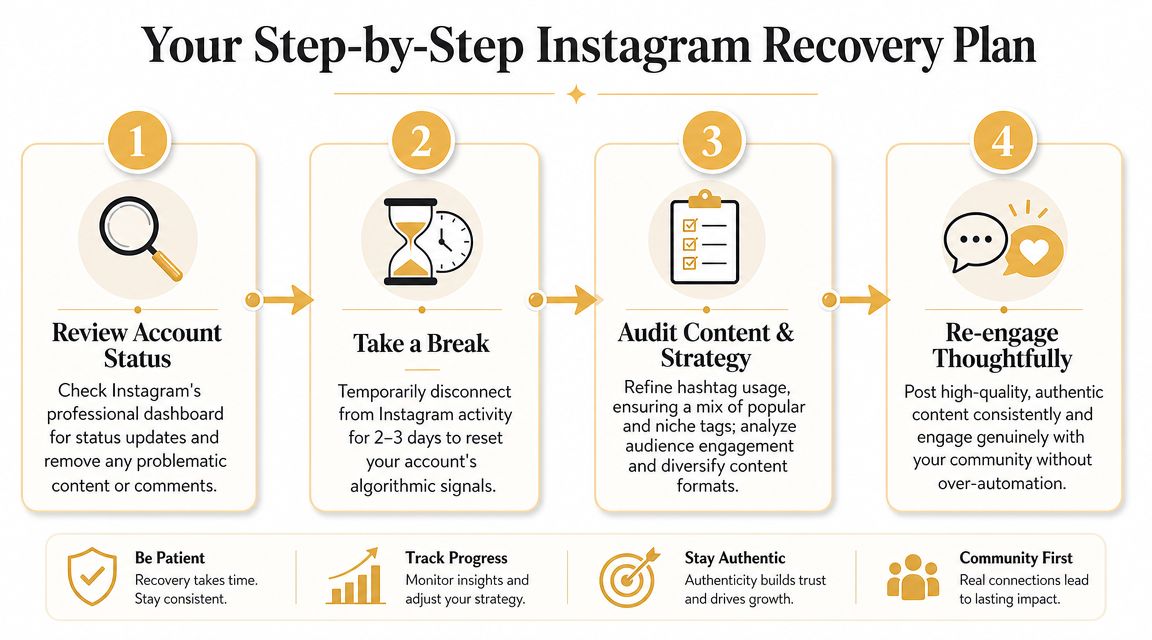
Step one: audit what Instagram can already see
Open Account Status and review any content warnings, recommendation limitations, or removals. If a specific post is flagged, treat that as the first place to act.
Then clean house:
- Archive or remove questionable posts that may be creating recommendation issues
- Review recent hashtags and stop using anything that looks risky, irrelevant, or repetitive
- Revoke third-party access for tools you don't fully trust or no longer use
- Check login hygiene so your access pattern looks normal and secure
This is also a good moment to tighten your publishing system. If your team is improvising every day, use a simpler planning framework like this guide on building a content calendar that keeps social execution consistent.
Step two: pause instead of pushing harder
If the account has been acting noisy, a short cool-down can help. That means no frantic posting sprint, no engagement pod behavior, and no trying to force signals back.
For a short period, reduce activity and let the account settle. If you've been using automation or questionable connected tools, stop immediately. The point is to remove the behavior that may be contributing to reduced distribution.
Recovery mindset: Don't stack new variables on top of a problem you haven't isolated.
Step three: relaunch with cleaner content
When you start posting again, go simple.
Use original creative. Keep captions clear. Choose relevant hashtags carefully. Avoid testing edgy angles just because they sometimes get attention. This is not the moment for experiments that flirt with policy boundaries.
A useful relaunch pattern looks like this:
- Pick your safest content themes that align tightly with your brand
- Post on a steady rhythm instead of in bursts
- Favor genuine engagement over mechanical outreach
- Watch each post's discovery behavior before changing the strategy again
Step four: monitor the right recovery signals
Don't judge recovery by likes alone. That metric is too shallow for this problem.
Look for signs that discovery is returning:
| Signal to monitor | What improvement looks like |
|---|---|
| Non-follower reach | More content starts reaching people outside your existing audience |
| Hashtag visibility | Test posts surface again under relevant niche tags |
| Explore and recommendation surfaces | Discovery traffic begins to reappear |
| Account Status | Fewer or no recommendation limitations appear |
If those signals improve, stay disciplined. Don't immediately reconnect every tool, flood the calendar, or recycle the exact behavior that got the account into trouble.
Proactive Strategies to Protect Your Instagram Reach
The best prevention strategy isn't one tactic. It's an operating system. I think of it as an Instagram immune system built from three habits working together: stronger content, authentic engagement, and steady compliance.
That framing matters because not every reach drop means you've been shadowbanned. Instagram's own tools push users toward a more practical question: whether content is eligible to be recommended across surfaces like Explore and hashtags, as discussed in Bitdefender's explanation of recommendation eligibility and Instagram account status. Businesses that think this way make better day-to-day decisions.
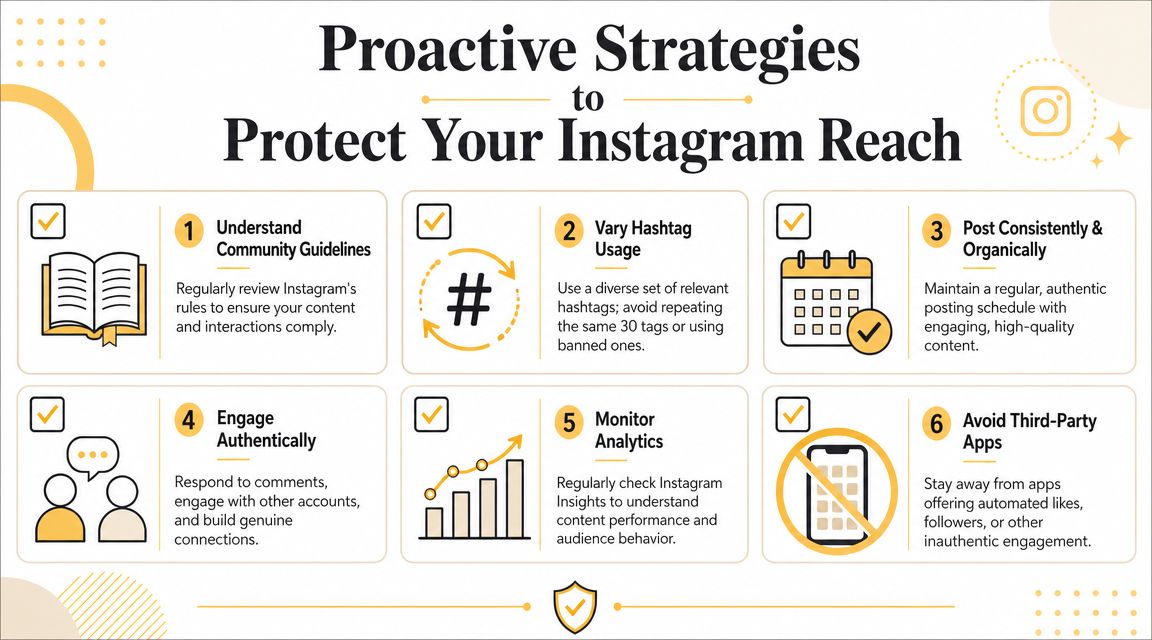
Build content that travels well
Recommendation systems tend to reward content that feels useful, original, and easy to place in front of the right audience. For a business, that usually means clear positioning and repeatable content themes.
A few protective habits go a long way:
- Stay in recognizable topic lanes so your account sends consistent signals
- Prioritize original creative over recycled posts and generic templates
- Format properly for the platform using current specs like this reference for Instagram image sizes and social media asset dimensions
Make engagement look human because it should be human
Instagram has every reason to reward real participation and distrust mechanical activity. Businesses that outsource interaction to low-quality automation often create the exact pattern they're trying to avoid.
Use a simple standard. If an action wouldn't make sense coming from a real employee or brand voice, don't automate it.
That means:
- Reply to comments with context
- Answer DMs thoughtfully
- Engage with partner accounts naturally
- Avoid repetitive comment templates across many posts
Healthy accounts don't just publish. They participate in ways that are easy to explain and easy to trust.
Keep compliance close to operations
A lot of teams treat guidelines as a legal footnote. On Instagram, they're a distribution issue.
Create a lightweight review process for content that touches sensitive topics, customer transformations, medical claims, financial claims, or controversial commentary. You don't need bureaucracy. You need a checkpoint before publishing.
Use this weekly checklist:
| Area | Question |
|---|---|
| Content | Does this post stay comfortably inside platform rules? |
| Hashtags | Are these tags relevant, varied, and worth using? |
| Access | Are any outdated tools still connected to the account? |
| Analytics | Is discovery stable, or are recommendation surfaces weakening? |
That's how you reduce surprise. Not by chasing algorithm hacks, but by running a cleaner account.
Building a Resilient Audience Beyond Instagram
The panic around shadowbans usually reveals a bigger business issue. Too much depends on one platform you don't control.
Instagram is valuable for discovery, awareness, and community building. It is not an owned asset. If the platform changes how it recommends content, your business can feel the impact immediately. That doesn't mean Instagram is bad. It means your strategy needs a second layer.
The safest move is to convert social attention into channels you own:
- Email lists you can reach without algorithmic filtering
- Website traffic you can measure and retarget
- First-party audience data that doesn't disappear when a platform changes ranking logic
- Content distribution across multiple channels so one dip doesn't break the whole system
For most small and mid-sized businesses, this starts with simple actions. Offer a useful lead magnet. Capture email from Instagram traffic. Send people to product pages, service pages, and educational content on your site. Build a content ecosystem instead of letting Instagram hold the entire relationship.
A stronger digital foundation also makes your social strategy better. When Instagram is one part of a broader system, you stop treating every post like a life-or-death event. You can test more calmly, measure more clearly, and make decisions from a business perspective instead of a fear response.
If you need a practical model for that broader system, study a few social media marketing strategy examples that connect content to owned channels. The best ones treat social as a bridge, not the destination.
Instagram reach will always fluctuate. Platform-specific issues are part of the job now. The long-term defense isn't finding a magic shadowban fix. It's building an audience your business can reach on its own terms.
If your business depends on Instagram for discovery but you need a stronger system behind it, Up North Media can help you connect social strategy with SEO, content operations, web experiences, and owned audience growth so one platform change doesn't stall your pipeline.