
First-party data is information you collect directly from your own customers through your own channels like your website, app, CRM, email, or in-store interactions, not data you buy from outside brokers. If your ad spend is rising but the audience insight still feels fuzzy, this is the dataset that usually fixes the problem.
A lot of businesses are sitting on useful signals already. The issue isn't lack of data, it's that the data is scattered across forms, transactions, emails, and support conversations, so nobody trusts it enough to use it well.
Understanding First-Party Data in Today's Marketing World
An Omaha retailer can spend more on ads every month and still not know which campaigns bring in repeat buyers. A local publisher can drive newsletter signups and still struggle to connect those subscribers to actual reading habits. An e-commerce store can collect orders and site visits all day long, then make decisions from half-organized spreadsheets and assumptions. That gap is where first-party data starts to matter.
At its simplest, first-party data is the information a company collects directly from its own customers and audience through owned channels such as websites, apps, CRM systems, email, and purchases, rather than buying it from outside data brokers. Multiple industry sources define it this way, including CDP.com, Contentful, and StackAdapt, and they all point to the same business reality, direct collection is what makes the data more reliable and privacy-aligned.
Practical rule: if your team can explain where the data came from, who shared it, and how consent was captured, you're dealing with first-party data.
The common mistake is treating it like one database. In practice, it's a collection of signals, website activity, purchase history, email engagement, app usage, sales interactions, and customer feedback. Those signals are useful because they come from a direct relationship with the user, which is why teams use them to build customer profiles, segment audiences, and personalize marketing instead of guessing from outside proxies.
For teams trying to protect data and avoid fines, clean collection matters as much as smart activation, and a practical privacy checklist like protect data and avoid fines helps keep the basics from slipping through the cracks.
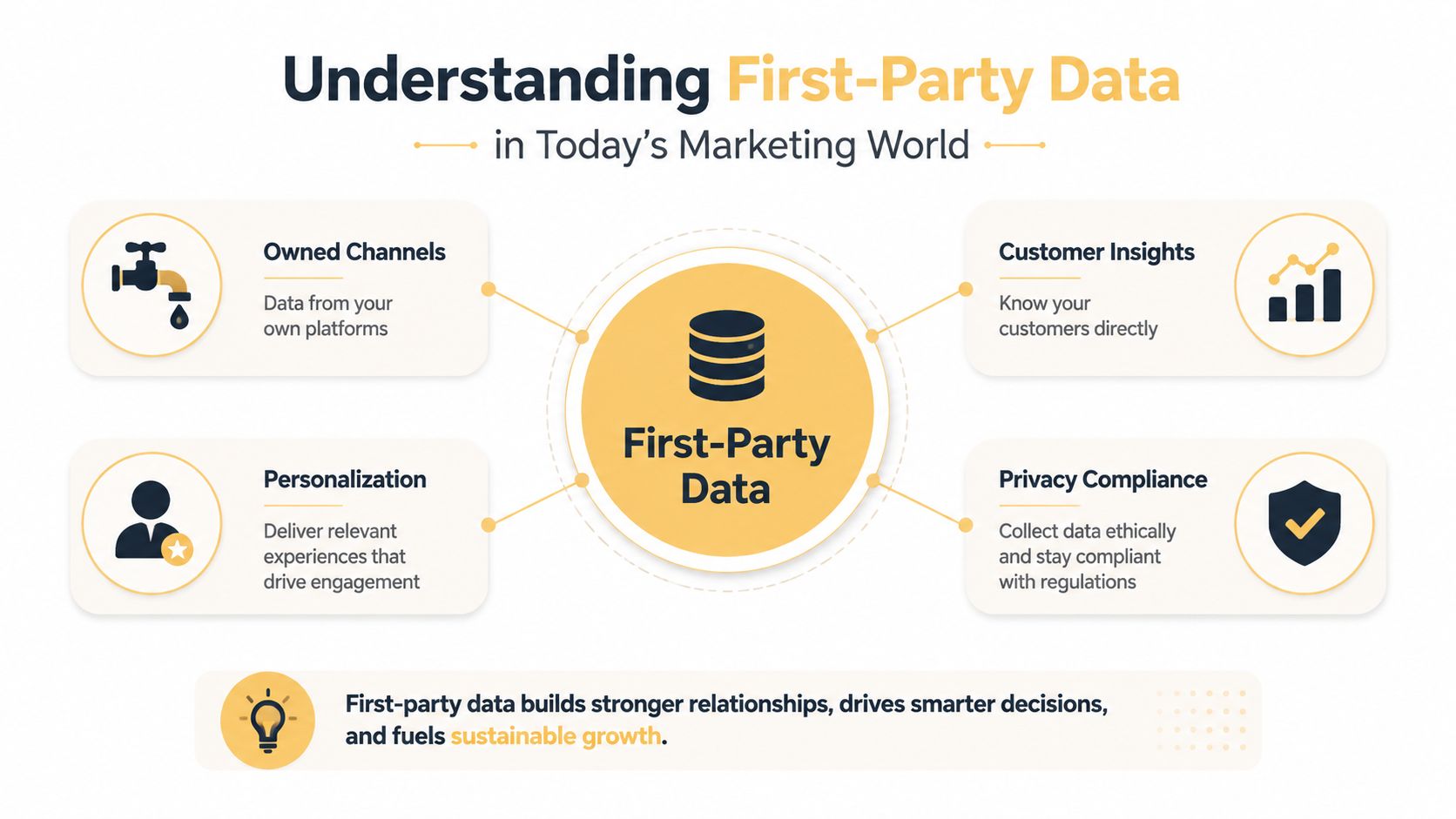
For a business owner, the point isn't jargon. It's control. When you own the signal, you can use it to improve relevance, tighten measurement, and stop paying for audiences you barely understand.
First-Party Data versus Third-Party Data What Actually Changes
The difference between first-party and third-party data starts with source, but the core difference is operational. First-party data comes from your direct relationship with the customer. Third-party data comes through an intermediary, which means you're farther from the original interaction and usually farther from the original context.
| Dimension | First-Party Data | Third-Party Data |
|---|---|---|
| Source | Collected directly from your own customers and audience | Collected by outside providers and sold or licensed onward |
| Accuracy | Tied to real interactions with your brand | Can be less specific, less current, or less relevant |
| Control | You control the identity schema, consent record, and retention policy | Control sits with the broker or platform |
| Privacy alignment | More naturally aligned with consented collection | Harder to defend when data lineage is unclear |
| Activation | Easier to use for segmentation, personalization, and attribution | Often weaker for precise targeting and measurement |
That table matters because the business case isn't abstract. BCG reported that first-party data strategies generate a 2.9x revenue uplift compared with third-party data approaches, and organizations activating first-party data can see 1.5x higher customer lifetime value according to the verified data set from Contentmation's 2026 first-party data compilation.
The practical shift is also a control shift. With first-party data, you own the relationship, so you can decide how long to keep the data, what permissions are attached to it, and which systems can activate it. With third-party data, you're usually buying an audience segment that was assembled somewhere else, which means weaker identity resolution and more uncertainty when performance drops.
Third-party data can still supplement strategy, but it shouldn't be the center of revenue planning anymore.
For a local service company, that difference shows up in follow-up quality. For an online store, it shows up in remarketing accuracy. For a publisher, it shows up in subscriber segmentation that reflects reading behavior instead of broad demographic guesses. If you're evaluating stack options, the question isn't which dataset sounds bigger. It's which one connects to customer actions you can trust.
How First-Party Data Is Collected and Activated
Collection starts where the customer already interacts with the brand. Websites capture page views, search behavior, and form fills. Apps capture usage patterns and account events. Email platforms capture opens and clicks. CRMs capture sales notes, lifecycle stage, and closed deals. Point-of-sale systems, loyalty programs, and support tickets round out the picture by bringing offline behavior into the same view.
The technical reason this data is so useful is simple, it comes from owned touchpoints, so the brand controls the identity schema, retention policy, and consent record. That makes the data easier to govern than borrowed audience files, and it gives operational teams something they can activate without depending on a broker.
Operational rule: collect both observed behavior and declared preferences. Page views tell you what people did, forms and surveys tell you what they meant.
Here's where the pipeline becomes useful. A retail shop in Omaha might collect email signups at checkout, connect them to purchase history in the CRM, and then use that list to send follow-up offers for repeat visits. A local publisher can tag article reads, newsletter clicks, and topic preferences, then segment subscribers into audiences that get different content paths. An e-commerce business can connect abandoned cart events to retargeting lists and product recommendations. The data is the same idea in each case, but the revenue outcome changes based on how cleanly the data is activated.
For teams that need a practical technical explanation of collection paths, server-side tracking explained is worth reading because it shows how owned signals can be captured more reliably in modern setups.
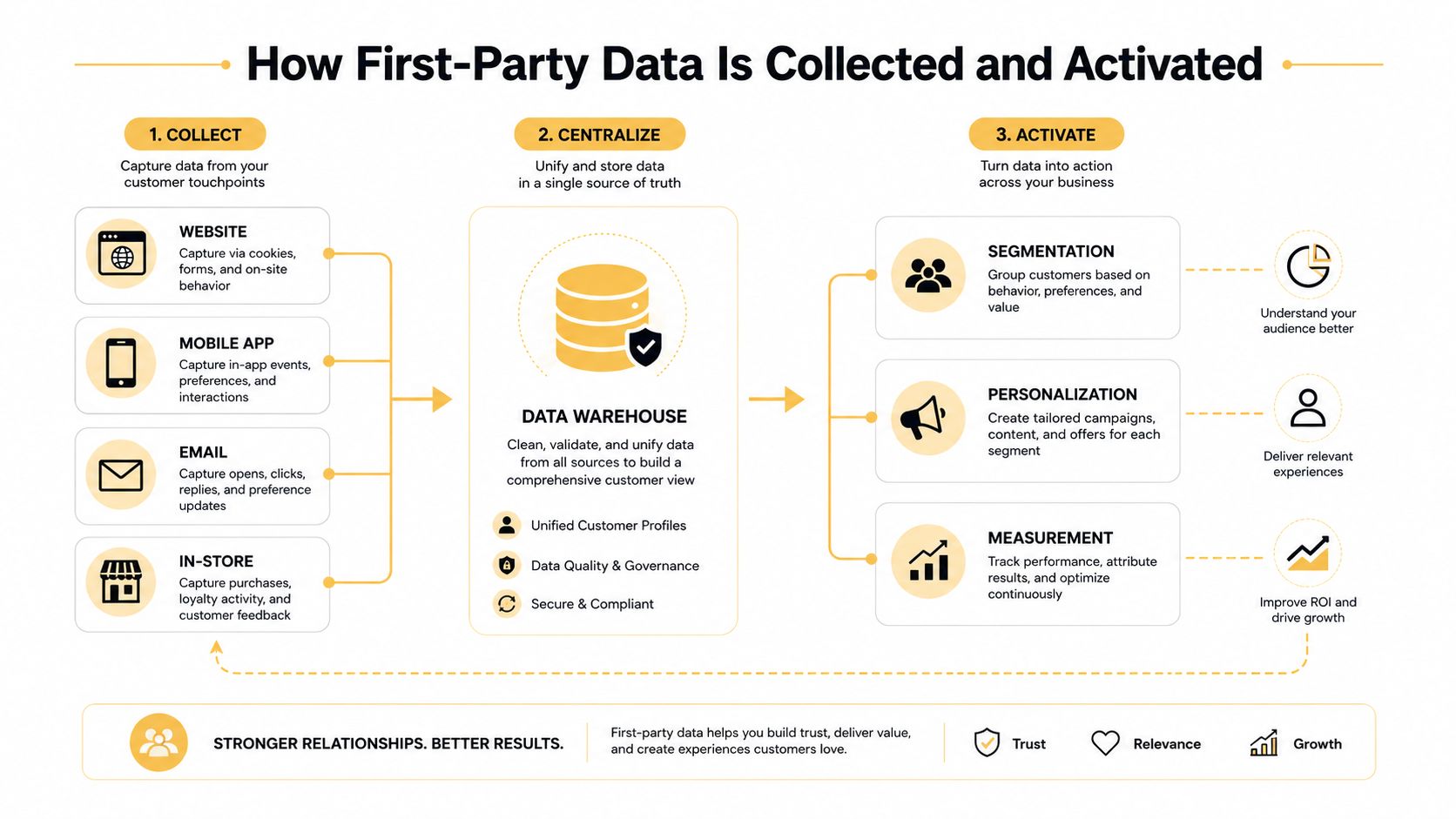
Once the data is centralized, the value comes from activation. That means audience segmentation, personalization, CRM enrichment, retargeting seeds, lookalike modeling, and product recommendation logic built on consented event streams. If your team isn't doing those things yet, the issue usually isn't strategy, it's that the collection points were never connected cleanly enough to support them.
Businesses that want a working data flow usually need a stack that can pull signals into one place, keep them organized, and push them back out into marketing tools without creating a compliance mess. A useful example of that kind of data architecture is available in the Snowflake success examples, especially for teams thinking about storage and activation at the same time.
Real First-Party Data Use Cases for Your Business Type
An e-commerce store uses first-party data differently from a publisher, but the logic is the same, use known behavior to improve the next interaction. Purchase history and browsing behavior can power recommendation logic, cart recovery, and repeat-purchase messaging. If a customer keeps looking at the same category without buying, that's a stronger signal than a broad interest segment bought from outside the business.
A local publisher usually has less transaction data and more engagement data, which still works well if the segmentation is disciplined. Email clicks, topic subscriptions, scroll depth, and article visits can tell you what to promote next, what to suppress, and what kind of sponsored content is likely to feel relevant. That's where a content system built around dynamic content for website becomes useful, because the site can respond to the data instead of treating every visitor the same.
For a service business, the strongest first-party signals usually live in CRM notes, call logs, quote requests, and customer feedback. Those teams don't need a giant platform to benefit. They need a workflow that turns intake data into better follow-up, cleaner reminders, and more relevant reactivation messages. That's how a plumbing company, legal practice, or home services brand starts making every lead feel like a known customer instead of a contact record.
Startups and tech companies often get the most value by using first-party signals to improve support workflows, recommend next steps inside the product, and personalize onboarding. That doesn't mean first-party data replaces everything else. It means it becomes the backbone of what's consented and measurable, then gets paired with preference data and privacy-safe activation methods where appropriate.
The mistake across all business types is chasing completeness before usefulness. A small business doesn't need every field in the world. It needs a few signals it can trust, a reason to collect them, and a way to act on them fast enough to affect revenue.
Implementing a First-Party Data Strategy Step by Step
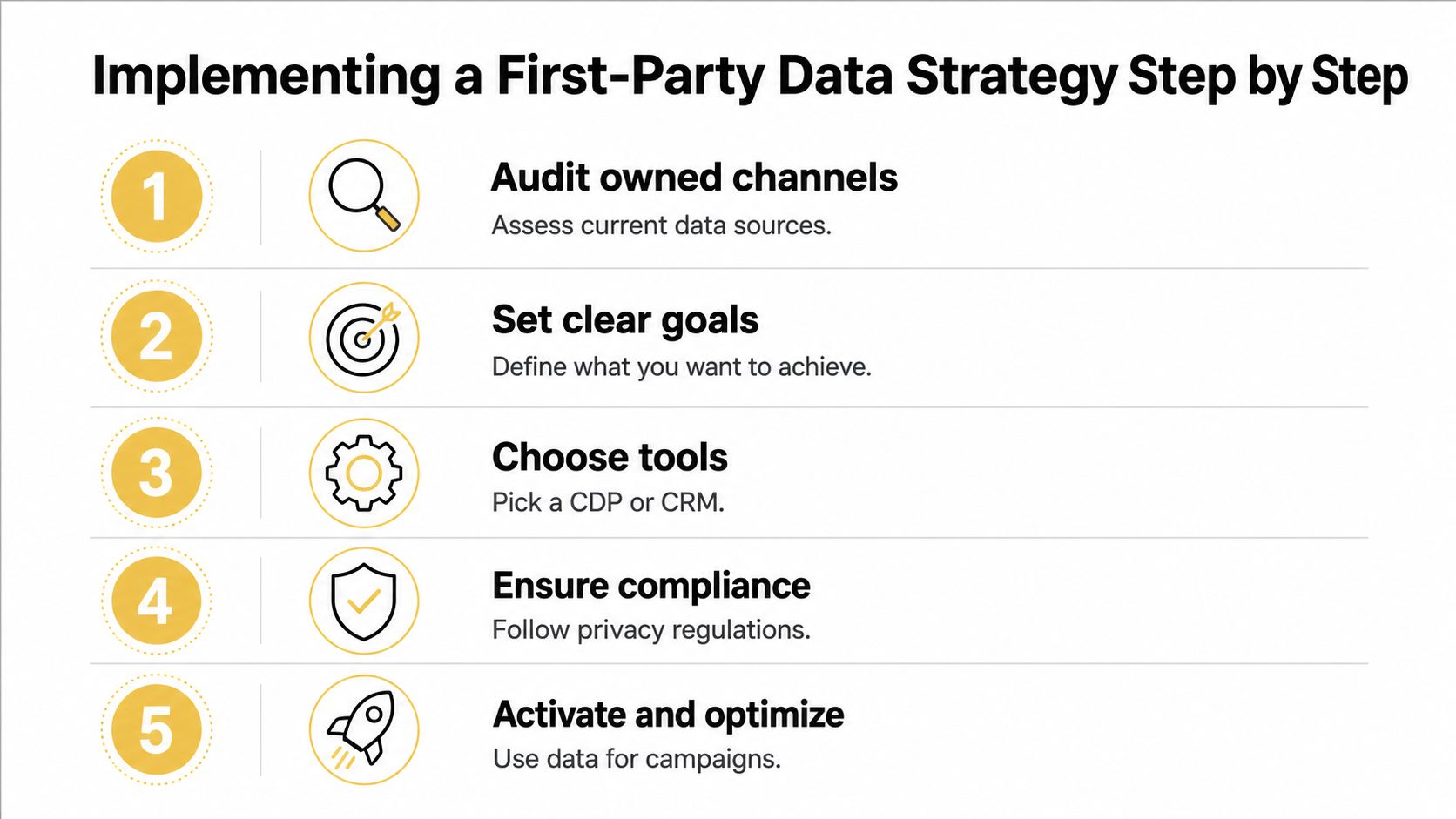
Start with an audit of owned channels. List every place your business already collects data, website forms, checkout pages, email signups, CRM records, call logs, support tickets, loyalty programs, and in-store interactions. Most companies already have more collection points than they think. The problem is that the signals aren't named consistently, so the data can't be joined without manual cleanup.
Next, define the outcome before adding more tools. Are you trying to improve conversion, retention, attribution, or personalization? If the goal is unclear, the data model gets bloated fast and nobody uses it. Clear goals keep the system lean enough for an SMB or publisher to manage.
Then put consent and governance in place. The data should be tied to a documented consent basis, a retention rule, and a process for opt-in or opt-out handling. That's not paperwork for its own sake. It's what makes the data usable when privacy rules and browser restrictions change. A CRM like HubSpot or Salesforce can store structured customer records, while a customer data platform can unify signals from multiple sources into a single profile. A marketing data cloud can help if your team needs more flexible storage and analysis.
The simplest implementation path is usually:
- Capture website events and form submissions cleanly.
- Push those records into a CRM or CDP.
- Segment by intent, source, or lifecycle stage.
- Sync those segments into email, ads, or personalization tools.
- Review which segments move revenue, then tighten the rules.
Practical rule: don't buy a platform to solve a tagging problem. Fix the data collection first, then add the software that needs it.
For teams exploring tool choices, one practical option is Up North Media, which can help businesses organize owned-channel data into a usable marketing system alongside web, SEO, and automation work. It's one option among several, but the important thing is the workflow, collect, govern, segment, activate.
Measuring First-Party Data ROI and Performance
The right way to measure first-party data is to compare what changed after the system went live, not just whether more data exists. Revenue per user, retention, click behavior, and average order value all tell part of the story, but the most useful measure is whether the business can make better decisions from owned signals than it could from purchased audiences.
BCG's reported 2.9x revenue uplift and 1.5x higher customer lifetime value from first-party data activation give the clearest external benchmark in the verified data set, and they line up with what strong internal programs try to achieve. The same verified compilation from Contentmation's 2026 first-party data statistics also says 81% of organizations had adopted privacy-first measurement strategies and 88% were projected to rely primarily on first-party data by 2027. Those figures matter because they show where measurement is heading, not just where marketing slogans are pointing.
A clean ROI review usually starts with a baseline. Track the current conversion path, how much paid traffic you need to generate a sale, and how often a returning customer buys again. Then compare the same metrics after segmentation and personalization are live. If your email list starts producing better repeat orders, or your retargeting gets less wasteful, the data strategy is earning its keep.
For a more formal approach to measuring marketing impact, how to calculate marketing ROI is a useful companion guide because first-party data only matters if it changes the numbers that leadership already watches.
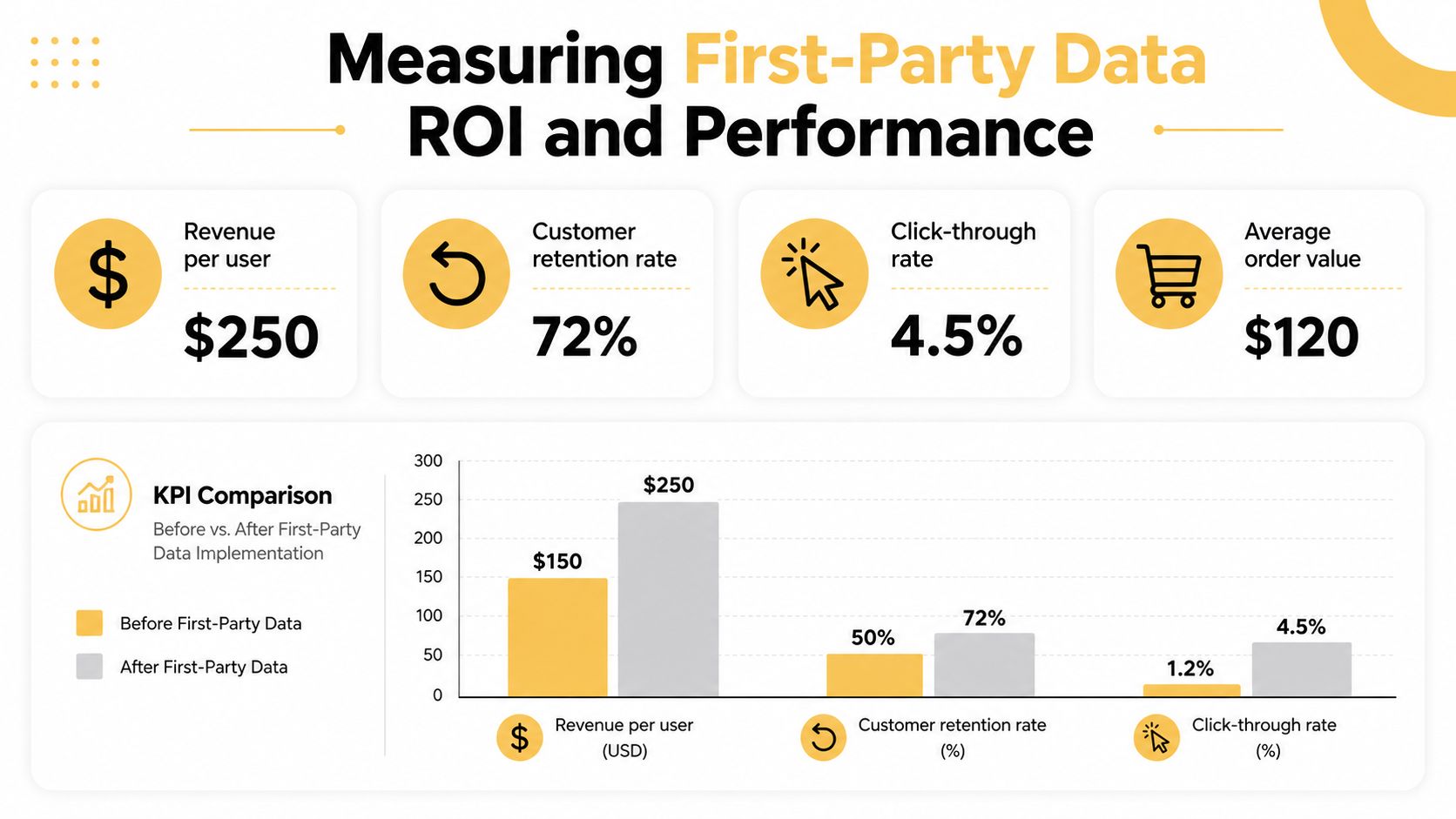
The biggest internal win is usually attribution clarity. When a business can connect a purchase, booking, or lead back to an owned touchpoint, it stops overpaying for broad acquisition and starts funding the channels that move customers. That shift is where the revenue story becomes visible.
Your First-Party Data Journey and Where It Heads Next
The privacy environment isn't going back to the old setup. Browser restrictions, consent expectations, and platform changes have made owned data more valuable, not less. Google's guidance points toward first-party data plus machine learning as a core part of future ad strategy, while current practice keeps moving toward consented collection, preference data, and privacy-safe activation methods.
Zero-party data is part of that next layer. It's what customers intentionally tell you, usually through preference centers, surveys, and profile fields. First-party data and zero-party data work best together because one shows what people do, the other shows what they say they want. AI can improve recommendations and timing, but only if the underlying signals are clean and consented.
A few questions come up repeatedly:
What is first-party data in the simplest possible terms? It's customer information you collect directly from your own channels, not a list you bought from someone else.
Can a small business build a useful strategy without a large team? Yes. Most SMBs can start with website events, email segmentation, and CRM cleanup before they ever buy a bigger platform.
How long does it take to see results? It depends on the quality of the collection points and the speed of activation. Teams usually feel the benefit first in cleaner segmentation, then in better campaign performance, then in reporting they can trust.
How does first-party data relate to zero-party data? First-party data is observed through your owned touchpoints, zero-party data is volunteered directly by the customer. The strongest systems use both.
Businesses that invest now won't be guessing later while everyone else scrambles to rebuild their audience systems. They'll already have the data foundation, the governance, and the measurement discipline in place.
If you want help turning owned-channel data into revenue, Up North Media builds practical digital systems for SMBs, publishers, and e-commerce teams that need cleaner collection, better activation, and more trustworthy measurement. Visit Up North Media to talk through a strategy that fits your business and turns first-party data into something your team can use.