
On-page SEO optimization is the practice of improving the content and HTML elements within an individual webpage so search engines understand its topic and users decide whether to click. It includes page titles, headings, descriptions, links, images, mobile content, and performance, not just repeated keywords.
A small-business owner in Omaha often encounters SEO as a pile of disconnected instructions: add keywords, write a blog, build links, fix speed, claim a profile. The advice feels complicated because it mixes different jobs. On-page SEO is the part you can control directly on each URL, and it gives search engines a clear document to crawl, interpret, and present to potential customers.
That clarity matters even more as search results increasingly answer questions before a visitor reaches a website. A page now needs to earn conventional clicks, support business decisions, and communicate its information clearly enough to be selected or cited in generated answers. The fundamentals remain practical: make every important page useful, accessible, internally connected, technically sound, and easy to summarize accurately.
Understanding What On-Page SEO Optimization Actually Means
A small business can publish a useful page and still get weak search visibility because the page sends mixed signals. A roofing company page might describe repairs in the body copy, use “Home” in the title tag, show “Welcome” as the main heading, skip image descriptions, and leave key service pages orphaned. A human visitor may piece it together. Search engines and AI-generated search systems have a harder job. If the page is hard to interpret, it is also hard to rank, rewrite into a strong title, or cite accurately in generated answers.
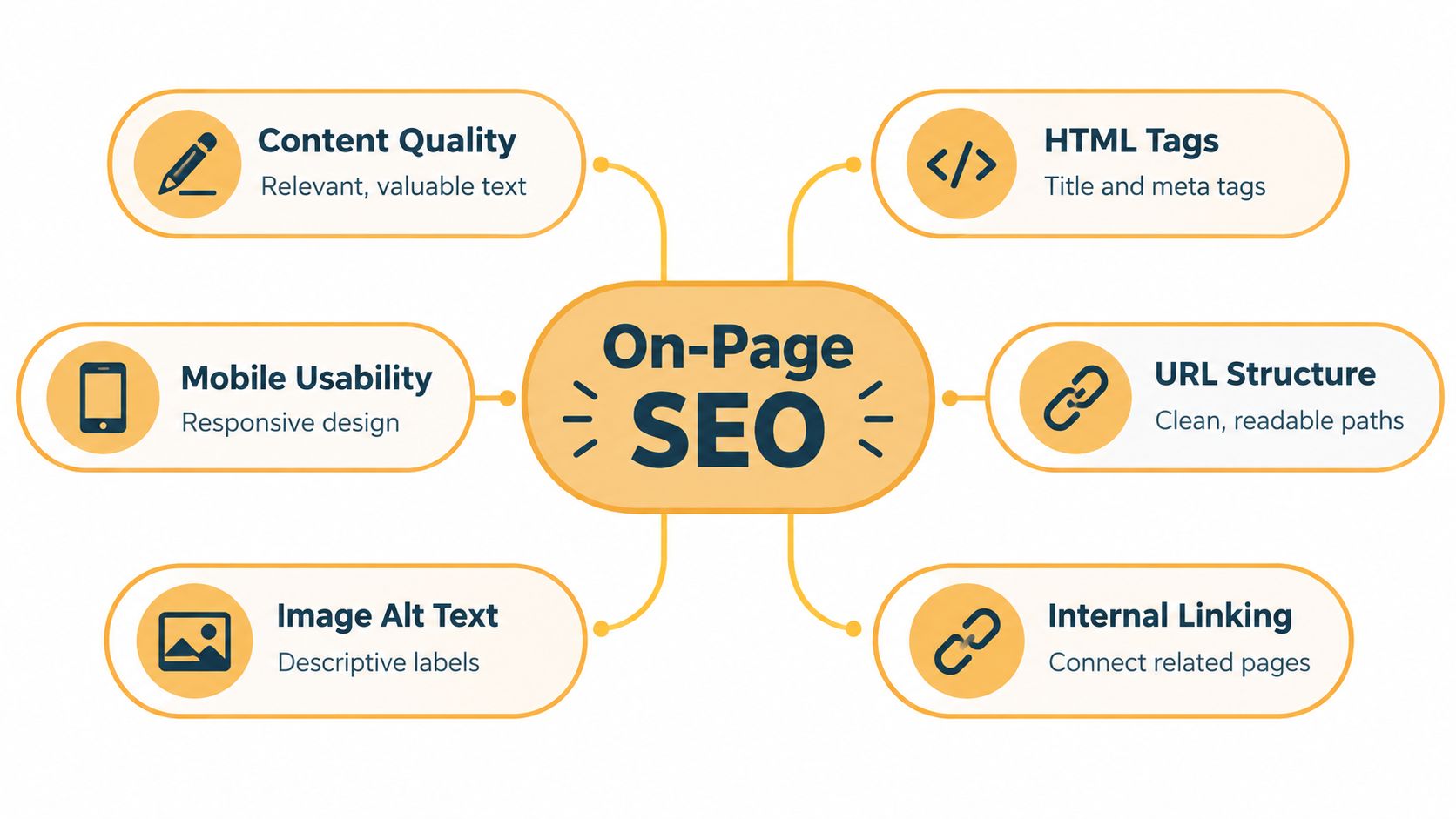
On-page SEO optimization is the work of improving the content and HTML on a single URL so the page can be understood, trusted, and acted on. That includes elements such as titles, headings, descriptive summaries, internal links, image text, mobile presentation, and page performance. As Google's SEO guidance explains, unique, clear page titles help shape how pages appear in search, and descriptive meta descriptions can help users judge relevance before they click.
The page is the unit of work
Search engines do not rank a business in the abstract. They assess individual pages against specific queries and intents. A product page should help someone evaluate a product. A location page should explain a local service clearly. An educational article should answer one defined question well. When a single URL tries to target every service, city, and keyword variation, the result usually becomes vague for users and messy for search systems.
I use a simple page-level test built around four questions:
- What does this page answer or provide? Set one primary intent.
- What supports that answer? Add specific details, proof, and useful context instead of filler.
- What should the visitor do next? Guide the next step with relevant internal links and clear anchor text.
- Can machines process the page easily? Check crawlable HTML, image context, mobile usability, and performance.
That last point matters more now. Pages are no longer judged only on whether they can win a blue-link click. They also need language and structure that can be summarized cleanly by AI systems without losing the meaning.
On-page SEO differs from off-page SEO because the work happens on your own site. Revising a service page, tightening its title, or connecting it to a related guide is on-page work. Earning mentions and backlinks elsewhere is off-page work. Both matter, but the practical starting point is the page you control.
Practical rule: Decide what a successful visitor should understand or do, then optimize the page around that outcome.
Core Elements That Drive Search Engine Rankings
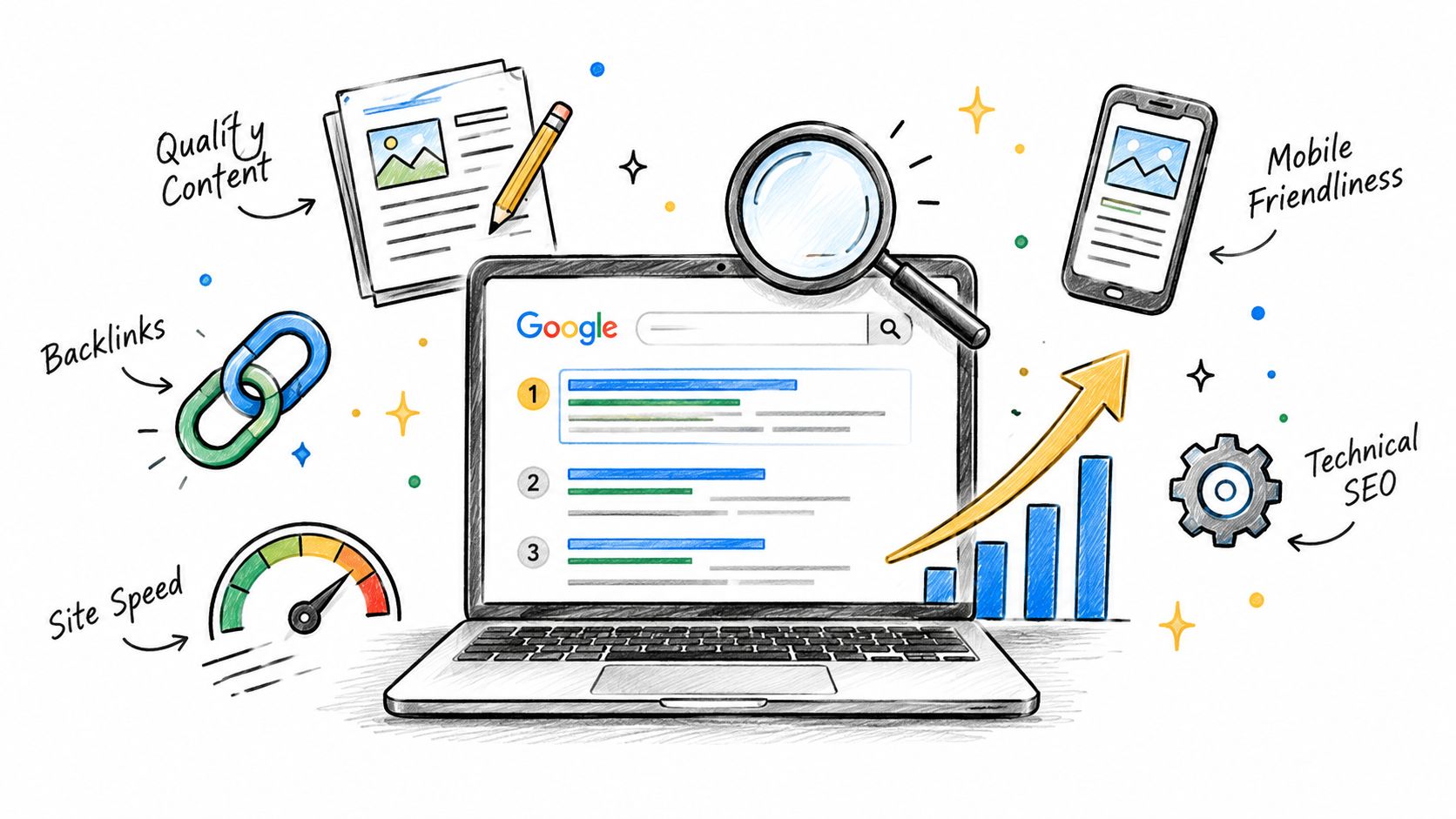
A page can look well optimized and still underperform because its signals point in different directions. The title promises one thing, the H1 says another, and the opening copy drifts into broad brand language. That mismatch hurts click-through from classic results and makes the page harder for AI-driven search systems to summarize accurately. Google explains that title links can draw from the title element, visible main title, headings, prominent text, anchor text, og:title, and WebSite structured data, so consistency across those elements still matters.
Start with the search result
Write a distinct title for each page that earns traffic or drives leads. A page about emergency furnace repair should say that plainly, while a broader heating services page should stay broad. The visible heading and first lines of copy should confirm the same offer and context so users, crawlers, and AI systems all get one clear message.
Meta descriptions still matter, but they work best as a strong summary rather than a control switch. Search engines may use the description tag, or they may pull a better matching passage from the page. Write one that explains the offer, what makes it useful, and what the visitor can do next. Keep it readable. Cramming in every keyword variation usually weakens the snippet and the page.
If you want a practical reference for stronger titles, review these title tag best practices. In practice, clear and specific titles outperform titles written to hit a rigid character target. Accuracy, uniqueness, and alignment with the page matter more than trying to force an exact formula.
Build a page people can scan
Good pages are easy to scan before they are easy to rank. Use one clear primary heading, then break the topic into subheadings that match the questions a visitor has. A service page might cover the problem, the solution, the process, the service area, and the next action. A product page might separate benefits, specifications, shipping details, and support information.
Use natural language that fits the topic. Repeating the target phrase in every section does not make the page stronger. It usually makes it less trustworthy. Descriptive alt text helps when an image adds meaning, while decorative images should stay quiet for assistive technology.
Connect related documents
Internal links shape how authority and context move through a site. A guide about clogged drains should link to the relevant plumbing service page with anchor text that tells users what they will find. Specific anchors set better expectations than vague phrases like “learn more,” and they give AI systems cleaner relationship signals between pages.
URL structure helps too. Readable paths support understanding, especially on larger sites where categories and service lines can blur together. Keep URLs stable unless there is a clear reason to change them, and use redirects carefully when you do. For broader usability and structure ideas, design tips from NZ Apps offers a useful outside perspective.
Debunking Common On-Page SEO Myths and Misconceptions
The most expensive SEO mistakes often begin with a simple formula. Someone decides that a page needs a particular keyword repeated a fixed number of times, a title of a prescribed length, or a word count copied from a competing result. Those rules feel measurable, but they can distract from the questions that determine whether a page deserves visibility.
Myth one says keyword density is a ranking recipe
There is no universal keyword density in Google's guidance. A page should use the language needed to explain its subject, including relevant terms and natural variants, but repetition alone doesn't demonstrate expertise or usefulness. A page about commercial insurance may need to discuss coverage, exclusions, claims, limits, and eligibility. Repeating “commercial insurance” in every paragraph adds little.
The alternative is topical completeness with restraint. Read the page aloud. If a phrase sounds inserted for a crawler rather than written for a customer, revise it. Search engines can interpret related language, while human readers quickly recognize awkward copy.
Myth two treats every title as a fixed technical measurement
Google doesn't prescribe one universal title length. It can generate a title link from several signals and may rewrite a title when the HTML title, visible heading, and page content disagree. A short title that accurately identifies the page is more useful than a carefully measured title that promises something the page doesn't deliver.
The same principle applies to meta descriptions. They can influence whether a searcher chooses your result, but they aren't a guarantee that Google will display the exact text or use it as a direct ranking control. Write a truthful summary, then inspect how the result appears in Search Console.
Myth three assumes longer content always wins
Longer isn't automatically better. A concise service page can outperform a bloated one when it answers the customer's question directly, explains the offer, and makes the next action obvious. An in-depth guide needs room when the subject demands it, but padding a page with repetitive sections weakens clarity.
Search optimization isn't a contest to produce the most text. It's the discipline of making the right information easy to find, understand, trust, and act on.
Implementing On-Page SEO for Business Results
Implementation works best when a team starts with pages that already have a business purpose. Don't begin by rewriting every URL on a large site. Identify important service, category, product, location, and editorial pages, then compare their search impressions, clicks, conversions, index status, and current content.
Audit the pages that matter
For each priority URL, record the page's intended query, title, main heading, meta description, internal links, mobile rendering, image treatment, and conversion action. Look for practical failures: two pages competing for the same intent, a valuable page with no internal links, a title that describes a different service, or a mobile version that omits important content.
A small Omaha home-services company might prioritize its plumbing emergency page before an old company-news post. An online retailer might start with a category page that receives impressions but attracts few qualified visits. A publisher might focus on a high-value explainer whose sections are difficult to scan.
Improve the page in a deliberate order
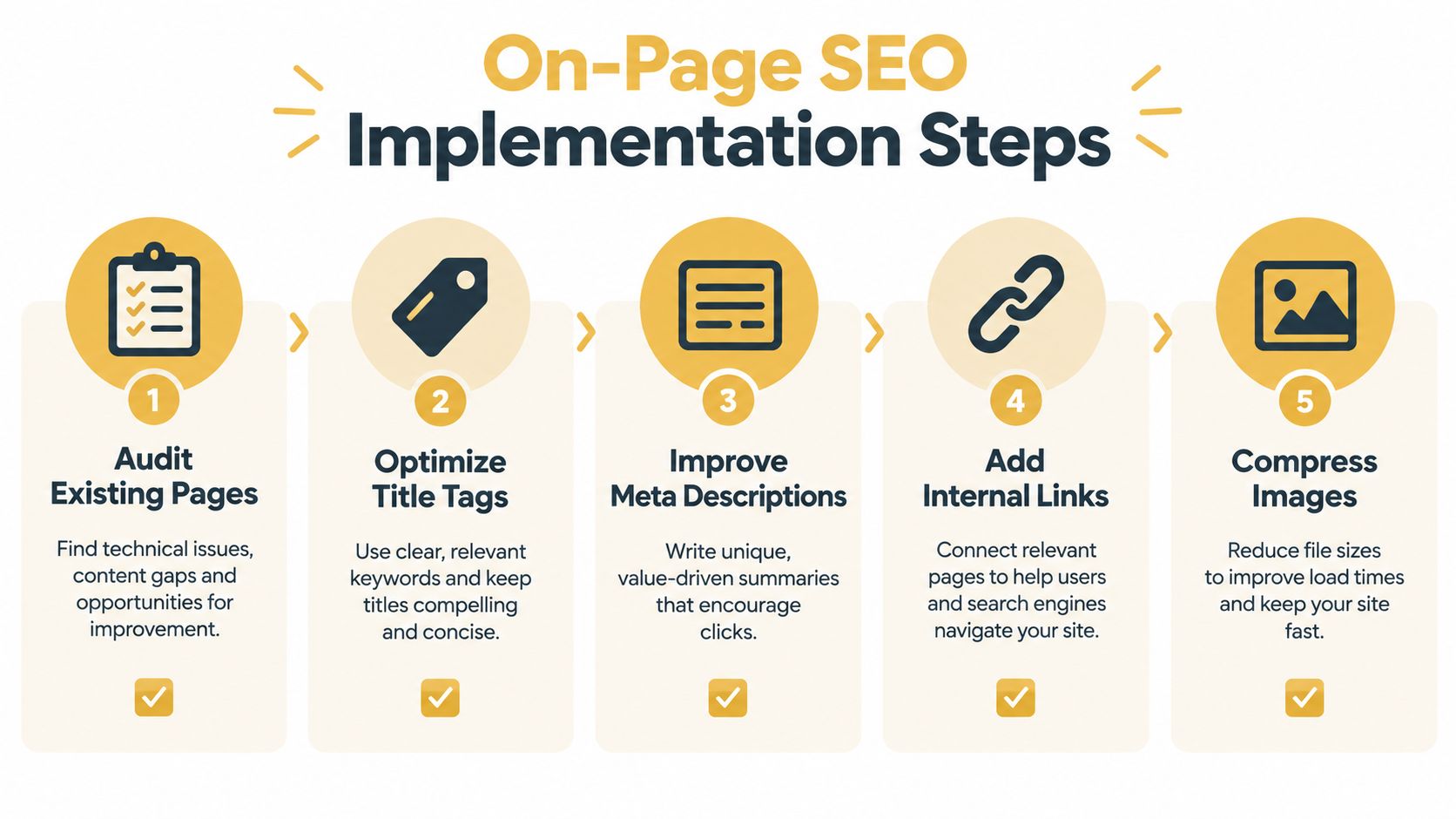
- Clarify intent: State what the visitor wants and what the business wants the page to achieve.
- Rewrite the result signals: Give the URL a unique title, aligned heading, accurate opening copy, and useful description.
- Strengthen the body: Answer the main question early, add meaningful subtopics, remove repetition, and include evidence or process details.
- Repair discovery paths: Add relevant internal links from established pages, with descriptive anchor text.
- Improve media and mobile use: Resize images, write useful alt text, check readable text, and confirm that mobile users receive equivalent content.
Use image alt text for SEO as a reference when reviewing image accessibility and context. Alt text shouldn't become a keyword container. It should describe the useful image for someone who can't see it.
A team can use Google Search Console to compare impressions and clicks before and after a substantial update, then connect those changes with leads, calls, purchases, or other meaningful actions in its analytics system. Up North Media offers SEO marketing, on-page optimization, content strategy, and AI consulting for organizations that need help coordinating this work across their website.
The implementation process can also include a technical review, structured data validation, and a human quality check. No tool can decide whether a service page gives a prospective customer enough confidence to contact the business. Automation finds omissions, while experienced review protects relevance and accuracy.
Measuring On-Page SEO Performance in 2026
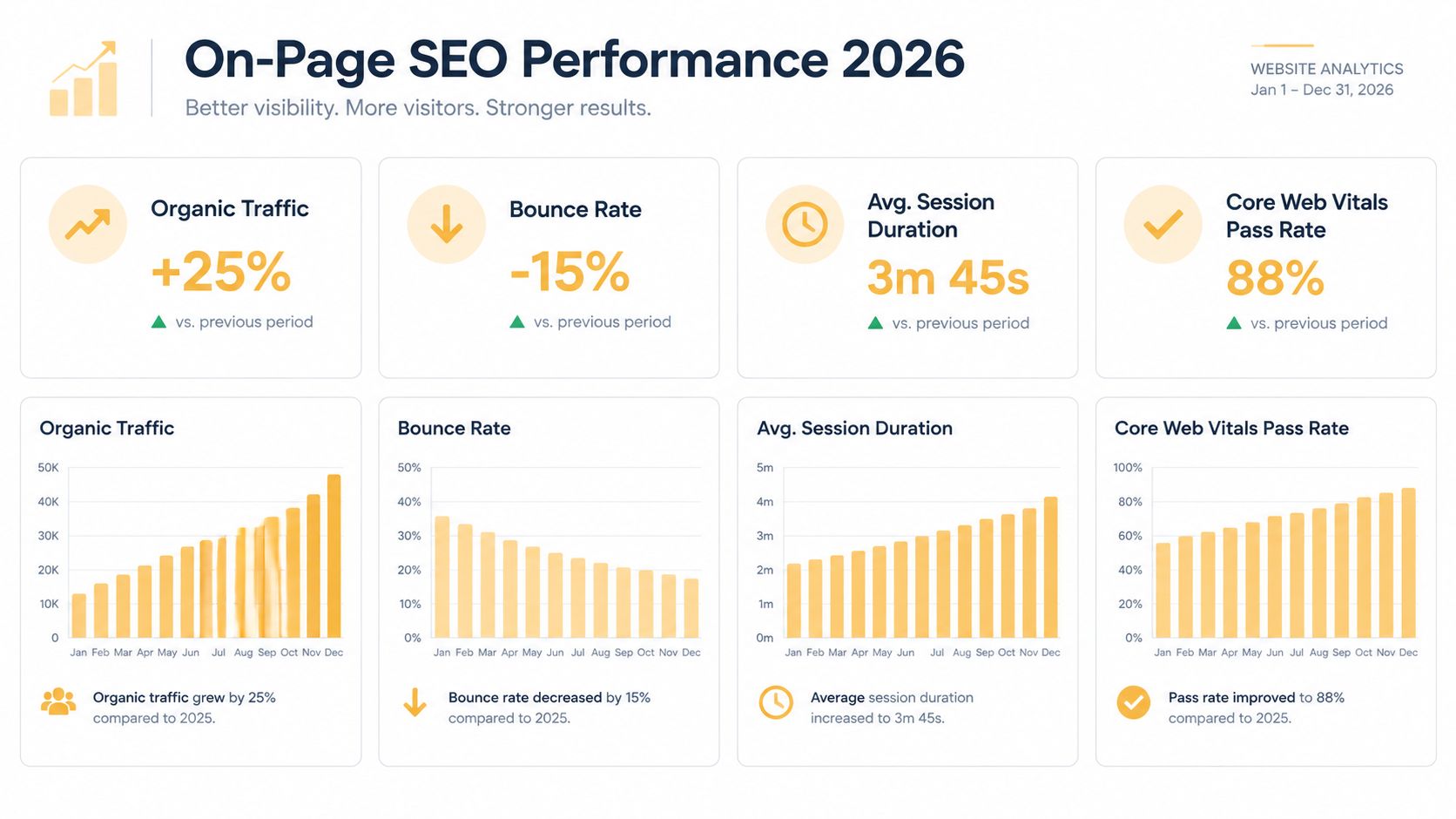
A ranking report can tell you where a page appears, but it can't tell you whether the page produces qualified business. Measurement should connect search visibility to user behavior and outcomes, while separating conventional clicks from impressions that build awareness without a visit.
Google Search Console provides a useful page-level view of impressions, clicks, click-through rate, and queries. Review those signals alongside analytics events such as form submissions, calls, purchases, or newsletter registrations. A page with more impressions but no relevant actions may need a sharper promise, better intent alignment, or a clearer conversion path.
Treat page experience as an engineering problem
Core Web Vitals turn vague complaints about “slow pages” into specific diagnostics. Google identifies a good-experience threshold of LCP within 2.5 seconds, INP below 200 milliseconds, and CLS below 0.1. These are separate problems with different causes.
- LCP: Oversized images, render-blocking resources, and slow server responses can delay the largest visible content.
- INP: Excessive JavaScript and long main-thread tasks can make interactions feel unresponsive.
- CLS: Injected banners, advertisements, or images without reserved dimensions can move content while someone is reading.
Prioritize compressing and properly sizing above-the-fold images, deferring noncritical scripts, reducing unused JavaScript, and reserving space for media and advertising. Check real-user performance rather than relying only on laboratory testing, because a clean test environment may not represent mobile visitors using slower connections.
Measure AI visibility separately
Generated search features create another reporting problem. A citation, an impression, a click, and a lead are different outcomes. Track them separately where your tools allow it, and don't treat an answer mention as equivalent to revenue.
The practical optimization is straightforward even when measurement is not. Make important claims easy to verify, define terms clearly, present concise answer blocks, show relevant expertise, and keep the surrounding context strong. No special markup or “AI keyword” guarantees inclusion, so the page still needs to satisfy people who arrive through conventional search.
Building Your Complete On-Page SEO Strategy
A durable strategy has three layers. First, establish a clean page foundation. Second, improve the pages tied to revenue or audience growth. Third, update the system as search behavior, business priorities, and page performance change.
The foundation includes crawlable internal links, distinct search intent for important URLs, consistent titles and headings, descriptive images, readable content, and mobile parity. Google moved to mobile-first indexing through a transition that began with its announcement in November 2016, broader rollout in March 2018, and default treatment for new websites in July 2019. Google reported that more than 50% of crawled sites had moved by December 2018, the share exceeded 70% by March 2020, and the remaining migration was completed in May 2023, with limited technical exceptions, as summarized in this mobile-first indexing overview.
That history has a direct operational consequence: review the mobile version as the primary document, not as a smaller desktop copy. Missing text, links, images, or structured data on mobile can reduce what Google processes, even when the desktop page looks complete.
Optimize for visibility and action
AI-generated results make a single success metric inadequate. A 2026 analysis citing Comscore reported that Google AI Overviews appeared on 39.4% of U.S. desktop queries in June 2026, compared with 25.8% one year earlier; the figures are directional and specific to the reported market and period (source analysis). The same analysis reported that cited pages could gain 2–5% traffic, while uncited results may experience substantial click-through-rate declines. These outcomes vary by query and market, so use them as context rather than a forecast.
Build content that can be quoted accurately, then measure both visibility and action. An Omaha service business should track qualified calls and forms alongside branded searches. A publisher should distinguish readership from citation visibility. An e-commerce team should connect product-page impressions and clicks to assisted purchases rather than judging every page by rank alone.
Use a focused internal linking strategy to distribute discovery paths across related pages. Review the site after major product, service, or editorial changes, and refresh pages when the underlying offer or customer question changes. Sustainable on-page SEO isn't a one-time upload. It's a repeatable operating practice that keeps every important URL understandable, useful, technically available, and commercially connected.
Up North Media helps businesses with data-driven SEO marketing, on-page optimization, content strategy, web applications, and AI consulting. Visit Up North Media to discuss a practical plan for improving your pages, measuring qualified outcomes, and building search visibility that supports real business goals.