
A 40-person e-commerce brand can lose an entire afternoon answering “Where's my order?”, “How do I return this?” and “Do you ship internationally?” A salesperson then offers a chatbot for $15,000. The owner has one reasonable question: what, exactly, am I buying?
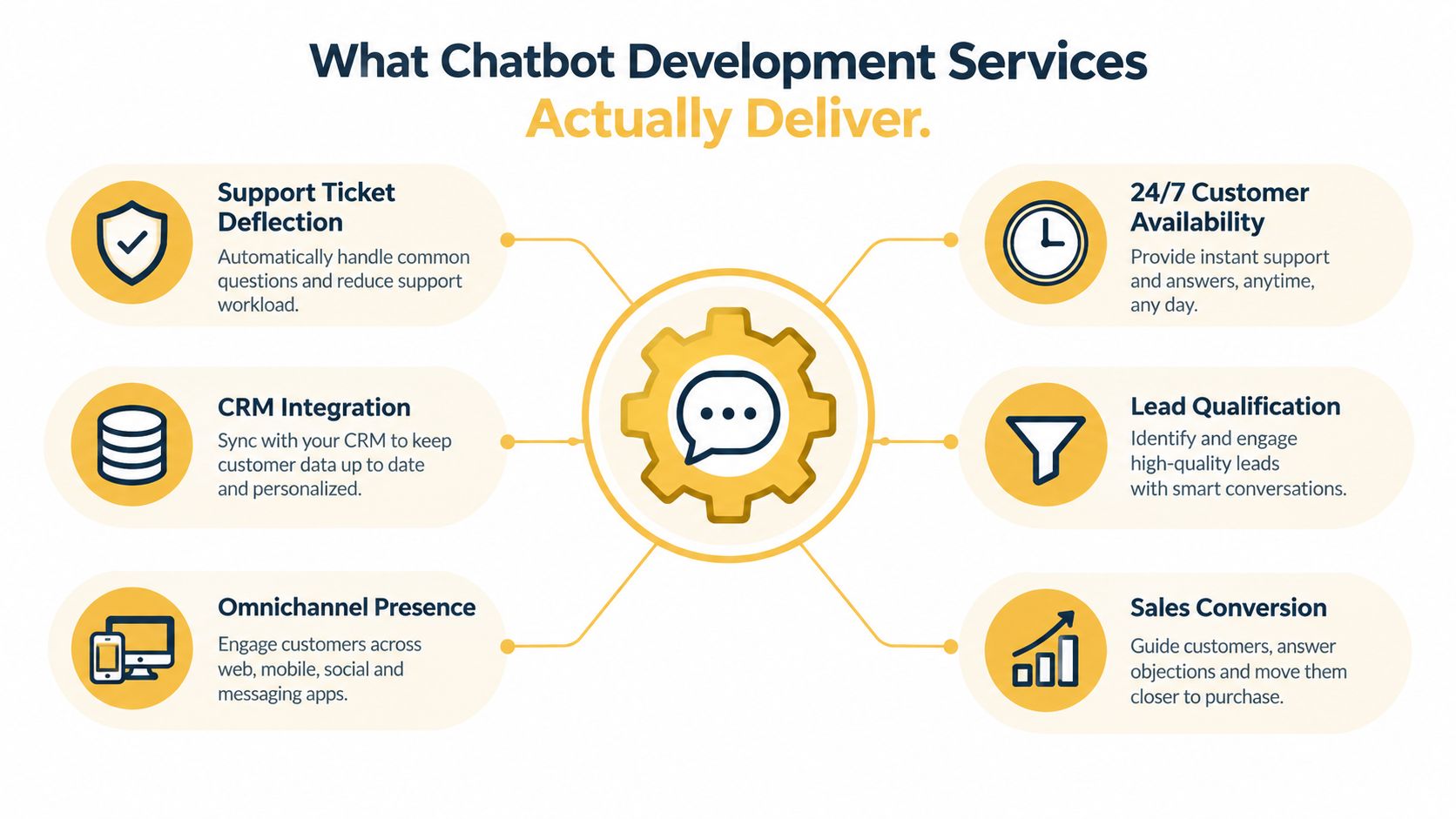
Not a widget. Chatbot development services should cover the design, engineering, integration, launch and ongoing improvement required to make conversations useful inside a real business. The software matters, but the workflow around it matters more. A bot that answers questions yet can't access order data, create a ticket or transfer a frustrated customer is an expensive FAQ page.
The commercial case is still strong. The conversational AI market is projected to grow from USD 17.97 billion in 2026 to USD 82.46 billion by 2034, implying a 21.00% CAGR, while North America held 35.10% of the market in 2025, according to Rasa's 2026 State of Conversational AI report. The opportunity isn't only to automate replies. It's to redesign the path from question to resolution, lead to qualification and intent to purchase.
What Chatbot Development Services Actually Deliver
A credible engagement begins with business operations, not a model demo. The provider should identify which conversations consume staff time, which answers require trusted data and which moments can produce revenue. That work determines whether the system belongs on a website, inside a helpdesk, across messaging channels or in an internal workflow.
The core deliverables usually include:
- Conversation design: Tone, prompts, branching logic, fallback language and escalation paths.
- Intent modelling: A map of what users are trying to accomplish, including ambiguous wording and topic changes.
- System integration: Connections to a CRM, helpdesk, commerce platform, booking tool or internal database.
- Data preparation: Cleaning, organizing and structuring the company's documents, tickets and policies.
- Analytics: Reporting on resolution, escalation, unanswered questions, conversion events and abandonment.
- Maintenance: A defined process for correcting failures, updating content and reviewing new intents.
The deliverable that gets overlooked
Human handoff deserves a place in the initial scope, not a footnote. The bot must recognize when a customer needs a person, transfer the conversation with its history intact and give the employee enough context to act without making the customer repeat everything.
For knowledge-heavy assistants, a retrieval-augmented generation architecture is usually more dependable than asking a model to answer from a broad prompt. Documents can be normalized, chunked, embedded and stored in a vector database, then retrieved through a hybrid approach that combines semantic search with BM25 keyword search. A re-ranker can add roughly 30 to 80 milliseconds while improving the ordering of the top 30 candidates, as described in this guide to smarter chatbot development techniques.
Practical rule: If a proposal describes the model but not the data, integrations, handoff and maintenance, it describes a demo, not a production service.
The return comes from three operational levers: redirecting repetitive inquiries, qualifying prospects before sales gets involved and covering customer intent outside staffed hours. Treating the project as workflow redesign keeps those outcomes visible when feature discussions start taking over.
The Main Types of Chatbots You Can Build
The right chatbot depends on the job. A scripted bot can outperform a complex model when the process is narrow, stable and regulated. An agentic system earns its complexity only when it needs to interpret requests and take actions across business systems.
Four practical choices
Rule-based chatbots follow explicit paths. A Shopify store can use one to answer business-hours, shipping-policy and return-window questions with predictable language. This is the right choice for controlled FAQs, simple navigation and lead capture. It needs limited data and modest integration work, but it won't handle unexpected phrasing well.
NLP and LLM-powered chatbots interpret more natural language. A banking customer asking to dispute a charge may use several different descriptions, and the bot needs to infer intent before guiding the next step. Teams building these systems should understand what natural language processing does, then decide whether retrieval, intent classification or generative responses belong in each flow.
Voicebots add speech recognition, telephony and text-to-speech. A clinic might use one to collect appointment preferences after the office closes. Voice introduces additional concerns, including interruption handling, accents, transcription quality and a reliable transfer to staff.
Agentic AI chatbots execute tasks rather than stopping at an answer. An internal IT assistant could verify an employee, reset a password, file a ticket and update the employee record. That capability requires stronger permissions, audit trails, error recovery and integration testing.
Chatbot Types Compared
| Type | Best For | Complexity | Typical Budget |
|---|---|---|---|
| Rule-based | Stable FAQs, navigation and basic lead capture | Low | Focused proof of concept, USD 10,000 to 30,000 |
| NLP or LLM-powered | Nuanced support and knowledge retrieval | Medium | Mid-complexity assistant, USD 30,000 to 100,000 |
| Voicebot | Phone booking and after-hours intake | Medium to high | Depends on telephony, speech and workflow scope |
| Agentic AI | Multi-step actions across business systems | High | Enterprise system, USD 100,000 to 350,000 or more |
These budget bands come from enterprise chatbot evaluation guidance. They aren't interchangeable quotes. Integration depth, compliance, data preparation and channel requirements determine where a project lands.
How a Typical Chatbot Project Is Scoped and Delivered
Projects run smoothly when both sides understand their work. Vendors own architecture, implementation and quality assurance. Clients own access to the business knowledge, systems and decisions that make the build accurate.
Six phases that prevent expensive surprises
-
Discovery: The team reviews ticket transcripts, support volume, channels, customer journeys and integration points. The client supplies access, examples and business priorities. The output should identify the first workflow and its success criteria.
-
Architecture: The vendor selects the model strategy, retrieval method, channels, authentication approach and data boundaries. The client confirms technical constraints, security expectations and the systems the bot must access. A useful chatbot implementation strategy should make these dependencies explicit.
-
Conversation design: Designers map the primary flows, tone, prompts, fallback responses and escalation rules. Subject-matter experts review the wording and approve what the bot may or may not say.
-
Development: Engineers build the interface, model orchestration, retrieval pipeline and API connections. The vendor should also create logging, permissions and failure handling instead of treating them as post-launch additions.
-
Testing: Quality assurance covers normal questions, edge cases, regression, permissions and integration failures. The client signs off on acceptance criteria using realistic conversations, not only polished demo prompts.
-
Launch and optimization: A phased release reduces risk. Staff training, monitoring and an ownership plan belong in the launch package, followed by reviews of intent drift, low-confidence interactions and content changes.
See the delivery process in action:
Where timelines usually break
Clients often delay projects by withholding transcripts, changing the first use case halfway through or failing to assign a subject-matter owner. Vendors create delays when they underestimate data cleanup, treat integrations as simple configuration or postpone handoff design.
Set a decision calendar at kickoff. Name who approves content, who grants system access, who validates answers and who owns the bot after launch. A chatbot isn't finished when it responds. It's ready when the business can operate, measure and improve it.
Pricing Models and What Really Drives the Budget
A chatbot budget grows when the project changes how work gets done. A bot that answers public FAQs needs limited setup. A bot that retrieves private records, updates systems, supports several channels or follows compliance controls requires a different operating model.
The budget bands in the earlier table are useful for orientation, but they are not the reason costs rise. Scope drives the increase. Data preparation, ingestion pipelines, vector storage, integrations and governance add work around the language model. A narrow workflow can stay focused. A production system must connect reliable information to the right action, define access rules and give staff a workable handoff.
Pricing tiers in plain terms
| Tier | Typical Range | Scope | Main Cost Drivers | TCO Watch-Out |
|---|---|---|---|---|
| Focused proof of concept | USD 10,000 to 30,000 | One narrow workflow or channel | Conversation design, source content and basic deployment | Expansion may require new integrations |
| Mid-complexity assistant | USD 30,000 to 100,000 | Custom retrieval, integrations and analytics | CRM, helpdesk, commerce and data pipelines | Maintenance and model usage need separate planning |
| Enterprise conversational AI | USD 100,000 to 350,000 or more | Deep integrations, governance and broader operations | Compliance, multilingual support, security and orchestration | Internal ownership and ongoing QA become material |
Use compare pricing tiers while building a vendor shortlist, but compare scope rather than headline fees. A fixed-fee project fits a defined workflow with stable acceptance criteria. Time and materials suit discovery-heavy work or projects with uncertain integration requirements. A managed retainer fits a bot that will keep changing, especially when the vendor handles regular optimization.
The budget checklist vendors often bury
Ask whether the proposal includes:
- Data preparation: Cleaning, permissions, document restructuring and ingestion.
- Integration work: API mapping, authentication, error handling and regression testing.
- Conversation design: Flows, fallbacks, tone, escalation and employee handoff.
- Usage costs: Model inference, hosting, storage and third-party channel fees.
- Operations: Monitoring, retraining, content updates and performance reviews.
- Human capacity: Staff time for approvals, escalations and knowledge maintenance.
These dependencies determine whether the bot supports a real workflow after launch. A low initial fee can become expensive when data cleanup, system access or ownership appears as an unplanned change request. Require each item to show its assumptions, exclusions and owner. Then assess total cost of ownership, not the number on page one.
Why Chatbot Projects Fail After Launch
The common diagnosis is that the bot is “too dumb.” That explanation is convenient and often wrong. Enterprise adoption is broad, yet confidence in complex conversations remains limited. One 2026 industry report found 67% of surveyed enterprises are expanding or scaling conversational AI, while average confidence in AI handling complex conversations was only 4.37 out of 7, according to Vention's adoption statistics summary.
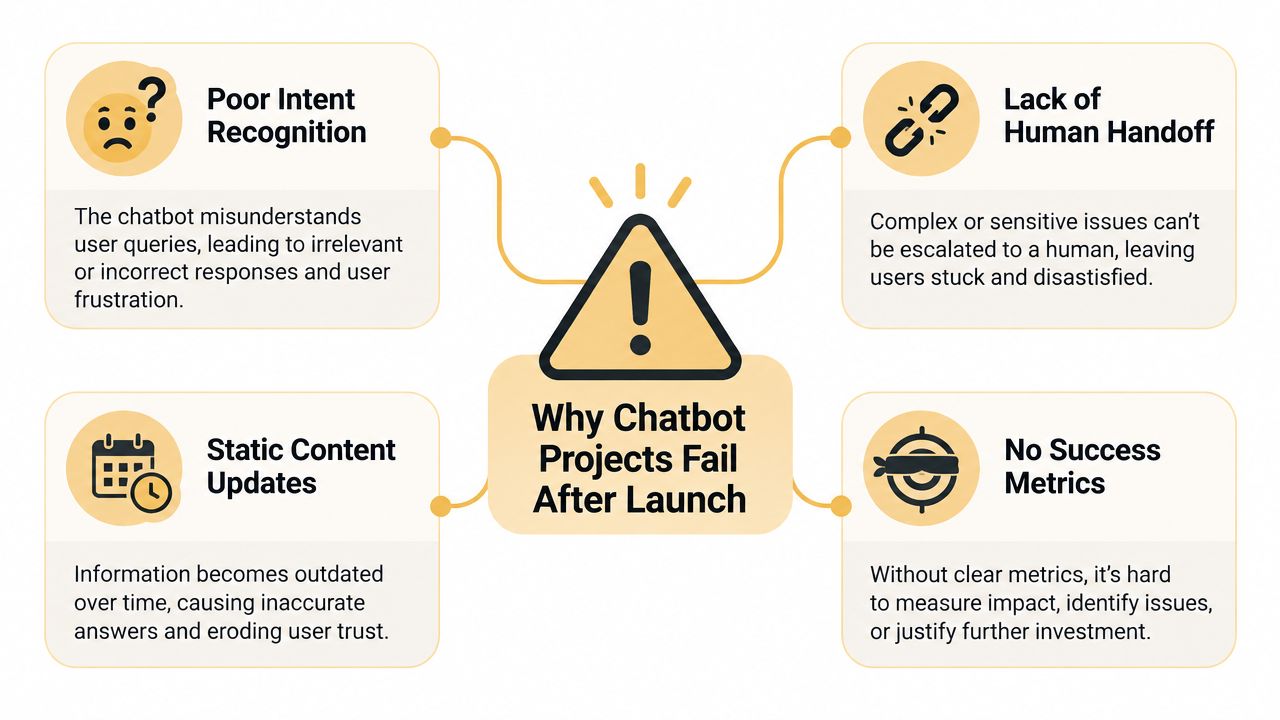
The gap usually comes from operational dependencies. A bot can understand a customer perfectly and still fail if it can't retrieve the right record, the source documents contradict each other or the customer has no workable route to a person.
Four failure points to test before launch
Brittle integrations: A retailer's assistant may answer shipping-policy questions but fail to retrieve a specific order because the order-management API was never mapped. The conversation sounds intelligent until the user asks for the one action that matters.
Poor data hygiene: Outdated policies, duplicate documents and internal jargon create unreliable retrieval. A model grounded in contradictory material can produce a confident answer that no manager approved.
Weak multilingual coverage: Translating a few interface labels doesn't create a multilingual service. Teams need to test language-specific intent, product terms, escalation and source coverage.
Bad human handoff: A customer who reaches the wrong queue, loses their conversation history or gets trapped in repeated fallback prompts will blame the company, not the architecture.
The launch is a beginning
Track more than containment. Review unresolved intents, escalation reasons, repeat contacts, customer feedback, integration errors and content gaps. A high resolution rate can conceal a poor experience if users abandon the conversation before reaching help.
One independent review identifies integration, training-data quality, multilingual support, change management, expectation setting, continuous quality assurance and regulatory compliance as recurring challenges. It also reports that implementation costs can run 30% to 50% above initial estimates, and estimates that 40% of chatbot projects fail because of poor human handoff and unrealistic scope, as documented in this review of conversational AI challenges.
A production chatbot needs an owner, a review cadence and a recovery path. Without those, launch simply makes the unfinished work visible to customers.
Industry Use Cases and Measurable ROI
The strongest business case starts with a specific workflow and one measurable outcome. E-commerce teams may prioritize resolution, publishers may prioritize engagement and local service companies may prioritize booked appointments. The technology changes with the job.
E-commerce
A retailer should begin with post-purchase support, not an all-purpose shopping companion. An assistant connected to the commerce platform, order system and returns workflow can authenticate a customer, retrieve delivery information, explain the next step and create an escalation when the exception needs staff.
Measure self-service resolution, repeat contacts and cost per resolved interaction. The useful comparison isn't “bot versus no bot.” It's the cost and quality of the old path against the redesigned path.
Digital publishing
A publisher can use a conversational interface to triage reader questions, route story tips to the correct editorial team and recommend relevant archived content. The value may appear in newsletter registrations, article discovery and engaged reading, rather than ticket deflection.
This requires careful editorial boundaries. The assistant should distinguish published facts from suggestions, preserve links to source content and pass sensitive or newsworthy tips to humans. For a practical commerce-focused perspective on connecting conversations to business outcomes, review Stimulead's ROI roadmap for conversational AI.
Home services
A regional home services company may get more value from a voicebot than a website chat window. An after-hours caller can describe the job, provide location details, select a preferred appointment window and receive confirmation, while urgent or unusual situations go directly to an on-call employee.
The primary metric is completed booking activity from calls that previously received no immediate service. The team should also monitor transcription errors, abandoned calls, transfer quality and appointments that require manual correction.
A simple ROI model
Start with three inputs:
- Baseline interaction cost: Include staff time, tools and escalation handling.
- Target automation or qualification rate: Use a realistic target for the first workflow, not the entire support operation.
- Monthly interaction volume: Count eligible conversations, not every inbound message.
Then compare the avoided handling cost and additional revenue against build, integration, usage, maintenance and human oversight. If you can't agree on the baseline, the project isn't ready for a vendor quote.
How to Evaluate and Hire the Right Vendor
A polished portfolio proves that a vendor can make a polished demo. It doesn't prove that the team can operate your integrations, protect your data or handle failure under pressure. Use a scorecard that forces specific answers.
| Evaluation Dimension | Key Questions to Ask | What a Strong Answer Looks Like | Red Flag |
|---|---|---|---|
| Production experience | Which live bots have you shipped? What happens when they fail? | The team explains scope, ownership, monitoring and lessons from production | Only screenshots and generic testimonials |
| Integration depth | Which CRMs, helpdesks, payment tools or commerce systems have you connected? | Engineers describe API permissions, retries, field mapping and testing | “Integration is straightforward” without technical detail |
| Conversation and model ownership | Who designs flows, trains intents and reviews failed conversations? | Named specialists own content, testing and iteration | The vendor relies on a model provider's defaults |
| Data and compliance | Where does customer data go? How are access and retention handled? | Clear data boundaries, permissions, logging and compliance process | Vague assurances about security |
| Post-launch KPIs | Which metrics will you review and how often? | The contract names targets, dashboards, review cadence and corrective work | Launch is treated as the final deliverable |
Questions that separate builders from presenters
Ask the technical lead to show how the bot behaves when the knowledge base has no answer. Ask who receives a low-confidence interaction and how that conversation reaches the employee. Ask whether your team can access conversation logs, correct content and export the data.
Request a paid pilot around one workflow before signing a broad multi-phase contract. The pilot should use your content, one realistic integration and agreed acceptance tests. You'll learn more from the bot's weak moments than from a scripted presentation.
Avoid vendors that offer vague timelines, can't name the person responsible for engineering or refuse to discuss failure modes. A serious partner will explain what the system won't do yet, what access it needs and how the team will detect problems after release.
Your Next Step Toward a Working Chatbot
The best starting point is rarely “build an AI chatbot.” It's “remove friction from this conversation.” Choose the workflow with high volume, clear rules, accessible data and a measurable business consequence.
Three ROI levers deserve priority:
- Redirect repetitive inquiries: Give customers immediate answers and free staff for exceptions.
- Qualify leads: Capture intent, budget, timing and fit before a salesperson spends time on discovery.
- Convert active visitors: Help people act when they're comparing products, requesting a quote or trying to book.
A focused first release creates a useful operating baseline. The team can inspect real questions, identify missing data, improve fallbacks and decide whether the next investment belongs in retrieval, integration, voice or agentic actions. Broad scope before evidence usually produces a bot that does many things inconsistently.
Up North Media's AI chat bots service is one option for businesses that need website-based customer support and lead qualification connected to broader AI consulting and workflow planning. The important part is the working session behind the proposal: review current support conversations, select the strongest automation candidate, map the required systems and document the likely effort and impact.
Don't book a call to hear a generic pitch. Book one to leave with a written next-step plan, including the first workflow, required data, integration dependencies, success metrics and the decisions that still need an owner.
Up North Media helps businesses plan and build intelligent chatbots for customer support, lead qualification and workflow automation. Visit Up North Media to request a consultation focused on your current conversations, systems and clearest path to measurable ROI.