
If you're running a publisher team right now, the likely reality is messy. The calendar keeps filling up, the archive keeps aging, the inbox keeps asking for more, and traffic no longer feels as dependable as it once did. Content marketing for publishers used to mean publishing more. In 2026, it has to mean building a system that creates efficient content, earns repeat attention, and supports revenue without burning out the newsroom or the audience.
Moving Beyond the Content Treadmill
A lot of publisher teams still operate like they're chasing a moving target. They publish, promote, refresh, repeat, and then wonder why yesterday's process no longer delivers the same lift. That's the content treadmill, and it usually starts when volume becomes the goal instead of a byproduct.
The bigger shift is simple. Content marketing is no longer a side tactic, it's a core business engine. The global content marketing industry is projected to rise from about $72 billion in 2023 to over $107 billion by 2026, a 33% increase that reflects how content now drives acquisition and monetization across major markets (Salesgenie). In the same source set, content marketing was identified as the most effective marketing strategy across the buying journey, ahead of organic SEO at 67%, paid advertising at 53%, and paid search at 45% (Salesgenie).
That matters for publishers because it changes the job. Content isn't just for awareness anymore. It has to bring in search traffic, convert that traffic into repeat visits, and support direct revenue.
A practical starting point is to stop treating the editorial calendar as a publication list and start treating it as an operating plan. If you need a clean way to organize topics, cadence, and owners, this content calendar framework is a useful foundation.
Practical rule: If a piece of content can't be tied to an audience outcome or a business outcome, it's probably adding motion, not value.
Building Your Audience-Centric Editorial Engine
The strongest publisher content plans start with a specific reader, not a generic category. “Audience” can't just mean age, geography, or device type. It has to include what the reader is trying to solve, what they already trust, where they consume content, and what action you want them to take next.
Start with a reader avatar that has operational value
A useful avatar is specific enough to change editorial decisions. For example, a niche financial news publisher might define a reader as a mid-career professional who checks market updates before work, cares about retirement planning, and prefers concise analysis over long opinion pieces. That avatar immediately shapes tone, format, subject depth, and distribution.
The reason this matters is that a high-operating model for publishers starts with a clearly defined audience, measurable goals, and a channel plan that explains how platforms work together (Page's The Magazine). If the audience definition is vague, every other decision gets fuzzy too. The content calendar fills up, but the strategy disappears.
A better process looks like this:
- Define the segment: Name the exact reader group you're trying to serve.
- Document the business goal: Tie content to newsletter sign-ups, registration, affiliate clicks, lead generation, or subscriptions.
- Map the preferred format: Determine whether the audience responds better to explainers, short video, email briefs, or data-led reporting.
- Set the channel role: Decide what each channel is supposed to do in the funnel.
Good content plans don't start with topics, they start with decisions about readers.
Tie every asset to one business outcome
Every article, newsletter, or video should be assigned a primary job. One piece can support discovery, but it should still have a clear main purpose. A finance publisher might use one article to attract search traffic, another to drive newsletter sign-ups, and a third to nurture paying subscribers with deeper context.
Many teams go wrong. They create content that is “useful” in the abstract, but they don't decide what success looks like. A measurable system forces those choices early, which is exactly what separates strategic content marketing from generic publishing (Page's The Magazine).
A strong editorial engine also needs internal alignment. Editorial, SEO, email, and revenue teams should all be looking at the same audience definition, the same funnel, and the same channel roles. If they aren't, content becomes a set of disconnected efforts instead of a growth system.
To formalize the audience work, many teams use a buyer-persona style exercise before they build the calendar. This buyer persona guide is useful if you want to move from rough assumptions to a tighter reader profile.
Keep the channel plan honest
The channel plan has to reflect behavior, not preference. If the audience checks social first and email second, the content plan should use those channels differently instead of pretending they serve the same role. The same story can power a search article, a newsletter summary, and a social hook, but each one needs a distinct job.
When the plan is built this way, editorial meetings get sharper. The discussion changes from “What should we publish this week?” to “What should this asset do, and who is responsible for moving it through the funnel?” That's a better question, and it produces better content.
Optimizing Large Content Libraries for Search
For established publishers, the hardest SEO problem usually isn't creating more content. It's managing the archive you already have. Old stories, half-updated explainers, orphaned pages, and duplicate angles can drag performance down if nobody owns the library like an asset.
Audit for relevance, not just volume
A useful audit starts by grouping content into three buckets, update, merge, or retire. Update the pieces that already have authority but need freshness, merge overlapping articles that compete with each other, and retire content that no longer supports any meaningful search or audience need. The goal is not to preserve everything, it's to keep the archive working.
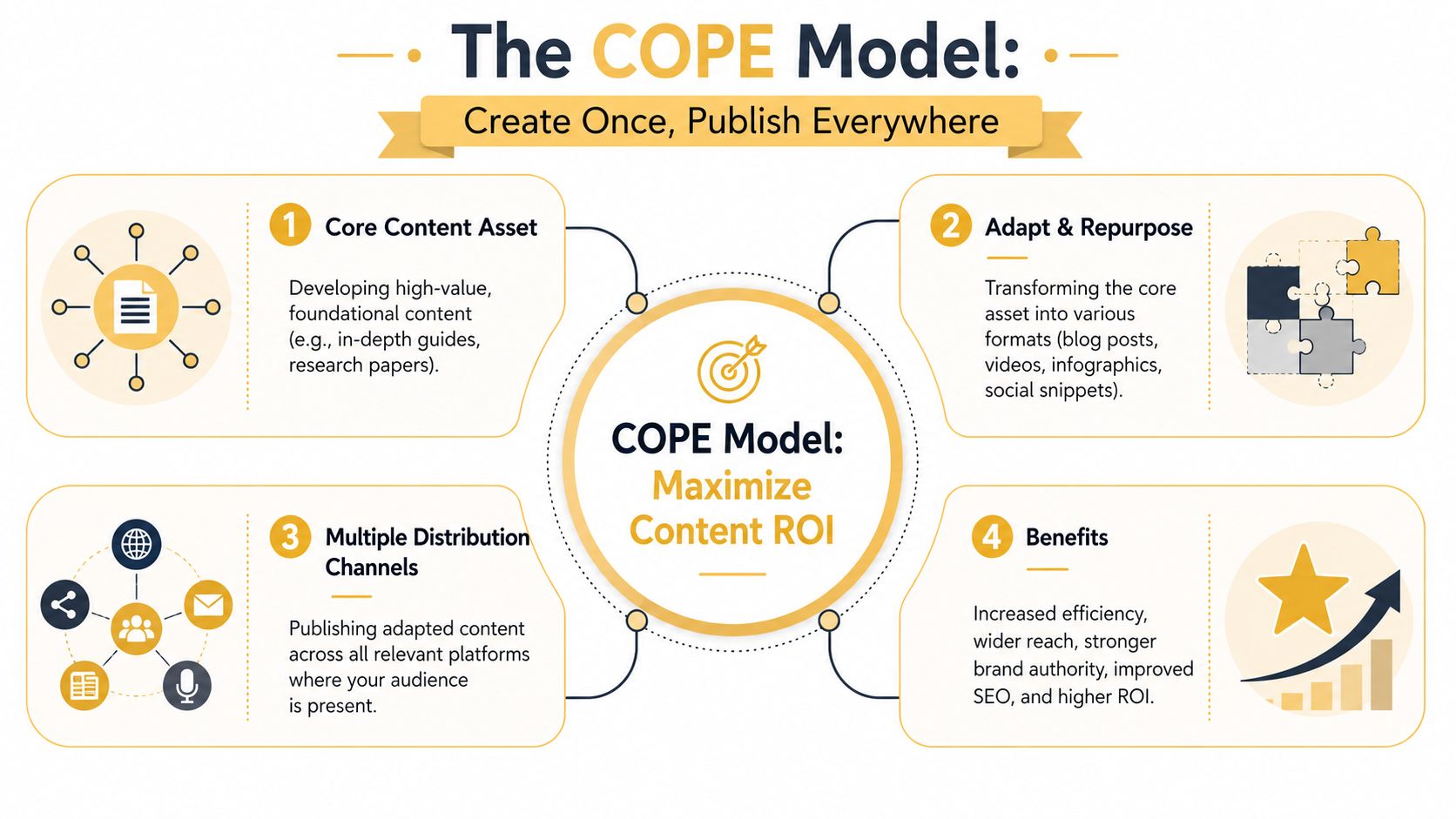
The COPE model, Create Once, Publish Everywhere, helps here because it pushes teams to think in reusable assets rather than one-off articles (Content Marketing Institute). If the library is built from modular content, you can refresh one core asset and improve several endpoints at once. That's much better than endlessly publishing isolated stories that age out fast.
A disciplined audit also needs topical grouping. Pages that support the same theme should point to each other, and pillar pages should sit at the center of that cluster. That structure helps readers move through the site and helps search engines understand which topics you own.
Old content isn't dead content. It's either an asset you haven't managed well or a liability you haven't cut loose.
Renovate the right pages first
Not every URL deserves the same amount of work. Start with the pages that already show signs of life, some impressions, some links, or clear topical relevance. Those are the easiest wins because the editorial lift is smaller and the upside is already partially validated.
The mistake to avoid is turning audit work into a never-ending cleanup project. Teams can get trapped reorganizing pages that don't matter while the highest-value articles stay untouched. The right sequence is clear, first prune the noise, then renovate the pages with the best chance of compounding.
Build internal pathways that move readers
A strong archive needs internal pathways, not just indexable pages. Readers should be able to move from a broad overview into a more detailed guide, then into a related newsletter signup or topic cluster. That kind of structure gives old content a second life and keeps high-intent readers in the ecosystem longer.
Publishers working at scale often pair this with programmatic topic expansion, but that only works when the underlying architecture is clean. If you want a practical overview of that model, this programmatic SEO guide is a useful reference point.
The key benefit is control. When your archive is audited, clustered, and linked well, you don't need to overload the editorial team with constant new output just to keep search traffic moving.
The Create Once Publish Everywhere Framework
The best repurposing systems don't start after publication. They start during planning. If the core asset is built to break apart cleanly, the team can produce more formats without rebuilding the same story from scratch every time.
Build the pillar asset for reuse
A good pillar asset is deep enough to stand on its own and modular enough to feed other channels. That could be a research report, a market analysis, or a long feature built around a clear audience question. The point is to create one strong source of truth, then atomize it into formats that fit different behaviors.
COPE becomes operational, not theoretical. A single report can become a blog series, a newsletter sequence, social snippets, a short-form video script, and a visual summary for sales or partnerships. The asset is still the same, but each version serves a different channel and different attention span (Content Marketing Institute).
A practical workflow looks like this:
- Write the core asset first. Make it complete enough to stand alone.
- Pull out the strongest claims or sections. Each one becomes a derivative.
- Match formats to channels. Search, email, and social all need different packaging.
- Measure each version separately. Don't assume the same story performs equally everywhere.
Do not repurpose randomly. Repurpose with intent, or you'll just multiply mediocre work.
Use one story to power several touchpoints
A research report can lead with an editorial article for search, then become a subscriber email, then fuel a set of short social posts, then support a homepage module. That's not duplication, it's distribution design. The reason it works is that each version meets the audience where they already are.
The main operational mistake is producing too many isolated assets and too few reusable ones. Publishers often spend time generating content that can't be extended, which creates a constant need for new ideas. COPE reduces that pressure by making reuse part of the original brief (Content Marketing Institute).
Measure by channel, not by instinct
Repurposing only works if you know which versions carry weight. One channel may excel at discovery, another at retention, and another at direct response. When teams measure those roles separately, they stop forcing every asset to do everything.
That perspective also helps editorial teams protect quality. If a newsletter is better for depth and a social clip is better for reach, the content doesn't need to be identical. It needs to be coherent.
Developing Revenue-Focused Content Models
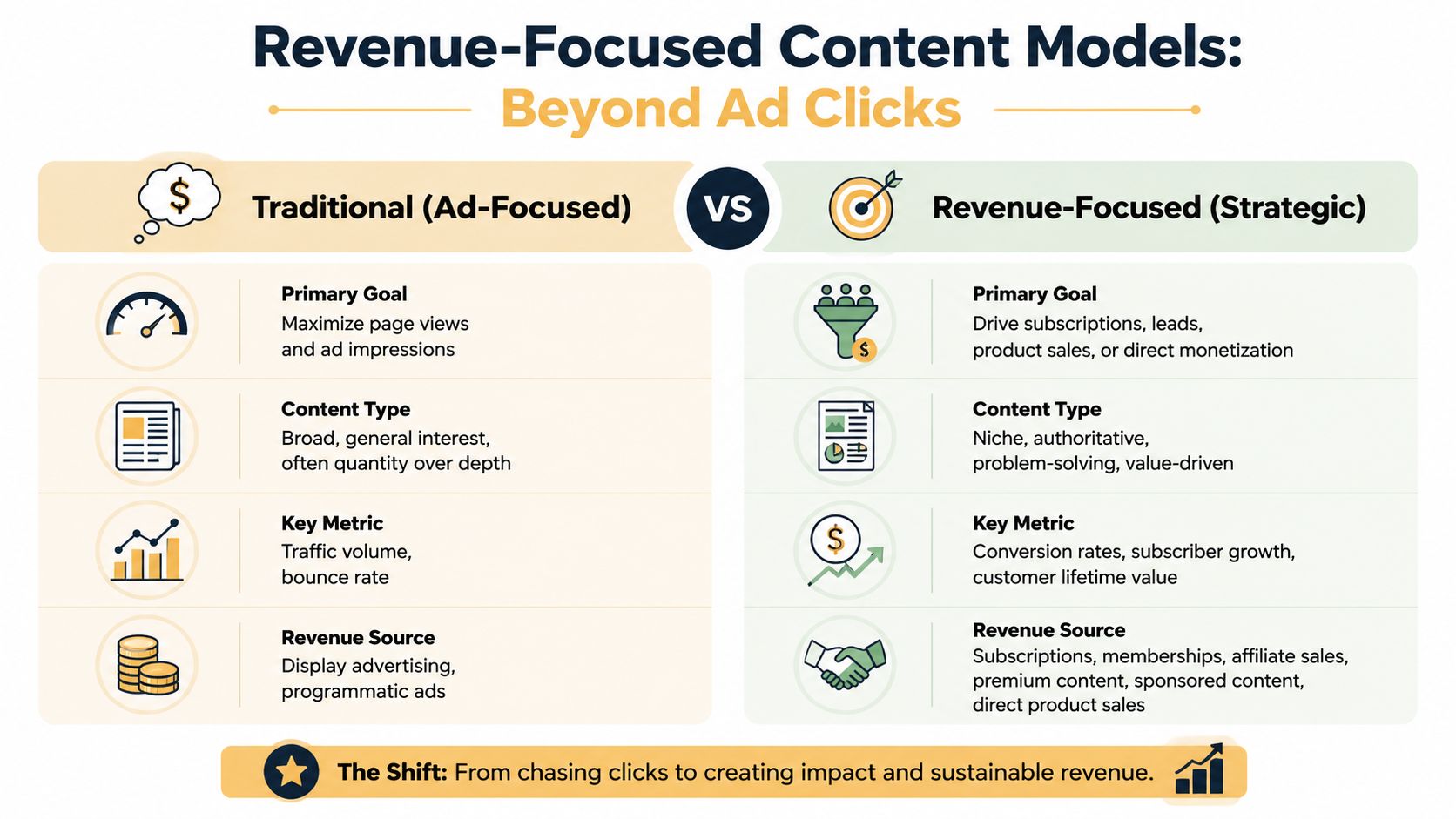
Publisher advice often stops at traffic. That's the wrong finish line. Traffic matters, but transient traffic is not the same thing as a durable audience, and a durable audience is what supports subscriptions, memberships, affiliate revenue, and direct monetization.
Design for repeat use, not one-off visits
The biggest distinction is between content that attracts and content that retains. Search-driven articles can bring in new readers, but they often have a short half-life unless they connect to a larger journey. By contrast, newsletters, recurring series, exclusive reports, and topic-led hubs can train people to come back.
That distinction matters more now because discovery is fragmented. 54% of respondents said they use social media for news every week in a 2024 Reuters Institute report referenced in Martech's summary of publisher best practices (Martech). If attention is already intermediated, then publishers need to decide which content rents attention and which content builds habit.
A revenue-focused model treats each content type as a step in the journey:
- Anonymous visitor content: Broad explainers, searchable definitions, and news moments.
- Registered-user content: Topic newsletters, saved guides, member prompts, and alerts.
- Paying-user content: Premium analysis, exclusive data, expert access, and deeper utility.
Match format to monetization intent
Not every article should be optimized for the same outcome. A general-interest story may be good for scale, but it rarely creates strong direct revenue on its own. A specialized, problem-solving piece is more likely to support conversions because it aligns with a reader who has already moved past casual curiosity.
That's why exclusive data reports, expert Q&As, and in-depth courses often outperform generic coverage when the goal is monetization. They solve specific problems, which gives readers a reason to register, subscribe, or return. The content is still editorial, but it's structured with a commercial path in mind.
Publishers don't need more content in every category. They need the right content in the right part of the reader journey.
Build calls to action that respect the audience
A revenue-focused content model doesn't mean slapping subscription prompts onto everything. It means placing the right ask at the right moment. A reader who just found you through search may be ready for a newsletter signup, while a returning reader may be ready for registration or a paid tier.
That's the gap most generic content advice misses. It focuses on volume and promotion, but not on the lifecycle mechanics that turn a visitor into a recurring user. Strong publisher content models make that transition visible and intentional.
The Modern Publisher's Tech and Analytics Stack
AI is already inside the content workflow, whether teams admit it or not. The question is no longer whether to use it, but where it fits, where it doesn't, and how to keep audience trust intact while improving speed and consistency.
Use AI for leverage, not for sameness
In 2026, 95% of B2B marketers reported using AI-powered applications, with 80% using AI for content creation and 75% for media production. Another source found 89% of marketers using AI-powered tools for content creation (Realize). That doesn't mean publishers should hand the whole editorial stack to automation. It means the baseline has changed, and the teams that ignore AI are going to spend more time doing work competitors have already compressed.
The key is to split the workflow. Let AI help with ideation, outlines, summarization, tagging, content variation, and distribution support. Keep human judgment on reporting, editorial framing, voice, sourcing, and trust-sensitive decisions. That's especially important in publishing, where credibility is part of the product.
Reuters Institute's 2024 findings add a useful caution. In the markets studied, 13% of news users had used generative AI to get news, while 55% were uncomfortable with news produced mostly by AI and 52% were uncomfortable with news personalized by AI (Reuters Institute via Magellan Media Partners). Those numbers make the trust issue hard to ignore.
Build analytics around behavior, not vanity
Publisher dashboards need to show more than pageviews. Teams should be tracking what content brings readers back, what content pushes registration, and what content helps subscriptions or memberships grow. If a piece gets attention but doesn't move a reader deeper into the ecosystem, it may be a weak revenue asset even if it looks good in a reporting meeting.
The smartest publishers set up reporting around lifecycle behavior, not just acquisition. That means seeing content as part of a relationship, not a one-time click. It also means content, email, and product analytics need to be in the same conversation.
Add automation where it removes friction
Automation works best when it removes repetitive work from the team. That can include publishing workflows, social scheduling, content tagging, and alerting systems that surface content updates or distribution tasks. It's the same logic used in a practical guide to email warmup for sales teams, where the value comes from structured behavior over time, not one-off bursts.
The same principle applies to publishing. If the team is constantly handling manual handoffs, repetitive formatting, or inconsistent distribution, content velocity will suffer. A tighter stack gives editors more time to do the work AI can't do well, which is the part readers remember.
If you want to turn content marketing for publishers into a real revenue system, Up North Media can help you build the SEO strategy, AI workflow, and conversion-focused content structure behind it. Visit Up North Media to see how a sharper content engine can support traffic, retention, and growth without adding unnecessary complexity.