
The most popular advice in marketplace app development is also the most expensive. Build the storefront first, bolt on trust later, and worry about liquidity once traffic arrives. That sequence fails because buyers and sellers won't transact on a platform that can't match them, protect them, or let them complete a purchase without friction. Treat trust, accessibility, and liquidity as build-time engineering gates, not post-launch cleanups, and your budget decisions get clearer from day one.
Why Marketplace Apps Need More Than a Storefront
A marketplace isn't an online store with extra listings. It's infrastructure that coordinates two groups with opposing incentives. Buyers want choice, low prices, and fast answers. Sellers want qualified demand, prompt payouts, and protection from abusive buyers. Your app has to serve both without favoring one side so heavily that the other leaves.
That coordination problem explains the scope. You need buyer discovery, seller onboarding, catalog management, payments, reviews, fraud controls, and customer service working together in the first release, not as disconnected modules. Miss one piece and transactions stall even if the homepage looks polished.
What the Scale Actually Demands
This isn't a niche channel anymore. The OECD reported that at least 62% of global web sales in 2020 occurred through online marketplaces, and 155 goods marketplaces attracted more than 1 million monthly visitors by April 2021. Users arrive with expectations set by those large platforms, even when they're shopping on a regional service.
A single-brand store controls its inventory, pricing, and fulfillment. A marketplace controls none of those directly. Instead, it controls the rules, the matching, and the money movement. That's why catalog-style sites built on a basic e-commerce template break down once real sellers create messy listings, dispute orders, or go inactive.
Consider a services marketplace where a parent needs help choosing support for your birth from Bornbir. The buyer journey involves credentials, availability, location, and personal fit. The provider journey involves verification, calendar management, and payment terms. A simple directory can't handle that matching logic, and it shouldn't try.
Practical rule: If your product only works when one side behaves perfectly, you haven't designed a marketplace yet. You've designed a brochure.
Before you commit, ask whether you have a two-sided problem. If you'll own the inventory or employ the providers, build a store or booking app instead. Marketplaces earn their complexity only when independent supply and independent demand both need the platform to find each other safely. That's the test most failed projects never ran.
Defining Your Launch Wedge and Core Features
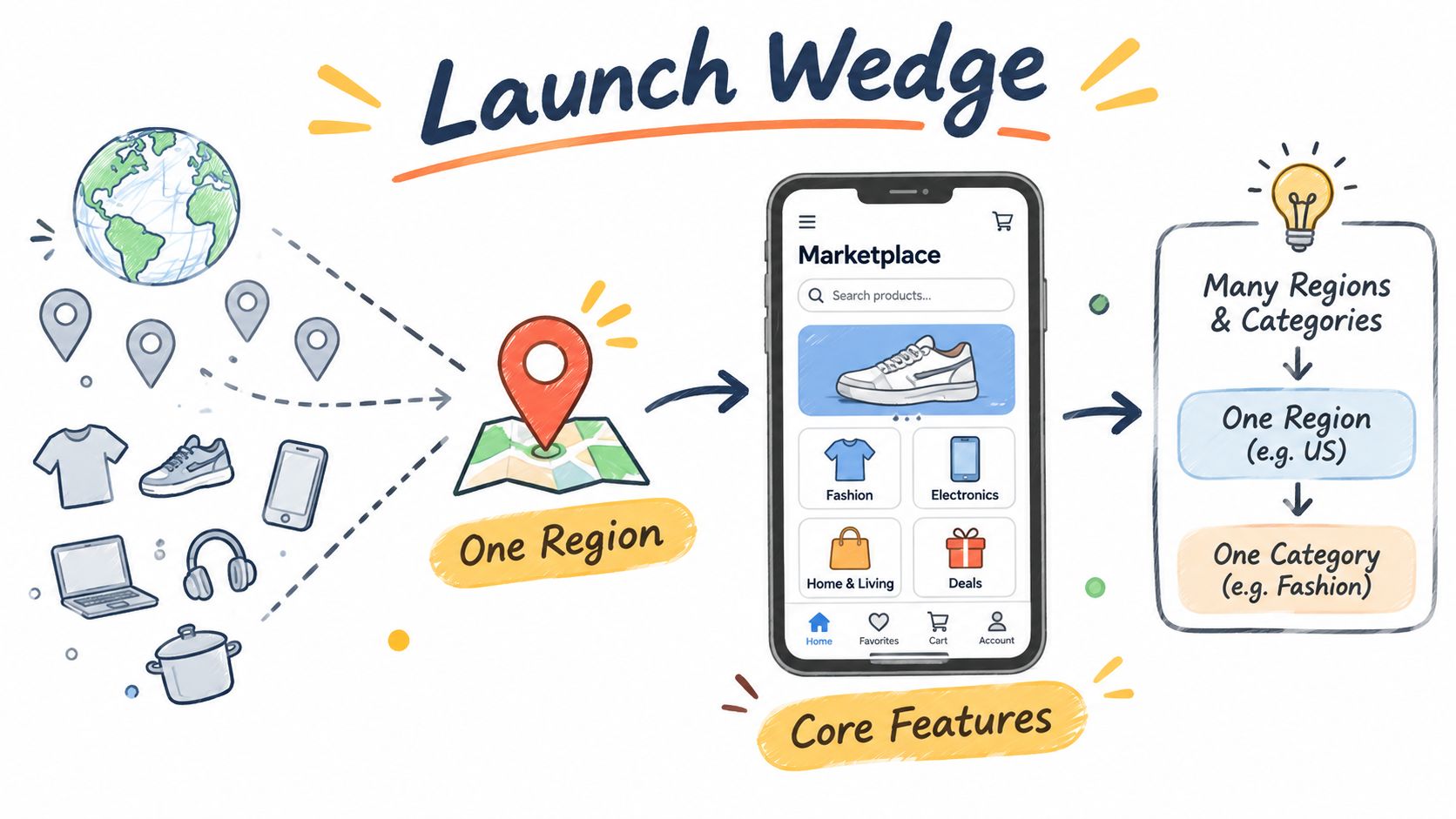
Start narrower than feels comfortable. A launch wedge is one geographic area or one category where you can recruit enough supply that every buyer sees meaningful choice. Launching nationally with thin supply everywhere guarantees empty searches, and empty searches teach buyers never to return.
The sequence below visualizes how that wedge works in practice.
A Launch Sequence That Tests Liquidity
Work through five steps in order. First, select the wedge. Second, recruit supply until buyers have real options. Third, seed demand through targeted acquisition rather than broad advertising. Fourth, measure whether users find a viable match within the normal time window for that category. Fifth, remove subsidies gradually and watch whether matching and completion hold.
A local tradesperson marketplace illustrates the logic. Serve one neighborhood well, with enough plumbers and electricians that a homeowner gets responses the same day. Expand to the next neighborhood only after that density exists. Pet services work the same way, which is why people who find trusted dog sitters through apps from Global Pet Sitter care about nearby, available sitters rather than a huge national roster they'll never book.
Metrics to Instrument Before You Build
Define separate buyer and seller funnels during discovery, then track them separately. As guidance on two-sided marketplace product management outlines, stronger simultaneous participation on both sides is associated with more trading activity, so balanced growth is a product KPI, not a marketing preference.
- Listing activation: Share of sellers who publish a complete, bookable listing.
- Qualified search and match rate: Searches that return viable options, and how often they lead to contact.
- Time-to-match: How long a buyer waits for an acceptable option.
- Completed and repeat transactions: Proof the match produced value worth repeating.
- Take rate and contribution margin: Revenue per transaction after payment, fraud, and support costs.
A useful operating test is that a participant should see roughly three to five reasonable options in their segment. Treat that as a starting hypothesis, not a law. Same-day services need rapid matching, while considered purchases can tolerate days or weeks. Rank features accordingly. Seller onboarding, search, and checkout come first. Advanced recommendations wait until liquidity exists to recommend from.
Choosing Between an MVP and a Full Marketplace Build
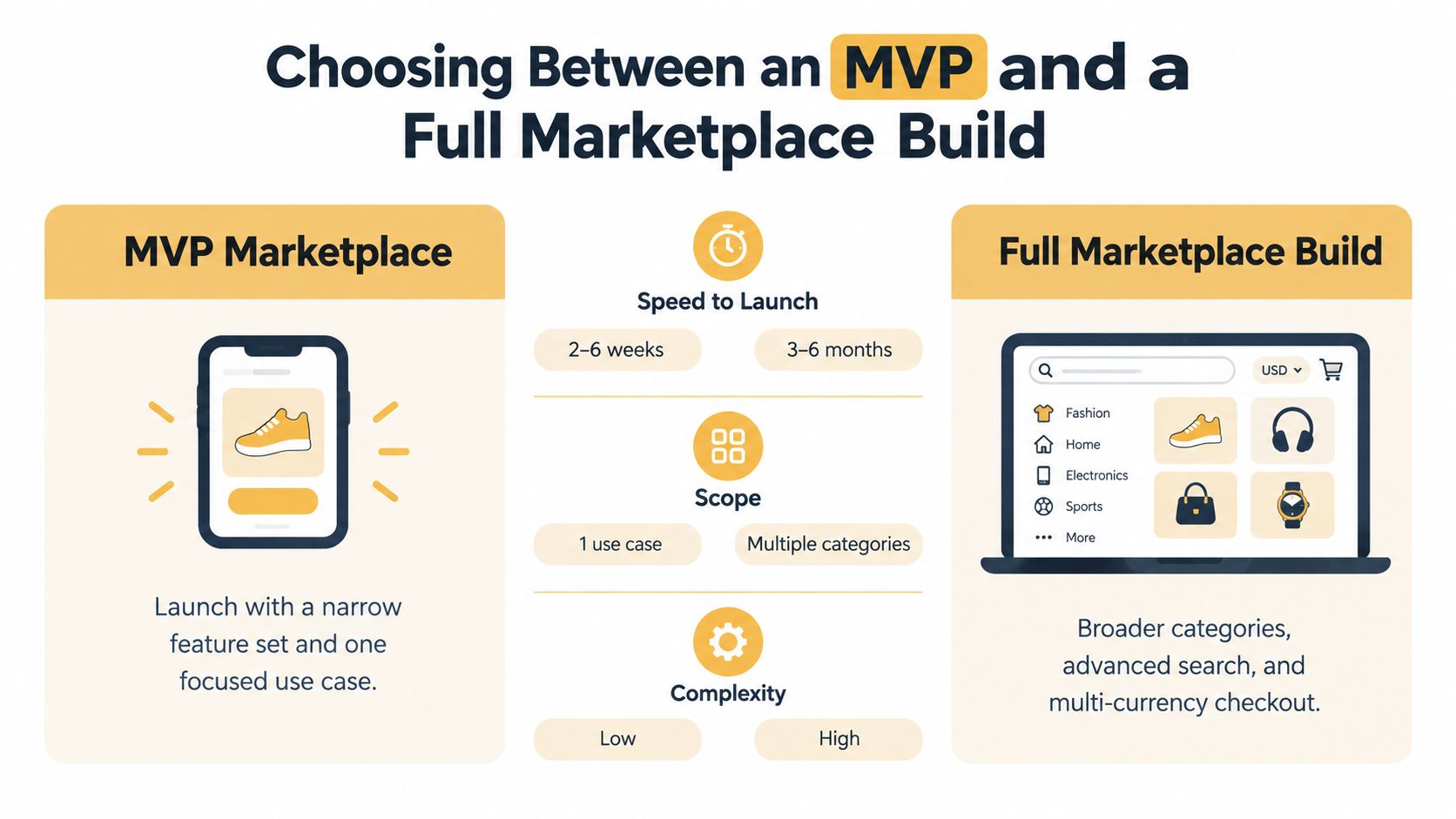
Teams frame this as a budget question. It's really a risk question. An MVP marketplace tests whether strangers will transact through you at all. A full build assumes they already will and optimizes for scale, breadth, and automation. Picking the second path before proving the first is where budgets disappear.
The comparison below summarizes the trade-offs across speed, scope, and complexity.
Criteria You Can Apply Today
Score your situation before anyone writes an estimate.
| Criterion | MVP fits when | Full build fits when |
|---|---|---|
| Budget runway | You need learning before more funding | Funding covers build plus operations |
| User roles | Two roles, simple permissions | Multiple roles, organizations, approvals |
| Transaction risk | Low value, reversible outcomes | Regulated, high value, safety critical |
| Manual operations | Your team can concierge early orders | Volume already exceeds manual capacity |
If you're still validating whether anyone wants the product, work through a founder's guide to testing demand from Find Startup Idea before scoping features. For the mechanics of scoping the smallest testable release, review how to build a minimum viable product without cutting transaction essentials.
What an MVP Can and Cannot Defer
Defer loyalty programs, AI recommendations, multi-currency checkout, and native apps for both platforms. None of those create liquidity. You can't defer secure payments, reconciled order states, seller payout logic, or basic dispute handling. Those aren't features. They're the transaction itself.
If money can move but nobody can explain where it is during a dispute, your MVP isn't minimal. It's unfinished.
Use this decision rule. If you can't yet name your first hundred sellers and how you'll recruit them, build the MVP. If you already operate a manual version of the marketplace and operations are breaking under volume, a fuller build is justified. Stage, not ambition, should drive the choice.
Picking the Tech Stack and Core Integrations
Judge every technical choice by one question. Does it help a transaction complete, or can it block one? That filter keeps small teams from spending months on infrastructure that buyers never notice while neglecting the search and payment paths they use every day.
Performance as an Engineering Gate
Set explicit service-level objectives before implementation. Instrument real-user monitoring for mobile load time, API latency, search latency, and payment authorization, and measure at P95 rather than averages. Averages hide the slow tail where buyers abandon. The stakes are concrete, since a one-second response delay can reduce conversions by about 7%, while a 0.1-second improvement was associated with conversion increases of 8.4% for retail and 10.1% for travel sites.
For an MVP, prioritize the unglamorous basics.
- Server-side pagination: Keeps large result sets fast on mobile connections.
- Indexed, faceted search: Lets buyers filter by price, location, and availability without timeouts.
- Cached high-volume queries: Protects your database during traffic spikes.
- Compressed, responsive images: Cuts load time without hurting listing quality.
- Asynchronous notifications: Prevents email or SMS delays from blocking checkout.
Payments Are a Ledger, Not a Button
The most common architectural failure is treating payment success as the end of the transaction. Your system must reconcile authorization, capture, cancellation, refund, chargeback, seller payout, tax, and platform-fee records so financial state stays consistent after retries or delayed webhooks. That requires resilient payment webhooks and idempotent order creation, so a retried request can't create two orders or two charges. Before selecting a provider, study payment gateway integration requirements for split payouts and reconciliation and evaluate candidates on fees, dispute tooling, regional support, and payout handling.
Integrate in this order. Payments and order state first, search second, messaging third, everything else after. On search specifically, most small teams should use a hosted service rather than building ranking and faceting in-house. You'll get relevance tuning and typo tolerance immediately, and your engineers can spend their time on the marketplace logic no vendor sells.
Designing Trust, Security and Accessible Experiences
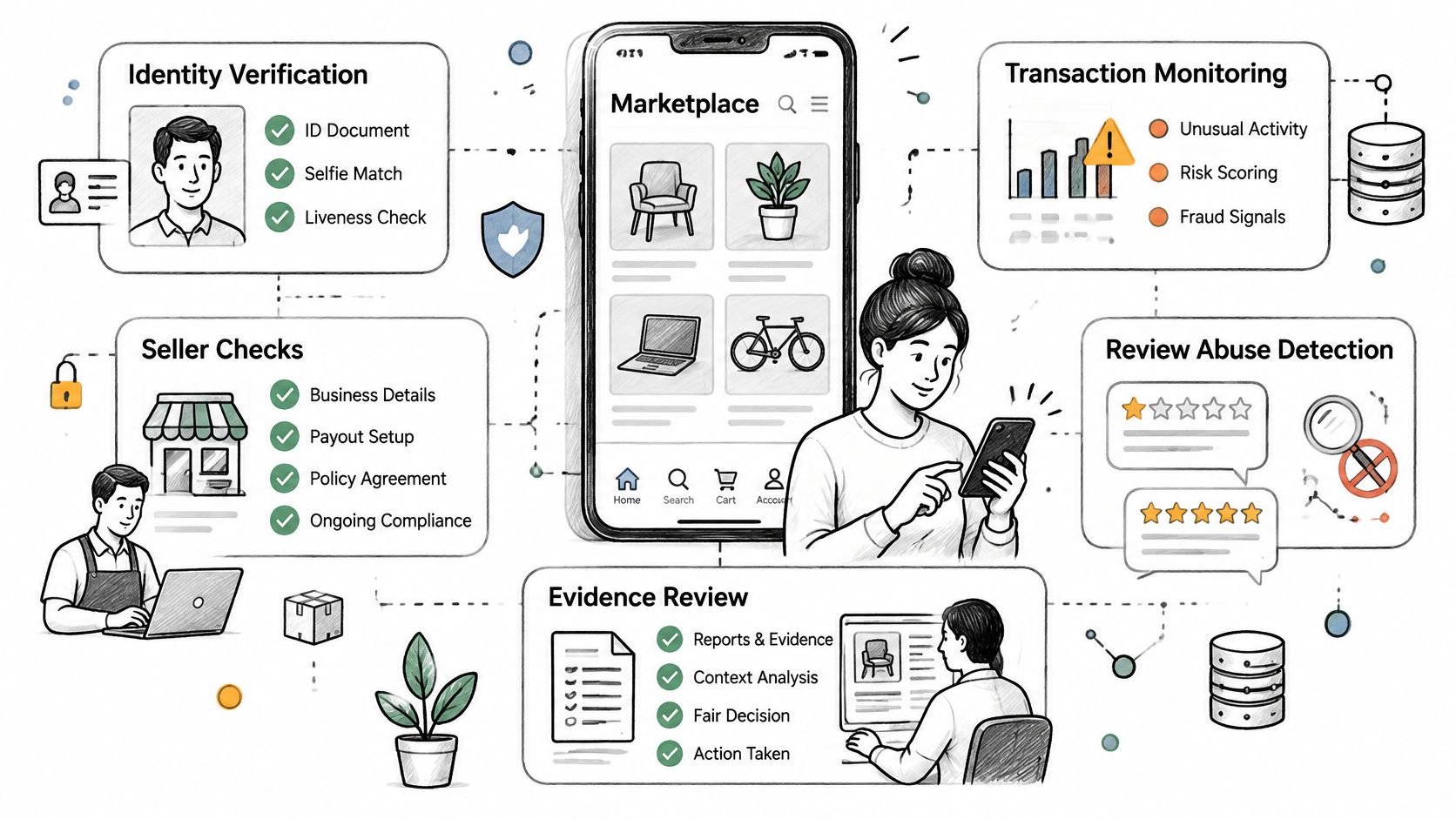
Trust isn't a badge you paste beside a seller's name. It's a set of decisions embedded in your data model, your onboarding flow, and your dispute process. The diagram below maps those controls across the development process.
Build Controls Proportionate to Risk
The demand side cares about this. In a December 2024 survey of 2,000 U.S. adults, 86% considered a platform's safety and security reputation important to their decision to use it, with fraud the leading concern at 55%, followed by identity theft at 43%. That makes trust architecture a conversion input, not a compliance expense.
Design risk-based verification so low-risk sellers face light checks while high-value or high-risk activity triggers stronger proof. Add transaction monitoring, review-abuse detection, evidence capture for disputes, human escalation paths, refund controls, and an auditable event ledger that records who did what and when.
Be honest about trade-offs. Requiring government ID reduces fraud but excludes legitimate casual sellers. Aggressive blocking increases false positives that punish good users. Star ratings alone can be manipulated or biased. Calibrate controls by marketplace type, transaction value, local versus cross-border activity, and the harm a failure causes.
The video below walks through how these trust decisions surface in product design.
Accessibility Is Revenue Design
Accessibility failures are widespread and operational. An audit of 250 pages from leading ecommerce sites across France, Germany, Italy, Spain, and the United Kingdom found 94% had inaccessible checkout journeys. In a marketplace, the exposure multiplies across faceted search, seller dashboards, variation selection, image uploads, messaging, checkout, returns, and dispute flows.
Test complete buyer and seller journeys with keyboard navigation, screen readers, zoom, contrast settings, plain-language errors, and low-bandwidth conditions. Measure completion and abandonment by task, because a technically conformant page can still fail when a user must compare many sellers or recover from a declined payment. Build accessible components once, reuse them everywhere, and retest whenever third-party payment, chat, analytics, or AI widgets enter the stack.
Estimating Costs, Timelines and Monetization Models
Generic price points are useless in a budget meeting. What you need is a phased plan that ties spending to the gates covered earlier, so leadership can see what each phase proves before the next one gets funded. The timeline below shows that progression from discovery through regional expansion.
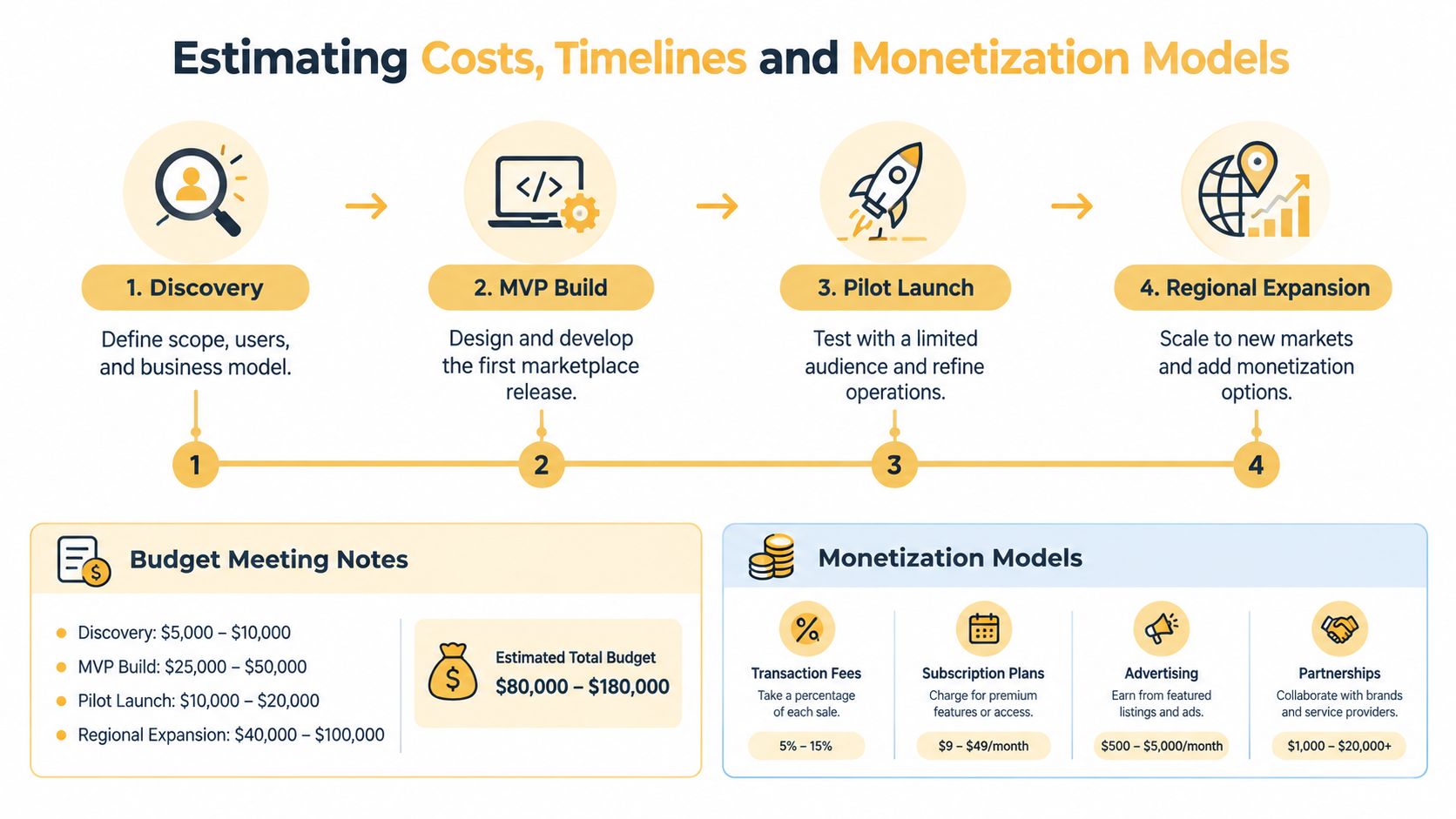
What Actually Drives Variance
Five factors move estimates more than any vendor's hourly rate.
- Number of user roles: Each role adds permissions, dashboards, and test coverage.
- Payment and identity integrations: Split payouts, tax handling, and verification add real scope.
- Custom search: Relevance, geo filtering, and availability logic cost more than keyword lookup.
- Native mobile versus responsive web: Two native apps roughly double your client-side maintenance, a trade-off worth reviewing against current mobile app development cost drivers.
- Compliance workload: Regulated categories add documentation, audits, and review cycles.
Request estimates broken into discovery, design, build, QA, and ongoing operations. A single lump sum hides where the risk sits. Global ambitions widen the spread further, since businesses in 43 economies generated almost $25 trillion in e-commerce sales in 2021, with UNCTAD estimating $27 trillion in 2022. Cross-border scope means localization, currency support, and regional payments, none of which are free.
Monetization Shapes Supply
Your fee model decides who lists with you. Commission on completed transactions aligns your revenue with seller success and lowers the barrier to joining. Listing fees deter spam but suppress casual supply. Seller subscriptions suit professional sellers with steady volume. Featured placements monetize attention but can erode buyer trust if ranking feels bought. Payment processing margins add quiet revenue but invite scrutiny on total take.
Model each option against contribution margin per transaction, after payment cost, fraud and dispute losses, and support cost. A high headline fee that drives your best sellers to a competitor is the most expensive pricing you'll ever set.
Budget test: If your monetization model only works at a take rate sellers would never accept, the problem isn't pricing. It's the value you're delivering per transaction.
For delivery, weigh an in-house team against an agency partner based on how much marketplace-specific experience you already employ. Up North Media, an Omaha-based digital agency, offers custom web application development, data-driven SEO, and AI consulting, with free consultations and dedicated support throughout a project. Whichever route you choose, fund operations explicitly. Support, moderation, and seller success are recurring costs, not launch leftovers.
Launching, Scaling Growth and Taking the Next Step
Launch day tells you almost nothing. The weeks after launch tell you whether liquidity is real. Segment every dashboard by market, category, cohort, and device, because aggregate conversion can look healthy while individual categories fail. A strong checkout rate among the few users who found a match can coexist with a dying marketplace.
Gates for Opening a New Region
Expand only when four signals improve without promotional support.
- Search-to-fill rate: Buyers consistently find viable options.
- Time-to-match: Matches happen inside the category's normal window.
- Completion rate: Matches convert into paid, fulfilled transactions.
- Repeat usage: Buyers and sellers return without discounts pushing them.
If those gates aren't met locally, a new city won't fix the problem. It'll replicate it at higher cost. Fix supply density, listing quality, or pricing in the current market first.
SEO and AI as Growth Infrastructure
Marketplaces have a structural SEO advantage that often goes unused. Build indexable category and location pages, add structured data to listings, and keep mobile performance fast so organic visitors don't bounce before search results render. Every quality listing is a landing page, but only if your templates expose it cleanly and your filters don't generate thousands of thin duplicate URLs.
Apply AI where volume overwhelms humans, not where judgment matters most. Good candidates include support triage, fraud review queues, listing quality checks, and seller onboarding assistance. Keep humans in every escalation path, especially disputes and enforcement decisions, and explain outcomes clearly to affected users. Automation that can't explain itself will cost you trust faster than it saves you payroll.
Tie the whole plan to measurable goals from the first month. Pick your wedge, set the liquidity metrics, fund trust and accessibility as engineering gates, and expand only when the numbers say you're ready. That's the playbook. It isn't glamorous, but it's how marketplaces survive contact with real buyers and sellers.
If you're scoping a marketplace and want the wedge, feature set, and timeline pressure-tested before you commit budget, Up North Media offers free consultations with dedicated support throughout the build. Bring your category, your supply plan, and your monetization thinking, and you'll leave with a phased roadmap tied to measurable liquidity and revenue goals.