
The most popular advice on Local SEO vs National SEO is to pick one, add your city name if you picked local, and publish more content either way. That advice wastes money. A city name on a national page isn't local SEO, and a perfect map profile won't win a research query your Omaha buyer asks two weeks before calling. I sort the work by query intent and by how you get paid, not by a label on a proposal.
Local SEO and National SEO Side by Side
Adding "Omaha" to a national service page doesn't make it local. Local SEO wins demand tied to a place. National SEO wins queries that aren't limited to one city, where location doesn't decide who can buy.
Local SEO vs national SEO at a glance
| Criterion | Local SEO | National SEO |
|---|---|---|
| Primary goal | Capture nearby demand and visits | Rank for non-location queries at scale |
| Typical query | Near me or city plus service | Category, comparison, or how-to |
| Main Google surface | Local pack, Maps, and localized organic | Traditional organic results |
| Core asset | Google Business Profile and location pages | Content clusters and backlinks |
| Key signals | Proximity, reviews, NAP, LocalBusiness schema | Topical authority, links, crawlable architecture |
| Best fit | Service firms and storefronts | E-commerce and publishers without a required visit |
| Conversion path | Calls, directions, and same-day visits | Sessions, subscribers, and online orders |
Revenue that depends on a nearby visit points to local SEO, revenue that depends on shipping or readership points to national SEO, and a business that needs both should split its dashboard before it splits its budget.
What the rows mean in practice
Take "plumber near me" versus "best standing desk". The first searcher wants someone close, now, with reviews and a call button. The second wants a comparison and will buy from whoever ships the right desk. You build a Google Business Profile and location pages for the first, and content clusters with links for the second. If you're still sorting your keyword list, work through keyword targeting by geographic reach before you assign pages, because a mixed list produces mixed assets that rank for neither job.
The local column converts differently. In Google's study, conducted across nine industries with 653 participants between December 18, 2013, and January 30, 2014, 50% of consumers who performed a local search on a smartphone visited a store within one day, compared with 34% of consumers who searched on a computer or tablet. 18% of smartphone local searches led to a purchase within one day, versus 7% for non-local searches, and 72% of smartphone users who searched for local information visited a store within five miles.
That fieldwork is old, so don't use it as a 2026 target. Use it to understand behavior. An Omaha storefront visit happens fast and close. A nationwide order or pageview can come from anywhere and take longer. Mark the column that matches how you get paid.
How Local Packs Differ From National Rankings
A local query can reward map visibility while a national query rewards organic reach. Local SEO is not national SEO with a city name added: the query's intent determines which results matter. Ready-to-visit searches often surface the local pack and Maps, while customers still researching may rely on localized organic pages, directories, or national-style answers. A business can win on one surface and miss the others.
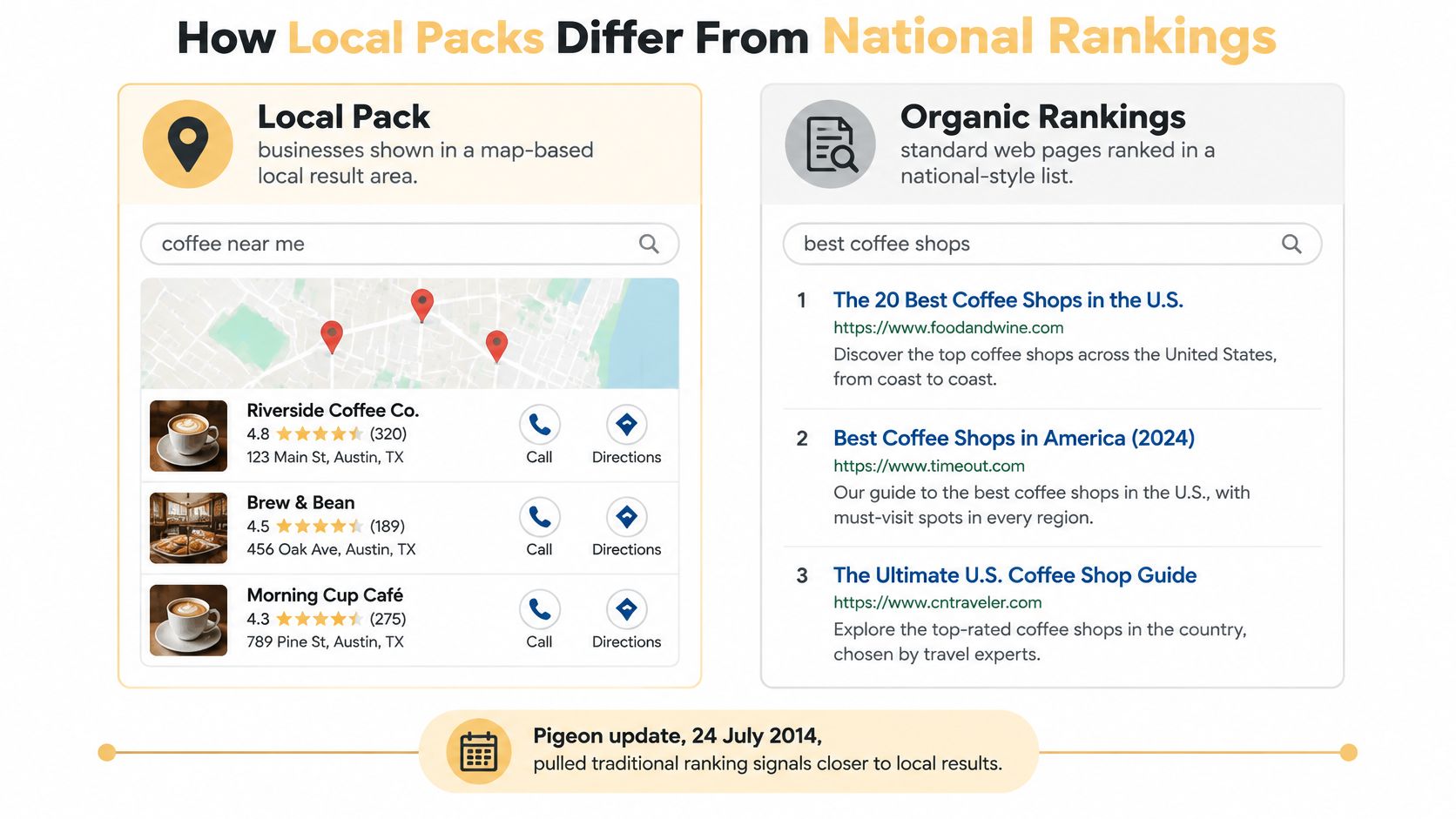
Traditional web ranking signals and local results are related, so strong organic visibility can support local visibility. Local results also depend on the surface and the search itself. The local pack now presents three businesses, while national queries compete mainly through organic listings and AI answers.
Four surfaces, four different fights
- Local pack: Three businesses receive prominent placement. On mobile, other results can sit below the fold, even when their websites are strong.
- Maps: Searchers can compare distance, hours, photos, and reviews without visiting a business's site.
- Localized organic: Service and location pages compete below the pack with other businesses and directories.
- Directories: In BrightLocal's analysis of 8,000 Google results from 800 local-business searches, directories made up 31% of local-intent organic results overall and 37% of results for informational local-intent queries.
That directory presence makes consistent name, address, and phone data part of the visibility work. Conflicting address or phone details can weaken the signals tying listings to the same business, while directories occupy a meaningful share of local organic results.
Missing the pack is different from ranking on page two nationally. Nearby buyers may not see you, while distant readers may never scroll far enough.
What this changes when you brief a vendor
Search your main service query on a phone from your service area. Record which surfaces appear, who holds the three pack positions, which directories rank organically, and whether an AI answer appears above them. Then ask how each surface will be tracked. If you need to find tools for monitoring search rankings, choose a tool that reports pack and organic positions separately. One blended rank can hide whether the gap is map visibility or web rankings.
For “Omaha roof repair,” a business could rank fourth organically while three competitors hold the pack. The practical trade-off is clear: strong organic placement may still miss ready-to-call searchers, so assess the pack and organic results separately before choosing where to invest.
Ranking Factors That Stay on One Side
Some signals don't travel. Work that moves the map won't necessarily move a national category page, and work that builds topical authority won't fix a broken profile. Build the asset the surface reads.
Local-only signals
Start with a complete Google Business Profile. That means the primary category matches the service people search, not the broadest label you qualify for, plus accurate hours, service areas, attributes, and current photos of your team, vehicles, and premises. Add secondary categories only for services you deliver.
Keep one consistent business name, address, and phone number everywhere. "Suite 200" on one listing and "#200" on another is trivial. Two different phone numbers or an old address still live on a major directory isn't. Pick one version, then fix your website footer, profile, and top directories to match it exactly.
Reviews do double duty. According to Rio SEO's 2025 local search consumer behavior study, 75% of surveyed U.S. consumers said they read at least four reviews before deciding about a local business. So review count and recency affect both whether you rank and whether the searcher calls. Ask at the point of completed work, respond to every review, and don't gate unhappy customers away from Google. That last habit creates risk you don't need.
Location pages should name real service areas with real proof, such as jobs done there, local staff, and travel or response details. Swapping the city name into identical copy across twenty pages is doorway-page spam, and it reads that way to customers too.
Add LocalBusiness structured data to those pages. Per Google's LocalBusiness structured data documentation, that markup can make pages eligible for local rich results, and you should validate required properties with the Rich Results Test and URL Inspection tool. Schema helps Google interpret your business as an entity. It doesn't guarantee a ranking, and it won't rescue a thin page. If you want the full local checklist in one place, our guide to local SEO ranking factors that affect pack and profile visibility breaks out each signal by surface.
National-only signals
National work runs on indexable templates first. Category, product, and article templates need clean crawl paths, unique titles, and no index bloat from faceted navigation or tag pages. Then build entity coverage through a pillar page and supporting pages that answer the sub-questions, linked internally so authority flows to the page you want ranking. Earn links from relevant sites in your topic, not general directories.
Practical rule: If a task doesn't name the surface it affects, don't fund it yet.
Say a single Omaha office publishes a nationally useful cost guide. That guide can win research traffic from anywhere, but it won't move the map pack by itself. The reverse also holds. A perfect profile won't rank a product category that has no demand tied to Omaha.
Local Searches That Need National Content
Sorting every task as local or national misses how your buyers search. The same Omaha customer asks a ready-to-buy question on Friday and a research question the week before. Those two searches produce different results pages, and they need different assets.
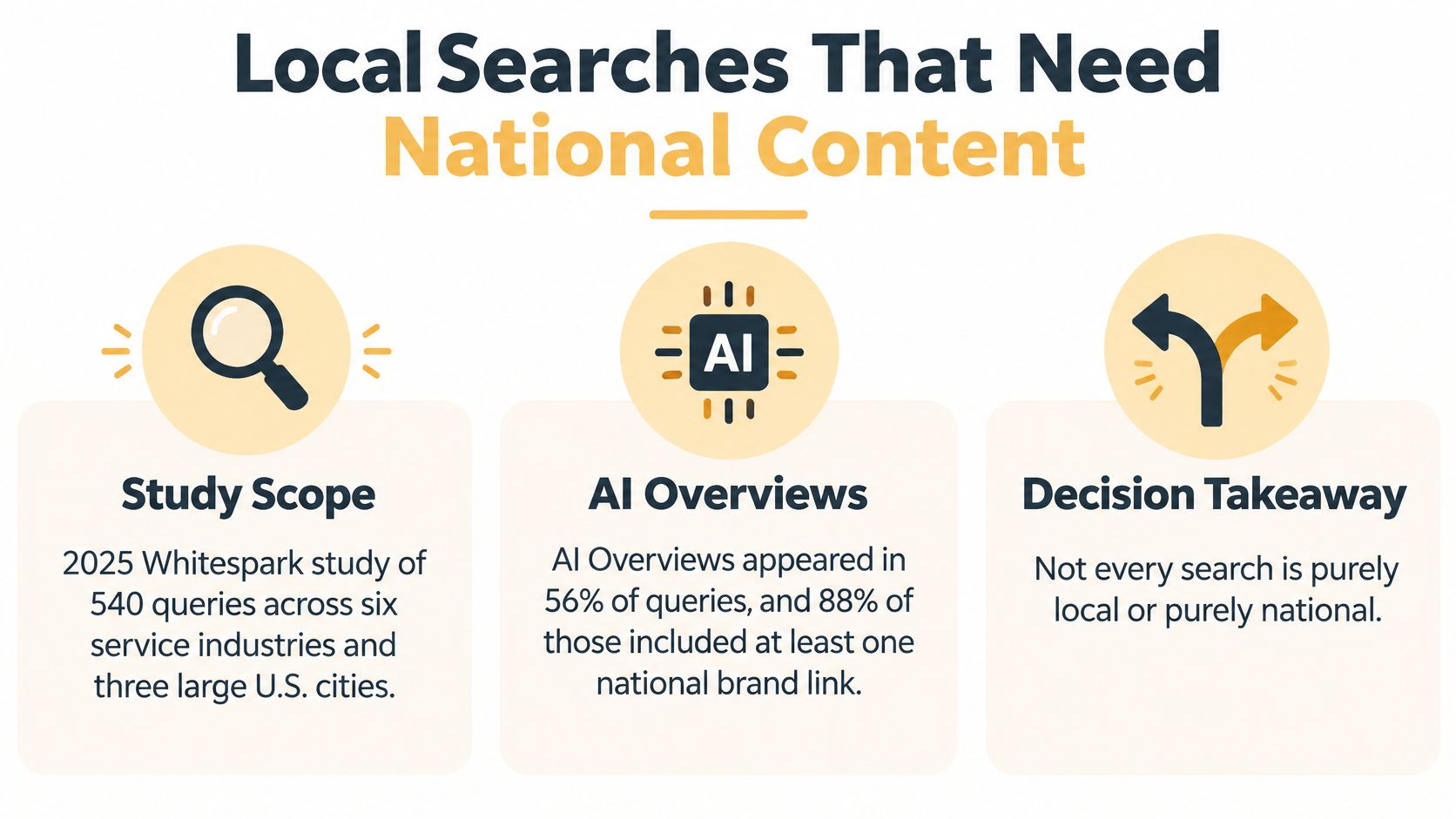
In the 2025 Whitespark study of 540 queries across six service industries and three major U.S. cities, AI Overviews appeared in 68% of local-business queries on average, while local packs appeared in only 39%. Split by intent, local packs appeared for 93% of straightforward local-intent searches, but AI Overviews appeared for 92% of informational-intent and 97% of hybrid-intent searches.
Two Omaha searches, two different jobs
"Emergency plumber near me" is a pack and call problem. The searcher has water on the floor. Your profile, reviews, hours, and distance decide whether you get the tap. A 2,000-word guide won't help in that moment.
"How much does a water heater cost in 2026" is an answer problem, even when the buyer lives in Omaha. I mean that as a question a buyer is asking this year, not a forecast. Google often answers it with an AI Overview and national-style content. If you don't publish price ranges, timelines, comparisons, and buying steps, a national publisher or a competitor who does publish them gets cited, and you meet the customer only at the quote stage, if at all.
Which parts of a local program should behave like national SEO, and how do you score them when the click never happens?
How I'd allocate the content
Pair your service and location signals with a small set of expert answer pages. For most local services, that's cost, timeline, repair versus replace, and what happens during the job. Write them to a national standard of depth, then add the local specifics only where they're true, such as permit steps, service area, and who does the work.
Track the results as separate lines: map actions, calls, leads, organic clicks, and AI citations. An AI answer can replace the click without replacing the job. If calls hold steady while clicks drop on research pages, you may be getting cited and remembered rather than visited. That's a measurement question to investigate, not a reason to delete the pages.
Strategy by Business Type in Omaha and Beyond
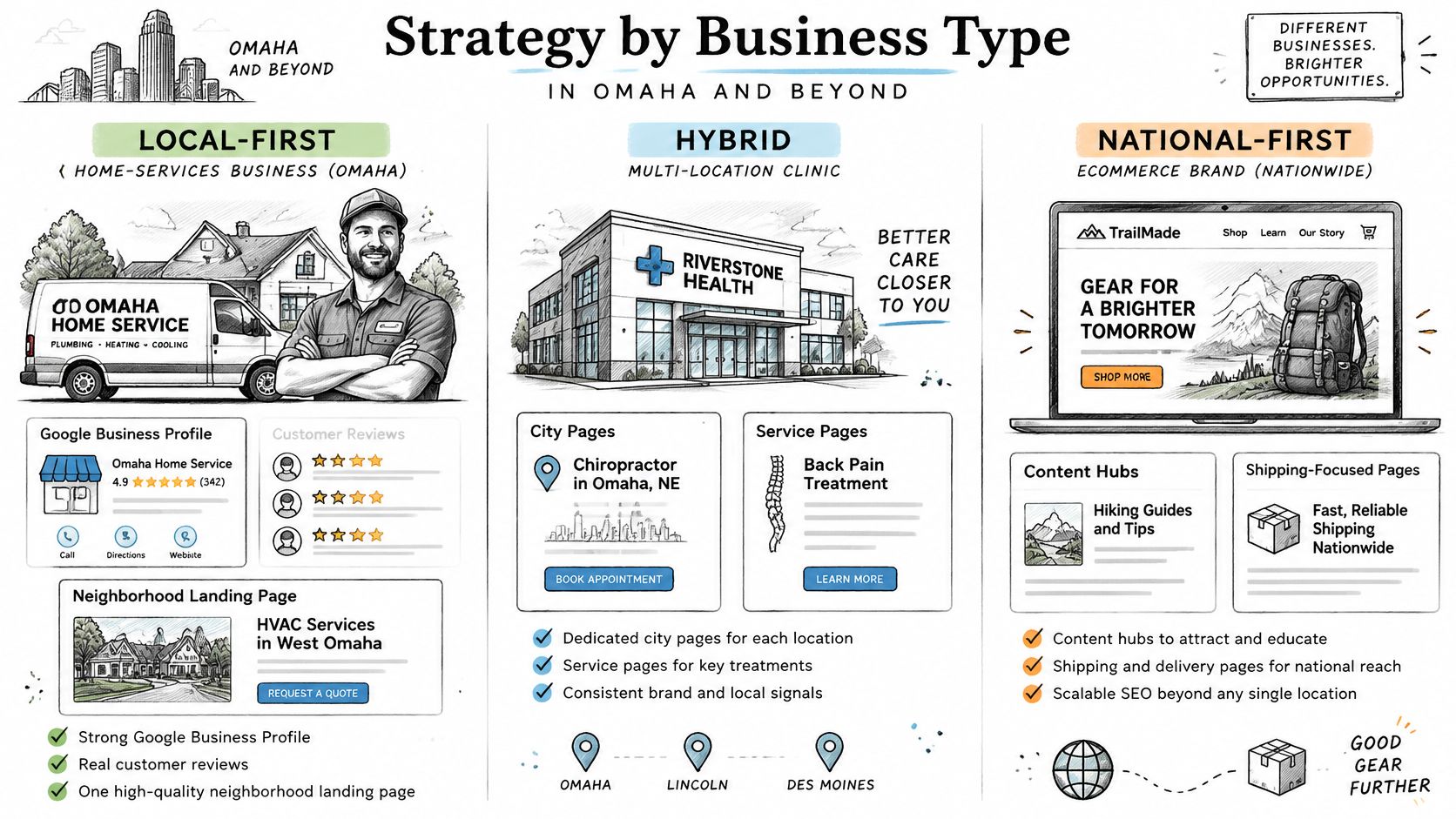
Local SEO is not national SEO with a city name added. Query intent sets the mix: map visibility matters when someone is ready to visit or call, while strong national-style answers help local customers who are still researching. Match the work to how you sell and deliver. Each scenario below ends with the metric that should move first.
Omaha home services or clinic
Lead with local visibility. Correct the profile, build a steady review flow, and publish a strong service-area page for each core service, with real proof of work nearby. Add cost and process guides for customers comparing options. Hold off on building many city pages until the main service page earns calls.
Local demand makes gaps easier to spot. SOCi's Consumer Behavior Index reports that in 2024, 80% of U.S. consumers searched online for local businesses at least weekly, while 32% searched daily or multiple times daily. For an Omaha firm, the first signal to watch is whether profile visibility turns into calls and direction requests. First metric to move: calls and direction requests from the profile.
The short video below shows how this local-first sequence applies to a service business.
E-commerce without pickup and digital publishers
Lead national when customers buy or read online without relying on a local storefront. For e-commerce, prioritize category and comparison content, technical templates that prevent filters from bloating the index, and links from relevant product and industry sites. A city page makes sense only when it reflects actual local inventory, delivery zones, or pickup. Otherwise, it adds little beyond a place name. First metric to move: non-brand category revenue.
Publishers should build topical clusters around original reporting and use location only when it changes the story. Adding “Omaha” to a national explainer does not make it useful to readers in Omaha or elsewhere. First metric to move: non-brand impressions on the target cluster.
The hybrid case
A regional software firm based in Omaha and selling nationwide needs both approaches, assigned to different goals. Keep its local profile accurate for brand and hiring searches, where candidates and partners may look it up. Build national revenue pages for buyers researching software beyond the home market, as outlined in this SEO strategy for SaaS companies selling beyond their home market. First metric to move: qualified demo requests from non-brand pages.
Multi-location brands need a distinct local case in every city: relevant proof, reviews, staff, and inventory or service details. Replacing one city name with another does not establish that local relevance. For rollout guidance, see LLMrefs advice on scaling location visibility. Measure locations separately so a strong city does not conceal a weak one. First metric to move: pack share in your weakest city, not your average across all cities.
Budgets Timelines and the KPIs That Matter
Treat these ranges as 2026 planning bands for a competent ongoing program for Local SEO vs National SEO, not quotes. Your actual number moves with location count, catalog size, existing authority, and whether the site needs technical repair before content. Our breakdown of what SEO costs for a small business shows how those inputs change a proposal line by line.
SEO budget, timeline, and KPI bands by business type
| Business type | Monthly planning band | Typical timeline | Primary KPIs |
|---|---|---|---|
| Omaha local service firm | $1,500 to $4,000 | 3 to 6 months | Map actions, calls, reviews, local leads |
| Multi-location or regional brand | $4,000 to $8,000 | 4 to 9 months | Pack share by city and location-page leads |
| E-commerce without stores | $5,000 to $15,000 | 6 to 12 months | Non-brand revenue and category rankings |
| Digital publisher | $4,000 to $12,000 | 6 to 12 months | Organic sessions and informational rankings |
| Hybrid local-and-national brand | $6,000 to $18,000 | 6 to 12 months | Map actions and non-brand traffic, tracked apart |
Why the bands spread so wide
A single-location firm with a sound site sits at the low end because the work is profile, reviews, and a handful of pages. Add five locations and you're maintaining five profiles and five sets of proof. E-commerce runs longer because template fixes and links compound slowly across hundreds of pages. A hybrid brand pays for two programs, which is honest pricing, not upselling.
Leading KPIs versus lagging KPIs
- Local leading indicators: Profile views, direction requests, calls, and new reviews per month.
- National leading indicators: Indexed pages in the target cluster, non-brand impressions, and rankings on priority terms.
- Lagging indicators for both: Qualified leads or revenue. Not raw traffic.
A national content push can raise sessions while local calls stay flat. That doesn't prove SEO failed. It proves you're reading a national metric against a local goal. I would pick one lagging KPI and two leading KPIs before month one, write them on the first report, and refuse to swap them mid-quarter because a different number looks better.
Choose Your Mix and Start the First 90 Days
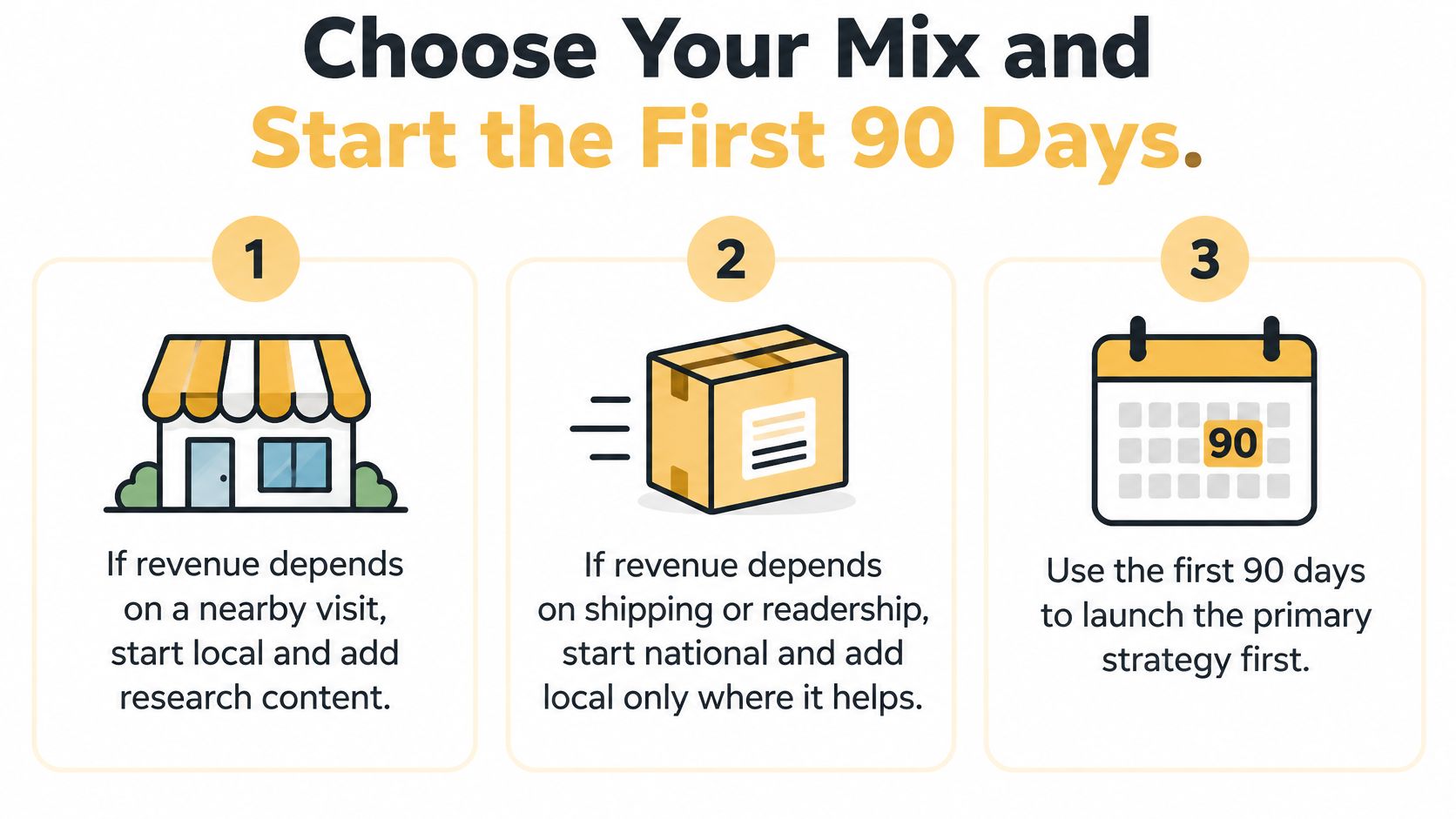
Local SEO is not national SEO with a city name added. Let query intent set the mix: prioritize map visibility for ready-to-visit searches, and build national-style answers for customers still researching. If revenue depends on nearby visits, start with local work and support it with research content. If revenue comes from shipping or readership, lead with national SEO and add local pages only for real locations. If both matter, track their results separately before deciding how to divide the budget.
- Export and label: Pull queries already producing calls or revenue. Mark each as ready-to-buy or research.
- Fix local identity: If local searches matter, correct the profile, categories, and name, address, and phone details.
- Repair one page: Publish or improve the page for your highest-value query, whether that is a service-area page or a category guide.
- Set the baseline: Record two leading KPIs and one lagging KPI for a baseline week.
- Fund one surface: Invest in reviews or links according to the surface you chose. Avoid funding both at full spend from day one.
- Review at day 90: Keep work tied to the chosen KPI and cut what does not support it.
For an Omaha service business, e-commerce catalog, or publishing site, Up North Media can audit your profile, money pages, and current KPIs, then recommend a mix that fits how you earn revenue. Book a free consultation and leave with a 90-day plan tied to calls, orders, or qualified traffic, rather than vanity rankings.