
Teams respond to a slow database by adding CPU, memory, or a larger managed instance. That can reduce symptoms, but it often leaves the expensive query, poor data model, lock contention, or unsuitable workload placement untouched. The result is a faster way to pay for the same architectural mistake.
Database optimization services take a broader approach. They connect query behavior with schema design, infrastructure, cloud spend, reliability, governance, and the demands of modern applications. That matters because today's systems rarely run on one clean database engine. Transactional workloads, analytics, search, document storage, and AI retrieval may all depend on different platforms.
The right service doesn't promise that every query can be tuned indefinitely. It identifies where tuning will help, where architecture needs to change, and how to prove the difference with production-relevant evidence.
Understanding Database Optimization Services
Database optimization services are often confused with routine maintenance. Maintenance includes backups, patching, capacity checks, index rebuilds, and configuration reviews. Those tasks matter, but they don't answer the harder questions: Which workload is consuming the most resources? Why did latency rise after a schema change? Is the cloud instance oversized because a query plan is inefficient? Should the team tune SQL, partition data, move a workload, or redesign the access pattern?
Professional optimization treats the database as part of a larger operating system for the business. Engineers examine application queries, execution plans, table statistics, indexes, connection behavior, storage patterns, and workload schedules. They then test changes against representative traffic rather than applying a generic checklist and hoping the dashboard improves.
Practical rule: More hardware is a valid mitigation when demand has genuinely outgrown capacity. It isn't a substitute for finding waste.
The market's direction reflects this broader role. One industry estimate values the database optimization tool market at USD 2.78 billion in 2025 and projects it to reach USD 9.43 billion by 2035, with a 13.01% CAGR from 2026 to 2035. The same estimate reports that cloud-based tools hold 57.80% of the market and North America represents 41.20% of global share. These figures come from Database Optimization Tool Market research, and they point to optimization becoming a mainstream infrastructure investment rather than a specialist task reserved for crisis response.
What the service actually includes
A serious engagement usually combines several layers of engineering:
- Workload diagnosis: Finding slow, frequent, blocking, or resource-heavy queries and connecting them to the application code that generates them.
- Plan and statistics analysis: Checking whether the optimizer has an accurate picture of row counts, distinct values, distributions, indexes, and system resources.
- Data-model review: Assessing relationships, data types, normalization, denormalization, partitioning, retention, and table growth.
- Infrastructure alignment: Matching storage, memory, CPU, replicas, connection pools, and workload placement to actual usage patterns.
- Operational controls: Establishing monitoring, alert thresholds, deployment safeguards, rollback procedures, and ownership.
The distinction between maintenance and performance engineering is accountability. Maintenance keeps a system available and orderly. Optimization services should show which bottleneck they addressed, why the intervention was selected, what trade-off it introduced, and how the team will verify that the benefit survives future releases.
Core Techniques for Faster Query Performance
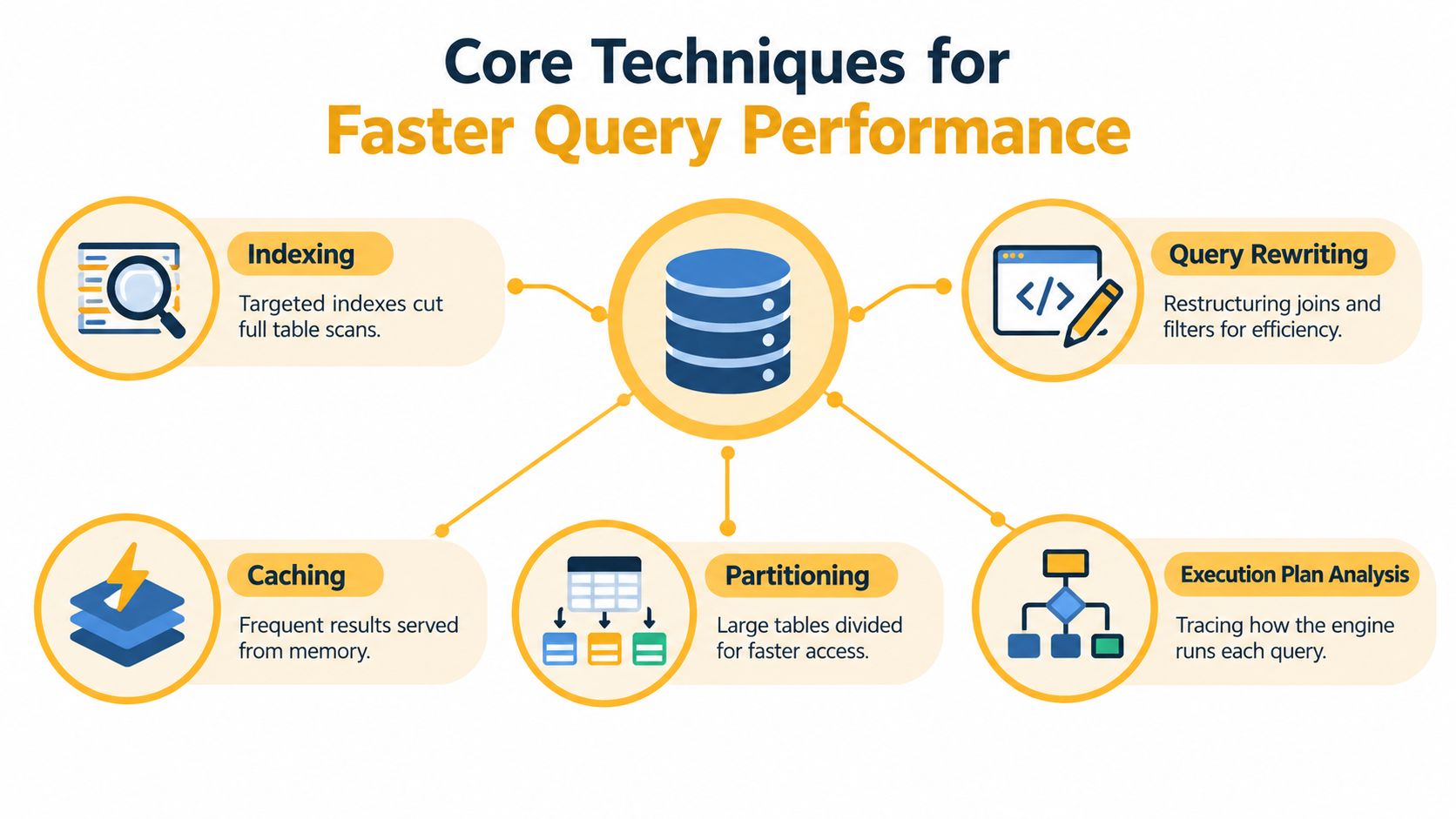
Fast queries usually come from reducing unnecessary work. A database engine spends time locating rows, joining tables, sorting results, reading pages from storage, moving data through memory, and returning records to an application. Optimization services inspect that work step by step, then remove the most expensive operations without damaging write performance or data integrity.
Indexing
An index works like a library catalogue. Without it, the engine may scan a large table page by page. With a suitable index, it can go directly toward the rows that match a filter, join, or sort. The right index can make query performance almost linear compared with absent-index cases, as reported in the empirical indexing study.
The qualification matters. Every index consumes storage and adds work to inserts, updates, and deletes. A consultant who recommends indexes without checking usage, selectivity, write volume, and execution plans may replace a read problem with a write problem. Specialists look for missing, redundant, and unused indexes, then validate whether the proposed structure changes the plan.
Query planning and rewriting
The optimizer chooses an execution plan based on the query and its understanding of the data. Rewriting a query can expose better join orders, reduce the rows processed early, remove unnecessary calculations, or make a predicate usable by an index. A plan viewer such as PostgreSQL EXPLAIN, SQL Server's execution-plan tools, or Oracle's plan analysis features helps engineers see whether the engine is scanning, seeking, sorting, hashing, or repeatedly invoking a costly operation.
The most useful analysis compares the estimated plan with observed behavior. A large mismatch often signals stale statistics, skewed data, an unsuitable join strategy, or parameters that produce different workload shapes.
Caching and partitioning
Caching serves repeated results from memory instead of recalculating them. It can be effective for stable reads, but stale data, invalidation complexity, memory pressure, and uneven access patterns can make it a poor fit. A cache should have a clear ownership model and an acceptable freshness policy.
Partitioning divides a large logical table into smaller physical segments, often by date, tenant, or another access key. It can reduce the amount of data considered by a query, but it also complicates indexes, migrations, constraints, and operational procedures. Partitioning isn't automatically an upgrade. It works when the partition key matches real query behavior.
For a practical introduction aimed at smaller organizations, Indiana SMB database optimization guidance provides useful context on connecting design choices with business outcomes. Teams building or revising a web application can also consult database design best practices before performance problems become embedded in application code.
What a Database Audit Should Deliver
A database audit should produce decisions, not a collection of preferred settings. Start with evidence about the workload: which services issue queries, when traffic peaks, which operations affect user latency, and which failures create the greatest business risk. In mixed environments, map these questions across transactional databases, warehouses, search systems, and AI-related stores so cost and performance problems are not isolated to one engine.
What engineers inspect
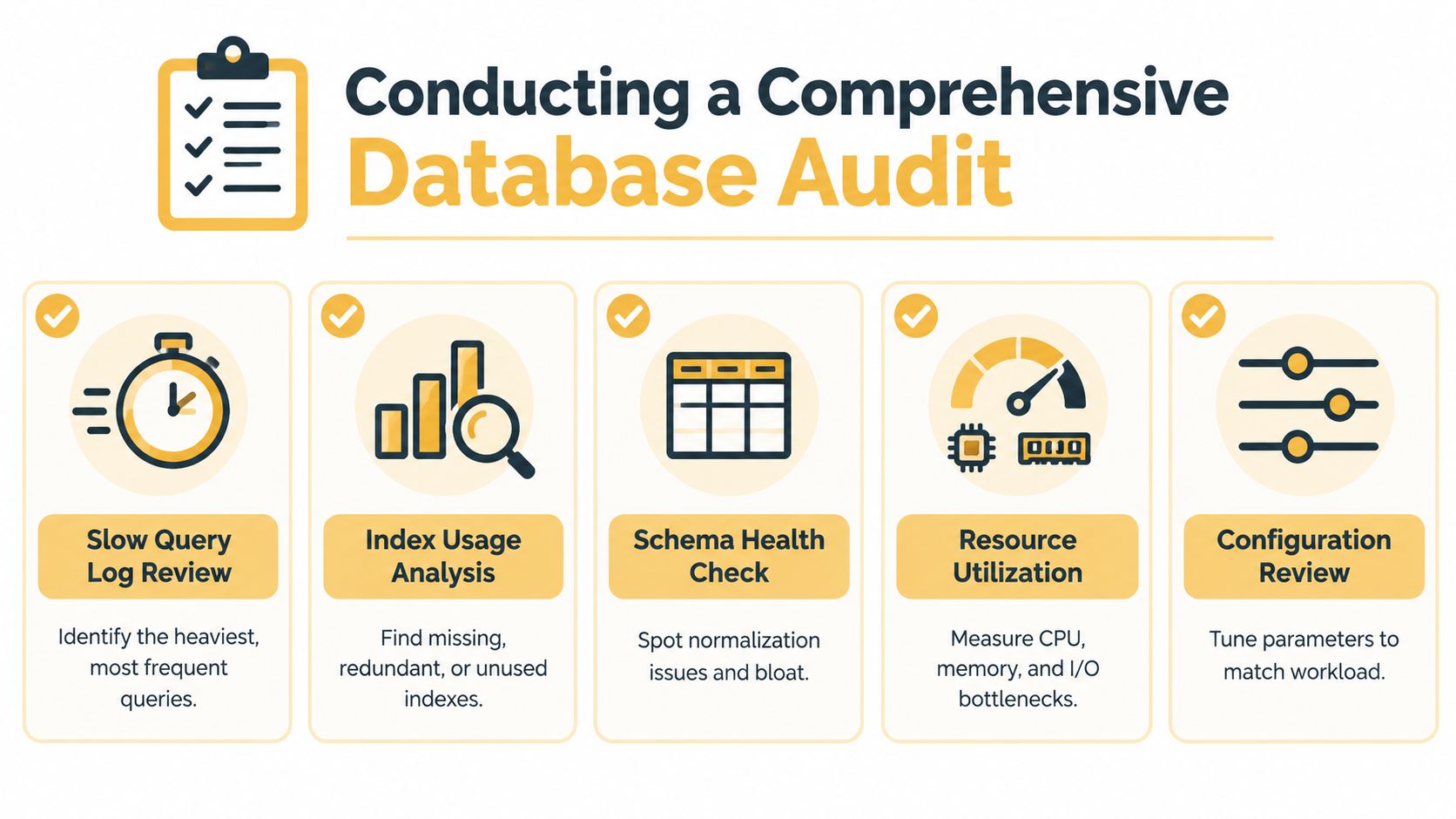
Slow-query logs and telemetry reveal more than the slowest statement. Rank candidates by elapsed time, execution frequency, total resource use, variance, and user-facing impact. A query that finishes quickly but runs constantly may consume more capacity and cloud budget than an occasional reporting query.
Lock analysis exposes another class of delay. A well-indexed query can still wait behind long transactions, hold locks too aggressively, or compete with batch processing. The audit should trace waits to sessions, transactions, tables, and application behavior, then identify whether a fix belongs in SQL, transaction handling, scheduling, or capacity planning.
Configuration review should cover memory allocation, connection limits, parallelism, autovacuum or maintenance behavior, storage settings, and replication choices. These settings require workload context. Copying a configuration from another environment can create higher costs or weaker performance, especially when services run on different platforms.
Why representative benchmarks matter
Basic decision-support benchmarks do not reproduce every application workload. The Join Order Benchmark research describes the JOB workload as 113 queries with varying join counts and more challenging for optimizers than standard decision-support benchmarks. Join-heavy application queries can expose cardinality-estimation and join-order problems that a simple benchmark misses.
The same research reports significant performance improvement for certain TPC-H queries after re-optimization in PostgreSQL. Treat that result as evidence for testing, not a promise for another database. A buyer should require tests that resemble the production schema, parameter distribution, concurrency, and query mix. For AI workloads, include retrieval traffic, embedding updates, and batch inference where they share infrastructure with customer-facing services.
Audit deliverables to require
A useful discovery report gives the buyer an ordered problem list:
- Baseline measurements: Latency, throughput, wait behavior, resource consumption, errors, and workload timing.
- Root-cause mapping: Each finding tied to a query, schema object, configuration choice, application path, or infrastructure constraint.
- Risk assessment: Expected effects on reads, writes, storage, consistency, availability, and deployment safety.
- Test plan: A repeatable comparison of current and proposed states under representative conditions.
- Prioritized roadmap: Quick fixes separated from migrations, refactoring, and architecture decisions.
Teams can use database management best practices alongside the audit. The final report should identify owners, expected trade-offs, and verification steps, so engineers can reduce latency or cloud spend without shifting the problem to another platform.
Managing Multi-Platform Database Complexity
A single database engine rarely supports every workload in a growing company. One product may use a relational system for transactions, a document store for flexible records, a warehouse for analytics, a search engine for discovery, and a vector-capable system for AI retrieval. Each platform brings different indexing rules, consistency models, backup methods, scaling behavior, and cost controls.
Recent market reporting puts the operational burden in clear terms: 84% of organizations manage two or more database platforms, according to Redgate's 2026 survey of database platform usage. Database optimization services therefore need to govern the complete data estate, not tune one engine in isolation. An improvement on one endpoint can increase synchronization work, cloud transfer, operational overhead, or vendor dependence elsewhere.
Why one-size tuning fails
A query pattern that works in PostgreSQL may not translate to a document database. A relational index can reduce read latency while increasing write cost. A replica can protect the primary workload, but replication lag may produce inconsistent reads. Moving analytical queries away from a transactional database can improve application responsiveness while adding ingestion pipelines and storage expenses.
The same trade-offs appear in AI systems. Retrieval traffic, embedding updates, and batch inference may compete with customer-facing transactions for compute, storage, and network capacity. A provider should test those workloads together, then set cost and performance controls across the platforms rather than optimize each service against a separate target.
The provider should map the full data path: where records originate, how they move between systems, which application owns each write, where derived data is stored, and which workloads share infrastructure. That map exposes both latency bottlenecks and cloud spending that would remain hidden in an engine-specific review.
Standardize the operating model
The goal is comparable operation, not identical platforms. A useful cross-platform model defines common names for services and workloads, clear ownership, shared severity levels, and dashboards that separate user-facing latency from background processing.
Governance must follow the workload. Document retention, access controls, encryption, auditability, backup testing, and deletion procedures across cloud-managed, open-source, and legacy systems. Database security best practices can support that work, but the provider still needs to explain how each control applies to the actual stack.
Fragmentation is a performance, cost, compliance, and reliability problem. Decisions can drift apart when every platform has separate owners and operating rules.
A capable partner should also address portability. Document dependencies, measure migration friction, separate portable application logic from platform-specific features where sensible, and make vendor lock-in an explicit business trade-off rather than an accidental outcome.
Measuring ROI and Business Impact
Database optimization earns its budget when it changes business performance, not merely when a query plan looks cleaner. Buyers should connect technical measures to customer experience, infrastructure cost, release velocity, and operational risk across every platform that supports the product.
Percona's 2026 report shows why a speed-only definition is too narrow. Respondents identified rising cloud spend as the biggest barrier to database total-cost-of-ownership reduction at 31%, while 23% cited rising licensing costs. Reported performance challenges included wasted engineering time at 41%, downtime at 40%, difficulty scaling at 37%, and slow throughput at 42%, as summarized in Percona's 2026 State of Open Source Database Management report.
The buying implication is direct. A latency reduction that adds operational work, storage, or licensing expense may weaken the business case. A smaller speed gain that reduces oversized capacity, incident effort, or scaling risk can produce greater commercial value, particularly when relational, document, analytics, and AI-serving workloads share a fragmented cloud estate.
Build a measurement baseline
Before implementation, record metrics that reflect the workload and its cost:
- p99 latency: Shows the experience of users affected by the slowest normal requests instead of hiding problems behind an average.
- Slow-query frequency: Shows whether troublesome statements are isolated events or recurring application behavior.
- Cloud resource consumption: Tracks CPU, memory, storage I/O, replicas, and database instance usage against workload volume.
- Engineering effort: Measures time spent investigating incidents, applying workarounds, and responding to recurring regressions.
- Reliability signals: Covers lock waits, failed transactions, connection exhaustion, replication health, and downtime.
The baseline should include ordinary traffic and known stress periods. Averages can conceal tail behavior in e-commerce, publishing, SaaS, and AI applications, where a small number of slow requests or overloaded workers can affect checkout, page rendering, API responsiveness, or model-serving capacity.
Optimization impact scorecard
| Metric category | What to compare before and after | Business impact |
|---|---|---|
| Query response time | p99 and peak-period latency by service | Faster user-facing requests and more capacity from existing infrastructure |
| Disk I/O | Reads, writes, storage pressure, and contention | Lower storage demand and fewer conflicts between workloads |
| CPU utilization | Utilization by engine, service, and workload | More headroom for traffic variation, background jobs, and AI processing |
| Query latency | Latency by platform and query class | Clearer evidence that tuning helped the intended system |
| Average execution time | Processing windows for application and analytical jobs | Shorter batch runs and faster downstream decisions |
The reported indexing, caching, execution-plan, and partitioning findings provide related technical context, but they should not be treated as the source for enterprise percentage estimates in this scorecard. Report measured results from the buyer's own baseline, segmented by platform and workload. Data distribution, write volume, concurrency, hardware, cache behavior, and implementation quality can change the outcome.
A vendor should report gains alongside their costs. Ask whether a change added indexes, increased storage, reduced write throughput, required cache invalidation, consumed another cloud service, or shifted work to an AI pipeline. The business case is credible when it shows latency, reliability, engineering time, and total platform cost together, then continues monitoring after deployment.
Choosing the Right Optimization Vendor
The right provider depends on the problem's urgency, the stack's complexity, and the level of ownership your team needs. An emergency consultant may be appropriate for a production incident. A one-time audit can suit a company preparing for a migration. A continuous retainer makes more sense when schemas, traffic patterns, and application releases change regularly.
Compare engagement models
Emergency response focuses on restoring service and reducing immediate risk. It can be fast and valuable, but it may produce a tactical fix without resolving the underlying architecture.
Fixed-scope assessment delivers an audit, prioritized findings, and an implementation plan. It gives buyers a clear decision point, although internal engineers still need the capacity to apply and validate the recommendations.
Implementation project includes the changes themselves, such as query rewrites, index strategy, partitioning, migration work, or configuration changes. The contract should define rollback, testing, access controls, and ownership after handoff.
Continuous optimization combines monitoring, regression review, capacity planning, and recurring tuning. It offers better protection against performance drift, but it requires clearer communication and a longer-term operating budget.
Questions that expose engineering depth
Ask the vendor to explain how it would handle your actual database engines, ORM, deployment process, and data sensitivity. Strong answers should be specific about evidence and failure modes.
- Testing: How will proposed changes be tested against representative data and concurrency?
- Deployment: Can the team support online index changes, staged releases, rollback, and zero-downtime migration planning?
- Security: What access is required, how is sensitive data protected, and how are credentials removed?
- Ownership: Who reviews query changes, updates runbooks, and responds when performance regresses?
- Economics: How will the provider measure cloud savings, licensing exposure, engineering time, and new operational costs?
- Platform breadth: Can it compare trade-offs across managed cloud databases, open-source engines, legacy systems, and AI-oriented stores?
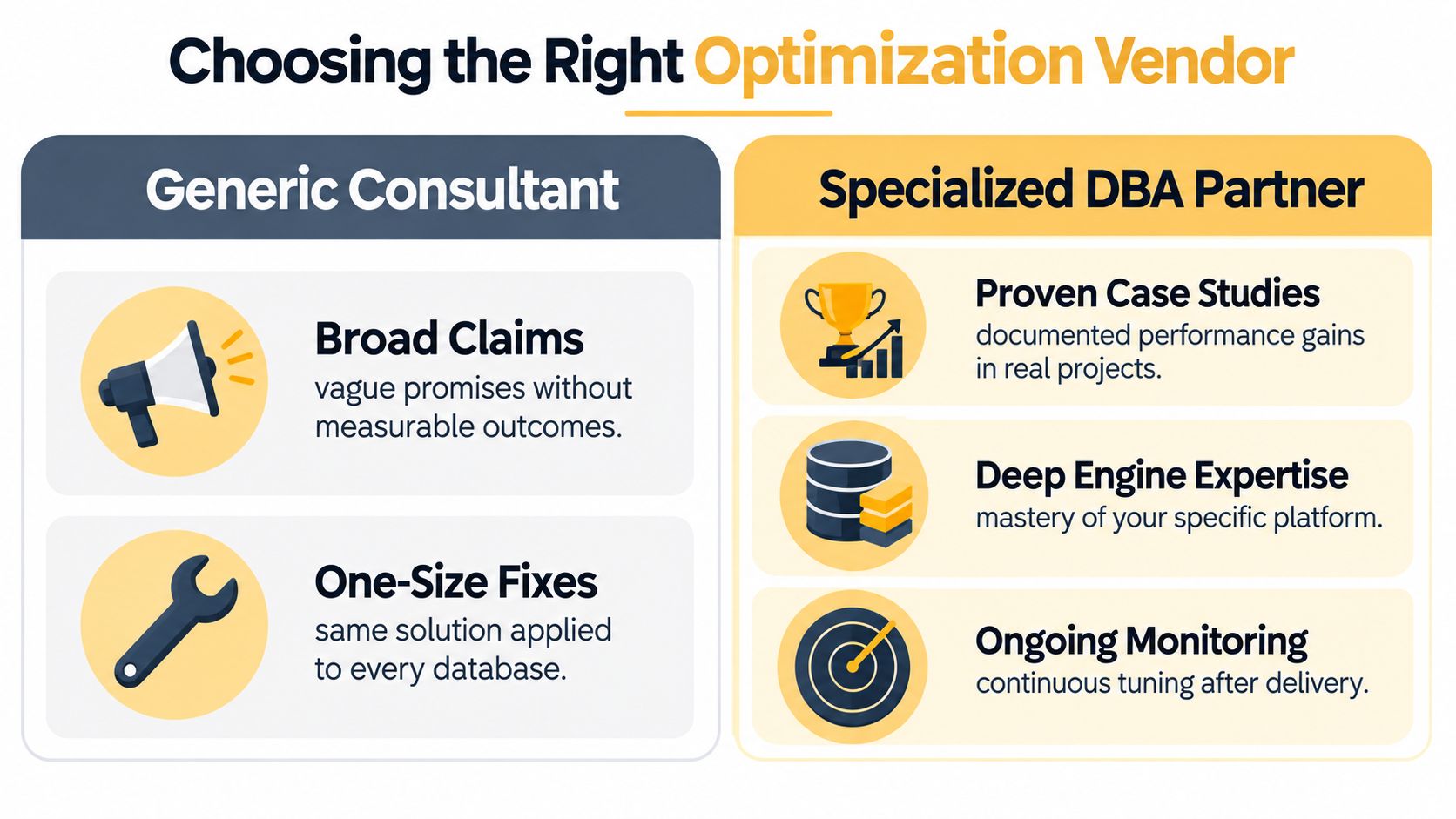
Be cautious with vendors that promise universal speed improvements before inspecting the workload. A credible proposal identifies uncertainty, names the measurements it will collect, and states what it won't change without approval. Pricing should be judged against the cost of incidents, oversized infrastructure, delayed releases, and lost engineering capacity, not against an arbitrary hourly rate.
Integrating Optimized Databases with AI Workflows
AI features expose database weaknesses quickly because they often combine high-volume retrieval with application logic, metadata filters, user context, and model orchestration. A product may appear to have a model-performance problem when the delay comes from fetching records, joining permissions, generating context, or waiting on a saturated transactional system.
Consider a publishing platform adding an AI-assisted search feature. The application needs to retrieve relevant content, apply access and freshness rules, assemble context, and return results without slowing ordinary page requests. Database optimization services can separate those workloads, review the schema used for retrieval, index the filters that accompany search, cache stable metadata, and establish monitoring for both average and tail latency.
The architecture still involves trade-offs. Precomputed retrieval data can reduce request-time work but introduces refresh pipelines. A vector store can support similarity search but adds another system to govern. Replicas can protect transactional reads but require an explicit policy for stale results. The right design depends on freshness, consistency, access control, and cost, not on choosing the newest database category.
AI scale begins with predictable data access. A model can't compensate for an unstable retrieval path.
The optimization loop should continue after launch. Track retrieval latency, database wait events, cache behavior, token or context preparation time, error rates, and the effect of traffic spikes. Review the system after schema changes, new tenants, new content types, and model changes, because each can alter query shape and resource demand.
For a business evaluating this work, the next step is a combined application and data review. Map the critical user journeys, identify every database involved, capture representative queries and workload periods, then ask the vendor to return a prioritized plan with measurable baselines, test evidence, security controls, and a clear ownership model.
Up North Media offers custom web application development, data-driven SEO marketing, and AI consulting that can connect database performance work with broader digital delivery. Visit Up North Media to discuss an application and data assessment focused on latency, cloud cost governance, and scalable AI workflows.