
A blank marketing plan can look productive without changing a single business outcome. An Omaha service company may list SEO, paid search, email, and social media in a spreadsheet, while an ecommerce operator builds a twelve-month content calendar that never gets reviewed after launch. The document feels complete, but nobody can say which audience matters most, what the baseline is, or which activity should receive more investment next week.
A practical digital marketing strategy template fixes that by turning planning into an operating system. It connects customer information, competitive intelligence, channel activity, and commercial results in one repeatable workflow. Modern guidance increasingly favors data-driven baselines, SMART objectives, omnichannel execution, and ROI-linked KPIs, with many planning systems organized around a 90-day cycle instead of an annual document that goes stale. (Adobe's marketing plan template guidance)
Why Most Marketing Plans Fail Before They Start
An owner might spend a weekend writing a plan that says the business will “increase awareness,” “grow online,” and “use social media consistently.” Those statements sound reasonable, but they don't tell the team which customers to prioritize, what action counts as progress, or when someone should change direction. By spring, the plan is sitting in a shared folder while the team reacts to sales fluctuations, competitor promotions, and whatever channel produced the latest inquiry.

The annual-plan problem
Traditional plans often fail for three practical reasons:
- They're too broad. A goal such as “improve digital presence” hides several decisions about audience, offer, channel, creative, and measurement.
- They're too static. Search demand, ad performance, inventory, customer objections, and competitor messaging change before an annual plan gets its next formal review.
- They're disconnected from execution. A list of campaigns isn't a system for assigning owners, checking results, testing alternatives, or reallocating resources.
The template should behave less like a binder and more like a control panel. It establishes the starting position, records the intended outcome, assigns tactics to channels, and creates scheduled points where the team decides what to scale, optimize, or stop.
Practical rule: If a plan doesn't help someone make a budget, messaging, or prioritization decision, it's documentation, not strategy.
Build around a shorter operating cycle
A 90-day cycle gives an Omaha SMB enough time to launch meaningful work without pretending that every assumption will remain valid for a year. The first cycle can establish tracking, clarify audience segments, improve high-intent pages, and test a focused offer. The next cycle uses the evidence from that work to sharpen the channel mix and investment choices.
Start the template with five fields:
- Business outcome: The commercial result the marketing activity supports.
- Priority audience: The segment most likely to create that result.
- Current baseline: What the business can measure today.
- 90-day objective: A specific, time-bound outcome tied to the baseline.
- Decision rule: The evidence that triggers scaling, optimization, or a pause.
Teams that need a basic orientation before building the dashboard can review beginner marketing KPIs and metrics. The important point isn't to track everything. It's to create a shared language for performance before channel activity begins.
Building Your Strategy Foundation
The strongest templates start with audience profiling, baseline measurement, and objective-setting. Skip the first step and the business targets channels instead of people. Skip the second and the team celebrates movement without knowing whether performance improved. Skip the third and the plan becomes a collection of tasks with no definition of success.
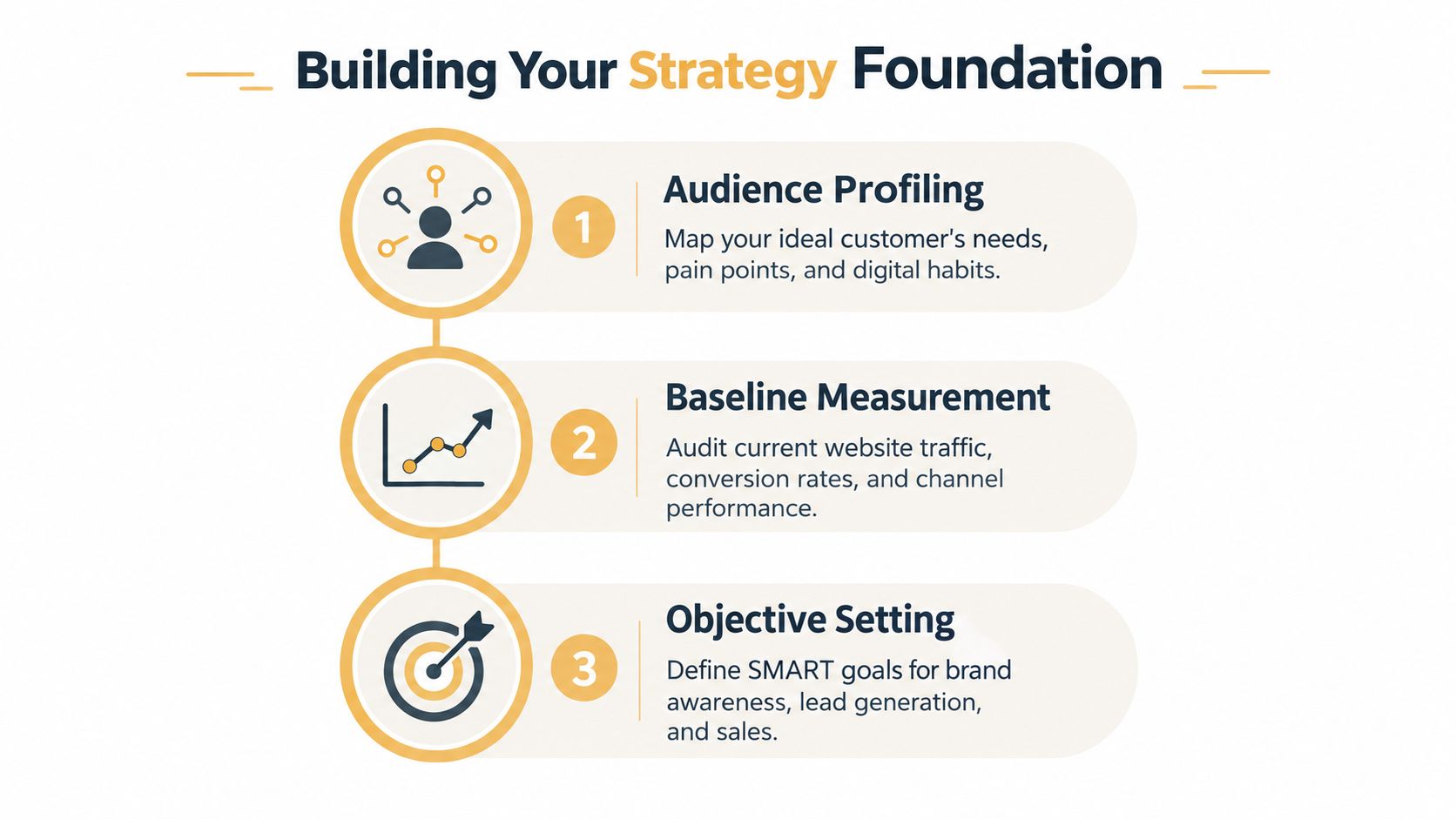
1. Profile audiences by need and behavior
Write an audience profile that a copywriter, salesperson, and campaign manager could all use. Include the customer's problem, urgency, buying trigger, objections, preferred information, location, and likely conversion action.
A local Omaha fitness studio might separate time-constrained professionals seeking guided workouts from people looking for rehabilitation-oriented support. A specialty ecommerce retailer might segment first-time researchers, repeat purchasers, and customers comparing technical product specifications. Those groups may need different landing pages, content formats, offers, and follow-up sequences.
Document the evidence behind each segment. Use customer interviews, sales-call notes, site searches, support questions, purchase history, and competitor reviews. A buyer persona creation guide can help organize the profile, but the useful persona is the one tied to observable behavior, not a fictional biography.
2. Score the current position
Use a five-point score for each core digital technique. Score the current capability, not the desired future state. A low score might indicate missing analytics, weak content coverage, unclear conversion paths, or inconsistent channel ownership.
Review areas such as:
- Reach: Search visibility, local discovery, paid audience coverage, and brand presence.
- Act: Landing-page relevance, content engagement, lead capture, and product consideration.
- Convert: Checkout or inquiry flow, conversion tracking, sales handoff, and offer clarity.
- Engage: Email retention, repeat purchase activity, customer support, and advocacy.
This maps naturally to the RACE framework, Reach, Act, Convert, and Engage. After scoring, translate each gap into one action with an owner and a measurement method. “Improve SEO” is too vague. “Repair the highest-value service page, add a clear inquiry path, and validate the conversion event” is actionable.
3. Set objectives from the baseline
Use SMART objectives, but keep them commercially grounded. An objective might focus on qualified leads, completed purchases, repeat orders, or revenue contribution from a defined audience. Record the baseline, target direction, deadline, owner, primary KPI, and supporting metrics in the same row.
The template should also include a short competitive review. Note which offers competitors emphasize, which queries they appear to own, what proof they use, and where their customer experience creates friction. The purpose isn't imitation. It's to identify a defensible position and a practical gap the business can address during the next cycle.
Choosing the KPIs That Actually Drive Revenue
A dashboard becomes less useful when every available metric receives equal attention. Conversion rate, click-through rate, return on investment, customer acquisition cost, and engagement remain common KPI categories, while reporting templates increasingly unify CTR, CPC, ROAS, revenue by channel, and conversion performance across SEO, PPC, email, and social media. (Smartsheet's digital marketing reporting templates)
The answer isn't to eliminate operational metrics. It's to give executives and channel operators different views of the same system.
| Reporting Level | Metric Count | Review Cadence | Example KPIs |
|---|---|---|---|
| Executive | 3–5 strategic metrics | Monthly or quarterly | Revenue contribution, ROI, customer acquisition cost, qualified leads, repeat purchase value |
| Channel operator | 8–15 operational metrics | Weekly | CTR, CPC, conversion rate, email engagement, landing-page actions, reach, assisted conversions |
| Campaign owner | As needed for diagnosis | During testing and optimization | Creative response, audience segment performance, search terms, offer response, funnel drop-off |
The executive layer should answer, “Is marketing supporting the business objective?” The operator layer should answer, “What changed, why did it change, and what should we do next?” Independent KPI guidance recommends limiting executive reporting to 3–5 strategic metrics and giving channel operators 8–15 operational metrics for weekly management. (Smart Insights' digital marketing benchmarking templates)
Assign metrics by decision
For SEO, rankings and organic sessions can help diagnose visibility, but they shouldn't be the final business measure. Track qualified organic conversions, assisted revenue, branded demand, and the visibility of priority topics. For paid media, connect spend to qualified actions, conversion rate, customer acquisition cost, and revenue rather than optimizing only for inexpensive clicks.
Email needs a lifecycle view. New-subscriber engagement, nurture progression, purchase conversion, repeat purchase, and unsubscribe behavior reveal whether the program supports revenue and retention. Social reporting should distinguish distribution and interaction from commercial influence. If creators or influencers are involved, use a structured approach to measure influencer ROI metrics, including tracked actions and downstream value rather than engagement alone.
Before trusting the numbers, audit the implementation. Analytics implementation guidance is useful when events, campaign parameters, form submissions, calls, or ecommerce transactions aren't being recorded consistently.
Decision test: Every KPI needs a corresponding action. If the number rises or falls and nobody knows what to change, it belongs in a diagnostic view, not the executive summary.
Channel Playbooks for SEO, Paid, Email, and Social
A channel belongs in the template only when the business can define its job, required inputs, owner, and revenue connection. A local service company might prioritize search visibility and lead handling, while an ecommerce brand may need stronger product content, shopping campaigns, lifecycle email, and creative testing. Neither should choose channels because a competitor happens to post there.
SEO
Build local content around services, locations, customer questions, proof, and conversion paths. For national ecommerce, organize content around product categories, use cases, comparisons, buying guidance, and technical product details. Technical health matters, but fixing every minor issue before improving a high-intent page often wastes limited capacity.
Audit checklist:
- Priority pages have a clear search intent and next action.
- Local pages provide useful location context.
- Product and category pages explain differences and buying considerations.
- Internal links connect informational content to commercial pages.
- Search visibility is measured alongside qualified conversions and revenue.
Paid media
Paid search captures existing demand, but it can become expensive when the landing page doesn't match the query or the campaign targets low-value intent. Paid social can create demand and support retargeting, but it needs stronger creative variation and a clear audience hypothesis.
Set budget rules before launch. Define the minimum evidence required to expand a campaign, the signal that calls for creative or landing-page changes, and the condition that pauses spend. Don't shift money based on one noisy day. Compare performance by audience, offer, query, creative, and conversion quality.
Email marketing
Separate acquisition, nurture, conversion, onboarding, and retention. A service business might send educational follow-ups after an inquiry, while an ecommerce brand needs browse, cart, post-purchase, replenishment, and win-back logic. Each sequence should have a trigger, a promise, a next action, and a stop condition.
Audit checklist:
- Segments reflect lifecycle or meaningful customer differences.
- Automations have a defined commercial purpose.
- Messages offer useful information, not just promotion.
- Revenue and conversion events are connected to campaigns.
- Dormant or unresponsive contacts receive appropriate treatment.
Social media
Choose platforms based on audience behavior and the brand's ability to produce native content. A local business may gain more from community proof and responsive conversation than from polished national-style campaigns. An ecommerce brand can test demonstrations, comparisons, creator content, and customer use cases, then connect the strongest themes to paid distribution.
Track reach, qualified engagement, profile actions, assisted conversions, and revenue influence. Follower growth alone won't tell you whether the channel deserves more resources.
Rethinking Search Metrics for AI-Driven Discovery
Search success is no longer only a question of how many people click a blue link. Current trend coverage describes discovery moving toward AI engines and zero-click experiences, with marketers rebuilding measurement around visibility rather than clicks. (Huble's digital marketing trends coverage)

A business can influence a buying decision without receiving a session. Its service may appear in an AI-generated recommendation, its product information may shape an answer, or its brand may become the reference a prospect searches directly afterward. A traffic-only template misses those moments and can label valuable visibility as failure.
Add three layers to search reporting
Visibility measures whether the brand, product, service, or point of view appears for relevant questions. Track presence across AI answers, featured results, local discovery surfaces, and important conversational prompts where the business can reasonably observe them.
Influence measures what happens after exposure. Look for branded searches, direct visits, assisted conversions, sales mentions, referral patterns, and customer language that indicates the buyer encountered the business during research.
Revenue remains the final test. Connect visible discovery and assisted interactions to qualified inquiries, purchases, repeat orders, and pipeline quality wherever the measurement system allows.
An Omaha service business might monitor whether AI answers accurately describe its services, locations, expertise, and differentiators. An ecommerce retailer should examine whether product attributes, comparisons, availability information, and use cases are represented correctly when shoppers ask conversational questions.
Teams building this capability can use answer engine optimization guidance to structure content around clear questions, credible evidence, consistent entity information, and useful explanations. The goal isn't to chase every new interface. It's to make the brand sufficiently clear, useful, and trustworthy that discovery systems can interpret it accurately.
The template should therefore include a visibility log, prompt or query themes, observed brand representation, referral or assisted signals, and a review date. Treat those fields as an emerging measurement layer, not a replacement for conversion and revenue reporting.
This video provides additional context for how AI search interfaces are changing discovery:
Your 90-Day Rollout Plan and Governance Checkpoints
A useful rollout turns the template into scheduled work rather than another planning exercise.
Days 1 through 30, establish the foundation
Confirm the priority audience, score current capabilities on the five-point benchmark, document the baseline, and set SMART objectives. Audit analytics, conversion events, campaign tracking, landing pages, and the customer handoff. Choose the executive metrics and assign channel owners.
Days 31 through 60, launch and learn
Release the highest-priority SEO, paid, email, and content changes. Establish a testing backlog covering offers, landing pages, creative, audiences, and messaging. Hold a weekly operator review, but avoid changing direction without a clear signal and a documented hypothesis.
Days 61 through 90, scale with control
Re-score the benchmark, compare results with the original baseline, and decide what to scale, optimize, or stop. Reallocate budget toward qualified outcomes, not activity that looks busy. A review citing Deloitte reported that up to 40% of digital campaigns fail to meet declared KPIs and 25% of budgets are spent inefficiently, which reinforces the need for governance checkpoints rather than post-campaign autopsies. (WJARR review on digital marketing strategy pitfalls)
Common failure modes include neglected analytics, incorrect KPIs, weak testing, underdeveloped creative, and dependence on one channel. Put an owner and a review date beside each risk. At the end of the cycle, keep the strategy, revise the assumptions, and start the next 90-day plan with better evidence.
Up North Media helps Omaha businesses and ecommerce brands turn this framework into measurable SEO, web development, and AI-enabled growth plans. Visit Up North Media to discuss your current baseline, priority channels, and next 90-day execution cycle.