Your website probably isn't failing in one dramatic way. It's doing something more common. It looks acceptable, loads slowly on a phone, says the same things your competitors say, and gives visitors no strong reason to trust you or contact you.
That's a real problem in Duluth. A business here doesn't compete in a generic market. It competes in a place with a clear identity, strong tourism pull, and customers who notice when a brand feels disconnected from the city around it. If your site could belong to any company in any town, it won't carry much weight.
Your Guide to Expert Duluth Website Design
A lot of Duluth business owners end up in the same spot. They launched a site years ago, maybe through a freelancer, maybe through a platform builder, and now it feels like dead weight. The site doesn't reflect the business anymore. It's hard to update. It looks dated next to newer competitors. On mobile, it feels like walking through slush in January.

That frustration usually isn't about aesthetics alone. It's about momentum. A site should help a visitor understand who you are, what you do, whether you're credible, and what to do next. When it doesn't, your team ends up compensating with extra calls, extra emails, and extra explanations.
What a strong site should actually do
A practical Duluth website design project should handle a few jobs well:
- Clarify your offer so a first-time visitor doesn't have to guess what you sell or who you serve.
- Reflect the market so the business feels rooted in Duluth instead of copied from a national template.
- Support lead flow with clean contact paths, usable forms, and clear calls to action.
- Stay maintainable so your staff can update hours, services, events, photos, or promotions without friction.
A good web partner doesn't start by asking what colors you like. They start by asking what the website needs to accomplish.
Practical rule: If a website redesign conversation starts with homepage mockups before business goals, the project is already drifting.
That's the lens we use when evaluating Duluth website design work. The agency doesn't have to be on your block. It does have to understand your market, your customers, and the difference between a brochure site and a working business asset. You can see that kind of strategic, execution-focused work in a web portfolio of launch-ready digital projects.
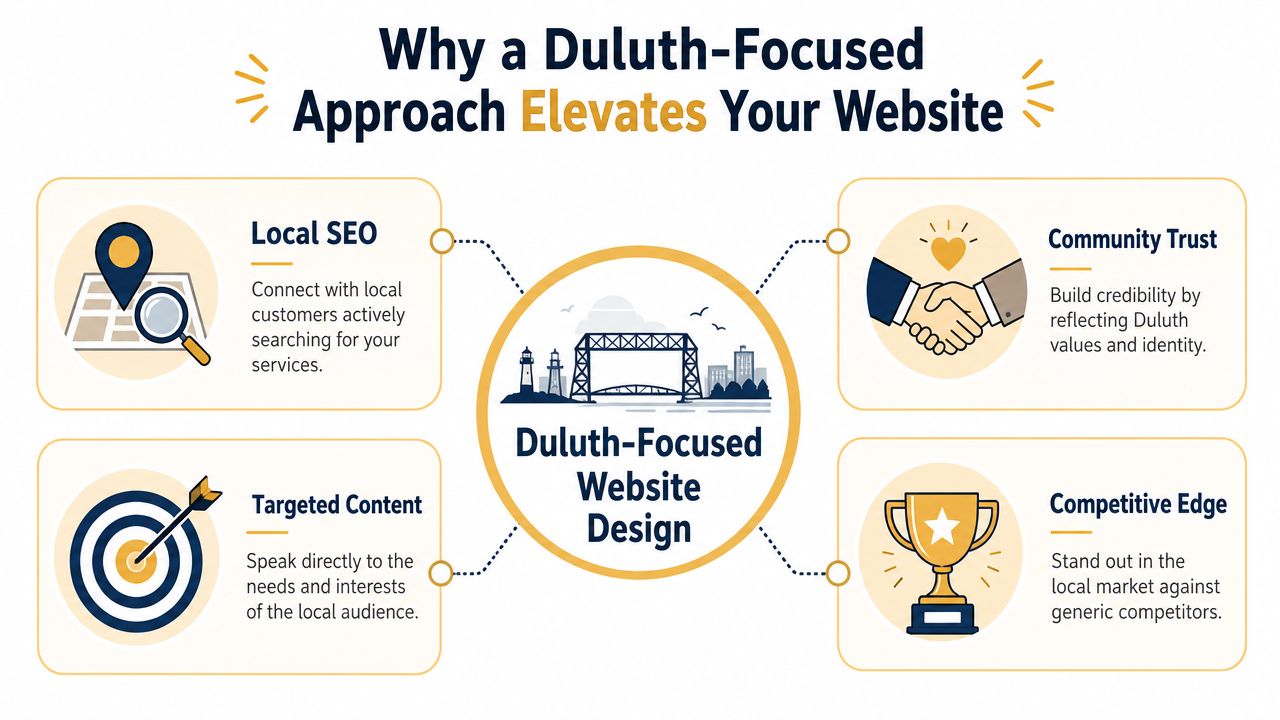
Why a Duluth-Focused Approach Matters
Duluth isn't a place where generic branding holds up well. The city has a distinct built environment, a distinct rhythm, and a distinct story. Your website needs to fit that reality.
The local preservation context matters more than many businesses realize. Duluth's Commercial Historic District Design Guidelines cover the district's period of significance from 1872 to 1929, which influences how downtown brands must balance modern usability with historic character in their digital presence, according to the city's historic district design guidelines. That doesn't mean every site should look antique. It means your digital identity should feel believable in the place where you operate.
Authenticity is a design decision
In Duluth, visual choices carry meaning. Typography that feels too slick, stock photography that could've been shot anywhere, or copy that ignores local context can make a business feel detached from its own market.
A stronger approach usually includes:
- Place-based photography that shows real spaces, real work, and recognizable surroundings.
- Color and texture choices that fit your brand while still feeling at home in Duluth's industrial, lakeside, and historic character.
- Story-driven copy that connects the business to the city, neighborhood, or audience it serves.
This matters for trust. When someone lands on your site, they're making a quick judgment about whether you understand them. A tourist deciding where to stop, a local customer comparing providers, and a donor evaluating a cultural organization all read those signals differently, but they all read them.
Proximity matters less than market fluency
A common objection is simple. “Shouldn't I hire someone local?” Sometimes, yes. But for many projects, shared understanding beats shared zip code.
The right partner should understand how local search, local trust, and local positioning work in a market like Duluth. They should also know how to translate that into page structure, service copy, metadata, content hubs, and conversion paths. If you want a better sense of how those signals connect, this guide to local SEO ranking factors for service-area businesses is useful context.
A website that feels generic asks visitors to do extra work. A website that feels rooted in Duluth removes friction before the first click.
Strategy Before Design Redesign or Optimize
A lot of business owners assume the answer is a full rebuild. Sometimes it is. Sometimes that's like replacing the whole cabin when the actual problem is the furnace, insulation, and front door.
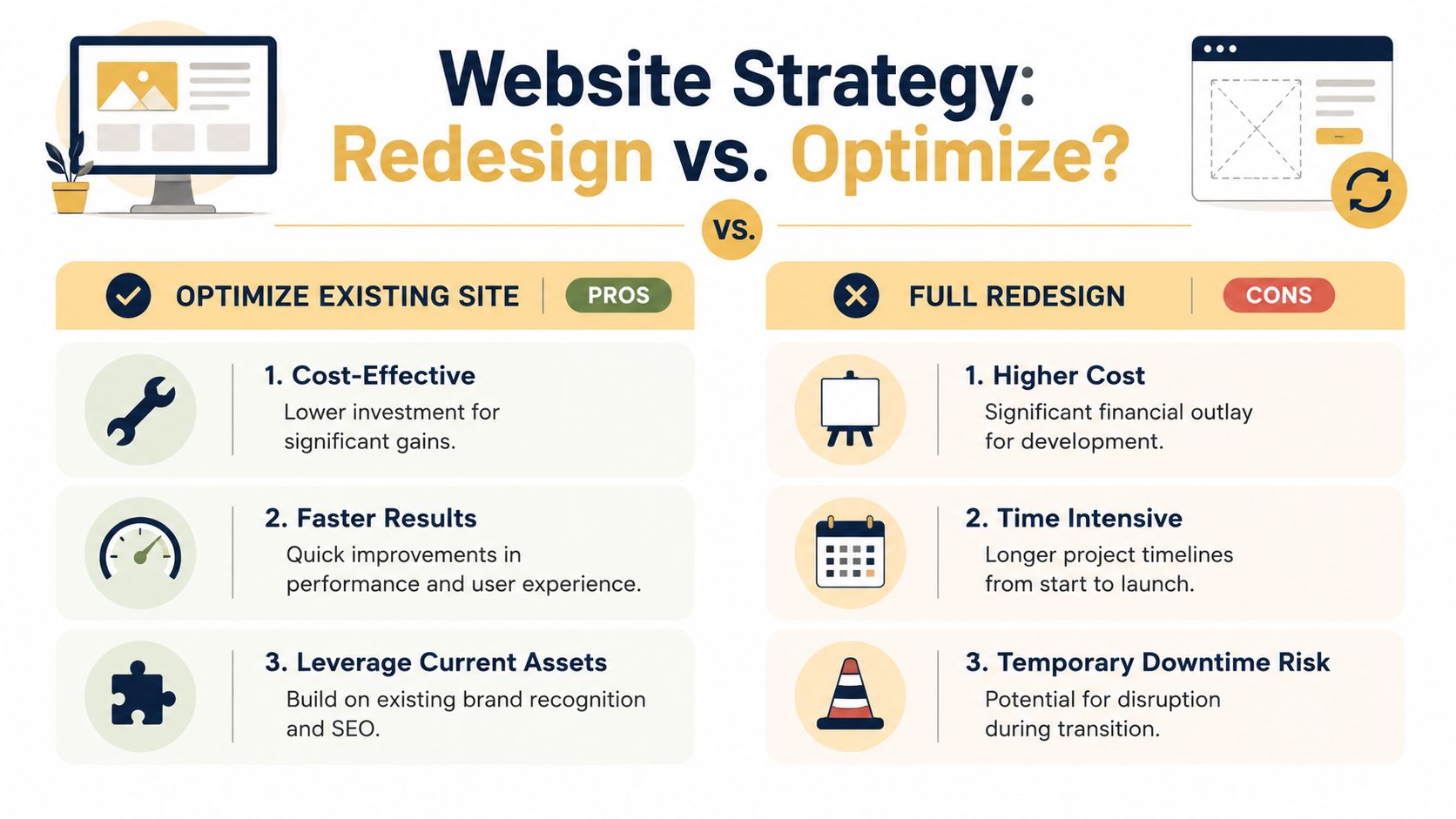
The smarter first question is this. Do you need a redesign, or do you need targeted improvement?
A useful local benchmark comes from a Duluth web design guide that points out a missed question in many projects: whether a full redesign is necessary, or whether targeted performance fixes offer better ROI, especially with Google's Core Web Vitals emphasizing speed and stability, as discussed in this Duluth web design overview.
When optimization is the better move
If your current site already has usable branding, decent content, and a structure search engines understand, optimization may be the better investment.
That often means fixing things like:
- Mobile speed issues that make pages feel sluggish on a phone.
- Cluttered calls to action that bury the contact path.
- Weak service pages that don't clearly explain what you do.
- Bloated plugins or scripts that drag down usability.
Those changes can produce a meaningful business impact without the cost and disruption of starting over.
When a redesign is justified
A rebuild makes more sense when the foundation is the problem. That usually shows up in one of these ways:
- Your site no longer matches the business. You've added services, changed audiences, or repositioned the company.
- The backend fights your team. Updating content is so painful that nobody does it.
- The structure is broken. Navigation is confusing, important pages are buried, and conversion paths are unclear.
If the site is structurally weak, polishing it won't help much. If the structure is sound, a rebuild can be unnecessary expense.
The right move starts with an audit, not a mockup. Review performance, content quality, mobile usability, contact flow, and search visibility before you commit budget. That keeps the conversation focused on ROI instead of novelty.
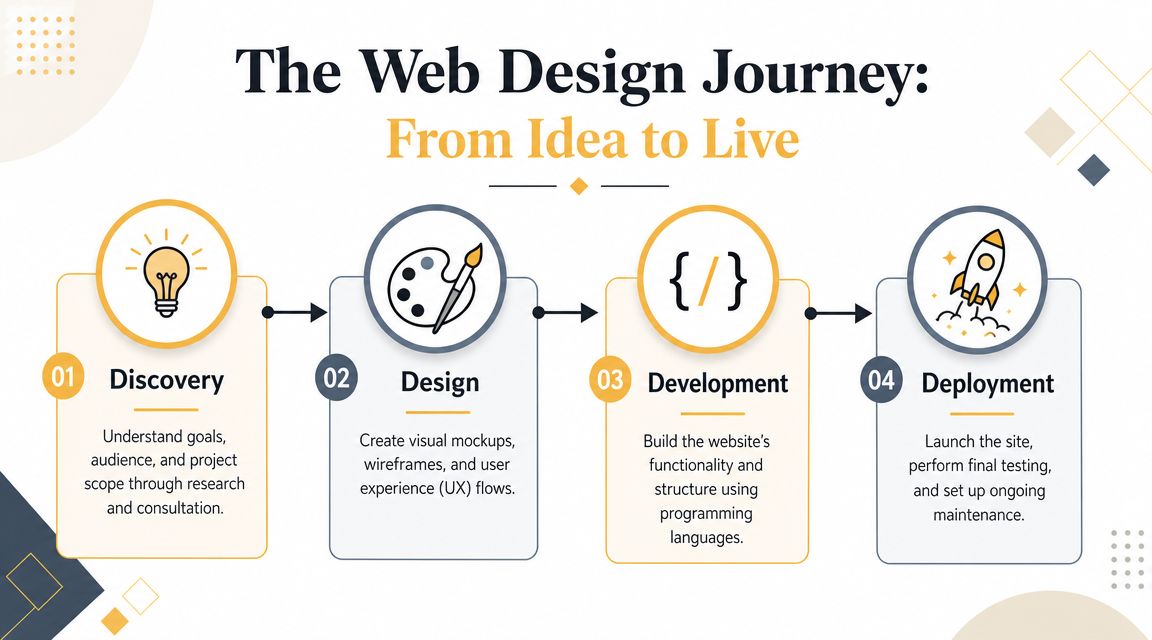
The Web Design Process From Discovery to Launch
A solid web process should feel less like buying a decoration and more like planning a build. Every stage has a job. Skip one, and the project usually gets more expensive, more confusing, or both.
Discovery
The essential work begins. Discovery defines who the site is for, what actions matter, and what content the business needs.
For a Duluth company, the audience might be a local homeowner, a visitor researching attractions, a student near UMD, or a buyer comparing commercial providers. Those are different users with different intent. The site architecture should reflect that.
Questions that belong here include:
- Who are the primary audiences
- What should they do on the site
- What information do they need before they trust you
- What content already exists and what has to be created
If a team skips discovery, design becomes guesswork.
A more detailed breakdown of that planning phase is covered in this article on the process for website redesign projects.
Design
Design isn't just picking a style. It's organizing information so users can move through the site without confusion. Wireframes act like blueprints. They show where headlines go, where trust signals belong, and where calls to action should appear.
This is also where many bad projects drift into vanity choices. A homepage can look polished and still perform poorly if the messaging is vague or the page hierarchy is weak.
Here's a useful walkthrough on how modern website planning and production fit together:
Development and deployment
Development turns approved designs into a working site. During this phase, platform decisions, CMS setup, page templates, forms, analytics, and testing come together.
Local analysis of Duluth websites found that 83% were mobile-friendly and 97% included contact forms, making those baseline expectations rather than differentiators, according to this Duluth web design analysis. The same guidance argues that SEO should be treated as an architectural requirement from day one.
That point matters. SEO isn't a layer you sprinkle on after launch. It affects page templates, heading structure, internal linking, indexable text, media handling, and conversion flow.
A few practical platform options are common:
| Platform | Good fit | Watchout |
|---|---|---|
| WordPress | Marketing sites that need flexible content editing | Plugin sprawl can hurt maintainability |
| Shopify | Product-driven stores and simple commerce workflows | Content flexibility can be narrower |
| Custom build | Complex workflows, memberships, apps, or integrations | Higher planning and support requirements |
One option in that broader field is Up North Media, which offers web design, web development, SEO, and related digital services for businesses that need strategy tied to execution.
Understanding Duluth Website Design Costs and Timelines
Website pricing feels confusing when agencies talk in vague ranges and avoid scope details. A better way to estimate a project is by feature tier, not page count alone.
A Duluth-focused industry guide gives a practical benchmark: basic sites typically range from $1,500 to $5,000 with a 4 to 6 week timeline, intermediate sites from $5,000 to $15,000 with a 6 to 12 week timeline, and advanced sites from $15,000 to $30,000+ with a 3 to 6 month timeline, according to this Duluth website design pricing guide.
Typical Duluth Website Design Costs and Timelines
| Project Tier | Typical Cost Range | Estimated Timeline |
|---|---|---|
| Basic | $1,500 to $5,000 | 4 to 6 weeks |
| Intermediate | $5,000 to $15,000 | 6 to 12 weeks |
| Advanced | $15,000 to $30,000+ | 3 to 6 months |
What pushes a site into a higher tier
The jump from one tier to the next usually has less to do with “more pages” and more to do with systems and complexity.
A project becomes more expensive when it includes:
- CMS configuration so your team can manage content across many templates or sections.
- Custom functionality such as calculators, member tools, booking workflows, or advanced filtering.
- E-commerce logic involving products, collections, shipping rules, and checkout behavior.
- Integrations and QA for CRMs, email systems, analytics setups, and edge-case testing.
The budgeting mistake to avoid
The biggest budget problem usually isn't the initial design. It's late-stage additions. A business approves a marketing site, then adds custom forms, video-heavy pages, gated resources, event logic, or multiple integrations after development starts.
That's how a manageable build turns into a longer, more expensive one.
Price follows complexity. Complexity usually enters through features, approvals, and content delays, not through the number of menu items alone.
If you want a more accurate estimate, define the essentials first. What has to be there on launch day, what can wait, and what belongs in phase two.
Measuring Success Beyond the Launch
A website launch isn't the finish line. It's the point where the site starts proving whether the strategy was sound.
That matters in Duluth because the website often acts as a discovery tool and a revenue path at the same time. Duluth's arts and culture directory lists dozens of destination-style attractions and venues, from the Duluth Playhouse and the Tweed Museum of Art to Glensheen, Fitger's, and the Art Dock, as shown in Visit Duluth's arts and culture listings. In a market like that, a website has to do more than look polished. It has to capture people searching for location, history, and attraction-related intent.
Metrics that matter more than vanity traffic
After launch, focus on actions tied to business value.
Useful signals include:
- Contact form submissions from people who are qualified to buy.
- Phone calls and inquiry quality rather than raw pageviews.
- Organic visibility for service and location pages that align with real customer searches.
- Bookings, purchases, or event actions if the site supports direct transactions.
A site can attract traffic and still underperform if visitors don't know what to do next.
What ongoing improvement looks like
The best post-launch rhythm is simple. Review user behavior, identify friction, make a focused change, and measure the result. Sometimes the improvement is messaging. Sometimes it's the layout of a form. Sometimes it's replacing a weak hero section with copy that explains the offer clearly.
For tourism, hospitality, arts, and local services, content also matters over time. New attraction guides, event pages, neighborhood content, and local landing pages can help the site stay relevant to both searchers and repeat visitors.
Launching a website without a measurement plan is like opening a storefront and never watching who comes in, what they ask for, or where they leave.
Frequently Asked Questions About Web Design
Do I need a web agency physically located in Duluth
No. For many businesses, location matters less than whether the agency understands Duluth as a market. A team can work remotely and still build a strong local strategy if it researches the audience, studies competitors, understands local search intent, and respects the city's identity. If an agency can't show market fluency, being nearby won't fix that.
Should I choose WordPress or a custom site
It depends on what you need the site to do.
WordPress works well for many service businesses, nonprofits, tourism brands, and content-heavy organizations because staff can edit pages, post updates, and manage blogs without developer help. Custom development makes more sense when the site needs special workflows, application features, or deeper integrations. The wrong choice usually isn't the platform itself. It's picking a tool that doesn't match your operational needs.
What should I prepare before asking for a proposal
Bring clarity on the business, not just the design.
A helpful starting package includes:
- Your goals such as leads, sales, bookings, applications, or awareness
- Your audience and the kinds of customers you want more of
- Your current problems like poor mobile experience, weak content, or hard-to-update pages
- Your must-have features including forms, CMS access, e-commerce, event pages, or integrations
That makes pricing and recommendations far more accurate.
Will I need support after launch
Usually, yes. Websites need updates, content changes, plugin or platform maintenance, analytics review, and periodic UX improvements. Even a well-built site can drift out of date if nobody owns it after launch. Ongoing support doesn't have to be complicated, but it should be defined.
How do I know if my current site is worth saving
Start with an audit. If the content is usable, the structure is mostly sound, and the branding still fits, optimization may be enough. If the site is hard to edit, misaligned with your business, and structurally confusing, rebuilding is often cleaner. The goal isn't to buy more website than you need. The goal is to remove friction and improve business performance.
If your current site feels outdated, slow, or disconnected from the Duluth market, a strategic review is the right first step. Up North Media works with businesses that need web design, development, SEO, and digital strategy grounded in business goals, not just visuals.